Cole Harding had spent eleven years saving four hundred and twenty dollars.
He earned it one blister at a time on ranches scattered across Wyoming, Idaho, and Montana Territory, sleeping in bunkhouses, eating whatever was served, and refusing nearly every luxury that might delay the one thing he wanted. He wanted land with his own name attached to it, not because he dreamed of becoming wealthy, but because after more than a decade repairing other men’s fences and moving other men’s cattle, he wanted to stand somewhere at sunset and know the ground beneath his boots belonged to him. When the bank finally offered the abandoned Harlan Ranch for exactly four hundred and twenty dollars, Cole handed over every cent.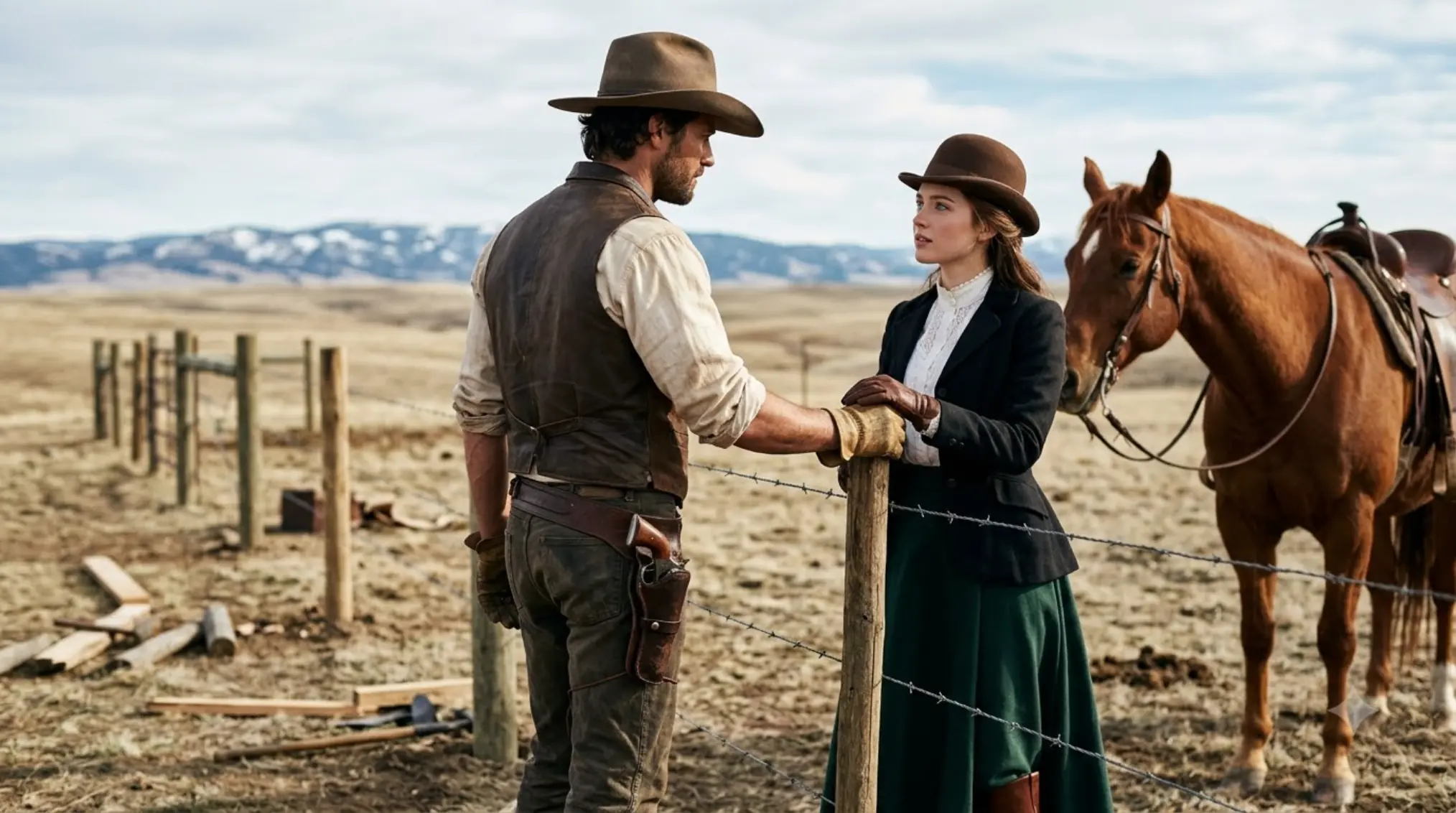
The property had been empty for six years.
Before that, Bill Harlan had spent two decades building it into a respectable cattle ranch until the terrible winter of 1886 destroyed nearly his entire herd. The cold stayed below zero for weeks, cattle froze where they stood, and ranchers across the valley abandoned land they could no longer afford to hold. Harlan walked away the following February, and after two prospective buyers rode out and immediately returned to town, the bank dropped the price until even the land itself seemed embarrassed by what it was worth.
Cole got off his horse.
That was the difference.
He stood in the center of the main field and looked at three broken fence lines, a barn with half its eastern roof collapsed, fields gone wild, and a farmhouse that leaned slightly toward the north as though exhausted from standing. He did not see failure. He saw an order of work.
Fence first.
Nothing else mattered until the livestock could stay where he put them.
Cole owned one horse, a tool chest, two rifles, three changes of clothing, and ten dollars left after paying the bank fees. He spent his first afternoon walking the south boundary, testing posts with his shoulder and marking the ones that needed replacement. By sunset, he had already driven two new posts into soil no one had disturbed in years.
That was when he heard hoofbeats.
Cole straightened slowly.
A chestnut horse entered through the open gate carrying a young woman whose clothing looked entirely too expensive for Harlan Ranch. She was twenty-two, strikingly beautiful, with fair sun-touched skin, clear blue eyes, chestnut-brown hair pinned neatly beneath a brown riding hat, and the easy posture of someone who had been in saddles since childhood. Her dark fitted riding jacket and long green skirt carried almost no dust.
Cole rested one gloved hand on the post driver.
“What are you doing here?”
The woman stopped her horse.
“Mr. Harding?”
“That depends who’s asking.”
“Abigail Whitmore.”
Cole recognized the name.
Everybody in Clearwater County knew Edward Whitmore.
Five thousand acres.
Hundreds of cattle.
Influence with every major buyer between Helena and Billings.
Abigail glanced across Cole’s property.
“My father owns the ranch northeast of here.”
“I know.”
“He sent me.”
Cole waited.
Abigail took an envelope from inside her jacket.
“He doesn’t like unstable property along his boundary.”
Cole looked toward the broken barn.
“Sounds like a personal problem.”
Her lips almost moved into a smile.
“My father is offering you seven hundred dollars to sell this land and leave.”
Cole stared at the envelope.
Seven hundred dollars.
Nearly twice what he had paid.
Enough money to start somewhere else without sleeping beneath a broken roof.
Enough to turn eleven years of saving into immediate profit.
Cole looked at the field.
Then the fence.
Then Abigail.
He drove the next post.
The heavy timber sank into Montana soil with one solid strike.
“Tell your father to keep his money.”
Abigail blinked.
“Mr. Harding, you understand what this ranch needs?”
“Yes.”
“You have ten dollars.”
Cole looked at her.
“You’ve been asking questions.”
“My father has.”
“Then he knows those ten dollars are mine too.”
Abigail glanced at the damaged property.
“The barn roof is open.”
“I noticed.”
“The north pasture hasn’t been worked in six years.”
“I noticed that too.”
“Winter will come.”
“It generally does.”
This time she did smile, though she tried to hide it.
“Seven hundred dollars is a fair offer.”
“No.”
“Why?”
Cole rested both hands on the driver.
“Because this place cost eleven years, not four hundred and twenty dollars.”
Abigail became quiet.
Cole continued.
“Your father can count money. I’m counting time.”
Something in her expression changed.
She put the envelope away.
“I’ll tell him.”
“Thank you.”
She turned her horse.
Cole watched her ride back through his gate and had the strange certainty that he would see her again.
Three days later, he did.
Abigail returned without an envelope.
She came alone in a white frontier blouse, dark riding jacket, deep-green skirt, gloves, and the same chestnut horse. Cole was halfway through setting another post when she stopped outside the repaired section and watched him work. He knew she was there, but he continued until the post stood upright.
“My father’s offer remains.”
“I figured.”
Abigail dismounted.
Cole looked at her.
“Then why are you here?”
She walked toward the fence.
“That post is wrong.”
Cole looked at it.
“It’s straight.”
“Exactly.”
He frowned.
Abigail crouched beside the base.
“Glidden wire pulls differently than smooth wire. This valley’s soil changed after the big freeze. You need two degrees into the tension or the post will drift by spring.”
Cole looked from her to the post.
“You’re sure?”
“I’ve been setting fence since I was twelve.”
“That doesn’t answer the question.”
Her blue eyes narrowed.
“Yes, I’m sure.”
Cole handed her the post driver.
“Show me.”
Abigail adjusted the angle, packed dirt around the base, and tested the line.
Cole drove it down.
She was right.
He hated how quickly he knew it.
“Thank you.”
Abigail looked mildly surprised.
“You’re admitting I was right?”
“Would be expensive not to.”
She smiled.
Cole moved toward the next mark.
He expected her to remount.
Instead she picked up another post.
“What are you doing?”
“Helping.”
“Your father know?”
“No.”
Cole studied her.
Abigail held his gaze.
“He told me to stay away.”
“And?”
“And I am twenty-two years old.”
Cole slowly nodded.
“Where do you want the next post?”
He pointed.
She carried it there.
That afternoon changed the ranch more than either understood.
Abigail returned the following Tuesday.
Then Thursday.
Then the next week twice more.
She did not arrive dressed for visiting anymore. She wore practical gloves, simpler skirts, older boots, and tied her hair back when the wind made it difficult to work. She never treated fencing as amusement, and Cole quickly discovered she understood drainage, pasture rotation, soil depth, and seasonal creek movement better than most hired men he had worked beside.
They argued constantly.
Not cruelly.
Productively.
Cole wanted the south fence finished before anything else.
Abigail agreed.
Cole planned standard oats in the north field.
Abigail told him the eastern third drained too quickly and would require a shorter-season variety.
He questioned her.
She explained.
He replanted.
One evening, after hours of work, they sat side by side on a completed section of fence.
Abigail looked across the abandoned ranch.
“Why this place?”
Cole wiped sweat from his forehead.
“What do you mean?”
“There were better ranches for sale.”
“More expensive.”
“Some only slightly.”
Cole looked toward the ruined barn.
“This one needed somebody.”
Abigail frowned slightly.
“That’s your reason?”
“Land nobody wants still needs someone to believe in it.”
She stared at the fields.
Her father’s ranch stretched for miles beyond the northern ridge.
Perfect fences.
Large barns.
Strong bloodlines.
Everything already valuable.
“My father’s land has never needed anyone to believe in it.”
Cole said nothing.
Abigail continued quietly.
“It has always been wanted.”
She looked toward him.
“That’s different from being cared for.”
Cole held her eyes.
Neither looked away quickly enough.
That night, a Whitmore ranch hand saw them sitting together from the northern ridge.
By morning, Edward Whitmore knew.
Edward arrived before breakfast.
Cole was repairing a gate when the older rancher rode into the yard. At sixty, Edward Whitmore remained broad-shouldered and imposing, with silver beginning to show at his temples and the settled confidence of a man who had not heard the word no often enough. He dismounted and studied the repaired fencing before acknowledging Cole.
“You’ve improved the property.”
“Yes, sir.”
“My daughter helped.”
“She did.”
Edward’s jaw tightened.
Cole added:
“She’s good.”
“I know exactly what my daughter is capable of.”
Cole waited.
Edward walked toward him.
“My daughter was educated in St. Louis.”
Cole nodded.
“She speaks French.”
“That so?”
“She plays piano.”
Cole looked toward the fence.
“I don't imagine either skill helps much with post angles.”
Edward’s eyes hardened.
“Do not be clever with me.”
Cole faced him directly.
“I’m not trying to be.”
Edward looked toward the house.
“Abigail deserves a certain kind of life.”
Cole understood.
“A richer one.”
“A secure one.”
“I haven't asked her to marry me.”
“Not yet.”
Cole was quiet.
Edward stepped closer.
“I started with thirty dollars and a bedroll. I know exactly what it costs to build from nothing.”
“Then you know better than most.”
“That is precisely why I don't want it for her.”
Cole respected the honesty, even while rejecting its conclusion.
“With respect, Mr. Whitmore, seems to me that should be her decision.”
Edward’s expression changed.
“My daughter is not for you.”
Cole looked at him evenly.
“I never said she was mine to take.”
That answer bothered Edward more than defiance would have.
He mounted his horse.
“Stay away from her.”
Cole watched him ride north.
Then went back to work.
Abigail confronted her father that evening.
Not dramatically.
She understood Edward too well for that.
“I’m going back.”
Edward lowered his account ledger.
“No.”
“Yes.”
“Abigail.”
“I have done what you asked my whole life.”
“This is different.”
“It is.”
She stood straighter.
“That is why I am choosing.”
Edward stared.
“He has nothing.”
Abigail thought about Cole sleeping beneath patched roofing because he had spent his limited money on fence wire first.
“He has character.”
“Character does not buy feed.”
“No.”
She looked directly at her father.
“But money doesn't create character either.”
Edward’s jaw tightened.
Abigail continued.
“I’m not asking permission.”
That was the sentence he had feared.
“I’m asking you to trust that you raised a daughter capable of recognizing a good man.”
She left him alone in the study.
Edward did not work again that night.
By June, Harlan Ranch looked different.
The south fence stood straight.
Four cattle grazed inside.
The north field held oats.
The barn roof was temporarily patched.
Cole still possessed little money, but every week the ranch became more functional than the week before.
Abigail continued coming.
Cole began noticing the sound of her horse before he could see her.
One Thursday she did not arrive.
The fence line felt strangely quiet.
He disliked that.
The following Tuesday, she appeared.
Cole tried not to look relieved.
Failed.
Abigail noticed.
Neither mentioned it.
That afternoon she corrected another mistake in the oat field.
Cole listened.
Again.
That mattered more to Abigail than compliments.
Many wealthy men she had known admired intelligent women only until intelligence contradicted them.
Cole could be stubborn.
Proud.
Irritating.
But when shown evidence, he changed course.
Abigail had begun thinking about him even when she was nowhere near Harlan Ranch.
That frightened her.
And thrilled her.
The fire changed Edward Whitmore’s mind.
It began just after midnight in July.
Cole woke to smoke carried on the wind.
He stepped outside and saw orange light beyond the northern ridge.
Whitmore Ranch.
Cole saddled his horse immediately.
He reached the property to find the east barn already lost.
Men formed bucket lines between the well and nearby buildings.
Then Cole heard horses screaming.
The breeding barn stood only yards from the fire.
Eleven valuable animals were trapped inside.
Smoke rolled from the roof.
Cole found the foreman.
“The horses?”
“We can't go inside.”
Cole looked toward the structure.
“Why?”
“Roof’s going.”
A beam cracked audibly from within.
The foreman pointed.
“I’m not sending men under that.”
Cole removed his bandana.
Soaked it in the water trough.
Tied it across his mouth.
The foreman grabbed him.
“Harding.”
“How many?”
“Eleven.”
Cole pulled away.
He opened the door.
Smoke swallowed him.
The first stallion nearly kicked him against the wall.
Cole spoke softly until the animal recognized that the open door was behind him.
He led it outside.
Then returned.
Again.
Again.
Four horses.
Five.
Six.
The air became almost impossible to breathe.
On the eighth trip, Cole dropped to one knee.
His lungs felt full of broken glass.
The mare he was leading pulled hard enough to drag him upright.
They stumbled through the door together.
The foreman caught Cole.
“Enough.”
“Three.”
“The roof—”
“Three horses.”
Cole went back.
The tenth came out bleeding from one flank.
The eleventh refused to move.
Cole removed his jacket, wrapped it partly around the terrified mare’s face, and guided her by touch.
He reached the doorway.
They cleared it.
Twelve seconds later, the roof collapsed.
Cole fell into the dirt outside.
He heard men shouting.
Then someone counting.
Eight.
Nine.
Ten.
Eleven.
Silence.
A hand gripped Cole’s arm.
Edward Whitmore pulled him upright.
Neither man spoke.
They did not need to.
Cole’s lungs recovered slowly.
For two weeks, heavy work was nearly impossible.
That threatened his harvest more seriously than anything before.
The oats were ready.
Hay needed cutting.
Winter preparations could not wait for his breathing to improve.
Two mornings after the fire, Cole heard horses.
He stepped outside.
Two Whitmore ranch hands entered his north field carrying tools.
Cole approached.
“Who sent you?”
The older man looked up.
“Mr. Whitmore.”
“I didn't ask.”
“No.”
Cole almost told them to leave.
Pride rose automatically.
Then he looked at his bandaged hands.
Thought about Abigail correcting the fence.
Thought about admitting she was right.
“Thank you.”
The men nodded.
Then continued cutting oats.
Accepting help felt harder than entering the burning barn.
Cole learned something about himself that week.
Independence had kept him alive.
But refusing every offered hand was not independence.
Sometimes it was fear wearing a proud man’s coat.
Edward came ten days later.
He walked Harlan Ranch slowly.
South fence.
North oats.
Pasture.
Barn.
He tested a post.
Two degrees into tension.
“Abigail?”
Cole nodded.
“She taught me.”
Edward almost smiled.
They reached the creek.
Edward stopped.
“I started Whitmore Ranch with thirty dollars.”
“I know.”
“She told me.”
“Of course she did.”
Edward looked toward Cole’s four cattle.
“I thought protecting her meant preventing her from struggling.”
Cole waited.
Edward continued.
“I may have confused protection with control.”
That was as close to an apology as Edward Whitmore had probably come in decades.
He turned toward Cole.
“You went back into my barn after the beam cracked.”
“Three horses remained.”
“For a man who told you to stay away from his daughter.”
“They were horses.”
Edward looked at him for a long time.
“That’s exactly the answer I expected.”
Cole said nothing.
Edward put on his hat.
“I am not giving you my blessing.”
Cole almost smiled.
“All right.”
“I am telling you I am no longer your enemy.”
Cole nodded.
“That’s enough.”
Edward mounted.
Then looked toward the patched roof.
“That won't survive winter.”
“I know.”
“I’ll send timber.”
“I’ll pay for it.”
Edward’s eyes met his.
“Yes.”
He nodded once.
“You will.”
Then rode away.
Cole proposed to Abigail in August.
No ring.
No elaborate speech.
They sat on his porch while evening settled across land most people had once considered worthless.
Cole looked at her.
“Abigail.”
She smiled before he even continued.
“If you're about to ask what I think you're about to ask, my answer is yes.”
He stared.
“I haven't asked.”
“You're slow.”
“I was trying to do this properly.”
“You bought an abandoned ranch with your life savings.”
She leaned closer.
“Properly was never your strongest quality.”
Cole laughed.
Then took her hand.
“Marry me.”
“Yes.”
“You sure?”
“I was sure sometime around the day you said unwanted land still needed somebody to believe in it.”
Cole looked toward the pasture.
“I was talking about dirt.”
“I know.”
She smiled.
“I wasn't.”
They married in September.
Abigail prepared in a small room beside Cedar Creek Church.
One fear remained.
Her father.
Edward had not promised to attend.
She told herself she did not need his approval.
That was true.
It was also true that she wanted him there.
Martha Greer adjusted Abigail’s dress.
Then suddenly looked toward the back entrance.
“Abigail.”
Edward Whitmore stood in the doorway.
Good coat.
Hat in both hands.
Abigail’s throat tightened.
He walked toward her.
Slowly.
“You look like your mother.”
Abigail did not answer.
Edward swallowed.
“I’ve been watching that man build since March.”
She waited.
“The fence.”
A pause.
“The fields.”
Another.
“The fire.”
Edward looked into her blue eyes.
“I spent years thinking acreage told me what kind of future a man could give my daughter.”
He looked toward the sanctuary.
“I was wrong.”
Abigail’s eyes filled.
Edward offered his arm.
“My daughter is not walking down that aisle alone.”
She took it.
At the altar, Cole saw them.
Edward met his eyes.
No smile.
No sentimental gesture.
Just one slow nod.
From Edward Whitmore, it meant more than words.
Cole and Abigail remained on Harlan Ranch.
The county expected them to move onto Whitmore’s enormous property.
They did not.
Harlan Ranch was theirs.
Edward sent twenty breeding cattle as a wedding gift.
Cole accepted.
Carefully.
The herd grew from twenty-four to thirty-two.
Then forty-eight.
The barn roof was rebuilt with Whitmore timber that Cole paid for gradually.
Edward’s men helped.
Sunday dinners began occasionally.
Then more often.
Two years after the wedding, Edward stopped at the south fence after supper.
He pressed one hand against the post Abigail had corrected during her second visit.
Two degrees.
Still solid.
Abigail stood beside Cole.
Edward tested it once more.
Then nodded.
He mounted his horse without comment.
Abigail watched him ride north.
“He’ll never say it.”
Cole slipped one arm around her.
“He doesn't need to.”
The evening settled across their ranch.
Cattle grazed behind the fence.
The barn stood straight.
Oats moved beneath the Montana wind.
Abigail rested her head against Cole’s shoulder.
Years later, people in Clearwater County would remember the fire.
Some remembered Cole refusing seven hundred dollars.
Others remembered Edward Whitmore appearing at the wedding.
But Abigail remembered something smaller.
She remembered a spring afternoon when she rode through a broken gate and found a man driving fence posts into abandoned land.
“What are you doing here?” he had asked.
At the time, Abigail had not known the real answer.
She knew now.
She had come to offer him money to leave.
Instead she stayed long enough to understand why he would not.
Cole Harding had not been rebuilding land because he expected anyone to praise him.
He was rebuilding it because it was his.
Because nobody else wanted it.
Because broken did not mean worthless.
Perhaps Abigail understood that lesson before her father did.
Perhaps Edward eventually understood because Cole showed him in the only language a rancher like him truly trusted.
Work.
Consistency.
Character when nobody was watching.
Edward had spent decades measuring men in acreage.
Cole had owned two hundred forty ruined acres and ten dollars.
Yet when eleven horses screamed inside a burning barn belonging to the man who had rejected him, Cole went inside.
Not once.
Not for recognition.
Not to earn Abigail.
Not to change Edward’s opinion.
Because three horses were still inside.
That was the moment Edward understood what his daughter had already seen beside a crooked fence post months earlier.
A wealthy man could provide comfort.
A powerful man could provide protection.
But character was what remained when neither money nor reward was involved.
And that was why Edward Whitmore eventually trusted Cole Harding with the thing his thousands of acres could never replace.
His daughter’s heart.
As for Abigail, she never again arrived at Harlan Ranch asking what Cole was doing there.
She knew.
He was building a home.
And eventually, she helped him build it.