Kesha Morgan did not move when the cold soda hit the top of her head. The open can hovered above her long black curls while clear liquid streamed through her hair, across the collar of her cream silk blouse, and down the front of her black trousers. Around her, nearly thirty employees inside the Dallas office of Meridian Core Technologies sat frozen behind computer monitors, some staring openly while others pretended to be fascinated by whatever was on their screens. Standing beside her with the empty can tilted between two fingers, Derek Walsh smiled and said, “Maybe stick to jobs that match your level.”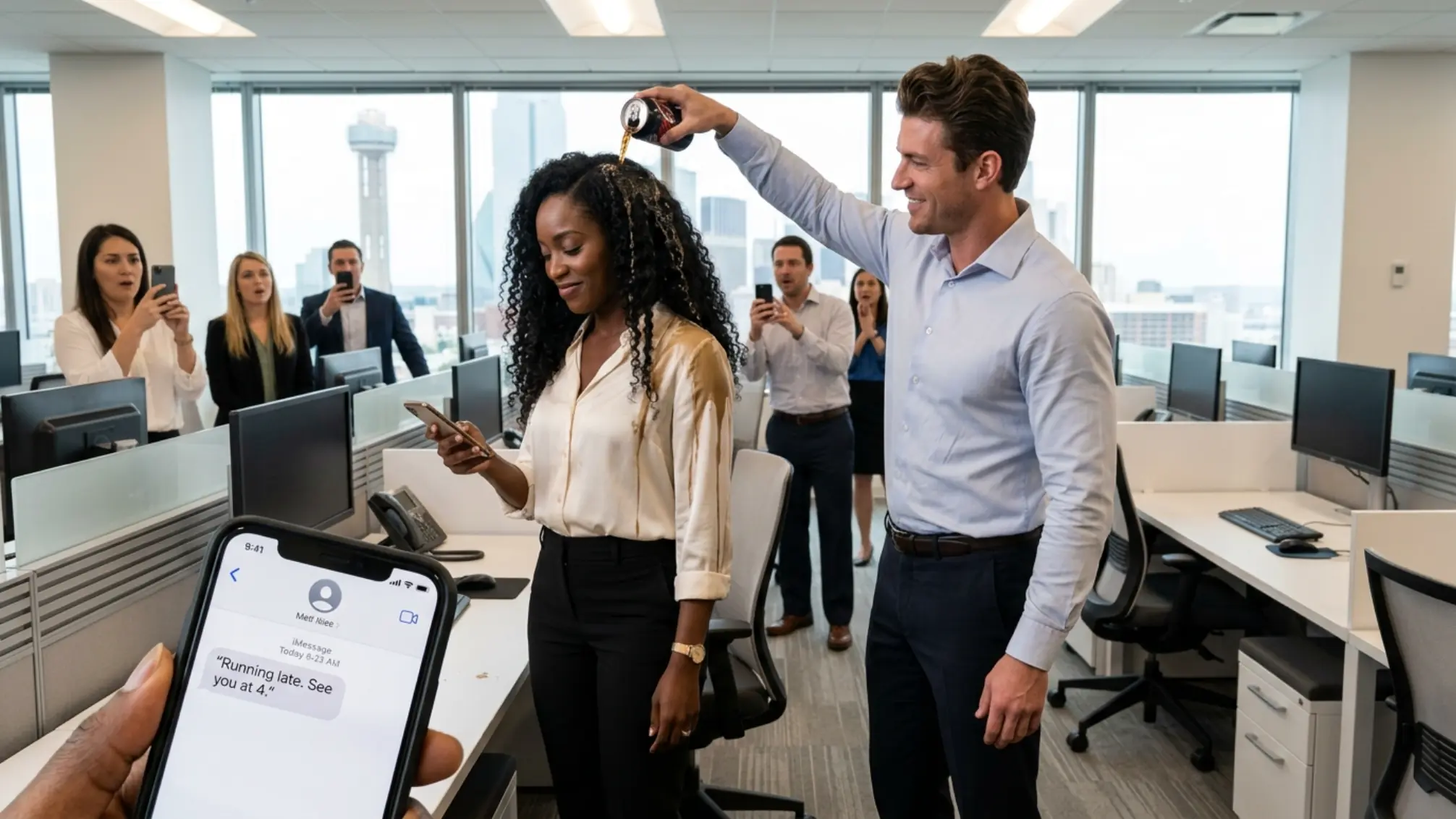
Kesha lowered her eyes to the phone in her hand. She did not shout, argue, or give Derek the reaction he clearly wanted. A few feet away, one employee had quietly raised a phone and was recording, while another woman covered her mouth in disbelief. Derek mistook Kesha’s silence for embarrassment and leaned closer. “Nobody here is risking their job for you.”
Kesha’s phone vibrated.
A single message appeared.
Running late. See you at 4.
For the first time since Derek opened the soda can, Kesha smiled.
He noticed.
“What’s funny?”
Kesha wiped one drop from her eyebrow with the back of her finger. “Nothing yet.”
What Derek Walsh did not know was that Kesha Morgan did not need anyone in that office to risk a job for her.
She owned the company.
Three months earlier, Meridian Core Technologies had been one of the fastest-growing enterprise software companies in Texas. The business employed nearly fourteen hundred people across Dallas, Austin, Denver, and Atlanta, with annual revenue approaching $600 million. Its cloud logistics platform served hospital networks, manufacturers, shipping companies, and several national retailers, and investors expected Meridian to pursue a public offering within two years.
From the outside, Meridian looked almost perfect.
Employee satisfaction surveys were strong. Public reviews described an innovative culture. Management reports showed high retention, good diversity numbers, and almost no serious complaints. Yet Kesha, the forty-year-old founder and chief executive officer, had begun receiving anonymous messages that told a very different story.
The complaints all came from the Dallas operations division.
Employees described favoritism, retaliatory performance reviews, public embarrassment disguised as humor, and supervisors who protected high-performing employees regardless of how they treated people beneath them. Several messages mentioned one name repeatedly.
Derek Walsh.
Officially, Derek was a senior account strategist.
Unofficially, he seemed to believe he ran the floor.
His sales numbers were exceptional. He brought in large contracts, entertained important clients, and had become close to regional director Martin Hale. Whenever HR received a complaint about Derek, the issue disappeared into vague language about “communication styles” or “personality conflicts.”
Kesha had read every report.
Then she requested the underlying documentation.
There was almost nothing.
That bothered her more than the complaints themselves.
She had founded Meridian fourteen years earlier from a borrowed desk inside a shared office in Houston. She had worked customer support at night, written proposals in coffee shops, and personally cleaned the first office because the company could not afford a janitorial service. Meridian had grown far beyond anything she imagined, but Kesha still believed culture could not be measured through polished executive summaries.
So she made a decision almost nobody on the executive team liked.
She went undercover.
Only four people knew.
Her general counsel, Ruth Ellis.
Board chair Gabriel Price.
Chief security officer Naomi Carter.
And Leah Monroe, an external workplace investigator who had spent twenty years examining corporate retaliation cases.
Meridian created a temporary operations role under Kesha’s middle name, Kesha Brooks, placing her inside the Dallas office as a contract process analyst. Her appearance was changed subtly rather than dramatically. She stopped wearing the custom suits employees associated with photographs of Meridian’s CEO, replaced her usual straightened hairstyle with long natural curls, removed expensive jewelry except for a simple watch, and arrived carrying an ordinary laptop bag.
Very few employees recognized her.
That fact itself taught her something.
They knew the logo.
They knew quarterly targets.
They knew Martin Hale.
But almost nobody knew the woman whose signature appeared at the bottom of their annual reports.
Kesha spent her first week listening.
Derek introduced himself on Monday morning.
He looked at her temporary badge, then at her workstation near the back of the floor.
“Contractor?”
“For now.”
He smiled without warmth.
“Then try not to reorganize anything. People come through here thinking three months makes them experts.”
Kesha answered politely.
By Wednesday, Derek stopped pretending to be polite.
When Kesha suggested a correction to a client forecast, he ignored it until another male employee repeated the exact point ten minutes later. Derek immediately praised the idea.
During a team meeting, Kesha asked why customer cancellation data had been excluded from a performance report.
Derek leaned back.
“Let the permanent employees worry about that.”
Martin Hale heard him.
The regional director said nothing.
Kesha wrote the moment down that evening.
She documented everything.
Dates.
Times.
Witnesses.
Emails.
Slack messages.
Management responses.
She also watched what happened to employees who challenged Derek.
Emily Tran, an account coordinator, was exceptionally capable but rarely spoke during meetings. Kesha eventually learned why. Months earlier, Emily had corrected Derek’s calculation during a client call. For the next three weeks, Derek reassigned her strongest accounts and told coworkers she “needed to learn humility.”
Carlos Mendes had reported Derek for making inappropriate comments about a colleague’s accent.
Two months later, Carlos received the lowest performance review of his career.
Priya Shah had complained about Derek taking credit for her work.
Martin Hale told her to become “less sensitive about recognition.”
Every incident remained small enough to explain away.
Together, they formed a system.
Derek was not powerful because he was unusually cruel.
He was powerful because everyone around him had learned that resisting him cost more than tolerating him.
Kesha became particularly interested in Martin Hale.
Martin had worked at Meridian for six years. His executive reports were immaculate, his presentations sharp, and his Dallas office consistently exceeded revenue targets. Kesha had personally approved his promotion two years earlier.
She began wondering how much of his success had been purchased with silence.
The answer arrived during her sixth week undercover.
An employee named Sarah Kim approached Kesha in the break room.
“Can I ask you something?”
“Sure.”
“You’ve worked at other companies, right?”
“A few.”
Sarah lowered her voice. “Is it normal for management to change written complaints after people submit them?”
Kesha’s expression remained neutral.
“What do you mean?”
Sarah explained that she had filed a complaint after Derek publicly ridiculed one of her presentations. HR later sent her a summary of the discussion, but the summary omitted Derek’s comments completely. Instead, it framed the incident as a disagreement over presentation quality.
“Did you challenge it?”
Sarah laughed quietly.
“I need this job.”
That sentence stayed with Kesha.
She sent a coded message to Leah Monroe that evening.
Expand review to HR documentation. Preserve originals.
Within forty-eight hours, investigators quietly began backing up Meridian’s internal complaint system.
What they found was worse than Kesha expected.
Several complaints had been edited after submission.
Names disappeared.
Descriptions softened.
Words such as “retaliation” were replaced with “conflict.”
One complaint originally stating that Derek repeatedly embarrassed junior employees became a note saying the department suffered from “communication tension.”
The edits were linked to an HR business partner named Claudia Benton.
Claudia reported directly to Martin Hale.
The investigation broadened.
Kesha remained undercover.
Then came Friday.
The office had been celebrating a major contract with a grocery distribution company. Someone ordered food. Music played quietly near the sales section, and several employees gathered around desks discussing weekend plans.
Derek had been drinking soda from a green can while bragging about the contract.
Kesha was reviewing an implementation spreadsheet when she found a serious problem.
The contract had been represented internally as a $14 million annual account.
But several implementation costs had been omitted.
If included properly, the account would generate less than half the margin Derek had reported.
Kesha asked him about it.
Derek’s smile vanished.
“You checking my numbers now?”
“I’m checking the project numbers.”
“They’re my account.”
“They’re company numbers.”
Nearby conversations slowed.
Derek stepped closer.
“Listen, contractor, you’ve been here what, seven weeks?”
“Eight.”
“Eight weeks.” He laughed. “And you think you understand this business better than someone who brings in more revenue than your entire department?”
Kesha closed the spreadsheet.
“I understand arithmetic.”
Two employees unsuccessfully hid smiles.
Derek noticed.
His face tightened.
“Careful.”
Kesha remained seated.
“About what?”
“Your attitude.”
“My spreadsheet doesn’t have an attitude.”
That drew another quiet laugh.
Derek looked around the office.
Something about being challenged in front of an audience seemed to trigger him.
He grabbed the soda can.
Emily Tran stood immediately.
“Derek, don’t.”
He ignored her.
Kesha rose from her chair.
Derek tipped the can.
Cold Sprite poured over Kesha’s curls.
The office went silent.
Liquid streamed across her blouse and onto the carpet.
Derek smiled.
“Maybe stick to jobs that match your level.”
Nobody laughed.
That seemed to frustrate him.
He looked around.
“Come on. It’s soda.”
Still nothing.
Kesha looked at him.
For a man who had spent years controlling rooms through confidence, Derek suddenly seemed uncomfortable with silence.
“Nobody here is risking their job for you,” he said.
Kesha’s phone vibrated.
Running late. See you at 4.
The message came from Gabriel Price, chairman of Meridian’s board.
He was flying in from New York.
The board meeting had originally been scheduled for 3:30.
His flight had been delayed.
Derek interpreted Kesha’s smile as arrogance.
“You think this is funny?”
“Not yet.”
Kesha picked up several tissues from a nearby desk and calmly pressed them against the sleeves of her blouse.
Then Martin Hale arrived.
“What happened?”
Derek answered first.
“Little misunderstanding.”
Emily stared at him.
“You poured a drink over her.”
Martin sighed.
“Derek.”
“What? She kept provoking me.”
Kesha watched Martin carefully.
This was the moment she had been waiting for.
Not Derek’s behavior.
Martin’s response.
The regional director looked at Kesha.
“Why don’t you take the afternoon, get cleaned up, and we’ll discuss this Monday?”
Several employees looked shocked.
Kesha asked, “And Derek?”
Martin hesitated.
“We’ll address everyone’s conduct.”
Kesha almost smiled again.
“Everyone’s?”
“You were challenging him publicly.”
“I asked about missing implementation costs.”
Martin lowered his voice.
“Kesha, you’re a temporary analyst. Derek manages relationships worth millions to this company. You need to understand context.”
There it was.
Clean.
Simple.
Undeniable.
Kesha nodded.
“I understand perfectly.”
She returned to her desk.
Martin looked relieved.
He assumed the problem was over.
Instead, Kesha opened her laptop and sent one message.
Proceed.
At 3:52, building security appeared on the floor.
Derek looked up.
“What’s this?”
Nobody answered.
At 3:57, Claudia Benton from HR arrived carrying a folder.
She looked nervous.
At exactly 4:08, the elevator doors opened.
Gabriel Price stepped out with general counsel Ruth Ellis, workplace investigator Leah Monroe, and two members of Meridian’s board.
Every conversation stopped.
Martin Hale hurried toward them.
“Gabriel. Nobody told me you were visiting.”
Gabriel looked past him.
His eyes found Kesha.
She was still wearing the wet cream blouse.
“That obvious enough for you?” he asked.
Derek frowned.
Martin turned toward Kesha.
“What is he talking about?”
Kesha removed her temporary badge.
Then she reached into her laptop bag.
She took out another credential.
Black.
Minimal.
Meridian logo.
Kesha Morgan
Founder & Chief Executive Officer
Martin stared at it.
Derek laughed once.
Nobody else did.
Kesha placed the badge on the desk.
“My full name is Kesha Morgan Brooks.”
Derek’s face changed.
Martin looked from the badge to Gabriel.
“This is some kind of—”
“No,” Gabriel interrupted. “It isn’t.”
Kesha walked toward the center of the office.
Soda continued dripping from the ends of her curls.
For eight weeks she had deliberately remained quiet.
Now every employee listened.
“I came into this office because our reports told me this was one of Meridian’s healthiest teams.”
She looked at Martin.
“They were wrong.”
Martin began, “Kesha, if I had known—”
“That’s exactly the problem.”
He stopped.
Kesha’s voice remained calm.
“If you had known who I was, you would have treated me differently.”
She turned toward Derek.
“He poured soda over an employee in front of thirty witnesses because he believed that employee had no power.”
Then she looked toward Martin again.
“And your response was to send that employee home.”
Nobody moved.
Kesha continued.
“This investigation was never about whether people could behave professionally around a CEO.”
Her eyes swept across the office.
“It was about whether they behaved professionally around someone they thought could do nothing for them.”
Derek finally spoke.
“This is ridiculous. She baited me.”
Emily Tran stepped forward.
“No, she didn’t.”
Derek turned.
Emily’s hands trembled, but she continued.
“You do this constantly.”
Sarah Kim stood next.
“She’s right.”
Then Carlos.
Then Priya.
Within thirty seconds, the silence that had protected Derek for years disappeared.
People began talking.
Not shouting.
Testifying.
Specific dates.
Specific comments.
Accounts reassigned.
Complaints changed.
Threats involving performance reviews.
Derek looked toward Martin for help.
Martin had nothing.
Leah Monroe opened her folder.
“We already have the records.”
Claudia Benton’s face went pale.
Kesha looked at her.
“Including the original HR submissions.”
Claudia lowered her eyes.
The investigation had preserved every version.
Forty-three complaints had been modified.
Seventeen involved Derek directly.
Nine involved retaliation claims.
Several had been edited after conversations between Claudia and Martin.
The deeper investigation also discovered that Derek’s celebrated sales performance had been exaggerated through accounting classifications.
Implementation costs had been pushed into other departments.
Customer discounts were hidden in later reporting periods.
Several contracts appearing highly profitable were barely profitable at all.
His value had protected his behavior.
But part of that value was imaginary.
Martin sat down.
Derek remained standing.
“You can’t fire me because of one stupid joke.”
Kesha looked at him.
“This isn’t about one soda.”
She gestured toward Leah.
“It’s about three years of documented conduct and the managers who concealed it.”
Derek’s confidence finally disappeared.
He glanced at the phones around the room.
Several were still recording.
Kesha noticed.
“Send the recordings to Legal.”
Employees slowly lowered their phones.
Derek looked at Kesha’s ruined blouse.
“You planned this.”
“I planned to observe the culture.”
“You set me up.”
“I asked you about a spreadsheet.”
Derek had no answer.
Security escorted him from the building twenty minutes later pending formal termination procedures.
Martin Hale and Claudia Benton were placed on administrative leave that afternoon.
Neither returned to Meridian.
The following investigation lasted six weeks.
The board reviewed hundreds of emails, Slack messages, HR documents, performance evaluations, and contract records. Employees who had left Meridian were contacted and invited to speak confidentially.
The pattern became undeniable.
Martin had protected Derek because Derek’s inflated sales results strengthened Martin’s own bonus calculations.
Claudia softened complaints because Martin pressured her to reduce formal escalation numbers.
Employees who complained were labeled “difficult,” “not collaborative,” or “poor cultural fits.”
Several lost promotions.
Two had resigned.
One had transferred across the country just to escape the Dallas office.
Kesha personally called each former employee who agreed to speak.
She apologized.
Not as a public-relations strategy.
As the CEO who had allowed a reporting system to look functional while failing the people inside it.
Meridian changed its policies.
But Kesha refused to solve the problem with another glossy training seminar.
Anonymous complaints would now be preserved in their original form.
No single HR manager could alter a submitted report.
Retaliation claims would automatically trigger independent review.
Managers’ bonuses would no longer depend only on revenue and productivity.
Retention quality, verified employee feedback, and misconduct history would matter.
Most importantly, repeated complaints could no longer vanish simply because the employee involved produced excellent numbers.
Three months later, Kesha returned to the Dallas office.
This time there was no temporary badge.
Employees knew exactly who she was.
She wore a charcoal suit and her natural curls exactly as she had during the undercover assignment.
Emily Tran had recently been promoted.
Carlos now led an account strategy team.
Sarah had joined a new employee oversight council.
The office itself looked almost identical.
Same desks.
Same windows.
Same skyline.
But the atmosphere felt different.
People disagreed openly during meetings.
Junior employees asked questions.
Managers explained decisions.
Nobody had to calculate whether honesty was worth the risk.
Kesha stopped beside the workstation she had used undercover.
A faint discoloration remained in the carpet where the soda had dripped.
Facilities had offered to replace the section.
She told them not to.
Not yet.
Gabriel Price later asked why.
Kesha looked at the stain.
“Because this company spent years polishing reports until everything looked clean.”
She paused.
“That mark reminds me to look closer.”
The video of Derek pouring soda had never been released publicly by Meridian.
Kesha refused to turn another employee’s worst moment into corporate marketing.
But within the company, the story became impossible to forget.
New managers heard about the undercover CEO who spent eight weeks sitting among employees without announcing who she was.
The lesson was not that the person beside you might secretly be the chief executive.
Kesha hated that interpretation.
The lesson was simpler.
It should never matter.
Months later, during a leadership meeting, a new vice president jokingly said, “I guess we should treat every contractor like they might secretly own the place.”
Kesha looked directly at him.
“No.”
The room became quiet.
“Treat every contractor like they’re a person.”
Nobody laughed.
Kesha continued the meeting.
By the end of the year, Meridian’s Dallas division had lower turnover, stronger internal satisfaction numbers, and ironically better revenue than it had under Martin and Derek.
But those statistics were not what Kesha remembered most.
She remembered the silence.
Thirty employees watching a man pour soda over someone while deciding whether speaking up was safe.
That silence was what frightened her.
Because bad workplace cultures rarely began with one spectacular act.
They grew from hundreds of moments when everyone learned that saying nothing was easier.
On the anniversary of her undercover investigation, Kesha visited the Dallas floor without warning.
She walked between desks, asked employees what was working, and more importantly asked what was not.
People answered.
Some answers were uncomfortable.
Kesha welcomed them.
Near the end of the afternoon, Emily approached carrying two cans of Sprite.
She offered one to Kesha.
Kesha stared at it.
Emily tried not to smile.
“Too soon?”
Kesha laughed.
“Probably.”
She took the can anyway.
They opened them together.
Across the office, several longtime employees noticed and laughed too.
This time the sound carried no cruelty.
Kesha looked around the room.
No one was pretending not to notice anything.
No one was lowering their eyes.
And no one had to wonder whether the person standing beside them was powerful enough to deserve basic respect.
Kesha had entered Meridian’s Dallas office pretending to be an ordinary temporary analyst because she wanted to discover what employees did when the CEO was absent.
What she discovered was more important.
Leadership was not revealed by how people behaved when the CEO entered the room.
It was revealed by how they behaved when they believed she never would.
And Derek Walsh learned that lesson one second too late—standing beside a soaked woman he believed had no power, while the owner of the entire company calmly looked down at her phone and waited for four o’clock.