October 1958 arrived cold and clear in the Texas Panhandle.
By nine on Saturday morning, pickup trucks and dusty sedans were already lining the section road outside Vaughn Farm, forty miles north of Amarillo. Men in clean work shirts stood beside tailgates drinking coffee from paper cups while wives gathered closer to the farmhouse porch. Almost everyone in the county knew why they were there, yet hardly anyone wanted to say the word aloud.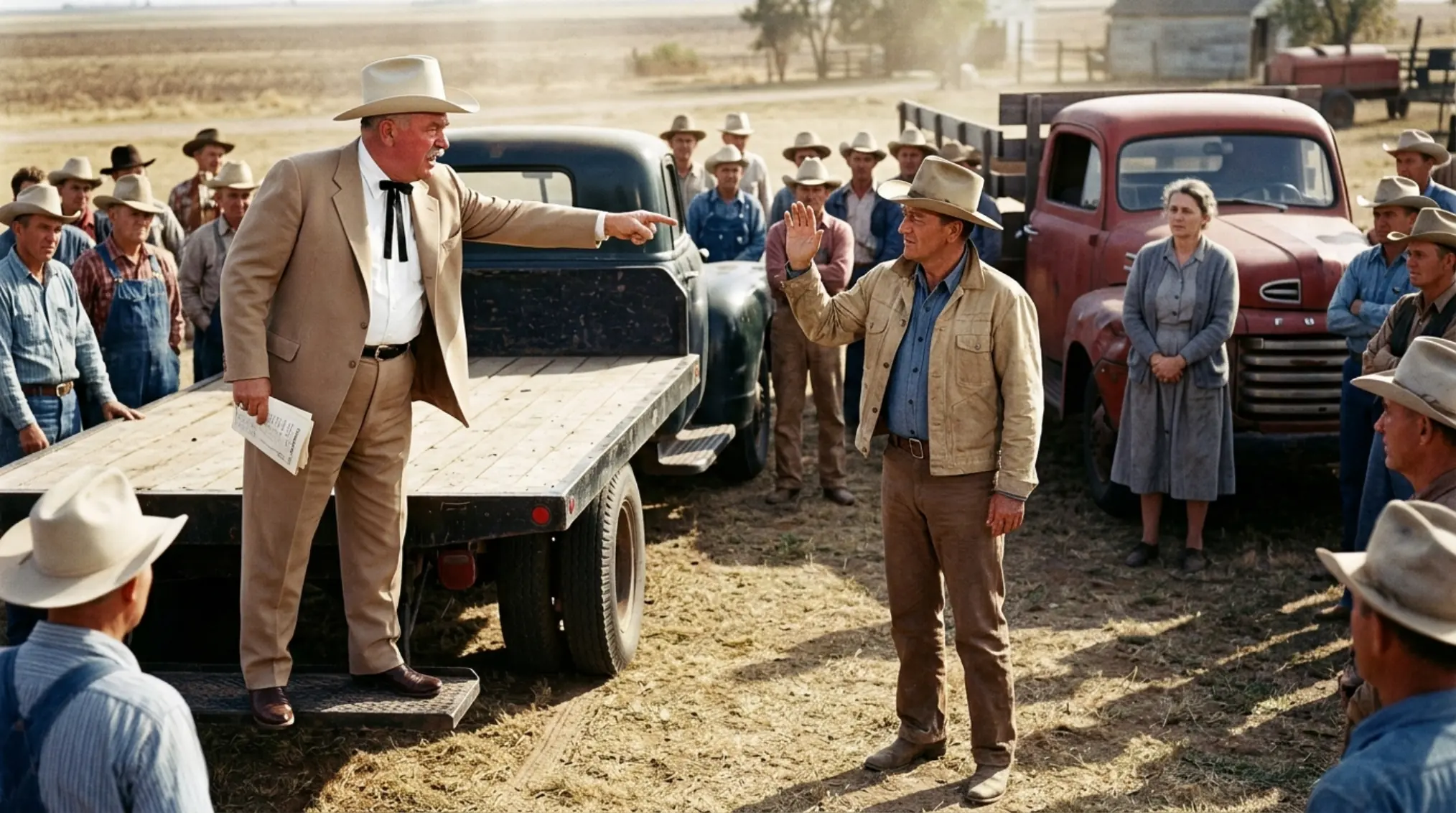
Auction.
Three hundred twenty acres of wheat ground.
One farmhouse.
One barn.
A combine shed.
A windmill.
A stock tank.
Thirty-one years of one family’s life being reduced to a number somebody could shout from a flatbed truck.
Ada Vaughn stood on the porch with both hands folded in front of her.
She was fifty-three, though the months since February had placed new lines around her eyes. Her gray cardigan hung over a faded work dress, and she wore the plain shoes she normally used for feeding chickens before sunrise.
Beside her stood her daughter Ruth.
Ruth wore Walter Vaughn’s old canvas work jacket.
The sleeves had been rolled three times because her father had been a much larger man.
Neither woman spoke.
There was nothing left to say that morning.
The farm had belonged to the Vaughn family since 1927, when Walter’s father first broke the hard Panhandle ground with a mule team. Walter took over after returning home in the 1940s and spent the next fourteen years slowly turning inherited soil into a working farm.
He married Ada.
They raised Ruth there.
They planted wheat.
Kept calves.
Repaired windmills.
Fixed fences after storms.
Paid the bank every year they could.
Walter carried the balance of the farm note in his head the way other men remembered birthdays.
After every harvest he would come into the kitchen, sit down with his coffee, and tell Ada how much smaller the number had become.
“Another year,” he would say.
Ada always answered the same way.
“Then we plant another year.”
They believed they had time.
In February, Walter went into the north quarter to repair a fence.
Ruth found him around noon.
He was lying in the bunch grass with the fencing pliers still beside his hand.
His heart had stopped.
Walter Vaughn was fifty-six.
After the funeral, the farm did not stop needing him.
That was the cruelty of it.
A broken fence remained broken whether a widow was grieving or not.
Cattle needed feed.
The windmill needed attention.
The tractor needed maintenance.
The wheat did not care that Walter was gone.
Ada tried.
So did Ruth.
But the two hired men eventually left for jobs where wages came every Friday.
The wheat harvest came in thin.
Then prices weakened.
By April, a representative from First National drove into Vaughn Farm with a folder on the passenger seat.
He sat at Ada’s kitchen table.
He removed his hat.
Then he told her he was sorry.
Twice.
The bank had carried the loan as long as it could.
The farm would go to public auction in October.
Anything above the outstanding debt and fees would belong to Ada.
Everyone knew what that meant.
Nothing.
Foreclosed farms had been selling cheaply all year.
The people with cash were not sentimental neighbors.
They were buyers representing cattle companies, investment groups, and land combines that understood exactly how desperate the Panhandle had become.
They waited until families had no choices.
Then they bought ground cheaply.
By Saturday morning, one of those buyers had arrived.
His name was Royce Maddox.
He had driven from Dallas in a dark sedan and stepped onto the Vaughn property wearing polished boots, a pale gray Western suit, and a cream Stetson that had probably never been caught beneath a tractor axle or soaked fixing fence in a thunderstorm.
He carried no sympathy.
Only numbers.
Royce had spent the year purchasing distressed agricultural property for a large cattle investment company.
He did not see farms.
He saw acreage.
He did not see barns where children had played.
He saw structures depreciating on paper.
He did not see a windmill Walter climbed every spring.
He saw water access.
Royce knew the debt on the Vaughn farm was a little over nine thousand dollars.
He also knew nobody standing in that yard wanted to bid.
That made the property valuable.
Not because it was cheap.
Because everyone else had a conscience.
Near ten o’clock, another vehicle appeared at the far end of the section road.
A battered truck pulled onto the shoulder.
The driver stepped out.
Tall.
Broad.
Tan Stetson.
Canvas ranch jacket.
Dust on his boots.
He did not enter the yard.
He simply leaned against the front fender and watched.
Most people were too focused on the auction to pay attention.
A few glanced toward him.
Then looked away.
At exactly ten, auctioneer Cy Pruitt climbed onto the flatbed of his truck.
Cy had sold sixty distressed farms that year.
He no longer enjoyed hearing his own voice at them.
He adjusted his papers.
Cleared his throat.
Then read the legal description.
“Three hundred twenty acres, more or less, including residence, barn, combine shed, windmill, stock tank, improvements and appurtenances.”
The bank representative stood beside him holding a black ledger.
Ada and Ruth moved from the porch toward the windmill so they could see.
Cy looked across the crowd.
“All right, gentlemen.”
Nobody moved.
“We’ll start the bidding.”
Silence.
Men looked at their boots.
Several could have used another eighty acres.
Some could have used all three hundred twenty.
A few had enough savings to make an offer.
Nobody lifted a hand.
There were rules in that part of Texas nobody bothered writing down.
One of them was simple.
You did not stand on a widow’s front lawn and compete to buy her family’s farm out from under her.
Cy understood.
So did Royce Maddox.
That was why Royce had come.
Cy tried again.
“Good wheat ground. Forty feet to water. House is sound.”
Nothing.
Wind turned the windmill above them.
A meadowlark called somewhere beyond the stubble.
Cy looked toward the bank representative.
The banker stared into his ledger.
Then Royce lifted one finger.
“Six thousand.”
The number struck the yard like an insult.
Ruth’s hand closed around Ada’s arm.
Six thousand dollars would not even cover the debt.
The bank would take a loss.
Ada would leave with nothing.
Royce’s company would acquire three hundred twenty acres for less than some new tractors cost.
Cy’s face tightened.
But he had a job.
“I have six thousand.”
He waited.
“Six thousand once.”
Nobody challenged it.
Ada stared straight ahead.
“Six thousand twice.”
Royce smiled faintly.
He had purchased properties like this before.
The moment always worked the same way.
Local farmers felt sorry for the family.
The bank needed closure.
The family had no cash.
He raised a hand.
The hammer fell.
Then the property belonged to him.
Cy lifted his hand for the final call.
“Eleven thousand.”
The voice came from the road.
Every head turned.
The stranger beside the battered truck still leaned against the fender.
One hand was raised.
Easy.
Almost casual.
Cy squinted.
“What was that?”
“Eleven thousand.”
Royce turned completely around.
He stared down the section road.
The stranger lowered his hand.
Royce’s smile disappeared.
“Twelve.”
The stranger answered instantly.
“Thirteen.”
A low murmur moved through the crowd.
Royce stepped away from his sedan.
“Fourteen.”
The man by the truck did not change expression.
“Fifteen.”
Now the yard was completely silent.
Fifteen thousand dollars was not a casual number in 1958.
Not for ground struggling beneath weak wheat prices.
Not when foreclosure auctions were producing bargains.
Royce looked toward the banker.
No help came.
The bank wanted the debt paid.
It did not care who paid it.
Royce looked toward Cy.
Then back toward the stranger.
“You planning to grow gold out there?” he shouted.
The stranger smiled faintly.
“No.”
A few farmers laughed.
Royce’s face reddened.
“You’re paying more than this place is worth.”
The stranger pushed away from the truck.
“Maybe to you.”
That irritated Royce.
He stepped forward.
“Fifteen thousand for a widow’s wheat ground?”
The stranger started walking up the section road.
“You’re either stupid or trying to make a fool out of me.”
The man stopped several yards away.
“You tried buying thirty-one years of her family’s life for six thousand dollars.”
Royce’s jaw tightened.
The stranger continued.
“I’m just making you pay what you hoped nobody else would.”
Several farmers looked toward one another.
Royce knew he had lost the room.
He also knew fifteen thousand was more than his employer wanted tied up in that parcel.
He adjusted his hat.
“That’s all for me.”
He said it loudly, as though withdrawing had been his choice from the beginning.
Cy waited.
“I have fifteen thousand.”
He scanned the yard.
“Fifteen thousand once.”
Nobody moved.
“Fifteen thousand twice.”