“Sign over the house, old woman—you’ve lived off our family long enough.”
Marissa Cole stood at the head of Margaret Lawson’s dining table with another ceramic plate raised beside her shoulder. Broken porcelain covered the carpet near Margaret’s feet, and a thin line of blood ran from the widow’s temple where the first plate had clipped her before exploding against the wall. Margaret remained upright, one hand pressed lightly to the injury while the other rested beside a stack of property-transfer documents. Across the room, four members of her own family watched without moving to help.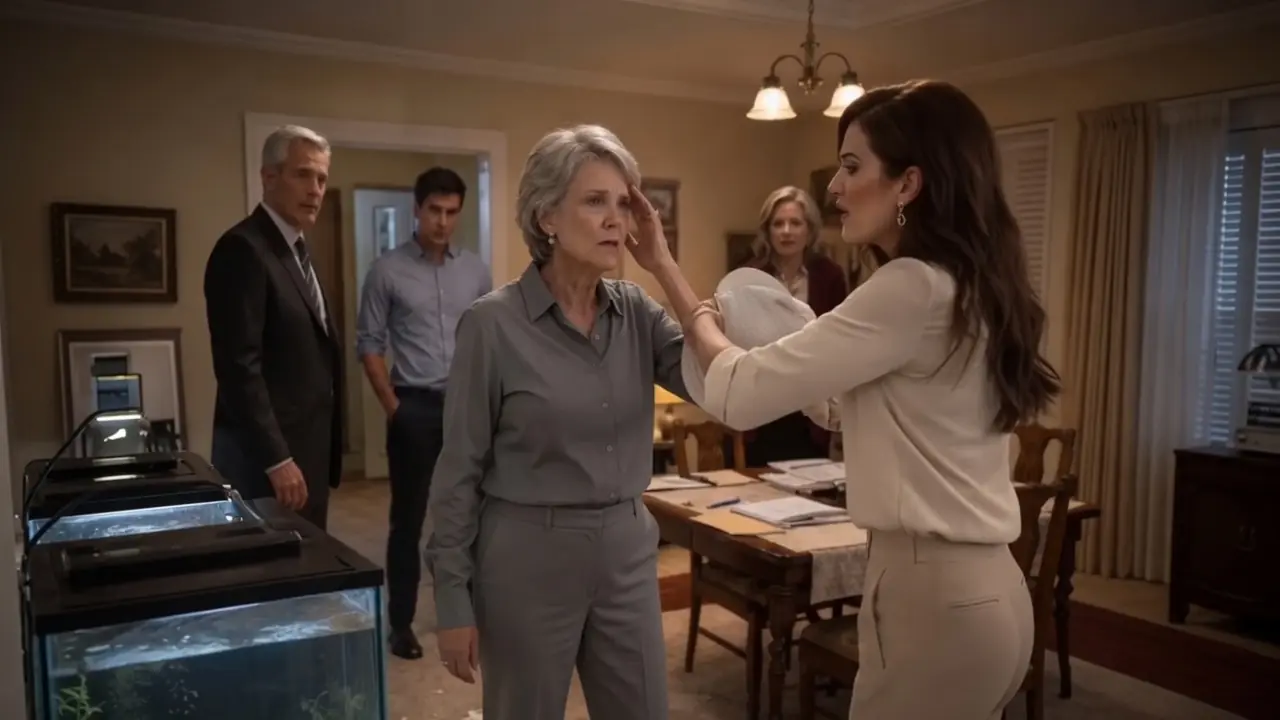
Margaret was seventy-two, with short silver-gray hair, clear blue eyes, and the composed posture of a woman who had survived three decades of work, widowhood, and financial uncertainty without asking anyone to rescue her. She wore a mustard-colored blouse, navy trousers, pearl earrings, and the low black shoes she usually reserved for church. She had arrived expecting to celebrate her grandson Tyler’s promotion at the engineering firm where he worked. Instead, the dining table had been prepared not for supper, but for surrender.
Marissa’s husband, Tyler, stood near the doorway with his arms hanging uselessly at his sides. Beside him were Marissa’s parents, Elaine and Robert Cole, both dressed as though they had come for a formal family dinner rather than an attempted property seizure. Margaret’s son, David, remained farther back near the hallway, his face pale and ashamed. Every person in the room had known about the papers before Margaret arrived.
The property they wanted was not the home where they stood. It was a four-unit rental house on Ashford Street, fifteen minutes away, which Margaret and her late husband, Henry, had purchased thirty years earlier. They repaired the plumbing themselves, replaced rotting floors one room at a time, and spent countless weekends repainting apartments between tenants. The building had financed Tyler’s childhood braces, David’s medical bills, and Margaret’s life after Henry died.
Now it was worth almost nine hundred thousand dollars.
Marissa lowered the second plate slightly. “Sign the transfer, and we can stop making this unpleasant.”
Margaret looked down at the documents. “You invited me here under false pretenses, surrounded me, threatened me, and struck me with a plate. Unpleasant is not the word I would choose.”
“You’re exaggerating,” Marissa snapped. “The plate slipped.”
“The second one appears very secure in your hand.”
Robert Cole stepped forward with the false calm of a man who believed a businesslike voice could make criminal behavior seem reasonable. “Margaret, no one wants conflict. Tyler and Marissa need the property to secure financing for their new development project. The building will remain within the family.”
“My name does not appear anywhere in that project.”
“You would receive lifetime occupancy protection.”
“I do not live there.”
“Then you lose nothing.”
Margaret lifted the top page. The document transferred the entire Ashford property to an LLC controlled by Marissa and Tyler. In exchange, Margaret would receive one dollar and a vague promise that she could continue collecting income only at their discretion. Another clause granted the new owners authority to refinance, sell, or pledge the building without her approval.
She had spent enough years reading leases and loan agreements to recognize theft wearing legal formatting.
Tyler finally spoke. “Grandma, we’re not trying to take anything from you.”
Margaret looked at him. “Your wife just broke a plate against my head.”
“She lost her temper.”
“And you lost your voice.”
His face tightened. “You don’t understand the pressure we’re under.”
“The bank denied your loan.”
Tyler looked toward Marissa.
That was the first confirmation Margaret needed.
For months, Tyler and Marissa had been promoting a plan to convert an abandoned warehouse into luxury apartments and retail space. They had no development experience, limited savings, and a projected budget built on optimistic numbers. Margaret asked questions during the first family presentation, and Marissa accused her of being negative.
Three banks rejected the project.
A private lender then offered financing if they pledged property worth at least seven hundred thousand dollars as collateral. Tyler’s small house had little equity, Robert and Elaine’s finances were weaker than they admitted, and David had already drained most of his retirement account helping his son. That left Margaret’s rental property.
They began with kindness.
Marissa invited her to lunches, brought groceries she had not requested, and repeatedly mentioned how exhausting it must be to manage tenants at her age. Tyler offered to “take responsibility” for maintenance, though he failed to appear for the first repair appointment. David suggested Margaret should simplify her estate before memory problems began.
Margaret heard the intention beneath every conversation.
She refused each time.
Then strange things started happening. A tenant reported that a woman claiming to represent the owner had entered the building and photographed the units. Margaret’s insurance company received a request to add an unknown LLC as an interested party. Someone contacted the county recorder asking how quickly a quitclaim deed could be processed.
Margaret did not confront the family.
She called an elder-abuse attorney.
Rebecca Sloan had spent twenty years handling financial exploitation cases involving adult children, caregivers, and relatives who treated aging as permission to seize control. After reviewing the suspicious communications, Rebecca told Margaret to preserve every message and avoid signing anything.
She also recommended moving the rental property into a protected trust.
Margaret completed the transfer two weeks before the dinner.
The Ashford building no longer belonged to her personally. It was owned by the Lawson Family Property Trust, with an independent trustee required to approve any sale, mortgage, or change in ownership. Margaret retained all income and control during her lifetime, but no relative could pressure her into signing away the building with a simple deed.
Only Margaret, Rebecca, and the trustee knew.
Marissa struck the table with the plate’s edge. “This is your final chance.”
Margaret glanced toward the side table where her handbag rested beside a small framed photograph. Her phone was inside the open bag, recording everything through a secure application Rebecca had installed. The attorney stood outside the room with a private investigator and two police officers who had agreed to wait until Margaret gave the signal.
The signal had not yet come.
Margaret wanted the entire plan stated clearly.
“Why is my signature required tonight?” she asked.
Robert answered before Marissa could. “The lender’s deadline is tomorrow morning.”
“And the lender believes Tyler already controls the building?”
Silence followed.
Margaret looked at her grandson. “What did you tell them?”
Tyler stared at the carpet.
“Answer her,” David said quietly.
Marissa turned on him. “You don’t get to act innocent now. You gave us the property records.”
Margaret’s eyes moved toward her son.
David looked as though the accusation had struck him physically. “I only gave Tyler a copy of the tax statement. He said he was helping you appeal the assessment.”
“You believed that?”
“He’s my son.”
“And I am your mother.”
David lowered his head.
Elaine Cole approached the table. “Margaret, the development will benefit everyone. Tyler has the vision to create something important, but people your age become attached to property out of fear.”
Margaret studied her. “People my age become cautious because we have watched confident fools lose what careful workers built.”
Robert’s expression hardened. “That building would not exist without your husband.”
“I laid floors beside him, collected rent while he worked nights, negotiated the mortgage, and managed every tenant after he died. Do not turn my labor into a dead man’s achievement because it makes theft easier.”
Marissa raised the plate again. “Stop lecturing us and sign.”
Margaret did not flinch this time. “No.”
The plate flew from Marissa’s hand.
It missed Margaret by inches and shattered against the wooden cabinet behind her. A serving bowl fell from the shelf and broke on the floor. Tyler stepped forward too late, catching Marissa by the wrist only after the damage was done.
Margaret stared at him. “Are you protecting me or stopping her from ruining the evidence?”
“That isn’t fair.”
“Neither was inviting your grandmother into an ambush.”
Marissa tore her arm free. “You want evidence? Fine. I’ll tell the police you attacked me first.”
She grabbed her own blouse near the collar and pulled hard enough to tear one button loose. Then she scratched the skin beneath her neck with two fingernails, leaving red marks.
Elaine gasped. “Marissa, stop.”
“No. This old woman thinks she can ruin us.” Marissa turned toward Margaret. “When the police come, they’ll see your blood and my injuries. Tyler will say you threw the first plate.”
Tyler’s face went white. “I never agreed to that.”
“You agreed to getting the building.”
“That isn’t the same.”
“It becomes the same if you want our marriage to survive.”
Margaret watched her grandson understand, perhaps for the first time, that Marissa’s loyalty existed only while he remained useful. He had participated willingly until the plan required a lie carrying criminal consequences. Now morality had arrived precisely where self-preservation began.
“Tyler,” Margaret said, “did your wife ask you to sign a statement accusing me of violence?”
He looked toward Marissa.
“Do not answer her,” Marissa ordered.
Margaret waited.
Tyler swallowed. “She drafted something.”
“Where is it?”
“In the study.”
Robert stepped between them. “This conversation is finished.”
“No,” Margaret replied. “It is finally becoming honest.”
Robert reached for the property papers. Margaret placed one hand over them.
“Don’t touch those.”
“They belong to us.”
“They were prepared to transfer my property. That makes them evidence.”
He laughed. “Evidence of what? A family discussion?”
The dining-room door opened.
Rebecca Sloan entered carrying a leather folder, followed by investigator Marcus Bell and two uniformed officers. The room froze. Marissa’s hand remained near her torn collar, Tyler still held her wrist loosely, and shattered porcelain surrounded Margaret.
Rebecca looked first at Margaret’s bleeding temple. “Are you hurt badly?”
“I don’t believe so.”
One officer approached and asked whether she needed an ambulance. Margaret accepted medical evaluation but said she could remain conscious and answer questions. The second officer moved toward the table, noting the broken dishes, documents, and people present.
Marissa recovered first. “Thank God you’re here. She attacked me.”
Rebecca removed Margaret’s phone from the handbag and stopped the recording. “That claim should be interesting beside forty-three minutes of audio and video.”
Marissa’s face lost color.
“There is no video,” Robert said.
Marcus Bell pointed toward the small framed photograph on the side table. A nearly invisible camera had been positioned inside the frame, capturing the table, Marissa, and most of the room.
Rebecca opened the folder. “Margaret contacted me after unauthorized inquiries were made about her rental property. We documented the attempted insurance changes, the county-record request, the lender communications, and tonight’s meeting.”
“You set us up,” Marissa whispered.
“No,” Margaret said. “I let you explain yourselves.”
The officers separated everyone for statements. Marissa attempted to maintain that the first plate had slipped, but the recording captured her threat before the second one. It also recorded her plan to fabricate an assault claim, tear her blouse, and force Tyler to lie.
The property documents created another problem.
Rebecca examined the notary section and found a signature already written beside Margaret’s printed name. The signature resembled hers but was not genuine. A notary seal had been stamped beneath it, even though Margaret had never appeared before that notary.
“Who prepared this?” Rebecca asked.
Robert remained silent.
Tyler looked toward his father-in-law. “You said it was only a draft.”
Robert’s calm disappeared. “Be careful.”
“You put a false signature on it.”
“The lender needed a preliminary copy.”
“That is forgery,” Rebecca said.
Elaine began crying, insisting she had believed the paperwork was legitimate. David sat in the hallway with his head in both hands. Tyler cooperated after the officers explained that silence would not erase his involvement.
He admitted that Marissa’s parents arranged the private lender and claimed Margaret had agreed verbally to transfer the property. Robert found a notary willing to stamp the deed without witnessing the signature. They planned to pressure Margaret into signing a second copy that evening, making the forged version unnecessary.
If she refused, they intended to use the existing deed anyway.
The dinner was designed to isolate her.
Marissa chose her parents’ house because there were no nearby neighbors and because Margaret believed she was attending Tyler’s celebration. David was asked to remain silent until the documents were signed. Tyler had been told that once the transfer was recorded, Margaret could complain but would lack the money and energy to fight a complicated property case.
They had mistaken age for exhaustion.
An ambulance arrived, and paramedics cleaned Margaret’s wound. She required three small stitches but had no fracture or concussion. Before leaving for the hospital, she watched officers place Marissa in handcuffs for assault, attempted extortion, conspiracy, and evidence fabrication.
Robert was arrested after investigators confirmed that he possessed the forged deed and had submitted it to the private lender. Elaine was not immediately charged, though her phone was taken as evidence. Tyler agreed to accompany detectives voluntarily and surrender every message connected to the transaction.
David followed Margaret toward the ambulance.
“Mom, please wait.”
She turned.
His eyes were red. “I didn’t know they would hurt you.”
“You knew they planned to trap me.”
“I thought once you heard the project details, you might agree.”
“You helped them bring me into a room where every person expected me to surrender.”
“I’m sorry.”
Margaret looked at the son she had raised, protected, educated, and repeatedly rescued from his own poor decisions. She loved him. That truth made the betrayal more painful, not less.
“Sorry is what you say after forgetting a birthday,” she replied. “For this, you will need to show me who you become next.”
At the hospital, Rebecca remained beside Margaret until the examination ended. Shortly after midnight, they sat in a quiet room while a nurse completed discharge papers.
“Do you want to know the best part?” Rebecca asked.
Margaret touched the bandage near her temple. “Tonight contained a best part?”
“The deed would have failed even if they forced your signature.”
Margaret smiled faintly. “Because of the trust.”
“Because the trust owns the property, and the independent trustee never approved a transfer. They prepared an ambush for an asset you no longer personally held.”
“They were threatening me for a key that opened nothing.”
“Exactly.”
The criminal investigation lasted four months.
Phone records showed that Marissa, Robert, and Tyler discussed the plan for nearly six weeks. Marissa searched for ways to have an older adult declared financially incompetent, while Robert contacted the notary and private lender. Tyler supplied Margaret’s signature from an old birthday card so Robert could copy it.
David had not participated in the forgery, but he helped arrange the dinner and pressured Margaret during earlier conversations. Prosecutors did not charge him after determining he lacked knowledge of the forged deed and intended assault. The family consequences were not as forgiving.
Margaret stopped answering his calls for several weeks.
She needed distance from his apologies, explanations, and repeated insistence that Marissa manipulated everyone. Manipulation had occurred, but David was sixty-eight years old. He could not blame another person for every silence he chose.
Tyler faced charges for conspiracy and attempted financial exploitation. In exchange for full cooperation against Robert and Marissa, he accepted probation, restitution obligations, and a permanent criminal record. His employer placed him on leave, then terminated him after learning he falsified financial information in the development proposal.
The promotion dinner never existed.
Tyler had invented it because he knew Margaret would attend.
Robert pleaded guilty to forgery, attempted fraud, and conspiracy after the notary agreed to testify. The court sentenced him to prison and ordered restitution for legal expenses, medical costs, and investigation fees. The notary lost her commission and faced separate prosecution.
Marissa rejected every plea offer.
She insisted Margaret had provoked her and claimed the hidden camera proved premeditated entrapment. The jury watched the recording twice. They saw Margaret refuse calmly, Marissa threaten violence, the first plate strike her head, and the second shatter behind her.
Most damaging was Marissa’s voice describing how she would fake injuries and blame the widow.
The jury convicted her on all major counts.
At sentencing, Margaret was invited to speak. She stood before the court in a navy suit, the wound at her temple reduced to a faint pale line.
“My granddaughter-in-law believed fear would make me obedient,” she said. “My grandson believed love meant I would forgive anything before consequences arrived. My son believed silence kept him innocent.”
The courtroom remained still.
“They wanted a building, but what they tried to take was larger than property. They tried to take my right to decide, my dignity, and the work of thirty years. They saw an elderly widow and imagined a frightened woman whose resistance could be broken in one evening.”
Margaret looked toward Marissa.
“They did not understand that aging does not erase the person you have spent a lifetime becoming.”
Marissa received a prison sentence followed by supervised release and a permanent protective order preventing contact with Margaret. The judge also prohibited her from serving as a fiduciary, caregiver, or representative for a vulnerable adult.
After the trial, Margaret reviewed the Lawson Family Property Trust with Rebecca. Her original plan divided the rental property equally between David and Tyler after her death. That arrangement no longer reflected reality.
She amended the trust.
A portion of the building’s future income would fund legal services for older adults facing financial exploitation. Long-term tenants would receive purchase options if the property was ever sold. David and Tyler would inherit nothing directly from the building.
Margaret did not make the decision in anger.
She made it because inheritance was not compensation for being related to someone.
David began therapy and volunteered with an elder-support organization, though Margaret initially suspected the work was an attempt to impress her. Over time, he stopped reporting every good action and simply continued doing them. That mattered more.
A year after the ambush, he asked to meet her at the Ashford property.
Margaret found him repainting the front railing under the supervision of the building manager. He wore old jeans, had paint on both hands, and had not invited anyone to witness the gesture.
“You missed a spot,” she said.
David looked up, startled.
Then he smiled carefully. “You always say that.”
“Because you always do.”
They stood in silence.
“I don’t expect you to trust me because I’m sorry,” he said. “I know trust has to survive what I do when you’re not watching.”
Margaret nodded. “That is the first intelligent thing you’ve said in a year.”
It was not full forgiveness.
It was a door unlocked one inch.
The Ashford building remained inside the protected trust. Its four families continued paying reasonable rent, repairs were completed on time, and Margaret still reviewed every monthly statement. She hired a manager not because she was incapable, but because she had earned the right to spend fewer evenings arguing with plumbers.
On the second anniversary of Henry’s death, she visited the building and stood beneath the small brass plaque near the entrance:
Lawson House — Built Through Work, Protected Through Wisdom.
Henry would have found the wording too grand. Margaret liked it anyway.
The dining room where Marissa attacked her was eventually sold with Robert and Elaine’s house to satisfy legal debts. The new owners replaced the damaged cabinet and removed the bloodstained section of carpet. To them, it became an ordinary room again.
For Margaret, the room represented the evening her family mistook silence for weakness.
They invited her under the promise of celebration, placed a forged deed before her, and expected shattered porcelain to accomplish what persuasion could not. They believed the Ashford house was already theirs because they wanted it badly enough.
But the property had been protected before the first threat was spoken.
The camera had been recording before the first plate left Marissa’s hand.
And the widow they intended to frighten had walked into the ambush knowing exactly where every exit led.