The Farmer, the Senior Technician, and the Retired Mechanic stood together beneath the towering header of a disabled Case IH AFS Connect 420 while four hundred acres of ripe Iowa corn waited behind them. The Farmer crushed the dealership’s diagnostic report in one fist, the Senior Technician held an expensive tablet against his chest, and the Retired Mechanic knelt beside a spoonful of hydraulic fluid glistening on the black soil. Rain was forecast within five days, and the Farmer knew that every hour of delay could turn a profitable harvest into a season of debt.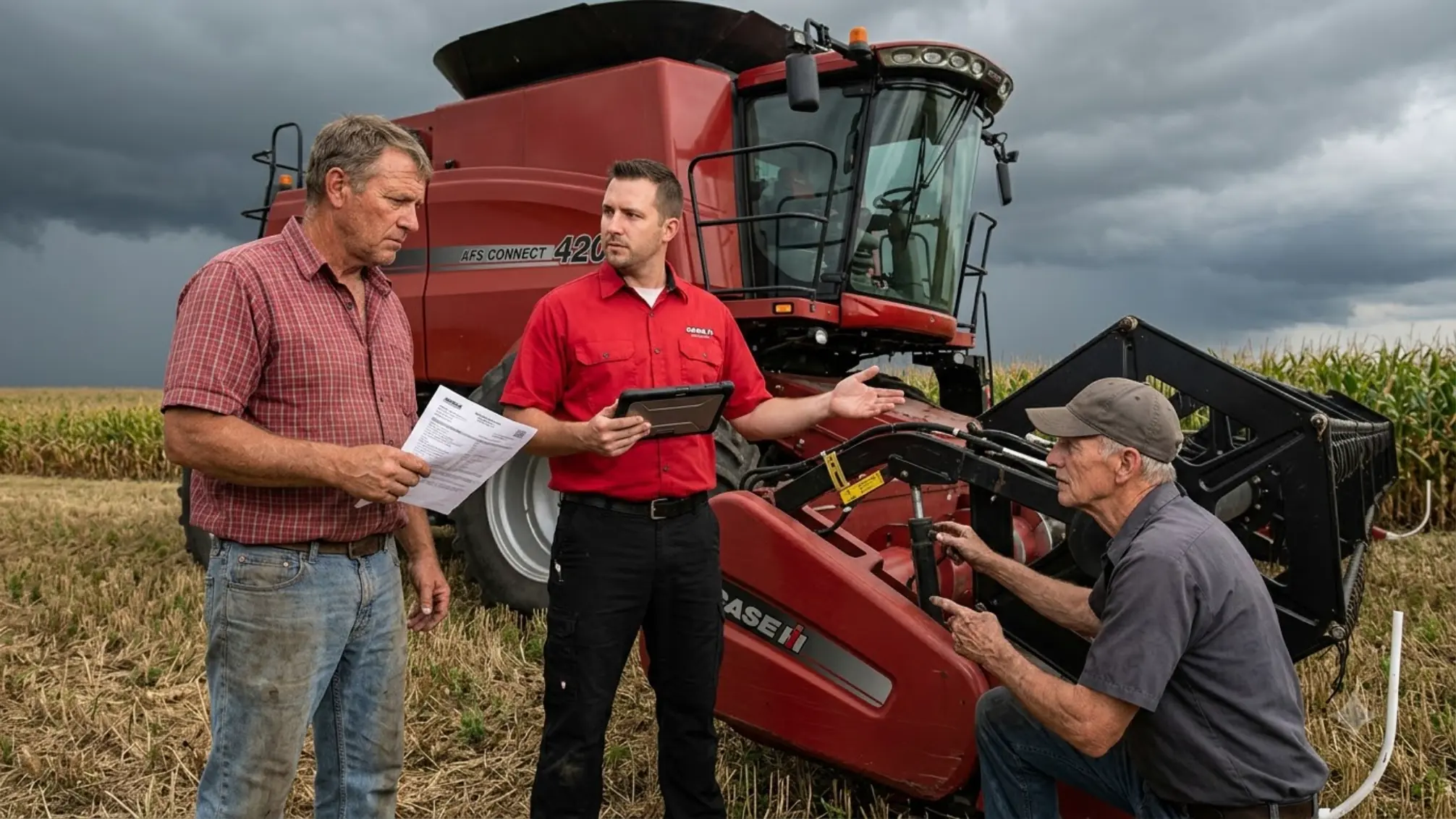
Six hours earlier, the combine had been moving cleanly through the Farmer’s best bottomland. The corn stood dense and dry, the weather remained clear, and the machine had already completed most of the eight-hundred-acre harvest without a serious warning. He had only two days of work left when a sharp metallic sound came through the cab, followed by complete silence.
Every warning icon illuminated at once.
Red and amber symbols covered the eighteen-inch display, announcing hydraulic, steering, control-module, and system-pressure errors. The machine locked itself down so completely that the Farmer could not raise the header, move the steering, or limp the combine toward the equipment shed. He sat behind the wheel with both hands motionless on the controls while the engine refused to respond.
The first dealership technician arrived before eleven carrying a laptop, tablet, and enough confidence to suggest the problem would soon become a completed service ticket. He connected the diagnostic cable, downloaded the fault history, and ran the automatic troubleshooting sequence twice. The display identified the electro-hydraulic control module as the most likely cause.
The young technician replaced one fuse, restarted the system, and cleared the memory.
The warnings returned immediately.
He called the dealership’s Senior Technician, who arrived shortly after noon. The Senior Technician repeated the automated tests, contacted the manufacturer’s support center, and spent thirty-one minutes discussing the fault pattern with an engineer. By the time he closed the laptop, his confident expression had become carefully professional.
“The module has failed,” he told the Farmer. “The secondary codes suggest damage may have reached the steering-priority valve and the main hydraulic pump.”
“Can you repair it here?”
“Not safely.”
“How long in the shop?”
“Four days if the module is the only failure. A week if the pump is damaged.”
The Farmer looked across the standing corn.
Rain would arrive before then.
Moisture would rise, stalks could bend, and the price paid at the grain elevator would fall. He had already spent more on diesel, seed, fertilizer, and equipment payments than he wanted to calculate. Losing a week during harvest could cost tens of thousands of dollars before the first repair invoice appeared.
The Farmer called two rental companies.
Neither had an available combine.
A custom harvesting crew told him every machine was committed through the end of the month. The Farmer ended the final call and stood beside the disabled combine while the dealership technicians began preparing it for transport.
That was when a neighboring farmer called.
“I heard your machine went down.”
“Word travels faster than service trucks.”
“What did the dealer find?”
“Control module, steering valve, maybe the main pump. They want a week.”
The neighbor remained silent for several seconds. “There’s a man east of Lohrville. Retired now, but dealers used to call him when their own people couldn’t solve something.”
The Farmer looked toward the two technicians.
“How old?”
“Seventy-three.”
“Does he work on modern equipment?”
“He worked on machines before computers started telling people where to look. Call him and let him see it fresh.”
The Farmer wrote down the number.
The Retired Mechanic answered on the second ring. His voice was low, unhurried, and stripped of every unnecessary word. He listened to the Farmer describe the sudden shutdown, the field conditions, the remaining acreage, and the approaching rain.
“Who looked at it?” he asked.
The Farmer hesitated, remembering the neighbor’s advice.
“Nobody who fixed it.”
A long silence followed.
“I’ll come,” the Retired Mechanic said. “I’m not promising anything.”
He arrived at three in the afternoon in a fifteen-year-old pickup carrying a toolbox older than the Farmer’s hired hands. The Retired Mechanic climbed out slowly, his body carrying the stiffness earned by decades of lifting things that should have required two people. White hair showed beneath an unmarked cap, and dark grease remained permanently embedded around his fingernails.
He did not ask for the tablet.
He did not climb into the cab.
Instead, he walked around the combine once without touching it. He studied the position of the header, the depth of the tire marks, the final section of corn, and the ground beneath each hydraulic connection.
The Senior Technician watched with open impatience.
“You need the fault codes,” he said.
The Retired Mechanic continued walking.
“You were running the header at full extension when it stopped,” he said to the Farmer.
“Yes.”
“Maximum load?”
“Best corn in the field.”
“End of the row?”
“Right there.”
The Retired Mechanic nodded toward the cab. “Turn the key to accessory. Don’t start it.”
He opened a narrow access panel neither dealership technician had inspected. For four minutes, only his boots remained visible beneath the machine. When he stood, he asked the Farmer to read every fault code instead of only the automated summary.
The Farmer scrolled through the list.
“F116 is marked secondary.”
The Retired Mechanic looked toward the Senior Technician. “That code isn’t secondary on this system.”
The Senior Technician folded his arms. “The software categorized it as a cascade error from the failed module.”
“The software summarized it that way.”
“That is what the manufacturer’s diagnostic program says.”
“The service manual says something different.”
The Senior Technician’s expression sharpened. “Which section?”
“Section four, subsection twelve.”
The Retired Mechanic turned toward the Farmer. “F116 means the control module received an input signal outside its programmed pressure range. The module did not fail. It locked the system to protect the pump.”
The Farmer stared at him.
“So the module is still good?”
“Most likely.”
“What sent the bad signal?”
The Retired Mechanic pointed toward the wet soil.
A small hydraulic leak had formed near the left auxiliary coupling. It was not large enough to suggest a broken line. There was perhaps a tablespoon of fluid on the ground, almost invisible beside the massive machine.
“The female coupling is worn,” he said. “Under full load, it allowed a pressure spike. The control system read the spike as a dangerous condition and shut down exactly as designed.”
The Senior Technician stepped closer to the coupling.
“You diagnosed all that from this?”
“From the fluid, the stopped position, the load, and the fault code you called secondary.”
“You haven’t tested the module.”
“You tested it for four hours.”
The Farmer looked between them. “What does the repair require?”
“A forty-dollar coupling, a hydraulic bleed, and a system reset.”
The Senior Technician gave a short, disbelieving laugh. “You’re telling him a three-hundred-forty-thousand-dollar machine has been disabled by one worn connector?”
“No,” the Retired Mechanic replied. “The connector caused a pressure spike. The safety system disabled the machine. There is a difference.”
The Farmer did not have the correct coupling in his shop. The nearest Case IH dealership was more than thirty miles away, but the John Deere dealership in Rockwell City was only twelve. The Retired Mechanic said its parts department should carry a compatible fitting.
The Farmer disliked the idea immediately.
Eight months earlier, he had walked into that dealership prepared to discuss purchasing an expensive tractor. He wore work jeans, a flannel shirt, and boots carrying real Iowa soil rather than polished showroom dust. The salesman looked at his clothes and redirected him toward smaller utility machines before hearing what he wanted.
The Farmer asked detailed questions about hydraulic priority, transmission options, and compatibility with his planting equipment.
The salesman answered only four.
The sales manager answered two more, then became irritated when the Farmer insisted on receiving a clear response to the final technical question. Instead of finding someone who understood the system, the manager suggested that the dealership might not be the proper fit for his needs.
The Farmer left without another word.
Six weeks later, he bought the Case IH combine from a competing dealer.
Now he returned to the John Deere building beside the Retired Mechanic, not as a potential buyer but as a farmer trying to save his harvest. The parts clerk recognized the Retired Mechanic the moment he entered.
“Haven’t seen you in two years.”
“I’ve been enjoying the silence.”
“What do you need?”
The Retired Mechanic named the coupling, pressure rating, thread size, and application from memory. The clerk entered the numbers and found two compatible parts in stock.
As he retrieved one, the salesman who had dismissed the Farmer emerged from the showroom.
His recognition was immediate.
“Mr. Mercer,” he began carefully. “I didn’t expect to see you here.”
“Parts counter.”
The salesman looked at the Retired Mechanic. “And you are?”
“Buying a part.”
The sales manager came from his office moments later. He had already heard that the Farmer’s machine had failed and seemed eager to show concern now that the expensive red combine was sitting dead in a field.
“Our service department may be able to help,” he said.
“It has been diagnosed.”
“What failed?”
The Retired Mechanic examined the new coupling under the counter light. “Worn left auxiliary connector. Pressure spike triggered F116 and protective lockout. Replace the coupling, bleed the line, clear the memory.”
The manager stared at him.
“The dealer technicians diagnosed a control-module failure.”
“They read the automated summary and stopped.”
“That is a strong accusation.”
“It is not an accusation. It is what happened.”
The manager stepped closer. “Our senior technician has twelve years of experience.”
“Then he has had twelve years to read section four.”
The parts clerk looked down to hide his reaction.
The salesman studied the Farmer’s face and seemed to understand that the humiliation from eight months earlier had returned to the showroom. The Farmer did not need to mention it. The manager who once dismissed his technical questions now stood beside a man explaining a modern hydraulic system in terms the dealership had failed to understand.
“Who are you?” the manager asked.
The Retired Mechanic placed the coupling on the counter.
“Nobody you would know.”
He picked it up and walked out.
Back at the field, the Farmer watched him work.
The repair itself took six minutes. The remaining time went into cleaning the connection, replacing the fitting, bleeding trapped air, checking pressure with a mechanical gauge, and verifying that the opposite coupling had not begun leaking.
Every movement was precise.
The Retired Mechanic selected each tool before he needed it and returned it before reaching for the next. He did not perform expertise for the watching technicians. He simply worked as though his hands and the machine had been speaking the same language for decades.
When the fitting was secure, he closed the panel.
“Clear the fault memory.”
The Farmer climbed into the cab and entered the diagnostic menu. He selected the reset command and watched the display cycle through every warning. One by one, the red and amber icons disappeared.
Only the normal operating screen remained.
“Start it,” the Retired Mechanic called.
The Farmer turned the key.
The engine fired immediately.
No module error appeared. The steering responded, the hydraulic pressure remained stable, and the header rose smoothly from the ground. The machine that two technicians wanted to dismantle in a shop was running after one inexpensive part and less than half an hour of work.
The Farmer engaged the header.
He drove into the corn while the three men watched from the field edge. The combine took the first rows cleanly, carrying a full load through the exact conditions that had caused the shutdown. At the far end, the Farmer extended the header, turned, and returned at full working pressure.
No warning appeared.
He parked beside the Retired Mechanic and climbed down.
“How did you know before you touched it?”
The older man pointed toward the ground. “The machine stopped under maximum load. Fluid appeared behind the header connection, but not enough for a broken line. That meant pressure escaped only when the worn coupling reached its limit.”
“The dealer followed the codes.”
“They followed the summary.”
“What is the difference?”
“A code tells you what the computer reported. Experience tells you what the machine meant.”
The Senior Technician remained near the service truck, staring at the small wet mark he had stepped over repeatedly. His face no longer carried contempt. It carried the heavier expression of someone realizing that his tools had not failed him—his dependence on them had.
“I want to see the manual section,” he said.
The Retired Mechanic looked at him.
“Read all seventy pages.”
“I will.”
“Good. Then next time, look at the ground before opening the laptop.”
The Farmer wrote the Retired Mechanic a check large enough to make the older man shake his head.
“That is too much.”
“Two technicians, manufacturer support, four hours, and a week-long estimate gave me nothing. You looked for ten minutes and saved my harvest.”
“The coupling cost forty dollars.”
“I am not paying for the coupling.”
The Retired Mechanic folded the check.
Before leaving, he pointed toward the right auxiliary connector. “Replace that one tomorrow. It has the same wear pattern but has not failed yet.”
The Farmer nodded. “I will.”
The Retired Mechanic drove away without waiting for praise.
The Farmer climbed back into the combine and worked until midnight. He continued the following day and completed the final four hundred acres before the weather changed. The first rain began several hours after the combine entered the equipment shed.
The machine ran without another fault.
The next morning, the Farmer replaced the right coupling. When he removed the old fitting, a visible wear line marked the sealing surface exactly where the Retired Mechanic predicted. It might have lasted another season, or it might have failed during the next heavy pass.
The Farmer placed both worn couplings on his workbench.
Together, they cost less than one dealership service call.
The dealership’s sales manager spent that evening learning who the Retired Mechanic was. For forty years, the older man had diagnosed equipment across the county, often after dealership technicians and manufacturer representatives failed to identify the real problem. He retired two years earlier after deciding modern service departments valued automated procedures more than patient observation.
The manager drove to the Retired Mechanic’s workshop the following morning.
“I owe the Farmer an apology,” he said.
“Yes.”
“I also owe my technicians better training.”
The Retired Mechanic waited.
“I want you to come to our shop once a week. Not as an employee. No forms, no quotas, and no warranty paperwork. Look at the difficult machines and explain what you see.”
The older man looked around his quiet workshop. Retirement had given him rest, but it had also removed the problems he had spent his life solving.
“Tuesday mornings,” he said. “Two hours.”
The manager smiled.
“One condition,” the Retired Mechanic added. “The technicians read the manual before I arrive.”
“Agreed.”
The Senior Technician read all seventy pages of section four that night. In subsection twelve, he found the F116 classification exactly as the Retired Mechanic described it: an input-signal anomaly capable of triggering protective lockout even when the control module remained functional.
The truth was not hidden.
It had simply been summarized away.
On the first Tuesday morning, the Retired Mechanic entered the dealership workshop without a uniform, company badge, or tablet. Three technicians stood beside a tractor showing inconsistent steering faults.
“What does the computer say?” one asked.
The older man pointed toward the floor.
“What does the machine say?”
No one answered.
He showed them a fine line of dust disturbed beneath a steering sensor. A loose mounting bracket allowed vibration to interrupt the signal only during sharp turns. The diagnostic software recommended replacing the sensor.
The Retired Mechanic tightened the bracket first.
The fault disappeared.
He did not tell the technicians to abandon technology. He taught them to stop mistaking technology for understanding. Computers could store more information than any mechanic, but they could not smell overheated insulation, notice the angle of a stopped machine, or ask why one spoonful of fluid appeared in the wrong place.
Experience did not compete with modern tools.
It gave them context.
Weeks later, the Farmer returned to the John Deere dealership. He carried the worn hydraulic coupling inside his jacket pocket and placed it on the sales manager’s desk.
The salesman who once redirected him toward utility tractors stood nearby.
The manager apologized without excuses.
“We judged your clothes before listening to your questions.”
The Farmer looked toward the showroom.
“You lost a sale because you assumed a farmer asking difficult questions could not afford the machine.”
“Yes.”
“You also had technicians follow an expensive answer past a forty-dollar problem.”
The manager nodded.
“We are changing that.”
The Farmer picked up the coupling.
“Good. Change before the next farmer loses a harvest.”
He did not purchase a tractor that day.
Trust required more than one apology.
But the dealership began earning it back through better service, honest explanations, and technicians willing to admit when they did not know the answer. The Senior Technician later visited the Farmer’s property to inspect the repaired combine and confirm no hidden damage had occurred.
“The old man was right,” he said.
“About what?”
“Everything.”
The Farmer shook his head. “Not everything. He was right about what he observed.”
The Senior Technician smiled faintly. “That sounds like something he would say.”
The forty-dollar coupling remained on the Farmer’s workbench through winter. Whenever a neighbor asked why he kept a worn piece of metal beside expensive tools, he explained that it had nearly caused the unnecessary replacement of a control module, steering valve, and hydraulic pump.
More importantly, it had revealed the gap between information and understanding.
The dealership technicians spent four hours searching for a failed computer.
The Retired Mechanic spent ten minutes listening to the machine.
When the next harvest began, the Case IH combine returned to the bottomland. The Farmer completed every pre-season inspection, replacing both couplings before visible damage developed. He also taught his son to inspect the ground after every pass, not merely the digital display.
“Why look down when the computer checks everything?” the boy asked.
“Because the computer knows what entered its system.”
The Farmer pointed toward the black soil.
“The ground knows what escaped.”
Years later, the Senior Technician became service manager. Every new employee received a copy of section four and attended Tuesday sessions with the Retired Mechanic until the older man’s health prevented regular visits. The workshop placed one simple sentence above the diagnostic computers:
Look at the machine before asking the machine what happened.
The Retired Mechanic never accepted credit for saving the Farmer’s entire operation. He said he replaced one worn coupling and cleared one protective lockout.
The Farmer knew better.
The older man saved the corn before the rain, protected the combine from an unnecessary teardown, forced a dealership to reconsider how it trained technicians, and reminded an experienced farmer that knowledge could remain valuable even after the world labeled its owner outdated.
Four hours of diagnostics produced an expensive theory.
Ten minutes of observation found the truth.
And the truth had been lying in the Iowa dirt the entire time.