Nine days after his father’s funeral, Luke Harper walked into Dalton John Deere wearing boots that were still too large for him. They had belonged to his father, and each step made the heavy leather shift around his heels. His brown work jacket hung loosely from his narrow shoulders, while a faded farm cap covered hair he had not bothered to comb. In one hand, he carried a folded receipt; in the other, he held the last three hundred dollars from the emergency jar above the kitchen refrigerator.
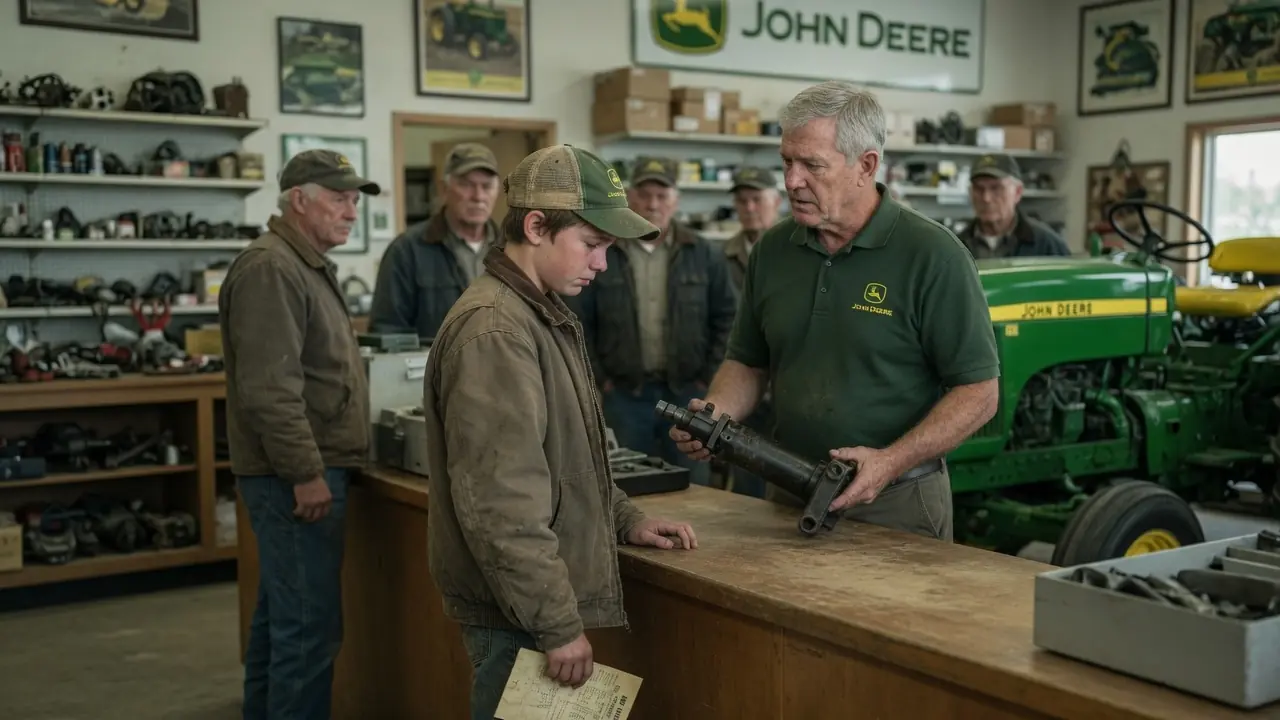
The dealership was crowded with farmers waiting for filters, hydraulic hoses, and last-minute parts before harvest. A polished green tractor stood beneath the showroom lights, spotless enough to look as though it had never touched soil. Older men in seed-company caps leaned against the counter, talking about moisture levels and the first hard freeze expected before November. Their voices softened when Luke stepped into line.
Everyone in the county knew what had happened to Daniel Harper.
Luke’s father had collapsed beside the combine after working late to repair a damaged feeder chain. By the time Luke found him, the evening sky had already turned purple over the cornfields. Daniel had managed to tell his son where the emergency shutoff was and to call their neighbor, but those were the last instructions he ever gave. Two days later, half the county stood beneath umbrellas while Luke and his mother buried him beside the small white church on Mason Road.
Now four hundred and eighty acres of corn remained unharvested.
Luke reached the counter and unfolded the receipt carefully. Behind it was Daniel Harper’s handwriting, written in dark pencil: Hydraulic pump—paid deposit—pick up Friday.
Frank Dalton, the dealership manager, examined the paper. He was fifty-eight, with short gray hair, a pressed green shirt, and the practiced expression of a man who could calculate a customer’s financial condition before offering a handshake. Frank knew Daniel well enough to recognize the handwriting immediately.
“Son,” he said, lowering his voice, “this order was placed by your father.”
Luke held his gaze. “But he’s been gone nine days.”
The men behind Luke stopped talking.
Frank looked toward the office, then back at the boy. “Is your mother handling the farm accounts?”
“She’s at home with my little sister.”
“Does she know you’re here?”
“She knows the combine needs this pump.”
Frank turned the receipt over. Daniel had paid a deposit, but the remaining balance was two hundred and eighty-seven dollars. Luke placed the money on the counter, smoothing each bill flat with both hands.
Frank did not reach for it.
“Luke, that pump is only one problem,” he said. “Your father told me the combine’s separator bearings were worn, the grain cart needed tires, and the operating loan comes due after harvest.”
“I know.”
“You cannot operate five hundred acres by yourself.”
“It’s four hundred and eighty-two.”
“That doesn’t make it easier.”
Luke’s fingers tightened around the receipt. “Can I have the pump?”
Frank looked past him at the farmers gathered near the parts shelves. He seemed embarrassed, but not enough to stop.
“Then sell it now,” he said. “Before your father’s farm dies with him.”
Luke felt the words enter his chest and remain there.
Several men shifted uncomfortably. One older farmer stared at the floor, while another quietly removed his cap. No one challenged Frank. Perhaps they believed he was being realistic, or perhaps none of them knew what could be said to a boy whose father had been buried nine days earlier.
Luke pushed the money closer.
“When I finish every acre,” he said, “you’ll apologize in front of every farmer here.”
Frank’s expression hardened. “Harvesting is not a school project.”
“No,” Luke replied. “It was my father’s work.”
He took the hydraulic pump from the counter, lifted it against his chest, and walked out without waiting for anyone to open the door.
The old Ford pickup started on the third try. Luke placed the pump on the passenger floor, tied it down with a length of baling twine, and drove home through roads bordered by corn that had already turned pale gold. The stalks stood ready, dry leaves rattling whenever the wind crossed the fields. Every acre looked like a promise Daniel had made and left behind.
Harper Farm sat six miles west of town, where two gravel roads met beside a red mailbox leaning slightly toward the ditch. The property included a white farmhouse, a machine shed, two grain bins, a weathered barn, and fields that stretched farther than Luke could see from the yard. Daniel had inherited eighty acres from his father and rented the rest, expanding slowly through years of careful work.
Luke’s mother, Sarah, stood on the porch when the truck arrived. She was thirty-nine, though grief had changed her face enough to make her look older. Luke’s eight-year-old sister, Emily, watched from behind the screen door, holding the stuffed rabbit Daniel had given her on her last birthday.
“You bought it?” Sarah asked.
Luke lifted the pump from the truck. “Dad already paid most of it.”
“What did Frank say?”
“Nothing important.”
Sarah knew immediately that it was not true. She also knew Luke would not repeat words that might hurt her more than they had hurt him.
The combine waited inside the machine shed. It was a fifteen-year-old John Deere 9650 that Daniel had purchased used and maintained with almost obsessive care. Its green paint had faded near the ladder, one side panel carried a dent from an old gatepost, and the cab seat had been repaired with black tape. To Luke, it was not merely equipment. It contained years of his father’s fingerprints.
Daniel had taught him to grease the fittings, clean the radiator screen, check the belts, and listen for sounds that did not belong. Luke had driven the combine across short sections of flat ground while his father watched from the passenger seat. He knew the controls and understood the basic systems, but he had never removed a hydraulic pump alone.
He set Daniel’s repair manual across the workbench and opened it to the page marked with a folded seed-company calendar. His father had already underlined the relevant section.
“Pressure loss at operating temperature,” Luke read softly.
Sarah stood in the doorway. “You don’t have to do this alone.”
“If we hire someone, we won’t have enough to make the loan payment.”
“We may have to sell.”
Luke turned toward her. “Do you want to?”
Her face tightened. “I want you and Emily safe.”
“That isn’t what I asked.”
Sarah looked beyond him at the combine. “Your father wanted this farm to become yours someday.”
“Then don’t sell it before someday gets here.”
For three hours, Luke struggled with bolts that had not moved in years. He scraped his knuckles, dropped a wrench into the oil pan, and installed one seal backward before recognizing the mistake. Twice he nearly called their neighbor, Earl Bennett, but pride stopped him.
Then he remembered Daniel’s voice.
Pride is expensive when a five-minute question can save a five-hour repair.
Luke wiped his hands and called Earl.
The sixty-three-year-old farmer arrived twenty minutes later in a brown pickup with a thermos balanced between the seats. He did not take over the repair. Instead, he stood beside Luke, asked what the manual said, and made him explain each step before touching the machine.
“You know more than you think,” Earl said.
“I know less than Dad.”
“So does everyone now.”
By sunset, the new pump was installed. Luke climbed into the cab, turned the key, and listened as the engine came to life. He waited for the hydraulic pressure to rise, then slowly activated the header.
The mechanism lifted smoothly.
For the first time since the funeral, Luke smiled.
The next morning, he prepared to enter the first field. Sarah stood beside the fuel tank with her arms crossed, watching him perform the inspection Daniel had taught him: oil, coolant, belts, tire pressure, grain tank, fire extinguisher, lights, and grease points. Luke moved through the list twice because he did not trust himself to remember it correctly.
Earl arrived with his tractor and grain cart. He had offered to help without charge, but Luke knew Earl still had his own soybeans to harvest. Luke promised to operate the combine while Earl hauled grain only until they found another solution.
“Your father helped me after my heart surgery,” Earl said. “He planted forty acres while I sat in a hospital bed complaining about the food.”
“That doesn’t mean you owe us.”
“No,” Earl replied. “It means he taught me what neighbors are for.”
Luke climbed into the combine. Daniel’s coffee cup remained in the holder beside the seat, stained along the rim and cracked near the handle. Luke had tried to remove it once but could not. He placed one hand over it, took a breath, and started toward the field.
The corn header entered the first rows shortly after eight. Stalks disappeared beneath the gathering chains, kernels struck the grain tank like hard rain, and chaff moved behind the machine in a dusty cloud. Luke held the steering wheel too tightly and checked every gauge every few seconds.
After fifty yards, the engine temperature remained steady.
After one acre, nothing had broken.
After five acres, Luke began breathing normally.
Sarah and Emily watched from the field entrance. Emily waved both arms each time the combine turned, and Luke lifted one hand from the wheel in response. He imagined Daniel beside him, pointing toward the end rows and reminding him not to swing the header too sharply.
By noon, they had harvested twenty-three acres.
By sunset, they had finished forty-one.
Luke climbed down exhausted, his shoulders aching from tension. Sarah met him with a sandwich wrapped in foil and tears she pretended were caused by dust.
“You look like him up there,” she said.
Luke lowered his eyes. “I don’t know if that’s good.”
“It is hard for me.”
“I’m sorry.”
“Don’t apologize for becoming who he taught you to be.”
The first week went better than anyone expected. Luke woke before five, completed school assignments at the kitchen table, and entered the field at sunrise. Sarah arranged with the school principal for temporary independent study, promising Luke would return after harvest. The principal agreed because Daniel had once volunteered to repair the school’s broken snowblower without accepting payment.
Word spread that the fourteen-year-old was running the combine.
Some people admired him. Others called it irresponsible.
Frank Dalton told customers the boy might finish the easy fields but would fail when he reached the northern ground, where drainage problems made harvest difficult. Luke heard the comment from a seed salesman but said nothing. Each evening, he recorded harvested acres in Daniel’s old notebook and wrote the remaining total beneath them.
Day 1: 41 acres.
Day 2: 38 acres.
Day 3: 44 acres.
On the fourth day, the feeder house jammed. Luke shut down the machine, lowered the header, and followed the safety procedure before climbing out. A bent corn stalk had carried a piece of wire into the gathering chains, wrapping it tightly around the shaft.
Daniel would have removed it in fifteen minutes.
Luke needed nearly two hours.
The delay cost them daylight, but the combine returned to work before evening. Luke finished only twenty-seven acres, then sat alone in the cab after everyone had gone inside. He stared across the unharvested field while darkness erased the rows.
“I’m trying,” he whispered.
The empty passenger seat offered no answer.
The following morning, three pickup trucks entered the farmyard. The men who stepped out were farmers who had witnessed Frank humiliate Luke at the dealership. Among them was Carl Jensen, the man who had stared at the floor during the confrontation.
Carl removed his cap. “We should have said something.”
Luke stood beside the fuel tank. “About what?”
“You know what.”
“I don’t need anyone fighting with Frank.”
“That isn’t why we came.”
The farmers had brought two grain carts, a portable fuel tank, and a service trailer. They could not harvest Luke’s crop for him without neglecting their own, but they offered to rotate hauling duties in the evenings. One man brought a moisture tester; another donated replacement belts from an older combine.
Carl handed Luke a sealed box. “Your father ordered these bearings last spring. He helped my son repair a planter and refused payment. I kept waiting for a chance to repay him.”
Luke opened the box. Inside were the separator bearings Frank had mentioned at the dealership.
For several seconds, Luke could not speak.
By the end of the second week, the farm had become a quiet community operation. Luke ran the combine. Sarah managed fuel records, meals, and grain tickets. Earl coordinated the carts, while neighboring farmers helped whenever their own schedules allowed.
No one treated Luke as a mascot. They corrected him when he turned too sharply, reminded him to reduce speed in damp corn, and made him shut down whenever exhaustion affected his judgment. The work belonged to him, but he no longer carried it entirely alone.
Then the weather forecast changed.
A strong storm system was expected within nine days, followed by freezing temperatures and possible early snow. Luke still had one hundred and ninety acres standing. If heavy rain arrived first, the northern fields could become inaccessible for weeks.
The local elevator extended its hours, and harvest lights began moving across Harper Farm long after sunset. Luke operated until ten each evening, then slept six hours before starting again. Sarah finally climbed into the cab and removed the key from the ignition one night when his eyes repeatedly closed.
“Dad worked later,” he protested.
“Your father was forty-two.”
“He would keep going.”
“Your father also told me never to let you become a machine.”
Luke struck the steering wheel with the heel of his hand. “If we lose the crop, we lose the farm.”
“If I lose you too, the farm means nothing.”
He looked at her and saw the terror beneath her anger. Sarah had already buried her husband. Watching her son disappear into the same work was becoming unbearable.
Luke handed her the key.
The next morning, the combine’s separator began vibrating. Luke recognized the sound immediately and stopped before the failure damaged the entire system. The bearings Carl had brought would fix it, but replacing them required lifting equipment and knowledge Luke did not have.
Earl called the dealership’s service department.
Frank answered.
When he learned whose combine needed help, he quoted an emergency rate nearly twice the normal amount and said the earliest technician could arrive in three days. Earl accused him of punishing a child for embarrassing him, but Frank insisted every customer followed the same schedule.
Luke took the phone.
“I’ll fix it myself.”
“You cannot replace separator bearings without the proper tools,” Frank said.
“Then rent me the tools.”
“We don’t rent that equipment.”
“Dad bought parts from you for twenty years.”
“Your father was an experienced farmer.”
“And I’m the customer standing here now.”
Frank paused. “Sell the crop where it stands, Luke. A larger operation may buy it and finish before the storm.”
“You still want my farm to fail.”
“I want you to stop pretending.”
Luke’s voice became cold. “When I finish, I’m bringing the combine to your dealership.”
“For what?”
“So you can apologize where everyone heard you insult me.”
Luke ended the call.
Earl contacted a retired mechanic named Wesley Grant, who had worked on John Deere combines for thirty-five years. Wesley arrived with a chain hoist and a toolbox large enough to require two men to unload it. Like Earl, he refused to perform the repair while Luke watched.
“You remove the housing,” Wesley said. “I’ll stop you before you ruin something expensive.”
They worked fourteen hours. Luke learned how to mark alignment positions, support the shaft, inspect wear patterns, and heat a bearing without damaging the seal. His arms shook by the time they finished, but the separator ran smoothly when he restarted the engine.
“You’re not your father,” Wesley said as they listened to the machine.
Luke looked down.
“That was not an insult,” the mechanic continued. “Daniel learned by failing for twenty years. You’re trying to remember lessons you only heard once.”
“I keep thinking he would do it better.”
“He probably would.”
Luke’s face tightened.
“But he is not here,” Wesley said. “And you are.”
The storm was now five days away.
Luke returned to the fields before dawn. He harvested sixty-two acres in two long days, moving carefully through the northern ground before the soil softened further. The community carts carried grain continuously to the bins and elevator.
On the third night, a headlight failed. Luke wanted to continue with the remaining light, but Earl blocked the field entrance with his truck until the repair was complete.
“Your father would haunt me if I let you drive blind,” Earl said.
“He’d haunt me first.”
“Then we agree.”
The final field contained forty-seven acres of corn beside the county road. Snow was forecast to begin shortly after midnight. The sky had already turned the flat gray color that came before winter weather, and wind pushed dead leaves across the rows.
Cars began parking along the road as word spread that Luke was nearing the end. Farmers from the dealership arrived in muddy pickups, along with teachers, neighbors, and grain-elevator workers. Sarah stood beside Emily near the mailbox, wrapped in Daniel’s old coat.
At four in the afternoon, Frank Dalton’s green SUV appeared.
He parked away from the crowd and remained inside for several minutes. Eventually, he stepped out wearing the same dealership jacket he had worn when Luke bought the pump. No one greeted him.
Luke saw Frank from the cab but kept harvesting.
The combine moved back and forth across the shrinking field. Each pass left fewer standing rows, exposing dark soil beneath the pale stalks. Snowflakes began drifting through the air before sunset, melting when they touched the windshield.
Ten acres remained.
Then five.
Then one long final pass stood between Luke and the western boundary.
Luke stopped at the edge and looked toward the passenger seat. Daniel’s cracked coffee cup remained beside him. Luke touched the brim of his father’s cap and lowered the header.
The final rows disappeared beneath the machine.
When Luke reached the end, he raised the header and shut down the combine. For several seconds, there was only the sound of wind and the first dry snow striking the cab.
Then horns began sounding along the road.
Luke climbed down slowly. His legs nearly failed beneath him when his boots touched the ground. Sarah reached him first, wrapping both arms around him while Emily pressed against his side.
“You did it,” Sarah whispered.
“We did.”
“You kept your promise.”
Luke looked across the harvested field. “I wanted Dad to see it.”
Sarah placed one hand against his cheek. “He saw enough of you to know.”
The farmers gathered around, shaking Luke’s hand and examining the clean field as though it were proof of something larger than harvested corn. Carl Jensen wiped his eyes and pretended the wind was responsible. Wesley Grant tapped the combine’s side panel approvingly.
Frank remained near the road.
Luke finally walked toward him.
Snow had begun collecting on Frank’s shoulders. The confidence he carried inside the dealership was gone, leaving an older man who seemed unsure where to place his hands.
“You finished,” Frank said.
“Every acre.”
“I heard the separator failed.”
“I replaced the bearings.”
“Wesley helped?”
“He taught me.”
Frank looked toward the combine, then toward the farmers watching them. “Your father would be proud.”
Luke’s expression did not change. “That isn’t the apology.”
Frank glanced at the crowd. He understood that Luke remembered every word spoken at the counter, especially the promise made before leaving.
Frank stepped onto the bed of a nearby pickup so everyone could see him.
“I told Luke Harper to sell his farm,” he said loudly. “I said one grieving boy could not harvest it, and that his father’s farm would die with him.”
The crowd became silent.
“I was wrong.”
Frank removed his cap. “Luke repaired the combine, harvested four hundred and eighty-two acres, and carried more responsibility at fourteen than many grown men could manage. I treated his age like proof that he would fail, and I used his father’s death to humiliate him. Luke, I am sorry.”
Luke stood beneath the falling snow.
He had imagined this moment repeatedly. In those versions, Frank looked defeated and Luke felt victorious. The real apology did not bring his father back, erase the funeral, or remove the fear that the bank might still take the farm.
But it mattered.
“I accept it,” Luke said. “Just don’t talk to the next kid like he’s already lost.”
Frank nodded. “I won’t.”
The harvest did not solve every problem. The corn price was lower than Daniel had expected, and the farm’s operating loan still required careful negotiation. Sarah met with the bank using grain receipts, insurance records, and the harvest ledger Luke maintained.
Because every acre had been completed before the snow, Harper Farm produced enough income to cover the loan payment, property taxes, and spring seed deposit. They would not be comfortable, but they would survive another year.
Luke returned to school two weeks later. He was behind in mathematics, exhausted in history class, and uncomfortable when other students called him famous. The principal allowed him to complete an agricultural mechanics project based on the combine repairs.
Frank Dalton changed as well.
The dealership created an emergency parts account for local farm families dealing with illness or death. Frank also hired Wesley Grant to teach free weekend repair classes for teenagers. The first class drew twenty-seven students.
Luke attended wearing Daniel’s boots, which finally fit more closely after months of growth. Frank did not introduce him as the boy who saved a farm. He introduced him as Luke Harper, a customer who had earned the right to speak for himself.
The following spring, Luke planted his first crop without his father. Earl helped calibrate the planter, Sarah managed the accounts, and Emily rode inside the tractor cab asking more questions than Daniel ever had patience to answer.
Before starting the first row, Luke placed his father’s cracked coffee cup in the holder beside him.
He no longer believed he had to become Daniel Harper. His father’s lessons were not instructions to imitate every movement or carry every burden alone. They were tools, like wrenches passed from one hand to another.
Luke had walked into the dealership nine days after losing his father, wearing boots too large for him and carrying money he could not afford to spend. A grown man told him grief made him incapable, that the farm would die, and that surrender was the only responsible choice.
Luke returned home with the part.
He repaired the machine, accepted help without giving away the work, and harvested every acre before the first snow covered the fields.
The farm survived because a fourteen-year-old refused to confuse youth with weakness.
And when the final rows disappeared beneath the combine, everyone who had doubted him saw the truth his father had known long before them.
Luke Harper was not waiting to become a farmer.
He already was one.