“That rusted truck proves you can’t afford anything here,” the dealership manager said, laughing as he pointed toward the parking-lot exit. “Leave before you embarrass yourself.”
Daniel Reed stood beside his faded 1995 Ford pickup, one grease-stained hand gripping a thin envelope filled with nearly every dollar he had managed to save. At thirty-eight, the widowed single father had learned to endure broken appliances, overdue bills, and strangers who mistook worn clothing for failure. But the manager’s voice was loud enough to reach the truck, where Daniel’s eight-year-old daughter, Emma, sat watching through the open passenger window.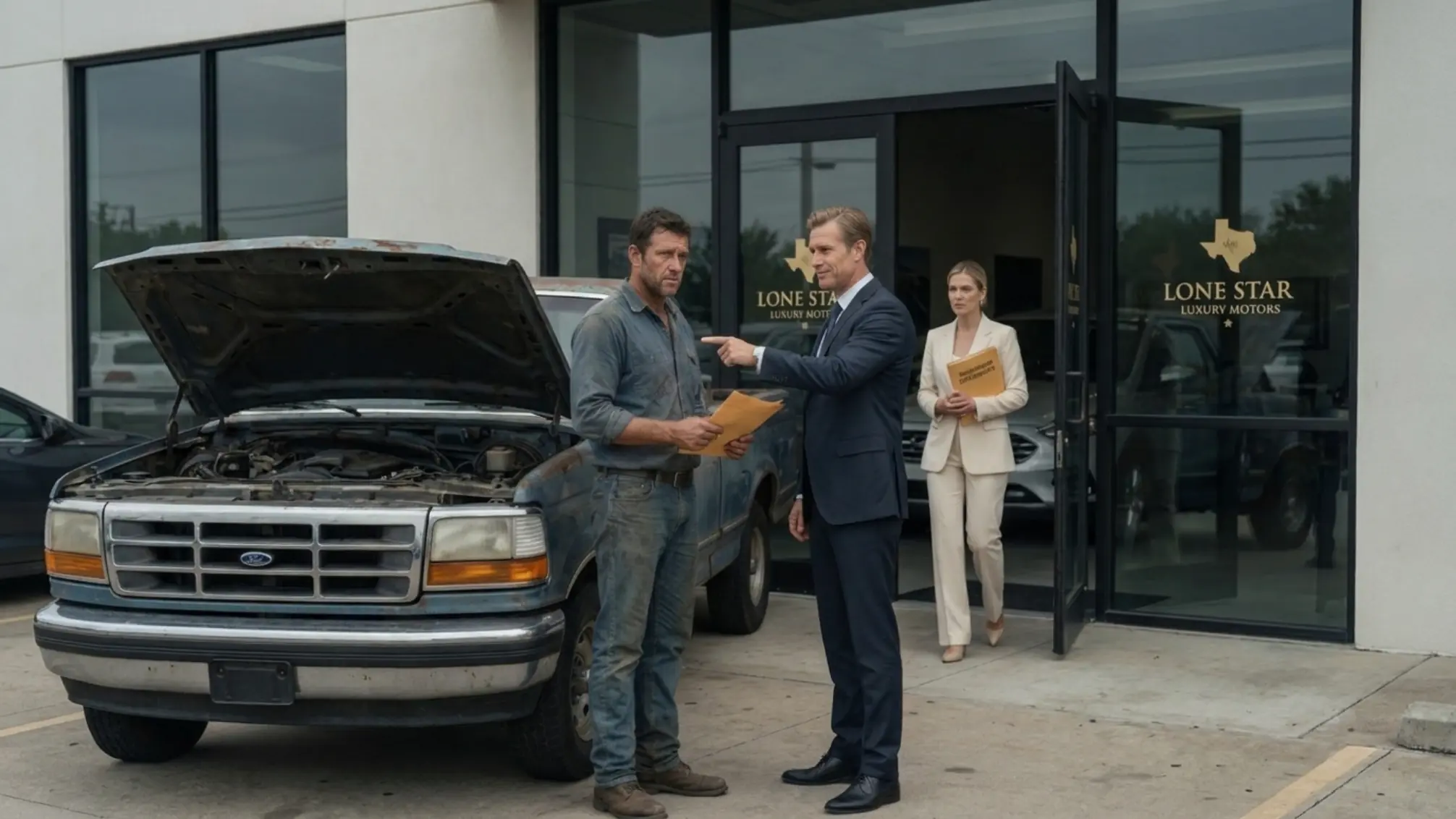
“I came to buy a safe car for my daughter,” Daniel replied. “Not your respect.”
The manager, Brent Lawson, adjusted the silver watch beneath his navy suit sleeve and looked Daniel over again. His attention lingered on the faded work shirt, worn jeans, and scuffed boots before moving toward the rust eating through the Ford’s rear wheel wells. Behind him, the glass walls of Caldwell Premier Motors displayed luxury SUVs beneath bright showroom lights.
“Touch one vehicle,” Brent said, pointing toward the road, “and I’ll have security drag you off the property.”
Daniel’s fingers tightened around the envelope. Inside it was $6,400, money gathered through eighteen months of skipped lunches, late-night welding jobs, and weekends repairing gates and farm equipment. It would not buy anything luxurious, but he had seen a used family SUV listed online for a price he could almost manage.
The Ford had stalled twice that month. Emma never complained, but Daniel had noticed how she held the door handle whenever the engine coughed on the highway. He had promised his late wife, Sarah, that their daughter would always feel safe with him, and lately that promise had begun to feel heavier than the truck itself.
Brent took a step closer. “People like you waste our time every Saturday. You walk around, touch the leather, ask about financing, then disappear when someone mentions a down payment.”
Before Daniel could answer, the dealership’s glass doors opened behind the manager.
A woman in a cream pantsuit stepped into the Texas heat, carrying a black folder beneath one arm. She was tall, composed, and striking, with dark chestnut hair pinned neatly away from her face. Her expression remained calm until she heard Brent’s next words.
“Take that scrapyard relic and your charity-case budget somewhere else.”
The woman stopped beside him.
“Call security,” she said. “Then explain why you just threw my next business partner out of my dealership.”
Brent turned so quickly that his polished shoe scraped across the pavement. The color drained from his face as he recognized Catherine Caldwell, owner of the entire dealership group. She had returned early from an investor meeting and entered through the side lot without notifying the staff.
“Ms. Caldwell, I didn’t realize you were here.”
“That is obvious.”
Catherine looked past him toward Daniel. Her eyes moved from his restrained expression to the envelope in his hand, then toward Emma inside the truck. But when she saw the Ford’s rear bumper, her composure changed.
A small letter M had been welded into the metal near the left corner.
Catherine walked closer without asking permission. Her fingers hovered above the mark, never quite touching it, as though the rusted bumper carried more value than every polished vehicle behind her. Daniel watched confusion and recognition move across her face.
“Where did you get this truck?” she asked.
Daniel glanced at Brent before answering. “It belonged to my wife’s father. He bought it used more than twenty years ago and gave it to us after we married.”
“Do you know who owned it before him?”
“No.”
Catherine finally touched the welded letter. Her father, Robert Mitchell, had marked every restoration project with that exact signature. He had taught her to form the letter when she was ten years old, guiding her hands as sparks fell across the concrete floor of his garage.
Brent forced an uneasy laugh. “It’s an old pickup, Ms. Caldwell. We have customers waiting inside who are actually prepared to purchase.”
Catherine turned toward him. “This man told you he came to buy a vehicle.”
“He has six thousand dollars in an envelope.”
Daniel stiffened. He had not told Brent the amount, which meant the manager had watched him count it through the truck window. Catherine noticed Daniel’s reaction and closed the distance between herself and Brent.
“You searched through a customer’s private financial information?”
“I was evaluating whether he was serious.”
“No,” Catherine said. “You were deciding whether his clothing made him worthy of basic dignity.”
Brent glanced toward the showroom, where two salespeople had begun watching through the glass. His embarrassment sharpened into defensiveness. “This is a premium dealership. We have an image to protect.”
Catherine looked toward Daniel’s Ford. “My father built his first business repairing trucks that looked worse than this one. Everything you are standing on began with hands covered in grease.”
Brent’s jaw tightened. “I was only trying to protect the company.”
“You were protecting your prejudice.”
Catherine opened the black folder and removed a document. It was a dealership performance report listing customer complaints, abandoned financing applications, and several transactions reassigned from junior employees to Brent himself. She had planned to question him privately on Monday.
Instead, she handed him the first page.
“Your employment is suspended pending a full review. Leave your keys with human resources.”
Brent stared at her. “You cannot fire me over one misunderstanding.”
“I am not firing you over one misunderstanding. I am investigating a pattern that became impossible to ignore when I witnessed it personally.”
He looked toward Daniel as though the mechanic had caused his downfall merely by arriving. Then Brent removed the dealership keys from his pocket and dropped them into Catherine’s open hand. He walked through the showroom without another word.
Daniel exhaled slowly. He had expected humiliation, perhaps another failed attempt to improve Emma’s life. He had not expected the owner of a luxury dealership to defend him, and he certainly had not expected her to study his truck like a lost family photograph.
“I appreciate what you did,” he said. “But I’m not looking for charity.”
“Neither am I.”
Catherine gestured toward the service building. “Your truck is overheating, and the alternator belt is slipping. Let our mechanics inspect it while I show you the SUV you came to see.”
Daniel’s suspicion returned. “How do you know what is wrong with it?”
She smiled faintly. “I grew up in a garage.”
Emma climbed from the passenger seat before Daniel could refuse. Her thick brown hair had escaped its ponytail, and she held her school backpack against her chest. She looked at Catherine with the direct curiosity children used before adults taught them to hide it.
“Do you really own all these cars?”
“I own the dealership,” Catherine said. “The bank probably owns more of the cars than I do.”
Emma considered the answer seriously. “That makes more sense.”
Daniel almost smiled.
The used SUV was seven years old, clean, reliable, and far less glamorous than the vehicles in the front showroom. Catherine opened the maintenance history and showed Daniel every repair, previous inspection, and unresolved cosmetic defect. She did not hide the scratches or pretend the vehicle was worth more than it was.
Daniel drove it around the block with Emma in the rear seat. The engine ran smoothly, the brakes responded cleanly, and the air conditioning worked without rattling. Emma leaned forward when they returned to the lot.
“Daddy, it doesn’t sound angry.”
Daniel laughed for the first time that afternoon. “No, it doesn’t.”
The price was still $2,300 beyond what he had saved. Daniel expected Catherine to offer a discount large enough to make him feel indebted, but she did something else. She reviewed his income from welding and repair work, then arranged financing through a local credit union at a rate lower than the dealership normally offered.
“The payment fits the budget you gave me,” she said. “No hidden service package and no penalty for paying it off early.”
Daniel studied the papers. “What do you get out of this?”
“A customer who can afford the vehicle he needs.”
“And the business-partner comment?”
Catherine glanced through the office window toward the Ford. “I said it because Brent needed to understand that someone’s value is not visible from a parking lot. But there may be something we can discuss after I learn more about that truck.”
The service department replaced the failing belt and tightened a loose battery connection at no charge. Daniel tried to object, but Catherine showed him the dealership policy permitting complimentary emergency repairs during an active vehicle purchase. She had not invented the rule for him.
As Daniel prepared to leave, Catherine asked whether she could photograph the welded letter on the bumper. Her voice became quieter when she explained that her father had used the mark on vehicles he restored. She had spent five years searching for his final truck, but incomplete sales records had led nowhere.
“My wife’s father bought this Ford from a mechanic named Robert,” Daniel said. “He never mentioned a last name.”
Catherine’s eyes filled with something she immediately controlled. “Robert Mitchell.”
Daniel looked at the letter again. “Your father?”
She nodded.
The Ford had been Robert’s retirement project, rebuilt slowly during evenings after customer work ended. He had planned to drive it across the country, but cancer arrived before retirement. Medical costs consumed his savings, and he sold the truck to keep Catherine in college.
Robert died believing he had given away the last thing connecting him to the life he loved. Catherine later built a luxury dealership group, but success never erased the memory of him watching the Ford leave his garage. She had searched for the vehicle ever since.
Daniel listened without interrupting. The truck had carried Sarah to prenatal appointments, brought newborn Emma home from the hospital, and transported Daniel through the loneliest years of his life. It belonged to Catherine’s past, but it had also become part of his family.
“I’m not asking you to sell it,” Catherine said.
Daniel looked surprised.
“My father sold it because he wanted another family to benefit from it. Taking it away from you would dishonor that choice.”
Emma stepped closer to the bumper. “So your dad built our truck?”
“He rebuilt most of it.”
“Then he helped bring me home when I was a baby.”
Catherine crouched so they were eye level. “I suppose he did.”
Before they left, Daniel wrote his phone number on the back of an old receipt. He told Catherine she could visit the truck whenever she wanted, though the invitation sounded awkward even to him. She accepted it as if he had offered something priceless.
Three days later, Catherine found Daniel and Emma at Sunset Diner. She claimed the meeting was accidental, though she had driven past twice before gathering the nerve to enter. Emma spotted her first and waved with both hands.
Catherine joined them after Daniel nodded. During breakfast, Emma knocked over her orange juice and froze as the liquid spread toward the edge of the table. Catherine grabbed napkins before anyone else could react.
“Accidents happen,” she said. “Nothing here is ruined.”
Emma relaxed immediately.
Their conversation drifted from school projects to welding, and Daniel admitted that he created metal sculptures in the garage behind his rented house. Catherine expected decorative horseshoes or rough garden signs. Instead, Emma described steel roses, birds suspended in flight, and a tree whose branches held tiny pieces of colored glass.
“You should see them,” Emma said. “Daddy thinks they’re not good, but Daddy is wrong.”
Daniel rubbed a hand over his face. “She has become very direct lately.”
“I learned it from you,” Emma replied.
Catherine followed them home that afternoon. The Porsche looked absurd beside the small house, but she forgot appearances the moment Daniel opened the garage. Metal birds hung from nearly invisible wires, their wings shaped with extraordinary precision. Steel flowers lined one wall, every petal formed by heat, force, and patience.
At the center stood an unfinished tree rising from a base of broken machine parts. Its roots twisted around scraps that once seemed useless, while its branches opened toward an empty space above. Catherine walked around it slowly.
“This belongs in a gallery.”
Daniel shook his head. “It belongs here until someone pays enough to cover the metal.”
“You are not making decorations. You are transforming grief into something people can understand without words.”
The observation left him silent.
Emma pointed toward a steel swan. “Daddy made that after Mommy went to heaven. He said she always wanted to fly.”
Catherine turned away briefly, blinking back tears. Her father had also transformed broken materials into useful things, insisting nothing honest should be discarded merely because it looked damaged. Daniel’s garage felt more connected to Robert Mitchell than the polished offices bearing Catherine’s surname.
Over the following month, Catherine visited often. Sometimes she came to study the Ford’s original restoration work, and sometimes she brought dealership records that helped Daniel understand its history. Gradually, those reasons became less important than sharing coffee with him while Emma worked on homework at the garage table.
Daniel learned that Catherine could identify engine trouble by sound and knew how to hold a welding torch, despite her immaculate clothes. Catherine learned that Daniel listened more than he spoke and never allowed hardship to make him cruel. Emma learned that happiness could return quietly, without replacing the mother she still loved.
Their growing connection frightened Daniel. Since Sarah’s death, he had accepted help only when he could repay it immediately. Catherine’s presence could not be calculated that way, and her wealth made every act of kindness feel dangerously unequal.
The trouble began when a private collector named Richard Blackwood arrived at Daniel’s garage with an offer to purchase every sculpture. Richard spoke about investment potential, resale values, and exclusive representation without asking what the pieces meant. The amount he offered could have cleared Daniel’s debts, but accepting would have surrendered control over his work.
Daniel immediately assumed Catherine had sent him.
“You showed my work to your wealthy friends.”
“I mentioned your name to no one,” Catherine said.
“Then how did he find me?”
Catherine could not answer. Richard had attended a dealership charity event and overheard one of her assistants discussing a local artist Catherine admired. She had never authorized contact, but Daniel saw only another powerful person turning his private grief into a commercial opportunity.
He threw Richard’s card onto the floor.
“I am not one of your projects.”
“You were never a project.”
“You followed my truck because it belonged to your father. You visited my garage because my work reminded you of him. Was any of this about me?”
Catherine’s face went pale. “More than I knew how to admit.”
But the answer arrived too late. Daniel asked her to leave, and Emma cried quietly from the doorway as the Porsche disappeared down the street.
For three days, Daniel tried to prove he needed no one. When the Ford developed another electrical fault, he refused to call Catherine or use the SUV for fear she might interpret dependence as permission to return. Instead, he walked two miles to the grocery store after leaving Emma with a neighbor.
A distracted driver ran a red light on the return journey.
Daniel woke briefly on the asphalt, hearing strangers call for an ambulance. His last clear thought was Emma waiting for him to come home.
At the hospital, Emma found Catherine’s number in Daniel’s phone. Her small voice trembled when the call connected.
“Daddy got hurt. I don’t know what the doctors mean.”
Catherine abandoned a dealership meeting and reached the hospital before Daniel left surgery. She found Emma alone in the waiting room, holding Daniel’s work shirt in both hands. The girl ran into her arms without hesitation.
Daniel awoke after midnight. His left arm was fractured, three ribs were bruised, and stitches closed a wound above his eyebrow. Catherine slept in the chair beside the bed while Emma rested across her lap.
The sight dismantled the anger he had used to protect himself.
When Catherine woke, she did not defend herself immediately. She told him the collector had acted without permission and showed him the messages proving it. Then she admitted the larger truth.
“At first, I followed you because of the truck,” she said. “Then I stayed because your garage reminded me of who I was before I started measuring my life in sales reports.”
Daniel looked toward Emma.
“I should have told you everything sooner,” Catherine continued. “I was afraid that once the mystery was gone, you would have no reason to let me remain.”
“You could have trusted me.”
“Yes.”
“And I could have asked before assuming the worst.”
“Yes.”
Emma opened her eyes. “Does this mean you’re not fighting anymore?”
Daniel almost laughed despite the pain in his ribs. “We are trying not to.”
Catherine reached into her purse and removed a worn letter. Robert had written it shortly before his death, addressing the daughter he feared would one day misunderstand why he sold the truck.
Objects matter because of the love people place inside them, he had written. But love sometimes means letting something go so it can carry another family farther than you could.
Daniel read the letter twice. Then he handed it to Emma.
“Your grandfather’s truck did exactly what he wanted,” Daniel told Catherine. “It carried us.”
Six months later, the garage behind Daniel’s house had become a legitimate workshop. Catherine helped him secure business advice and exhibition contacts, but every contract remained in Daniel’s name and under his control. He sold several sculptures, repaired vehicles during the week, and began offering Saturday welding classes for teenagers who needed practical skills and somewhere safe to belong.
The dealership changed too. After an internal investigation uncovered repeated discrimination and dishonest sales practices, Brent was permanently dismissed. Catherine introduced transparent pricing, affordable used-vehicle programs, and customer-service rules that measured employees by how they treated people before knowing their credit scores.
A section of the showroom became a rotating gallery for local artists and tradespeople. Daniel’s Tree of Life stood at the center, its roots formed from discarded metal and its branches reaching upward through fragments of colored glass. A small plaque beneath it carried no price.
Broken does not mean worthless.
The 1995 Ford remained in Daniel’s driveway. Catherine never asked to own it, but on certain Sunday afternoons, Daniel handed her the keys. She drove slowly through the Texas countryside while Emma sat between them, talking enough for all three.
One evening, the truck stopped beside the garage where Catherine’s father had once worked. The building had been empty for years, but the faded outline of Robert Mitchell’s old sign remained above the door. Catherine rested both hands on the steering wheel.
“My father would have liked you,” she told Daniel.
“He never met me.”
“He would have respected the way you build things. And the way you refuse to let anyone buy what matters most.”
Daniel looked toward Emma, who had fallen asleep against Catherine’s shoulder. “I almost let pride cost me the people who mattered.”
“So did I.”
He placed his hand over hers.
A year after their first meeting, Caldwell Premier Motors reopened under a new name: Mitchell & Reed Automotive. The dealership still sold luxury vehicles, but its largest division focused on reliable used cars, transparent repairs, and employment programs for single parents and veterans. Daniel did not become Catherine’s employee; he became an equal partner responsible for restoration, community training, and custom metal design.
On opening day, a nervous father arrived in an old sedan with two children in the back seat. His shirt was stained from construction work, and he apologized before asking whether anything on the lot might fit his limited budget. A young salesman welcomed him inside without glancing at his clothes.
Catherine watched from her office doorway.
Daniel stood beside her, arms crossed. “That is the real test.”
She nodded. “Respect before identity.”
Outside, the Ford sat beneath the afternoon sun. Its paint remained faded and rust still marked the wheel wells, but the engine ran smoothly after Daniel and Catherine rebuilt it together. Robert Mitchell’s welded M remained visible on the bumper.
Emma had added something beside it.
With Daniel’s guidance, she welded a small R into the metal—not to erase the first family, but to connect it with the next. Two letters now marked a vehicle that had carried sacrifice, grief, survival, and second chances across generations.
People had once laughed at the truck because they saw only age and damage. Brent Lawson had looked at Daniel and seen a poor man wasting space outside a luxury dealership. Catherine had recognized what everyone else missed: careful maintenance beneath scratched paint, craftsmanship beneath rust, and a family protecting the last useful pieces of a life broken by loss.
But the truck had never been the only thing misjudged that afternoon.
Daniel’s faded clothes had concealed an artist. His thin envelope had concealed eighteen months of sacrifice. His controlled silence had concealed a father willing to exhaust himself so his daughter could feel safe.
Catherine’s cream suit had concealed a mechanic’s daughter who still remembered the smell of oil in her father’s garage. Her success had concealed loneliness, guilt, and the fear that she had abandoned everything Robert taught her. By recognizing the truck, she had begun recognizing herself again.
On Sunday mornings, the three of them returned to Sunset Diner. Emma ordered pancakes and orange juice, though she now kept the glass safely away from the table’s edge. Catherine handled business papers while Daniel sketched ideas for sculptures on napkins.
Their life was not perfect. Daniel still guarded his independence too closely, and Catherine sometimes tried to solve emotional problems with money before remembering to listen. They disagreed, apologized, and chose each other again.
The Ford waited outside whenever they finished breakfast.
It was never the most expensive vehicle in the parking lot. It was not polished enough to attract attention, and strangers still occasionally wondered why the owner of a successful dealership rode inside it. But Daniel, Catherine, and Emma understood what the truck carried.
A dying father’s sacrifice.
A young widow’s memories.
A single dad’s determination.
A little girl’s trust.
And a woman’s decision to step between cruelty and someone who had been judged by everything except his character.
The manager had believed the rusted pickup proved Daniel could not afford anything inside the dealership.
Instead, it revealed that Daniel possessed the one thing money could never guarantee: the ability to recognize true value before the rest of the world learned its price.