“Business class isn’t a shelter,” Harper Caldwell said, lowering her voice just enough to make the insult sound civilized. “Take your filthy clothes and noisy child back to economy.”
Cole Bennett stopped fastening his six-year-old son’s seat belt and slowly lifted his head. The faded brown work vest over his broad shoulders still carried faint oil marks from the auto shop, and the skin around his blue-gray eyes looked older than thirty-nine. Ryan sat between them in a red hoodie and denim overalls, clutching a scratched F-22 model whose chipped wings had survived hundreds of imaginary missions. Around them, the business-class cabin grew unnaturally quiet as nearby passengers pretended not to listen.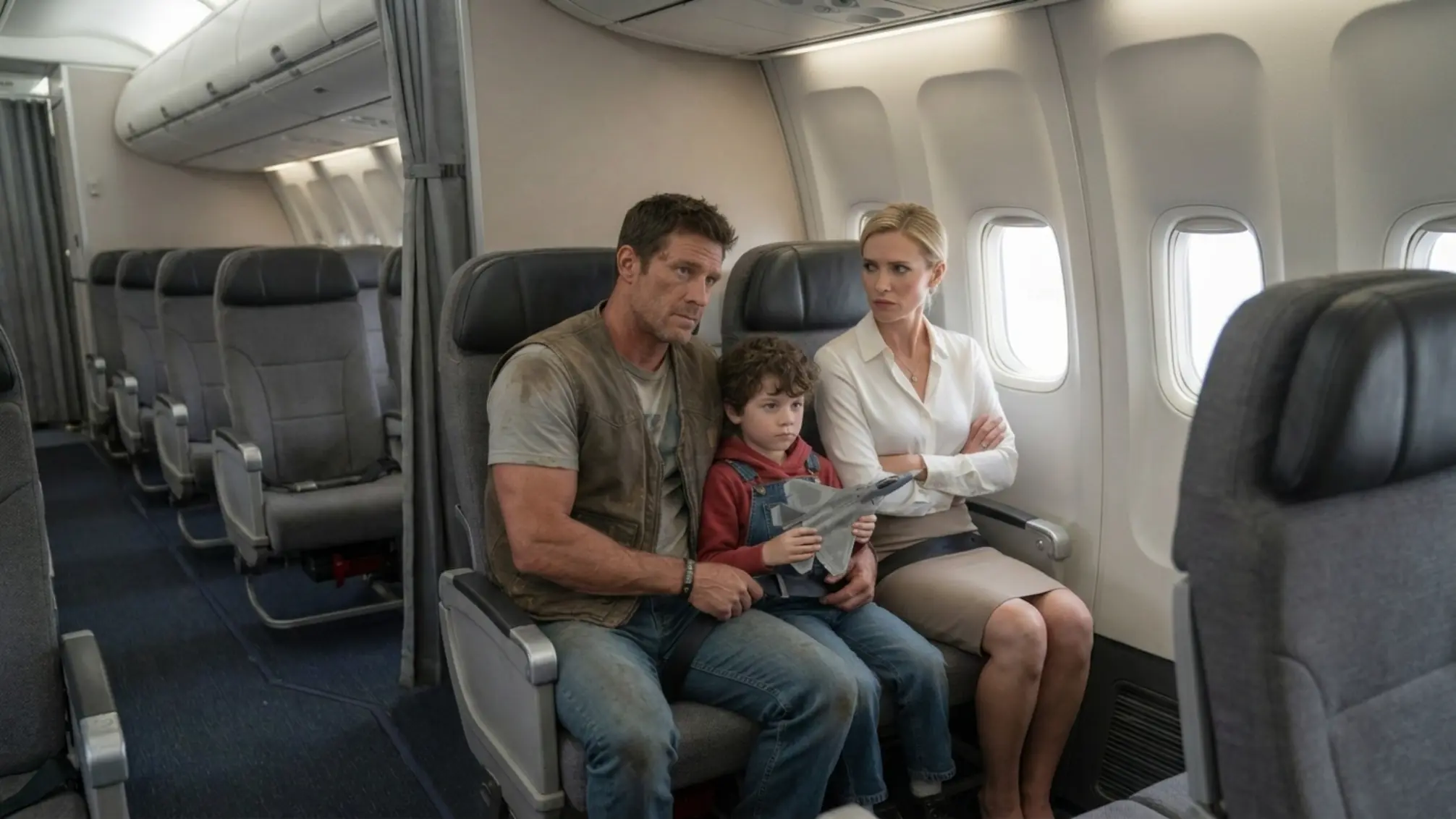
Ryan stared down at the toy in his lap. “My dad paid more for this country than you ever could.”
Harper’s expression hardened as though the child had damaged something expensive. She was a striking blonde executive in a fitted white blouse, beige pencil skirt, black heels, and enough understated jewelry to signal wealth without ever needing to mention it. Her company, Caldwell Aeronautics, supplied electronic components to several military aircraft programs, and she carried that fact like a private rank. She reached toward the flight-attendant call button with one manicured finger.
“I supply the Air Force,” Harper said. “One call, and security removes you both.”
Cole pulled his sleeve back just far enough to reveal the steel band around his wrist. Two engraved words caught the cabin light.
REAPER 6.
“Make that call,” he said quietly. “Then ask them what happens when Reaper 6 answers.”
Harper stared at the bracelet for half a second before giving a dismissive laugh. To her, it looked like another piece of military merchandise purchased by someone desperate to borrow importance. She pressed the call button anyway, then turned toward the window as though Cole and Ryan had already been removed. Cole covered the engraving again and returned his attention to his son.
The seats had come from a veteran’s courtesy upgrade, not money. Cole had spent most of the previous year working ten-hour shifts at Precision Auto outside Dallas, repairing transmissions, cooling systems, and engines for customers who rarely remembered his name after receiving their keys. His late wife, Captain Jessica Hayes, had once teased that he could hear a faulty turbine before an instrument panel noticed it. Now he used those instincts to identify worn bearings in minivans and loose belts in delivery trucks.
Ryan leaned closer to him. “Are we really supposed to be here?”
Cole felt the question like a blade between his ribs. His son was not asking about seat numbers or boarding passes; he was asking whether Harper’s judgment was correct. Cole had spent years teaching Ryan never to measure himself by other people’s cruelty, yet a few sentences from a stranger had undone that lesson. He placed one hand over the boy’s scratched fighter jet.
“We were invited into these seats,” Cole said. “That means we belong in them.”
The flight attendant arrived wearing a professional smile that weakened when Harper gestured toward Cole. Harper complained that the child’s toy was disruptive, that the father’s clothing was unsanitary, and that business-class passengers had paid for a certain standard. Ryan had not made a single airplane sound since boarding. Cole’s work vest was clean, despite the permanent stains embedded in its fabric.
The flight attendant hesitated. “Mr. Bennett, would you and your son be more comfortable in another row?”
“His assigned seat is here,” Cole replied.
Harper gave the woman a cold look. “I have a Pentagon procurement meeting this afternoon. I cannot arrive exhausted because someone decided to turn business class into a daycare.”
Ryan’s fingers tightened around his toy until his small knuckles turned white. Cole wanted to tell Harper that Jessica had helped develop electronic-warfare procedures now taught to active pilots. He wanted to tell her that every contract her company won depended on men and women willing to climb into machines designed to carry weapons through hostile skies. Instead, he looked at the flight attendant.
“My son will remain quiet,” Cole said. “We will remain in our seats.”
The attendant nodded, relieved to escape without making a decision, and moved toward the galley. Harper unfolded her tablet and began reviewing financial projections as though she had successfully disciplined an employee. Cole stared straight ahead while the aircraft doors closed. Beneath his sleeve, his thumb traced the edge of the steel band Jessica had given him the day he took command of his squadron.
The engines began to rise in pitch. Ryan looked toward the window, but Harper’s seat gave her the clearest view, so the boy leaned forward carefully without invading her space. The plane accelerated, pressed them into the leather seats, and lifted through the cloud cover. For one dangerous moment, Cole’s body remembered a cockpit instead of a passenger cabin.
He heard imaginary radio calls layered beneath the civilian engine noise. He felt the pressure of a flight helmet around his jaw and the familiar resistance of a control stick beneath his palm. Then Ryan slipped his hand into Cole’s, pulling him back into the present. Cole squeezed gently and forced his breathing to slow.
“Dad,” Ryan whispered, “do you think Mom can see us this high?”
Cole swallowed. “I think she can see you wherever you are.”
Harper glanced toward them before returning to her screen. Her company’s logo appeared on a document labeled ADVANCED AVIONICS PROCUREMENT STRATEGY, followed by columns representing millions of dollars. She spoke loudly into her wireless headset about delivery schedules, contract penalties, and unacceptable testing delays. Pilots were discussed as operational end users, never as human beings.
Ryan began moving his toy in a silent arc above his tray table. Harper stopped speaking and turned her icy blue eyes toward him.
“I already asked for quiet.”
“He wasn’t making any noise,” Cole said.
“He was waving it beside me.”
Ryan immediately lowered the jet. Harper resumed her call without apology, and Cole saw his son’s shoulders fold inward. Six years earlier, Cole had promised Jessica that their child would grow up knowing courage rather than shame. Yet every month of financial struggle seemed to teach Ryan the opposite lesson: worn clothes invited judgment, silence made insults easier, and dignity was something wealthy people believed they owned.
The captain announced that they had reached cruising altitude. Meal service began, and Harper received sparkling water in a glass while Cole’s coffee came in a paper cup with a plastic lid. The difference was not unusual, but after Harper’s attack, every small distinction felt deliberate. Ryan selected chicken from the menu only after Cole assured him the meal was included.
Halfway through lunch, the aircraft shuddered. It was brief enough that most passengers dismissed it as turbulence, but Cole stopped with his coffee halfway to his mouth. A second vibration followed, lower and more sustained. Somewhere beneath the ordinary engine noise, he heard an irregular hydraulic whine.
The captain’s voice returned, calm but tighter than before. “Ladies and gentlemen, as a precaution, we will be making an unscheduled landing at Fort Stockton Air Force Base. Please remain seated and follow all crew instructions.”
Harper’s tablet lowered. “An Air Force base?”
Cole looked toward the wing, studying its movement against the clouds. The aircraft began descending faster than a routine diversion required, and the flight attendants moved through the cabin with clipped efficiency. They were trying not to alarm anyone, which meant they had received information serious enough to frighten them.
Ryan pressed against Cole’s side. “Is the plane broken?”
“It has a problem,” Cole answered. “The pilots know what they’re doing.”
Harper clutched both armrests. Her earlier superiority had vanished beneath a sudden, unguarded fear. She demanded more information from a passing attendant, then tried calling an assistant despite being told to put away her phone. Cole said nothing to her, but he listened to the aircraft as carefully as he once listened to damaged fighters returning from combat.
The landing gear deployed with a heavy mechanical thud. The plane banked, corrected, then descended over the long military runway. When the wheels struck, the impact threw every passenger forward against their seat belts. Reverse thrust roared, brakes vibrated beneath the cabin, and the aircraft finally slowed.
Applause broke out from the economy section. Cole did not join it. He was watching the fire vehicles stationed near the runway and the maintenance trucks waiting before the plane had even stopped.
They were escorted into a sparse passenger terminal overlooking the flight line. Harper immediately claimed a seat near an electrical outlet and began calling her staff, demanding that alternative transportation be arranged. Cole sat on the floor beside Ryan near the windows, where the boy could watch distant aircraft without disturbing anyone. The scratched F-22 model returned to Ryan’s hands.
Outside, several real F-22 Raptors rested beneath the Texas sun. Their angular gray bodies looked almost unreal against the wide runway. Ground crews moved beneath them with practiced precision, checking panels, wheel assemblies, and weapon-bay doors. Cole could identify every inspection step without thinking.
Ryan’s eyes widened. “Dad, are those the planes you used to fix?”
Cole hesitated. He had never lied about being in the Air Force, but he had allowed Ryan to believe he had worked around aircraft rather than flown them. Speaking about his former life meant speaking about Jessica, and speaking about Jessica often meant returning to the final radio transmission he still heard in nightmares. He touched the steel band beneath his sleeve.
“I didn’t fix them,” Cole said. “I flew them.”
Ryan turned so quickly that his curls bounced. “You were a fighter pilot?”
Before Cole could answer, Harper’s voice rose behind them. She had cornered a young lieutenant who had entered to update the stranded passengers.
“I do not care about protocol,” she said. “My company supplies avionics for aircraft on this base, and I have a procurement meeting that affects your funding. Find me another plane.”
The lieutenant remained composed. “Ma’am, civilian transportation from this installation requires authorization.”
“Then call whoever gives authorization.”
Three pilots entered from the flight line, still wearing green flight suits. One was a gray-haired major, another a young captain, and the third a lieutenant colonel carrying a helmet beneath one arm. They moved toward the vending machines until the major’s eyes passed over Cole.
His gaze stopped.
Cole’s sleeve had ridden upward while he rested one hand on Ryan’s shoulder. The engraved steel band was visible. The major said something quietly to the other pilots, then walked directly across the terminal.
“Excuse me, sir,” the major said. “Is that your call sign, or are you wearing someone’s memorial band?”
The room fell silent. Harper stopped arguing with the lieutenant and turned around. Cole could feel every passenger watching the stained vest, the worn boots, the child’s battered toy, and the two words on his wrist.
“It’s mine,” Cole said. “Reaper 6.”
The major straightened as though an invisible command had passed through him. His hand rose in a crisp salute.
“Captain Bennett,” he said. “It’s an honor, sir.”
The young captain nearly dropped the bottle of water he had been holding. The lieutenant colonel stepped closer, staring at Cole with unmistakable recognition. Harper’s mouth opened, but no sound emerged.
Cole rose slowly. He had not returned a salute since leaving active duty, and doing so in civilian clothes felt like reaching into another man’s life. Yet his body remembered. He lifted his hand, fingers aligned, posture instinctively straight despite the weight of grief and years.
The major lowered his salute. “I qualified under Captain Jessica Hayes. She talked about Reaper 6 constantly.”
Cole’s face changed. “Jessica was my wife.”
Understanding moved through the pilots. The lieutenant colonel looked toward Ryan, then back to Cole. They knew the story, or enough of it: Captain Hayes dying during a training malfunction, Cole being medically grounded, one of the Air Force’s most gifted tactical pilots disappearing from service months later.
The young captain looked at Ryan’s toy. “Your father developed maneuvers we still study.”
Ryan stared up at Cole. “You really flew those?”
Cole nodded once. “A long time ago.”
The lieutenant colonel gestured toward the windows. “Captain Bennett, would you and your son like to see one up close? Our maintenance team is finishing checks on tail number 775.”
Cole’s chest tightened. He knew that number. He had brought that aircraft home from a deployment with damaged hydraulics, failing communications, and part of one wing shredded by debris. Jessica had remained on the radio throughout the landing, guiding him when warning systems screamed louder than thought.
Ryan grabbed his hand. “Please, Dad.”
They were escorted onto the flight line while the stranded passengers watched through the terminal glass. Harper followed as far as security allowed, her arms crossed tightly against her body. For the first time that day, she appeared uncertain of where she belonged.
Chief Master Sergeant Elena Martinez met them beside the F-22. Her expression was skeptical until she saw Cole’s face and the band on his wrist. Then she removed one glove and offered her hand.
“Reaper 6,” she said. “I was crew chief for this aircraft during your Syria deployment.”
Cole accepted the handshake. “You kept her alive.”
“You brought her home after everyone thought she was finished.”
Martinez crouched beside Ryan. “Would you like to see where your father sat?”
The boy’s face transformed. A maintenance ladder was rolled into place, and Cole guided Ryan upward with one hand behind his back. When the canopy opened above them, Ryan stared at the controls with reverence. His scratched toy looked impossibly small beside the real machine.
“You touched all this?” Ryan whispered.
“Every switch I was supposed to,” Cole said.
Ryan placed both hands near the control stick without touching it. “Was Mom here too?”
“Not in this jet,” Cole replied. “But she flew beside me more times than I can count.”
Harper watched from beyond the marked boundary. The company executive who had claimed ownership over the Air Force’s technology now stood outside a world where her contracts carried less weight than Cole’s sacrifice. Every person around the aircraft treated him with a respect money could not purchase. The stained vest she had mocked no longer looked like proof of failure; it looked like what remained after a man had traded status for survival and fatherhood.
Colonel Nathan Davis, commander of the F-22 squadron, arrived moments later. After speaking briefly with the lieutenant colonel, he approached Cole and offered his hand.
“Captain Bennett, our pilots train with scenarios you created,” Davis said. “The Reaper Roll prevented a fatal training loss here last year.”
Cole glanced toward the aircraft. “I developed it because standard recovery procedures failed under asymmetric hydraulic pressure.”
“That explanation is exactly why I want you in the ready room.”
Cole hesitated. “I’m not an officer anymore.”
Davis shook his head. “Your commission ended. Your experience did not.”
Inside the ready room, fifteen pilots rose when Cole entered. Ryan stood close beside him, holding his toy against his chest. The pilots had heard the name Reaper 6 in classrooms, mission briefings, and stories told by instructors who believed some standards were too valuable to disappear.
A female major stepped forward. “Sir, the maneuver you designed saved my life.”
She saluted him. One by one, the others followed until the entire room stood at attention.
Cole tried to speak, but his throat closed. For six years, he had believed leaving the Air Force erased everything he had contributed. He had confused survival with cowardice and poverty with proof that his most useful years were behind him.
Ryan tugged his hand. “Why are they saluting you?”
Cole looked down at him. “Because they remember something I forgot.”
Colonel Davis asked Cole to address the room. Cole stood before the pilots in his stained work vest and spoke without prepared remarks. He told them that courage did not end when the cockpit closed for the final time, and that some missions began only after a uniform was removed.
“I left because grief made me dangerous to myself,” Cole said. “I could not sleep, could not trust my judgment, and could not look at the sky without hearing my wife’s final transmission. I thought choosing my son instead of a desk assignment meant I had failed.”
Ryan watched him without moving.
“I repair cars now,” Cole continued. “Some months I barely cover rent, and some nights my son and I eat cereal because it is what we have. The world sees that and assumes I became less than I was. But raising him is the hardest mission I have ever accepted, and it is the only one I cannot afford to abandon.”
The ready room remained silent.
Colonel Davis stepped beside him. “Then let us give you another mission. We need civilian tactical consultants who understand the F-22 beyond simulation data. Part-time, flexible schedule, and enough compensation that your son will not have to wonder whether dinner is available.”
Cole looked at Ryan, who was staring at him as though discovering his father for the first time. The offer was not a return to flying, and nothing could restore the life he had shared with Jessica. But it was a path back toward purpose.
“Yes, sir,” Cole said. “I’m interested.”
When Cole and Ryan returned to the passenger terminal, Harper was waiting near the entrance. Her confident posture had collapsed into something smaller and more honest. She held neither her tablet nor her phone.
“Mr. Bennett,” she said, “I owe you and your son an apology.”
Cole stopped but did not rescue her from the silence.
“I judged you by your clothing and your income,” Harper continued. “Then I used my position to make a child feel unwelcome. What I did was cruel.”
Ryan moved closer to his father.
Harper looked at him. “Ryan, I was wrong. You had every right to sit in that seat and play with your jet.”
The boy studied her carefully. “You only believe that because the pilots saluted Dad.”
Harper flinched. Cole said nothing, allowing the truth to remain exactly where Ryan had placed it.
“You may be right,” Harper admitted. “That is the part I need to change.”
Cole finally spoke. “Respect that appears only after discovering someone’s rank is not respect. It is fear of consequences.”
“I understand.”
“No,” Cole said. “You understand what I used to be. The real test is how you treat the next mechanic, waiter, cleaner, or exhausted parent who cannot prove they were once important.”
Harper lowered her eyes. “Then I will start with the next person.”
The repaired aircraft was cleared before sunset. When they boarded again, no one questioned whether Cole and Ryan belonged in row 12. The flight attendant greeted Ryan warmly and asked about the F-22, while Harper settled into the window seat without opening her tablet.
During the final approach to Dallas, Ryan leaned against his father. “Were you scared when you flew those planes?”
“Every time.”
“But heroes aren’t supposed to be scared.”
Cole turned the scratched toy over in his hands. “Being brave does not mean fear disappears. It means someone is counting on you, so you move anyway.”
Ryan rested his head against Cole’s arm. “You still do that for me.”
The words broke through defenses that combat, grief, and poverty had failed to destroy. Cole wrapped one arm around his son and closed his eyes. For the first time since Jessica’s death, he allowed himself to believe that the man Ryan needed was not a damaged version of Reaper 6.
He was simply Cole Bennett.
Six months later, Cole stood in a briefing room at Fort Stockton, presenting an emergency-recovery scenario to a new group of pilots. The consultant position had paid enough for a safer apartment, reliable heating, and a bedroom where Ryan displayed the scratched F-22 beside a photograph of both his parents in flight suits. Cole still repaired cars three days a week, but he no longer felt invisible while holding a wrench.
Harper Caldwell kept her promise imperfectly but seriously. Her company introduced anonymous résumé screening, mandatory ethics reviews for military contracts, and a program that hired veterans based on operational knowledge rather than polished corporate credentials. She sent Cole one message explaining the changes and asking for nothing in return.
Cole replied with only one sentence.
“Make sure dignity is offered before identity is revealed.”
Then he deleted her number.
On a bright Saturday morning, Cole brought Ryan back to the base for an open-house event. The boy wore a new red hoodie but carried the same battered toy jet. When a formation of F-22s crossed overhead, Ryan raised the model toward them.
“Do you miss it?” he asked.
“Every day,” Cole answered.
“Would you leave me to fly again?”
Cole looked toward the disappearing aircraft and then at his son. Years earlier, the question would have torn him in half. Now the answer came without hesitation.
“No mission in that sky is more important than the one standing beside me.”
Ryan slipped his hand into Cole’s. Around them, pilots, mechanics, families, and visitors filled the runway with noise and movement. Cole’s steel wristband caught the sunlight, but he no longer needed to hide it or display it.
Reaper 6 was not proof that he deserved respect.
It was only one chapter of a larger life—the chapter before grief, before poverty, before a cruel woman in business class tried to decide his worth from the stains on his clothing. The title had once belonged to an elite fighter pilot who refused to leave anyone behind. Now it belonged just as fully to a single father who had learned that survival could also be an act of courage.
Ryan lifted his toy toward the sky again.
Cole smiled and lifted him onto his shoulders.
Together, they watched the fighters disappear beyond the clouds, carrying pieces of his knowledge into missions he would never fly. And for the first time, Cole did not feel abandoned on the ground. He understood that some men defended their country from a cockpit, while others protected its future by teaching, enduring, and raising a child who would never have to question whether he belonged.
The cost of seat 12F had never mattered.
The man sitting in it had already paid in ways Harper Caldwell could not see—and no amount of money could ever measure.