The first scream did not come from pain.
It came from the sound of porcelain exploding against black-and-white tile.
Mama Etta Thompson’s coffee cup hit the floor of Briar’s Diner at 10:17 on a Sunday morning, shattering beneath the fluorescent lights while seventy-two-year-old Etta stumbled sideways into the chrome edge of the counter. Her lavender Sunday coat pulled tight across one shoulder as she caught herself, and a room that had been filled seconds earlier with forks, conversation, and the smell of bacon suddenly went silent.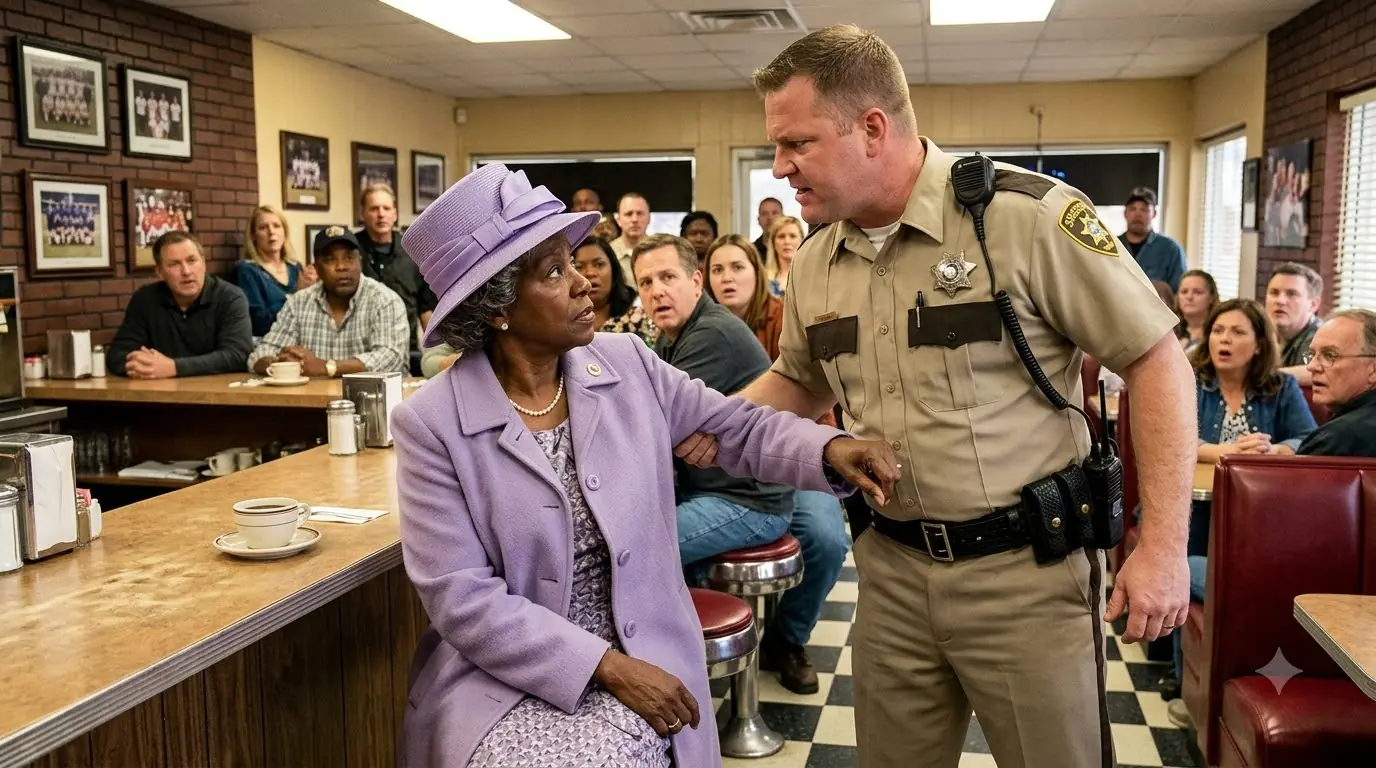
Deputy Carl Whitmore stood beside her.
His right hand was still half raised.
He was forty-two, broad through the shoulders, pale-skinned, with close-cropped blond hair and the heavy build of a man who had spent enough years wearing a badge that he no longer remembered what he looked like without one. His tan Oakwood County sheriff’s uniform was immaculate, his black duty belt polished, and his expression carried the irritated certainty of someone who believed explaining himself was a courtesy rather than an obligation.
“Sit somewhere else,” he said.
Mama Etta stared at him.
Coffee dripped from the counter.
A purple flower on her church hat had shifted sideways.
She did not answer.
Carl stepped closer.
“You heard me.”
The woman behind the register, Grace Bell, froze with a receipt in her hand.
Mama Etta’s usual stool sat at the far end of the counter, third from the window. She had sat there almost every Sunday since 1992, back when her husband Earl was still alive and their children complained about being dragged to breakfast after church.
Today, the diner was crowded.
A family waited near the door.
Two construction workers sat in a booth.
Three retirees drank coffee beneath a framed photograph of the old steel mill.
Nobody moved.
Carl pointed toward the back.
“There’s a table open.”
Mama Etta’s voice came softly.
“I’m already sitting here.”
“You were told this section is being cleared.”
Grace finally found her voice.
“No, she wasn’t.”
Carl turned.
Grace immediately regretted speaking.
The deputy stared at her.
“What?”
“I didn’t tell her that.”
Carl’s jaw moved.
“You told me you needed room.”
“For the church group coming at eleven.”
“It’s ten seventeen.”
Grace swallowed.
Mama Etta looked toward Carl.
“You heard her.”
Something changed in his face.
Not rage.
Something smaller.
More dangerous.
Humiliation.
Carl leaned closer.
“You trying to make me look stupid?”
Mama Etta’s tired eyes narrowed.
“No, baby.”
The word landed badly.
“I think you’re managing that on your own.”
A nervous laugh escaped from somewhere near the booths.
Carl heard it.
His hand closed around Mama Etta’s upper arm.
Grace gasped.
“Deputy—”
Mama Etta stiffened.
“Take your hand off me.”
“Move.”
“No.”
Carl pulled.
Mama Etta’s shoe slid against the tile.
The coffee cup tipped.
Then his palm shoved hard against her shoulder.
The cup fell.
Porcelain exploded.
Mama Etta staggered sideways.
A woman screamed.
Several people stood at once.
One man reached for his phone.
Carl looked around.
“What?”
Nobody answered.
Mama Etta straightened slowly.
The dignity in that movement would later be described differently by everyone who witnessed it.
Some said she looked furious.
Others said frightened.
Grace said she looked tired.
Mama Etta herself would later say she felt none of those things first.
What she felt first was recognition.
She had seen Carl’s expression before.
Not on him.
On another Whitmore.
Fifty years earlier.
That memory returned so clearly that for one terrible second she was twenty-two again, standing outside the Oakwood courthouse while a deputy with the same pale eyes told her father that a piece of paper mattered more than the house he had built with his own hands.
Carl stepped toward her.
“You want to make a scene?”
Mama Etta looked directly at him.
“No.”
She adjusted the lavender sleeve he had twisted.
“You already did.”
That time nobody laughed.
Several phones were recording now.
Carl saw them.
His expression changed instantly.
“Put the cameras away.”
A college student near the window shook his head.
“I’m not interfering.”
“You’re recording a law-enforcement interaction.”
“Yes.”
Carl moved toward him.
Mama Etta spoke.
“Leave that boy alone.”
Carl turned.
“You don’t tell me what to do.”
Mama Etta rested one trembling hand on the counter.
“No.”
Her voice became quieter.
“But someday somebody will.”
Carl stared at her.
For the first time that morning, something uncertain moved behind his eyes.
Then it disappeared.
He pointed toward the door.
“Go home, Etta.”
Grace whispered:
“She hasn’t paid.”
Mama Etta reached into her purse.
Carl laughed.
“Forget the pancakes.”
Mama Etta took out six dollars.
She placed the money on the counter beside the spilled coffee.
Then she looked at Carl.
“My name is Mrs. Thompson.”
The diner remained silent.
Carl said nothing.
Mama Etta turned.
She walked toward the door with her back straight.
Only after reaching the parking lot did her hands begin shaking.
By noon, everyone in the Thompson house knew.
The kitchen still smelled like scorched cornbread because Vanessa Thompson had forgotten it in the oven while watching the third video someone sent her.
Vanessa was forty-four, Mama Etta’s eldest daughter, a constitutional-law professor and civil-rights attorney who had spent most of her professional life dismantling other people’s certainty with documents, statutes, and patience. She had represented families after unlawful searches, challenged discriminatory zoning rules, and once spent thirteen hours questioning a county administrator without raising her voice.
None of that prepared her for seeing her mother shoved.
She played the video again.
Carl’s hand.
Mama Etta’s arm.
The cup.
The push.
The gasp from the room.
Vanessa paused it.
Her mother appeared mid-stumble.
“Turn it off,” Mama Etta said.
Vanessa looked up.
Mama Etta sat at the scarred oak table wearing a house dress now, the lavender coat folded carefully across the back of another chair. A faint red mark had appeared near her shoulder.
“Why?”
“Because I know what happened.”
“I need to see it.”
“You’ve seen it six times.”
“I need to understand the sequence.”
Mama Etta smiled sadly.
“You’re not in court.”
“Not yet.”
That answer came too quickly.
At the refrigerator stood Jamal Thompson, Mama Etta’s forty-year-old nephew who had served years overseas before joining the Illinois State Police and later becoming an instructor in use-of-force policy. He had arrived ten minutes after Vanessa called and had barely spoken since.
His jaw was tight.
Arms folded.
Eyes fixed on the frozen frame.
Vanessa pointed toward the screen.
“He grabs her before giving any lawful instruction that requires physical removal.”
Jamal answered.
“I know.”
“No arrest.”
“I know.”
“No immediate threat.”
“I know.”
“No attempt to de-escalate.”
“Vanessa.”
She looked at him.
“I know.”
The room fell quiet.
Across the kitchen, seventeen-year-old Aaliyah Thompson, Mama Etta’s granddaughter, paced near the sink.
“This is insane.”
Nobody answered.
“He’s done this before.”
Vanessa turned.
“What?”
Aaliyah stopped.
“He followed Grandma last month.”
Mama Etta looked sharply at her.
“Aaliyah.”
“What?”
Vanessa stared.
“What does she mean?”
Mama Etta folded her hands.
“Nothing.”
Aaliyah laughed bitterly.
“It wasn’t nothing.”
“Baby.”
“He followed her from the diner to the pharmacy.”
Vanessa’s face changed.
“When?”
“Three weeks ago.”
Mama Etta looked toward the window.
Vanessa moved closer.
“Why didn’t you tell me?”
“Because nothing happened.”
Aaliyah threw both hands upward.
“He pulled behind her and sat there with his lights on for like five minutes.”
Jamal unfolded his arms.
“Did he initiate a stop?”
Mama Etta shook her head.
“No.”
“Speak to you?”
“Yes.”
“What did he say?”
Mama Etta looked annoyed now.
“He asked what I was doing.”
“At a pharmacy?”
“In my car.”
Jamal’s mouth tightened.
Vanessa asked:
“What else?”
Mama Etta said nothing.
Aaliyah answered.
“Two Sundays before that, he knocked coffee near her shoes and told her she was slowing down the counter.”
Mama Etta sighed.
“That was foolishness.”
“It was intimidation,” Vanessa said.
Mama Etta looked at her daughter.
“Words matter.”
“Yes.”
“Then use the right ones.”
Vanessa stopped.
Mama Etta continued.
“You don’t know what he intended.”
“I know what he did.”
“That’s enough.”
Vanessa recognized the rebuke because it sounded like advice she herself gave clients.
Evidence first.
Conclusions later.
She sat down.
“What aren’t you telling us?”
Mama Etta’s eyes moved toward the hallway.
No one noticed at first.
Then Jamal did.
“Aunt Etta?”
She looked at him.
“You said something in the diner.”
“What?”
“Someday somebody will tell him what to do.”
Mama Etta’s fingers tightened.
Vanessa watched.
“You knew this was coming?”
“No.”
“You expected something.”
Mama Etta did not answer.
A small voice came from the breakfast bench.
Eight-year-old Tyler Thompson, Vanessa’s nephew, had been sitting there silently holding an old family photograph.
He whispered:
“That man grabbed her again.”
Vanessa turned.
Tyler’s eyes were wet.
“What do you mean again?”
Mama Etta closed her eyes.
“Baby, don’t.”
Tyler looked at her.
“He grabbed her outside.”
The room became still.
Jamal stepped forward.
“Outside where?”
“The diner.”
“When?”
“Last month.”
Mama Etta rubbed her forehead.
Tyler continued.
“He said she was too slow getting into the car.”
Vanessa’s voice became almost inaudible.
“You were there?”
Tyler nodded.
“He said, ‘Move before I move you.’”
No one spoke.
Mama Etta looked toward the photograph in Tyler’s hands.
It showed her at twenty-three wearing a church hat beside a tall Black man in a narrow tie.
Vanessa knew the photograph.
She had seen copies her entire life.
Mama Etta beside Isaiah Freeman.
Before he became Judge Freeman.
Before Oakwood became a place neither of them spoke about.
Aaliyah stopped pacing.
“That wasn’t about pancakes.”
Her voice was fierce.
“That wasn’t about a seat.”
Mama Etta looked at her.
Aaliyah pointed toward the laptop.
“He thought Grandma looked like somebody he could push.”
The truth sat heavily in the room.
Mama Etta finally spoke.
“I was sitting at that counter before Carl Whitmore was born.”
Vanessa leaned closer.
“Mama.”
Etta’s eyes moved toward the photograph.
“His father used to stand outside that same courthouse wearing the same kind of badge.”
Jamal frowned.
“His father?”
Mama Etta nodded.
“Bennett Whitmore.”
Vanessa knew the name vaguely.
Former sheriff.
Dead nearly fifteen years.
“What does that have to do with Carl?”
Mama Etta’s answer never came.
Tires crunched across gravel outside.
Not one car.
A heavy vehicle.
Jamal moved toward the window.
A black government SUV stopped beside the mailbox.
A second followed.
Doors opened.
Two men in dark suits stepped out first.
Then an older Black man.
Tall despite his age.
Silver hair cut short.
Charcoal suit.
Walking cane in his left hand.
Vanessa stopped breathing.
“No.”
Mama Etta did not look surprised.
The knock came.
Three deliberate strikes.
Jamal started toward the door.
Mama Etta raised one hand.
He stopped.
She stood slowly.
Every person in the kitchen watched her.