The first window broke with a sound Maya Williams would remember more clearly than the deputy's face.
It was not the sharp pop she expected. The laminated glass bowed inward, whitened in a web around the head of the baton, and then collapsed across the cream leather passenger seat in thousands of small glittering pieces. For half a second, even Travis Mercer seemed surprised by how final the sound was.
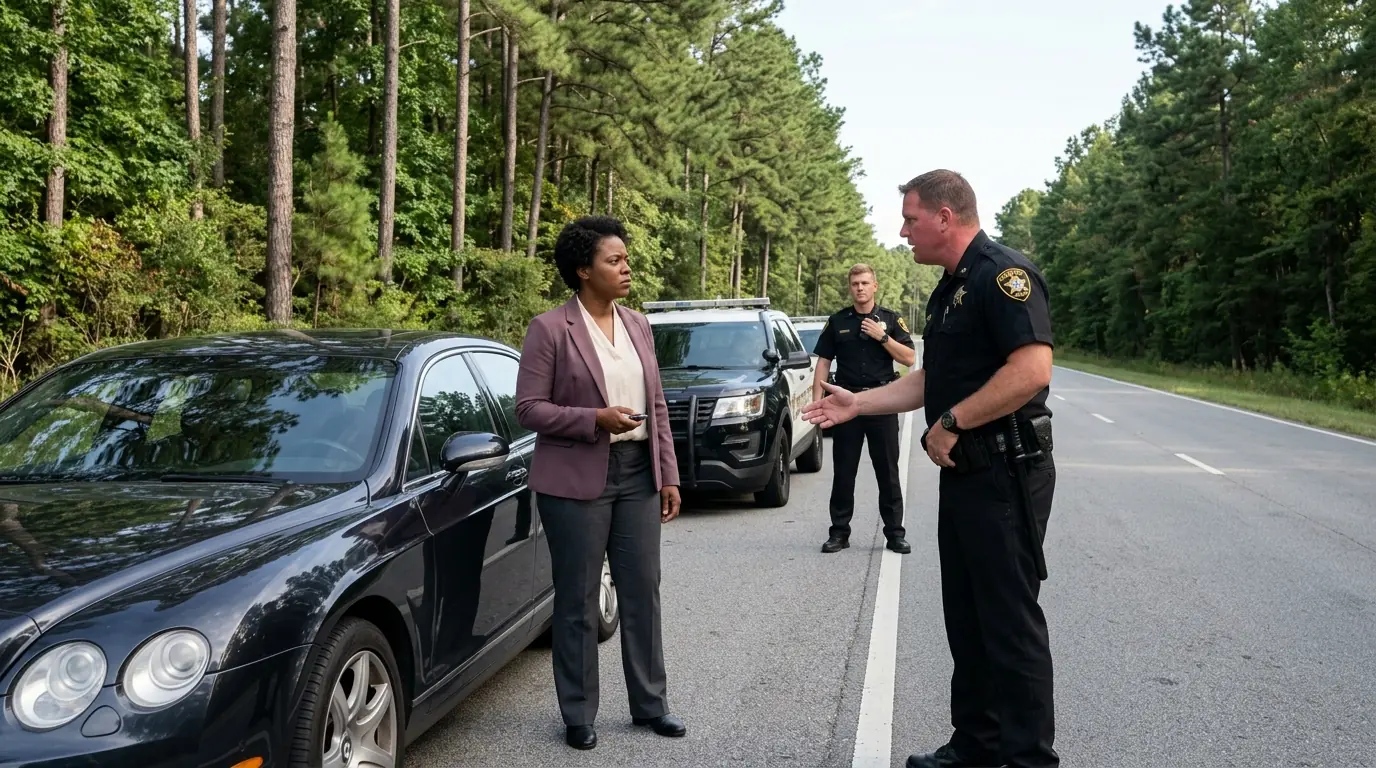
Maya stood on the shoulder with both hands visible at her sides. The evening light had begun to thin over Carver County, turning the fields beyond the road a washed-out green. Her black Bentley sat ten feet away, its driver's door locked, its engine off, its registration already confirmed. Deputy Noah Bennett, who had arrived in a second patrol vehicle only minutes earlier, stood near the rear quarter panel with the expression of a man who had just realized he was watching a routine stop become something he might someday have to explain under oath.
Mercer lifted the baton again.
"Deputy," Maya said, "the registration is clean. Your partner just confirmed it."
Mercer struck the second window.
The sound carried farther this time. Somewhere across the road, a dog started barking. Maya did not move toward the car. She did not touch Mercer. She did not raise her voice. She simply watched him break another window, then another, as if the act of refusing a search had somehow transformed the glass itself into evidence against her.
"Open the car," Mercer had told her less than two minutes earlier. "Hand over the key."
Maya had pressed the remote, locked every door, and slipped the key into her coat pocket.
"You don't have a warrant," she had said. "I don't consent to a search."
That had been the moment his posture changed.
The stop itself had begun almost ordinarily. Mercer had been sitting in a marked unit near a county road that curved toward the courthouse square when the Bentley passed. He ran the plate. The system did not return a stolen-vehicle alert, an insurance cancellation, or an active warrant. It returned an administrative delay, the kind that often appeared when databases were slow to synchronize. Mercer treated the delay as reason enough to stop the car while he waited for the record to clear.
Maya pulled over immediately.
She had spent years around county systems and knew better than to make a roadside encounter harder simply because she believed it should not have happened. When Mercer approached, she lowered the window, kept her hands visible, and supplied her license, registration, and proof of insurance. The Bentley was registered to her. The address matched. The insurance was current. Nothing in the vehicle identification returned as stolen or altered.
Mercer still asked where she was going.
"Into Carver County," Maya answered.
"For what?"
"Work."
"What kind of work?"
"County administration."
He looked at the Bentley again, then at her. "County administration pays better than I thought."
Maya let the remark pass.