“Those tips belong to the house,” Assistant Manager Lisa Rodriguez said, sliding three folded bills from the waitress’s apron into her own pocket. “Touch them again and you’re fired.”
Jennifer Martinez tightened both hands around the glass coffee pot. “You’ve already taken half my pay this week.”
“Call it company policy, or I’ll report you for stealing.”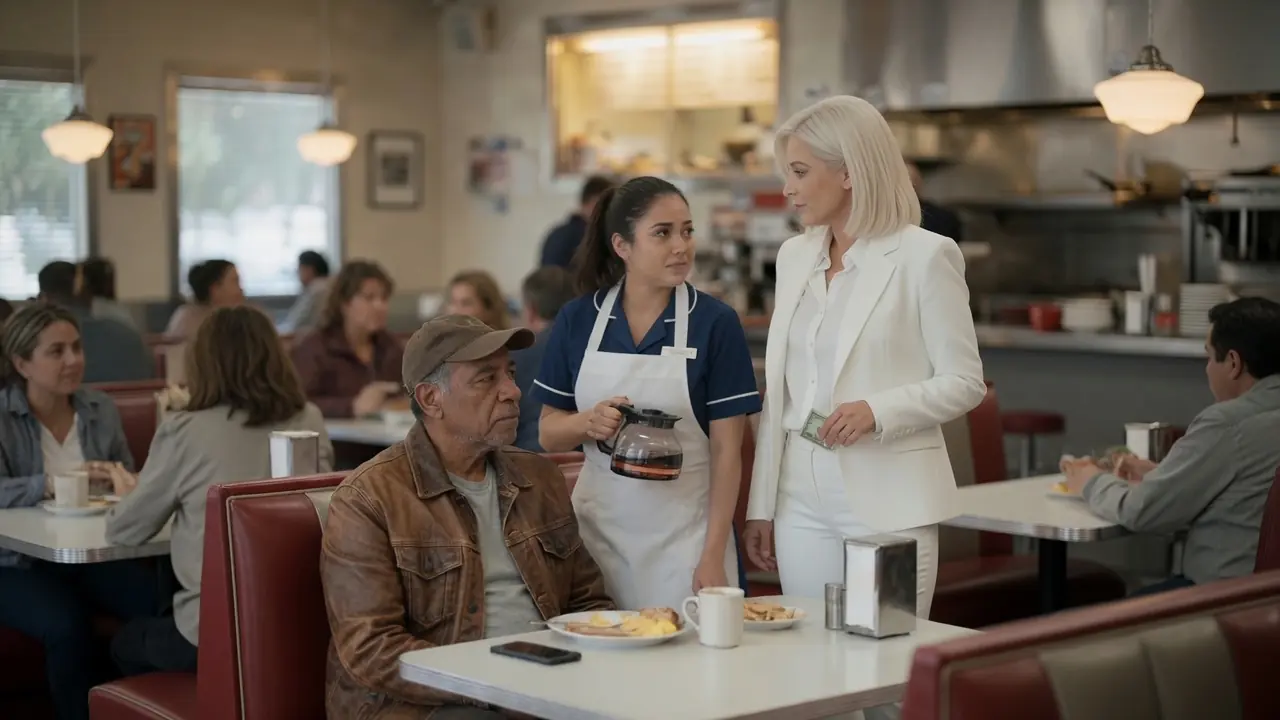
From the red vinyl booth beside them, the quiet Black customer raised his eyes from an unfinished plate of eggs. “I’ve eaten in this diner for forty minutes, and the only thief I’ve seen is wearing a manager’s badge.”
Lisa turned toward him, her face hardening. “Mind your filthy business—customers like you don’t interfere with management.”
Kevin Washington lowered his coffee cup without answering. He wore a faded gray cap, rectangular glasses, a worn denim jacket, and scuffed sneakers that made him look like a delivery driver stopping for breakfast between shifts. His phone rested faceup beside his plate, recording every word spoken near the booth. Lisa never noticed the small red light reflected in the metal napkin holder.
The diner occupied a busy corner near downtown Atlanta, where construction crews, nurses, office workers, and delivery drivers filled the booths before eight each morning. Sterling Diner Group had owned the location for eleven years, and on paper it was one of the chain’s most profitable restaurants. Sales were strong, labor costs appeared unusually low, and customer complaints rarely reached corporate headquarters. Those numbers had once impressed Kevin.
Now they frightened him.
Three months earlier, an unsigned envelope arrived at his office containing photocopied time sheets, handwritten tip totals, and a note made from words cut out of printed receipts. The message claimed managers at several Atlanta locations were stealing cash tips, changing employee hours, and threatening anyone who complained. It also warned that corporate inspections were useless because managers always received advance notice.
Kevin asked the legal department to identify the sender.
The note contained no fingerprints, return address, or identifying handwriting. Every document had been copied from records available to dozens of employees. The only clue was a grease stain shaped like the edge of a coffee cup.
The compliance department reviewed the Atlanta branch remotely and found nothing unusual. Payroll totals matched the reports submitted by management, cash deposits balanced, and employee turnover remained within the chain’s average. Lisa’s supervisor, District Operations Director Paul Hensley, described her as strict but effective. He also assured Kevin that complaints about missing tips usually came from careless employees who could not remember what customers had left.
Kevin did not believe him.
He had inherited the first Sterling Diner from his mother, Ruth Washington, who opened it with twelve tables and a kitchen barely large enough for two cooks. Ruth had spent thirty years warning him that numbers could be made obedient while people could not. Whenever a restaurant’s records looked perfect but its employees looked afraid, she said, the truth was hiding somewhere outside the spreadsheets.
Kevin decided to visit without announcing himself.
He left his company car at home, borrowed an old pickup from the maintenance department, and entered the diner shortly after seven wearing clothes no employee at corporate had ever seen. Only three people knew about the visit: the company’s payroll director, an independent auditor, and attorney Camille Brooks. They waited in a van behind the diner with access to the restaurant’s live accounting system.
Jennifer served Kevin first.
She was twenty-four, with tired brown eyes, black hair tied into a high ponytail, and a pale pink uniform that had been repaired near one sleeve. She moved quickly between five tables, refilling coffee before customers asked and remembering which man wanted hot sauce without writing it down. When an elderly customer struggled to cut his toast, Jennifer quietly brought him a softer piece without adding it to the bill.
Kevin left a twenty-dollar tip beneath his coffee cup.
Jennifer saw it, smiled with visible relief, and slipped it into the small pouch attached to her apron. Less than ten minutes later, Lisa called her toward the register. She demanded the cash, claiming Jennifer had failed to sell enough premium breakfast combinations during the previous shift.
“There’s no policy like that,” Jennifer whispered.
“There is now.”
Lisa took the money.
Kevin messaged the payroll director from beneath the table.
Did corporate authorize tip penalties?
The answer arrived immediately.
Never. Managers are prohibited from touching employee tips.
Kevin ordered another coffee and continued watching.
Lisa collected money from two other servers before eight o’clock. She called one deduction a uniform fee and another a customer-recovery penalty, though no customer had complained. Each time, she placed the cash inside her blazer pocket instead of entering it into the register.
Jennifer tried to object after Lisa took the third set of bills.
That was when Lisa threatened to report her for stealing.
Kevin spoke.
Lisa insulted him without hesitation.
For several seconds, the diner became unusually quiet. Nearby customers stopped eating, and one cook looked through the service window before quickly lowering his head. Jennifer stared at Kevin with a silent plea not to make the situation worse.
Lisa pointed toward the entrance. “Finish your coffee and leave.”
Kevin stood.
The assistant manager smiled, believing she had intimidated him. “Good choice.”
Instead of walking toward the door, Kevin removed his cap and placed it beside the plate. He reached inside his denim jacket and took out a black identification wallet embossed with the silver Sterling Diner Group emblem. Then he laid it beside the phone that had recorded her threats.
Lisa looked at the badge but did not understand it immediately.
“Get that junk off my table,” she said.
Kevin opened the wallet.
His corporate photograph appeared beside his full name and title.
KEVIN WASHINGTON — CHIEF EXECUTIVE OFFICER AND MAJORITY OWNER.
Lisa’s expression emptied.
She looked from the identification to Kevin’s face, searching for differences between the quiet customer and the man whose photograph appeared in every annual report. Without the cap, the resemblance was undeniable.
“You’re…” she began.
Kevin turned the phone toward her. “Kevin Washington—owner of every diner carrying this name.”
Lisa’s fingers tightened around the stolen bills still visible in her hand.
“You’re the owner?”
Kevin looked toward the kitchen entrance. “Seal the office. She just confessed in front of forty witnesses.”
Camille Brooks entered first, followed by Payroll Director Denise Parker and two independent auditors carrying locked equipment cases. A corporate security specialist came through the rear hallway and disconnected the office computer from the network before anyone could delete records. Denise activated a remote hold that prevented changes to every employee time sheet, payroll file, and cash report connected to the branch.
Lisa remained beside Kevin’s booth, unable to move.
“This is a misunderstanding,” she said. “I was enforcing branch policy.”
Kevin faced Jennifer. “Has any corporate officer ever explained this policy to you?”
Jennifer shook her head.
Lisa interrupted. “She’s lying because she’s angry about being disciplined.”
Kevin picked up his phone. “You explained it clearly enough on the recording.”
“I didn’t consent to being recorded.”
“You made the statement in a crowded dining room beside twenty customers.”
“This is private company business.”
“You called it private after taking an employee’s money in public.”
Lisa looked toward the office.
Kevin noticed.
“What are you worried we’ll find in there?”
“Nothing.”
“Good. That should make the audit quick.”
She rushed toward the hallway.
The security specialist stepped between her and the office door.
“Move,” Lisa ordered. “I’m the acting manager.”
Kevin answered from behind her. “You were.”
Lisa turned slowly.
“You cannot fire me without an investigation.”
“I can suspend your access while one occurs.”
“I have rights.”
“So does every employee whose wages you touched.”
Kevin asked Lisa to surrender her keys, company phone, and management badge. She placed them on the counter with trembling hands, then reached into her blazer pocket and removed the cash she had taken from Jennifer. Seventy-three dollars landed beside the register.
Jennifer stared at the bills.
“That isn’t all of it,” she said.
Lisa’s eyes snapped toward her. “Be careful.”
Kevin stepped between them. “No more threats.”
Jennifer’s voice shook, but she continued. “She has been taking our tips for nine months. Sometimes she keeps cash. Sometimes she makes us put it in a black envelope in the office.”
“For what purpose?” Denise asked.
“She calls it the performance fund.”
“Have you seen any written policy?”
“No.”
Lisa laughed sharply. “Of course she hasn’t. She’s a waitress, not management.”
Kevin looked at her. “That sentence may explain more than you intended.”
The auditors entered the office with a camera running. Inside the bottom drawer of Lisa’s desk, they found twenty-two black envelopes labeled with employee names and dates. Each contained handwritten amounts, warnings, and descriptions such as late greeting, low upsell, customer attitude, and uniform appearance.
None of those deductions appeared on payroll records.
A locked filing cabinet held a second set of time sheets. The official payroll system showed employees leaving at the scheduled end of their shifts, but the paper sheets recorded how long they actually remained to clean, count inventory, and prepare the restaurant for the next morning. Jennifer had worked thirty-seven unpaid hours during the previous two months.
Other employees had lost even more.
Lisa claimed she maintained the records for scheduling research.
Denise opened another folder.
Inside were photocopies of signed disciplinary notices that employees said they had never seen. Several documents stated that servers voluntarily surrendered tips to cover shortages. Jennifer’s signature appeared on four forms.
“That isn’t mine,” Jennifer said.
Lisa crossed her arms. “You signed them.”
“I never saw those papers.”
Kevin examined the signatures. They resembled Jennifer’s handwriting but repeated the exact same curve and spacing each time, suggesting they had been copied from one original document.
Camille placed each page inside an evidence sleeve.
“This has moved beyond an internal policy violation,” she said.
Lisa’s face hardened. “You are all letting one emotional waitress destroy a profitable branch.”
Kevin looked around the diner.
The cooks had stopped working. Servers stood near the kitchen entrance, some still holding plates. Every one of them appeared to be waiting for permission to speak.
Kevin addressed them.
“Nobody will lose a shift, reference, or benefit for giving truthful information today. Anyone who destroys evidence or lies during the audit will be treated differently.”
A dishwasher raised his hand.
His name was Samuel Green. He had worked at the branch for three years and rarely spoke during staff meetings because Lisa mocked his stutter.
“She changes our clock-out times,” he said slowly. “If we stay until eleven, she enters ten thirty.”
A cook named Rosa Delgado stepped forward next.
“Paul Hensley taught her how.”
Lisa turned toward Rosa. “You have no idea what you’re saying.”
Rosa ignored her. “He visits on Mondays. They count the envelopes after closing.”
The district director’s name changed the atmosphere.
Paul Hensley supervised twelve restaurants and approved every manager’s payroll report. If he participated, the theft extended far beyond one branch.
Kevin sent Camille a message.
Do not contact Paul. Freeze all district systems first.
Camille nodded and stepped away.
Within minutes, corporate security locked Paul out of payroll, scheduling, and financial platforms across the Atlanta region. Investigators began copying records before he could understand what had happened.
At 8:41, Paul called Lisa’s company phone.
It lay on the counter beside Kevin.
The screen displayed his name.
Kevin answered but did not speak.
Paul’s voice came through immediately. “Did you get the envelopes out before Washington’s surprise team arrives?”
Kevin looked at Lisa.
She closed her eyes.
Paul continued. “Lisa? I said move everything. He’s sniffing around tip complaints again.”
Kevin activated the speaker.
Every employee nearby heard the next sentence.
“If the Martinez girl talks, use the cash in her locker and fire her for theft.”
Jennifer’s face went pale.
Kevin spoke.
“Good morning, Paul.”
Silence filled the line.
“Who is this?”
“The man sniffing around.”
The call ended.
Corporate security reached Paul’s office fifteen minutes later. He had already left the building, but access logs showed him attempting to erase files remotely from his car. Because Kevin had ordered the system frozen first, every deletion request was preserved as evidence.
Investigators found Paul at another Sterling Diner location, removing a laptop from the trunk of his vehicle.
The device contained a spreadsheet covering eleven restaurants.
It listed tip collections, reduced labor hours, cash shortages, and monthly payments distributed between Paul and selected managers. Servers who complained were marked with a red symbol. Some had been fired for alleged theft after managers planted cash in their lockers or registers.
Jennifer’s name appeared near the top.
Beside it, Paul had written:
Persistent. Financially vulnerable. Remove after replacement is trained.
Kevin read the line twice.
He returned to the dining room, where Jennifer sat alone in his former booth with the coffee pot beside her. She had stopped crying but still held a napkin tightly in one hand.
“They planned to fire me?” she asked.
“Yes.”
“Because I asked about my tips?”
“Because they believed you had no protection.”
She looked toward Lisa, who waited under supervision near the counter. “I sent the letter.”
Kevin sat across from her.
“The anonymous envelope?”
Jennifer nodded. “I copied everything during closing shifts. I thought corporate would ignore me if I used my name.”
“Why?”
“Lisa said Paul had friends at headquarters.”
Kevin could not tell her that part of that fear was justified. Several corporate inspectors had visited the branch and failed to notice anything because Paul controlled the schedules and documents they reviewed. The company’s system had been designed to catch careless misconduct, not organized theft protected by management.
“You forced me to look closer,” Kevin said.
“I almost didn’t send it.”
“What changed your mind?”
Jennifer glanced toward Samuel and Rosa. “Lisa took money from a sixteen-year-old busser. He was saving for his mother’s medication. She told him children did not deserve tips.”
Kevin felt his anger sharpen.
“How much did she take from you?”
“I don’t know anymore.”
“Try.”
Jennifer opened the notes app on her phone.
She had recorded every stolen tip, altered shift, unpaid cleaning hour, and unexplained deduction for nine months. Her total exceeded five thousand dollars. Combined with the other employees, the single branch had taken nearly sixty thousand.
Across eleven restaurants, the amount approached nine hundred thousand dollars.
The scheme became profitable because it operated in small pieces. Five dollars disappeared from one server, twenty minutes vanished from another cook, and thirty dollars was labeled a shortage at the end of a shift. Each loss looked too small to justify hiring an attorney or risking unemployment.
Together, those losses paid Paul’s mortgage, funded Lisa’s vacations, and inflated the performance bonuses they received for keeping labor expenses below corporate targets.
Kevin realized his own compensation system had helped create the crime.
Managers earned bonuses when labor percentages fell, but the company had not required independent verification that those savings were legitimate. Paul discovered he could steal unpaid time, report lower costs, and receive additional rewards from headquarters.
At an emergency board meeting that afternoon, several executives advised Kevin to describe the event as isolated misconduct.
He refused.
“It was not isolated,” he said. “Our bonus structure paid them for making wages disappear.”
One director warned that public disclosure could trigger lawsuits.
“The employees already have claims.”
“Admitting fault will strengthen them.”
“Hiding fault will prove we learned nothing.”
Kevin authorized a complete review of every Sterling Diner location in five states. The company suspended Paul, Lisa, and six other managers while outside investigators examined payroll and tip records. Employees received written guarantees against retaliation and direct access to independent counsel paid for by the company.
The audit lasted fourteen weeks.
It uncovered wage theft at seventeen locations, though the methods differed. Some managers altered time sheets. Others forced servers to surrender tips for broken dishes, walkouts, or customer complaints. One branch charged employees a cash fee for uniforms that corporate supplied free.
Not every manager participated.
Several had followed company rules and maintained accurate records despite pressure to reduce labor costs. Kevin publicly recognized them, not because honesty deserved a special prize but because their records proved the theft was a choice rather than an unavoidable feature of the business.
Lisa continued denying responsibility until investigators opened her personal bank records under a court order. Deposits matched the amounts recorded in the black envelopes. Text messages showed her and Paul joking about “breakfast taxes” collected from servers.
One message concerned Jennifer.
She smiles too much for someone that broke. Take another fifty and see how long it lasts.
During her formal interview, Lisa insisted the employees had voluntarily contributed money.
Camille placed the diner recording on the table.
Lisa’s own voice filled the room.
Those tips belong to the house—touch them again and you’re fired.
The interview ended shortly afterward.
Paul attempted to blame Lisa, claiming she created the system without his knowledge. His phone records, spreadsheet, and recorded call proved otherwise. Prosecutors charged both of them with wage theft, forgery, conspiracy, evidence tampering, and fraud.
Several former employees returned to testify.
One woman described being fired after questioning why her paycheck contained only twenty-three hours when she had worked forty-one. A former cook explained that Paul threatened to report him to immigration authorities even though he was a lawful permanent resident. Another server admitted she had considered sleeping in her car after stolen wages left her unable to pay rent.
Jennifer testified last.
Lisa’s attorney asked why she continued working if the conditions were so terrible.
“I needed the job,” Jennifer answered.
“So you accepted the rules?”
“Needing breakfast does not mean you agree to be poisoned.”
The courtroom became silent.
Both defendants were convicted on the major charges.
Sterling Diner Group repaid employees with interest and additional compensation for lost benefits, late fees, housing problems, and other harm caused by missing wages. Kevin refused to require confidentiality agreements.
He also changed the company’s bonus system.
Managers could no longer earn rewards based only on low labor costs. Bonuses now depended on verified payroll accuracy, employee retention, customer satisfaction, food safety, and independent staff interviews. Tip deductions were prohibited without exception, and every employee could view time-sheet changes through a personal account.
Any manager editing a clock-out time had to provide a reason visible to both the employee and corporate payroll.
Surprise inspections became truly unannounced.
Regional directors no longer controlled which employees auditors interviewed. Instead, inspectors selected workers randomly and contacted former employees as well as current staff.
Kevin returned to the Atlanta diner six months later.
This time he wore a tailored navy suit and arrived through the front entrance without disguise. The red booths had been repaired, the office windows had been replaced with clear glass, and a digital screen near the time clock displayed every employee’s confirmed hours.
Jennifer still worked there.
She had declined an immediate management promotion because she wanted training before supervising others. Kevin respected the decision and funded her enrollment in a hospitality leadership program. She now served as an elected employee representative, with authority to review payroll complaints across the Atlanta district.
When Kevin entered, she poured him coffee.
“No recording phone today?” she asked.
He placed the device faceup on the table.
“Old habit.”
Jennifer smiled. “You still take your eggs the same way?”
“I do.”
She looked toward the counter where new manager Rosa Delgado helped a busser count his tips. No money disappeared into a blazer pocket. No employee lowered their voice when management approached.
Kevin left twenty dollars beneath his cup.
Jennifer picked it up and held it toward him. “You know I’m checking whether this is another test.”
“It is.”
“What am I supposed to prove?”
“That you know what belongs to you.”
Jennifer folded the bill and placed it inside her apron.
Around them, the breakfast rush continued. Plates moved through the service window, coffee filled white mugs, and customers complained about ordinary things like cold toast and missing syrup.
The diner had not become perfect.
It had become accountable.
Months earlier, Lisa had looked at Kevin’s faded clothes and assumed he was powerless. She believed his concern could be dismissed because he appeared to be an ordinary customer interfering in management business.
She was wrong about who he was.
But Kevin understood that her greater mistake was believing ordinary customers and workers deserved less respect in the first place.
Lisa did not lose her job because she insulted a hidden CEO.
She lost it because she stole from people she believed would never be heard.
Jennifer’s anonymous letter changed the company before Kevin’s executive badge ever touched the table. Samuel’s testimony, Rosa’s warning, and the records kept by frightened employees exposed the system behind the theft.
Kevin revealed his title in one breakfast.
The workers revealed everything else.
And long after Lisa’s office was sealed and Paul’s spreadsheet became courtroom evidence, the sentence remembered throughout Sterling Diner Group did not belong to the corrupt manager.
It belonged to the quiet customer who rose from a red vinyl booth, placed his badge beside a recording phone, and reminded every manager watching what ownership truly meant:
“Your floor? I own the chain—but those tips belong to her.”