The rain had been falling for three days straight, turning the narrow streets of Baltimore into muddy rivers.
Inside a small brick house at the end of the block, an elderly retired doctor and his wife were about to close their modest home clinic for the night until three desperate knocks echoed through the storm.
On their doorstep stood a soaked young mother, clutching her feverish daughter and begging for help.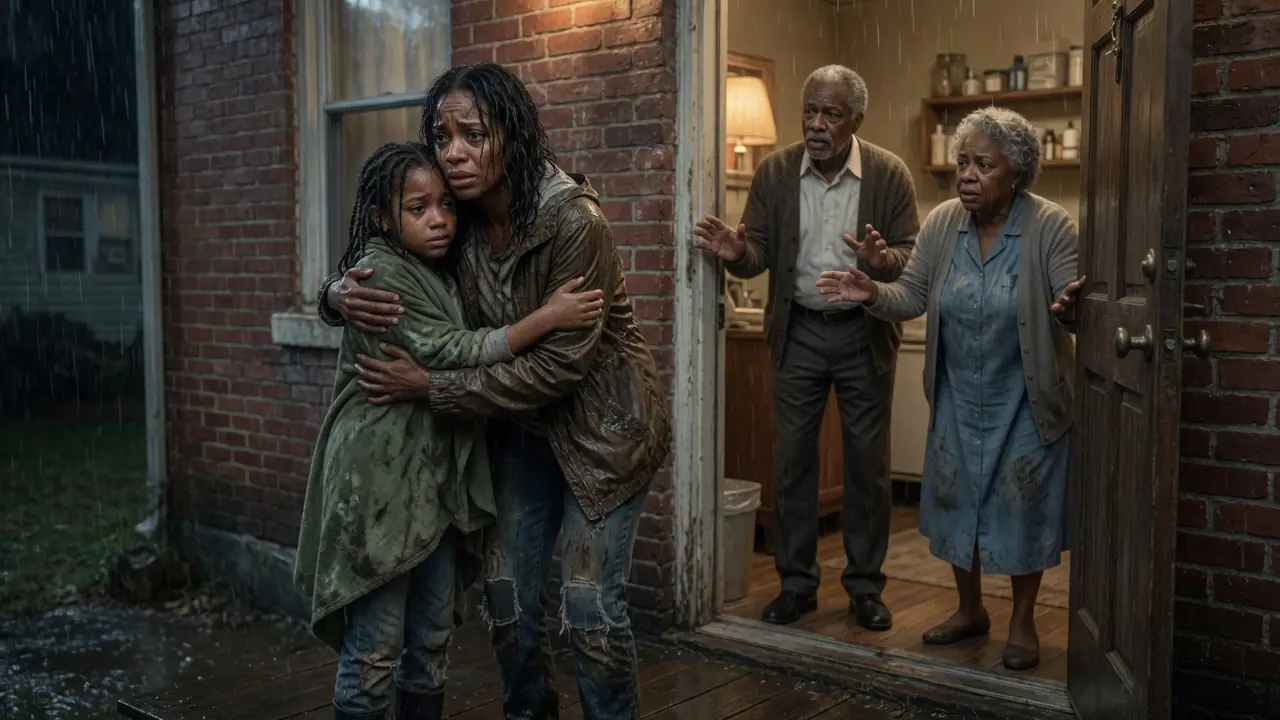
Without hesitation, they brought the two inside and treated them for free.
But what happened next would change their lives forever.
The rain had been falling for three days straight in Baltimore, turning the narrow streets of West End into rivers of forgotten dreams. At the end of Maple Street stood a weathered brick house, its paint peeling like old skin, but its windows glowing warm against the winter darkness.
A hand-painted wooden sign hung crooked by the front door.
Lewis Home Clinic.
Inside, Dr. Samuel Lewis moved with the practiced ease of a man who had spent forty years healing bodies. At sixty-eight, his hands showed the tremor of age, but they were still steady enough to wrap Mrs. Henderson’s sprained ankle.
His dark skin held deep laugh lines around his eyes, and his salt-and-pepper hair crowned a face that had seen both the best and worst of humanity.
“Now you keep that elevated for three days, Mrs. Henderson,” Samuel said, his voice carrying the warm gravel of a thousand patient conversations. “And no dancing at your grandson’s wedding next week.”
Mrs. Henderson, a rail-thin woman in her seventies, laughed.
“Doc, I ain’t danced since 1987, but I appreciate you pretending I might.”
Martha Lewis emerged from the kitchen carrying a small paper bag. At sixty-three, she moved slower than she used to, her joints protesting each step with the sharp whisper of arthritis. But her smile remained as bright as the day Samuel had met her in nursing school forty-two years ago.
“Here’s some aspirin,” Martha said, pressing the bag into Mrs. Henderson’s weathered hands. “On the house.”
“Martha, you can’t keep—”
“We can, and we will.” Martha’s tone was gentle but firm, the voice of a woman who had nursed thousands and argued with none. “You just get better.”
After Mrs. Henderson left, shuffling into the rain under a borrowed umbrella, Samuel locked the front door and turned off the clinic light. The living room that doubled as their waiting area looked tired in the dim glow from the kitchen.
Mismatched chairs. Outdated magazines. A blood pressure cuff draped over a coat rack like a strange decoration.
“Another day, another zero,” Samuel said.
But there was no bitterness in his voice, only the acceptance of a man who had made peace with his choices.
Martha was already at the stove stirring a pot of soup that smelled of chicken and thyme.
“We have enough,” she said. “We’ve always had enough.”
They ate dinner at the small kitchen table, the same ritual they had performed for decades. The house creaked around them, old bones settling. Outside, the rain drummed a steady rhythm on the roof.
“I saw Mr. Chen today,” Martha said, breaking the comfortable silence. “His diabetes is getting worse. He needs insulin, but he can’t afford it.”
Samuel nodded slowly, his soup spoon pausing halfway to his mouth.
“I’ll call Dr. Patterson tomorrow. See if he has any samples.”
“You’re a good man, Sam.”
“I’m an old man who can’t fix what’s broken.”
Martha reached across the table and took his hand. Her fingers, twisted slightly by arthritis, squeezed his with surprising strength.
“You fix what you can. That’s enough.”
But was it?
Samuel wondered, not for the first time.
They had no children. Martha could not conceive, and he had always felt it was somehow his fault, though doctors said otherwise. No legacy except the people they had helped, whose names they would forget and who would forget theirs.
Just two old people in a dying neighborhood, playing doctor in a house that should have been condemned years ago.
“We’re getting old, Martha.”
“Yes, we are.” She smiled, but there was sadness in it. “But we’re getting old together. That’s more than most people get.”
They finished their meal in silence, washing dishes side by side as they had done ten thousand times before. The routine was comforting, familiar as breath.
Martha dried while Samuel washed, and when they were done, they moved to the living room, where their two worn recliners sat facing a television that rarely worked.
The rain continued its assault on the windows. Harder now. Aggressive.
Martha settled into her chair with a small groan.
“Rain again. Someone’s in trouble tonight.”
Samuel eased into his recliner, feeling every one of his sixty-eight years in his joints.
“Then let’s hope they find our door.”
The words had barely left his mouth when three sharp knocks echoed through the house.
Both of them froze.
It was nearly ten o’clock. No one came this late unless—
Another knock, more desperate this time.
Then a voice, thin and breaking.
“Please. My daughter. Please help.”
Samuel was on his feet before his mind caught up with his body. Martha grabbed her cane and followed him to the door. Through the frosted glass, they could see a figure hunched against the rain, cradling something in her arms.
Samuel threw open the door.
The woman on their doorstep looked like she had been drowning for days. Her hair hung in wet ropes around a face too young to look so defeated. She could not have been more than thirty, but her eyes held the exhaustion of someone twice that age.
She wore a soaked jacket over a stained shirt, jeans with holes at the knees, not the fashionable kind, but the kind that came from wearing the same clothes every day for months.
In her arms, wrapped in a thin blanket that was more holes than fabric, was a little girl, six years old, maybe seven. Her skin burned with fever-red patches, and her breathing came in shallow, rattling gasps.
“Please,” the woman gasped. “The hospital. They said no insurance, no treatment. She’s been sick for three days. I don’t know what to do. Please. I’ll do anything.”
“Get inside,” Samuel said, already reaching for the child. “Martha, boil water. Get the thermometer, the antibiotics from the cabinet, the amoxicillin.”
The woman stumbled inside, and Samuel caught her elbow before she collapsed. Up close, he could see she was trembling from cold, or fear, or both. Her clothes smelled of rain and garbage and desperation.
Martha was already moving faster than she had moved in years, her cane tapping a frantic rhythm as she gathered supplies.
Samuel carried the little girl to the examination table they kept in the corner of the living room, laying her down with the gentleness of someone handling broken glass.
The girl’s eyes fluttered open, glassy and unfocused.
“Mama.”
“I’m here, baby.” The woman pressed close, her hand smoothing the girl’s wet hair. “These people are going to help you.”
Samuel pressed his fingers to the girl’s neck, counting her pulse.
Too fast.
He pulled back her eyelids. Pupils responsive, but sluggish. When he placed his hand on her forehead, the heat coming off her skin made him wince.
“How long has she had this fever?”
“Three days, maybe four. I lost track.”
“Any vomiting? Diarrhea?”
“Yes, both. She can’t keep anything down.”
Martha returned with a basin of warm water, towels, and a tray of medicine. She worked in silence, the old nursing instincts taking over. She had retired fifteen years ago, but some things you never forgot.
Samuel inserted a thermometer under the girl’s tongue while Martha began stripping off her wet clothes, replacing them with a clean, oversized T-shirt from their closet.
The thermometer beeped.
104.3 degrees Fahrenheit.
“Jesus,” Samuel muttered.
Any higher, and they would be looking at lasting damage.
He turned to the mother.
“Lily. Her name is Lily.”
The woman’s voice cracked on the word, like it was the last solid thing she had to hold on to.
“And yours?”
“Grace. Grace Miller.”
“Okay, Grace. I’m Dr. Lewis, and this is Martha. We’re going to bring that fever down, but I need you to stay calm. Can you do that?”
Grace nodded, but tears were already streaming down her face.
“I tried everything. Cold compresses, children’s Tylenol from the dollar store, but nothing worked. The free clinic said they were full. The hospital...”
Her voice broke.
“They said no insurance, no treatment. They gave me a billing estimate for three thousand dollars just to be seen. I don’t have three dollars.”
“Then they forgot what medicine means,” Samuel said quietly.
He prepared a syringe of antibiotic, measuring carefully despite his shaking hands.
“This is going to help fight whatever infection she has. Martha’s going to cool her down with these compresses.”
Grace watched them work with the desperate intensity of someone witnessing a miracle.
Martha dipped towels in cool water and placed them on Lily’s forehead, neck, and wrists. Samuel administered the injection and started an IV drip with practiced efficiency using supplies he had kept from his practicing days.
“How are you doing this?” Grace whispered. “The equipment, the medicine.”
“I kept a few things when I retired,” Samuel said. “And every now and then, some old colleagues send me samples or leftover supplies. Hospitals throw away more than most people ever see. I couldn’t stand the waste.”
For two hours, they worked in near silence.
Samuel monitored Lily’s vitals every fifteen minutes while Martha changed the compresses, her arthritic hands moving with gentle precision.
Grace sat in the corner, hugging herself, rocking slightly. Every few minutes, she would look up at them as if expecting to wake up from a dream.
Samuel found himself studying her in the brief moments between checking Lily’s pulse. Grace had the hollow-cheeked look of someone who had been hungry for a long time. Her fingernails were broken and dirty. There was a bruise on her collarbone that looked old, faded to yellow-green. Her jeans had been patched with duct tape.
Where did she come from, he wondered. How long had she been out there?
But he did not ask. He had learned long ago that some stories were too heavy to tell all at once.
At midnight, Lily’s fever broke.
The change was subtle at first, a slight decrease in the heat radiating from her skin, a deepening of her breathing. Then slowly, color began returning to her cheeks.
Her eyes opened, clearer now, and she looked around the unfamiliar room with the confusion of someone waking from a nightmare.
“Mama.”
“I’m here, sweetheart.” Grace was at her side instantly, pressing kisses to her daughter’s forehead. “I’m right here.”
“Where are we?”
“Somewhere safe.”
Martha brought a glass of water with a straw, and Lily drank in small, careful sips. She managed half the glass before her eyes began to droop again. But this time, it was the natural exhaustion of healing, not the dangerous unconsciousness of fever.
“She’s going to be okay,” Samuel said.
The relief in his voice surprised him. He had treated hundreds of children over the years, but each one still mattered, still made his heart pound with fear and flood with joy when they recovered.
Grace looked at him, and her expression, raw gratitude mixed with disbelief, made him look away.
He was not used to being looked at like he had performed a miracle.
He had just done what any doctor should do.
“Thank you,” Grace whispered.
The two words carried the weight of everything she could not say.
“Thank you. Thank you.”
“You can stay tonight, sweetheart,” Martha said gently, placing a hand on Grace’s shoulder. “Both of you. There’s a spare bedroom upstairs. Nothing fancy, but it’s warm and dry.”
“I can’t. I don’t have—”
“We’re not asking for payment.” Martha’s voice was firm. “You need rest, and so does Lily. We’ll check on her every few hours to make sure the fever stays down.”
Grace opened her mouth to argue, but exhaustion won. She nodded, tears streaming down her face again.
They helped her upstairs to the small guest room that had not been used in years. Martha found clean sheets and made up the bed while Samuel carried Lily, who had fallen back into a peaceful sleep.
They laid her on the bed, and Grace crawled in beside her, still fully clothed, wrapping her arms around her daughter like she could protect her from the world just by holding tight enough.
“We’ll leave the door open,” Samuel said quietly. “Call if you need anything.”
Grace looked up at them from the bed, her face streaked with tears and rain and relief.
“Why are you doing this? You don’t even know us.”
Samuel thought about that for a moment.
Why did they do this?
They had no money, no official license to practice anymore, no obligation to anyone. They could have closed the door, called 911, let someone else handle it.
But that was not who they were.
“Because she needed help,” he said simply. “That’s all the reason we need.”
He and Martha went downstairs, leaving the mother and daughter curled together in the safety of clean sheets and warm walls.
In the kitchen, Martha made chamomile tea while Samuel sat at the table, feeling the adrenaline drain from his body, leaving him hollow and tired.
“That was close,” Martha said, setting a mug in front of him.
“Too close. Another few hours and—”
He did not finish the sentence.
“But she got here in time. That’s what matters.”
Martha sat down across from him, wrapping her hands around her own mug.
“Did you see how she looked at Lily? Like she was her whole world.”
Samuel nodded.
He had seen it. He had seen it in a thousand parents over the years, but it never stopped affecting him. That fierce, desperate love that made people do impossible things.
“Makes me think,” Martha said softly. “About what might have been. If things had been different.”
Samuel reached across the table and took her hand.
“We have each other. That’s more than most people get.”
He was repeating her words from earlier, but he meant them.
They did have each other, and maybe that had to be enough.
They finished their tea in comfortable silence, listening to the rain finally begin to soften. The storm was passing outside. The world would wake up tomorrow and keep turning, indifferent to small miracles performed in old houses on dead-end streets.
“We should get some rest,” Martha said eventually.
“You go up. I’ll stay down here for a bit. Make sure everything’s cleaned up.”
Martha kissed the top of his head and made her way upstairs, each step a small effort.
Samuel sat alone in the kitchen, looking at the medicine cabinet they had raided, at the empty syringe on the counter, at the towels still damp from cooling a little girl’s fever.
“That’s all the thanks we need,” he thought, seeing her wake up. “That’s enough.”
He was wrong, of course.
But he did not know that yet.
Samuel cleaned up, put away the supplies, checked the locks, and turned off the lights. He climbed the stairs slowly, pausing outside the guest room door.
Inside, he could hear Grace’s quiet breathing and Lily’s small snores, the sound of two people sleeping without fear, at least for one night.
He smiled and continued to his own bedroom, where Martha was already asleep.
He slid under the covers beside her, feeling the familiar warmth of her body next to his, and closed his eyes.
Outside, the rain stopped.
When Samuel woke the next morning, sunlight was streaming through the curtains, the first sun they had seen in days. He stretched, feeling the usual protests from his joints, and made his way downstairs to start coffee.
The house was quiet.
Too quiet.
He checked the living room. Empty.
He looked out the window at the street. No unfamiliar cars.
A cold feeling settled in his stomach.
He climbed the stairs quickly, ignoring the pain in his knees, and pushed open the guest room door.
The bed was empty, neatly made. On the pillow sat a piece of paper, folded once, and beneath it a crumpled twenty-dollar bill.
Samuel’s hands shook as he picked up the note. The handwriting was shaky, written in pencil.
Thank you for saving my daughter. I’ll come back when I can pay. I promise.
Grace.
Martha appeared in the doorway, still in her nightgown.
“Sam, what—”
She saw his face and stopped.
“They’re gone.”
He handed her the note without speaking.
Martha read it, her eyes filling with tears.
“Oh, that poor girl. She thought she had to leave. She thought we wanted payment.”
“She didn’t owe us anything,” Samuel said, his voice rough. “Not a damn thing.”
Still, Martha sank onto the edge of the bed, holding the note like it was something precious.
“I wish she’d stayed. Just for breakfast. Just so we could tell her.”
She could not finish.
Samuel sat beside her, and they stayed there for a long time in the empty room that smelled faintly of rain and fear and something else, something like hope, or maybe just the memory of it.
The twenty-dollar bill lay on the pillow between them.
Neither of them picked it up.
Outside, the sun climbed higher, indifferent and bright.
Somewhere in the city, a mother and daughter were walking, still alive, still together, carrying with them a debt they did not owe and a promise they might never be able to keep.
But they were alive.
And for Samuel and Martha Lewis, sitting in the quiet aftermath of mercy, that would have to be enough.
It was not, though.
Not really.
They both felt it. The hollow space where something could have been, but was not. The daughter they never had. The family they almost touched.
They sat together in the sunlight, holding hands, and did not speak of it again.
Three weeks after the rainy night, Baltimore woke up to a winter morning so cold the air hurt to breathe. Samuel Lewis was reading the newspaper at his kitchen table, a ritual he had maintained since he was twenty, when Martha came in holding her phone with a strange expression on her face.
“Sam, you need to see this.”
He looked up from the obituaries. Morbid, maybe, but at his age, you checked to see which friends were still around.
“See what?”
“Mrs. Henderson called. Said something’s on the news about us.”
Samuel felt a prickle of unease.
“What do you mean about us?”
Martha navigated to a news website with the careful deliberation of someone still suspicious of technology. She held the phone out, and Samuel squinted at the screen.
Unlicensed Retiree Operating Illegal Clinic in West End.
The article sat beneath a photo of their house taken from the street. Someone had zoomed in on the Lewis Home Clinic sign.
Samuel’s coffee went cold in his hand as he read.
Dr. Samuel Lewis, 68, a retired physician living in West End Baltimore, has been providing medical treatment to uninsured residents despite not holding a current medical license. According to Maryland State Medical Board records, Lewis’s license expired in 2018 and has not been renewed.
Local residents praise Lewis for offering free care when no one else will, but health officials warned that unlicensed practice poses serious risks to public safety.
“We appreciate his intentions,” said Mark Richardson, spokesperson for the Maryland Board of Physicians. “But without proper licensing and oversight, he’s operating outside the law. This isn’t just about paperwork. It’s about patient safety.”
Lewis’s neighbor, Mrs. Veronica Henderson, defended the doctor. “He’s helped more people on this street than any hospital ever has. He don’t charge nothing. Don’t turn nobody away.”
The article referenced the recent incident three weeks ago when Lewis allegedly treated a six-year-old child suffering from severe fever and dehydration.
“This is exactly the kind of situation where unlicensed practice becomes dangerous,” Richardson continued. “What if the child had needed emergency hospitalization? What if his diagnosis was wrong?”
The article went on, but Samuel stopped reading.
His hands had gone numb.
“How did they find out?” he whispered.
Martha took the phone back, scrolling through.
“There’s more. Someone posted about it on social media. It’s... Sam, people are arguing about us online.”
“What?”
She showed him.
The local news station had shared the article on Facebook, and the comments section was a war zone.
DrMike87: Good for him. Hospitals don’t care about poor people, only money.
SarahJJ_21: Are you kidding? This is dangerous. What if he kills someone?
MariaG_1959: My husband went to Dr. Lewis when he hurt his back. Couldn’t afford the ER. Dr. Lewis didn’t charge us a penny and got him fixed up. This man is a hero.
KevinP_RN: As a registered nurse, I’m horrified. There are laws for a reason. Medical licensing protects patients from harm.
On and on it went. Hundreds of comments. People who had never met him arguing about whether he was a saint or a criminal.
Samuel set down his coffee cup carefully, afraid his shaking hands would drop it.
“I don’t understand. Who did this? Who called the news?”
The answer came that afternoon when there was a knock at the door.
Samuel opened it to find a young man in his late twenties wearing a heavy coat and holding a digital recorder. He had the eager, slightly apologetic look of someone who knew he had caused trouble but justified it as doing his job.
“Dr. Lewis, I’m Evan Shaw, Baltimore City Reporter. I wrote the article about your practice. I was hoping to get your comment on—”
“You wrote that?” Samuel’s voice was flat.
Evan shifted uncomfortably.
“Yes, sir. I heard about what you did helping that woman and her daughter, and I thought it was an incredible story. People should know about the healthcare crisis in this city, about how even children can’t get treatment without—”
“So you told everyone I’m breaking the law.”
“Well, sir, you technically are breaking the law. Your license expired seven years ago. I checked with the medical board. They said—”
“I know what they said. I read the article.”
Samuel’s hands gripped the door frame.
“Did you think about what would happen after you published that?”
Evan looked genuinely confused.
“I thought... I mean, people are mostly supportive. The comments are—”
“The comments don’t matter.” The words came out sharper than Samuel intended, anger he had not known he was holding suddenly breaking free. “You put a target on my back. You told the state medical board exactly where to find me. You think they’re going to let this slide now that it’s public?”
Understanding dawned on Evan’s face, followed by guilt.
“I didn’t... I thought maybe it would pressure them to change the system. To make it easier for retirees to—”
“You didn’t think.”
Samuel started to close the door.
“You saw a story, and you didn’t think about the people in it.”
“Dr. Lewis, wait.”
“Please leave.”
He shut the door before Evan could respond, then stood there in his own hallway, feeling like a stranger in his own life.
Behind him, Martha had emerged from the kitchen, her face pale.
“What do we do?” she asked.
“I don’t know.”
That night, neither of them slept well.
Samuel lay in bed, staring at the ceiling, listening to Martha’s uneven breathing beside him. He kept thinking about Grace and Lily, about the desperate look in Grace’s eyes when she begged for help.
He would do it again, he realized.
Even knowing what would come after, even knowing it would cost him everything, he would open that door again.
“You were just trying to help,” Martha whispered in the darkness.
“I forgot helping needs permission.”
The investigation came on a Tuesday morning, exactly eleven days after Evan Shaw’s article appeared.
Samuel was making breakfast when he saw the vehicles pull up outside, a police cruiser and an unmarked sedan with government plates.
His stomach dropped.
“Martha,” he called, his voice steady despite the fear coursing through him. “We have visitors.”
She came to the window still in her robe, and her hand found his.
They stood together watching four people emerge from the vehicles. Two police officers and two people in suits carrying official-looking folders.
The knock was professional, authoritative.
Samuel opened the door.
“Dr. Samuel Lewis.” The woman in front held up a badge. “I’m Inspector Patricia Walsh from the Maryland Department of Health. This is Inspector Rodriguez. These officers are here to ensure everyone’s safety during our visit. May we come in?”
There was no real question in her tone.
They were coming in whether Samuel said yes or not.
“Of course,” he said, stepping aside.
The four of them filed into his living room, and suddenly his home, his sanctuary, felt invaded, violated.
Inspector Walsh was a stern-looking woman in her fifties with gray-streaked hair pulled back in a tight bun. Inspector Rodriguez was younger, Hispanic, with sympathetic eyes that suggested he did not enjoy this part of his job.
“Dr. Lewis, I’ll be direct,” Walsh said, pulling papers from her folder. “We’ve received multiple complaints about your unlicensed medical practice. These complaints are corroborated by a published news article detailing specific medical treatments you’ve provided without proper licensing.”
“I was helping people who had nowhere else to go.”
“I understand that, sir, but the law doesn’t make exceptions for good intentions.”
She handed him a document.
“This is a cease and desist order. You are hereby prohibited from practicing medicine in any capacity without a valid medical license. This includes diagnosis, treatment, prescribing, or administering medication, and any other activities that constitute medical practice under Maryland law.”
Samuel took the paper, the words blurring in front of his eyes.
Martha’s hand tightened on his arm.
“Furthermore,” Walsh continued, “we’ll need to collect any medical supplies, equipment, or prescription drugs on the premises for evidence.”
“What?” Martha stepped forward. “You can’t. Those belong to us. Sam bought them with his own money.”
“Mrs. Lewis,” Walsh said, softening slightly. “Unlicensed possession of prescription medication is a regulatory violation. We’re required to secure them as part of the investigation.”
“You’ll receive an itemized record of everything taken,” Rodriguez added quietly. “We understand this is difficult. You’ve been helping people, but the law still has to follow its process. What if someone has an adverse reaction to medication? What if a condition is misdiagnosed? The legal ramifications—”
“I worked as a physician for forty years,” Samuel said quietly. “I’ve treated thousands of patients. I never lost a medical malpractice suit. Not one. My record was spotless.”
“Which is commendable, sir,” Walsh said. “But your license is expired. Without it, any medical activity you engage in is illegal.”
Rodriguez actually looked sorry.
“There are processes for license renewal, even for retirees who want to volunteer.”
“I tried that route,” Samuel interrupted. “Do you know what it takes to renew an expired license after seven years? I’d need to retake exams, complete continuing education credits, pay thousands in fees. I’m sixty-eight years old and living on a fixed income. The system you’re defending made it impossible for me to help people legally, so I did it anyway.”
Walsh’s expression did not change.
“I understand your frustration, Dr. Lewis, but my job isn’t to debate policy. My job is to enforce it.”
She nodded to Rodriguez.
“Let’s proceed with the inventory.”
For the next two hours, Samuel and Martha watched as their home was systematically searched.
Rodriguez and one of the officers went through every cabinet, every drawer, every closet. They took his old doctor’s bag, his stethoscope that had served him for thirty years, his blood pressure cuff, his thermometer.
They took the antibiotics he had kept, the sterile bandages, the surgical tools he had maintained with such care.
They took everything that made him a doctor.
Martha cried silently, tears streaming down her face as she watched them carry out boxes of supplies. Samuel put his arm around her, but he had no comfort to offer.
He felt hollowed out, like they were removing parts of his soul with each box.
Outside, people from the neighborhood had gathered.
Mrs. Henderson stood on her porch across the street, hand over her mouth. Mr. Chen watched from behind his curtain. A small crowd had formed, murmuring among themselves.
And at the edge of the crowd, Samuel saw him.
Evan Shaw.
Camera in hand, recording everything.
Their eyes met across the distance. The young reporter had the decency to look ashamed, but he kept filming.
When the inspectors finished, Walsh handed Samuel a receipt for the confiscated items and a copy of the cease and desist order.
“If you’re found practicing medicine again, you’ll face criminal charges. Do you understand?”
“I understand that you’re doing your job,” Samuel said, his voice empty. “I understand that following orders is easier than questioning them.”
Walsh’s expression flickered, just for a moment, something that might have been regret or understanding. But then it was gone, replaced by professional detachment.
“Take care of yourself, Dr. Lewis.”
They left.
The police cruiser and sedan pulled away, leaving Samuel and Martha standing in their living room, surrounded by the absence of everything that had given Samuel’s life meaning.
Martha broke first.
She sat down heavily in her chair and covered her face with her hands, her shoulders shaking.
Samuel knelt beside her, ignoring the pain in his knees, and held her while she cried.
“Forty years,” she sobbed. “Forty years you spent helping people, and this is how they thank you.”
Samuel did not cry.
He could not.
He felt too empty for tears.
He looked around their living room, at the examination table they had used for Grace’s daughter, at the space where his medicine cabinet had been, at the bare walls that once held his medical degree and certifications.
He had taken those down years ago when he retired, thinking his healing days were over.
He had been wrong.
They were over now.
That evening, after Martha had cried herself to sleep, Samuel went outside and stood in front of his house.
The wooden sign still hung by the door.
Lewis Home Clinic.
Evan Shaw’s car was parked down the street. The reporter got out and approached slowly, like someone approaching a wounded animal.
“Dr. Lewis, I’m so sorry,” Evan began. “I never meant for—”
“Go home, Mr. Shaw.”
“I just wanted to help. I thought if people knew what you were doing, if the story got attention, maybe it would force changes to the system.”
“You know what you did?” Samuel turned to face him, and Evan took an involuntary step back. “You turned mercy into a crime. You turned a dying neighborhood’s last hope into a headline. And for what? A byline? A story?”
“I’m a journalist. I report the news. I don’t make it.”
“You made this. Own it.”
Samuel turned back to his door.
“Now leave us alone.”
He went inside and locked the door, then stood there for a long moment, his hand on the wood, feeling the grain under his fingers.
This door had opened for so many people. Mrs. Henderson with her ankle. Mr. Chen with his diabetes. Grace and Lily on that rainy night.
It would never open that way again.
Slowly, Samuel climbed the stairs, took down the wooden sign, and brought it into his bedroom. He hung it on the wall where he could see it from bed, a memorial to something that had died, but that he could not bear to throw away.
Martha stirred.
“Sam?”
“I’m here.”
“We’ll be okay, won’t we?”
He climbed into bed beside her, pulling her close.
“We’ll be okay.”
But he was not sure he believed it.
Outside, the city continued its indifferent rhythm.
Somewhere, people were sick and could not afford care. Somewhere, a mother was deciding between medicine for her child and rent for her apartment. Somewhere, people were suffering, and Samuel Lewis, who had spent his entire adult life healing, could do nothing but watch.
He closed his eyes and tried to sleep, but all he could see was Lily’s fever-bright face, Grace’s desperate eyes, and that reporter with his camera recording the death of mercy in real time.
Five years passed like water through fingers, so slowly you did not notice it moving until suddenly it was gone.
Samuel and Martha Lewis moved away from Baltimore. The house on Maple Street was sold to a developer who tore it down to make room for a convenience store. The neighborhood they had served for decades forgot them the way neighborhoods do.
Quickly, quietly, with the ruthless efficiency of survival.
They moved to Wilmington, Delaware, to a small ranch house on a quiet street where nobody knew their names or their history. They lived on Samuel’s pension and Social Security, neither generous nor meager, just enough.
The rhythm of their days became predictable, comfortable in its monotony.
Samuel woke at seven, made coffee, read the newspaper. Martha tended a small garden in the backyard, coaxing tomatoes and herbs from the soil despite her arthritic hands. They went for short walks in the evening. They watched television. They played cards.
They did not talk about Baltimore.
Samuel’s hands shook more now, a tremor that had nothing to do with age and everything to do with the parts of him that had gone unused for too long. Sometimes he would wake in the night, gasping from dreams where people were dying and he could not reach them, his feet stuck to the floor, his hands empty of tools.
Martha would hold him until the panic passed, and neither of them would speak of it in the morning.
They made no friends in Delaware.
They were polite to their neighbors, nodding, waving, making small talk about the weather, but they let no one in.
Their home remained exactly that, a home. Not a clinic. Not a sanctuary. Just a place where two old people lived out their remaining days.
Some nights, when Martha was already asleep, Samuel would stand in their spare bedroom, a room they had furnished as a guest room but which never had guests, and think about Lily.
She would be eleven now, almost twelve.
Did she remember that night? Did Grace ever tell her about the old man and woman who had saved her life? Did it matter?
One afternoon in late autumn, five years and seven months after they had left Baltimore, Martha was cleaning out a closet when she found a box they had never unpacked.
Inside, wrapped in old newspaper, was the wooden sign.
Lewis Home Clinic.
She carried it to Samuel, who was reading on the back porch, and set it in his lap without a word.
He looked at it for a long time, running his fingers over the hand-painted letters, remembering the day he had made it. Forty-three years old, full of purpose and hope, believing he could change the world one patient at a time.
“We should throw this away,” he said finally.
“Should we?”
“It’s from another life.”
Martha sat beside him.
“We should have insisted they stay that night.”
He knew exactly who she meant, though they had not spoken of Grace and Lily in years.
“Maybe they had somewhere better to be.”
“Maybe.”
Martha took his hand.
“But I still think about them. I wonder if they’re okay.”
“They’re probably fine. Grace seemed like a survivor.”
They sat in silence, the autumn wind rattling the dried leaves in the yard. Somewhere in the distance, a siren wailed. Ambulance or police, impossible to tell.
Once, that sound would have made Samuel’s heart race, would have sent him running to help.
Now it just made him feel old.
“Do you regret it?” Martha asked. “Any of it?”
He thought about that.
Did he regret opening the door that rainy night? Did he regret all the people he had helped before that? All the years of free clinics and house calls and choosing compassion over common sense?
“No,” he said finally. “I don’t regret helping people. I regret that the world punishes you for it.”
Martha leaned her head on his shoulder, and they watched the sun set, turning the sky orange and purple and gold.
The sign sat between them, a ghost of something that once had meaning.
They brought it inside and hung it in the garage where they would not have to look at it every day, but where they could not quite bring themselves to throw it away.
Life continued.
Days became weeks. Weeks became months. Winter came, then spring, then summer again. They grew older, quieter. They talked less about the past and stopped planning for the future.
They simply existed.
Two people moving through time, holding on to each other because letting go would mean admitting they were alone.
And then, on a warm afternoon in June, the mail arrived.
Samuel was watering Martha’s tomato plants when he heard her call from inside the house. Her voice held something he had not heard in years.
Excitement.
Or maybe fear.
Or maybe hope.
Something alive.
He set down the watering can and went inside.
Martha stood in the kitchen holding an envelope with shaking hands.
The return address was printed in neat letters.
Grace Miller, Executive Director, Community Hope Foundation, Baltimore, Maryland.
They stared at each other.
“She found us, Sam.”
His heart was hammering in a way that had nothing to do with his age and everything to do with the feeling that maybe, just maybe, something was about to end or begin.
He was not sure which.
Martha opened the envelope with careful fingers and pulled out a letter written on professional letterhead.
Dear Dr. and Mrs. Lewis,
I don’t know if you’ll remember me. Five years ago, you saved my daughter’s life when no one else would help us. I’ve spent every day since trying to find you, to thank you properly, to show you that your kindness changed everything.
I would be honored if you would allow me to visit. I have something to show you.
With eternal gratitude,
Grace Miller.
At the bottom was a phone number and an email address.
Martha’s hands were trembling so badly she almost dropped the letter.
Samuel took it from her, reading it again. Then a third time, as if the words might disappear if he looked away.
“She’s looking for us,” Martha whispered. “After all this time.”
Samuel could not speak.
Something was rising in his chest. Something that felt like crying, but was not. Something that felt like laughing, but could not be.
It was the feeling of being remembered, of mattering, of someone out there in the world carrying your name in their heart.
They had mattered.
They still mattered.
“We should call her,” Martha said.
“Yes,” Samuel managed. “Yes, we should.”
But they did not call immediately.
They sat at the kitchen table holding hands, the letter between them, and allowed themselves to feel something they had forgotten.
Hope.
Outside, the world continued its rotation, indifferent and eternal.
But in a small house in Delaware, two old people who had believed their story was over discovered that perhaps it was just beginning its final chapter.
And this time, maybe it would end differently.
The call came three days later.
Samuel’s hands shook as he dialed the number, not from age, but from anticipation mixed with something like fear.
What if Grace was disappointed in what they had become? What if the people she remembered were grander than the reality?
She answered on the second ring.
“This is Grace.”
Samuel’s throat went dry.
“Miss Miller, this is Samuel Lewis. My wife and I received your letter.”
There was a sharp intake of breath on the other end, then softly.
“Dr. Lewis?”
“Yes.”
“Oh my God.” Her voice cracked. “Oh my God. I can’t believe... I’ve been looking for you for so long.”
They talked for an hour.
Grace told them how she had gone back to the house on Maple Street only to find it demolished. How she had asked neighbors, searched records, tracked down leads that went nowhere. How she had hired a private investigator six months ago, and he finally found their address through old pension records.
“I kept my promise,” Grace said. “I told you I’d come back when I could pay.”
“You didn’t owe us anything,” Samuel said, the same words he had thought a thousand times. “You never did.”
“Maybe not, but I want to show you what your kindness created, if you’ll let me visit.”
They set a date.
The following Saturday at two in the afternoon.
The days leading up to it felt surreal. Martha cleaned the house three times despite Samuel’s protests that it was already spotless. She baked cookies and made a pitcher of iced tea. She kept standing in front of the mirror, smoothing her gray hair, worried that they had aged too much, that Grace would not recognize them.
“We’re not the same people,” she fretted on Friday night. “We’re so much older now.”
“So is she,” Samuel pointed out. “Five years older, with five years more life lived. We’ll all be different.”
But he understood her fear.
They had become smaller versions of themselves, had they not? They had retreated from the world, let their light dim.
What if Grace expected heroes and found only two tired old people?
Saturday arrived sunny and warm.
At 1:45, Samuel and Martha sat in their living room, hands clasped, watching the clock.
At 1:52, a black sedan pulled into their driveway.
Samuel and Martha stood and moved to the window.
The driver’s door opened, and a woman stepped out. She wore a professional gray suit, her hair pulled back in a neat bun. She looked healthy, confident, put together, nothing like the desperate rain-soaked woman from five years ago.
But when she looked toward the house and her eyes met Samuel’s through the window, her composure shattered.
Her hand went to her mouth, and even from a distance, Samuel could see tears streaming down her face.
The passenger door opened, and a young girl emerged.
Lily.
She was twelve now, tall and bright-eyed, wearing jeans and a purple T-shirt. Her hair was in braids, and she carried a bouquet of flowers.
She looked at her mother with concern, then followed her gaze to the house.
Samuel opened the front door.
Grace stood frozen in the driveway, crying openly now, making no attempt to hide it. Lily took her mother’s hand, and together they walked to the porch.
“You probably don’t remember me,” Grace began, her voice thick with tears.
“Rainy night,” Martha said, stepping forward. “Little girl. Fever. We never forgot.”
That broke something in Grace.
She collapsed into Martha’s arms, sobbing. Martha held her the way she had held a thousand patients over the years, firmly, gently, letting them break, because sometimes that was what healing looked like.
Lily stood nearby, looking uncertain.
Samuel knelt down, his knees protesting but holding, and smiled at her.
“Hello, Lily. I’m Dr. Lewis. We met when you were very small.”
“I remember,” Lily said softly. “Not everything, but some. You gave me medicine when I was sick.”
“Your mama brought you to us. We just did what needed doing.”
“You saved my life.”
She held out the flowers.
“These are for you and Mrs. Lewis. Mama said you like gardens.”
Samuel took the flowers, feeling something crack open in his chest.
“They’re beautiful. Thank you.”
They moved inside.
Grace wiped her eyes, apologizing for breaking down, but Samuel waved it away.
They sat in the living room, Grace and Lily on the couch, Samuel and Martha in their chairs. For a moment, no one knew how to begin.
Then Grace started talking.
She told them about the days after that rainy night. How she had left because she was terrified, convinced they would want money she did not have. How she had spent months in a shelter, working cleaning jobs, saving every penny. How she had thought about them every single day.
“I kept looking at Lily,” Grace said, “and thinking that she was only alive because two strangers decided to care. That kept me going when everything else was falling apart.”
She told them about meeting Caroline Hart, the director of a small nonprofit that helped homeless women. Caroline had seen something in Grace, intelligence, determination, resilience, and offered her a job as a volunteer coordinator, then a paid position, then a scholarship to finish her college degree.
“I had dropped out of the University of Maryland my junior year,” Grace explained. “I was studying economics, but I got pregnant. Lost my job, lost my apartment. Everything fell apart so fast.”
She looked at Lily with such tenderness.
“But she was worth it. She was worth everything.”
With Caroline’s support, Grace had finished her bachelor’s degree while working full-time. Then, against all odds, she had been accepted to a part-time MBA program.
“It took me four years instead of two,” Grace said. “But I graduated last year, and the whole time, all I could think about was that night. How you didn’t ask about my degree or my job or whether I deserved help. You just helped. That’s what healthcare should be. That’s what I wanted to build.”
Martha was crying now, quiet tears sliding down her weathered cheeks.
“We didn’t know,” she whispered. “We had no idea what happened to you.”
“I tried to find you.”
Grace pulled out her phone and showed them photos. The demolished lot where their house had been, letters she had written to the medical board that went unanswered, newspaper clippings about their case.
“I finally hired an investigator, and he tracked your pension records. It took six months, but we found you.”
“Why?” Samuel had to ask. “Why did it matter so much?”
Grace looked at him with an intensity that reminded him of that rainy night, that same fierce determination.
“Because I made a promise. And because you showed me that people can be good, even when the world tells them they shouldn’t be. You didn’t just save Lily’s life. You saved mine too.”
Lily spoke up, her voice clear and young.
“Mama says you’re heroes.”
Samuel shook his head.
“We’re not heroes, sweetheart. We’re just two old people who did what was right.”
“That’s what makes you heroes,” Grace said softly.
She reached into her bag and pulled out a yellowed, water-stained piece of paper.
Samuel recognized it immediately.
The note Grace had left on the pillow five years ago. The one that had broken Martha’s heart.
“I’ve carried this with me every day,” Grace said, unfolding it carefully. “I said I’d come back when I could pay. Now I know there’s no way to pay you back, but maybe I can pay it forward.”
She pulled out an iPad and turned it toward them.
On the screen was a website.
Harper Community Health Center.
“I named it after my grandmother,” Grace explained. “She raised me after my mom died, and she always said that healing and helping were the same thing. So when the Community Hope Foundation made me their CEO last year, the first thing I did was raise funds to open a free clinic. We opened three months ago in West End Baltimore. We serve anyone who walks through our doors, regardless of ability to pay.”
Samuel stared at the screen.
The website showed a bright modern facility, smiling staff members, families receiving care.
“We have six doctors now, all volunteers,” Grace continued. “Two nurses, a pharmacy that provides free medications, a social worker, a mental health counselor. We see about a hundred patients a week, and it’s all legal, all licensed, all by the book, because I made sure we did it right.”
She swiped to another image.
A photograph of a reception area.
On the wall behind the desk hung a wooden sign.
Samuel’s breath caught in his throat.
It was their sign.
Lewis Home Clinic.
“I found it in a secondhand shop in Baltimore six months ago,” Grace said, her voice trembling. “The owner said someone had bought the contents of a storage unit, and this was in it. I bought it on the spot.”
“I thought it was lost forever,” Samuel whispered.
“Things worth keeping always find their way home,” he managed to say.
Martha leaned forward.
“You built a whole clinic. How?”
“Grants, donations, fundraising events. But mostly, I told your story.” Grace smiled through her tears. “I told people about the doctor and the nurse who lost everything for helping a stranger. About the system that punished mercy. People wanted to help. They wanted to prove that kindness isn’t criminal. It’s essential. We raised three hundred thousand dollars in the first year.”
Samuel felt like he was floating outside his body, watching this moment happen to someone else.
This could not be real.
They had spent five years believing their story had ended in defeat, in silence, in forgetting.
And here was Grace telling them it had just been waiting.
“There’s something else,” Grace said.
She pulled out a manila envelope and handed it to Samuel.
“Open it.”
Inside were official documents from the Maryland Board of Physicians. Samuel scanned the first page, then stopped, reread it, convinced he was misunderstanding.
“This is—”
He could not finish.
“A formal apology,” Grace said. “And an invitation to reinstate your medical license through an expedited process. I spent the last year working with legislators to change the licensing requirements for retired physicians who want to volunteer at free clinics. The law passed three months ago. It’s called the Lewis Act.”
Martha made a sound, half laugh, half sob.
“They named it after us?”
“After you,” Grace confirmed. “Because what happened to you was wrong. Everyone knew it was wrong, even the people enforcing the rules. So we changed the rules.”
Samuel looked at the documents in his shaking hands. Certification of completion, updated license renewal forms, letters from state legislators, all the pieces that would let him practice again legally if he wanted to.
“I’m seventy-three years old,” he said quietly.
“And I was a homeless single mother when you met me,” Grace said.
She leaned forward, her eyes blazing with the same fierce determination she had had when she begged for help on that rainy night.
“Age is just a number. What matters is whether you still have healing in you, and I think you do.”
Lily spoke up, her young voice cutting through the heavy emotion in the room.
“Will you come see our clinic? Mama worked really hard on it.”
Samuel looked at Martha.
She was smiling through her tears, nodding.
“We’d be honored,” he said.
Later, after they had talked for hours and drunk all of Martha’s iced tea and eaten all her cookies, Grace told them about the search.
“It wasn’t easy,” she said. “You weren’t just missing. You were actively trying to disappear.”
She had started looking after her first year at the Community Hope Foundation. By then, she was stable enough, had an apartment, had steady income to think beyond survival, and she kept thinking about Dr. and Mrs. Lewis, the two people who had saved everything and asked for nothing.
She had gone back to West End on a Saturday morning, taking two buses and a train. The whole ride, she had practiced what she would say, how she would thank them properly.
She brought Lily, who remembered only fragments, but whom Grace wanted to understand the magnitude of what had been given to them.
When they turned onto Maple Street, Grace had frozen.
The house was gone.
Not abandoned. Not boarded up.
Completely gone.
In its place stood a construction site, workers pouring the foundation for what would become a 7-Eleven.
“I just stood there,” Grace told them, her voice distant with memory. “Lily asked why I was crying, and I couldn’t explain. I couldn’t tell her that the place where she had been saved from death was now a hole in the ground.”
She had asked the construction workers, but they knew nothing.
She had knocked on doors. Mrs. Henderson was gone, moved to a nursing home. Mr. Chen had passed away. The Garcias still lived two houses down, and Mrs. Garcia remembered the Lewises.
“Sweetest folks I ever met,” she had said, echoing words that brought Grace both comfort and pain. “They moved away a few years back. I heard Delaware, but I’m not sure. The city did them wrong, you know. Real wrong.”
Grace had searched public records, but Samuel and Martha were not on social media, did not have email addresses in any database. They had effectively vanished.
“I was about to give up,” Grace admitted. “It had been three years, and I thought maybe it was meant to be a moment, not a connection. Maybe I was supposed to just remember you, not find you.”
But then she had become CEO of the Community Hope Foundation. With resources at her disposal, she had hired a private investigator, a retired officer who specialized in finding people who did not want to be found.
“It took him six months,” Grace explained. “He tracked your pension payments. It wasn’t easy. He had to go through about fifteen different bureaucratic channels, but eventually, he found a Delaware address. When he told me, I just sat in my office and cried for an hour.”
She had written the letter immediately, then spent two weeks rewriting it, trying to find words big enough to contain five years of gratitude.
“I was terrified you’d throw it away,” Grace said. “Or that you’d moved again. That you...”
She trailed off, not wanting to say the words.
“Or that we’d died,” Samuel said gently.
“Yes.” Grace’s voice was barely a whisper. “Every day of searching, I thought, what if I’m too late?”
Lily, who had been quiet, suddenly spoke up.
“But you weren’t. They’re here.”
“Yes, baby,” Grace said. “They’re here.”
The sun was setting now, casting long shadows through the living room. Samuel realized they had been talking for nearly four hours.
Outside, the neighborhood was settling into evening. Sprinklers hissing. Children being called in for dinner. The world continuing its familiar rhythms.
But inside this small house in Delaware, something impossible had happened.
The people who thought they had been forgotten had been remembered.
The story that had ended in silence had found its voice again.
The mercy that had been punished was being redeemed.
Grace stood to leave, gathering her things. Lily helped, moving with the easy grace of a healthy child, a child who should have died, but did not because two strangers chose compassion over caution.
At the door, Grace turned back.
“Will you come to Baltimore to see the clinic?”
Martha answered before Samuel could.
“Yes. We’ll come next Saturday.”
“I want you to see it. I want everyone to meet you.”
“We’ll be there,” Samuel promised.
After they left, Samuel and Martha stood at the window, watching the black sedan pull away. They stood there until the taillights disappeared, until the street was just another quiet street in just another quiet neighborhood.
“Sam,” Martha said softly.
“Yeah?”
“We mattered.”
He pulled her close, and they stood together in the fading light.
Two old people who had believed their purpose had died, discovering that it had only been sleeping, waiting for someone to remember it back to life.
The drive to Baltimore felt like traveling backward through time.
Samuel sat in the passenger seat while Martha drove, their hands clasped between them, both silent with anticipation and something like fear.
They had left Delaware at noon, giving themselves plenty of time. Grace had insisted on sending a car service, but Samuel had refused.
Some journeys you had to make yourself.
As they crossed into Maryland, as the landscape shifted from suburban Delaware to the outskirts of Baltimore, Samuel felt his chest tighten.
How many years had he spent in this city? How many lives had he touched in these streets? And how completely had he been erased?
They entered West End just before two in the afternoon.
The neighborhood looked different. Some buildings were new, others had been demolished, and there was a vitality he did not remember from five years ago.
Street vendors sold fruit and flowers. Children played on a basketball court that had not existed before.
Something had changed.
“There,” Martha said, pointing.
At the corner of Maple and Third stood a two-story brick building painted cheerful yellow and white. Large windows fronted the street, and above the entrance hung a professional sign.
Harper Community Health Center.
They parked in the lot behind the building and sat for a moment staring at it.
“You ready?” Martha asked.
“No,” Samuel said honestly. “But let’s go anyway.”
Inside, the clinic was exactly what the website had promised.
Bright. Clean. Modern.
The waiting room held about twenty people, families with children, elderly folks, young adults. The receptionist looked up and smiled.
“Dr. Lewis, Mrs. Lewis. Miss Miller said you’d be arriving. Please come with me.”
She led them through a hallway lined with photographs. Community events, ribbon cuttings, volunteers in action.
And there in the middle was a large framed photo of Samuel and Martha’s old house, the Lewis Home Clinic sign visible on the door.
Samuel stopped, staring at it.
“Miss Miller had someone restore the image,” the receptionist explained. “She wanted everyone to know where the inspiration came from.”
They continued to a conference room where Grace waited along with a half dozen other people. She was wearing a white coat now, official, professional, but when she saw them, she ran across the room and hugged them both.
“You came,” she whispered.
“We promised.”
Grace introduced them to her team.
Dr. Hassan, the medical director. Nurse practitioner Tammy Rodriguez. Social worker Jerome Washington. Pharmacist Linda Chen, Mr. Chen’s granddaughter.
It turned out they had all heard the story.
They all knew what Samuel and Martha represented.
“We wanted you to see what you started,” Grace said.
She gave them a tour.
Six examination rooms, each equipped with modern tools. A pharmacy stocked with medications. A lab for basic testing. A private room for mental health counseling.
Everything was spotless, professional, legal.
“We see between eighty and one hundred twenty patients a week,” Grace explained. “No one is turned away. We work on a sliding scale. If you can pay, you pay what you can. If you can’t, you don’t. Simple as that.”
In the reception area, Samuel saw families waiting, children playing with toys, elderly people reading magazines.
It looked like any other clinic, except for the absence of tension.
People here were not worried about being rejected.
They knew they would be seen.
Then Grace led them to the main exam room, the largest one.
Above the examination table, mounted on the wall in a place of honor, hung the original wooden sign.
Lewis Home Clinic.
Samuel’s knees went weak.
Martha grabbed his arm to steady him.
“I thought it was lost forever,” he managed to say.
“Things worth keeping always find their way home,” Grace said, echoing his words from a week ago. “You said that, and you were right.”
She told them how she had found it in a resale shop in East Baltimore, buried under boxes of random junk. The owner had no idea what it was, had priced it at fifteen dollars. Grace had paid a hundred and carried it out like it was made of gold.
“This is where it belongs,” she said softly. “This clinic exists because you existed. Because you chose to help when helping was hard. This sign reminds everyone who works here why we’re doing this.”
Martha was crying openly now.
Samuel felt tears on his own cheeks but made no move to wipe them away.
A small crowd had gathered at the doorway. Staff members, volunteers, a few patients who had heard the Lewises were visiting. They watched in respectful silence as two old people stood before a simple wooden sign and saw their lives reflected back at them in ways they had never imagined.
Grace stepped forward and took both their hands.
“This clinic is yours as much as mine,” she said. “Your names, your story, your mercy, it’s all here, and it will stay here for as long as this place stands. You’re not forgotten. You never were.”
Three months after their first visit, Samuel and Martha Lewis returned to Baltimore permanently.
They did not move back to West End. That house was gone. That life was over.
Instead, Grace helped them find a small apartment two blocks from the Harper Community Health Center, a sunny one-bedroom with a view of the street and enough room for Martha’s plants.
It was not home yet, but it was becoming one.
Samuel had completed his license renewal under the new Lewis Act, named after him, a fact that still made him shake his head in disbelief.
At seventy-three, he was officially a licensed physician again, certified to volunteer at free clinics throughout Maryland.
He worked Tuesdays and Thursdays at Harper, four-hour shifts that left him exhausted but fulfilled. Martha volunteered too, helping in the pharmacy, talking to patients, offering the gentle presence that had comforted thousands over her nursing career.
On a Saturday in October, the clinic held a special ceremony.
The waiting room had been cleared, chairs arranged in rows. Local news crews set up cameras. City council members arrived in suits. And standing at the front of the room, Grace Miller prepared to dedicate something she had been working on for months.
Samuel and Martha sat in the front row, uncomfortable with the attention but unable to refuse Grace’s request.
Lily sat beside them, now twelve and already talking about becoming a doctor someday.
Grace stood at a podium, looking professional and confident, a far cry from the desperate woman who had appeared on a doorstep five years ago.
“Thank you all for coming,” she began. “Today, we’re celebrating more than just a clinic. We’re celebrating an idea that healthcare is a human right, not a privilege. That mercy should never be punished. That the most vulnerable among us deserve the same care as the most powerful.”
She talked about the clinic’s first year, over four thousand patients seen, zero turned away. She thanked donors, volunteers, staff. She talked about the legislative changes that made their work possible.
Then she gestured to the wall behind her, where a large cloth covered something.
“But before we unveil our new dedication, I want to tell you a story.”
She told them about the rainy night, about Lily’s fever, about two people who had every reason to turn them away but did not. She told them about the investigation, the punishment, the years of silence.
“Dr. Samuel Lewis and Martha Lewis didn’t just save my daughter’s life,” Grace said, her voice breaking. “They showed me that the world can be better than its worst systems. That compassion can survive in the cracks between laws. That one act of kindness can ripple forward in ways you’ll never see.”
She pulled the cloth away.
Behind it was a large wooden plaque, beautifully carved and stained.
The Lewis Center for Compassionate Care.
In honor of Dr. Samuel Lewis and Martha Lewis, who taught us that healing begins with kindness.
The room erupted in applause.
Samuel felt Martha’s hand squeeze his. He felt tears blur his vision. People were standing, clapping, some of them crying.
Grace crossed to them, pulling them both to their feet.
“This clinic will always carry your name, your legacy, your mercy.”
Martha spoke first, her voice shaking.
“You’ve become the daughter we never had.”
Grace smiled through her tears.
“You already were my family.”
Later, after most people had left, Samuel stood alone in the main exam room, looking up at the old Lewis Home Clinic sign.
Behind him, he heard footsteps.
It was Evan Shaw.
The young reporter looked older now. He would be in his mid-thirties, Samuel calculated. His eagerness had been tempered by something else.
Experience maybe.
Regret.
“Dr. Lewis,” Evan said quietly. “I know I’m probably the last person you want to see.”
Samuel turned.
“You wrote the article.”
“I did. And I’ve regretted it every day since.” Evan stepped closer, not quite meeting Samuel’s eyes. “I was young and stupid and convinced I was exposing some important truth. I didn’t think about what would happen to you. I didn’t think about the consequences. I just wanted the story.”
Samuel studied him for a long moment.
“Why are you here?”
“To apologize. And to show you something.”
Evan pulled out his phone and opened a document.
“This is running in tomorrow’s paper.”
The article headline was visible.
The Doctor Who Lost Everything for Compassion, and the Woman Who Gave It Back.
“I spent six months researching this,” Evan said. “Interviewed dozens of people, traced the entire story from that rainy night to today. I wanted to get it right this time. I wanted to tell the truth, not just the facts.”
Samuel took the phone and began reading.
The article was beautiful, carefully written, deeply researched, humanizing everyone involved. It did not vilify the medical board or the police, but it did not excuse them either. It simply told the truth: that good people were punished for doing good, and that the system that punished them was fundamentally broken.
But more than that, it told Grace’s story.
It told about the Harper Community Health Center, about the Lewis Act, about how one act of mercy had created a wave of change.
“This is good work,” Samuel said finally, handing back the phone.
“It’s what I should have written five years ago.” Evan’s voice was thick. “I’m sorry, Dr. Lewis. I’m so sorry for what I did to you.”
Samuel looked at this young man who had caused so much pain through ignorance and good intentions.
He thought about Grace, about Lily, about all the people who had been helped because of a chain of events that began with that terrible article.
“You can’t undo the past,” Samuel said. “But you can do better going forward. Looks like you’re trying to.”
Evan nodded, unable to speak.
“Thank you for coming,” Samuel said. “And thank you for telling the rest of the story.”
After Evan left, Samuel stood alone again, looking at the two signs, the old wooden one from his past and the new plaque honoring his present.
Both carried his name.
Both represented healing.
Martha found him there.
“You okay?” she asked.
“Better than okay.”
He took her hand.
“I think I’m exactly where I’m supposed to be.”
They walked out together through the clinic they had inspired, past the staff who had volunteered because of their example, past the patients who had received care because someone decided mercy should not be a crime.
Outside, Baltimore was settling into evening.
The streetlights were flickering on. Somewhere nearby, someone laughed. A car horn honked. Life continued its messy, beautiful, complicated rhythm.
And in a small clinic on the corner of Maple and Third, the sign above the door would stay lit through the night, a beacon saying:
You are welcome here.
You matter here.
We will help you here.
No questions asked.
Six months later, on a warm evening in April, Samuel sat by the window of the clinic staff breakroom, watching the sunset paint the sky in shades of orange and gold.
Behind him, he could hear the soft sounds of the clinic winding down. Doors closing. Computers shutting off. The murmur of last conversations.
Martha was at the reception desk chatting with Linda Chen about herb gardens. Grace was in her office finishing paperwork.
In six hours, they had seen forty-three patients.
A construction worker with a broken finger. A grandmother with diabetes. A teenager with a cough. A baby with colic. A veteran with PTSD. A homeless man with pneumonia.
Forty-three people who had received care regardless of their ability to pay.
Forty-three people who mattered.
Samuel’s hands ached, not from the tremor that had plagued him for years, but from the good, honest ache of useful work.
He had sutured a cut, diagnosed a respiratory infection, held a crying child while Martha gave vaccinations.
He had done what he was meant to do.
The door opened, and Grace came in carrying three mugs of tea. She handed one to Samuel and one to Martha, then sat down in the chair beside him.
“Long day,” she said.
“Good day,” Samuel corrected.
They sat in comfortable silence, watching the sun sink lower. Outside, the neighborhood was alive with evening sounds. Children playing. Music drifting from open windows. The occasional burst of laughter.
“I’ve been thinking,” Grace said quietly. “About expanding. There are three other neighborhoods in Baltimore that need clinics like this. I’ve been talking to donors, and we have enough funding to open at least two more locations in the next year.”
“That’s wonderful,” Martha said.
“I was hoping you’d help,” Grace continued. “Not working. You’ve earned your rest. But advising, teaching, sharing what you know with the new staff.”
Samuel looked at Grace, this woman who had walked into his life as a desperate stranger and stayed to become the daughter he never had.
She had taken the mercy he and Martha had given and multiplied it beyond anything he could have imagined.
“We’d be honored,” he said.
Grace smiled, relief and gratitude mixing in her expression. She reached into her bag and pulled out a worn notebook.
“I found something I want to give you.”
She opened it carefully.
Inside were names, hundreds of them written in different handwriting, some in pencil, some in pen, some fading with age.
“Your old neighbor, Mr. Garcia, gave me this,” Grace explained. “He said you kept it in the clinic. Every person you ever treated who couldn’t pay, you wrote their names in here.”
Samuel took the notebook with trembling hands.
He recognized his own handwriting on some pages, Martha’s on others, names he had forgotten, faces he would never see again. People who trusted him when they had nowhere else to turn.
“There are 1,847 names in here,” Grace said softly. “I counted. One thousand eight hundred forty-seven people you helped over forty years. People who couldn’t afford care anywhere else. This is your legacy, Dr. Lewis. These names.”
Samuel flipped through the pages, feeling the weight of all those lives, all those moments of trust.
Mrs. Henderson. Mr. Chen. The Garcia family. The Williams boy with the broken arm. The Rodriguez grandmother with heart failure.
On and on, page after page, a catalog of mercy.
And on the last page, in Grace’s handwriting, two new names.
Grace Miller.
Lily Miller.
“Make sure they never have to pay,” Samuel whispered, echoing the words he had said to himself a thousand times. “Make sure no one ever has to choose between healing and eating, between medicine and rent, between living and affording to live.”
“That’s the promise,” Grace said. “That’s what this clinic stands for. That’s what your name means now.”
Martha joined them at the window, and the three of them sat together as the sun completed its descent, as darkness crept across the city, as lights began flickering on in windows and streetlamps hummed to life.
Samuel thought about his life, seventy-three years of joy and pain, success and failure, hope and disappointment.
He thought about the rainy night when everything changed, when a desperate woman knocked on his door and he chose to answer. He thought about how close he had come to saying no. How easy it would have been to call 911 and let someone else handle it. How tempting it had been to protect himself, to avoid risk, to stay safe behind locked doors and expired licenses.
But he had not.
And because he had not, because Martha had not, because they had chosen compassion over caution, forty-three people had received care today, and thousands more would receive care tomorrow, and next week, and next year.
“Maybe healing isn’t about medicine,” he said aloud, the thought forming as he spoke. “Maybe it’s about love passed from one soul to another. Maybe that’s all it ever was.”
Grace leaned her head on his shoulder.
Martha took his hand.
And the three of them, the doctor, the nurse, and the woman they had saved, sat together in the gathering darkness, watching the city they had chosen to serve settle into night.
Outside, the sign above the clinic door glowed warm and bright.
The Lewis Center for Compassionate Care.
Below it, in smaller letters:
Health care is love made visible.