“Come closer, rookie, and I’ll put you through that wall.”
Rear Admiral James Hawthorne stood beneath the fluorescent lights of Naval Medical Center San Diego, one shoulder pressed against the corridor wall while blood soaked through the front of his camouflage uniform. His bruised face had turned gray, but the fist raised toward the approaching nurse remained powerful enough to frighten every doctor and security officer behind the yellow caution tape. Three gunshot wounds had not convinced him he was safe, and the hospital around him had disappeared behind the battlefield still raging inside his mind.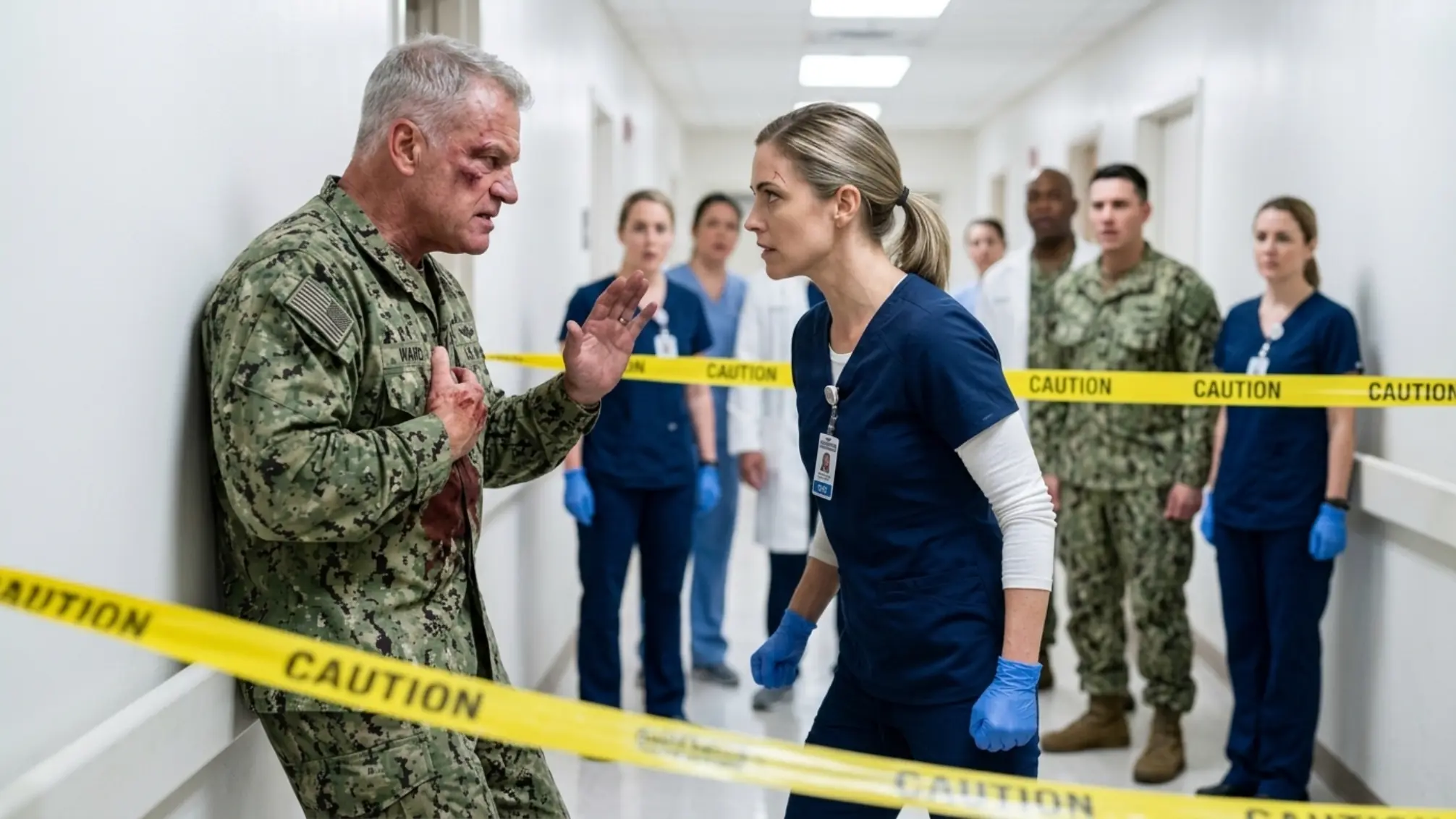
Carmela Rose ducked beneath the tape and continued toward him in fitted navy scrubs, blue gloves, and dark hospital shoes. Her dirty-blonde hair was secured in a low ponytail, revealing the thin scar above her left eyebrow. She appeared small beside the six-foot-five admiral, but her gray-blue eyes showed none of the fear he expected. “Swing once,” she said, “and you’ll bleed out before you touch me.”
“Nobody gets near me without the extraction code,” Hawthorne snarled.
Carmela stopped six feet away and locked eyes with him. “Then stand down, Hawkeye. Valkyrie just found you.”
The change was immediate.
Hawthorne’s raised fist froze in the air. His wild eyes focused on her face, moving from the scar above her eyebrow to the steady hands held openly at her sides. The admiral’s expression passed through suspicion, recognition, and finally disbelief.
“Valkyrie?” he whispered.
“That’s right.”
“You died.”
“Not today.”
The admiral’s knees buckled.
Carmela crossed the space between them before anyone behind the caution tape reacted. She caught his weight beneath one arm, turned her body, and controlled his fall so smoothly that his head never touched the floor. Two hospital corpsmen rushed forward, but Carmela raised one hand and ordered them to wait until Hawthorne released the small combat knife hidden inside his sleeve.
His fingers opened.
The blade struck the tile.
“Threat cleared,” Carmela said. “Move him now.”
The corridor exploded into motion.
Doctors pushed a trauma bed beneath Hawthorne while nurses cut through the bloodstained uniform. Carmela climbed beside him, pressed both hands against the worst chest wound, and called for blood, imaging, and a thoracic surgical team. Her voice no longer carried the apologetic softness everyone associated with the timid new nurse.
Dr. Marcus Thorne stood behind the bed, staring at her.
Only twenty minutes earlier, he had publicly called Carmela incompetent.
Thorne was thirty-six, talented, ambitious, and convinced that every room functioned best when everyone acknowledged him as its smartest person. He wore his white coat like a rank insignia and treated hesitation as evidence of weakness. Carmela had worked at the hospital for eight months, and he had spent nearly all of them ensuring that she understood her low position.
That morning, he had criticized her for placing an IV in a patient’s right arm rather than his preferred left. The right arm had offered the stronger vein and created no surgical conflict, but Thorne corrected her loudly in front of two residents. When Carmela apologized, he assigned her to change linens and restock supply rooms.
“She might be useful around bedpans,” one resident joked.
Carmela lowered her eyes and carried the empty trays away.
Nobody noticed that the IV she had placed remained the only line that did not fail during the patient’s emergency surgery.
Carmela had spent years teaching people not to notice her.
Her hands trembled when she carried medication, her shoulders curved inward whenever a doctor raised his voice, and she spoke as if every sentence required permission. The clumsiness was occasionally exaggerated, the nervousness carefully maintained. She understood that confident people attracted questions, while forgettable people moved freely through restricted spaces.
Her personnel file supported the disguise.
Carmela Rose was thirty-two, an average graduate from an ordinary nursing program in Nevada. Her record showed no military service, no overseas assignments, and no advanced tactical training. Every former supervisor confirmed that she was quiet, dependable, and unremarkable.
The file did not mention Lieutenant Commander Carmela Torres.
It did not mention eight years attached to Naval Special Warfare Development Group, forty classified missions, advanced battlefield surgery, or the twelve operators she had kept alive after an ambush near Kandahar. It did not mention the call sign Valkyrie, given to a medic who repeatedly entered places evacuation teams refused to approach.
Officially, Commander Torres had died in 2019.
Carmela had helped write the lie.
The operation that ended her public life began with a compromised intelligence network and a transport aircraft that never reached its destination. Carmela survived the crash, pulled two wounded operators through burning wreckage, and disappeared before the men who ordered the attack could confirm she was alive.
The Navy concealed her survival while investigators searched for the leak.
Months became years.
The investigation stalled, the people responsible remained protected, and Carmela’s temporary identity became the only life she could safely inhabit. She renewed her nursing credentials, moved between civilian hospitals, and eventually accepted a position at Naval Medical Center San Diego because working near military patients made her feel useful without returning her to war.
For eight months, the disguise held.
Then Admiral Hawthorne arrived dying.
The corpsmen who brought him in reported that his convoy had been attacked outside a restricted training facility near the California desert. Three rounds had entered his chest and abdomen. He remained conscious during the helicopter flight but became violently disoriented when the aircraft landed.
Inside the emergency department, Hawthorne believed the ambush was still happening.
He tore free from five medical workers, knocked an orderly into a cart, and used an IV pole to keep security officers away. Every person who approached became another hostile figure inside the memory trapping him. Sedation failed because blood loss and adrenaline had made his response unpredictable.
Thorne ordered stronger medication.
Dr. Sarah Chen objected. “That dose could stop his heart.”
“If we don’t restrain him, he’ll kill someone.”
Security advanced with batons.
That was when Carmela stepped beneath the caution tape.
Now Hawthorne lay on a trauma bed while Carmela applied pressure to his chest. His breathing became shallower, and the monitor showed his blood pressure dropping despite the first transfusion.
“His left lung is collapsing,” Carmela said.
Thorne checked the imaging screen. “We don’t have confirmation.”
“You can confirm it after he dies, or decompress it now.”
“I’m the attending.”
“And he is losing oxygen.”
Thorne looked at the monitor, then at the admiral’s chest. He hesitated for one second too long.
Carmela reached for the needle kit.
Thorne caught her wrist. “You are not authorized.”
She broke his grip with a sharp rotation that nearly forced him to his knees. “Hold me again, and hospital security will be protecting you from me.”
Everyone in the room stopped.
Carmela drove the needle into the appropriate space between Hawthorne’s ribs. Trapped air escaped with a violent hiss. His oxygen level began climbing within seconds.
Dr. Chen stared at the monitor. “She was right.”
Carmela secured the needle and looked at Thorne. “Get him to surgery.”
No one questioned her again.
The operation lasted four hours.
Surgeons repaired intestinal damage, controlled bleeding near the kidney, and removed the three rounds. Hawthorne’s injuries should have killed him, but the bullets had missed his heart, aorta, and liver by narrow margins. Thorne performed the most difficult repairs himself, though twice Carmela quietly identified changes in the admiral’s blood pressure before the anesthesia team reacted.
When the surgery ended, Hawthorne was transferred to a secured intensive-care room.
Two armed Marines guarded the door. A third remained inside. Carmela was assigned to monitor him through the night, not because Thorne trusted her, but because he wanted to understand what she had done.
Before leaving the ICU, he stopped beside her.
“What did you say in that corridor?”
“I gave him an instruction.”
“You used a classified call sign.”
“He was delirious.”
“He recognized you.”
Carmela checked the admiral’s IV line. “Then ask him when he wakes.”
Thorne lowered his voice. “I checked your file. Nothing in it explains your behavior.”
“Files rarely explain people.”
“You expect me to ignore this?”
“I expect you to care more about whether your patient survives.”
Thorne walked away, but suspicion followed him.
At 1:17 a.m., Hawthorne’s heart rhythm changed.
Carmela saw the first irregular beat before the alarm sounded. She moved toward the bed, checked the IV connections, and noticed a fresh puncture in the medication port. Someone had injected a substance after the last documented check.
Hawthorne convulsed.
The monitor screamed.
Carmela disconnected the contaminated line and struck the emergency button. “Potassium poisoning. Bring calcium gluconate and insulin with dextrose.”
The Marine guard stared at her. “How do you know?”
“Because I’ve seen it used to hide assassinations.”
A male night nurse stood near the doorway.
His identification badge read Jeffrey Morrison. He had entered the room four minutes earlier, claiming he needed to inspect the infusion pump. Now he watched Carmela with the expression of a man recalculating an operation that should have remained invisible.
Carmela pointed at him. “Do not move.”
Morrison ran.
The Marine guard lunged and missed. Morrison drove an elbow into the man’s throat, crossed the corridor, and reached for the emergency stairwell. Carmela caught him before his hand touched the door.
She struck the back of his knee, redirected his falling body, and twisted his arm until his shoulder pressed against the tile. Morrison attempted to reach inside his pocket. Carmela trapped his wrist and removed a small syringe filled with clear liquid.
Dr. Chen arrived with the code team and stopped dead.
The trembling nurse had a trained attacker pinned beneath one knee.
“Secure him,” Carmela ordered the Marines. “He poisoned the admiral’s line.”
Morrison looked up at her and smiled through the pain.
“You should’ve stayed dead, Valkyrie.”
The corridor fell silent.
Carmela increased pressure on his arm.
“Who sent you?”
“You know who.”
“Say the name.”
“Ghost Ship remembers Kandahar.”
Morrison bit down.
Carmela saw the movement and forced his jaw open before he could break the capsule hidden between his teeth. A small plastic container fell onto the floor.
“Cyanide,” she said. “Bag it.”
The Marines dragged Morrison away.
Carmela returned to Hawthorne.
Dr. Chen administered the medications exactly as Carmela directed. The admiral’s heart rhythm stabilized before cardiac arrest began, but the margin was measured in seconds.
When the crisis passed, Chen turned toward Carmela.
“Who are you?”
Carmela looked at Hawthorne’s face.
“I’m the reason he’s alive.”
“That isn’t an answer.”
“It is the only one that matters tonight.”
Hospital administration disagreed.
At three in the morning, Carmela sat inside the medical director’s office with Dr. Chen, Chief Thorne, two federal agents, and Commander Rebecca Walsh, the hospital’s senior naval administrator. Morrison’s attempted assassination had transformed an internal medical event into a national-security emergency.
One federal agent placed an enlarged security photograph on the desk.
It showed Carmela restraining Morrison. Her hair had shifted, exposing the scar above her eyebrow and a cluster of smaller marks along her neck.
“These injuries match a classified casualty description,” the agent said. “Lieutenant Commander Carmela Torres, presumed killed in Afghanistan in 2019.”
Carmela remained silent.
Thorne looked at her as though the woman he had humiliated for months had become someone else while sitting in the same chair.
Commander Walsh leaned forward. “Admiral Hawthorne identified you as Valkyrie.”
“He was under extreme stress.”
“Morrison used the same name.”
Carmela met her eyes.
Walsh lowered her voice. “Commander Torres, twelve SEAL operators disappeared during the last six months. Admiral Hawthorne believed someone inside Naval Special Warfare was operating illegal detention sites and selling classified personnel information. He was attacked before he could deliver the evidence.”
“Where is the evidence?”
“We hoped you could ask him.”
“He is sedated.”
“Then we wait.”
Carmela shook her head. “Whoever sent Morrison will not.”
The lights went out.
Emergency illumination filled the room with red.
An explosion shook the lower floor, followed by suppressed gunfire.
Carmela stood before anyone else processed the sound.
“South entrance breach,” she said. “They’re here for Hawthorne.”
Walsh reached for the phone. “We need evacuation.”
“He will die if moved.”
“Then we defend the ICU.”
Carmela looked at the two federal agents. “How many trained security personnel?”
“Twelve Marines and six hospital officers.”
“Against a professional assault team that already placed an assassin on staff.”
The first agent opened a locked cabinet and removed a sidearm. “What do you recommend?”
Carmela’s posture changed completely.
The timid nurse disappeared.
“Clear the floor. Move Hawthorne into the windowless treatment room. Position Marines at both corridor choke points, but do not place everyone near the obvious entrance. They’ll expect that defense.”
Commander Walsh watched her. “And you?”
“Give me armor and a rifle.”
Thorne stared at her navy scrubs. “You’re a nurse.”
Carmela looked directly at him. “Tonight I’m both.”
Twenty minutes later, the assault team entered through the south stairwell.
They moved with military precision, wearing dark equipment and using suppressed rifles. The first group attacked the corridor defense while two additional operators climbed through maintenance access above the secured treatment room.
Carmela had predicted both moves.
The Marines allowed the first team into the central corridor before closing the doors behind them. Flashing emergency lights and overturned medical carts disrupted their visibility. Carmela fired from cover, disabling the lead operator while the Marines trapped the others from both sides.
The second team dropped through the ceiling.
One attacker entered Hawthorne’s room before Carmela reached it. He raised his weapon toward the unconscious admiral while Dr. Chen stood directly behind him, making a clear shot impossible.
Carmela threw her rifle.
The weapon struck the attacker’s shoulder and spoiled his aim. She crossed the room, trapped his wrist, and broke his elbow against the bed rail. When he reached for a sidearm, she kicked it away and forced him facedown.
“Who ordered the attack?”
He laughed. “You think stopping us changes anything?”
Carmela pressed the barrel of her recovered pistol beside his eye. “It changes the next five seconds.”
“Vice Admiral Richard Keller.”
Dr. Chen gasped.
Keller was Hawthorne’s deputy and one of the most respected officers in Naval Special Warfare. He had served thirty years, received multiple decorations, and possessed access to nearly every classified operation Hawthorne supervised.
“Why?” Carmela demanded.
“Nightfall. Hawthorne found the sites.”
“The missing SEALs?”
“Twelve still alive. Keller needed to know where Hawthorne hid the records before killing him.”
Carmela restrained the attacker and contacted the federal agents.
At sunrise, Hawthorne awakened.
He found Carmela sitting beside his bed in navy scrubs beneath a tactical vest. The rifle rested within reach, and dried blood marked one sleeve.
“Valkyrie,” he rasped.
“Hawkeye.”
“You really are alive.”
“So are you. Try to keep it that way.”
He managed a weak smile.
Carmela told him Morrison had been captured, the assault team defeated, and Keller identified. Hawthorne closed his eyes briefly.
“I hid the evidence at the Coronado safe house,” he said. “False wall behind the armory. Three drives and a recorder.”
“Who knows?”
“Now you.”
Carmela stood.
Hawthorne caught her wrist gently. “Keller will be watching it.”
“I hope so.”
“You cannot fight an entire compromised command alone.”
“I don’t plan to.”
Federal agents surrounded the safe house before Carmela entered. Keller’s men still attacked, confirming their connection while creating the evidence needed for immediate warrants. The firefight lasted less than three minutes.
Carmela recovered all three drives.
They contained recordings of Keller ordering assassinations, financial transfers to private mercenaries, and coordinates for six illegal detention facilities. The missing operators were alive, held because they had discovered unauthorized missions funded through hidden accounts.
NCIS arrested Keller inside his office that afternoon.
Within forty-eight hours, federal and military teams recovered all twelve SEALs. Several senior officials were suspended, and congressional investigators opened hearings into Operation Nightfall. Hawthorne’s evidence dismantled a network that had survived for years by hiding behind decorated careers and classified budgets.
Carmela’s identity could no longer remain buried.
Hospital staff assembled in the auditorium one week later. Admiral Hawthorne entered in a wheelchair, weak but alive, wearing a clean naval uniform. Carmela stood beside the stage in navy scrubs, visibly uncomfortable with the attention.
Hawthorne addressed the room.
“The nurse many of you knew as Carmela Rose is Lieutenant Commander Carmela Torres. She served with Naval Special Warfare, saved personnel during more than forty classified missions, and was presumed killed while protecting an operation in Afghanistan.”
Thorne sat in the front row.
Hawthorne continued. “She saved my life in the corridor, during surgery, during an assassination attempt, and during the attack that followed. More importantly, she exposed the network responsible for imprisoning twelve of our people.”
Applause began slowly and filled the auditorium.
Carmela looked at her hands.
They were trembling again.
Afterward, Thorne approached her alone.
“I treated you like you were incompetent.”
“Yes.”
“I believed your quietness meant you lacked confidence.”
“You believed what made it easier to feel superior.”
He accepted the words without defending himself.
“I’m sorry.”
Carmela looked toward the nurses leaving the auditorium. “Apologizing to me is the easy part.”
“What is the hard part?”
“Changing how you treat the next person whose history you cannot see.”
Thorne nodded. “I will.”
“Then prove it when no admiral is watching.”
Carmela remained at Naval Medical Center San Diego.
She declined full operational reinstatement but accepted a role combining trauma nursing, combat-medicine instruction, and military crisis response. Her personnel record now carried her real name, though many details remained classified.
Her hands continued trembling during quiet moments.
They became perfectly still whenever someone’s life depended on them.
Months later, Carmela entered the emergency department and found a new travel nurse standing nervously beside Thorne. The young woman had made a small documentation error and waited for the public humiliation that usually followed.
Thorne corrected the chart privately.
Then he asked what experience she brought from her previous hospital.
Carmela watched from across the room.
He had listened.
The admiral’s first words to her had been a threat. He saw an inexperienced nurse approaching and believed force was the only language left to him. The doctors saw her navy scrubs and assumed she belonged beneath their authority.
Only Hawthorne recognized the hidden call sign.
“Hawkeye,” she had said.
“Valkyrie just found you.”
In that moment, the dying warrior stopped fighting, the invisible nurse stopped hiding, and an entire hospital discovered that the quietest person in the corridor had once carried soldiers through fire—and had never forgotten how to bring one home.