The loader was already moving when Clara Whitlock pulled into the rear lot of Route 9 Farm Market. Its yellow arm lifted another bucketful of torn burlap sacks toward the dumpster, spilling sprouted potatoes across the cracked pavement. Some were soft, some were wet with rot, and several had pushed pale shoots through the fabric as though refusing to accept that their usefulness had ended. Clara stepped from her truck, walked directly into the loader’s path, and raised one hand.
“Stop,” she called. “I’ll take every sack.”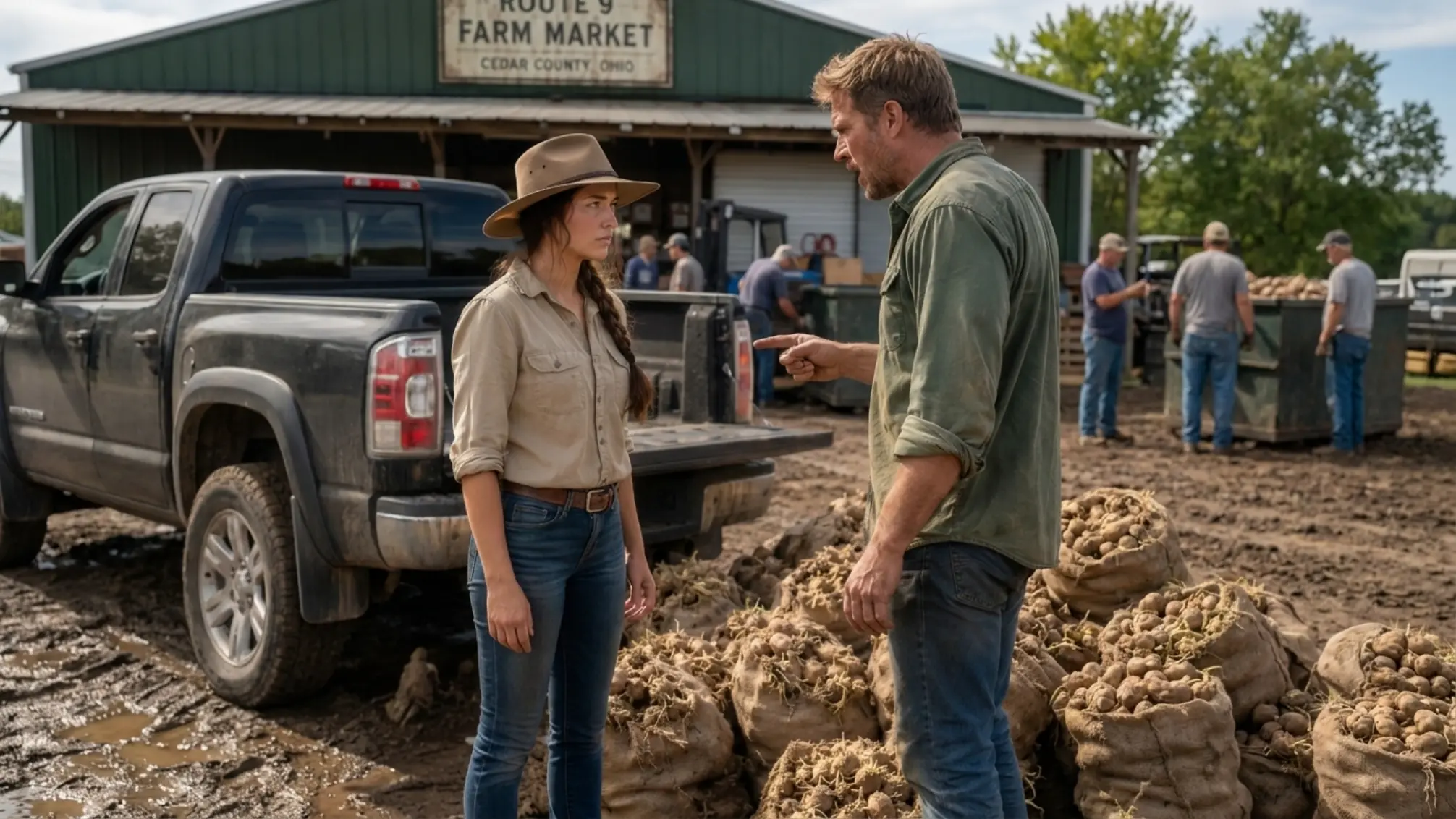
The loader operator released the controls and stared at her. Behind him, Phil Gentry, the market manager, stepped from the loading bay with both hands on his apron. He looked from Clara to the four hundred rejected sacks piled against the wall and then back at her as if waiting for the joke to reveal itself.
“Clara, those potatoes are finished,” Phil said. “Half are sprouted, and some are nearly liquid.”
“They’re still potatoes.”
“They’re garbage.”
Clara opened the tailgate of her old pickup. “What they become after they’re loaded is my business.”
The dock workers began drifting closer. An older man wearing a faded Cedar County feed cap kicked one of the leaking sacks and laughed when gray water seeped across the concrete. Another asked whether Clara planned to plant food or bury evidence.
Then Garrett Pike arrived.
He was forty-three, broad-shouldered and confident, with weathered skin, sandy-brown hair, and the reputation of being one of Cedar County’s most successful farmers. Garrett had stopped to collect livestock feed, but the gathering behind the market interested him more than his order. When he learned what Clara intended to buy, his smile sharpened.
“That dead field beat your father,” he said. “Now you’re bringing it garbage.”
The laughter became louder.
Clara stood opposite him in a dusty-beige work shirt, dark jeans, rugged farming boots, and a wide-brimmed tan hat. Her long brown hair hung in a braid over one shoulder, and her hands remained empty at her sides. She could have defended herself, explained her idea, or reminded Garrett that he knew nothing about what she planned.
Instead, she met his eyes.
“Garbage is all a fool sees.”
The men around them fell quiet.
Garrett stepped closer and pointed toward the sacks. “You’ll bury four hundred bags and lose what’s left of your farm.”
“Then watch that trash feed the whole county.”
Clara turned away and backed her truck toward the loading dock.
Phil helped her work, partly because he felt guilty and partly because he could not watch anyone load alone. The sacks were heavier than healthy potatoes should have been, saturated with their own breakdown. Dark stains spread across the truck bed, and the sweet, unpleasant smell of vegetable rot clung to Clara’s clothes.
“You’re sure about this?” Phil asked quietly.
“No.”
He looked at her.
“But I’m doing it anyway.”
Phil almost smiled. “Every grower along Miller Creek lost part of the spring planting. If you have a plan, the county could use one that works.”
By sunset, everyone in Cedar County knew Clara Whitlock had spent four hundred dollars on potatoes too spoiled to feed a hog. By the following morning, the story had reached the feed store, the diner, and the church parking lot. Most people agreed it proved what they already suspected: grief and desperation had finally made Clara reckless.
Whitlock Farm sat two miles from Route 9 at the end of a gravel road lined with leaning fence posts. The farmhouse had once been bright white, though decades of wind and sun had faded the paint to chalk. A weathered red barn stood behind it beside a chicken coop, a small hog enclosure, three compost bays made from old pallets, and several fields producing just enough to keep the bills paid.
Then there was North Ridge.
Forty acres of heavy clay lay across the northern boundary of the property. In spring, it held rainwater like a shallow lake. By July, the ground hardened into cracked gray slabs strong enough to resist a shovel.
Local farmers called it the brick field.
Clara’s father, Walter Whitlock, had tried to revive it for twenty years. He planted cover crops, rotated grains, dug channels, and paid for drainage pipes he could barely afford. Some methods helped temporarily, but nothing transformed the land into dependable soil.
Walter died three winters earlier.
Clara found him in the barn after his heart failed during morning chores. She was thirty-one then, unmarried and suddenly responsible for a farm that had always required two people. Since that day, she had survived through egg sales, vegetables, hay, six hogs, careful budgeting, and an unwillingness to admit when she was exhausted.
She had considered selling North Ridge more than once.
A neighbor offered to purchase the acreage cheaply, mostly for grazing. Clara nearly accepted, but every time she imagined signing the deed, she remembered her father walking the field after rain, mud reaching his ankles while he searched for one more adjustment that might finally make the soil respond.
She could not sell the place where he had refused to surrender.
That first night, Clara sorted potatoes beneath the barn’s bare hanging bulbs until nearly midnight. She divided them into three groups: firm potatoes with strong sprouts, softened potatoes still usable as animal feed, and collapsed ones suitable only for compost.
The work was slow and unpleasant.
Several sacks split when she lifted them. Rotten liquid ran between her boots, and the cold burlap left her fingers cracked and numb. When she finally finished, she had counted 286 sacks that might produce seed, seventy-one sacks suitable for feed, and forty-three sacks of complete rot.
Clara sat on an overturned crate and stared at the piles.
Garrett’s voice returned to her.
That field beat your father.
She opened one last sack and found nothing inside but gray-brown sludge. The smell forced her to turn her head. For the first time since stopping the loader, she wondered whether everyone had been right.
Four hundred dollars was not a fortune, but on Whitlock Farm it represented feed, fuel, repairs, or several overdue bills. She had spent it on waste because one idea had formed in her mind faster than caution could stop her.
Clara switched off the lights and walked back to the farmhouse in darkness.
She slept badly.
Three evenings later, she pulled her father’s farming journals from a shelf in the front room. Walter had filled nine notebooks with weather reports, planting dates, yields, costs, and failures. His writing was practical, but occasionally a longer thought appeared between the numbers.
Clara found an entry about North Ridge written eleven years earlier.
I keep treating this land as though it is normal ground. It is not normal yet. The field does not need a miracle. It needs organic material, patience, drainage, and something stubborn enough to grow before the soil is ready. I do not have the money to bring in enough compost, and I may not have the years left to build it slowly. Maybe Clara will have one or the other. Maybe she will see what I missed.
She read the paragraph twice.
Then she looked through the kitchen window toward the barn.
The potatoes were not one crop. They were seed, feed, and compost. The animal-grade sacks could lower her grain expenses. The rotten material could begin changing the clay. The sprouted potatoes might provide a living crop stubborn enough to push through ground not yet ready.
Clara opened her notebook and wrote beneath the date:
Dad knew what North Ridge needed. He could not afford the material. I have four hundred sacks of it.
The following Tuesday, she entered the Cedar County feed store and felt the conversation change the moment the door opened. Men near the fertilizer aisle stopped speaking loudly and continued in lower voices. Ronnie, the clerk behind the counter, avoided looking toward them while preparing Clara’s order.
Garrett appeared near the chicken-feed display.
“I heard Phil gave you the whole reject pile,” he said.
“I paid for it.”
“You’re actually planting those things?”
“Some.”
“In North Ridge?”
“Yes.”
Garrett laughed. “Your father used certified seed, professional drainage, and twenty years of experience. The field still beat him. What makes you think you’ll win with something Phil couldn’t sell?”
Clara lifted the feed sacks from the counter.
“We’ll see.”
That answer disappointed him. He wanted anger because anger would have made her easier to dismiss. Clara walked outside, loaded her truck, and drove home with her jaw clenched.
The insult about the potatoes did not matter.
The insult about her father did.
For nearly two weeks, Clara turned the viable potatoes into seed pieces. She cut each one carefully, keeping at least one healthy eye and enough flesh to support early growth. The pieces covered screens, old feed sacks, tables, and hay bales throughout the barn.
She dusted the cut sides with wood ash and left them to cure in the cool air. The exposed surfaces callused gradually, sealing themselves against soil-borne rot. By the end, she had produced more than eleven thousand seed pieces.
The feed-grade potatoes went into large iron pots over an outdoor fire. Clara cooked and mashed them before mixing them carefully into the animals’ regular ration. The hogs accepted the new food immediately, and even the chickens stopped rejecting it after several days.
Within two weeks, her grain use declined.
The worst forty-three sacks went into the compost bays with straw, dried leaves, and chicken manure. Steam rose faintly from the first pile on cold mornings. Material everyone else had called useless was already reducing Clara’s expenses and building the amendment North Ridge lacked.
She chose six acres for the first planting.
They lay along the higher side of the field where water drained slightly faster. Clara formed raised ridges eight inches tall, ran them with the slope, and placed compost beneath half the rows so she could compare the results.
Over ten days, she planted eleven thousand pieces.
She worked alone from sunrise until the light disappeared, pausing only for meals and animal chores. When the last row was complete, Clara stood at the field’s edge and imagined her father beside her.
“This is the beginning,” she whispered.
Eight days later, the rain arrived.
It fell steadily for three days, saturating the farm and filling low areas of North Ridge. Water gathered between the rows, climbed the bases of the ridges, and surrounded thousands of buried seed pieces.
Clara walked into the mud after the sky cleared.
Her first test hole showed a potato piece already softening. The next had collapsed completely. In the lowest third of the planting, nearly three thousand pieces were lost.
News spread quickly.
At the gas station, Garrett rolled down his truck window while Clara filled her tank.
“Told you that field eats everything,” he called. “Just like it ate every dollar your father put into it.”
Clara did not answer.
That evening, she walked alone through North Ridge and knelt beside one of the failed rows. The mud soaked through her jeans. A seed piece came apart in her hand, cold and gray, leaving nothing that could become a plant.
For the first time, Clara allowed herself to imagine selling the field.
She could stop spending time and money on stubborn clay. She could invest the proceeds in the garden, repair the barn roof, hire seasonal help, and build a life around the parts of the farm that already worked.
She almost stood with the decision made.
Then she saw something two rows away.
A single pale-green sprout had broken through the mud. It grew in one of the composted rows on slightly higher ground where the ridge had remained above the standing water.
One surviving plant did not prove the experiment successful.
But it showed Clara exactly where the method had worked.
“That isn’t luck,” she murmured. “That’s information.”
She returned to the house and spent most of the night comparing notes. The composted rows performed better. The higher ground survived. The ridges needed greater elevation, and the spaces between them required channels deep enough to carry rainwater away.
Three thousand pieces were gone.
Eight thousand remained.
Clara rebuilt the planting system.
She raised the new rows to fourteen inches, dug drainage channels between them, concentrated compost directly beneath each planting point, and covered the tops with straw. Instead of beginning with the lower sections, she worked outward from the driest ground.
A sixteen-year-old neighbor named Sam Daring helped for one Saturday after asking whether Clara had paid work available. She put him on drainage channels while she handled the seed pieces herself. Together, they completed more in one day than Clara had managed alone in three.
Twelve days later, the remaining eight thousand pieces were underground.
Now she waited.
Six weeks passed before the field changed.
At first, only scattered green shoots appeared. Then they formed imperfect but visible lines across the higher ground. Several low sections remained empty, but most composted ridges produced plants.
Clara stood beside the rows at sunrise and wrote one sentence in her notebook.
This is no longer an experiment. It is a crop.
Colorado potato beetles arrived in June.
Their striped bodies appeared beneath leaves, followed by clusters of orange eggs and hungry larvae. Clara could not afford enough commercial treatment for six acres, so she tried rotating chickens through portable fencing.
Her first attempt damaged nearly a dozen plants.
The birds ate the beetles, then scratched around the shallow roots and broke several stems. Clara reduced the flock, shortened each rotation, and began collecting the remaining insects by hand into buckets of soapy water.
The work was tedious and slow.
She did it anyway.
Meanwhile, the rest of Cedar County’s potato crop worsened. Spring flooding had destroyed fields along Miller Creek. The summer then turned unusually dry, stressing whatever survived.
By August, the school district struggled to secure enough potatoes for autumn meals. The church pantry received fewer donations, and the diner on Main Street considered increasing menu prices. Regional suppliers charged more because shortages extended beyond the county.
Clara heard the discussions but made no promises.
She still did not know what lay beneath her plants.
In September, she carried a digging fork to the strongest section of North Ridge. The first plant lifted from the soil with several solid potatoes attached beneath it. They were not enormous, but their skins were clean and their flesh firm.
Clara dug another plant.
Then another.
Every successful row produced more than her father’s old records suggested the untreated field had ever managed. The poorest sections yielded less, but even they produced usable potatoes.
The full harvest took most of September.
Clara hired Sam and two other teenagers to help dig, sort, and fill crates. By the time they finished, the six acres had generated several times the yield anyone expected from North Ridge.
The field was not fixed.
But it was awake.
Clara’s first stop was Route 9 Farm Market.
She backed her truck against the same loading dock where Phil had helped her collect the rejected sacks five months earlier. This time, the truck bed held crates of clean potatoes.
Phil lifted one, examined the skin, and looked toward her.
“North Ridge?”
“Six acres.”
He cut one open with a pocketknife. The inside was firm and pale.
“This is good stock.”
“It should be. Your market supplied the seed.”
Phil laughed.
Clara sold him several crates at a fair wholesale price. Then she drove to the school district and offered a reserved quantity below the regional supplier’s quote. The procurement manager accepted immediately.
At the church pantry, Clara donated part of the harvest. The volunteer coordinator hugged her so suddenly that Clara nearly dropped the invoice folder. The Main Street diner bought enough potatoes to avoid increasing prices through the fall.
At Whitlock Farm, Clara placed crates beneath the roadside stand and painted a sign:
NORTH RIDGE POTATOES
Cars began turning down the gravel road.
On the second Saturday in October, a district van collected two full crates. The driver told Clara the potatoes would appear on three hundred lunch trays the following day.
After the van left, Clara remained in the driveway.
Garrett had said she would bury garbage and lose the farm.
Instead, children would eat lunch from the field he called dead.
A week later, Garrett’s truck appeared at the farm stand.
He stepped out and studied the potatoes for a long time. Clara waited behind the table with her arms folded.
“These really grew in the brick field?”
“They did.”
“I heard you lost three thousand pieces.”
“I changed the method and replanted.”
Garrett picked up one potato, turning it slowly in his hand.
“I laughed at you,” he said. “At the market and the gas station.”
“Yes.”
“I said things about your father I should not have said.”
Clara remained silent.
Garrett placed the potato back carefully. “I saw rotten sacks and bad land, and I thought I knew how the story ended.”
“You saw rot,” Clara replied. “I saw a beginning.”
He nodded.
Garrett purchased two large bags, though Clara suspected his household needed only one. Before leaving, he stopped beside the truck.
“If you expand next spring, you’ll need deeper drainage. I have a tractor and usually have time in April.”
Clara studied him.
“Are you offering help?”
“Yes.”
“I may accept it.”
“You should.”
The following winter, Clara reviewed the complete numbers. Six acres had improved, while thirty-four still remained heavy and unproductive. The successful ground appeared darker and held moisture differently, but one season had not erased generations of clay.
She refused to call it a miracle.
Miracles required no explanation. North Ridge had responded because Clara observed every failure, recorded the differences, and changed her method instead of pretending the first attempt had worked.
The potatoes also fed her livestock through rising grain prices. Their waste created compost for the following year. Their harvest paid the farm’s overdue feed balance, supplied the school, supported the church pantry, protected the diner’s prices, and created demand at Clara’s roadside stand.
Four hundred sacks had done exactly what she promised.
They fed the county.
The next April, Clara stood at North Ridge while Garrett’s tractor idled behind her. She had marked twelve additional acres for drainage, compost, and raised planting rows—twice the area treated the year before.
Phil had already called about spoiled onions and bruised apples the market could not sell. Clara accepted both loads. Some became animal feed, and the rest joined the compost piles.
Nothing was used carelessly.
Nothing was called worthless before she examined it.
Clara opened her father’s old journal that evening and placed her own notebook beside it. Walter’s final entry about North Ridge ended with the possibility that his daughter might see something he had missed.
She wrote beneath it:
You were right about what the field needed. You were wrong about one thing. I did not have more money than you. I only found material everyone else had stopped valuing.
The following morning, Clara returned to North Ridge wearing her tan hat, dusty work shirt, jeans, and farming boots. Six improved acres stretched green behind her, while the remaining clay waited ahead.
She started the tractor.
Most people at Route 9 Farm Market had seen four hundred sacks of spoiled potatoes headed for a dumpster. Clara had seen seed, feed, compost, and one final chance to continue the work her father could not finish.
She had not conquered the entire field.
She had done something more important.
She had learned how to begin.