The auctioneer barely slowed when he reached the final item at the farm liquidation sale outside Grundy Center, Iowa, in the spring of 1971. Sixty acres of flood-damaged bottomland had drowned three crops in four years, driven away its previous tenant, and earned a reputation as ground that consumed seed, fuel, and hope without returning anything. When the auctioneer asked for twenty dollars, only thirty-one-year-old Lorraine Schrock raised her hand. Moments later, she owned the lease for forty-five dollars while the surrounding farmers laughed as though she had purchased sixty acres of mud.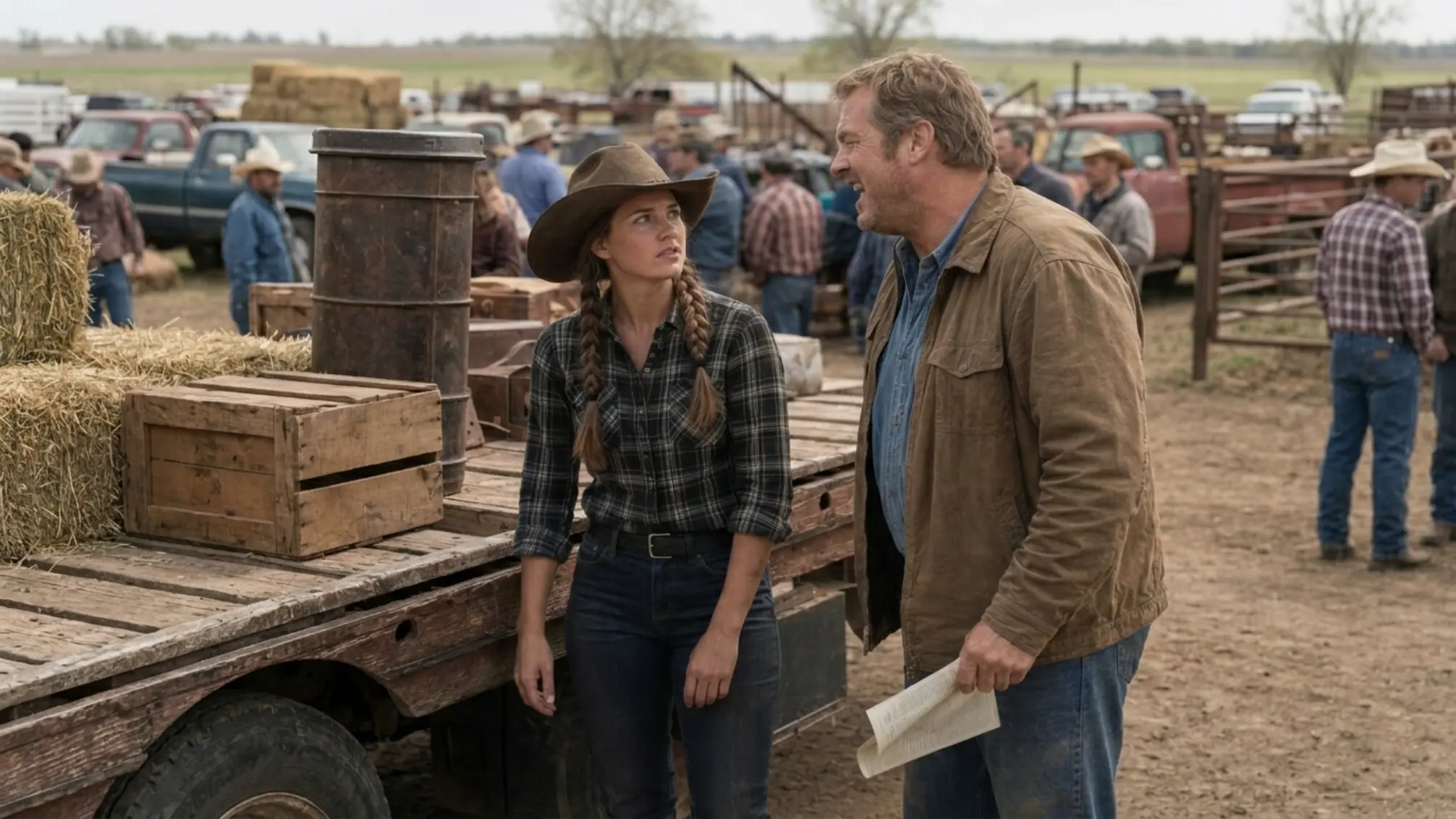
Her brother-in-law, Delbert, found her near the auction wagon before she could leave. He was forty-four, broad across the shoulders, and proud of the eight hundred acres he hoped to control before retirement. In one hand, he held the sale sheet; with the other, he pointed toward the distant bottomland.
“That flooded field killed three crops,” he said. “And you paid for it.”
Lorraine adjusted the brim of her brown farming hat. Two thick chestnut braids rested over her black-and-gray plaid shirt, and dried mud covered her work boots from chores completed before dawn.
“The field isn’t broken,” she replied. “Your plan was.”
Delbert laughed. “Plant it, and the next flood will bury you.”
Lorraine met his eyes. “Then watch what rises after the water leaves.”
By Sunday, the story had traveled from the auction to the feed store, the cooperative, the Cozy Corner Diner, and the parking lot outside First Lutheran Church. At every stop, it became slightly more ridiculous. Some said Lorraine had bought a swamp. Others claimed she planned to plant corn in water deep enough to float a fishing boat.
Nobody asked what she knew.
Lorraine had spent eighteen months studying that land before raising her hand. She had driven past it after spring rains and watched where the water settled. She observed the volunteer grasses growing along the drainage swales and noticed how dark the exposed soil became when the water receded.
The previous autumn, after the tenant publicly announced he was abandoning the field, Lorraine walked in from the county road and collected two soil samples. She mailed them to a laboratory in Ames without telling anyone. When the report returned, she placed it on the workbench inside her father’s old machinery shop and read the figures twice.
Organic matter measured 4.8 percent.
The soil pH was 6.9.
Phosphorus and potassium were both high after decades of crop residue and periodic layers of fertile silt deposited by floodwater. The ground was not dead. It was rich soil trapped beneath the wrong farming system.
Corn and soybeans needed predictable spring access, fast drainage, and firm planting dates. The bottomland offered none of those things. Every farmer who had failed there had asked the field to behave like higher ground.
Lorraine planned to ask it for something different.
Her father, Harold Schrock, had taught her to read soil reports when she was fourteen. He was a quiet man who believed debt killed more farms than drought, insects, or poor harvests ever could. Behind their farmhouse, he maintained a repair shop with a drill press purchased secondhand in 1948, a workbench built before Lorraine was born, and rows of carefully labeled parts he refused to discard.
“The person who understands the cost controls the decision,” he often said.
Harold used the word man, as people did in those years, but Lorraine always understood that he meant her too.
He taught her to weld, sharpen blades, rebuild bearings, and measure machinery parts with a micrometer. When equipment failed, Harold did not complain about manufacturers or wait for a salesman. He opened the machine, found the damaged part, and learned why it had broken.
Lorraine inherited the farm after he died in 1966. At twenty-six, she became the sole owner of 280 debt-free acres, the machinery shop, and a savings account holding $14,200. Her brothers received property in town and older equipment they could sell or use.
People expected Lorraine to marry, hire a manager, or eventually lease the farm to one of her brothers. She did none of those things. She ran it herself, repaired her machinery at night, and wrote every cost in the same columned ledger her father had used.
The sixty-acre lease became her first major expansion.
Lorraine did not intend to drain the entire field with expensive underground tile. She could not afford that, and the forty-five-dollar lease would not justify it. Instead, she planned to establish alfalfa with oats as a companion crop.
Alfalfa had deep roots capable of opening compacted soil over time. Once established, it could survive short periods of excess water better than young soybeans and would increase organic matter as its root system developed. The oats would germinate quickly, hold the soil in place, compete with weeds, and provide income during the first season while the alfalfa strengthened beneath them.
Lorraine calculated everything before planting.
Certified Vernal alfalfa seed would cost $112. Oat seed would cost twenty-seven dollars. Rhizobium inoculant, needed to ensure the legume could fix nitrogen properly, cost fourteen dollars.
Based on the soil recommendation, she purchased $310 of phosphate fertilizer. With equipment fuel, lease costs, and repair parts included, she expected to spend roughly $501 establishing the sixty acres.
Delbert learned about the plan at the diner.
“You’re spending five hundred dollars to plant hay in a bathtub,” he said loudly enough for nearby tables to hear.
Lorraine stirred her coffee. “I’m planting roots in soil that needs them.”
“You think roots will stop a flood?”
“No. I think the right crop will use what the field already has.”
Several farmers laughed.
Delbert leaned closer. “Your father never farmed bottomland like that.”
“My father taught me not to copy a method after the ground proves it wrong.”
That answer silenced him for only a moment.
The real work began inside Harold’s shop. Lorraine’s old John Deere grain drill had worn seed discs, uneven press wheels, and depth bands that no longer held consistent placement. A dealer quoted more than four hundred dollars for repairs.
Lorraine rebuilt it herself for thirty-eight dollars.
For eleven evenings after chores, she disassembled the worn sections, cleaned the bearings, shaped two replacement bushings on the drill press, and installed used parts purchased from a machinery yard. When she finished, every row unit turned smoothly and placed seed at a consistent depth.
She ran the drill across the bottomland during the first week of April, as soon as the higher sections became firm enough to support the tractor. The lowest corners remained too wet, so she marked them and worked around them rather than forcing machinery into unstable soil.
After drilling the oats, Lorraine mixed the alfalfa seed with inoculant inside a galvanized tub. The treated seed darkened beneath her hands. She broadcast eight pounds per acre across the prepared ground, then pulled a light cultipacker over the surface to press the seed into contact with the soil.
For several weeks, nothing happened publicly.
Privately, every morning mattered.
Lorraine checked the field at dawn before returning home for livestock chores. The oats emerged first in clean green lines. Beneath them, tiny alfalfa seedlings appeared unevenly—thin in the wet corners, stronger across the middle elevations.
The differences matched her soil map.
The first serious rain arrived in May. Water gathered in the lowest ground, and several farmers drove past slowly, expecting the entire planting to disappear. Some stopped along the road, watching as if waiting for a public failure.
Lorraine walked the field in rubber boots after the water receded.
The oats had flattened slightly in two sections but remained rooted. A portion of the alfalfa seedlings in the lowest corners had died, exactly as she anticipated. Across most of the acreage, the stand survived.
She returned to the shop and drew the damaged sections on a hand-made map. Lorraine did not describe the losses as a disaster or pretend they did not matter. She recorded them as information for the next rotation.
In July, the oats were ready.
Lorraine harvested thirty-eight bushels per acre and sold the grain at the Grundy Center elevator for $1.14 per bushel. The final check came to $2,604.
The first-year companion crop repaid every establishment expense and left more than $2,100 for future operations.
That evening, Lorraine entered the figures in her ledger. She used ink, never pencil, because Harold had believed a number written in pencil was one a farmer was still trying to negotiate with himself.
She allowed the young alfalfa to grow through late summer and autumn. In September, she conducted another soil test and applied a small amount of potassium where the field needed it. Before winter, she mapped stand density by zone and pinned the drawing above the workbench.
The field entered dormancy uneven but alive.
The laughter continued.
At church, people asked whether she planned to harvest mud. At the co-op, one man offered to sell her a boat for the first cutting. Delbert predicted the winter would kill whatever the spring water had spared.
Lorraine did not argue.
She had the oat revenue in the bank, the surviving plants beneath the soil, and numbers supporting every decision. The opinion of men who had never tested the ground changed nothing.
Spring returned slowly in 1972.
For several weeks, the bottomland looked brown and empty. Then the alfalfa broke dormancy across the middle of the field. Dark green growth spread through the stand with a density that could be seen from the county road.
By early May, drivers began slowing again.
This time, they were not laughing.
The field appeared darker and more uniform than the surrounding corn ground. Each week, the plants thickened. Their roots had spent an entire season pushing downward, opening channels through soil that had once been considered impossible to manage.
A livestock operator from near Ackley stopped at the fence one afternoon. He examined the stand, walked several yards into the field, and returned to Lorraine’s truck.
“How much will you have?”
“I’ll know after cutting.”
“I’ll take one hundred eighty tons at twenty-eight dollars.”
“You haven’t seen the hay.”
“I’ve seen the field.”
Lorraine negotiated written terms before accepting. She did not confuse praise with payment or a handshake with guaranteed revenue. By the time she cut the field in the third week of June, most of the first harvest was already sold.
The alfalfa yielded 3.8 tons of dry matter per acre.
Across sixty acres, Lorraine harvested 228 tons.
The hay cured cleanly, with strong leaves and bright color. She baled it using Harold’s old New Holland machine, stacking each load inside the barn she had repaired the previous autumn.
The Ackley buyer purchased 180 tons for $28 per ton. Another livestock producer near Reinbeck bought the remaining forty-eight tons for twenty-six dollars.
The first cutting generated $6,288.
From the initial lease through the first major harvest, Lorraine had invested $1,847 in the field. After expenses, she stood more than $4,400 ahead on land the county had considered worthless.
The news traveled differently this time.
Mockery moved through a farming community without evidence. Respect required yield numbers.
Farmers began discussing 3.8 tons per acre at the feed store. They repeated the price per ton at the cooperative. Men who had called the land a swamp drove past the fence and calculated the revenue in silence.
Clarence Vetter, who operated a cow-calf farm east of town, arrived at Lorraine’s barn. He broke open one bale, lifted a flake of hay, smelled it, and examined the leaf content.
“How much next year?”
Lorraine named her price.
“I’ll take one hundred tons.”
By the end of summer, she had forward contracts for three hundred tons of the next year’s crop before cutting a single windrow.
Delbert visited the farmhouse again.
He stood in the same kitchen doorway where he had once asked why she bought the land.
“I didn’t think it would work,” he admitted.
“I know.”
“Your father would have seen it too.”
“He taught me how.”
Delbert nodded and left.
It was the closest apology he knew how to offer.
Lorraine refined the system over the following years. She cut three or four times each season depending on rainfall, rotated the alfalfa on a six-year cycle, and adjusted establishment rates based on which sections held water longest.
In 1974, she leased forty additional acres of higher ground and planted a mixed alfalfa-orchard-grass stand. The upland field gave her a drought hedge while the bottomland produced heavily during wetter seasons.
She bought used machinery only when the numbers justified it. A worn haybine cost $1,100 in 1973. Lorraine rebuilt its conditioning rolls herself and had it operating by spring.
A used rake followed two years later for $340.
She paid cash for both.
By 1976, the hay operation generated between $18,000 and $24,000 annually. Operating costs remained below $9,200 during the most expensive years, leaving margins greater than fifty-five percent.
Lorraine deposited the difference into the Grundy County State Bank.
Around her, farmers were making different choices.
Commodity prices rose sharply during the 1970s. Banks encouraged expansion, and land values climbed from roughly $800 per acre in 1972 to $2,400 by the end of the decade.
Farmers borrowed against rising land values to purchase larger tractors, combines, and neighboring acreage. A three-hundred-acre operation became six hundred. Six hundred became nine hundred.
Delbert expanded aggressively.
Clarence purchased another 160 acres with a variable-interest loan. Equipment dealers sold machines faster than manufacturers could deliver them.
Lorraine watched without judgment but kept running the arithmetic.
The new operations required high commodity prices, affordable interest, and increasing land values. If any one of those conditions failed, the debt would remain even after the profits disappeared.
Lorraine continued repairing old equipment in Harold’s shop.
She kept cutting hay.
She kept saving cash.
Then the agricultural economy collapsed.
Interest rates climbed toward eighteen percent. Corn prices fell below two dollars per bushel. Iowa farmland that had been valued near $2,400 an acre sold for less than half that amount only a few years later.
The loans remained based on the old prices.
Banks began foreclosing.
Clarence lost the expansion property he had purchased and carried the remaining deficiency for six years. Another farmer, Harlan Dettwiler, lost an operation he had managed for three decades after financing new machinery and land at the height of the market.
They were not foolish men. They had followed the advice of bankers, industry representatives, and nearly every respected voice around them.
The advice had been wrong.
Lorraine’s hay prices softened as livestock operations contracted, but her business survived. She had no mortgage, equipment note, or operating debt. Her expenses remained fertilizer, seed, fuel, repair parts, and the bottomland lease.
During the difficult 1983 season, her net margin fell to forty-nine percent.
It was her worst result in years.
It was also real profit in a county where families were losing farms.
By the end of 1984, Lorraine had accumulated $91,000 in savings. She told no one. The number appeared only in ink at the bottom of her ledger.
The following spring, 120 acres bordering her eastern boundary went to auction.
The land belonged to Gerald Pfeifer, who had farmed it for twenty-two years before variable-interest loans overwhelmed his operation. The Federal Land Bank advertised the property at the cooperative, the feed store, and in the county newspaper.
A large crowd attended.
Some came to bid. Others came because farm auctions had become the public face of the crisis, a place where neighbors watched a family’s lifetime divided into numbered lots.
Lorraine arrived in Harold’s 1962 Ford pickup. It had more than two hundred thousand miles, but she maintained it herself and saw no reason to replace it.
She registered quietly and stood near the back.
The auctioneer opened the bidding at four hundred dollars per acre. A Des Moines investment company, a Tama County farmer, and Lorraine remained active through the early rounds.
The investment company withdrew at $680.
The Tama County farmer stopped at $740 after consulting his partner.
Lorraine bid $760 per acre.
The auctioneer searched the crowd.
No one answered.
“Sold. One hundred twenty acres at seven hundred sixty dollars per acre to the lady in the back.”
The total was $91,200.
Lorraine opened her checkbook.
The crowd fell silent.
A man beside Delbert stared as she signed.
“Where did she get that kind of money?”
Delbert watched Lorraine fold the receipt and place it inside her coat.
“Alfalfa,” he said.
She left the auction with 120 additional acres and two hundred dollars remaining in the savings account. That night, Lorraine entered the new land total into the ledger: four hundred acres, all paid for.
Then she closed the book and went to sleep.
No celebration.
No speech.
Only a completed calculation written in ink.
Lorraine farmed for another twenty-two years. She converted part of the newly purchased ground to alfalfa, rented the remainder for row crops, and continued refusing to borrow against the land.
Her niece, Dana, began spending summers on the farm when she was thirteen. Lorraine recognized the same patience and attention Harold had once recognized in her.
She taught Dana to read a soil test, operate the drill press, repair machinery, and back a loaded hay wagon into the barn. At the kitchen table, she showed her the ledger and explained why totals were written in ink.
In 1997, the Grundy County Farm Bureau invited Lorraine to speak.
She stood before a room containing farmers who had laughed in 1971, farmers who had purchased her hay, and families that had survived the crisis beside her.
“I paid forty-five dollars for land everyone considered worthless,” she said. “People saw standing water and failed soybeans. I saw 4.8 percent organic matter, a pH of 6.9, and twenty years of fertility trapped beneath the wrong crop.”
The room remained quiet.
“The field was not broken. The plan was broken.”
She explained that eighteen years of hay revenue had produced the cash used to purchase the neighboring 120 acres during the farm crisis. She credited her father’s tools, his lessons, and his refusal to confuse rising prices with permanent wealth.
“A paid-for farm,” Lorraine said, “is the only farm a bank cannot take from you. Everything else is borrowed time.”
Clarence approached her afterward.
“Your father raised you right.”
“He tried.”
“He did more than try.”
He shook her hand and walked away.
Dana gradually assumed control of the operation beginning in 2003. The transition took three years, involved no debt, and was recorded carefully in the same ledger system used since Harold’s time.
The bottomland remained productive through multiple alfalfa rotations. Decades of roots increased its organic matter, opened the soil structure, and improved drainage. A later soil test measured organic matter above six percent.
Harold’s old drill press still stood in the shop.
The ledger totals remained in ink.
Most people at the 1971 auction saw sixty acres of mud and a woman making an emotional mistake. Lorraine saw rich soil, an unsuitable crop plan, and years of income waiting beneath the water.
The farmers saw what the land had been.
Lorraine saw what it was for.
And when the flood years came, followed by the debt crisis that stripped better-known men of better-looking farms, the forty-five-dollar bottomland did more than produce hay.
It gave Lorraine the cash to buy the ground no bank could ever take from her.