“You’re a driver, kid—not a businessman. Nobody buys garbage.”
Dale Kowalski kicked the side of the enormous flower tote, sending broken zinnia stems sliding across the wet loading dock behind Halloway Flower Company. Nineteen-year-old Malachi Rhodes stood opposite him with a white bucket hanging from one hand and his late grandmother’s cracked clothbound ledger tucked beneath the other arm. Behind them, nearly two tons of bent stems, split blossoms, and damaged flowers waited to be loaded into a waste truck and buried.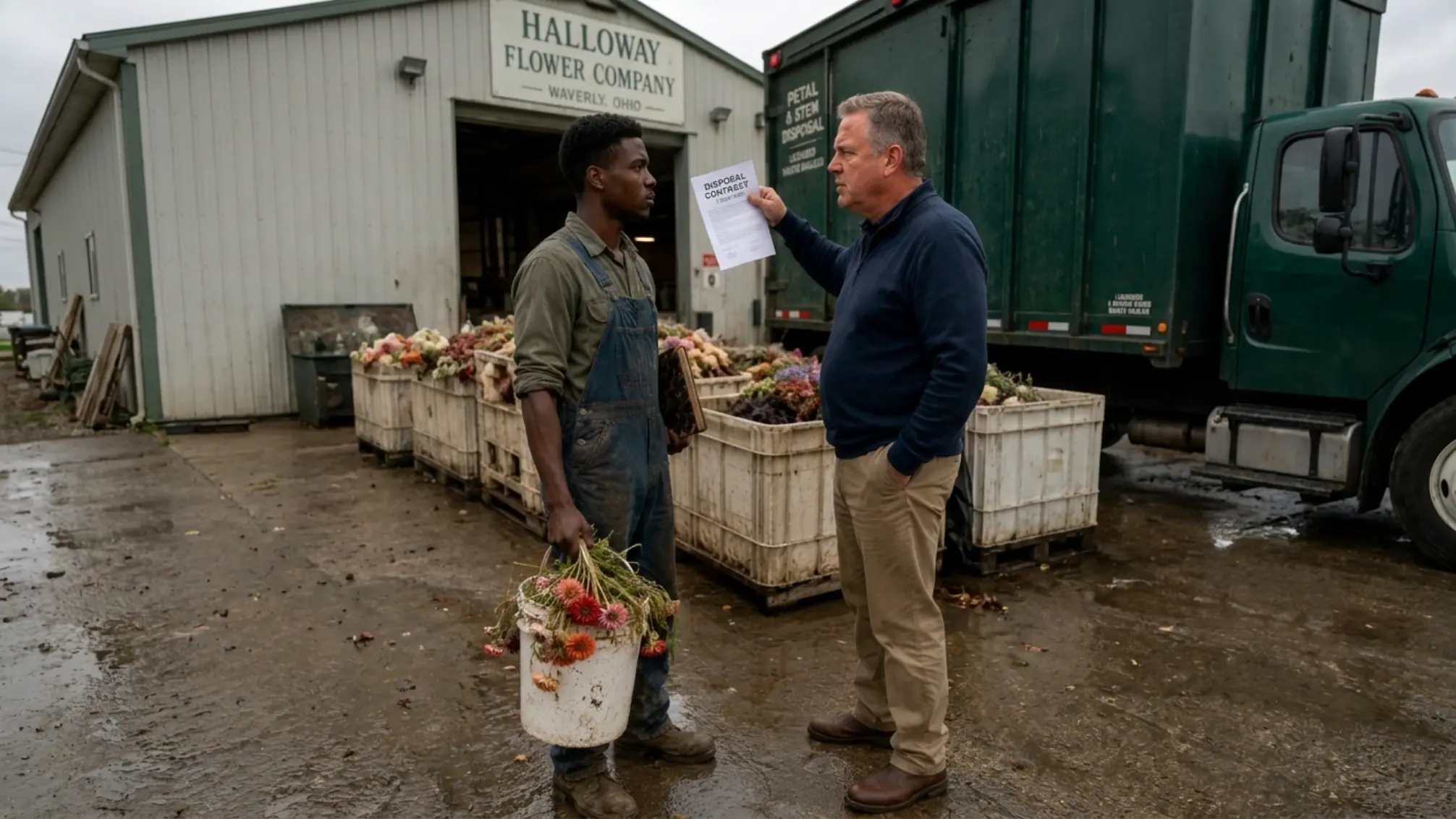
“Then stop paying strangers to bury what my grandmother proved was valuable,” Kai said.
Dale raised the new three-year disposal contract and laughed loudly enough for the dock workers to hear. “Take one more stem, and I’ll fire you for stealing company property.”
Kai pulled a small gold fabric swatch from his pocket and placed it on the manager’s clipboard. “Then meet me here at sunrise—and watch New York fight over your garbage.”
The laughter stopped for only a moment.
Dale looked at the cloth, rubbed it between two fingers, and dropped it onto the wet concrete as though it meant nothing. The gold was unusual—deep without being brown, bright without looking artificial—but Dale had spent twenty years learning that confidence mattered more than curiosity. He stepped over the swatch and walked toward the office without asking how Kai had made it.
That was the mistake Kai would remember.
For forty years, Halloway Flower Company had treated damaged flowers as a necessary loss. Six hundred acres produced roses, dahlias, marigolds, cosmos, coreopsis, and zinnias for supermarkets and wholesalers across the Midwest. Buyers demanded straight stems, perfect blossoms, and colors matching exact sample cards.
Anything imperfect went into gray plastic totes.
At ten each night, Kai backed a flatbed truck to the disposal pit behind the cooler. He worked the hydraulic lever and watched thousands of flowers slide into the ground. Some had snapped during harvest, others had opened too early, and many were rejected for flaws so small that Kai could barely find them.
The company paid a contractor to bury all of it.
Kai had calculated the volume once while sitting inside the truck. On busy nights, he dumped more than forty thousand stems. If each one had been worth only a nickel, nearly $2,000 disappeared every time he pulled the lever.
But everyone at Halloway agreed the flowers were worthless.
Kai had accepted that judgment until his grandmother died.
Eleanor Ruth Rhodes—Ruthie to everyone who knew her—had worked on Halloway’s grading line for thirty-one years. She could strip leaves from a stem faster than most machines and identify the best cutting time for a dahlia simply by looking at it beneath the morning fog. Her hands were always stained with colors that never disappeared completely from the creases around her knuckles.
When Kai was a child, he asked what caused the stains.
“It’s the dirt, baby,” she always answered.
After the funeral, Halloway asked the family to empty Ruthie’s locker. Kai’s mother could not bring herself to enter the tool shed, so Kai went alone on a quiet Sunday afternoon. He expected to find gloves, family photographs, rubber bands, and the windbreaker Ruthie wore every spring.
Instead, beneath several old feed sacks, he found the ledger.
The first pages recorded thirty-one years of hourly wages. Each raise appeared so slowly that Kai felt angry watching the numbers climb. Six dollars and fifty cents became seven, then eight, while Ruthie’s life passed line by line.
Halfway through the book, the records changed.
The handwriting grew smaller and faster.
Zinnia stems. Alum first. Simmer forty minutes. Cotton takes longer.
Marigold skins with iron water. Deep gold. Holds beautifully.
No aluminum. No petals. Petals bleed the wrong way.
The earliest entries were dated more than twenty years before Ruthie began working at Halloway. She had experimented with natural dyes in her own kitchen during the 1970s and 1980s, using broken flowers, rusted nails, vinegar, water, and fabric.
At the back of the ledger, she had pinned a card containing seven words:
Forty minutes. No aluminum. No petals. Don’t forget.
Kai took the book home.
For several nights, he carried buckets of discarded flowers from the farm and set them beneath the leaning carport beside the rented house he shared with his mother. He had no plan, no equipment, and only $61.40 in his credit-union account. He simply could not continue watching the flowers disappear while holding proof that Ruthie once found value inside them.
His first attempt failed completely.
He filled his mother’s dented aluminum stockpot with whole zinnias and cosmos, brought the water to a rolling boil, and dropped in pieces of an old cotton sack. For forty minutes, the liquid turned a promising orange-brown.
By morning, the cloth looked like weak tea.
The second batch faded faster.
The third became an ugly gray.
Kai worked his night route, slept only a few hours, and returned to the pot after sunset. Dock workers heard what he was doing and began mocking him whenever he carried a bucket toward his car.
“Dollar for that tote!”
“Two dollars! Going once!”
One woman on the grading line laughed and told him stores already sold dye.
Even his mother struggled to understand.
“You’re not working on flowers,” she said one night. “You’re working on your grandmother.”
Kai knew she was right.
Ruthie’s death had left an empty space inside their home that neither he nor his mother knew how to enter. The buckets beside the carport felt like a way of keeping one place at the table set for someone who would never return.
But grief alone could not create lasting color.
The breakthrough came while Kai sat inside the truck waiting for the disposal hauler. He read the pinned card again and suddenly realized he had broken every instruction.
He had boiled instead of simmering.
He had used aluminum instead of steel.
And he had included petals when Ruthie had written no petals.
That Saturday, Kai bought a used stainless-steel canning pot for nine dollars. He stripped the leaves and petals from a bucket of zinnia stems, soaked cotton in alum overnight, and kept the water barely trembling for forty minutes.
He hung the fabric outside and refused to look at it until morning.
At sunrise, the cloth had become something he had never seen in a store. It was not yellow and not brown. It resembled an old photograph warmed by decades inside a drawer—soft at the edges but deep within the weave.
Kai washed it once.
The color remained.
He washed it again.
Nothing faded.
Only then did he understand that his grandmother had not been playing with flowers. She had developed a process.
Kai photographed four swatches and sent them to a small textile studio in Columbus. The owner, Norah Whitcomb, replied within an hour and asked him to visit. She held each piece against the window, examined both sides, rubbed the weave, and asked where the rest of the cloth was.
“There isn’t any more,” Kai admitted. “Just these.”
“What fiber?”
“Cotton from an old flower sack.”
Norah looked at him differently after that. Natural dyes often worked well on wool but faded or turned muddy on cotton. Ruthie’s color had penetrated completely and survived repeated washing.
“Can you make forty yards?” Norah asked.
Kai said yes before calculating anything.
She offered $400 for a test order.
Forty yards arrived at his house in two enormous bolts. His twenty-quart pot could process only a few yards at a time, and every batch required hours of preparation. He still had shifts at Halloway, his final month approaching because the company planned to eliminate his disposal route.
Kai became desperate to deliver on time.
That desperation ruined the order.
The ledger required cotton to remain in the alum bath overnight, sometimes longer. Kai shortened the process to eight hours, then six. The cloth looked perfect when it came from the pot, and the small square he washed once appeared to hold.
He shipped the entire order.
Four days later, Norah called.
Her voice was kind, which made the failure hurt more.
“The warm-water test came out the color of weak tea,” she said. “The fabric can’t be used.”
Kai sat beneath the carport with the phone pressed against his ear.
“I’ll return the money.”
“I’m not asking for it.”
“I sent you unusable cloth.”
“The first swatches held,” Norah reminded him. “Something changed between those and the order. You’re the only person who can find out what.”
After the call, Kai opened Ruthie’s ledger and found a sentence he had rushed past.
Cotton is stubborn and will lie for two washes.
His grandmother had already warned him.
Kai wanted to prove he could fulfill an important order, so he ignored the slowest part of the process. The color had looked complete without becoming permanent.
He had not failed because Ruthie’s method was wrong.
He failed because he believed speed could replace discipline.
Three days before Kai’s final scheduled shift, Dale summoned him to the office. A section of his old employment agreement had been highlighted in yellow. It stated that all flowers, culls, byproducts, and waste remained Halloway property until transferred to the licensed disposal company.
“You’ve been removing company property and selling it,” Dale said.
“It’s garbage.”
Dale leaned back. “It’s byproduct. If somebody pays for it, it has value.”
The contradiction struck Kai immediately. When he offered to purchase the flowers, Dale said nobody bought garbage. Now that a designer wanted the dye, the same stems had become valuable property.
Kai was suspended and ordered off the farm.
His badge went into a drawer.
The remaining broken flowers entered a three-year disposal contract with Portsmouth Environmental. Every tote would be weighed at the gate and hauled away. Kai could no longer legally take a single stem.
Then a designer from New York arrived at Halloway asking about the gold fabric she had seen inside Norah’s studio.
Dale gave her a tour and claimed the company was developing a natural-dye program using its own flower byproducts.
One week later, Kai received a letter from Halloway’s attorney. The company demanded Ruthie’s ledger, arguing that it had been found inside a company building and contained information related to work performed by a company employee.
The letter reserved Halloway’s rights to every commercial process described inside it.
Kai read the pages repeatedly at his kitchen table.
The facts appeared powerful.
Ruthie had worked there for thirty-one years.
The ledger had been hidden inside their shed.
The stems came from Halloway.
The company possessed attorneys, contracts, and property records. Kai possessed a stained book, a burn scar, and two bolts of failed cotton.
“They’re going to say she belonged to them,” his mother whispered.
That was when the fight stopped being about money.
Ruthie had created the dyes before Halloway hired her. She hid the process because she understood what might happen if the company learned a grading-line worker possessed something commercially valuable. Now Halloway planned to remove her name and sell her discovery as corporate innovation.
Kai returned to the ledger.
A receipt had been glued into the spine. It came from Piedmont Fiber and Notions in Berea, Kentucky, and was dated October 1974.
Dyed stem lot — $52.40.
Below the amount, Ruthie had written:
He’ll remember her.
The business had disappeared decades earlier, and its owner had died in 1988. Kai nearly abandoned the search until a volunteer from the Berea historical society identified the man’s surviving daughter, Marjorie Ellison.
Kai called her.
He described Ruthie, the ledger, the receipt, and another name written twice in the margin.
“Karina Dare,” he said.
Something struck a table on the other end of the line.
“That was my mother.”
Marjorie remembered the dye business. Her father purchased Ruthie’s fabric lots, while Karina handled the correspondence and testing. Both parents were dead, but Marjorie had preserved their filing cabinet inside her garage.
“There was a cancellation letter,” she said. “Your grandmother sent it.”
Kai drove 211 miles to Kentucky.
Marjorie welcomed him into a quiet house filled with photographs and boxes. After listening to his story, she entered the garage and returned carrying an old folder.
Inside was a letter dated 1982—thirteen years before Ruthie began working for Halloway.
The letter explained that Ruthie could not deliver a cotton order because the mordant had failed. She refused to put her name on fabric that would lose color during a second wash, even though canceling meant losing money she badly needed.
Her full signature appeared at the bottom.
Eleanor Ruth Rhodes.
Her home address followed.
Stapled behind the letter was a four-inch cotton swatch dyed in Ruthie’s permanent gold. After forty-four years in storage, the color remained deep and clear.
Marjorie gave Kai the folder.
“My father kept this because he said it was the only canceled order that made him respect the seller more.”
On the long drive home, Kai understood what Ruthie had been trying to teach him.
She did not build her reputation by never failing.
She built it by refusing to hide failure inside someone else’s purchase.
Kai had made the opposite choice with Norah’s first order. He had known the process required more time, yet shipped the cloth because he wanted to become the kind of person who delivered impressive numbers.
Now he had proof of Ruthie’s authorship—and proof of the standard he needed to inherit.
But evidence alone would not give him access to Halloway’s flowers.
Kai studied the farm’s disposal contract summary. Portsmouth Environmental charged Halloway by weight, with no guaranteed minimum tonnage. If less material entered the waste truck, the company paid less.
The wall blocking Kai was not truly a wall.
It was an expense.
He requested twenty minutes with Dale.
When Kai returned to the office, he placed four items on the manager’s desk. First came Ruthie’s signed 1982 letter and the historical business listing. Second came the preserved gold swatch beside Kai’s faded cloth.
Third came the disposal cost per ton.
Last came his proposal.
Kai would purchase Halloway’s broken flowers by weight at the gate. He would provide his own trailer, insurance, labor, and equipment. The company would save every dollar it currently paid to dispose of material he removed.
Halloway would also receive a small percentage of finished sales.
“One condition,” Kai said.
Dale studied the numbers. “What?”
“The product carries my grandmother’s name. The ledger stays with my family, and your attorney withdraws the claim.”
Dale looked at the old swatch.
“What happens to that letter if we refuse?”
“Nothing. It isn’t a threat.”
“Then why bring it?”
“Because the name isn’t yours to sell.”
Dale signed eleven days later.
He did not suddenly respect Kai.
The arithmetic simply made respect cheaper than resistance.
The New York designer returned in September. She ordered forty yards of gold cotton, but Kai refused to rush. He soaked the fabric for the full twelve hours, added two more, processed every batch carefully, and shipped eleven days later than requested.
Her answer contained one sentence.
Late is fine. Weak tea is not.
Kai repaid Norah’s $400 and replaced the failed cloth. She returned the check as a deposit on her next order.
He created another color using rusted nails soaked in vinegar. The iron pulled Ruthie’s gold into a deep plum resembling a second-day bruise. A textile magazine photographed Kai’s stained hands holding the finished fabric.
Within eighteen months, New York designers were waiting for his dye.
Kai moved production to Ruthie’s white house and restored the neglected garden. His mother handled the books. Denise Marrow—the grading-line worker who first laughed at his buckets—left Halloway and became the best vat operator in the workshop.
They called the business Ruthie Dye Works.
Every steel drum carried her name.
The same broken flowers still came off Halloway’s grading line each night. Bent zinnias, split dahlias, and imperfect stems filled the same gray totes handled by many of the same workers who once mocked Kai.
But the flowers no longer disappeared into a pit.
They crossed the scale, traveled four miles to Ruthie’s property, and entered steel vats. Twice a month, finished dyes and fabric left for studios that once believed such colors could not survive on cotton.
Kai kept the original white bucket beside the workshop door.
At the end of each day, he filled it with broken flowers and left them untouched overnight. He did not boil them, process them, or sell them.
Every morning, he looked at the bucket before beginning work.
A reporter once asked why he kept doing that when he no longer needed the reminder.
“Because the day I stop needing it,” Kai said, “is the day I become somebody who doesn’t notice what’s being thrown away.”
He understood something Dale never had.
Nobody hands you the thing capable of changing your life with a label explaining its value. Sometimes it waits inside a cracked ledger, beneath old feed sacks, beside a grave, or at the bottom of a pit everyone stopped questioning forty years ago.
Kai did not invent Ruthie’s colors.
He noticed them.
He failed with them.
Then he became patient enough to understand why her rules mattered.
The farm manager called him a driver and threatened to fire him for stealing garbage. Eighteen months later, Halloway earned money every time Kai’s trailer crossed its scale, while designers in New York competed for material the company had once paid to bury.
And on every yard of gold and plum fabric was the one word Dale had tried to remove:
Ruthie.