“Sign the $12.4 million order.”
Brandon Cowell slammed the contract onto the polished desk inside the John Deere dealership in Tribune, Kansas. Beyond the glass walls, forty gleaming green tractors, combines, and specialty machines stood beneath bright showroom lights, their fresh paint promising efficiency, power, and a future without breakdowns. Calvin Mercer remained standing across from him, one weathered hand resting on a thick cost-analysis folder. At fifty-eight, Calvin had spent enough years farming to know that the most expensive trap was usually the one designed to look like progress.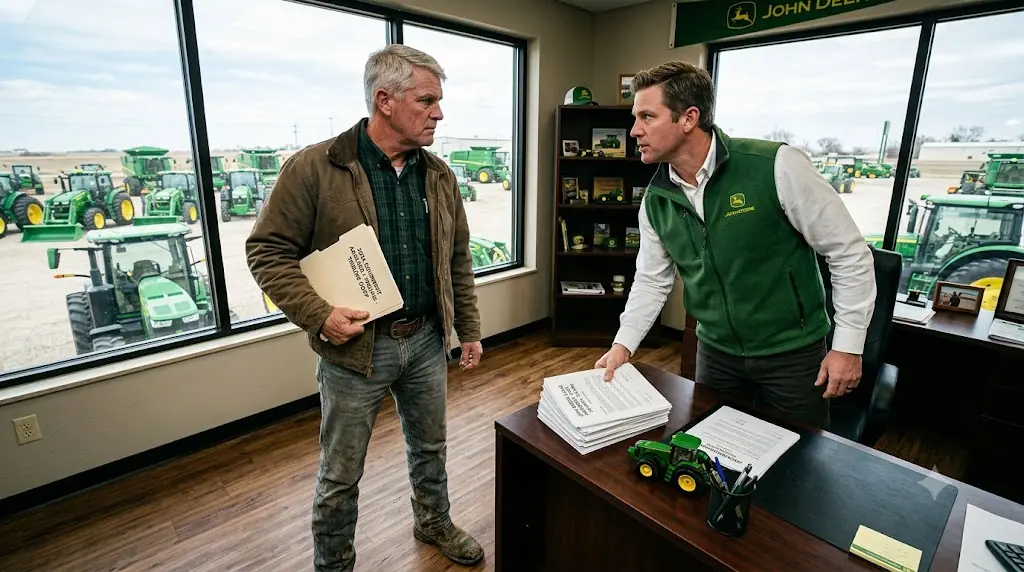
“Not with your repair trap,” Calvin said.
Brandon’s polished confidence hardened into contempt. He had cultivated the sale for eleven months, invited cooperative board members to demonstrations, arranged financing, and promised delivery before the summer harvest. His regional manager had already counted the order in the quarterly forecast, and Brandon had mentally spent the commission on a finished basement and a family vacation. He had not come to negotiate; he had come to collect Calvin’s signature.
“Walk away, and you’re finished,” Brandon warned. “No dealer in Kansas will prioritize a cooperative that wastes eleven months of our time.”
Calvin raised the folder between them. “Keep them—farmers will learn the truth.”
The salesman stared at him as if he had lost his mind. The Greeley County Farmers Cooperative operated one of the largest agricultural fleets in western Kansas, and its existing machines were between eight and twelve years old. Several tractors needed hydraulic work, two combines showed bearing wear, and the maintenance yard seemed to produce a new problem every week. Every visible fact suggested that Calvin should sign.
What Brandon could not see was the research inside Calvin’s folder.
For sixteen months, Calvin had studied a change coming to agricultural equipment—a change hidden not in steel, horsepower, or fuel consumption, but in software. The newest machines were moving toward closed diagnostic systems that independent mechanics would not be allowed to access. When a sensor failed, an engine code appeared, or an electronic controller needed resetting, only an authorized dealer would possess the required software and permissions. Farmers would still own the machines, but they would no longer control who repaired them.
Brandon stepped around the desk. “You think you understand our service system better than trained engineers?”
“I understand dependency.”
“You understand fear.”
“I understand arithmetic.”
Brandon gave a sharp laugh. “Your old fleet will bleed money. When those combines fail during harvest, your board will remember that I offered you the best machines on the market.”
“They’ll also remember that you never discussed what happens when the machines refuse to recognize a mechanic we choose.”
“You’re canceling forty units over speculation?”
“No,” Calvin said. “I’m canceling because three independent lines of evidence reached the same conclusion.”
Brandon’s expression shifted. Until that moment, he had believed Calvin was bluffing for better terms. Now he realized the cooperative manager had already made the decision. No discount, financing structure, or delivery promise could restore the sale because Calvin was no longer evaluating the machines; he was rejecting the system attached to them.
“You’ll regret humiliating this dealership,” Brandon said.
Calvin closed the folder. “That depends on which one of us is embarrassed when the invoices arrive.”
He walked out through the showroom while employees watched from behind counters and glass offices. Green machines towered on either side of him, beautiful and silent, each one carrying a price visible on paper and another cost hidden inside years that had not happened yet. Calvin stepped into the cold March wind, climbed into his weathered pickup, and drove back toward the cooperative.
The decision had begun sixteen months earlier when a retired engineer named Norman Hastings appeared at Calvin’s office after sunset.
Norm had worked in product development for twenty-seven years before retiring to a small wheat farm twelve miles outside Tribune. He arrived wearing a faded canvas jacket and carrying his hat in both hands, looking less like a corporate insider than a man asking permission to borrow a tool. Calvin had met him only twice, but he recognized the gravity in his expression.
“I need to show you something,” Norm said.
Inside Calvin’s office, he removed a folded product roadmap from his coat. The document outlined a long-term shift toward integrated software platforms, dealer-controlled diagnostics, restricted service tools, and electronic systems designed to operate within an authorized network. Nothing in the language sounded openly threatening. It spoke instead of efficiency, digital ecosystems, brand integration, and improved customer support.
Calvin read it twice.
“You’re telling me independent mechanics will eventually be locked out,” he said.
Norm nodded. “Not all at once. That would create resistance. Access will narrow over several product generations until farmers realize the transition only after their alternatives are gone.”
“What will it do to labor rates?”
“An independent mechanic charges between sixty-five and ninety dollars an hour around here. Authorized dealers already charge far more. Remove competition, and there’s nothing preventing diagnostic rates from climbing past two hundred.”
Calvin leaned back. “Across forty machines operating twelve hours a day during planting and harvest.”
“The service increase over ten years could exceed the purchase price.”
Those words remained in the room long after Norm stopped speaking. Calvin imagined a tractor sitting motionless during planting because an electronic code required a dealer technician who could not arrive for three days. He imagined farmers paying loan installments on machines they could not repair, while independent mechanics who had served them for decades stood outside the locked software system. The future did not look like progress. It looked like ownership stripped of control.
“Why bring this to me?” Calvin asked.
“Because your cooperative is large enough to prepare before the transition,” Norm said. “And because when everyone else notices, it will be too late to avoid the first wave.”
Calvin did not act immediately. He thanked Norm, locked the document in his desk, and spent the next year trying to prove the retired engineer wrong. If the warning collapsed under scrutiny, Calvin would sign the fleet order and forget the conversation. If it survived, he would have to make the most unpopular decision of his career.
His first evidence came from trade publications. Articles praised agricultural software integration, remote diagnostics, proprietary data platforms, and networks linking machinery to manufacturer services. Individually, none admitted that farmers would lose repair freedom. Together, they described exactly the direction Norm had predicted.
Calvin highlighted passages and stored them inside a folder.
His second line of evidence came from Dr. Patricia Holden, an agricultural economist at Kansas State University. She had modeled long-term ownership costs under closed repair architectures, though few farmers had read her work because it was buried in academic language and treated as a distant concern. Calvin drove three hours to her office and questioned her for nearly an afternoon.
“What happens when a manufacturer becomes the only practical service provider?” he asked.
“Competitive pressure disappears,” she replied. “Labor rates rise, response times worsen, and owners absorb the cost because switching equipment platforms is expensive.”
“How much could costs rise?”
“Depending on fleet usage, between one hundred eighty and two hundred forty percent over seven to ten years.”
Calvin wrote every number down.
The third line of evidence came from independent mechanics. He visited repair shops across western Kansas without explaining the full reason for his questions. Each mechanic described changes already appearing in newer machines: inaccessible fault codes, resets requiring proprietary systems, restricted manuals, and diagnostic tools that no longer completed functions they had performed the previous year.
Cleat Dawson, a mechanic outside Dighton, gave the bluntest warning.
“In three years, I won’t be able to touch half the new equipment coming through that door,” Cleat said. “Not because I forgot how engines work. Because the computer will refuse to let me finish the repair.”
“And the dealer?”
“The dealer will name the price because the farmer won’t have another door to knock on.”
By February 2012, Calvin’s model was complete. He compared the proposed $12.4 million purchase against refurbishing the cooperative’s current fleet. He included downtime, replacement parts, fuel use, mechanic wages, authorized service rates, financing costs, and projected software restrictions. He tested best-case and worst-case scenarios.
The older fleet remained cheaper.
Calvin presented his findings to the cooperative board during a ninety-minute meeting. Seven farmers sat around the long conference table, studying graphs that contradicted every sales presentation they had seen. The machines needed repairs, and the board had spent two years preparing for replacement. Walking away felt irresponsible.
Frank Odell, the fleet manager, pushed back hardest. “You’re asking us to keep equipment that’s already aging out.”
“I’m asking us to preserve control over our repair costs.”
“We know the maintenance cost of old machines. We don’t know that these projected service rates will happen.”
“We know the direction,” Calvin said. “We know independent access is narrowing, and we know what happens when competition disappears.”
One board member tapped the table. “Are you asking us to trust an estimate over forty new machines we can see?”
“I’m asking you to trust evidence over paint.”
The vote passed seven to two.
That approval led Calvin into the John Deere dealership, where Brandon tried one final time to force the signature. By noon, the canceled order had become the largest story in Greeley County. By evening, people at the feed store were calling Calvin stubborn, frightened, and too old to understand modern agriculture.
The criticism continued for eighteen months.
Every repair on the cooperative’s aging fleet became public evidence against him. When a hydraulic pump failed, farmers said a new tractor would have prevented it. When one combine remained idle for two days awaiting a bearing, two board members demanded another meeting. Rival cooperative managers openly mocked Calvin’s refurbishment program.
Doug Sellers managed the Western Kansas Tri-County Cooperative sixty miles north. Six weeks after Calvin canceled his order, Doug signed a $14.8 million agreement for forty-two new John Deere machines. At an industry meeting in Wichita, he criticized unnamed managers who confused caution with wisdom.
Everyone knew he meant Calvin.
“A cooperative unwilling to modernize becomes a museum,” Doug told the room.
Calvin sat three rows away and said nothing. The evidence was not yet visible, and arguing too early would turn the issue into a contest between personalities. He believed reality would eventually make the case more effectively than he could.
That patience became difficult during the summer of 2013.
Frank entered Calvin’s office carrying repair invoices. “We’re sixty thousand dollars over the refurbishment budget.”
Calvin opened his model. “Find year two, maintenance variance.”
Frank scanned the column. The projection showed fifty-five thousand dollars above the original budget.
“We’re still inside the model,” Calvin said.
Frank looked at him differently. “You predicted this three years ago.”
“I allowed for it.”
“And you still believe keeping the old fleet is cheaper?”
Calvin pointed to the ten-year comparison. “If the service rates follow the trajectory supported by the evidence, we save more than two million dollars by year seven.”
“If they don’t?”
“They will.”
Frank remained silent for a long moment. “What aren’t you telling us?”
“Something I can’t prove publicly yet.”
“That answer won’t satisfy everyone.”
“It doesn’t have to. The numbers do.”
The cooperative continued refurbishing tractors and combines. Local mechanics rebuilt transmissions, replaced hydraulic systems, repaired wiring, and manufactured parts no longer readily available. Calvin expanded the maintenance shop and hired two apprentices, creating a repair program capable of responding during planting and harvest without waiting for outside technicians.
The old machines did not become new.
They became dependable.
Then, in 2015, the software transition became impossible to ignore.
Farmers who purchased newer equipment began encountering problems independent mechanics could diagnose but could not fully resolve. A technician might replace the correct sensor yet remain unable to clear the fault code. A repaired machine could refuse to operate until authorized software completed an electronic verification. Dealer appointments stretched from hours into days during the busiest seasons.
Service rates climbed.
Doug Sellers received his first major invoice after a combine shut down during harvest because of an electronic control issue. The physical replacement took less than two hours. Diagnostic access, travel charges, software initialization, and dealer labor transformed the repair into a bill several times larger than expected.
More invoices followed.
By early 2016, Doug’s authorized diagnostic rate had reached $247 per hour. Scheduled service cost more than $200, and his cooperative had no practical alternative. The fleet carried millions in debt, and switching brands would require absorbing another massive loss.
Doug called Calvin at 7:15 one morning.
“You knew,” he said without greeting him.
“I had evidence.”
“In 2012?”
“Earlier.”
Doug exhaled through the telephone. “My service costs have risen by three hundred forty thousand dollars annually. My operating margin is disappearing.”
Calvin looked through his office window toward the maintenance yard. Mechanics were rebuilding a gearbox on an eleven-year-old tractor, using tools the cooperative owned and knowledge no software company controlled.
“What do I do?” Doug asked.
Calvin could have reminded him of the speech in Wichita. He could have enjoyed the vindication, demanded an apology, or allowed a rival cooperative to suffer the consequences of its confidence. Instead, he pulled a legal pad closer.
“You organize.”
“With whom?”
“Every cooperative trapped in the same service structure.”
“What good does that do when the dealer is the only option?”
“One cooperative has no leverage. Fifteen cooperatives representing millions in annual service work do.”
Doug became quiet. “You’d help us?”
“Yes.”
“After what I said about you?”
“You made a bad judgment, not a lifelong commitment.”
Doug swallowed his pride. “I owe you an apology.”
“Use it to make the next decision better.”
Over the following months, Calvin contacted cooperative managers across western Kansas. Some had mocked him. Others had ignored the cancellation because they assumed it resulted from financing problems. All now faced rising authorized service costs and equipment they could not freely repair.
Fourteen managers gathered inside the same conference room where Calvin once rejected Brandon’s contract.
Norm Hastings sat in the back with his weathered hat in his hands.
Calvin placed the old product roadmap on the table. For the first time, he revealed the document that started his investigation. The managers read the language describing integrated platforms and authorized diagnostic networks, then compared it with the invoices spread before them.
Frank looked toward Norm. “You brought this to him in 2010?”
Norm nodded. “I knew where the company was going. Calvin was the only manager I trusted to verify it instead of dismissing me or panicking.”
Doug stared at Calvin’s original model. The projected service rates were within eight percent of the actual costs his cooperative now paid.
“You saw this six years ahead,” he said.
“No,” Calvin replied. “I saw a warning. Then I did the work.”
That distinction mattered to him. He was not a prophet, and he had not canceled the order because of instinct alone. He had gathered independent evidence, tested assumptions, challenged his own conclusion, and accepted public criticism while waiting for results.
The meeting created the Western Kansas Cooperative Service Alliance.
Together, the cooperatives represented enough equipment and annual service spending to become impossible for regional management to ignore. They demanded volume pricing, guaranteed response times during planting and harvest, transparent diagnostic fees, and standardized contracts preventing unexpected charges. They also funded training programs for independent mechanics and began purchasing future equipment based partly on repair accessibility.
The first negotiation was difficult.
Dealer representatives initially insisted that rates reflected specialized technology and technician training. Calvin agreed that expertise deserved fair payment but rejected pricing made possible only by eliminated alternatives. He presented service records showing that multiple cooperatives paid different rates for identical diagnostic work.
“If the value comes from expertise,” Calvin said, “explain why the same expertise changes price according to how trapped the customer is.”
The room went silent.
Within three months, alliance members received a twenty-two percent reduction in authorized service rates. The agreement did not restore open repair access, but it prevented several cooperatives from losing their operating margins. More importantly, farmers learned that collective action could recover some control even after individual contracts had taken much of it away.
Brandon Cowell attended one of the final meetings.
He was no longer smiling when Calvin entered. Six years had passed since the confrontation inside the dealership, and Brandon’s hair had begun graying at the temples. The basement commission had disappeared with the canceled order, but he had continued selling equipment and had watched customers become angrier as service costs rose.
“You made me look like a liar,” Brandon said privately.
“I never said you knew what was coming.”
“You called it a repair trap.”
“That’s what dependency becomes when the customer discovers it too late.”
Brandon looked through the meeting-room window at farmers gathering outside. “Do you still believe canceling was worth it?”
Calvin handed him the latest report. The Greeley County Cooperative had saved more than $2.3 million compared with the projected ownership cost of the new fleet. Its maintenance shop employed independent mechanics, trained apprentices, and kept most machines operational without dealer authorization.
“The numbers answered that,” Calvin said.
Brandon studied the report. “Forty machines would have made my career.”
“They might have broken forty farming operations.”
The salesman closed the folder. For the first time, he seemed to understand that Calvin had not attacked him personally. He had rejected a transaction whose consequences extended far beyond one commission check.
Years later, the restored tractors at Greeley County continued operating. Some carried faded paint, welded panels, and replacement parts manufactured in local shops. They were not as elegant as the machines Calvin had walked past in the showroom, but farmers could open them, understand them, repair them, and return them to work.
The cooperative placed Calvin’s original cost model inside its records room beside Norm’s product roadmap. New board members were required to study both before approving major equipment purchases. The lesson was not that new technology should always be rejected or that old machinery was inherently better.
The lesson was that ownership without control carried a hidden price.
Calvin retired after forty-two years in agricultural management. On his final morning, he stood by his office window holding coffee in both hands and watched Frank’s apprentices repair a tractor in the yard. Beyond them stretched the flat Kansas horizon, wide enough to make every human decision look small and every consequence impossible to hide forever.
Doug arrived carrying a framed copy of the canceled $12.4 million order.
Across the bottom, the cooperative managers had written a message.
For the man who trusted the evidence before the rest of us could see it.
Calvin read it and shook his head. “You make it sound like I did something heroic.”
“You protected hundreds of farmers while we called you a fool,” Doug said.
“I made a decision.”
“And stood by it.”
Calvin looked toward the maintenance yard again. “Standing by a decision is easy when everyone agrees. The real test comes during the years when you may be right, but nothing visible has proved it yet.”
He hung the framed contract near the door—not as a trophy, but as a warning.
The forty machines were never delivered.
The commission was never paid.
The signatures Brandon expected never touched the paper.
But the cancellation gave one cooperative time to prepare, gave independent mechanics years of meaningful work, and eventually helped farmers across western Kansas negotiate as a united force.
Calvin had walked into a John Deere dealership with a folder beneath his arm and forty machines waiting behind glass.
Then he walked away from $12.4 million in polished steel because he understood that the most dangerous cost was not always printed on the contract.
Sometimes it was hidden inside the future—and waiting for every farmer who signed.