“I married you to card wool, not gamble away my ranch.”
Caleb Mercer slammed the merchant’s contract onto the rough sorting table so hard that the loose fleece jumped beneath Eleanor’s hands. Dust drifted through the late-afternoon sunlight, and hundreds of restless sheep pressed against the wooden rails behind them. Caleb stood on the opposite side of the table with one hand gripping the fence, his broad shoulders rigid beneath a faded gray shirt and worn leather vest. His dark beard framed a face shaped by hard winters, failed lambing seasons, and a bank note due in less than three weeks.
Eleanor Mercer did not flinch.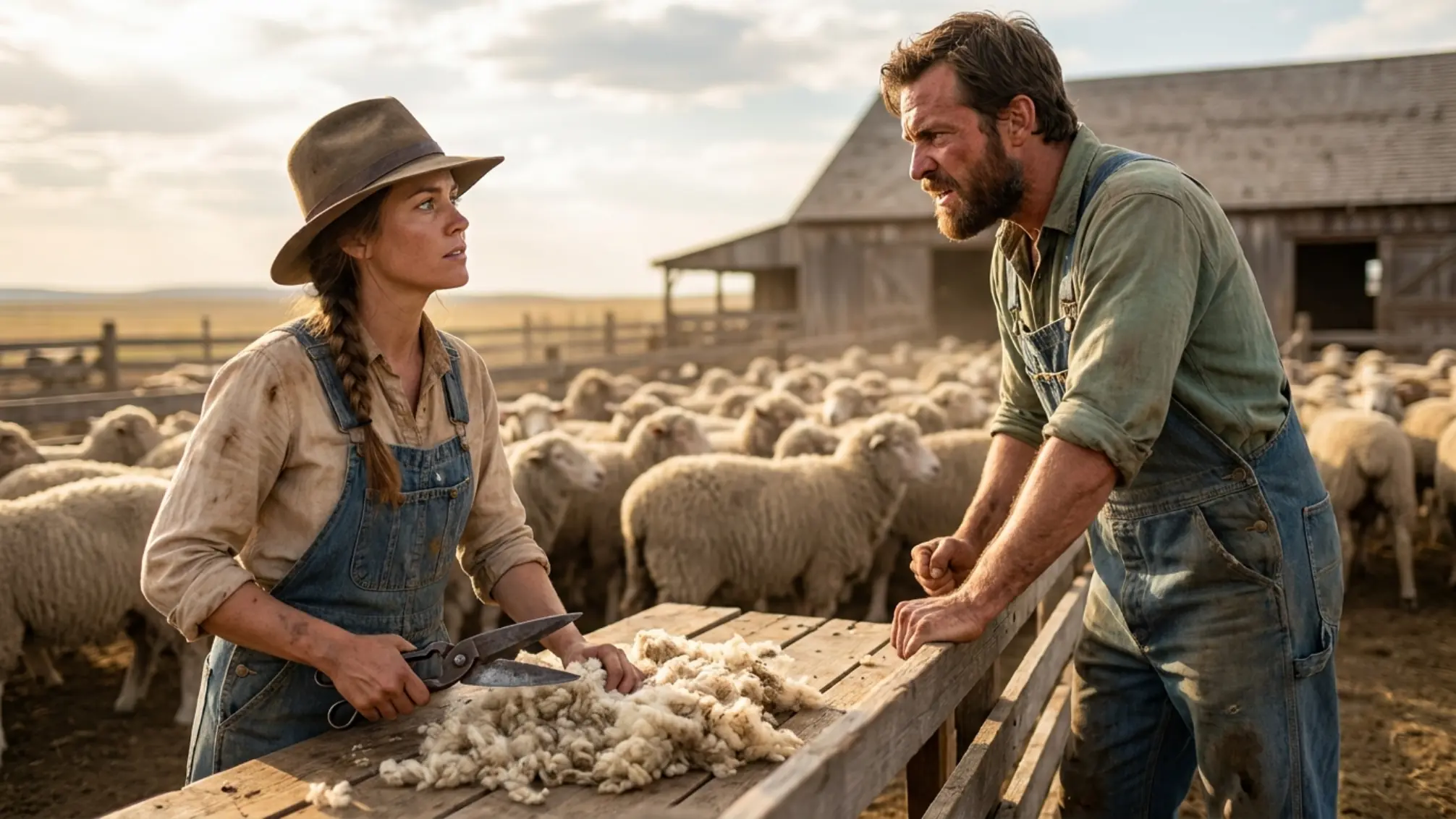
She was twenty-six, with green eyes, fair sun-browned skin, and long dark hair braided beneath an old ranch hat. Her cream blouse was rolled above her elbows, and a stained leather apron protected her long skirt from grease and wool dust. In her right hand, she held the heavy steel shears Caleb had taught her to sharpen during their first week of marriage.
“Your buyer offered pennies because he thought I was ignorant,” she said.
“He offered cash.”
“He offered theft with a signature line.”
Caleb stepped around the table. “Silas Crowe controls every wool shipment between Laramie and Cheyenne. If we refuse him, the fleece stays in that barn until it rots.”
Eleanor raised the shears slightly—not as a weapon, but as a warning not to crowd her.
“Sign his contract now,” Caleb said, “or leave my land tonight.”
She reached beneath the table and threw down a sealed envelope bearing the stamp of the Union Pacific freight office.
“Touch that contract,” she said, “then watch the railroad buyer pay off your bank by sunrise.”
Caleb stared at the envelope.
For nearly a year, he had assumed his wife knew nothing beyond domestic work, needlework, and the quiet duties expected from a woman who had answered a marriage advertisement in an eastern newspaper. He had wanted someone capable of cooking, keeping accounts, tending an injured lamb, and helping prepare raw fleece for sale. He had not wanted a business partner.
He certainly had not expected one.
Caleb Mercer had been thirty-three when he placed the advertisement.
Wyoming rancher seeks practical wife. Must accept hard winters, isolated life, and honest work. Knowledge of wool preparation preferred.
He received twenty-seven responses. Most came from women seeking adventure, security, or escape from families who considered them burdens. Eleanor Hale’s letter was different.
She did not describe herself as gentle, obedient, or cheerful.
She asked questions.
How many sheep did he own?
What breed?
What was the average fleece weight?
How much did he receive per pound?
Who bought it?
Did he sell raw wool, washed wool, carded wool, or spun yarn?
Caleb almost discarded the letter because it sounded more like an interrogation than courtship. Yet something about the precision interested him. He replied with short answers and expected never to hear from her again.
She wrote back three days later.
Your sheep are producing enough wool to support the ranch. Your problem is not the flock. Your problem is what happens after shearing.
Caleb read that sentence six times.
Then he sent for her.
Eleanor arrived in Laramie in the spring of 1887 carrying one wooden trunk, two carpetbags, and a portable spinning wheel wrapped in canvas. She wore a dark blue traveling dress and did not appear frightened when Caleb met her at the station.
He was taller than she expected, lean but powerful, with a face made older by weather and worry. His hat was dusty, his boots were cracked, and his wagon had one wheel repaired with iron strips. He apologized for the wagon before introducing himself properly.
Eleanor touched the damaged wheel.
“You repaired this yourself?”
“Yes.”
“Then it will reach the ranch.”
That was the first thing she ever said to him.
They married three days later in a small church near the railroad depot. Caleb’s foreman, Jonas Pike, stood as witness. The minister’s wife gave Eleanor a bouquet of yellow wildflowers, and afterward they ate cold chicken beside the station because Caleb could not afford a formal meal.
The Mercer ranch lay nearly twenty miles north of town, surrounded by open grassland and low hills stripped by constant wind. The house had two rooms, a leaking roof, and a kitchen stove that smoked whenever the weather turned east. The main sheep barn leaned slightly to one side, and several sections of fencing needed replacement.
Caleb watched Eleanor’s face as she stepped from the wagon.
He expected disappointment.
Instead, she asked to see the wool barn.
Inside were bales from the previous shearing season, stacked beneath torn canvas. Some had absorbed moisture. Others contained burrs, dirt, and grease that reduced their value. Caleb explained that Silas Crowe purchased the fleece each year and deducted processing costs from the final price.
“How much did he pay last season?” Eleanor asked.
Caleb named the amount.
She looked at the bales again.
“That is less than half what this wool should bring.”
“He sets the local price.”
“He sets the price because everyone lets him.”
Caleb’s expression hardened. “You have been here less than an hour.”
“And the wool has been here all winter.”
Their first argument occurred before her trunk entered the house.
The second happened that evening when Eleanor discovered Caleb had borrowed heavily against the next shearing season. The ranch owed the Territorial Bank of Wyoming more than four thousand dollars. Interest accumulated monthly, and failure to make the summer payment would allow the bank to seize the southern pasture.
Caleb had inherited the ranch from his father along with two hundred aging ewes and a reputation for never asking help. He expanded the flock, survived two blizzards, and nearly doubled production. Yet every year, Silas Crowe lowered the wool price while transport, feed, medicine, and bank interest increased.
Caleb worked harder.
The ranch grew poorer.
Eleanor studied the account book after supper.
“Why do you sell all the wool raw?”
“Because that is what ranchers do.”
“Some ranchers.”
“All ranchers here.”
“That does not make it wise.”
Caleb took the ledger from her. “I did not bring you west to criticize how I run this place.”
“You brought me because your advertisement asked for someone who understood wool.”
“I asked for help carding it.”
Eleanor met his eyes. “Then let me help.”
For the next month, she said little about prices.
She learned the ranch first.
She rose before dawn, made coffee, and followed Caleb into the lambing pens. She treated infections, repaired torn sacks, marked weak animals, and discovered which ewes became dangerous when separated from their young. Her hands blistered from hauling water, then hardened.
Jonas Pike expected her to quit within two weeks.
By the sixth week, he asked her advice about a ewe refusing to nurse.
Eleanor also examined every stored fleece.
She separated fine wool from coarse, discarded contaminated sections, washed small batches in heated tubs, and built drying racks beside the barn. At night, she spun yarn by lamplight while Caleb repaired tack across the room.
The spinning wheel irritated him.
Its steady rhythm filled the house with a sound that suggested a plan he did not understand.
“What are you making?” he asked.
“Samples.”
“For whom?”
“Buyers.”
“We have a buyer.”
“We have a man who profits from our lack of buyers.”
Caleb set down the leather strap he was stitching. “You will not provoke Silas Crowe.”
Eleanor continued spinning.
“He cannot take what we do not sell him.”
“He can refuse every rancher in the county who crosses him.”
“Then perhaps the county needs another market.”
Caleb stood. “You think because you read a few books in Boston, you understand Wyoming?”
Eleanor’s hands stopped.
“My father owned a textile mill in Massachusetts.”
Caleb stared at her.
She had never mentioned her family beyond saying both parents were dead.
“Our mill purchased raw fleece from Vermont, Ohio, and Pennsylvania,” she continued. “I learned grading at twelve, washing at fourteen, carding at sixteen, and contract pricing before I was old enough to vote—which, being a woman, I still cannot do in most states.”
“What happened to the mill?”
“My father trusted a partner who sold inferior goods under our name. The contracts vanished. The bank took the building. My father died six months later.”
Caleb’s anger softened, though pride prevented him from apologizing.
“Why did you answer my advertisement?”
“Because you had sheep, land, and the exact problem I knew how to solve.”
“That sounds like business, not marriage.”
“At first, it was both.”
The answer stayed with Caleb long after Eleanor carried the yarn into the bedroom.
She began traveling to town every other Thursday. Caleb believed she was purchasing household supplies. In truth, she visited the freight office, telegraph office, dressmakers, and hotel managers.
She displayed samples of cleaned wool and tightly spun yarn.
Most merchants dismissed her politely. Some refused to negotiate with a woman. One dry-goods owner advised her to return with her husband.
Eleanor returned alone the following week.
Eventually, a dressmaker named Abigail Stone bought twenty pounds of spun yarn. She paid nearly four times what Silas Crowe would have offered for the same amount in raw fleece.
Eleanor invested the money in hand cards, soap, dye, and two secondhand spinning wheels.
Then she hired Clara Bell and Ruth Donnelly, widows living outside Laramie who supported five children between them. Both had experience spinning but no steady income. Eleanor paid them by finished weight and required consistent quality.
Caleb discovered the arrangement when he returned early from the north pasture and found three women working inside the wool barn.
“What is this?”
“A production line,” Eleanor replied.
“This is my barn.”
“And your wool.”
“You hired people without asking me.”
“I paid them from money I earned.”
“You earned it using my sheep.”
“Our sheep.”
The women stopped working.
Caleb looked toward them and lowered his voice. “Outside. Now.”
Eleanor followed him into the yard.
“You are turning my ranch into a factory.”
“I am turning your losses into products.”
“I need raw fleece ready for Crowe.”
“You need money for the bank.”
“He pays immediately.”
“So will my buyers.”
“What buyers?”
Eleanor showed him a small order from a hotel in Cheyenne requesting wool blankets. Another came from a railway supplier seeking heavy socks and cold-weather liners for maintenance crews.
Caleb read the pages slowly.
“These quantities are impossible.”
“Not if we hire more women.”
“Where?”
“There are families across Albany County who need work.”
“You cannot promise what we cannot produce.”
“I promised samples first. Full orders follow approval.”
Caleb handed back the papers. “And if they reject them?”
“Then Crowe buys what remains.”
He hated that she had considered the risk more carefully than he had.
The first blanket order nearly failed.
The washed wool dried unevenly after two days of rain. One spinning wheel broke. A batch of gray dye turned brown, and several finished blankets shrank because the women used water that was too hot.
Eleanor worked for thirty-six hours without sleeping.
Caleb found her before sunrise repairing a loom strap with bleeding fingers.
“You’re going to ruin yourself.”
“The train leaves at noon.”
“Then miss it.”
“If we miss the shipment, the hotel cancels.”
“There will be other orders.”
“No. There are other orders for people who already have reputations. We have one chance.”
Caleb stood silently.
Then he removed his coat, rolled up his sleeves, and asked what needed doing.
Together, they completed the shipment with eleven minutes to spare.
The Cheyenne hotel accepted the blankets.
The manager ordered twice as many for winter.
Word spread.
Railroad workers preferred Eleanor’s thick socks because they remained warm when damp. Ranch families requested blankets. A merchant in Denver asked for dyed yarn samples. Eleanor created a simple mark stamped onto every package:
MERCER RANGE WOOL — WYOMING TERRITORY
Caleb pretended not to care about the label.
He kept one in his coat pocket.
Silas Crowe noticed the missing fleece before anyone expected him to. He arrived at the ranch in a black carriage wearing a dark suit inappropriate for dust and heat.
“You have failed to deliver this season’s wool,” he said.
Caleb stood near the barn. “We have not agreed on a price.”
“We have done business for seven years.”
“That is not a contract.”
Silas looked toward the women working inside. “Your wife has filled your head with foolishness.”
Caleb’s jaw tightened.
Eleanor stepped into the yard wearing her leather apron.
“My husband’s head is his own.”
Silas smiled. “Mrs. Mercer, ranch work is difficult enough without eastern women imagining themselves merchants.”
“Then you should have no trouble making a fair offer.”
“I make market offers.”
“You deduct cleaning, transport, storage, brokerage, and grading charges after purchasing ungraded fleece. Then you resell the best wool at three times the price.”
Silas’s smile vanished.
Caleb looked at her.
She continued. “Your weight records also differ from the railroad scales by six to eleven percent.”
“That is an accusation.”
“It is arithmetic.”
Silas turned to Caleb. “Control your wife.”
Caleb stepped between them.
“Leave my ranch.”
Silas’s face darkened. “You owe money. When the bank takes this place, do not expect my help.”
He climbed into the carriage and left.
That evening, Caleb asked Eleanor about the railroad scales.
She showed him three years of Crowe’s receipts compared with shipping records stored at the freight office. The differences amounted to hundreds of dollars.
“He has been cheating every rancher who sells to him,” Caleb said.
“Yes.”
“Why haven’t you told anyone?”
“They would not believe me without proof.”
“Will they believe it now?”
“I need Crowe’s original weighing ledger.”
Obtaining it proved easier than expected because Silas considered women invisible. During his next inspection at the freight warehouse, he left the ledger open while arguing with a clerk. Abigail Stone copied several pages and delivered them to Eleanor that night.
The records confirmed systematic underpayment across five counties.
Eleanor planned to confront Crowe publicly after the summer wool auction.
Before she could, the bank called Caleb’s note.
The notice arrived by messenger on a Tuesday morning. Payment was due within ten days rather than three weeks. The bank claimed the ranch’s declining raw-wool sales increased its risk.
Caleb understood immediately.
“Crowe pressured them.”
“He may have purchased the note,” Eleanor said.
“Can we pay it?”
She examined the accounts.
Their small orders had produced profit, but most money had been reinvested into equipment and wages. The large railroad contract had not yet been approved.
“We are short fourteen hundred dollars.”
Caleb sat at the kitchen table.
For the first time since Eleanor arrived, he looked defeated.
“We sell the southern pasture.”
“Then the ranch loses winter grazing.”
“We lose it anyway if the bank forecloses.”
Eleanor placed a sealed envelope on the table.
The Union Pacific purchasing office had requested a private demonstration in Laramie. If the samples passed inspection, the company would order three thousand blankets, four thousand pairs of socks, and insulated wool padding for freight crews operating through mountain passes.
The advance alone would pay the bank.
“When?” Caleb asked.
“Tomorrow.”
“What do they need?”
“Proof we can produce at scale.”
“We cannot.”
“Not yet.”
Caleb looked toward the barn, where sixteen women now worked on wheels, cards, and looms.
“How many more?”
“At least forty.”
“Where do we find them?”
Eleanor smiled faintly. “You ride west. I’ll ride east.”
For the next twelve hours, they visited every struggling household within twenty miles. They offered paid training, steady wages, and a share of bonuses if the railroad contract succeeded.
Women came first.
Then older men unable to manage ranch labor.
Then teenagers whose families needed winter income.
The wool barn became too small, so Caleb cleared the machinery shed and built additional tables. Jonas organized deliveries. Clara Bell supervised spinning quality, while Ruth Donnelly managed dyeing and washing.
At sunrise, two wagons carried samples, production records, worker schedules, and cost estimates toward Laramie.
Caleb and Eleanor entered the railroad office together.
Three purchasing officials examined the blankets, stretched seams, tested weight, checked wool density, and compared prices. Eleanor answered every question clearly.
Caleb said nothing unless asked.
After two hours, the senior buyer offered a contract larger than anything Eleanor had dared expect. The railroad would provide a thirty-percent advance upon signature.
The amount was enough to pay the bank, repair the barn, purchase machinery, and retain emergency savings.
Eleanor signed first.
Caleb signed beneath her.
They returned to the ranch near sunset.
Silas Crowe was waiting.
He stood beside the sorting table holding his old contract, unaware of the railroad agreement inside Eleanor’s coat. He had already heard that the bank deadline had been accelerated and assumed desperation would force Caleb to surrender.
That was when the confrontation erupted.
“I married you to card wool—not gamble away my ranch!” Caleb shouted, performing the anger Eleanor had asked him to show.
Her eyes flashed, but she understood.
Silas needed to believe husband and wife were divided.
“Your buyer offered pennies because he thought I was ignorant,” she replied.
Caleb stepped closer. “Sign his contract now—or leave my land tonight.”
Eleanor threw down the sealed railroad order.
“Touch that contract—then watch the railroad buyer pay off your bank by sunrise.”
Silas stared at the envelope.
Caleb stopped pretending.
He opened it and displayed the advance authorization.
“You called the note too early,” he said. “You expected us to fail before another buyer could act.”
Silas’s face tightened. “You cannot prove I influenced the bank.”
Eleanor placed copied ledger pages beside the railroad contract.
“But we can prove you altered weights and underpaid ranchers.”
Silas looked from one page to another.
Jonas opened the barn doors.
Behind him stood nearly forty ranchers who had received word of the evidence and gathered to hear the truth. Some carried their own Crowe receipts.
Caleb raised his voice.
“For seven years, he told us our wool was dirty, light, and poorly graded. Then he changed the weights after purchase and kept the difference.”
Silas pointed at Eleanor. “She stole private records.”
“The freight warehouse recorded the lawful weights,” Eleanor said. “Your ledger recorded what you claimed to pay. The difference belongs to these ranchers.”
One older shepherd pushed through the crowd.
“You took four hundred pounds from me last year.”
Another stepped forward. “Six hundred from my brother.”
Silas backed toward his carriage.
“You will regret this.”
Eleanor folded her arms. “No. You will explain it to the territorial court.”
The investigation lasted four months.
Silas lost his trading license and was ordered to repay thousands of dollars. The bank denied knowingly participating in his scheme, though two directors resigned after their correspondence became public.
The Mercer ranch paid its note in full.
The railroad contract transformed the operation.
Caleb built a proper processing house with washing vats, carding machines, spinning stations, and six looms. By the following winter, sixty-three people worked there. Widows earned reliable wages. Young families remained in Wyoming instead of leaving for cities. Ranchers received fair prices based on verified weight and quality.
Eleanor created separate grades for wool and taught local producers how breeding, feeding, and storage affected value. Better fleece earned better prices, encouraging improvements throughout the county.
Caleb stopped calling it his ranch.
It became the Mercer Wool Cooperative.
Three years later, the railroad expanded the contract across the western territory. Hotels ordered blankets. Mining companies purchased heavy socks and insulated liners. A Denver merchant sold Mercer yarn under its original label rather than replacing it with his own.
Eleanor’s name appeared on every contract.
One evening, she found Caleb repairing the old sorting table where their confrontation with Silas had taken place.
“You threatened to throw me off the land,” she said.
“You told me to make it convincing.”
“You enjoyed the performance.”
“A little.”
She sat beside him.
“Did you truly believe I was gambling with the ranch?”
“At first.”
“And now?”
Caleb looked toward the processing building, where lamplight shone through the windows and spinning wheels continued turning after sunset.
“Now I think I gambled when I kept selling to Crowe.”
Eleanor smiled.
He reached for her hand.
“When you answered my advertisement,” he said, “you wrote that my sheep could support the ranch.”
“They could.”
“You also said the problem was what happened after shearing.”
“Yes.”
“I thought I needed a wife to card wool.”
“You did.”
Caleb laughed softly. “I did not know she would build an empire from it.”
Eleanor leaned against his shoulder.
“I did not know either.”
The Mercer ranch eventually expanded to three thousand acres, but its greatest growth was measured inside the homes surrounding it. Children attended school because their mothers earned wages. Aging ranchers kept their land because the cooperative paid honest prices. Families once dependent on Silas Crowe gained access to railroad and eastern markets.
Eleanor refused to take sole credit.
She said Caleb gave her sheep, land, and the opportunity to test what she knew.
Caleb corrected anyone who repeated that version.
“She gave the ranch a future,” he said.
Years later, visitors asked about the framed contract hanging inside the cooperative office. Beneath it rested Silas Crowe’s rejected agreement.
One offered pennies.
The other saved the ranch.
The difference between them was not merely price. It was the difference between a man who looked at wool and saw desperate ranchers to exploit, and a woman who looked at the same fleece and saw workers, blankets, contracts, and a business no one else had imagined.
Caleb had believed strength meant surviving alone.
Eleanor taught him that survival could become prosperity only when knowledge was respected, labor was shared, and pride stopped pretending it already knew the answer.
He had married her to card wool.
She taught an entire county what the wool was truly worth.