“Your husband’s gone, and you’re too clueless to farm this place alone. Sell before you ruin it.”
Dale Briggs leaned against the stone well and laughed as if the entire cattle yard belonged to him. Three neighboring farmers stood behind him near the weathered barn, grinning while seventy Hereford cattle moved through the muddy pasture. Thirty-six-year-old Maisie Vaughn kept feeding hay, refusing to reward him with the frightened reaction he had come to collect.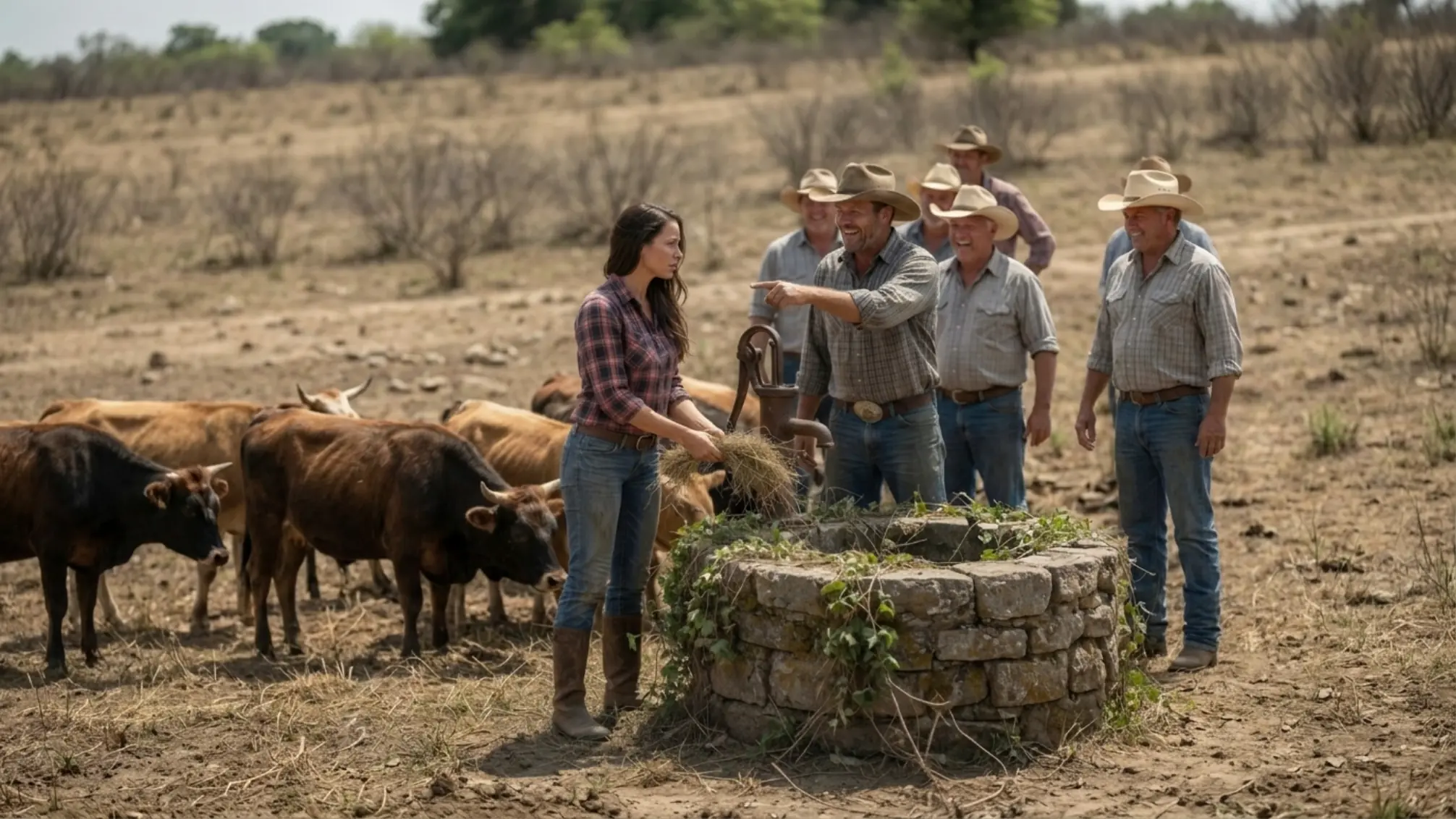
She had lightly tanned skin, fierce hazel-green eyes, and long dark-brown hair pulled over one shoulder beneath a straw farming hat. Her red-and-navy plaid work shirt was damp with sweat, her jeans were stained with mud, and her boots had already sunk twice into the softened ground around the old pump. Yet she stood straighter than every man watching her.
“You sold your water for forty thousand dollars,” Maisie said, “without knowing what your grandfather signed.”
The laughter stopped.
Dale glanced toward the rusted pump. “Keep digging through weeds, widow. Cascade will own this aquifer before harvest.”
Maisie finally looked at him. “Then bring them here at sunrise—and watch one letter from 1919 drown every contract you signed.”
Dale’s smile weakened, though he tried to hide it behind another laugh. He pointed at the cattle, mocked the rough pasture, and told the others she had lost her mind after her husband’s death. Then the men climbed into their trucks and left the farm beneath a cloud of dust.
Maisie waited until the last engine disappeared beyond the tree line.
Only then did she allow her shoulders to fall.
Fourteen months earlier, her husband Travis had died at their kitchen table while pouring coffee. His heart stopped without warning, and the cup shattered across the linoleum before Maisie understood that the man she had loved since she was nineteen would never speak again.
Since the funeral, every decision had become hers.
The bank wanted her to borrow $140,000 for a new combine and convert the northeast pasture into corn. Equipment dealers told her cattle were inefficient. Neighboring farmers warned that a woman running an old family farm without a husband would lose everything within two seasons.
Maisie listened to all of them.
Then she continued doing what the ground required.
The northeast forty-three acres looked worthless from the county road. Sumac, hawthorn, brush, and flood debris covered most of it. The cattle moved through the growth slowly, eating what they could and opening paths where machinery had not traveled in decades.
But Maisie remembered something Travis’s father had said years earlier.
“Never sell that corner. Never tile it. There is water beneath it—the kind that comes up.”
At the time, Maisie had been newly married and still learning which fields drained quickly after rain. Her father-in-law had spoken the warning during a February snowstorm, then looked directly at her instead of his son.
Travis forgot the conversation.
Maisie never did.
Three days before Dale mocked her, a white BMW had rolled into the gravel driveway. A thirty-eight-year-old executive named Brennan Mercer stepped out wearing Italian shoes, a gray jacket, and the polished smile of a man who expected rural people to feel honored by his presence.
He represented Cascade Water Resources.
Brennan sat at Maisie’s kitchen table and offered $180,000 for the groundwater extraction rights beneath the northeast acreage. He claimed the property contained no measurable aquifer and described the payment as found money for something that did not exist.
Maisie watched him place the contract beside the unpaid bills and the bank’s equipment-loan proposal.
“Nobody pays that much for nothing,” she said.
Brennan’s smile tightened. “The company wants consolidated rights across the county. Your parcel has strategic value even without usable water.”
“Then why does the offer expire Friday?”
“Business requires deadlines.”
“So does desperation.”
For one second, the salesman disappeared and something colder looked out through Brennan’s eyes. He left his business card beside the contract and warned Maisie not to think too long.
She waited until his BMW disappeared before opening her father-in-law’s old metal filing cabinet in the attic.
The cabinet had not been touched since Travis carried it upstairs after his father died. Its bottom drawer still required lifting and pulling at the same time. Inside were tax receipts, seed invoices, equipment records, and documents dating back more than sixty years.
Behind a folder marked County Correspondence, 1979–1984, Maisie found a single sheet of notebook paper.
A rough map showed the northeast corner, the creek bend, and an X located sixty feet from the property line. Beneath it, someone had written:
Hand dug, 1919. Deepened, 1961. Casing sound as of 1986. Letter—Book 14, Page 87.
Maisie studied those words until the early morning light reached the kitchen window.
The next day, she drove to the county feed cooperative. Dale Briggs, Cole Pierce, and Wade Pierce sat outside discussing equipment prices. Dale called across the parking lot, telling her she should accept Cascade’s offer before the company realized a widow’s signature was not worth the trouble.
Maisie stopped at the door. “How many farms signed?”
“Eleven,” Dale answered proudly. “Easy money. We sold rights to water they say isn’t even there.”
A woman emerged from the side entrance before Maisie could respond. Sadie Pierce worked for the county extension office and had grown up on the neighboring farm. She pulled Maisie around the corner of the building, beyond the men’s view.
“Do not sign anything,” Sadie whispered. “Come to my office tomorrow before anyone else arrives.”
At eight the next morning, Sadie spread a geological map across her desk.
Cascade was not buying ordinary water access. It was purchasing permanent extraction rights across neighboring farms so the company could drill deep industrial wells and pipe groundwater to growing cities. Eleven landowners had signed contracts, and seven of those farms sat above the same eastern aquifer.
Sadie’s father had accepted $42,000.
Eight months later, the farmhouse well went dry.
The cattle well failed six weeks after that.
He had already spent nearly $60,000 trucking water onto land that supposedly contained none.
“When Cascade starts pumping,” Sadie explained, “every private well connected to this aquifer drops with it.”
She showed Maisie the official 1962 geological survey stating that the eastern half of Boone County held no significant groundwater. The survey bore the signature of Gregory Mercer, Brennan’s father.
Gregory left the state survey office three years later and founded Cascade Water Resources.
The same man who declared the aquifer nonexistent later built a company purchasing the rights to extract it.
Maisie called Brennan from her kitchen.
“I have considered your offer.”
His voice brightened. “Excellent. I can bring the final documents this afternoon.”
“The answer is no.”
A long silence followed.
“Mrs. Vaughn, perhaps you misunderstood the value.”
“Your father signed the survey claiming my land has no water.”
Brennan stopped breathing loudly enough for her to hear the silence change.
“I’ll call you back.”
“You won’t need to.”
She hung up, walked to the barn, and climbed into Travis’s old John Deere tractor.
Maisie had not operated it alone in seven years. The seat was too high, the controls felt stiff beneath her hands, and the cab still carried the faint smell of Travis’s canvas jacket and machine oil. She adjusted the seat, found the key hanging from baling twine, and turned the ignition.
The diesel engine coughed twice before settling into a steady idle.
A Rhino brush cutter remained attached to the rear hitch exactly as Travis had left it before his final morning. Maisie lowered the blade and drove toward the northeast corner.
The cutter tore through sumac and thorn bushes. Branches shattered beneath the blades while cattle watched from the far pasture. Maisie worked slowly, following the measurements drawn on the notebook page.
On the fifth pass, the cutter struck metal.
She shut down the power, climbed from the tractor, and pulled branches from the soil. Beneath decades of roots and leaf matter lay a round cast-iron cover set flush with the ground.
Stamped across its surface were the words:
HARWELL SUPPLY — 1919.
Maisie sat beside it and cried for the first time since Travis’s funeral.
The well had been there through droughts, water deliveries, bank meetings, and sleepless nights. Her husband’s family had protected it for nearly a century, yet the knowledge had almost disappeared with the people who carried it.
She returned with a pry bar and lifted the eighty-pound cover.
Cool air rose from a stone-lined shaft. Fifteen feet below, her flashlight reflected against a perfectly still surface of water. The limestone walls were carefully fitted, and a deeper steel casing disappeared beneath the visible shaft.
Four feet down, tucked inside a recess between stones, was a sealed tin tube.
Maisie opened it at the kitchen table.
Inside she found a hand-drawn map of three neighboring farms, a faded photograph of three young men standing beside the unfinished well, and a note directing her to Boone County Recorder’s Book 14, Page 87.
One man in the photograph was Travis’s grandfather, Walker Vaughn.
The others were Augustus Briggs and Jeremiah Pierce—the great-grandfathers of the men who had laughed at her.
According to the map, the three families had built the well together after returning from the First World War. They believed the aquifer beneath their adjoining farms would protect their descendants when dry years arrived.
But the legal agreement was not inside the tube.
It had been filed at the courthouse in 1919.
Before Maisie could retrieve it, Cascade returned.
Brennan arrived with the company’s general counsel, Vincent Roth. This time, the offer was $340,000 for the rights beneath the entire farm.
Maisie did not serve coffee.
“Why did the offer nearly double?” she asked.
“Strategic positioning,” Roth answered.
“Your company claimed there was no water.”
“We are attempting to resolve uncertainty.”
“The answer remains no.”
Roth closed his portfolio. “Our next visit will not be friendly.”
It was not.
A county engineer arrived two days later and claimed the rediscovered well was unregistered and illegal. Maisie had already invited Hank Donovan, a seventy-four-year-old licensed well driller, to inspect it.
Hank showed the young engineer his license and explained that a hand-dug well built before modern registration laws was legally protected. The 1961 secondary casing was also valid under the grandfather provisions of state law.
Then Hank asked who had reported the inspection.
The engineer refused to answer.
He returned to his truck and left without issuing a violation.
Hank watched the county vehicle disappear. “Someone with influence wants that well sealed before you prove what it reaches.”
He measured the static water level and examined the casing. His conclusion was unmistakable.
The well tapped the eastern aquifer, remained pressurized, and could sustainably produce approximately fourteen gallons per minute.
More importantly, it appeared nowhere on the official 1962 survey.
“Whoever prepared that map left this well off deliberately,” Hank said.
The lawsuit arrived the following Wednesday.
Cascade asked the court to prevent Maisie from using the well until ownership of the groundwater rights could be determined. The company’s final settlement offer increased to $600,000 if she signed before the hearing.
That same afternoon, the bank called.
Because the farm was now involved in litigation, the outstanding parcel loan would undergo an emergency review. The loan officer spoke gently, but the threat was clear: sell the water or risk foreclosure.
Court.
Money.
Bank.
They had attacked from three directions, expecting a frightened widow to choose survival over resistance.
The next morning, Maisie entered the county recorder’s office wearing a cream cardigan, navy skirt, and her late mother-in-law’s leather handbag. She approached the clerk and requested Book 14, Page 87 from the 1919 freehold records.
The clerk looked surprised. “That ledger is in the basement archive. Nobody has requested it in eleven years.”
“I need a certified copy of an agreement signed by Walker Vaughn, Augustus Briggs, and Jeremiah Pierce.”
Twenty-two minutes later, the clerk returned carrying a leather-bound book nearly the size of a family Bible.
She turned to Page 87.
The document had been notarized on September 14, 1919. It established a shared right to groundwater accessed through the Harwell well and attached that right permanently to the three farms and their successor parcels.
Maisie read the crucial language twice:
These rights shall pass with the land to heirs and successors and shall not be separable from the freehold.
The Cascade contracts were built on a legal impossibility.
Dale Briggs, Cole Pierce, Wade Pierce, and the other farmers had attempted to sell water rights their ancestors had permanently attached to the land. Because the 1919 agreement was publicly recorded, Cascade was legally presumed to know it existed.
The company could not claim ignorance.
Maisie requested three certified copies.
Then she stopped at the cemetery.
She placed one hand on Walker Vaughn’s tilted gravestone and thanked a man she had never met for writing down what everyone else had forgotten.
That afternoon, she brought the agreement to Patrick Vance, a seventy-year-old attorney and one of Travis’s oldest friends. He read it twice, examined Cascade’s lawsuit, and closed the folder.
“I’m taking this case without charging you.”
“I cannot ask that.”
“You didn’t. Travis once caught me cheating on a driving examination and kept silent. I have been waiting fifty years to repay him.”
Within days, eleven farming families gathered inside Cole Pierce’s machine shed.
The same men who mocked Maisie now sat beneath fluorescent lights reading copies of the 1919 agreement. Sadie explained that seven Cascade contracts were immediately challengeable and that the remaining farms could join the action because pumping would damage the shared aquifer.
Dale looked across the folding chairs at Maisie.
“My grandfather never told us.”
Maisie nodded. “That does not make the contract legal.”
“I laughed at you.”
“Yes.”
“I was wrong.”
“Yes.”
She did not comfort him. He was not the person who needed comfort.
Each farmer signed a document allowing Patrick to challenge Cascade collectively.
Four days before the hearing, Brennan returned alone.
He wore no suit and carried no briefcase. Standing at the bottom of Maisie’s porch, he offered $800,000 from his personal funds. Cascade would cancel every county contract, return the water rights, and allow each farmer to keep the money already paid.
Maisie asked one question.
“Did your father know about the well?”
Brennan looked down.
“Yes.”
He had found Gregory Mercer’s private notes in the company safe. His father discovered the well while working for the state survey office and intentionally omitted it from the 1962 map. Cascade had been created around a lie designed to acquire the aquifer later.
“Take your money back to the board,” Maisie said. “Cascade signed the contracts. Cascade will make the farmers whole, pay interest, and answer publicly for what your father did.”
“I am trying to prevent a disaster.”
“You are trying to keep it quiet.”
“Mrs. Vaughn—”
“Leave my porch. I will see you in court.”
The hearing took place on a cold October morning.
Vincent Roth spoke for half an hour about water infrastructure, regional development, and legal efficiency. He referred to Maisie’s farm as an obstruction to a multiregional project and claimed that groundwater extraction rights could be transferred independently from the land.
Then Patrick stood with a single folder.
He introduced the certified 1919 agreement, the old photograph, Hank’s well inspection, and records showing that Gregory Mercer prepared the false geological survey before establishing Cascade.
Judge Margaret Holden read the agreement silently.
Then she read it aloud.
When she reached the phrase not separable from the freehold, the entire courtroom understood that the case had ended.
The judge denied Cascade’s claim.
She declared the seven existing contracts voidable at the farmers’ request and referred the 1962 survey to state investigators. She also noted that Cascade had constructive notice of the 1919 agreement because it had remained continuously available in public records.
Brennan sat behind his attorney without moving.
Dale, Cole, and Wade waited on the courthouse steps after the hearing. None tried to shake Maisie’s hand. They simply removed their caps and gave her the same quiet nod their great-grandfathers had shared beside the newly dug well ninety-nine years earlier.
Within two weeks, Cascade abandoned its Boone County project.
The seven farms regained full water rights, kept their original payments, and received interest through a settlement. Brennan resigned as chief executive officer after company records confirmed that his father had deliberately falsified the survey.
The bank closed Maisie’s emergency review.
Six months later, she paid off the remaining parcel loan without purchasing the combine everyone insisted she needed.
Hank installed a modern pump without damaging the original iron cover. When the motor started, clear cold water rose from the aquifer at fourteen gallons per minute and filled a new cattle tank along the south fence.
The flow never weakened.
During the following winter drought, neighboring farms paid thousands to haul water. Maisie’s cattle drank from the same source Walker Vaughn, Augustus Briggs, and Jeremiah Pierce had protected for their descendants.
Dale visited her before Thanksgiving.
He removed his hat at the door and apologized for mocking her, insulting her judgment, and invoking Travis’s name as if the dead man would have agreed with him.
Maisie listened.
Then she handed him a certified copy of the agreement.
“This belongs to you,” she said. “Your great-grandfather signed it.”
Dale stared at the old signature until his eyes filled.
“Thank you.”
“Remember it next time someone tells you inheritance is only land.”
He left quietly.
The following spring, Maisie walked alone toward the northeast corner wearing Travis’s loose canvas jacket over her plaid farming shirt. The cattle moved calmly toward the stock tank while morning light touched the restored iron wellhead.
She placed one hand over the words Harwell Supply—1919.
Men with expensive machinery, legal teams, corporate maps, and bank accounts had told her that the water did not exist. They told her she was too young, too emotional, too inexperienced, and too alone to understand the value of her own ground.
Maisie had answered without shouting.
She cleared the brush.
She opened the well.
She found the letter.
And the document three farmers signed in 1919 protected seven families, stopped a $47 million extraction project, and returned an entire aquifer to the people whose land had always carried it.
Dale once laughed because he believed widowhood had made Maisie weak.
Cascade underestimated her because she wore muddy boots instead of a suit.
Neither understood that the quietest person on the farm was the only one who had listened when the dead tried to leave instructions.
The water had waited beneath the pasture for nearly a century.
The truth had waited inside a forgotten courthouse ledger.
Maisie Vaughn simply became the woman stubborn enough to uncover both.