The auctioneer read the description twice because nobody believed anyone would bid on the land. Sixty-four acres of low creek-bottom pasture lay beneath an abandoned hillside field outside Cedar Hollow, Tennessee, with broken fences, seasonal flooding, no certified well, and enough standing mud to swallow a work boot. A few cattlemen near the courthouse steps laughed when the parcel number was announced. Then twenty-six-year-old Luke Mercer quietly raised one strong, sun-browned hand.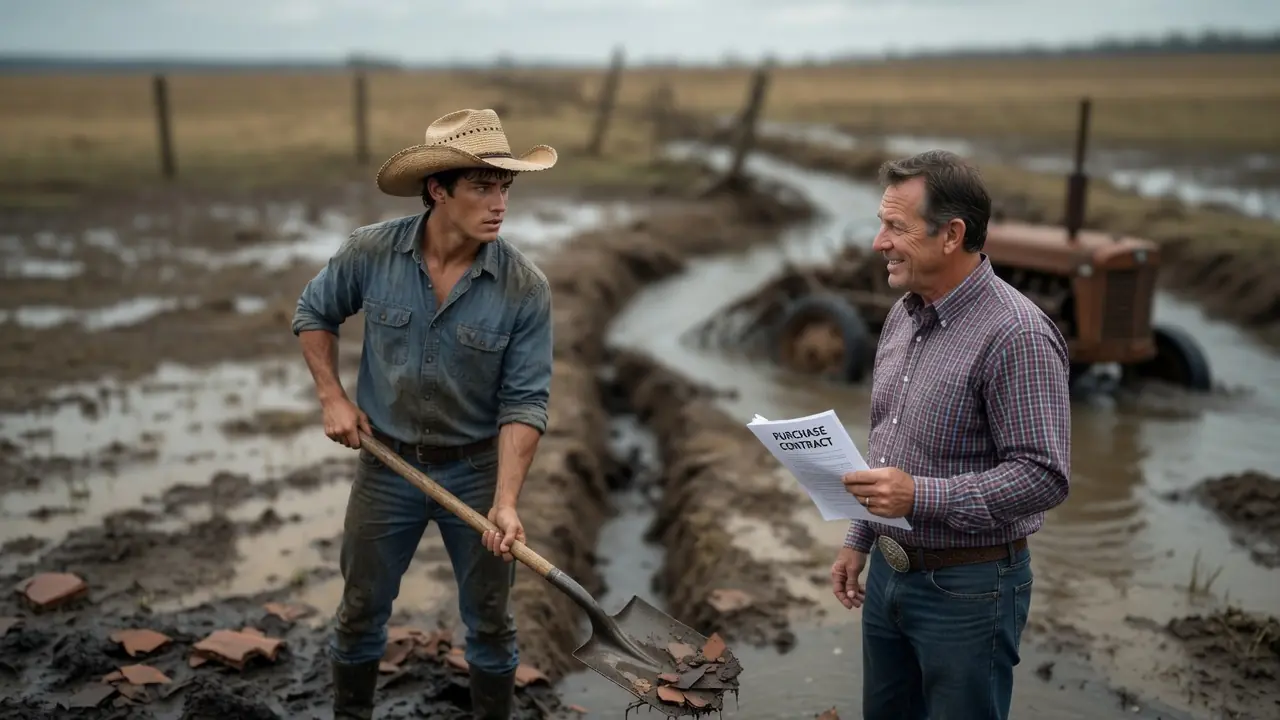
Luke was young enough that many of the older farmers still called him “the Mercer boy,” although he had operated his late father’s farm alone for nearly three years. He was strikingly handsome, with a clean youthful face, short dark hair, warm tan skin, broad shoulders, and clear hazel eyes that appeared gentler than the stubborn mind behind them. He usually wore a wide woven straw hat, a faded blue denim shirt, heavy jeans, and boots repaired more than once at the heel. Several women in town noticed him, but Luke spent more evenings repairing fences than attending dances.
“Mercer just rented himself sixty-four acres of mud,” someone said.
Laughter moved through the crowd.
The auctioneer looked directly at Luke. “You understand the parcel has no dependable livestock water?”
“I understand the description,” Luke answered.
That response made Wade Collins laugh louder than anyone else. Wade owned the neighboring two hundred acres, drove a new truck every eighteen months, and treated every conversation as an opportunity to remind people that his farm had belonged to the Collins family for four generations. He was not an unintelligent man, but success had convinced him that any ground he rejected must be useless. When Luke signed the lease, Wade leaned against the courthouse railing and shook his head.
“Your father knew better than to waste money on bottomland,” Wade said.
“My father also taught me to walk ground before judging it.”
“I’ve driven past that creek for twenty years.”
“That isn’t walking it.”
Wade’s smile disappeared briefly.
The jokes followed Luke from the courthouse to the feed store. Men warned him about hoof rot, drowned calves, washed-out fences, and the impossibility of borrowing against land that turned into a shallow lake after every heavy storm. One farmer said willows did not make loan payments. Another said cattle could not gain weight while standing knee-deep in mud.
Luke offered no argument.
He had seen the mud.
What the others had not seen was the green patch beneath the north willow line during the driest week of the previous August. The creek had nearly disappeared then, leaving only warm pools between stretches of pale stone, yet one section of moss remained dark and wet beneath exposed roots. A rusty streak ran down a rock face nearby, too narrow and consistent to have come from ordinary rain runoff.
Luke had pushed through the blackberry vines and heard water dripping.
Buried beneath roots and decades of silt, he found the broken mouth of an old clay drainage tile fitted into a rusted metal sleeve. Water emerged one slow drop at a time even though no rain had fallen for sixteen days. Most men would have dismissed the flow as insignificant. Luke remembered something his father had repeated whenever they crossed wet ground together.
“Water never disappears,” Benjamin Mercer used to say. “It only changes where it shows itself.”
Benjamin had worked for a drainage contractor before saving enough money to purchase the Mercer farm. He understood slopes, soil pressure, clay tile, springs, and the hidden routes water carved beneath hillsides. When Luke was twelve, his father taught him how to distinguish rainwater from a persistent underground seep. When Luke was seventeen, Benjamin made him repair a collapsed drainage junction before allowing him to borrow the truck for a Saturday dance.
Luke had resented the lesson then.
Now it might save his farm.
The Mercer home place held sixty-two beef cows on dry upland pasture. During an ordinary year, a pond and two shallow wells supplied enough water. During a brutal summer, however, the pond shrank, the wells weakened, and Luke spent nearly fifty dollars a day hauling water instead of maintaining fences or cutting hay.
Another drought could force him to sell part of the breeding herd.
The creek bottom did not need to become beautiful land. It needed to provide grass during wet months and dependable water when the hills turned brown. If the old tile line still intercepted seep water beneath the slope, Luke might develop a small stock-water system for less than the cost of hauling tanks all summer.
He wrote every possibility in his father’s old notebook.
The first year punished him immediately.
Luke repaired nearly half a mile of leaning fence, cleared blackberry vines from the outlet, and cut young willows until both arms shook at night. He rented a small excavator for one weekend, then finished the narrow drainage channel by hand because he could not afford another day. Every expense went into the notebook: posts, wire, gravel, fuel, pipe, fittings, equipment rental, and the cheap meals he bought while working after dark.
The first eighteen cows found every flaw in his plan.
One stepped into a soft patch near the crossing and came out limping. Two calves pushed through a weak corner where blackberry canes concealed rotten wire. A May thunderstorm flooded the creek, washed gravel twenty yards downstream, and tore forty feet of new fence from the low bank.
Wade drove past while Luke stood ankle-deep in mud resetting posts.
“How’s the richest swamp in Tennessee treating you?” Wade called through the open truck window.
Luke drove the post deeper. “Still teaching me.”
“What lesson is that?”
“Where not to put the fence.”
Wade shook his head and drove away.
At the bank, Luke received even less sympathy. The loan officer studied the pasture lease and receipts before explaining that seasonal bottom ground could not be counted as reliable collateral. Luke asked whether developed stock water would change the appraisal.
“Perhaps,” the officer said. “But you don’t have developed stock water.”
“Not yet.”
The officer closed the folder. “Be careful that ‘not yet’ doesn’t take your home place with it.”
For several nights afterward, Luke sat at his kitchen table calculating whether he had mistaken stubbornness for insight. The first year’s lease, fence materials, gravel crossing, used stock tank, and pipe would consume nearly every dollar he had saved. The tile outlet flowed more strongly after he cleared it, but not enough to satisfy sixty-two thirsty cows through August. Mud filled the ditch after every storm, and the creek bottom seemed determined to prove the entire county correct.
Luke considered quitting.
Then he opened his father’s notebook and found an old drainage sketch folded inside the back cover. It showed the typical pattern contractors used fifty years earlier: clay tiles laid diagonally beneath hillside pasture, collecting seep water before it saturated the bottom ground. One outlet rarely stood alone. If Luke had found the lower discharge point, collapsed joints or secondary branches probably remained uphill.
He returned to the property before sunrise.
Using a steel probe, a shovel, and the slope itself as a guide, Luke searched the north hillside for buried tile. He moved slowly, testing the ground every few feet, marking unusual resistance with small wooden stakes. Near an old hedge line, the probe struck something hollow.
Luke dug until his palms blistered.
Three feet beneath the surface, he found a section of collapsed clay tile packed with roots and dark silt. Water pressed against the blockage from uphill, escaping through cracks and saturating the surrounding soil. When Luke removed the broken pieces, clear water surged into the trench strongly enough to cover his boots.
He laughed alone in the field.
For the next two weeks, Luke rebuilt the junction with modern perforated pipe, gravel, and a protective sleeve. He connected the restored line to the old outlet, fenced cattle away from the seep, and ran eighty feet of pipe toward a stock tank positioned on a raised gravel pad. An overflow line returned excess water to the creek bed so the drinking area would not become another swamp.
The system remained modest.
It did not gush like an artesian well or fill the tank in minutes. At first, it produced only several hundred gallons each day. But the flow continued overnight, during clear weather, and after the creek itself slowed.
That steadiness mattered more than force.
Luke rotated cattle between the bottom pasture and his upland fields instead of allowing them to crowd the tank constantly. He opened access in small groups, watched the water level, and closed the gate before the herd could trample the soft ground. Every morning, the storage tank recovered.
He recorded the flow rate beside the date.
Three hundred twenty gallons.
Four hundred ten.
Five hundred after rain, then four hundred again during dry weather.
The following spring, Luke discovered another blocked tile farther up the hillside. Restoring it increased the daily flow to nearly one thousand gallons. With a larger storage tank collecting water through the night, the system provided more than fifteen hundred usable gallons on a good day.
It was still not enough for waste.
It was enough for discipline.
Wade remained unconvinced.
One afternoon, he stopped beside the wooden fence while Luke inspected the pipe connection. Wade wore polished boots and a pressed red plaid shirt, holding a folded purchase agreement he had brought without invitation. He said the creek bottom remained a liability and offered to take over the lease before Luke lost more money.
“This mud patch is drowning your farm,” Wade said, waving the contract. “Sign it over before it buries you too.”
Luke rested both hands on his shovel. “Keep talking. I just opened the line you said was dead.”
“One rotten pipe won’t save sixty-four acres of swamp.”
Luke drove the shovel into the soil beside the flowing outlet. “Then stand there and watch, because the next thing breaking open is your lie.”
Wade’s expression hardened. “You think I lied?”
“You told everyone there was no useful water here.”
“There wasn’t.”
“You never looked beneath the willows.”
Wade folded the contract. “When the creek floods again, remember I offered you a way out.”
It flooded two weeks later.
A hard June storm sent brown water across the low ground and tore out another corner of fence. Three cows escaped onto Wade’s hayfield before Luke repaired the gap. Wade arrived furious, demanding payment for damaged grass and repeating that bottomland held trouble better than cattle.
This time, Luke did not defend the original fence placement.
He paid for the damage, moved the boundary higher up the bank, and narrowed the cattle crossing. He spread new gravel over geotextile fabric so the base would drain rather than disappear into mud. The cost hurt, but the repaired design survived the next storm.
Luke was beginning to understand that finding water was only the first victory.
Managing it was the real work.
By late July, the rain stopped.
Day after day, clear skies stretched above Cedar Hollow while temperatures climbed. Grass on the hill pastures lost its deep color, ponds developed wide rings of cracked mud, and shallow wells began pulling air. The feed store sold every portable water tank it had, then started a waiting list for the next shipment.
Hay prices rose almost overnight.
At the livestock market, farmers discussed selling cows before everyone else made the same decision. A breeding animal that would have earned a strong price in autumn could bring far less during a drought-driven selloff. Every cow sold also represented a calf that would not arrive the following spring.
Luke checked the hidden tile line before dawn each morning.
The creek narrowed to a ribbon, then separated into isolated pools between dry stones. The willows curled slightly at the edges, but the restored pipe continued filling the tank. Water moved quietly from the hillside, collected through the night, and waited behind the fence for Luke’s cattle.
He allowed the herd access in groups.
The cows drank, moved away, and returned to grazing instead of standing desperately around an empty pond. Luke still watched the level twice a day and closed the gate whenever the flow needed time to recover. He treated every gallon as a resource rather than proof of his cleverness.
Across the road, Wade began hauling water.
His south pond failed during the first week of August. Each morning, he pulled a large trailer from town, backed it toward his dry lot, and lost hours waiting while cattle drank. Fuel, equipment wear, and labor consumed money daily.
One morning, Wade stopped his truck near Luke’s fence.
The sun had barely risen, but sweat already darkened his collar. Behind Luke, the stock tank stood nearly full after recovering overnight. Wade stared at the clear water entering through the pipe.
“How much does it make?” he asked.
“Enough.”
“That isn’t a number.”
“About fifteen hundred gallons on a strong day. Less when the herd draws hard.”
Wade removed his hat. “The creek is dry.”
“The tile isn’t the creek.”
“Where’s it coming from?”
“The hillside seep.”
Wade looked toward the green strip beneath the north willows. “How did you know?”
“I didn’t know.”
“You bid on sixty-four acres without knowing?”
“I knew those willows stayed greener than they should have.”
For once, Wade had no mocking response.
The drought continued for nearly two months.
Luke did not haul a single water tank to the bottom pasture. He did not sell any breeding cows, and the calves maintained enough weight to reach the regular fall sale. When the market opened, Luke sold fifty-four healthy calves and received a check large enough to cover the pasture expenses, the repaired water system, and the interest on his operating note.
He returned to the bank with records.
The notebook contained daily water measurements, grazing rotations, calf weights, repair costs, photographs, and fuel receipts proving he had avoided water hauling during the county’s driest summer in years. The bank sent an appraiser to inspect the property. He found repaired fences, controlled cattle access, stable gravel crossings, a fenced spring outlet, and a functioning storage system.
The old appraisal had described wet bottomland with limited grazing and no reliable water.
The new report called it creek pasture with developed stock water.
The value more than doubled.
The change was not enough to make Luke wealthy, but it transformed how the bank viewed his next loan. Instead of treating the creek bottom as a dangerous expense, the lender recognized it as productive leased acreage supported by documented infrastructure. Luke used the improved financial position to secure the purchase option before another bidder understood what the water system made possible.
He became the legal owner the following spring.
At the feed store, men stopped calling it mud pasture.
Some now claimed they had always suspected the hillside contained water. Others asked Luke detailed questions about clay tile, storage tanks, and controlled grazing. Luke answered politely without reminding them what they had said at the auction.
Wade visited during winter.
He parked beside the fence and walked to the restored outlet, keeping his clean boots on the gravel. The pipe continued running beneath a thin shell of ice, feeding the tank one quiet stream at a time.
“You think my south ditch has one of these?” Wade asked.
“Maybe.”
“My grandfather drained that slope when he was young.”
“Then walk it during August.”
“What am I looking for?”
“Grass that stays green when it shouldn’t. Moss beneath exposed roots. Rust stains. Water where the surface says there ought to be none.”
Wade nodded slowly. “I was wrong about this place.”
Luke looked across the creek bottom. Flood debris still clung to one fence, willows would need cutting again, and several low spots remained too wet for safe grazing. The land was not magically transformed.
“You were right about the mud,” Luke said.
“But wrong about the value.”
“You priced the whole field by its worst feature.”
Wade looked toward the full tank. “And you priced it by one dripping pipe.”
“I priced it by what that pipe could become if someone worked.”
The following summer, Wade found an old outlet beneath his south ditch.
Luke helped him clear it.
Some people in Cedar Hollow expected Luke to refuse after years of ridicule, but he spent two Saturdays tracing the tile line and repairing the lowest junction. When Wade offered payment, Luke accepted only the cost of materials.
“You could have let me haul water another year,” Wade said.
“I could have.”
“Why didn’t you?”
“My father taught me that water wasted underground doesn’t care who owns the fence above it.”
Wade laughed quietly. “Your father sounds like a difficult man.”
“He was.”
“Good farmer?”
“The best.”
Years later, Luke expanded the system with another storage tank and a solar-powered pump that carried excess water toward a higher trough. He never overdeveloped the field or pretended it was suitable for crops. The bottom still flooded after hard rain, and maintaining it required constant attention.
But each August, when nearby ponds shrank and dry wind moved across the hills, the hidden tile line kept working.
Luke eventually placed a small wooden bench beside the fence near the original outlet. On clear evenings, he sat there wearing his straw hat and faded denim shirt, watching cattle drink from water everyone else had driven past. The handsome young farmer who once rented the county’s worst field became the man neighbors called whenever difficult ground behaved strangely.
He never claimed to possess special luck.
Luck had not repaired broken tile, moved fences uphill, hauled gravel, measured flow, managed cattle, or kept detailed records for the bank. Luck had shown him one dripping outlet.
Everything after that required patience.
The county had looked at the creek bottom and seen only mud.
Luke had noticed water continuing to move after the creek ran dry.
That difference saved his herd, secured his farm, and turned sixty-four unwanted acres into the ground he was proudest to own.
Not because it became perfect.
Because it became useful.
And because beneath everything people had dismissed, something valuable had been flowing quietly the entire time.