Rick Harmon almost destroyed the nest before he ever knew it was there.
It was late August on his small Florida farm, the kind of morning when the air felt wet before the sun was fully up.
Rain had passed through during the night.
The lower fields were soft.
Tall grass leaned over the drainage channels.
Mosquitoes hovered above every patch of standing water.
And Rick was already behind schedule.
He had a strip of overgrown ground beside the pond that needed clearing before equipment could move into the adjacent field.
Normally, it was routine work.
The farm track ran close to the water, curved beside an old stump, then crossed toward the livestock pens.
Rick had driven it hundreds of times.
He knew every rut.
Every soft patch.
Every place where the tires slipped after rain.
That morning he eased the tractor forward, lined up his next pass—
and saw something pale beneath a mound of leaves.
Rick stopped.
Killed the engine.
The sudden silence felt strange after the diesel noise.
He climbed down.
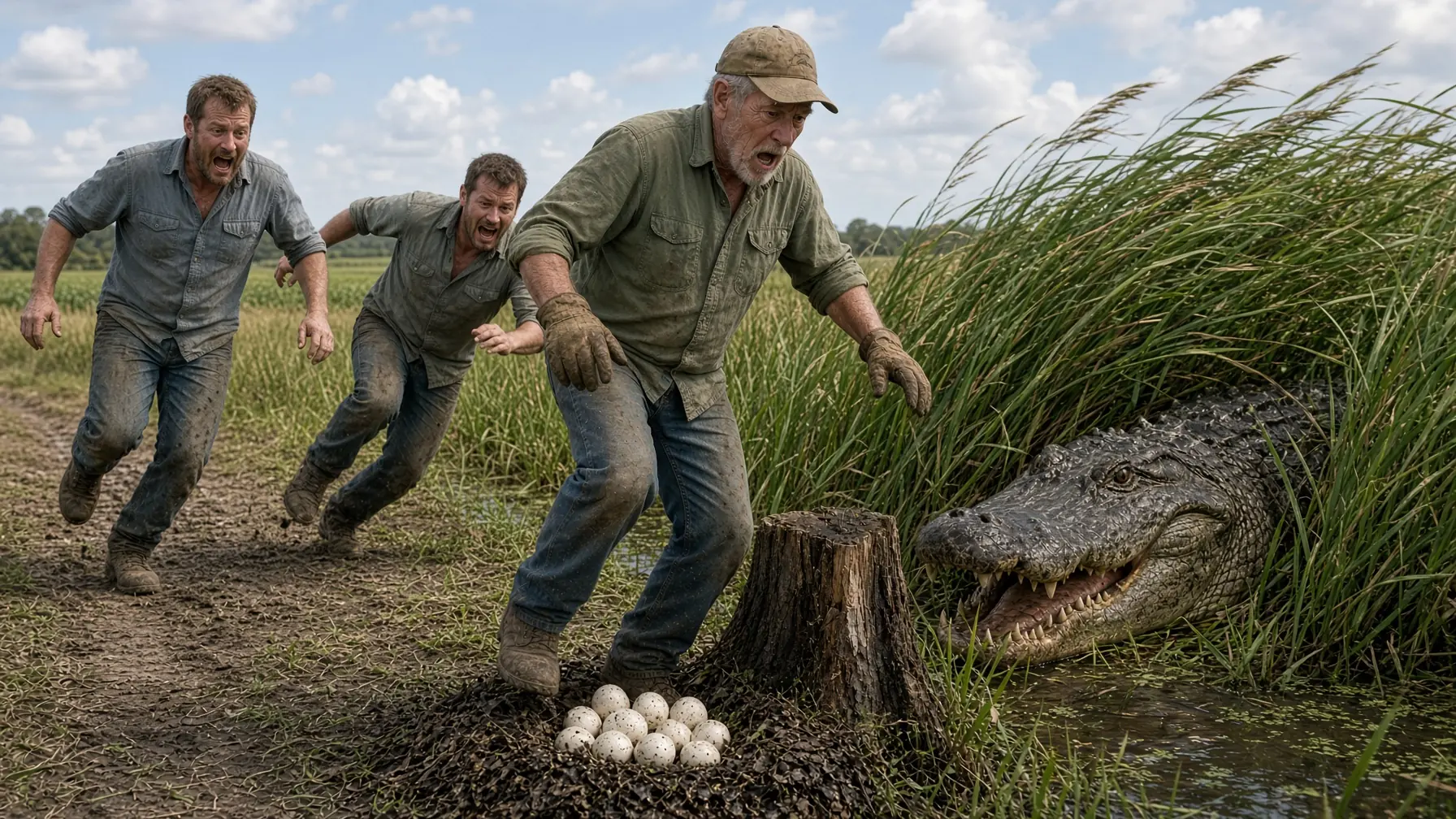
Near the stump was a low mound made of grass, leaves, mud, and decaying vegetation.
Several smooth pale shapes showed through a gap in the covering.
Eggs.
Rick crouched.
They were much larger than bird eggs.
And there were more of them than he expected.
Some lay close to the surface.
Others disappeared deeper beneath the nest material.
Rick stood and scanned the pond.
Nothing moved.
The reeds on the far side swayed gently.
Dragonflies skimmed the water.
A heron stood fifty yards away.
Rick wondered whether a large snake had nested there.
Reptiles were nothing unusual on his property.
He had found small snakes in equipment sheds.
Turtles near the irrigation ditch.
Lizards everywhere.
But he had never found a nest like this.
He looked at the tractor.
Another ten feet and the front tire might have gone directly over it.
Rick walked back to the equipment shed, grabbed a bright survey flag, and planted it well away from the mound.
When his workers arrived, he pointed toward it.
“Stay clear of that spot.”
One man asked:
“What is it?”
“Eggs.”
“What kind?”
Rick shrugged.
“Don't know.”
The worker smiled.
“Breakfast?”
Rick gave him a look.
The smile disappeared.
“Just keep machinery away.”
That was the end of it.
At least Rick thought it was.
Later that afternoon, Rick walked the pond to see how much of the clearing job they would have to reroute.
That was when he found the second mound.
Farther around the water.
Raised slightly above the wet ground.
Partly hidden by waist-high grass.
The shape looked almost identical.
Rick did not dig into it.
He simply planted another flag.
Now two bright markers interrupted the route he had intended to clear.
He moved the crew to another section of the property.
There was plenty else to do.
Fence repairs.
Feed delivery.
A broken gate.
Two customers coming for livestock later in the day.
The nests disappeared into the long list of things a farmer noticed, adjusted around, and promised himself he would investigate when there was time.
But the following morning, one of Rick’s workers called him over.
“Rick.”
“What?”
“You see that?”
The man pointed toward the mud beside the pond.
A broad flattened trail crossed the bank.
Not footprints exactly.
The overnight rain had blurred whatever tracks might have been there.
But something heavy had moved from the water toward the grass near the first flag.
Rick crouched.
The flattened strip was wider than he expected.
“How big a raccoon you got out here?” the worker joked.
Rick did not answer.
He followed the mark visually until it disappeared into vegetation.
Then looked toward the pond.
Nothing.
Again.
He told the crew:
“Stay off the wet edge.”
“Still think it's snakes?”
“Don't know.”
“Want me to check?”
“No.”
That answer came quickly.
Rick did not understand why.
Just instinct.
Something about the width of that disturbed grass made him uneasy.
So they worked elsewhere.
Another day passed.
On the third morning, Rick went back alone.