“Clear out that garbage mountain, farm boy—it’s stinking up the whole road.”
Roy Fenner stood beside the white fence separating his land from the Carter farm, one hand pointing toward the enormous mound rising behind the equipment shed. The pile contained spoiled hay, cattle manure, wood chips, leaves, coffee grounds, and bruised vegetables, and a faint ribbon of steam lifted from its center into the cool Iowa morning. Twenty-four-year-old Eli Carter faced him calmly, wearing a broad straw hat, a tan work shirt beneath faded blue overalls, and brown boots stained by the same dry soil everyone said he was wasting.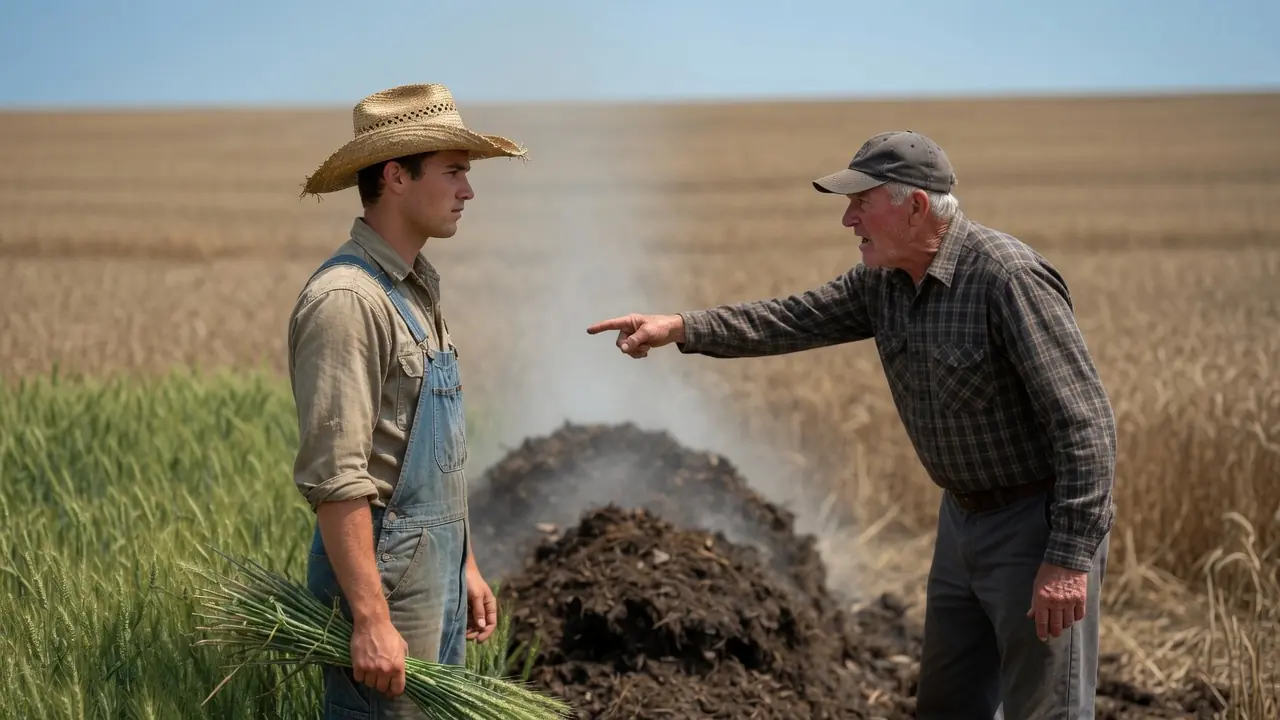
“You’re laughing at what your dying soil is begging for,” Eli replied.
Roy’s face hardened. “One more complaint, and the county shuts this farm down.”
Eli lifted the bundle of wheat he had cut from his experimental field. The stalks were strong, heavy, and greener than anything growing across Roy’s side of the fence. “Bring them tomorrow—then dig six inches down and see whose field still holds water.”
Roy laughed as he climbed into his pickup, but the sound was less confident than it had been a month earlier. Almost every field in Marion County had begun showing signs of stress, even though summer had barely started. Corn leaves curled inward before noon, wheat heads remained thin, and the ponds farmers depended upon were already shrinking. Yet behind Eli stood ten acres of crops that looked as though they belonged to a different season.
The Carter farm had once covered nearly four hundred acres. Eli’s grandfather, Samuel Carter, had raised corn, soybeans, wheat, and cattle there for more than fifty years. Samuel believed good farming meant leaving the land stronger than he found it, but falling grain prices, rising fertilizer costs, and repeated droughts gradually pushed the family toward survival rather than stewardship. By the time Eli inherited the property, only one hundred and sixty acres remained.
His father, Thomas, had died when Eli was nineteen. A heart attack took him during planting season, leaving Eli with a grieving mother, a younger sister preparing for college, and debts that arrived more reliably than rain. Eli abandoned plans to study agricultural engineering and returned home before his first semester began. Within a week, he was making decisions that men twice his age found difficult.
For five years, Eli followed the system his father had used. He borrowed money for fertilizer, planted the same crops, sprayed the same chemicals, and hoped high yields would cover increasing expenses. Some seasons brought enough profit to repair machinery or pay down a loan. Others left him working evenings at a livestock auction just to keep the farm account above zero.
The soil changed during those years.
The upper fields crusted after rain and cracked during dry weather. Water rushed down the slopes instead of soaking into the ground, carrying thin red-brown streams into the drainage ditch. Eli applied more fertilizer, but the crops responded for shorter periods. The land behaved like an exhausted worker being shouted at instead of allowed to rest.
Roy Fenner insisted the answer was greater efficiency. He farmed seven hundred acres east of Eli and owned machinery large enough to fill most of the county road. Every few years, he purchased a newer planter, a larger combine, or another computerized tractor. He believed nearly every agricultural problem could be solved by spending enough money quickly.
“You’re trying to farm like your grandfather,” Roy told Eli one winter morning at the cooperative. “That worked when land was cheap and nobody knew better.”
“My grandfather never lost topsoil into the creek.”
“Your grandfather also harvested half what we harvest now.”
“He spent half what we spend growing it.”
Roy laughed. “You can’t save a modern farm with old wisdom.”
The conversation remained with Eli.
Several weeks later, he attended a free soil workshop at the county extension office because lunch was included and the farm was too frozen for fieldwork. The speaker was Dr. Elaine Yoder, a university soil scientist with silver hair and mud on her boots. She opened her presentation by placing two trays of soil on a table.
One sample came from a field managed with continuous tillage and heavy chemical inputs. The other came from land amended with compost, cover crops, and reduced disturbance. When Elaine poured equal amounts of water over both, the first tray shed muddy runoff almost immediately, while the second absorbed the water slowly.
“Soil is not simply material holding a plant upright,” she explained. “It is structure, chemistry, biology, and stored water. When organic matter disappears, the field loses more than nutrients—it loses resilience.”
Eli remained after everyone else left.
He showed Elaine photographs of his cracked fields and described the rising cost of keeping them productive. She did not promise miracles or tell him to abandon conventional farming overnight. Instead, she suggested selecting a small test area and rebuilding it gradually.
“Compost can help,” she said. “But bad compost creates new problems. You need the right materials, enough oxygen, controlled moisture, and patience.”
“How much patience?”
“More than your neighbors will give you.”
Eli discovered that part quickly.
His first pile began behind the abandoned hog barn where few people could see it. He mixed fallen leaves, spoiled hay, and manure from his remaining cattle. A diner in town agreed to save coffee grounds, and a grocery store let him collect vegetables too damaged to sell. A tree service delivered wood chips rather than paying disposal fees.
The small pile became a long row.
Then another truck arrived.
By spring, the compost covered nearly half an acre and rose higher than Eli’s grain wagon. Drivers slowed along County Road 12 to stare. Someone at the diner called it Carter’s Garbage Mountain, and within days the name became more familiar than the actual farm.
Eli pretended the jokes did not bother him.
He heard men at the cooperative guessing how long it would take before rats covered his property. Someone suggested charging admission to the county dump. Even his mother, Margaret, stood near the pile one evening and asked whether he truly understood what he was doing.
“No,” Eli admitted.
Her eyebrows lifted.
“I understand what I’m trying to learn.”
“That is not the same thing.”
“I know.”
Margaret looked toward the farmhouse Thomas had spent years protecting. “Your father would have been frightened.”
“So am I.”
“Then why continue?”
“Because what he did is no longer working.”
The honesty quieted her.
Eli’s first batch failed spectacularly. He added too much manure, soaked the pile, and failed to turn it frequently enough. Oxygen disappeared from its dense center, and the material transformed into a slimy mass with a smell that drifted nearly a mile.
Roy arrived before sunrise with a handkerchief covering his nose. “That soil of yours smells like something died.”
“Something probably did.”
“The county will fine you.”
“Then I’ll fix it before they arrive.”
Roy shook his head. “A sensible man would haul it away.”
“A sensible man built it wrong. A farmer learns and rebuilds.”
Eli tore the pile apart.
He spread the wet material thin, added dry straw and wood chips, then rebuilt it into smaller windrows that allowed air to move through the center. He purchased a long compost thermometer and checked each row morning and evening. When a pile became too hot, he turned it; when it cooled too soon, he adjusted moisture and nitrogen.
The second batch became too dry.
The third heated unevenly.
The fourth attracted flies because Eli added vegetable waste without burying it deeply enough. Every failure cost time, labor, and a little more of the confidence he presented to his neighbors.
Elaine answered his calls patiently.
“Stop looking for a perfect recipe,” she told him. “Every material is different. Compost is less like baking and more like managing livestock.”
“Livestock usually makes noise when something is wrong.”
“So does compost. You just haven’t learned its language yet.”
Eli began keeping detailed records.
He wrote down the weight and type of every material, the amount of rainfall, temperatures at three depths, turning dates, moisture levels, and smell. Soon he could recognize a healthy pile before touching it. Proper compost smelled like damp woodland soil, while unhealthy material carried sharp ammonia or sour decay.
The work became almost scientific.
A county inspector named Nathan Brooks arrived after Roy and two other neighbors submitted formal complaints. Nathan walked the entire composting area with a clipboard, examining drainage, runoff, pests, and distance from the nearest well. He found several violations, including uncovered vegetable waste and a windrow positioned too close to the ditch.
“You have thirty days,” Nathan said.
“To remove everything?”
“To correct it. If you cannot demonstrate safe management, then you remove it.”
Roy watched from the road, arms folded over his chest.
Eli did not argue with the inspector. He requested written standards, asked questions, and photographed each problem. That night, he used his tractor loader until the headlights dimmed, relocating three windrows and building a gravel drainage channel.
Margaret brought him coffee after midnight.
“You could sell the land,” she said. “There would be no shame.”
“I know.”
“Your sister could finish school. You could work for someone else and sleep at night.”
Eli leaned against the loader tire. “I’m not staying because I’m ashamed to leave.”
“Then why?”
He looked toward the compost rows steaming beneath the stars. “Because the ground has been carrying this family for a hundred years. I want to know whether we can carry it for once.”
Margaret touched his shoulder before returning to the house.
During the final week of the inspector’s deadline, Eli installed covered bins, corrected runoff, built a simple washing station, and started recording all incoming materials. Nathan returned, examined the improvements, and approved the operation on a limited experimental basis. Roy heard the decision and accused the county of encouraging a public nuisance.
Nathan handed him a small shovel. “You reported the site. You’re welcome to examine what he made.”
“I’m not touching garbage.”
“Then stop pretending you understand it.”
Roy left without taking the shovel.
By the end of the second year, Eli produced his first fully mature batch. The compost was dark, crumbly, and cool throughout. Original ingredients were nearly impossible to identify, except for occasional softened pieces of wood.
Elaine sent samples to a laboratory.
The results showed stable organic material, balanced nutrients, safe pathogen levels, and no dangerous contaminants. She warned Eli that compost was not a magical substitute for all fertilizers, but it could improve soil structure, biological activity, and water retention over time.
Eli spread the finished material over a ten-acre test field.
He applied it lightly, incorporated it into the upper soil, and planted wheat alongside an untreated comparison strip. For the first several weeks, both sections looked similar. Some neighbors claimed that proved the entire project had been useless.
Then the rains came.
A violent spring storm dropped more than three inches overnight. The untreated ground sealed into a hard surface, and brown water flowed toward the ditch. In the compost-amended section, water entered the soil instead of escaping across it.
Eli dug test holes the next morning.
The treated field was moist more than eight inches deep. Its structure broke into small aggregates rather than sticky slabs. Earthworms appeared where he had rarely seen them before.
The difference encouraged him, but one successful storm did not prove the field could survive a season.
The true test arrived that summer.
Rain stopped near the end of May. June passed with only two brief showers, neither providing enough water to reach deep roots. By July, temperatures exceeded ninety-five degrees for twelve consecutive days.
The county changed color.
Pastures faded from green to gray. Corn leaves rolled tightly by midday, and soybean plants stopped filling pods. Wheat heads became light and brittle before harvest.
Roy’s irrigation pond dropped until mud surrounded its edges. He pumped from it day and night, but his largest fields remained too far away for irrigation. Every week, he purchased more fuel and watched his crops weaken anyway.
Eli had no irrigation system large enough to protect his entire farm.
He stood at the edge of the fields each morning, afraid his compost experiment would fail exactly when everyone was watching. The untreated wheat began showing the same stress visible across the county. Yet the ten amended acres remained darker.
Not perfect.
Not untouched.
Simply alive longer.
Eli pushed a steel probe into both fields. It entered the untreated soil with difficulty after four inches. In the compost field, it reached nearly ten before resistance increased.
Roy noticed the green strip from the road.
For several days, he said nothing.
Then one evening he climbed the fence and walked into Eli’s field without permission. Eli found him kneeling between wheat rows, pushing his bare hand into the soil.
“What are you doing?” Eli asked.
Roy pulled out a handful of dark earth. “Checking whether you buried an irrigation line.”
“You’ve watched this land for thirty years. You know there isn’t one.”
Roy dug deeper. The soil beneath the surface remained cool and faintly moist. Across the fence, his own field crumbled into powder between his fingers.
“How?” he asked.
“The compost increased organic matter and improved structure.”
“That pile made this?”
“Two years of properly finished material made this.”
Roy looked toward the dying crops beyond the fence. “Can you spread some on my field?”
“Not now.”
“I’ll pay.”
“It doesn’t work overnight.”
“Then what am I supposed to do?”
Eli heard fear beneath the anger. Roy had borrowed heavily for his newest machinery and planted more acres than ever. A severe crop failure could take the land he had spent his life expanding.
“You harvest whatever survives,” Eli said. “Then you start rebuilding before the next drought.”
Roy rose. “That doesn’t help me now.”
“No. It would have helped when you were laughing two years ago.”
The words landed hard.
Eli regretted them immediately, but he did not apologize for the truth.
Elaine returned with two agronomists from the university. They collected samples from Eli’s treated field, his untreated ground, and Roy’s neighboring land. Laboratory testing showed that organic matter in Eli’s experimental acres had risen from just under two percent to more than four percent.
That difference transformed how the soil managed water.
Organic matter held moisture like a sponge. Improved aggregation created spaces where rain could enter instead of running away. Earthworm channels carried water deeper, while fungal networks helped roots reach beyond their usual zone.
The compost had not created rain.
It had prevented the field from wasting the rain that came earlier.
Nathan Brooks organized a county demonstration after other farmers began asking questions. More than forty people gathered beside Eli’s field on a brutally hot morning. Some had mocked him openly, while others had simply watched in silence.
Elaine poured equal amounts of water into metal rings pressed into three soil samples. The water disappeared fastest into Eli’s amended ground. On Roy’s compacted sample, much of it remained at the surface.
A farmer near the back raised his hand. “Can this save crops already dying?”
“No,” Elaine answered. “This is not emergency medicine. It is long-term health.”
The men became quiet.
They had grown accustomed to products promising immediate solutions: stronger fertilizer, new seed, deeper tillage, larger equipment. Eli’s field offered something less convenient. It demanded planning before the crisis arrived.
Roy stepped forward unexpectedly.
“I called that pile garbage,” he said.
Several people glanced toward him.
“I reported it to the county. I told everyone Eli was ruining good land.” He looked across the fence at his own damaged wheat. “Turns out he was building soil while the rest of us were buying ways to force ours harder.”
Eli said nothing.
Roy faced him. “I was wrong.”
The admission carried farther through the county than the original jokes.
Harvest began early because drought had accelerated crop maturity. Roy’s fields produced less than half their usual yield. Several smaller farms suffered similar losses, and two families announced they would sell before winter.
Eli’s untreated acres also struggled.
The compost test field did not produce a miraculous record, but its yield exceeded the rest of his land by nearly one-third. The wheat heads were heavier, the stalks stronger, and the grain quality high enough to earn a better price.
That ten-acre difference kept the Carter farm current on its loan.
Without it, Eli would have missed his autumn payment.
He stood beside the combine after weighing the final wagon and realized that the ugly pile had not merely won an argument. It had protected his home.
Roy approached slowly.
“How much finished compost do you have left?”
“About sixty tons.”
“I need more than that.”
“So does everyone else.”
“You could name any price.”
Eli shook his head. “I won’t let desperation turn this into another thing farmers can’t afford.”
He created a waiting list and prioritized small operations facing the greatest risk. Buyers paid fair market rates, but Eli also required them to attend a workshop covering proper application, soil testing, cover crops, and reduced disturbance. He refused to sell compost as a miracle because he knew disappointment could destroy trust faster than drought destroyed plants.
Roy received enough for a five-acre trial.
He complained that five acres were insignificant.
Eli handed him a pitchfork. “My first experiment was smaller.”
The following spring, three farms built composting areas of their own. The cooperative began collecting crop residue and manure that had previously become disposal problems. The diner delivered coffee grounds to a shared processing site, while the grocery store stopped sending damaged produce to the landfill.
Eli did not keep his method secret.
He shared every record, including failures. He showed farmers photographs of sour piles, temperature charts, laboratory reports, and the county violations he had corrected. He believed useful knowledge became stronger when neighbors could challenge it.
A regional agricultural paper published a story about the young farmer and the Garbage Mountain that saved his harvest. The reporter asked Eli whether he felt proud that everyone who mocked him now wanted his advice. He looked across the dark windrows and considered the question.
“I’m proud the soil survived,” he said.
“That’s all?”
“The jokes didn’t hurt my field. Drought did.”
The article brought attention, buyers, and offers from investors who wanted to expand compost production rapidly. One proposed purchasing the Carter farm and building a large processing plant. Another offered Eli a high-paying management position if he licensed his name.
He rejected both.
Instead, he formed a farmer-owned soil cooperative. Members supplied organic material, shared equipment, and purchased finished compost at transparent prices. Eli accepted a paid role managing the first three-year trial, with his performance reviewed by farmers and extension specialists.
The arrangement protected the idea from becoming another expensive product controlled by distant executives.
Roy joined during the second year.
His first compost batch became too wet and smelled bad enough for Eli to notice from the road. Eli drove over without being invited.
Roy stood beside the pile with his arms crossed. “Don’t say it.”
“Say what?”
“That it smells rich.”
Eli smiled. “Add dry straw, reduce the height, and turn it.”
Roy looked embarrassed. “You going to tell everyone?”
“No.”
“I told everyone when you failed.”
“I remember.”
“Then why help me?”
Eli placed the thermometer into the pile. “Because your soil doesn’t care whether you deserved the lesson.”
Over time, the county’s fields began changing.
Not every farmer adopted composting, and not every acre transformed quickly. Some used cover crops, reduced tillage, or smaller amounts of organic material. The goal was not copying Eli’s exact method but rebuilding resilience according to each farm’s needs.
Five years after the drought, another dry summer arrived.
This one was not as severe, but farmers noticed the difference. Fields with higher organic matter remained healthier longer. Water infiltrated during sudden storms, and the county irrigation pond did not empty as quickly.
The Carter farm survived without emergency borrowing.
Eli restored thirty acres previously considered too depleted to plant profitably. His mother expanded the garden near the farmhouse, and his sister returned after college to manage the cooperative’s accounts.
The original composting site remained behind the equipment shed.
Visitors often expected to find the towering Garbage Mountain described in the article. Instead, they saw carefully managed windrows, covered curing areas, drainage controls, and testing stations. Eli kept one photograph of the first chaotic pile pinned inside the barn.
Beneath it, he wrote:
They laughed because the work looked ugly before the result became visible.
Roy saw the sentence during a cooperative meeting.
“You wrote that about me.”
“I wrote it about half the county.”
“I was the loudest.”
“That part is true.”
Roy looked toward the photograph. “Do you ever wish you had proved me wrong faster?”
Eli shook his head. “Fast compost is usually bad compost.”
Roy laughed.
Years later, children from the county school toured the farm. They gathered around Eli, now wearing the same faded overalls and straw hat, though his shoulders had broadened and fine lines had formed around his eyes. He handed each child a small amount of finished compost.
“What is it?” one boy asked.
“Yesterday’s waste,” Eli replied.
A girl held it close to her face. “It smells like the woods.”
“That means it finished changing.”
She looked toward the green wheat field beyond the fence. “Did this save your farm?”
Eli considered the question.
“The compost helped,” he said. “But what saved the farm was beginning before we were desperate.”
The children carried those words home.
So did many adults.
The lesson of Eli Carter’s Garbage Mountain was never that one pile could defeat every drought. It was that healthy land required investment long before the sky stopped providing rain. Soil remembered every season of neglect, but it also responded to patience, biology, and care.
Roy had seen garbage because the pile looked ugly.
Eli had seen stored water, future roots, and life waiting for time.
When the drought arrived, both men discovered which vision had understood the land.
And for the first time in generations, the Carter farm entered a difficult season with something more dependable than hope beneath its crops.
It entered with living soil.