On a cold October morning in 1994, Claire Whittaker drove a nearly new John Deere 8400 into the gravel parking lot of Brennan John Deere in Marshall County, Iowa. The tractor had cost her father $180,000 only eleven months earlier, and its green paint still carried the polished shine of a machine that had barely seen one harvest. Claire climbed down wearing faded denim overalls, a beige work shirt, mud-stained boots, and a red gingham scarf tied over her dark hair. Then she walked into the dealership and asked to return the most expensive piece of equipment on the Whittaker farm.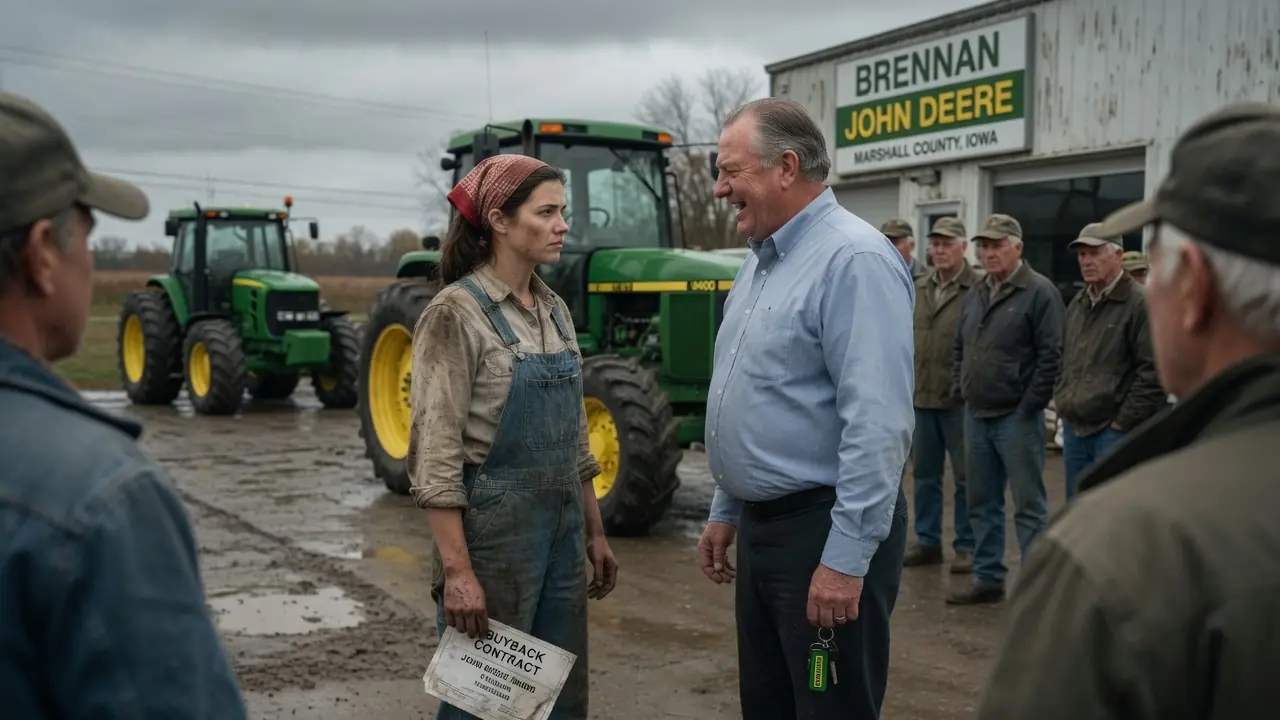
The conversations inside the parts department stopped immediately. Several local farmers turned toward the window, watching the twenty-four-year-old woman cross the lot with the tractor contract in one hand and the keys in the other. Most of them had known her father, Walter Whittaker, for decades. By the time Claire reached the office door, they had already decided that grief had finally made her lose her judgment.
Bill Brennan came outside before she could enter. He was a heavyset man in his late fifties who wore spotless shirts even when the lot was covered in dust. He had sold Walter every important machine the farm had purchased since the mid-1970s, and he carried himself like a man who believed that history gave him authority over the Whittaker family. When Claire held out the keys, he stared at them as though she were returning her father’s coffin.
“Claire, honey, let’s go inside and discuss this.”
“There’s nothing to discuss.”
“Something must be wrong with the tractor.”
“Nothing is wrong with it.”
Bill looked toward the watching farmers, embarrassed by her refusal to cooperate. “Then why are you bringing it back?”
Claire opened the contract to a page marked with a paper tab. Her father had negotiated a twelve-month buyback clause allowing him to return the tractor for eighty percent of the purchase price. Bill had agreed because Walter bought equipment regularly, paid on time, and had never once returned anything. The clause had seemed harmless when the sale was made.
“I’m exercising the buyback,” Claire said.
Bill’s practiced smile disappeared. “Your father spent six months choosing this tractor.”
“My father is dead.”
The words settled across the lot more heavily than the morning frost. Walter had suffered a fatal heart attack in a cornfield nine months earlier, leaving Claire 480 acres, several operating loans, and more equipment debt than she had ever imagined. The John Deere alone still carried nearly $140,000 in financing.
“He wanted you to have the best,” Bill said more softly.
“What he wanted and what this farm can afford are not the same thing.”
Bill raised the keys in front of the watching men. “You think a young woman knows farming better than Walter Whittaker did?”
Claire did not react to the insult. “I know this machine’s debt will bury the farm he left me.”
A few farmers shifted uncomfortably, but none defended her. They had all heard the same promises from dealers and lenders: bigger tractors produced more acres, more acres produced more income, and more income justified more debt. Returning a new machine was not viewed as financial discipline. It was viewed as surrender.
Bill looked toward Claire’s rusted 1979 Ford pickup. “Take the refund, and this whole county will watch you lose everything by spring.”
Claire turned toward the truck. “Meet me at tomorrow’s auction.”
“What are you buying?”
She opened the driver’s door. “Something I can own.”
By that evening, the story had crossed every diner, feed store, and machine shed in Marshall County. Walter Whittaker’s daughter had returned his new John Deere after one harvest. Some people predicted she would lease the land within months. Others believed she would sell the farm and move back to Ames, where she had attended Iowa State University.
Claire heard all of it.
She also knew something they did not.
During her four years studying agricultural economics, Claire had researched hundreds of family farms that disappeared during the financial crises of the 1980s. Some had experienced drought. Others suffered low commodity prices or poor harvests. But the factor that repeatedly separated survival from foreclosure was equipment debt.
Walter had dismissed her conclusions when she came home.
“The numbers don’t pull a plow,” he had told her.
“No,” Claire had replied. “But the bank uses them to take the land.”
They had argued often during her final year at college. Walter believed a successful farm had to modernize or fall behind, while Claire believed borrowing money for capacity they did not need made them vulnerable. Neither persuaded the other. Then Walter purchased the John Deere three months before his death.
He called it her future.
Claire called it a twenty-one-thousand-dollar annual payment before fuel, insurance, maintenance, and repairs.
During the autumn harvest, she operated the tractor across fields her father had planted. The climate-controlled cab was quiet, the steering effortless, and the electronic systems more advanced than anything previously owned by the Whittakers. It was an excellent machine.
That was not the problem.
Every hour Claire drove it, she calculated its costs. Every winter month it sat unused, the payment still came due. Every computerized component represented a repair she could not perform herself. By the time the last corn entered the grain bin, Claire understood that keeping the tractor meant allowing one machine to determine every future choice she made.
The night before she returned it, she invited her uncle Ray to dinner.
Ray Whittaker was Walter’s older brother and the closest thing Claire had left to a parent. He had helped settle the estate, accompanied her to the bank, and gently suggested leasing the farm until she gained more experience. Claire prepared Walter’s favorite pot roast and poured Ray a glass of bourbon before explaining her plan.
Ray placed his fork down halfway through the meal. “Tell me you’re joking.”
“I’m not.”
“You’re returning the 8400?”
“Tomorrow morning.”
“And replacing it with what?”
Claire told him.
Ray closed his eyes.
For several seconds, the only sound in the kitchen was the old refrigerator motor. When he finally looked at her, his face carried equal parts fear and disbelief. He reminded Claire how proud Walter had been when the machine arrived and how he believed it would carry the farm into the next century.
“I know what he believed,” Claire said.
“You’re undoing his last major decision.”
“I’m trying to protect everything he made before it.”
Ray pushed his plate aside. “That tractor can work this farm for twenty years.”
“The loan can destroy it in two.”
“That is the cost of modern farming.”
“No, Uncle Ray. That is the cost of farming someone else’s way.”
She opened a notebook and showed him the figures. The machine cost approximately $1,800 a month in financing. Fuel and expected maintenance pushed the annual cost higher, while the farm used only a fraction of its capacity. Claire could not increase acreage enough to justify the tractor without borrowing even more money to purchase or rent land.
Ray studied the pages but remained unconvinced.
“The whole county will think you’re foolish.”
“I know.”
“If you fail, people will say you destroyed Walter’s farm.”
“I know.”
“And if they’re right?”
Claire closed the notebook. “My father died at sixty-one while owing more money than he had ever owed before.”
“That tractor did not kill him.”
“No. But the pressure did.”
Ray’s expression hardened. “That isn’t fair.”
“It may not be fair, but it is true. He spent his last years believing he had to become bigger, newer, and more expensive just to remain respectable. I’m not letting that same fear decide my life.”
Ray finished his bourbon in silence. When he stood to leave, he still did not approve of the decision. Yet before stepping onto the porch, he turned back and hugged her.
“I hope you know what you’re doing.”
“So do I.”
The following afternoon, Claire attended an equipment auction two counties away. Instead of one modern tractor, she bought four older machines and several used implements. The first was a 1972 John Deere 4020 for $7,200, a reliable diesel tractor simple enough to repair with ordinary tools. The second was a 1965 Farmall 1206, strong and heavy but uncomplicated.
She purchased a 1978 Massey Ferguson 1085 for utility work and spent money rebuilding Walter’s abandoned Farmall 560. The old tractor had sat in the back of the machine shed for almost two decades, collecting dust beneath a damaged tarp. Claire replaced the engine components, repaired the hydraulics, and restored the transmission.
Four tractors cost her less than thirty thousand dollars.
She then bought a used eight-row planter, a disc, a five-bottom plow, a field cultivator, a grain cart, and a wider grain head for Walter’s old combine. Her total equipment spending remained below sixty thousand dollars. After receiving the tractor refund, she paid down part of the operating loan and placed fifty thousand dollars into a reserve account.
The county saw a yard full of old machines.
Claire saw redundancy, flexibility, and freedom from monthly payments.
Bill Brennan told customers that she would be “selling pencils by Christmas.” Tom Brennan, his nephew, drove past the Whittaker farm and laughed at the newly restored Farmall. Several neighboring farmers openly wondered which of Claire’s tractors would break first.
Spring arrived late in 1995.
Rain kept the soil cold and wet through much of April. The county’s largest tractors and planters were too heavy to enter the fields without causing deep compaction. Farmers waited near their sheds, watching weather reports while valuable planting days disappeared.
Claire drove the lighter John Deere 4020 into her first field on April 22.
The tires crossed the soft ground without sinking deeply. She planted steadily for long hours, switching tractors when one needed fuel or minor maintenance. By the time her neighbors finally moved their large equipment into the fields, Claire had already finished most of her corn.
Bill passed her property one morning and saw the 4020 pulling the planter.
He shook his head and kept driving.
Claire did not notice him. She was watching the soil close behind each row and calculating whether the seed depth needed adjustment.
Summer brought a different challenge.
July became hot and dry, and by early August, temperatures climbed above one hundred degrees. Several newer tractors in the county began suffering sensor failures and electronic shutdowns. Some problems were serious, while others were false warnings that still prevented the machines from operating.
Bill Brennan’s service department became overwhelmed.
Farmers waited two or three days for technicians carrying specialized diagnostic equipment. Crops continued growing while tractors remained parked at the edge of fields. Every missed day increased weeds, fuel costs, and frustration.
Claire’s older tractors had no computers capable of shutting them down.
When a belt wore out, she replaced it. When a hydraulic line leaked, she repaired it inside the machine shed. The work was dirty and sometimes exhausting, but she never waited for permission from a computer or availability from a dealership.
By August, the Whittaker fields appeared cleaner than those surrounding them.
Cars began slowing near the property on Sunday afternoons. Farmers who once laughed now studied the rows through their windows. Claire’s corn remained healthier because she had completed cultivation on schedule, while the soybeans looked more uniform than anything she had produced with her father.
Still, no one admitted she had been right.
They said the real test would be harvest.
October brought heavy, wet corn and soybeans that matured earlier than expected. Then rain stopped the harvest for nearly a week. When the fields finally dried, another storm appeared in the forecast, forcing every farmer to race against time.
Modern machinery should have dominated.
Large combines could operate longer, unload faster, and navigate after sunset through electronic guidance. But cold mud affected sensors and complicated hydraulic systems. Once again, dealership service crews could not answer every call.
Claire operated Walter’s 1986 John Deere 7720 combine.
It lacked many modern conveniences, but it ran. Her four tractors moved wagons and grain carts in rotation, allowing the combine to remain in the field. When one machine needed attention, another took its place.
Claire began before sunrise and stopped only when evening moisture became too heavy. Uncle Ray joined her for several days, driving the restored Farmall 560. He said little about the decision he had once opposed.
On November 3, Claire delivered her final load of corn.
Tom Brennan, farming across the road with newer equipment, finished eleven days later after losing three days to a sensor replacement. Grain quality had declined during the delay, reducing the price he received.
At the elevator, manager Chuck Lindstrom asked Claire about her yields.
“One hundred ninety-two bushels per acre on corn,” she replied. “Sixty-one on beans.”
Chuck whistled.
The county averages were far lower.
“You finished early too.”
“Yes.”
Chuck looked toward her old Ford and the weathered combine visible in the distance. “Walter would be proud.”
Claire could not answer immediately. She nodded, climbed into the pickup, and drove home.
The emotional victory mattered to her.
The financial numbers mattered more.
At the end of the season, Claire compared every dollar earned and spent. Her equipment expenses were tens of thousands below neighboring operations carrying modern fleets. The higher yield helped, but low debt created the real advantage.
She used part of the profit to buy eighty additional acres. Another portion paid for a larger equipment shed, while the rest funded the following season without new borrowing. For the first time since her father’s death, Claire went to sleep without wondering whether the bank controlled the next decision.
The following year, she repeated the system.
Then she repeated it again.
Claire did not reject technology simply because it was new. She purchased tools only when their productivity justified their cost and when she could maintain control over the risk. She kept careful records of fuel, repairs, weather, soil conditions, and yields.
Every winter, she studied agricultural journals and equipment manuals. She introduced crop rotations that protected the soil and reduced disease. She paid cash whenever possible and bought land when struggling neighbors needed to sell.
By 1999, she owned 720 acres.
By 2001, she controlled 880.
The men who predicted foreclosure stopped laughing, though some still described her success as luck. Then a widespread crop disease struck much of the region. Farms planting corn repeatedly suffered heavy losses, while Claire’s rotation of corn, soybeans, and oats interrupted the disease cycle.
Her yields declined only slightly.
That was when the county finally stopped calling her lucky.
In 2002, the Marshall County Farm Bureau included the Whittaker farm on its annual agricultural tour. Journalists, university researchers, and farmers walked through the machine shed where Claire’s old tractors stood clean, maintained, and ready for work. The restored Farmall 560 still started easily, while the John Deere 4020 had completed thousands of additional hours.
A reporter asked Claire to explain the secret behind her success.
“My father thought he was buying productivity when he borrowed money for that tractor,” she said. “What he actually bought was vulnerability.”
The reporter appeared surprised.
Claire continued. “Every required payment removed a choice. It meant we had to plant what produced immediate cash, even when another crop might have protected the soil. It meant one expensive breakdown could control the entire season.”
“Do older tractors reduce productivity?”
Claire smiled. “I earned more profit per acre last year than any comparable farm in this county. I gave up the appearance of productivity. I did not give up the result.”
The interview reached television stations across Iowa. Soon afterward, an agricultural economist from Iowa State contacted Claire and requested access to her financial records. Her farm became part of a larger study examining equipment debt and long-term sustainability.
The research concluded that many small and mid-sized farms with lower equipment debt outperformed heavily financed operations across profitability and resilience measures. Claire’s property appeared anonymously as Farm K. Everyone in Marshall County knew exactly who Farm K was.
That autumn, Bill Brennan drove to the Whittaker farm.
He parked outside the machine shed wearing the same style of clean shirt he had worn eight years earlier. Claire emerged carrying a wrench, grease covering both hands. She was thirty-two now, more confident and less concerned with anyone’s approval.
Bill removed his hat.
“You were right.”
“About what?”
“The equipment. The financing. The way we sold farmers things they didn’t need.”
Claire waited.
“I told people you would fail,” he continued. “I said you’d be gone by Christmas.”
“I heard.”
“I wanted you to be wrong because if you were right, then I had spent years encouraging men like your father to borrow more than they should.”
Claire placed the wrench on a workbench.
“I did not return that tractor to prove you wrong,” she said. “I returned it because the numbers did not work.”
“I understand that now.”
“My father trusted you.”
Bill lowered his eyes.
“He believed the tractor was the correct decision because you told him it was,” Claire continued. “You may not have intended to hurt him, but intentions do not pay loans.”
Bill stood silently for a long time.
“Where should I apologize?” he finally asked.
Claire looked toward the road. “The cemetery on Route 14.”
Bill nodded.
Before leaving, he asked whether he could send a young farming couple to speak with her. They had inherited 120 acres and planned to finance a new tractor larger than their property required. Bill wanted them to see another way before signing the contract.
“Send them,” Claire said. “I’ll show them the books.”
That couple became the first of many.
Over the following years, Claire taught young farmers how to calculate real equipment costs, maintain older machinery, manage debt, and separate pride from profit. She did not tell everyone to copy her decisions. She taught them to understand their own land before allowing a salesman, lender, or neighbor to define success.
By 2010, Claire owned more than twelve hundred acres.
She remained in the farmhouse where she had grown up. The restored Farmall continued working, and the John Deere 4020 still hauled wagons during harvest. Claire had married an agricultural researcher named David, and together they raised two children.
Her winter course, Farming Without Debt, eventually developed a waiting list.
Some of her students adopted older equipment strategies. Others used newer machines but purchased them only after careful financial analysis. The point was not nostalgia.
The point was freedom.
Years later, Iowa State University awarded Claire an honorary doctorate for her contribution to sustainable farm economics. She accepted the honor wearing jeans, a clean work shirt, and the same style of red scarf she had worn the morning she returned the tractor.
Her speech contained only a few sentences.
“My father bought a machine he believed would carry our farm into the next century,” she said. “What carried it forward was returning that machine. The tractor was valuable, but the freedom to choose was worth more.”
In 2015, Bill Brennan died.
His dealership had already closed after years of financial trouble. Before his death, Bill requested that Claire speak at his funeral. The invitation surprised nearly everyone, but Claire accepted.
She told the congregation about the day Bill came to her farm and admitted he had been wrong. She described the young farmers he later sent to her, many of whom avoided dangerous loans because he finally told them the truth.
“Bill built his career selling bigger machines,” Claire said. “But he found the courage to question the business that had rewarded him. Being wrong does not define a person forever. Refusing to admit it does.”
After the service, Claire drove to the cemetery where Walter lay beside her mother.
She stood before the simple headstone and told her father about the farm, the children, and the coming planting season. She did not apologize for returning his tractor. She had spent years wondering whether he would have forgiven her, but eventually understood that forgiveness was not what she needed.
Walter had wanted to leave her security.
She had simply discovered that security looked different from what he imagined.
The $180,000 John Deere was an extraordinary machine. It was powerful, comfortable, and modern. Yet keeping it would have required Claire to spend her life serving the debt attached to it.
By returning the tractor, she bought four older machines, used implements, a financial reserve, and lower operating costs.
More importantly, she bought time.
She bought choices.
She bought the right to farm without asking a lender what she was allowed to do next.
The county remembered the morning Claire Whittaker returned her father’s finest tractor as the day a young woman appeared to reject everything he had built.
Eight years later, those same farmers stood inside her machine shed asking to see her records.
Only then did they understand that Claire had not thrown away her father’s legacy.
She had removed the debt that was slowly crushing it—and given the farm the freedom to survive.