The doors of Trauma Bay Two slammed open at 2:47 in the morning, and Nora Vance knew the wounded man was dying before the paramedics finished pushing his stretcher into the room. His torn camouflage clothing was soaked with blood, a crude dressing had been wrapped across his chest, and each breath came as a shallow, desperate pull that failed to lift the left side of his ribs. The smell of copper, scorched fabric, and burned skin followed him through the doors. Whatever had happened to him had not been an ordinary street shooting.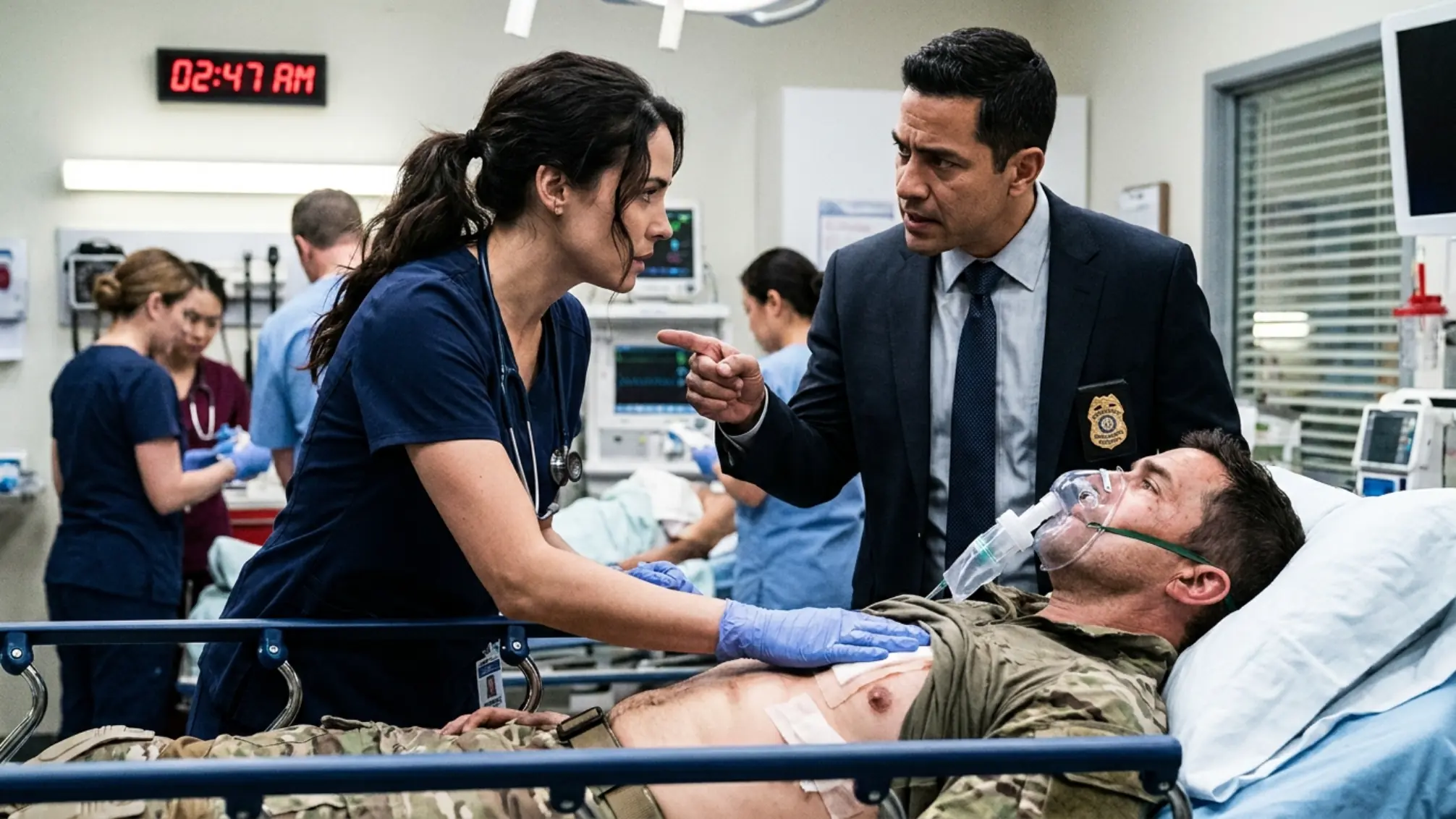
“Multiple gunshot wounds,” a paramedic shouted. “Lost consciousness twice during transport. Blood pressure is seventy-eight over forty and falling.”
The trauma team surged forward. Nurses cut away clothing, a respiratory therapist prepared oxygen equipment, and two residents began calling out medications. Dr. Alan Whitfield entered last, pulling on gloves while issuing orders with the confidence of a man accustomed to everyone moving when he spoke.
“Portable chest film,” Whitfield ordered. “Set up ultrasound and bring me the chest-tube tray.”
Nora reached the stretcher and placed two fingers against the patient’s wrist. His pulse was rapid, weak, and beginning to disappear beneath her touch. She watched his neck veins, the uneven movement of his chest, and the way his trachea had shifted slightly away from the injured side.
He did not have time for imaging.
Nora pressed one gloved palm against the upper left side of his chest.
“Tension pneumothorax,” she said. “He needs decompression now.”
Whitfield turned sharply. “I didn’t ask for your diagnosis, Nurse Vance.”
“He’ll arrest before the film arrives.”
“I ordered imaging.”
The monitor released a shrill alarm.
The patient’s oxygen level dropped to seventy-nine percent. His eyes opened briefly beneath the clear mask, but they did not focus on anyone. His right hand moved weakly across the sheet as though searching for something that was no longer there.
Nora opened the crash cart.
Whitfield stepped toward her. “Get the chest-tube kit and let me handle this.”
She removed a fourteen-gauge needle.
Every person in the bay stopped for a fraction of a second.
Whitfield’s face hardened. “Put that down.”
Nora looked directly at him. “If you wait for imaging, he dies before the machine reaches the door.”
“You are not authorized to perform that procedure without an order.”
“Then give the order.”
“I will not let a floor nurse improvise on a critical patient.”
Nora’s voice became colder. “This isn’t improvisation.”
The wounded man’s blood pressure disappeared from the automatic monitor. The respiratory therapist called for a manual reading, but Nora already knew what the result would be.
She positioned the needle against his chest.
Whitfield pointed toward the exit. “Step away from him now.”
Nora did not move. “You can fire me after he’s breathing.”
For one furious second, Whitfield looked as though he might physically pull her away. Then the monitor alarm intensified, and the patient’s body went frighteningly still.
Whitfield clenched his jaw.
“Do it,” he snapped. “Since you’re so confident.”
Nora inserted the needle.
A violent hiss of trapped air escaped from the man’s chest. His ribs shifted, his breathing deepened, and the oxygen numbers began climbing almost immediately.
“Eighty-three,” the respiratory therapist called. “Eighty-seven. Ninety.”
The room exhaled.
Nora did not.
She was already examining the wound in his thigh. Blood continued seeping beneath the temporary bandage despite a tourniquet placed high above it.
“Two units of O negative,” she said. “Activate the rapid infuser. The exit wound is posterior and low. Possible femoral involvement.”
Whitfield stared at her. “How do you know that?”
“Because the entry angle is wrong for a simple through-and-through.”
“You haven’t seen the scan.”
“I don’t need the scan to see where the blood is collecting.”
One resident looked toward Whitfield, waiting to see whether he would challenge her again. He did not. He ordered the blood.
Nora checked the patient’s ribs. A section moved inward when the rest of the chest expanded.
“Possible flail segment,” she said. “Three ribs at minimum.”
Whitfield’s expression shifted from anger to suspicion. Nurses were trained to recognize trauma, but Nora moved differently. She did not search for instruments or hesitate before decisions. Her hands traveled directly to what she needed, as though every item in the bay had been placed according to a map already burned into her memory.
She had been working at St. Aldric Medical Center for three years.
During that time, Whitfield had seen her handle difficult patients, unexpected bleeding, cardiac arrests, and frightened families. He considered her unusually calm but had never questioned where that calm came from.
Tonight, it no longer looked like temperament.
It looked like training.
The wounded man’s eyes opened again. This time, they found Nora’s face. He attempted to speak beneath the oxygen mask, but only a broken sound escaped.
Nora leaned closer.
His lips formed a single word.
“Doc.”
Not doctor.
Doc.
The field name used for the person carrying the medical bag when there was no hospital, no surgeon, and often no second chance.
Nora’s jaw tightened.
She adjusted his mask and spoke quietly enough that only he could hear.
“You’re safe now. I’ve got you.”
The man’s eyes changed.
Recognition flickered through the pain.
His hand stopped searching.
Whitfield heard the phrase. Something about its measured rhythm troubled him more than the procedure she had performed.
The patient stabilized enough for transport to imaging, and the team rushed him through the rear doors. Nora remained behind for only a moment, removing blood-covered gloves and reaching for the chart.
Whitfield blocked her path.
“That was textbook battlefield triage.”
Nora’s eyes lifted.
“The kind we do not teach hospital nurses,” he continued. “Where did you learn it?”
“I have trauma experience.”
“That is not an answer.”
“It is the answer you need.”
“You performed an invasive procedure before receiving authorization.”
“And it worked.”
“That does not erase the chain of command.”
Nora stepped closer. “Neither does your title erase the four minutes you almost wasted.”
The room went silent again.
Whitfield’s face darkened. “Be very careful.”
“I was careful. That’s why he’s alive.”
Before the argument could continue, a man in a dark suit entered from the observation corridor. He was in his mid-forties, with tan skin, short black hair, and the still, watchful posture of someone trained to notice the detail everyone else ignored.
He displayed a federal badge.
“Special Agent Marcus Reyes.”
Nora looked at the badge, then toward the doors through which the patient had disappeared.
Reyes had been standing behind the observation glass for the entire resuscitation. He had arrived at the hospital to protect the wounded man and identify anyone who showed unusual interest in his condition.
Instead, the most unusual person in the building had been the nurse saving him.
“That was an impressive four minutes,” Reyes said.
“My patient is not ready for questioning.”
“I’m not asking about him yet.”
He pointed toward her.
“I’m asking about you.”
Nora’s expression hardened. “Lower your hand.”
Reyes slowly did so.
“How does a nurse know how to perform battlefield triage?”
“I read.”
“You didn’t read that.”
He moved closer but kept enough distance to avoid appearing threatening.
“You recognized his chest condition before the attending physician. You identified the probable path of a second wound without imaging, and you used a phrase I have heard in special-operations medical briefings.”
Nora looked toward Whitfield, who remained nearby pretending to study the chart.
Reyes continued. “The man you saved is connected to a federal investigation. If you know him, his unit, or anything about how he was injured, I need an honest answer.”
“I don’t know his name.”
“But you recognized something.”
Nora remained silent.
Reyes studied her reaction. “The wound?”
Her eyes shifted slightly.
That was enough.
“What did you see?” he demanded.
“My patient comes before your investigation.”
“If the people who shot him know he survived, they may attempt to finish the job.”
Nora stepped between Reyes and the hallway.
“Then protect the hospital instead of interrogating the nurse keeping him alive.”
Reyes’s voice lowered. “Your silence could become obstruction.”
“Threaten me after he reaches surgery.”
Whitfield finally spoke.
“Tell him, Nora.”
She turned toward him.
His expression no longer contained arrogance. It contained curiosity and something close to concern.
“Whatever this is,” he said, “I watched you save that man. That was not luck.”
Nora closed her eyes.
For three years, she had constructed a life in which nobody knew what she had been before St. Aldric. She rented a modest apartment, drove an aging car, and worked night shifts because the hospital was quiet enough after midnight for her memories to remain manageable.
She never discussed deployments.
She never displayed photographs.
She had placed her medals inside a cardboard box beneath winter clothes and had not opened it since moving to San Diego.
At the hospital, she was simply Nora Vance, registered nurse.
Dependable.
Private.
Ordinary.
Now three years of deliberate invisibility were collapsing under the attention of a doctor she had defied and an agent who recognized the skills she tried to bury.
Nora opened her eyes.
Her posture changed.
The slight civilian slouch disappeared, and her shoulders squared with an instinct older than her hospital badge.
“I was a Navy corpsman,” she said.
Whitfield stared at her.
Reyes did not react outwardly, but his attention sharpened.
“For how long?” he asked.
“Eight years. Four attached to a special-warfare unit.”
“What unit?”
“Classified.”
“What operations?”
“Also classified.”
Reyes stepped closer. “The weapon signature?”
Nora looked toward the observation glass.
“The entry wound is unusually narrow. Minimal tearing around the first impact, but the secondary cavitation pattern is severe. The fragments inside his vest are not from standard ammunition.”
“You recognized it.”
“I saw the same pattern once.”
“Where?”
“A country I am not authorized to name, during an operation that officially never happened.”
For the first time, Reyes lost control of his expression.
His investigation had followed a particular ammunition signature for eight months. The rounds came from an experimental weapons program with distribution restricted to a sealed logistics chain. Officially, none had left secure storage.
Yet similar wounds appeared in three unsolved attacks.
Now a fourth victim lay inside St. Aldric.
“You’re certain?” Reyes asked.
“I removed fragments from two men hit by the same round.”
“Did they survive?”
“One did.”
“Can you identify the weapon?”
“Not the exact model. But I can identify what it is not.”
Reyes glanced toward the trauma doors.
“The man you saved is Lieutenant Commander Daniel Cross. He was investigating the disappearance of restricted equipment from a secure facility.”
Nora’s face remained controlled, but the title explained the recognition in Cross’s eyes. They had never met, yet he understood the language she used because both had operated inside the same closed world.
“The attack happened during an unscheduled transfer,” Reyes continued. “Only six people knew the route.”
“Then one of those six gave it away.”
“That is our working theory.”
“No,” Nora said. “It’s more than that.”
Reyes waited.
“The field dressing was applied incorrectly, but the material came from a specialized medical kit. Whoever reached him first had access to the equipment but no proper medical training.”
“One of the attackers?”
“Possibly. Or someone staged the rescue.”
Whitfield leaned closer despite himself.
Nora continued. “The dressing was wrapped to slow the visible bleeding but not to seal the chest. That made the injury appear treated while allowing the pressure to keep building.”
Reyes’s expression became grim. “You think someone wanted him to survive long enough to reach the hospital, then die from a complication.”
“Yes.”
“Why?”
“So the death would look like delayed trauma rather than an execution.”
The agent reached for his phone.
Nora caught his wrist.
Reyes looked down at her hand.
“Don’t broadcast it,” she said. “You said only six people knew the route. How many know he is alive?”
“Too many already.”
“How many know what caused his collapse?”
Reyes understood.
“Only the people in this room.”
Nora released him.
“Then keep it that way.”
Reyes contacted his team using an encrypted message rather than a standard call. Security officers quietly sealed the imaging floor, restricted access to Cross’s record, and removed his name from the public patient system.
Nora entered the imaging suite before anyone could stop her.
Cross remained unconscious but stable. The chest scan confirmed everything she predicted: collapsed lung, multiple fractured ribs, fragments lodged near the shoulder, and a round path through the thigh that had narrowly missed the femoral artery.
The surgeon scheduled immediate operations.
Before Cross was taken away, his eyes opened.
He looked at Nora and raised two fingers weakly.
A familiar signal.
Still here?
She nodded.
Still here.
He relaxed.
Reyes watched the exchange from the doorway.
“You’ve never met him?”
“No.”
“He trusts you.”
“He trusts the job I used to do.”
“What is the difference?”
Nora looked at Cross.
“Trusting me is personal. Trusting the corpsman means he believes I will stay until someone else can keep him alive.”
“And will you?”
“Yes.”
The operation lasted almost five hours.
During that time, Reyes brought Nora into a secure consultation room. A laptop displayed photographs from previous attacks, recovered fragments, warehouse records, and the names of the six people who knew Cross’s route.
One name caught Nora’s attention.
Commander Grant Sutter.
She had encountered him seven years earlier during the operation she could not discuss. Sutter had managed transportation and supply movements. After the attack that produced the strange wounds, he claimed the ammunition originated from enemy forces.
Nora had doubted him even then.
“Why are you looking at Sutter?” Reyes asked.
“He was connected to the only other incident where I saw these rounds.”
“You said that operation was classified.”
“It was.”
“Was Cross there?”
“No.”
“Who survived?”
Nora’s eyes darkened. “A man named Elias Ward.”
Reyes searched the database.
The file existed, but most of it was sealed.
“Ward disappeared two years ago,” he said.
“He didn’t disappear.”
“How do you know?”
“Because people who disappear do not send coded postcards every Christmas.”
Reyes stared at her.
“You know where he is?”
“No. But I know he is alive.”
“What does the code say?”
“Usually nothing important. A location where we once trained, a phrase one of our friends used, confirmation that he has not been found.”
“Found by whom?”
Nora looked again at Sutter’s photograph.
“Maybe by the same person who attacked Cross.”
The conspiracy widened rapidly.
Reyes obtained emergency authorization to reopen sealed logistics records. Nora identified discrepancies that ordinary investigators overlooked: medical serial numbers from one region appearing in supply manifests from another, transport dates inconsistent with field requests, and replacement orders submitted before units reported equipment missing.
Someone had been removing restricted weapons in small quantities for years.
Cross had discovered the pattern.
Sutter had discovered Cross.
At sunrise, Reyes’s team intercepted a hospital employee attempting to enter the surgical recovery floor using forged maintenance credentials. The man carried a syringe containing a medication that could cause fatal cardiac arrest while appearing consistent with complications from blood loss.
He was not a hospital employee.
His phone contained one recent encrypted message.
CONFIRM ASSET TERMINATED BEFORE 0600.
The originating device belonged to a secure logistics office managed by Grant Sutter.
Reyes issued an arrest request.
Sutter fled before agents reached the facility.
Cross regained consciousness two days later.
Nora stood beside his bed when his eyes opened. She held up a simple card because speaking remained painful.
YOU MADE IT.
Cross read the words and gave a weak smile.
He wrote on a notepad:
KNEW YOU WOULD STAY, DOC.
Nora answered:
YOU DID NOT MAKE IT EASY.
He wrote again:
SUTTER?
She looked toward Reyes, who stood near the door.
The agent nodded.
Nora wrote:
EXPOSED. NOT CAUGHT YET.
Cross closed his eyes briefly, then added:
CHECK WARD. HE HAS THE LEDGER.
Reyes moved instantly.
“Elias Ward?”
Cross nodded.
The missing survivor had not simply been hiding. He had taken the original transaction ledger proving Sutter sold restricted equipment through a black-market network. Cross had been trying to locate him when the attack occurred.
Using the codes in Nora’s postcards, investigators identified a series of towns rather than sentimental references. The first letters created coordinates leading to an isolated cabin in northern Idaho.
Ward was found alive.
He had spent two years moving between safe locations because Sutter’s network extended into several agencies responsible for protecting witnesses. The ledger he preserved documented buyers, shipments, payments, and names.
Sutter was arrested at a private airfield four days later while attempting to leave the country.
The federal case became one of the largest internal weapons-trafficking investigations in decades. Twelve people were charged, including officers, contractors, and intermediaries.
Nora refused interviews.
She wanted no cameras, headlines, or public discussion of her former service. She returned to the hospital as soon as Cross no longer required her constant supervision.
Her colleagues no longer knew how to speak to her.
Some stared.
Others became overly respectful.
Nora disliked both reactions.
Whitfield found her replacing supplies inside Trauma Bay Two.
“I owe you an apology,” he said.
She continued counting needles.
“For which part?”
“The way I spoke to you.”
“That narrows it slightly.”
He accepted the remark.
“I spent three years assuming I understood what you were capable of.”
“You understood what my current job allowed you to see.”
“I should have trusted your assessment.”
“Yes.”
Whitfield looked toward the bed where Cross had nearly died.
“You saved him.”
“We saved him.”
“You acted while the rest of us hesitated.”
Nora closed the supply drawer.
“I acted because I recognized something. Next time, another nurse may recognize what I miss. The lesson is not that I have a secret history. The lesson is that your title does not make everyone else’s judgment irrelevant.”
Whitfield nodded slowly.
He changed afterward, though not immediately and not perfectly. He began asking nurses what they observed before announcing his conclusions. He created a trauma review process allowing any team member to stop an unsafe delay without waiting for permission.
The first person to use it was a twenty-three-year-old respiratory therapist.
Whitfield listened.
Three weeks after the shooting, Cross left the hospital in a wheelchair. Reyes accompanied him through a private exit to avoid reporters.
Before leaving, Cross asked to see Nora.
She met him in the quiet corridor outside Trauma Two.
“You disappeared well,” he said.
“So did you.”
“Not well enough.”
“You’re alive.”
“Because you broke cover.”
Nora looked through the glass doors at the room where she had performed the decompression.
“I was never under cover here.”
“You know what I mean.”
She did.
By acting instinctively, Nora had revealed a past she believed was safely buried. Yet as she looked at Cross standing alive, the exposure no longer felt like failure.
“Some things should stay hidden,” she said. “Skills that save people aren’t one of them.”
Cross extended his hand.
Nora took it.
Reyes watched from several feet away.
“That four-minute procedure gave us the witness, the injury signature, and the final connection we needed,” he said. “You didn’t only save one man.”
Nora released Cross’s hand.
“I saved the patient in front of me.”
Reyes smiled faintly. “That is probably why you did everything else correctly.”
Months later, a small commendation ceremony was held inside St. Aldric. Nora attended only after administrators agreed there would be no press and no mention of classified operations.
She stood beside the trauma team rather than in front of it.
The hospital director praised her courage.
Nora corrected him.
“I was afraid.”
The room became quiet.
“I was afraid of losing the patient, afraid of losing my license, and afraid that acting would expose a life I had spent years trying to separate from this one.”
She looked toward Whitfield.
“Courage was not the absence of fear. It was deciding the patient could not wait for me to feel comfortable.”
Cross sat in the front row, his shoulder still supported by a brace. Reyes stood beside him.
Nora continued.
“Do not wait for a hidden résumé before respecting someone’s judgment. Most capable people will never have dramatic secrets. Listen because they are present, trained, and paying attention.”
After the ceremony, Nora returned to Trauma Bay Two.
The room had been cleaned, restocked, and prepared for another emergency. No trace of Cross’s blood remained on the floor.
At 2:47 that morning, she had been an ordinary nurse nobody questioned closely because nobody imagined there was anything to discover.
Four minutes later, a dying man breathed again.
Within hours, a federal investigation had reopened.
Within days, a trusted insider’s network had begun collapsing.
People later called it the night Nora Vance’s hidden past was revealed.
She remembered it differently.
It was the night she stopped treating her past as something that needed to be buried.
The training, the losses, the decisions made in darkness, and the people she had been unable to save were not separate from the nurse she became. They lived in her hands, her instincts, and the quiet promise she gave every frightened patient.
You’re safe now.
I’ve got you.
Nora turned off the lights and stepped into the corridor as another ambulance siren approached from outside.
She did not know what would come through the doors next.
She only knew she would be ready.