“First class isn’t for women who steal someone else’s seat.”
The flight attendant spoke loudly enough for the entire forward cabin to hear. Brielle Carter stood beside seat 2A holding a silver tray with two champagne glasses, her blonde hair secured in a perfect bun and a bright red scarf tied sharply beneath her chin. Below her, Naomi Grant sat calmly in a wide brown leather seat, dressed in a tailored black pantsuit and simple white blouse, with one hand resting on the armrest.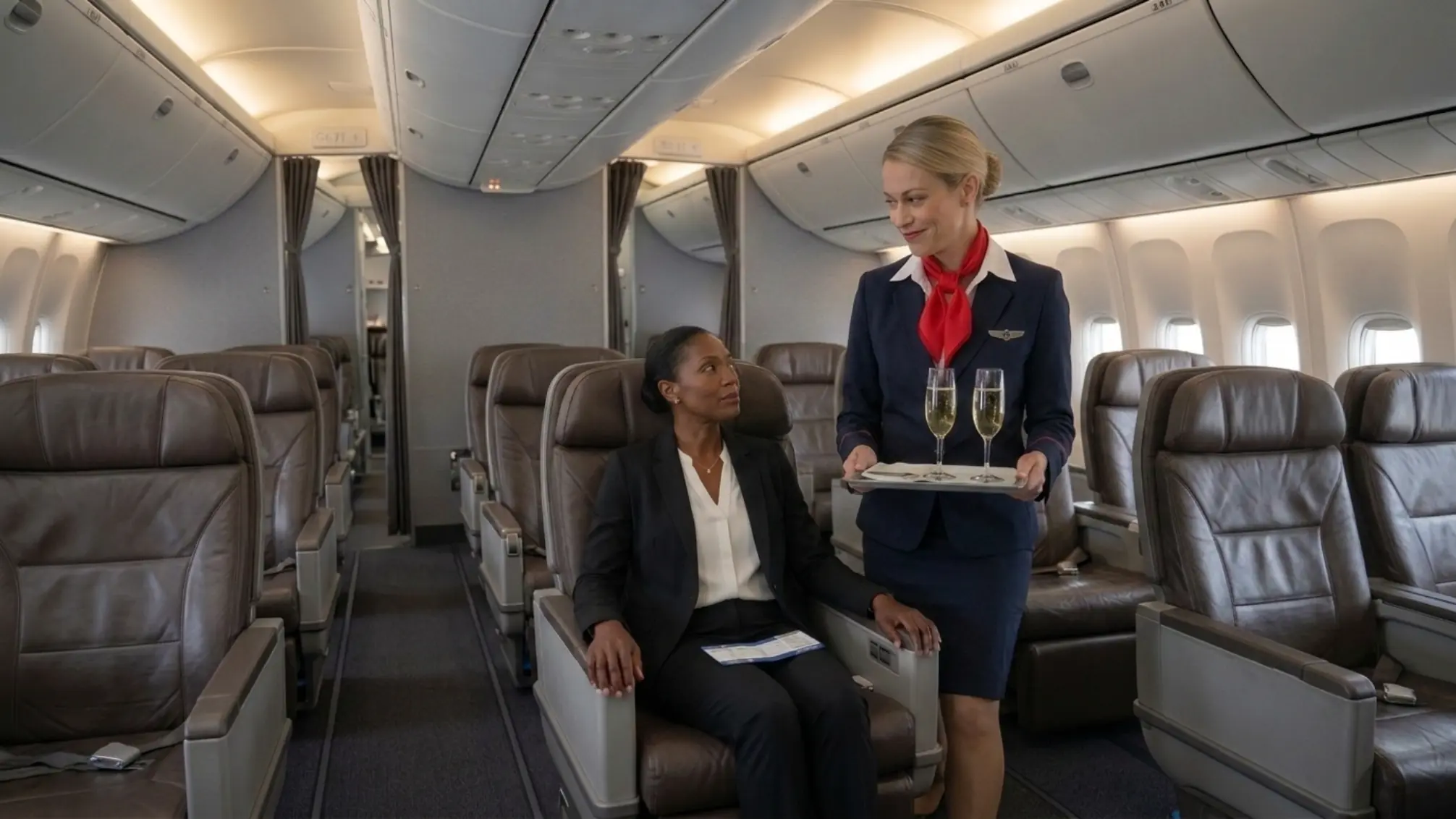
Naomi looked up without changing her expression. “Pick up my boarding pass and read the name you just insulted.”
Brielle gave a small, contemptuous laugh. Minutes earlier, she had snatched the ticket from Naomi’s hand, glanced at the first-class designation, and decided it could not possibly belong to the quiet Black woman sitting before her. Instead of scanning it, she had dropped it onto Naomi’s lap as though returning something dirty.
“Keep arguing,” Brielle said, “and security will remove you before takeoff.”
Naomi lifted her phone from the armrest. “Call them. Then explain why you threatened the woman who bought this airline today.”
The champagne glasses trembled slightly on Brielle’s tray.
A businessman across the aisle stopped typing. Two additional flight attendants near the galley exchanged startled looks, while a man seated behind Naomi leaned forward as if he had misheard. Brielle’s smile remained in place, but it had become rigid and unnatural.
“You bought the airline,” she repeated.
“That is what I said.”
Brielle looked toward Naomi’s crumpled boarding pass. The name printed across it was clear.
NAOMI GRANT.
The flight attendant knew that name. Everyone employed by Meridian Crown Airlines had received a brief corporate announcement that morning confirming the company’s acquisition by Grant Aviation Holdings. The message had included no photograph because the new owner had requested that the transition remain quiet until she completed an internal review.
Brielle’s eyes slowly returned to Naomi’s face.
Naomi had spent the previous eighteen months negotiating the purchase. Meridian Crown was a once-respected airline weakened by poor leadership, rising complaints, and a culture that prioritized appearances over passengers. Naomi’s company had acquired controlling ownership at 8:12 that morning, less than three hours before she boarded Flight 718 from New York to Atlanta.
She could have arrived with lawyers, executives, and photographers waiting at the gate. Instead, Naomi booked an ordinary first-class ticket, carried her own small bag, and entered the aircraft without identifying herself to the crew. She wanted to see how the airline treated passengers when no senior manager was expected to be watching.
Within seven minutes, she had her answer.
At the boarding door, Brielle greeted every passenger before Naomi with a smile. She offered to hang jackets, confirmed seat numbers, and addressed several travelers by name. When Naomi approached, Brielle’s eyes moved from her plain black suitcase to her understated clothing and then to the first-class marking on her boarding pass.
“You may be looking for the main cabin,” Brielle said.
“My seat is 2A.”
Brielle did not scan the ticket. “This is the first-class entrance.”
“I am aware.”
The people behind Naomi began waiting. Brielle’s embarrassment at being questioned hardened into hostility, and she finally waved Naomi through without the welcome offered to anyone else. Naomi said nothing, but she recorded the time in a secure inspection file on her phone.
The seat itself was clean and prepared. Naomi stored her suitcase, sat down, and opened a document reviewing employee turnover across Meridian Crown’s network. Before she could finish the first page, Brielle returned and demanded to see the boarding pass again.
Naomi handed it over.
Brielle studied the ticket without scanning the barcode. “Where did you get this?”
“The airline issued it.”
“That was not what I asked.”
Several passengers turned their heads. Naomi saw curiosity in some faces and amusement in others. No one intervened.
Brielle looked toward the passenger manifest displayed on the cabin tablet. “This seat is reserved under an executive account.”
“Yes.”
“You are claiming to be associated with Grant Aviation Holdings?”
“I am associated with it.”
Brielle’s lips tightened. “People use screenshots and transferred passes all the time. You will need to move until this is verified.”
Naomi extended her hand. “Scan the boarding pass.”
Instead, Brielle dropped it onto her lap.
That was the moment the inspection stopped being theoretical.
Now, standing beside Naomi after the ownership revelation, Brielle seemed unable to decide whether to apologize, deny what had happened, or continue pretending she still controlled the situation. The tray remained balanced in her hands, but the champagne inside each glass rippled.
“This is inappropriate,” Brielle said at last. “Passengers cannot impersonate corporate ownership to intimidate crew members.”
Naomi unlocked her phone.
“I agree. Identity should be verified.”
She tapped one contact and placed the device on the armrest between them. Brielle opened her mouth to object, but the call had already connected.
“This is Naomi Grant,” she said. “Activate executive review for Flight 718. Preserve all cabin recordings, gate footage, crew communications, and passenger-service notes. Place the regional operations director on speaker.”
The cabin went completely still.
A man’s voice answered seconds later. “Ms. Grant, this is Regional Director Michael Reeves. Your identity is confirmed. Are you safe?”
“I am seated in 2A.”
“Do you require airport security?”
Naomi looked directly at Brielle. “Not for me.”
The senior flight attendant standing near the galley stepped forward. Her name badge identified her as LEAD PURSER — HELEN MARKS. She had spent nineteen years flying for Meridian Crown and understood the meaning of an executive preservation order. Once activated, no crew report, camera file, or internal message connected to the flight could be altered or deleted.
“Ms. Grant,” Helen said carefully, “may I ask what occurred?”
Naomi did not answer immediately. She picked up her boarding pass, smoothed it once against her knee, and placed it on the armrest.
“Your flight attendant accused me of stealing a first-class seat,” Naomi said. “She refused to scan my ticket, dropped it onto my lap, and threatened to have me removed.”
Helen’s face changed. “Brielle?”
“She was unable to verify her booking,” Brielle said quickly. “The passenger became confrontational.”
Naomi turned toward the passengers around them. “Did I raise my voice?”
No one answered at first.
The businessman across the aisle closed his laptop. “No.”
Brielle looked at him sharply.
He continued, less comfortably. “She asked you to scan the ticket. You refused.”
A woman seated behind Naomi spoke next. “The flight attendant said she did not look like she belonged here.”
“I said her reservation appeared inconsistent,” Brielle replied.
“No,” the woman said. “You said women like her were always trying to get into seats they had not paid for.”
Another silence moved through the cabin.
Brielle’s face flushed. “You heard only part of the conversation.”
Naomi looked toward Helen. “Is there any legitimate reason the boarding pass was not scanned?”
Helen picked up the ticket and placed it beneath the handheld reader. The device chimed immediately.
The screen displayed Naomi’s verified name, seat assignment, executive booking status, and internal designation as majority owner of Grant Aviation Holdings.
Helen stared at it for one long second.
“The ticket is valid,” she said.
Naomi nodded. “It was valid before my identity became expensive.”
Brielle shifted the tray into one hand. “I was protecting the cabin.”
“From what?”
The question was quiet.
Brielle looked toward the other passengers, searching for language that would sound reasonable. “First class is frequently targeted by people seeking complimentary upgrades, compensation, or attention.”
“Did you suspect the businessman across the aisle?”
“No.”
“The couple behind me?”
“They did not create concerns.”
“What concern did I create?”
Brielle did not answer.
Naomi’s gaze remained steady. “My clothing was clean. My boarding pass showed seat 2A. I entered through the correct door, carried one approved suitcase, and spoke calmly. What exactly made me suspicious?”
Helen lowered her eyes.
Everyone in the cabin understood the answer.
Brielle finally placed the tray on an empty side console. “You arrived without the presentation associated with an executive passenger.”
Naomi’s expression hardened. “I did not ask whether I looked like an executive. I asked why you decided I was a thief.”
“I never used that word.”
“You accused me of stealing another person’s seat.”
“That is not the same thing.”
“It is exactly the same thing said with customer-service vocabulary.”
The regional director’s voice came through the phone again. “Ms. Grant, the airport station manager is standing by. Do you wish to delay departure?”
Naomi glanced toward the cabin clock. Boarding was nearly complete, and more than two hundred passengers expected the aircraft to leave on time. Punishing them for one employee’s conduct would create the wrong lesson.
“No,” she said. “The flight will depart once safety procedures are complete.”
Brielle exhaled faintly.
Naomi continued. “Ms. Carter is removed from customer-facing duty immediately. She may occupy a crew seat under supervision until the aircraft returns to the gate, or she may disembark now pending investigation.”
The relief vanished from Brielle’s face.
“You cannot suspend me in front of passengers.”
“You attempted to remove me in front of passengers.”
“This is retaliation.”
“No. Retaliation is punishment for reporting misconduct. This is a response to misconduct witnessed by an entire cabin.”
Helen stepped closer to Brielle. “We need you to come with me.”
Brielle did not move. “I have flown for this airline for eleven years.”
“Then you had eleven years to learn how to scan a boarding pass before humiliating someone.”
The words came from a younger Black flight attendant standing near the galley. Her badge read JANELLE PRICE. She had watched the confrontation in silence, hands clasped tightly in front of her.
Brielle turned toward her. “You should be careful.”
Janelle’s posture stiffened.
Naomi noticed the fear immediately. “Careful about what?”
Janelle looked from Brielle to Helen. “Nothing, ma’am.”
“That did not sound like nothing.”
Brielle picked up the tray. “This flight is already delayed. We should continue service.”
Naomi turned to Helen. “Has Ms. Carter threatened other employees?”
Helen hesitated.
The cabin seemed to hold its breath again.
“Answer honestly,” Naomi said. “Your job is not dependent on protecting management.”
Helen looked toward Janelle. “There have been complaints.”
Brielle’s voice sharpened. “Unverified complaints from inexperienced staff.”
Janelle’s eyes filled with anger. “You wrote me up for serving a Black family before finishing service for the white passengers behind them.”
“I wrote you up for ignoring sequence.”
“They rang the call button because their child was choking.”
“You abandoned your assigned row.”
“I gave him water.”
Brielle turned toward Naomi. “Crew discipline cannot be understood from isolated emotional stories.”
Naomi picked up her phone. “Regional operations, preserve all disciplinary reports signed by Ms. Carter during the past three years. Cross-reference them with passenger race, complaint outcomes, seat class, and employee demographic information.”
The regional director answered. “Understood.”
Brielle’s face went pale.
Naomi had not built her company by relying on dramatic moments alone. A single confrontation could reveal prejudice, but patterns proved whether an organization allowed it to become policy. She wanted dates, recordings, complaints, and comparisons.
“Ms. Carter,” Naomi said, “you may leave the aircraft now.”
For the first time, the flight attendant looked frightened.
“If I leave, I lose the entire trip assignment.”
“You lost the assignment when you used your uniform to turn bias into authority.”
“I have bills. I have a family.”
“So did every employee you threatened when they challenged you.”
Brielle looked toward Janelle. The younger attendant did not lower her eyes this time.
Helen escorted Brielle toward the aircraft door. Before passing through the curtain, Brielle turned back.
“You planned this,” she said. “You dressed down and came here hoping someone would make a mistake.”
Naomi remained seated. “A navy suit is dressing down?”
“You concealed your identity.”
“Ordinary passengers cannot announce ownership before asking for respect.”
“You wanted to trap us.”
“I wanted to see the airline I bought.”
Brielle’s voice broke through her controlled expression. “And now you are destroying my career over one misunderstanding.”
Naomi looked at the boarding pass resting beside her.
“No. You made a decision before checking one fact. The investigation will determine whether it was one misunderstanding or the latest example of who you become when you believe your target has no power.”
Brielle left the aircraft.
The cabin door remained open while a replacement crew member hurried from the terminal. Passengers began speaking quietly among themselves, many now uncomfortable with their earlier silence. Naomi noticed several people delete recordings they had started only after learning she was wealthy.
The businessman across the aisle leaned toward her. “For what it is worth, I am sorry.”
“What are you apologizing for?”
“I saw what she was doing.”
“And?”
“I assumed the crew would handle it.”
“The crew was doing it.”
He looked down.
Naomi did not humiliate him further. The purpose was not to make every silent witness perform guilt in public. Yet she wanted him to remember the moment before her ownership was revealed, when intervention carried no social reward.
The replacement attendant arrived, the door closed, and the aircraft pushed back from the gate. Naomi declined champagne and requested water. Janelle brought it with hands that still trembled slightly.
“Thank you,” Naomi said.
Janelle nodded. “I should have spoken sooner.”
“You were afraid of retaliation.”
“That does not make staying quiet feel better.”
“No. But responsibility belongs most heavily to the people who created the fear.”
Janelle glanced toward the galley. “Brielle has friends in management.”
“Then management will be reviewed too.”
The aircraft climbed above the clouds.
Once the seat-belt sign disappeared, Naomi opened the employee-culture report she had planned to review quietly. The document praised Meridian Crown’s commitment to premium service, inclusion, and professional excellence. Beneath those polished words, anonymous employee surveys told another story.
Black crew members reported being assigned more disciplinary points for minor uniform violations. Latino employees described managers mocking accents and discouraging them from working first class. Several attendants said complaints involving wealthy passengers were routinely closed without investigation.
Naomi began making notes.
The incident with Brielle was not the disease. It was a visible symptom.
Halfway through the flight, Helen asked permission to speak privately. Naomi invited her to sit in the empty seat across the aisle.
“I owe you an apology,” Helen said. “I saw Brielle challenge your ticket.”
“Why did you remain in the galley?”
“She has close relationships with two base supervisors. When people report her, the complaints return as performance problems for the employee who spoke.”
“You are the lead purser.”
“I know.”
“Then other crew members expected protection from you.”
Helen’s face tightened. “Yes.”
Naomi allowed the silence to remain.
Helen continued. “I told myself I could manage her quietly. Correct small things, move assignments, warn younger attendants. But I was protecting the schedule, not the people.”
“That distinction matters.”
“I understand that now.”
“Understanding after my identity was revealed is easy.”
Helen nodded. “Then judge me by what I do next.”
Naomi studied her. “Write a complete statement before landing. Include every incident you witnessed, every complaint you discouraged, and every supervisor who pressured you to remain silent.”
Helen looked anxious but relieved. “I will.”
“Do not make yourself innocent in the statement.”
“I won’t.”
When Flight 718 landed in Atlanta, three executives from Grant Aviation Holdings were waiting at the gate. Naomi instructed them not to create a public spectacle. No photographers, welcoming banners, or statements to the press would be allowed until employees and passengers involved in the incident had been interviewed.
Brielle had already contacted her union representative and claimed Naomi staged the encounter to justify mass terminations. The union demanded a transparent investigation. Naomi agreed immediately.
Transparency protected more than ownership.
Investigators reviewed cabin recordings, gate footage, internal messages, and three years of disciplinary records. What they found extended far beyond one boarding pass.
Brielle had been named in twenty-seven complaints. Nine involved Black passengers questioned despite holding valid premium tickets. Four involved disabled travelers publicly challenged over boarding priority. Seven employees accused her of retaliating after they reported discriminatory treatment.
Most complaints had been closed by the same two base supervisors.
One internal message from Brielle described first class as needing protection from “upgrade hunters who do not fit the cabin profile.” Another instructed a gate agent to scrutinize passengers who “looked more coach than Crown.”
The investigation also uncovered falsified service reports, altered witness statements, and complimentary travel credits offered to targeted passengers in exchange for withdrawing formal complaints.
Brielle was terminated.
The two supervisors who protected her were dismissed after separate hearings. Three additional managers were disciplined for failing to preserve complaints, while Helen remained employed under a final warning after submitting a detailed statement and agreeing to help rebuild reporting procedures.
Janelle was invited to join a new employee advisory council. She accepted only after Naomi promised the council would have direct access to ownership rather than reporting through the same management structure it was expected to challenge.
Naomi did not issue a triumphant public statement.
Instead, she gathered Meridian Crown employees in a company-wide broadcast. She stood in an ordinary training room without a stage, speaking beside an enlarged image of the crumpled boarding pass.
“This ticket was valid before anyone knew who I was,” she said. “My dignity was not created by the acquisition agreement signed that morning.”
Thousands of employees watched from crew rooms, airport offices, maintenance hangars, and customer-service centers.
“The failure was not that one flight attendant failed to recognize an owner,” Naomi continued. “The failure was that she believed an ordinary Black passenger could be humiliated without consequence, and too many people had learned that opposing her was dangerous.”
The airline introduced mandatory ticket verification before any passenger could be challenged about seating. Crew complaints were moved to an independently monitored system. Managers could no longer close discrimination reports without review outside their local base.
Naomi also ordered a study of upgrades, seat changes, removals, and security referrals. The data showed that Black passengers were questioned about premium seating at more than twice the rate of white passengers with comparable booking circumstances.
The policy changes reduced those incidents within months.
Six months after the confrontation, Naomi boarded another Meridian Crown flight without announcing herself. She wore dark jeans, a blue sweater, and carried the same small suitcase. The crew greeted her, scanned her ticket, and directed her toward seat 3C without hesitation.
A few minutes later, a Black college student boarded wearing a hooded sweatshirt and carrying an old backpack. His boarding pass placed him in first class, purchased with points his parents had saved for his graduation.
The flight attendant scanned the ticket.
“Welcome aboard,” she said. “Your seat is just ahead on the left.”
Nothing dramatic happened.
No executive call was placed.
No cabin froze in silence.
The young man sat down and looked through the window, unaware that his ordinary welcome represented months of painful change.
Naomi watched from across the aisle.
That was the outcome she had wanted—not an airline where employees treated her carefully because they recognized the owner, but one where no passenger needed ownership to be believed.
Janelle served the cabin that day. When she reached Naomi’s row, recognition flickered in her eyes, but she gave no sign that might expose her identity.
“Would you care for something to drink?” she asked.
“Water, please.”
Janelle handed her the glass.
Then she leaned slightly closer. “The system works better now.”
“Systems work only while people keep using them honestly.”
“We are trying.”
Naomi smiled. “That is where change begins.”
Outside, the aircraft climbed above a field of clouds. The first-class cabin looked nearly identical to the one where Brielle had dropped a boarding pass onto Naomi’s lap: wide leather seats, closed overhead compartments, polished trays, and soft lighting.
But appearances had never told the whole story.
Brielle believed the cabin’s luxury gave her authority to decide who belonged inside it. She saw a quiet Black woman in a simple suit and assumed humiliation would carry no cost.
One sentence changed when she learned Naomi owned the airline.
The truth did not.
Naomi Grant had belonged in that seat before the acquisition, before the phone call, and before anyone in the cabin understood the power behind her name.
The boarding pass proved where she was assigned.
Her humanity should have been enough to prove she deserved respect.