“Don’t touch anything, thief.”
The accusation cut across the white exhibition hall with enough force to silence the conversations around the champagne tables. Naomi Carter had not touched the Vincent van Gogh painting hanging before her, nor had she crossed the narrow brass viewing line positioned several feet from its gilded frame. She had simply been standing alone beneath the warm gallery lights, studying the violent blue sky and fields of yellow paint when Richard Vale decided she did not belong there.
Naomi turned slowly.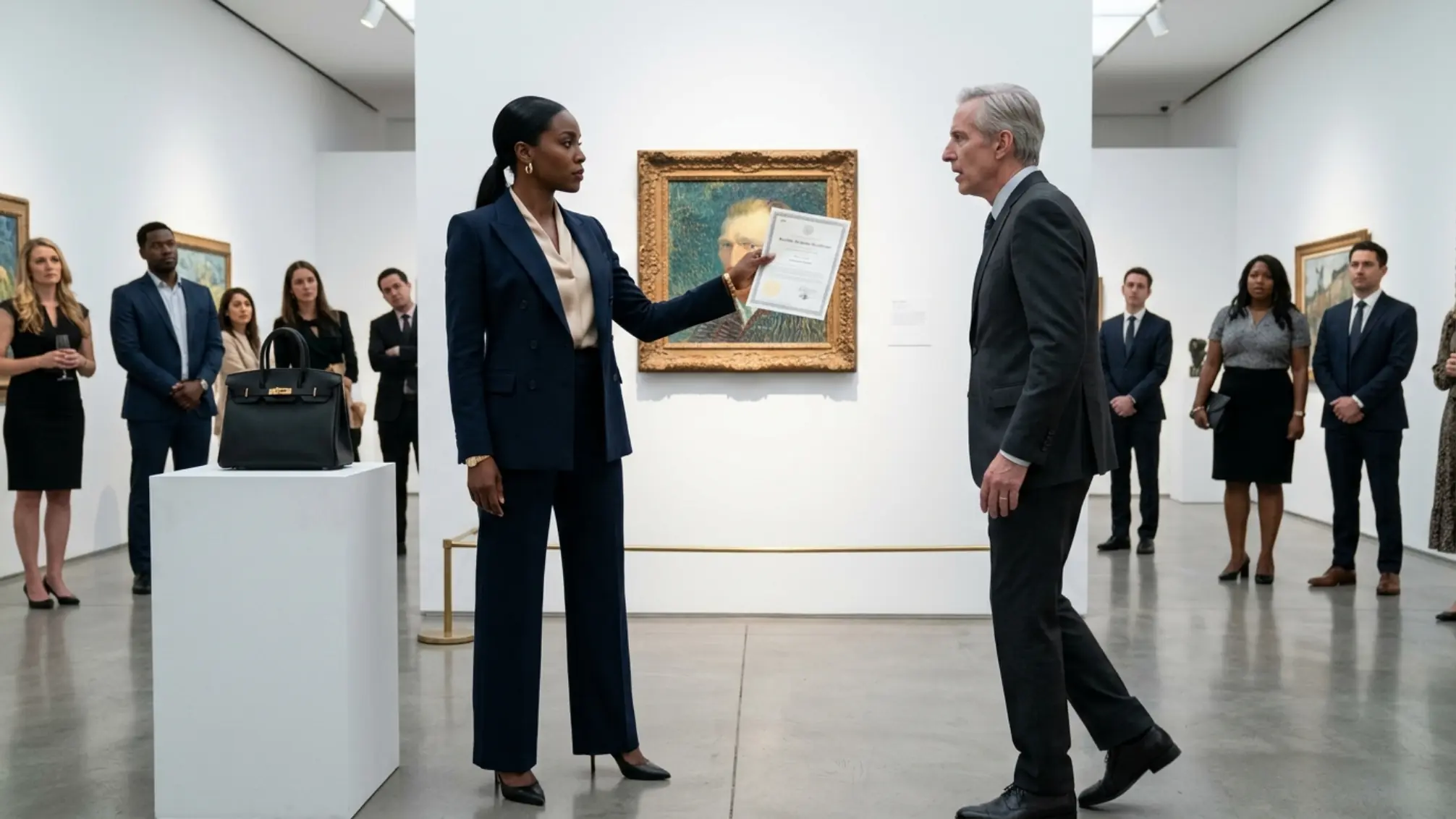
She was forty-one, tall and composed, with deep brown skin, sharp dark-brown eyes, and long glossy black hair gathered into a sleek low ponytail. Her midnight-navy double-breasted blazer had been tailored precisely to her figure, resting over a champagne silk blouse and flowing wide-leg trousers. Pointed black heels, small gold earrings, a slim watch, and a structured leather handbag completed an appearance that was elegant without demanding attention.
Richard approached as though confronting someone caught reaching into a display case. He was fifty-eight, white American, silver-haired, and dressed in an expensive charcoal suit with a pale tie. His face carried the certainty of a man accustomed to having suspicion treated as evidence.
“I said step away from the painting.”
Naomi glanced at the empty space between herself and the brass line.
“I’m already behind the barrier.”
“Do not argue with me.”
“I stated where I’m standing.”
Several guests turned toward them. A woman wearing a diamond necklace lowered her champagne glass, while two men near a bronze sculpture raised their phones slightly. Across the room, a young gallery assistant froze with a tray balanced in both hands.
Richard stopped within three feet of Naomi.
“This is a private exhibition. We have had problems with people wandering into restricted rooms and attempting to take whatever they can carry.”
Naomi looked back at the enormous painting.
“You believe I was planning to carry away a Van Gogh?”
A few guests laughed nervously.
Richard did not.
“People like you usually begin with something smaller.”
The room became quieter.
Naomi allowed the words to remain exposed without helping him soften them.
“People like me?”
Richard’s eyes traveled over her skin, hair, handbag, and suit.
“People who dress above their station and assume no one will question them.”
Naomi’s expression did not change.
“Call security.”
Richard blinked. “What?”
“You believe I’m a thief. Call security and explain exactly what you saw.”
His mouth tightened.
“I am giving you an opportunity to leave without embarrassment.”
“You created the embarrassment when you shouted across the room.”
“You should be grateful I have not called the police.”
“Call them too.”
Richard studied her face, searching for fear. Instead, Naomi checked the time on her watch and returned her gaze to him with the patience of someone waiting for a delayed meeting.
“You find this amusing?”
“No. I want your accusation documented before your memory improves.”
The guests closest to them exchanged looks. Richard became aware of the phones, but rather than retreat, he seemed energized by the audience. Marlowe House had employed him for nearly twenty-five years, and he had curated private collections for some of the wealthiest families in the country. Within these walls, donors asked for his approval, artists waited for his attention, and junior employees learned not to challenge him.
He pointed toward Naomi’s handbag.
“Place that on the floor.”
“No.”
“I will have security remove it.”
“Then security can explain why they searched the legal owner of the painting.”
Richard laughed.
It was a short, contemptuous sound.
“You expect anyone here to believe that?”
Naomi remained still.
Three nights earlier, she had purchased the Van Gogh at the Hope Through Art charity auction for thirty-eight million dollars. The sale had been covered by financial newspapers, though Naomi’s identity as the buyer remained private at her request. Every dollar from the purchase was being divided between pediatric hospitals, housing programs for families undergoing long-term medical treatment, and public-school arts education.
The painting had remained temporarily at Marlowe House under a thirty-day exhibition agreement. Naomi had permitted the display because the gallery promised to use it as the centerpiece of a charitable fundraising campaign expected to generate another twelve million dollars.
Richard knew the painting had been sold.
He simply did not know the buyer standing before him.
Naomi had arrived early for a private donor reception because she wanted five quiet minutes with the artwork before the speeches began. Her name was on the invitation list, her ownership certificate had been issued by the gallery’s legal department, and the black leather folder in her handbag contained every document proving the transfer.
Richard saw none of that.
He saw a Black woman standing near an expensive object and decided the explanation must be criminal.
“That costume does not make you a collector,” he said.
Naomi’s eyes hardened.
“My clothing is not evidence.”
“It is evidence of someone trying too hard.”
“To do what?”
“To look as though you belong in rooms like this.”
Naomi stepped closer.
Richard did not move, though surprise flickered through his face.
“Call security,” she repeated. “I want them standing here when you say that again.”
He removed his phone.
“Gladly.”
He contacted the gallery’s security desk and announced that a suspicious woman had entered the private exhibition. He described Naomi as aggressive, possibly carrying tools in her handbag, and standing dangerously close to a multimillion-dollar artwork.
Naomi watched him speak.
He did not mention that she remained behind the barrier. He did not mention that she had obeyed every visible rule. He did not mention that he had never asked for her invitation.
When the call ended, Naomi spoke calmly.
“Did you see tools?”
“No.”
“Did you see me touch the painting?”
“You were preparing to.”
“What movement indicated that?”
Richard glanced toward the young assistant with the champagne tray.
“My staff witnessed it.”
Naomi turned to her.
“What is your name?”
The assistant looked immediately at Richard.
“Emily.”
“Emily, did you see me cross the line?”
Richard raised his voice. “She is not part of this conversation.”
Naomi kept her eyes on the young woman.
“Did I touch anything?”
Emily’s fingers tightened around the tray.
“No.”
Richard’s face darkened.
“You were across the room.”
“I could see her,” Emily said quietly. “She was just looking at the painting.”
“Return to the reception desk.”
Emily hesitated.
“Now.”
She walked away with her shoulders rigid.
Naomi watched her leave.
“You just punished an employee for telling the truth.”
“I corrected someone without the experience to understand a security risk.”
“You mean she contradicted you in public.”
Richard stepped closer.
“You are very comfortable making accusations for someone standing where she should not be.”
Naomi reached slowly toward the inside of her blazer.
Richard’s hand rose.
“Keep your hands visible.”
She stopped.
“What exactly do you think I’m carrying?”
“I am not waiting to find out.”
“Then ask me.”
“I do not need your permission to protect this collection.”
“No, but you need facts before you accuse someone of theft.”
Two security officers entered through the side corridor. Both wore dark suits with discreet earpieces. Behind them came the gallery’s head of security, Thomas Duncan, a white American man in his early fifties with a shaved head and a cautious expression.
Richard pointed at Naomi.
“This woman entered a private area without authorization and refused to leave.”
Naomi looked at Thomas.
“Before you act, ask him whether he checked the guest list.”
Thomas glanced toward Richard.
“Did you?”
Richard hesitated.
“That is not relevant.”
“It is extremely relevant,” Naomi said.
Thomas held out his hand.
“Ma’am, may I see your invitation?”
Naomi opened her handbag slowly and removed the embossed card.
Richard watched every movement.
Thomas examined the invitation, then checked the name against a tablet carried by one of the officers.
His expression changed.
“Ms. Carter is on the list.”
Richard leaned toward the screen.
“That could be another Carter.”
“The invitation number matches.”
Richard recovered quickly.
“Then her conduct still created a concern.”
“What conduct?” Naomi asked.
“You positioned yourself too close to the painting.”
Thomas looked at the brass boundary.
“She is behind the line.”
“She may have stepped back when she saw me.”
Emily spoke from the reception desk.
“She never crossed it.”
Richard turned sharply.
Naomi noticed Thomas’s eyes narrow.
“Are there cameras in this room?” she asked.
“Yes,” Thomas replied.
“Then preserve the footage.”
Richard gave a dismissive laugh.
“You have no authority to issue orders here.”
Naomi reached into her blazer again.
This time, she withdrew a cream-colored certificate inside a protective leather sleeve.
“Read the buyer’s name,” she said, holding it toward him. “Then explain why you are threatening the woman who owns the painting.”
Richard stared at the document.
The top carried the Marlowe House seal. Beneath it was the auction title, lot number, final price, and transfer authorization for the original Van Gogh hanging behind Naomi.
At the bottom, printed in dark formal lettering, appeared the name:
NAOMI ELISE CARTER
CHAIRWOMAN AND CHIEF EXECUTIVE OFFICER
CARTER DEVELOPMENT GROUP
Richard read it twice.
The color left his face.
Thomas moved closer and examined the signature.
“This is authentic.”
Richard looked from the certificate to Naomi and then toward the painting.
“You bought it?”
Naomi lowered the document.
“I paid thirty-eight million dollars for it three nights ago.”
The guests around them began whispering.
Richard’s mouth opened, but no sound came out.
Naomi continued.
“The gallery is displaying it because I agreed to a temporary charitable loan. The exhibition proceeds are supposed to support pediatric hospitals and public-school arts programs.”
Richard stepped backward.
“Ms. Carter, I did not realize—”
“No. You did not.”
“There has been a serious misunderstanding.”
“You called me a thief before asking my name.”
“I was protecting your painting.”
“You were protecting it from me.”
His face tightened with panic.
“You should have identified yourself.”
“Would ownership have made me less suspicious?”
“That is not what I meant.”
“It is exactly what you meant.”
Thomas looked toward the security officers.
“Preserve all footage from this room and the entrance.”
Richard turned on him.
“There is no need to escalate this.”
“The owner requested preservation.”
Naomi corrected him.
“A witness requested preservation. My ownership should not determine whether evidence survives.”
The gallery’s executive director, Margaret Marlowe, arrived less than four minutes later. She was sixty-two, white American, and dressed in a pale gray silk suit. The moment she saw Naomi holding the purchase certificate and Richard standing beside security, she understood that the evening had moved beyond ordinary damage control.
“Ms. Carter,” Margaret said, extending both hands. “I am so pleased you could join us.”
Naomi did not take them.
“Are you?”
Margaret lowered her arms.
“I understand there was confusion regarding your identity.”
“There was no confusion about my identity. He never asked for it.”
Margaret looked toward Richard.
“What happened?”
Richard answered quickly.
“Ms. Carter was standing unusually close to the painting. I followed normal security protocol.”
“You called me a thief,” Naomi said.
“I used strong language because you refused instructions.”
“Your first instruction was not to touch something I had never touched.”
Margaret’s expression hardened.
“Richard, did you check her invitation?”
“There was no time.”
“You had time to call security.”
“I was acting on instinct.”
Naomi removed a small notebook from her handbag.
“Please repeat that.”
Richard stared at her.
“What?”
“You accused me on instinct. I want the exact wording.”
Margaret stepped between them.
“Ms. Carter, perhaps we should discuss this privately.”
“Your curator humiliated me publicly.”
“I want to understand the situation without creating further disruption.”
“The disruption began before anyone knew my name.”
Margaret glanced toward the surrounding phones.
“What would resolve this?”
Naomi closed the notebook.
“Do not begin by asking what I want.”
“Then where should we begin?”
“Ask whether he has done this before.”
Richard’s head snapped toward her.
“That accusation is outrageous.”
“You were comfortable enough to insult me in front of donors, order security to search my bag, and invent behavior that your own employee denied witnessing. People do not become that comfortable on their first attempt.”
Margaret looked at Thomas.
“Have there been prior complaints?”
Thomas hesitated.
Richard interrupted.
“Security receives complaints constantly. Most come from guests who dislike being reminded of boundaries.”
“That was not my question,” Margaret said.
Thomas looked toward Naomi, then back to the executive director.
“There have been incidents.”
“How many?”
“I would need to review the files.”
Richard crossed his arms.
“This is becoming a trial based on one emotional reaction.”
Naomi moved one step toward him.
“You falsely accused me of a felony. My reaction is the calmest thing in this room.”
The gallery entrance opened again.
Two police officers entered, responding to Richard’s earlier call. Officer Teresa Alvarez approached with her partner, Daniel Price, and asked who had reported the suspected theft.
Richard raised one hand reluctantly.
“I did.”
Officer Alvarez looked toward the painting and then at Naomi.
“What did you observe?”
Richard’s confidence returned slightly in the presence of official authority.
“She was behaving suspiciously around the artwork and refused to comply with instructions.”
“What behavior was suspicious?”
“She was standing too close.”
Officer Price examined the boundary.
“She is behind the line.”
“She moved.”
Emily spoke from the reception area.
“No, she didn’t.”
Richard glared at her.
Officer Alvarez noticed.
“Ma’am, did you witness the incident?”
Emily nodded.
“Yes.”
“Did Ms. Carter touch the painting?”
“No.”
“Cross the barrier?”
“No.”
“Attempt to remove anything?”
“No.”
Richard’s voice rose.
“She reached into her handbag after I told her not to.”
Naomi opened the leather sleeve containing the certificate.
“I retrieved proof that the painting belongs to me.”
Officer Price read the document.
Then he looked at Richard.
“You called the police on the owner?”
“I did not know who she was.”
Officer Alvarez’s expression remained neutral.
“What caused you to believe she was stealing before you knew?”
Richard searched for an answer that would not sound like the truth.
“She looked out of place.”
Naomi wrote down the words.
Margaret closed her eyes briefly.
Officer Alvarez continued.
“What specifically made her look out of place?”
Richard looked at Naomi’s elegant suit, then away.
“She did not behave like our usual collectors.”
“How do your usual collectors behave?”
“They understand discretion.”
Naomi looked at him.
“You shouted ‘thief’ across the gallery.”
Several guests nodded.
Richard’s face reddened.
Margaret addressed the officers.
“I believe we can confirm there was no theft attempt.”
Naomi spoke immediately.
“That does not end the false report.”
Richard turned toward her.
“You cannot possibly intend to press this.”
“You described me as a criminal without evidence.”
“I made a mistake.”
“A mistake is misreading an invitation number. You constructed an entire crime around my presence.”
“I apologized.”
“You apologized after learning what I owned.”
Richard stepped closer.
“I will not have a thirty-year career destroyed over one sentence.”
Naomi held his stare.
“You were willing to risk my freedom over one glance.”
Officer Price positioned himself slightly nearer to Richard.
Margaret pointed toward the office corridor.
“Richard, leave the exhibition floor.”
He did not move.
“You cannot suspend me because a donor became offended.”
“She is not merely a donor,” Margaret replied.
Naomi’s eyes shifted toward her.
“That distinction should not matter.”
Margaret fell silent.
Naomi turned toward the police officers.
“I want the original call preserved, the gallery footage secured, and every witness offered the opportunity to provide a statement.”
Richard looked at Margaret.
“You are letting her take control of the gallery.”
“No,” Naomi said. “I am taking responsibility for evidence connected to an accusation against me.”
Thomas ordered his staff to secure the recordings. One of the officers returned moments later with a concerned expression and whispered something to him.
Thomas looked toward Richard.
“There is a problem.”
“What problem?” Margaret asked.
“The main gallery footage was marked for deletion two minutes ago.”
Every face turned toward Richard.
He shook his head.
“I did not touch the system.”
Thomas checked the tablet.
“The request came from the curator’s office terminal under your login.”
Richard’s mouth tightened.
“My assistant uses that terminal.”
Emily looked up sharply.
“I don’t know his password.”
“I was not talking about you.”
“You don’t have another assistant tonight.”
Richard’s face went still.
Naomi closed her notebook.
“You attempted to erase the footage after learning who I was.”
“That is false.”
Thomas spoke quietly.
“The cloud backup has already synchronized. The recording is intact.”
Richard stared at him.
Margaret’s voice hardened.
“Give Thomas your access card.”
“This is absurd.”
“Your card, Richard.”
He removed it from his jacket and placed it on the table with enough force to make the champagne glasses shake.
“You will regret humiliating me in front of everyone.”
Naomi stepped closer.
“You began the evening by demonstrating how little humiliation concerns you when you believe the victim has no power.”
Richard looked at her with open hatred.
“You came here to trap us.”
“I came to see a painting I bought for children who may never have the chance to stand inside a room like this.”
He said nothing.
“You turned that into evidence against yourself.”
Richard was escorted to his office while the reception remained suspended. Margaret offered Naomi access to a private lounge, but she declined. She remained in the gallery until the officers completed their preliminary statements and every recording was formally preserved.
The Van Gogh hung silently behind them.
Its price had drawn the wealthy. Its charitable purpose had drawn cameras. Yet the confrontation beside it revealed something more valuable than either publicity or money.
The gallery claimed to celebrate humanity through art while treating certain people as threats before learning their names.
The investigation began the following morning.
Naomi had no interest in using her financial power to demand a symbolic firing and then move on. She hired an independent civil-rights auditing firm and invoked a clause inside the charitable loan agreement requiring Marlowe House to maintain nondiscriminatory public-access practices.
Margaret initially argued that one curator’s conduct did not justify reviewing the institution.
Naomi sent her the contract.
Section fourteen allowed immediate suspension of the loan if the gallery engaged in conduct likely to undermine the charitable purpose of the exhibition.
Without the Van Gogh, the reception series would collapse. Major donors had pledged matching contributions only while the painting remained on display. Removing it could cost the children’s programs more than eight million dollars.
Margaret agreed to the review.
The auditors found forty-six complaints involving racial profiling over five years. Twenty-nine came from Black visitors. Nine involved Latino American visitors, and six involved young artists whose clothing or appearance did not match the gallery’s preferred donor image.
Richard appeared in eighteen complaints.
Guests described being followed through rooms, questioned about invitations, ordered to open handbags, or warned not to touch artwork when they had remained behind barriers. Some had been accused of photographing security systems when they were merely taking pictures of sculptures.
Most complaints ended with the same conclusion:
Curator acted within discretionary authority. No further action required.
Margaret had signed eleven of those closures.
When Naomi confronted her with the findings, the executive director did not deny the signatures.
“I trusted Richard’s judgment.”
“You trusted it after repeated evidence showed whom that judgment targeted.”
“He was respected throughout the art world.”
“Respect is not an investigation.”
“He brought major collections here.”
“And you allowed the value he generated to purchase silence.”
Margaret looked toward the Van Gogh visible through the office window.
“Are you going to remove the painting?”
“That depends on what happens next.”
“The charities will lose millions.”
“No. The gallery will lose the privilege of raising those millions through my property. I will move the exhibition somewhere else.”
Margaret understood the difference.
The children were never leverage. Naomi had already arranged alternative venues with three museums willing to preserve the full charitable program.
Marlowe House could not hide behind the beneficiaries.
Emily became the most important witness in the review. She provided copies of a private guest-screening document called the Courtesy List. It contained photographs, social media profiles, and coded warnings attached to certain visitors.
Black guests were marked with phrases such as “watch bag,” “verify invitation,” “possible activist,” or “unlikely collector.”
Naomi’s own name appeared.
Beside it, Richard had written:
Corporate executive. No public photograph verified. Review appearance at entrance.
He had known a woman named Naomi Carter owned the painting.
He simply had not believed the Black woman standing before it could be that Naomi Carter.
Additional emails showed that Margaret knew the Courtesy List existed. She had not created it, but she advised staff to avoid racial descriptions in writing.
That message ended her claim of ignorance.
Marlowe House’s board convened an emergency meeting. Richard was terminated, though he publicly insisted he had become the victim of a wealthy executive seeking revenge.
The gallery released a statement describing his conduct as isolated.
Naomi rejected the statement.
She provided the board with the complaint files, the screening list, and the email showing leadership’s attempt to conceal the racial basis of the practice.
“An isolated event does not produce five years of matching records,” she said.
Margaret resigned before the board could vote on her removal.
Naomi agreed to keep the Van Gogh at Marlowe House only under binding conditions. The gallery had to establish an independent visitor-rights office, eliminate appearance-based guest screening, preserve all complaints outside local management, and provide restitution to individuals previously targeted.
Every dollar from the exhibition would continue reaching the charities.
None could be used for the gallery’s legal defense or public-relations campaign.
Naomi also prohibited Marlowe House from using her confrontation in promotional materials. The board wanted to announce a new era of inclusion using a photograph of Naomi standing beside the Van Gogh.
She refused.
“My humiliation is not your redemption campaign.”
The reforms took nearly a year.
During that time, the painting traveled to children’s hospitals, public museums, and school exhibitions under strict security. Naomi arranged for students from neighborhoods with limited arts funding to see it without charge.
At one event, a ten-year-old Black girl stared at the heavy yellow brushstrokes and asked Naomi why anyone would pay thirty-eight million dollars for a painting.
Naomi smiled.
“I did not pay for the canvas alone.”
“What did you pay for?”
“The hospitals, the family housing, the teachers, and the chance for you to stand here asking that question.”
The girl studied the painting again.
“Do you keep it in your house?”
“No.”
“Why not?”
“Some things become more valuable when more people can see them.”
One year after the original confrontation, the Van Gogh returned to Marlowe House for the final week of the charity exhibition.
Naomi attended without announcement.
She wore the same midnight-navy suit, champagne blouse, black heels, and gold earrings. Her hair rested in the same low ponytail, and the ownership certificate remained inside her handbag.
A new curator stood near the entrance.
He did not recognize her.
“Good evening,” he said. “May I see your invitation?”
Naomi handed it to him.
He checked the name and returned the card.
“Welcome, Ms. Carter. The Van Gogh is in the east gallery.”
No suspicion entered his voice. No one searched her handbag. No security officer followed her.
Naomi walked through the bright white rooms and stopped behind the same brass line where Richard had called her a thief.
Emily approached a moment later. She now served as director of visitor standards and ethics.
“You came without telling anyone,” Emily said.
“I wanted to know how they treated an unknown woman.”
“And?”
Naomi looked toward the entrance.
A Black mother had arrived with two young children. The younger boy moved excitedly toward a sculpture, and a security officer gently redirected him without raising his voice or grabbing his arm.
“No one asked who she was,” Naomi said.
Emily smiled faintly.
The Van Gogh remained unchanged—yellow fields beneath a restless blue sky, thick layers of paint creating movement inside stillness.
Naomi had purchased it for charity, but the painting ultimately funded more than hospitals and classrooms. It forced an institution to confront the difference between admiring humanity on a wall and respecting it when it entered through the door.
Richard became polite only after discovering that Naomi owned the artwork.
Real change arrived later, when visitors without wealth, titles, or certificates were treated as though dignity already belonged to them.