The ground shook first.
That was always how it started.
Not with sight, not with sound, but with the earth itself registering the approach. A low-frequency tremor moved up through boot soles, rattled loose change in pockets, and made livestock in nearby fields lift their heads and stand still.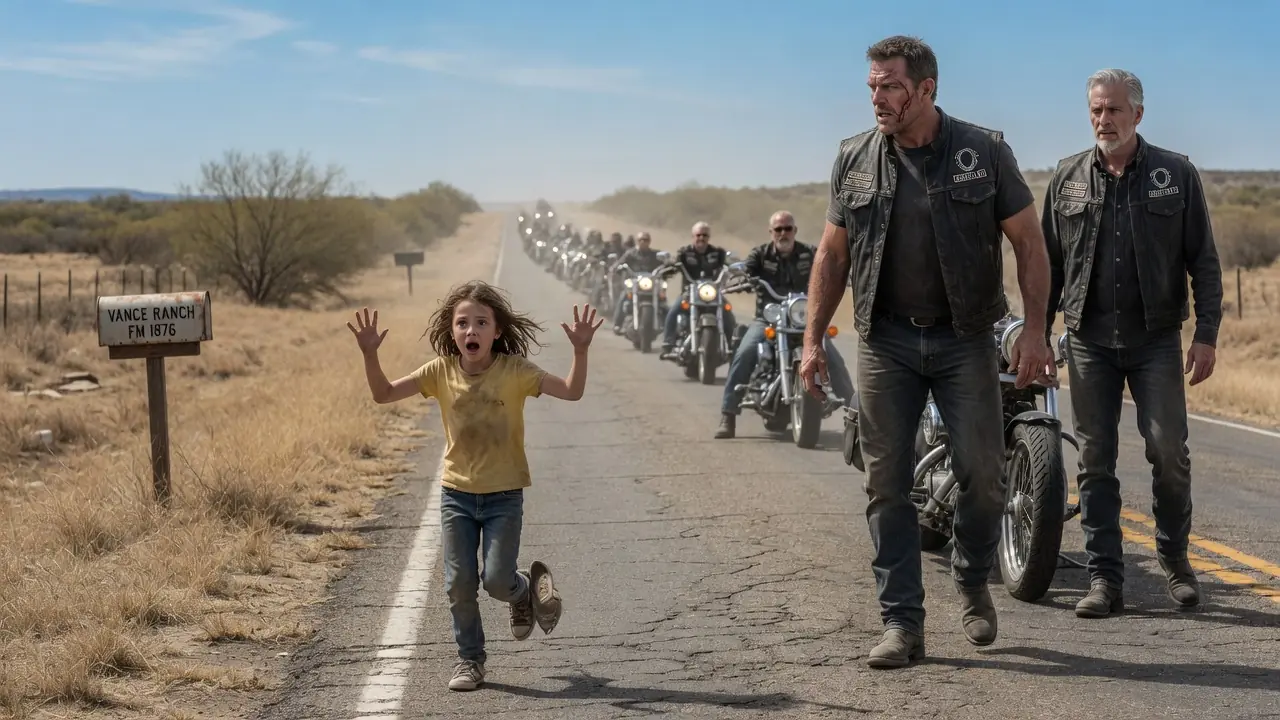
Then the sound arrived.
Fifty Harley-Davidson engines in rolling formation.
A wall of noise so dense and physical it pressed against the chest like a hand.
Highway 9 ran straight and empty through the flat Texas scrubland, shimmering with midday heat, and Colt Barrett’s column ate up the asphalt with the particular authority of people who had never learned to make themselves smaller.
Colt “The Axeman” Barrett rode point, as he always did. He was thirty-eight years old, six foot four, with a face that looked like it had been assembled from spare parts by someone working under pressure. He had a jaw that could stop a fist, a nose broken enough times to have its own history, and a scar that ran from his left ear to the corner of his mouth, left by an explosion outside Kandahar that had taken two men who had been standing closer to it than he was.
He was the president of the Ironclad chapter of the Hells Angels, and he had ridden this stretch of highway more times than he could count.
Every time he passed the county line marker coming up on his left, he did the same thing he always did.
He looked at the faded mailbox at the edge of the Vance property.
Danny Vance.
Killed two years ago.
Left behind a wife, a daughter, and a piece of land that still did not seem to understand that the man who worked it was gone.
Colt was still looking at the mailbox when the girl ran out of the scrub brush and stood in the middle of the road.
His hand crushed the front brake.
The Road King fishtailed hard, the rear wheel breaking loose on the sun-softened asphalt, and forty-nine bikes behind him responded in a chain reaction of shrieking rubber and roaring deceleration that sounded like the world tearing itself in half.
The column lurched to a stop in a ragged, overlapping mass of chrome and leather.
Bikes canted at angles.
Boots hit the ground.
Silence came down like a hammer.
The girl was still standing there.
Twelve years old.
He knew her age because he had been at her baptism, watching as she was held by a woman named Sarah Vance while her husband Danny stood beside them and grinned the way Danny always grinned, like every single thing was slightly funnier than you realized.
The girl had Danny’s dark eyes and Sarah’s stubborn jaw. She also had three days of highway dust on her face and hands. She was holding a piece of torn cardboard in front of her with both hands, shaking so hard the sign trembled.
Colt cut his engine.
The silence that followed was absolute.
Fifty machines went quiet in the same moment, the way they did when Colt raised his fist, because what Colt’s fist said, fifty engines obeyed.
He stepped off his bike and walked toward her, his boots loud on the gravel shoulder, and read the cardboard sign as he closed the distance.
The letters were large and uneven, written in what looked like charcoal or a burned piece of wood, pressed hard enough to groove the cardboard.
Help. Sheriff locked my mom in the concrete pit to steal our ranch. Please.
Colt read it once.
He read it again.
He looked up at Maisie Vance.
Colt turned back to his column.
Fifty men sat on their bikes and watched him.
He raised his fist.
“Kill the engines,” he said. “Reverse formation. We’re going back.”
Colt had known Danny Vance for nineteen years.
They had met in the army, Colt in combat engineering, Danny in infantry, both of them nineteen years old and trying to look like they were not scared in a forward operating base outside Fallujah.
Danny had the specific quality of a man who was genuinely unafraid of the things that made other men afraid, and genuinely, profoundly afraid of the things that actually mattered. Losing people. Breaking promises. Falling short of the standard he held himself to.
He had been the best man at Colt’s first wedding. He had flown across three states for the funeral when that marriage ended. He had patched into the Ironclad chapter four years after Colt, and he had ridden beside him for a decade and a half.
Two years ago, a drunk driver on Route 12 had changed direction without warning, and that had been the end of Danny Vance.
He died on a Tuesday in October, and the chapter buried him with full honors. His wife Sarah stood at the graveside with twelve-year-old Maisie and held herself together with a dignity that made every hard man present look toward the middle distance and breathe carefully.
Colt had driven out to the Vance ranch three times in the months that followed.
Sarah was managing.
The ranch was small, forty acres of mid-grade grazing land, a decent house, and a barn that needed work. But it was hers, deeded to Danny’s family for two generations, and she had been working it with Maisie’s help and the occasional assistance of neighbors who respected what she was trying to do.
He had not been out in five months.
Chapter business.
A run to the coast.
The ordinary momentum of things.
Five months.
Now he crouched in front of Maisie on the shoulder of Highway 9 and looked at her hollow cheeks, cracked lips, and the duct tape wrapped around the sole of her left shoe where it had started to separate.
He felt something move through him that was not quite any single emotion, but was made of parts of all of them.
“How long?” he said.
“Three days.”
Her voice was dry.
She had been rationing water.
“They came with the trucks on Monday morning. Deputies and men from the mining company. They said Mom had to sign papers or they were going to take the property. When she wouldn’t sign, Sheriff Albright…”
She stopped, swallowed, and started again.
“He had his men take her to the old cement works on Route 4. He said if she signed the papers, he’d let her out. She wouldn’t sign.”
“Three days,” Colt said again.
“I tried to get to the neighbor’s place, but they’d put men on the road. I tried the county line going east, but there was a patrol car.”
She looked at him directly.
“I’ve been waiting here since Monday afternoon because I knew you all came through this way on the summer run. I didn’t have anywhere else to go.”
Colt stood up.
Weston Sterling materialized at his shoulder.
Weston was forty-five years old, silver-haired, the chapter’s vice president, and the man most responsible for the fact that Colt’s decisions usually had a second stage of thinking behind them.
Weston looked at the cardboard sign.
He looked at Maisie.
Then he looked at Colt.
“Brody Albright,” Weston said.
The name came out with a specific flatness that contained a complete assessment.
“Yeah,” Colt said.
Sheriff Brody Albright had been the law in Cutter County for eleven years. He had been reelected three times with comfortable margins, backed by county money and the particular deference small towns extend to men who project certainty.
He was forty-seven years old, thick-necked, and had been taking money from Consolidated Western Mining for at least four years by Weston’s careful accounting. Payments routed through shell companies and a consulting firm registered out of state.
The chapter knew this because Weston made it his business to know things about the people in their county.
Knowing things was how the chapter had survived in Cutter County for twenty-three years without the kind of direct confrontation that ended badly.
Apparently, the confrontation had decided to find them anyway.
Colt looked at the faded Vance mailbox.
He looked at the cardboard sign.
Then he looked at the fifty men sitting on their bikes in the heat of the midday highway, watching him with the patient attention of people who would go wherever the point rider went.
“Maisie,” he said, “you’re riding with me.”
He walked back to his Road King.
He settled her on the back, felt her thin arms wrap around his waist, and felt her grip tighten in the way someone grips something they have been waiting three days to find.
He fired the engine.
Around him, in the specific ripple of sound that always followed his lead, forty-nine engines came back to life.
The yellow crime scene tape was still stretched across the Vance property’s front gate when the column turned off Highway 9.
Two strips of it crossed the entrance, with a county notice stapled to the gatepost declaring the property under temporary seizure pending investigation.
Three vehicles from Consolidated Western Mining were parked in the yard: two pickup trucks with the company logo on the doors, and a flatbed carrying a compact excavator, its bucket resting against the ground like a sleeping animal waiting to be put to work.
Four men in company hard hats stood by the flatbed. They looked at the column arriving and looked at each other with the expressions of people revising their day’s plans.
Deputy Garrett Creed’s cruiser was parked directly in front of the house’s porch.
He was twenty-nine, broad-shouldered, with a haircut that indicated he thought about his appearance more than his job performance warranted. He came out of the front door of the house when he heard the bikes, holding a beer that did not belong to him, and looked at the arriving column with the particular arrogance of a man who believed the badge on his chest was a permanent force field.
“Private property under county seizure,” he called out, one hand dropping toward his holster. “Turn those bikes around.”
Colt had already stepped off his Road King.
He covered the distance to the porch in six strides.
What happened next took only seconds.
Creed’s hand moved for his weapon, and Colt closed the distance before the deputy could complete the motion. He caught Creed’s wrist, redirected him, and used the man’s own forward momentum to send him stumbling back through the porch’s screen door and across the living room coffee table.
The table was a solid piece of pine that had belonged to the Vance family for twenty years. Colt had sat at it, drunk beer, and watched football with Danny.
The coffee table did not survive.
Creed lay in the wreckage of it and decided, with considerable wisdom given the circumstances, not to get up.
Colt stood in the doorway of the house he had visited a hundred times and looked at what had been done to it.
The shelves had been pulled out.
Drawers had been emptied onto the floor.
Family photos had been taken down.
He could see the nail marks, the pale rectangles on the paint where they had hung.
On the floor near the fireplace, face down, was a framed photograph he recognized even from a distance.
It was him and Danny Vance at the chapter’s fifteenth anniversary run. Both of them grinning. Danny’s arm across his shoulders. Both of them covered in highway dust and younger than they had felt in years.
Someone had stepped on it.
The glass was cracked.
A boot print crossed Danny Vance’s face in dried mud.
Colt looked at it for a long time.
Weston appeared at his shoulder, looked at the photograph, and said nothing.
He did not need to.
Colt picked the photograph up from the floor.
He removed the broken glass carefully, shook the frame clean, and set it upright on the mantelpiece where it belonged. He looked at Danny’s face, the grin, the highway dust, the arm across his shoulder, for a moment that he did not extend and did not cut short.
Then he turned to the four mining company workers, who had been very sensibly standing completely still near their vehicles since the deputy’s brief introduction to the coffee table.
“The woman they took,” Colt said. “The cement works on Route 4. Which building?”
The foreman, a practical man who had done his own fast arithmetic, answered immediately.
The Hartley Cement Works had been closed for eleven years.
It sat on six acres of cracked concrete and industrial desolation on the south edge of Route 4. Its main processing building was a massive poured-concrete shell with windows long since boarded and a roof missing sections where weather had taken its toll.
The surrounding fence was chain-link topped with rusted barbed wire, two padlocks on the main gate, and a county notice declaring the property condemned.
Colt’s column did not stop at the gate.
Three bikes at the front pushed it off its hinges at a roll. The chain-link folded, the padlocks tore free from the posts, and the column flowed into the property like water through a breach.
The main building’s entrance was a steel door, industrial grade, locked from the outside with a deadbolt and a hasp padlock.
Weston produced a bolt cutter from his saddlebag.
Weston was a man who believed in carrying the right tools.
The hasp came free in two cuts.
Two chapter brothers hit the door together, and it swung inward on darkness, concrete dust, and the particular dead air of a space that had been sealed.
Colt went in first with a flashlight.
The processing floor was vast and dim. The concrete floor was cracked and pooled with old water stains. The machinery had long since been stripped or rusted to immobility.
At the far end, a staircase descended into what had been the aggregate storage basement, a series of interconnected concrete pits, each roughly ten feet square and eight feet deep, designed to hold raw material before processing.
The light found her in the third pit.
Sarah Vance was forty-one years old and had the rancher’s build of a woman who had spent twenty years doing physical work, compact and strong, with hands that were calloused and capable.
She was sitting with her back against the concrete wall, her wrists restrained to a rusted iron ring embedded in the wall, her eyes closed.
She was alive.
He could see the shallow movement of her chest, but the dehydration was clear in her cracked lips and the dry, papery quality of her skin, visible even in the flashlight beam.
“Sarah.”
He kept his voice level.
Her eyes opened.
She looked at the light for a moment without apparent comprehension.
Then something came back into them.
Recognition.
Behind it, the controlled emotion of a woman who had held herself together for three days and was not going to stop now just because help had arrived.
“Colt.”
Her voice was barely a rasp.
“Yeah,” he said. “We’re here.”
Weston had the restraints off her wrists in less than a minute with a utility knife. Two brothers went down into the pit and brought her up carefully, supporting her weight.
Patches, the chapter medic, who had ridden out with the column and was already opening his kit, moved in immediately.
Maisie, who had been waiting at the building’s entrance, came across the floor at a run when she saw her mother’s face and did not stop until she had both arms around her.
Colt stepped back and let them have that.
He was standing near the pit entrance, watching Patches work and letting the particular cold fury in his chest organize itself into something useful, when he heard the vehicles outside.
First one engine.
Then another.
Then the crunch of multiple sets of tires on broken concrete.
The sound of doors.
The amplified crackle of a police radio.
Then Sheriff Brody Albright’s voice through a megaphone, flat and satisfied and loud enough to fill the building.
“Attention inside. This is Sheriff Albright. You are trespassing on a county-designated crime scene, and you are all under arrest for obstruction, breaking and entering, and assault on a county deputy. Come out with your hands visible, or I will authorize force. You have two minutes.”
Colt walked to the building’s entrance.
Through the gap where the steel door stood open, he could see them.
Thirty-two men spread across the cement works’ main yard in a tactical fan.
Some were county deputies in uniform. Others were men in mining company gear carrying weapons they had no official reason to hold.
Three cruisers flashed with lights.
A company truck had a spotlight mounted on the roof.
Albright stood at the center of his line, megaphone in one hand, his other thumb hooked in his belt with the specific self-satisfaction of a man who believed he had just arrived at checkmate.
He was thick-necked and florid, with the kind of belly that years of unchallenged authority builds.
And he was smiling.
Colt looked at that smile.
He pulled his phone.
“Weston,” he said, “pull the red line.”
Albright was still talking through the megaphone when Colt stepped out of the building.
He stepped out alone, which surprised the sheriff enough that the megaphone dropped slightly.
Colt walked to the center of the yard, hands loose at his sides, and stopped ten feet from Albright’s line.
He looked at the thirty-two men arrayed against him.
He looked at Albright’s smile.
“You kept a woman chained in a concrete pit for three days,” Colt said at normal conversational volume, “to steal her property. The property of a man who died serving this country.”
He paused.
“Danny Vance served two tours. You know that.”
Albright’s smile stayed in place.
“Son, you’ve got about ninety seconds before I give the order, and not a judge in this county is going to—”
“I’m not talking to a judge,” Colt said.
He raised his right fist.
The red line signal had gone out eleven minutes ago.
The Ironclad chapter’s maximum emergency frequency bounced through three relay points to every chapter in contact range. It carried a single encoded word that every patch member in four states understood without elaboration.
Brotherhood down.
All available.
Now.
The sound reached Albright’s line before the light did.
That deep, ground-level vibration built from nothing to everything in the space of thirty seconds.
It came from the north approach road.
From the east county road.
From the service track that ran along the south fence line.
Not one direction.
All of them.
Albright turned his head.
His megaphone hand dropped.
The first headlights appeared on the north approach.
A column of them.
White and blazing, stretching back in a line so long the end of it was beyond the horizon.
The east road answered with its own column of lights a moment later.
The south track, narrower and rougher, produced a third. Bikes ran two abreast where the track allowed it and single file where it did not.
An unbroken chain of light and sound curved around the cement works property and began to close.
The Ironclad chapter had forty-eight men.
Three affiliated chapters that had been within range added one hundred ninety more.
Two additional chapters, traveling to the same regional rally and catching the red line frequency, added two hundred sixty.
Independents and associates who monitored the channel and had decided independently that this was exactly the kind of situation they rode for added another one hundred twelve.
Five hundred eighty-seven motorcycles settled into position around the Hartley Cement Works with the unhurried finality of a tide coming in.
Their engines idled.
The light from their combined headlights turned the property’s interior into something close to noon. Harsh, white, casting hard lines from every person and vehicle on the ground.
The sound, not revving, not aggressive, just present, was a physical thing.
It pressed against the eardrums and the sternum simultaneously.
And it did not stop.
Albright’s thirty-two men looked at the light.
They looked at the long shadows the light threw behind them across the concrete.
They looked at one another.
Two of the mining company men lowered their weapons first.
Men who had taken the job for a check were now conducting a rapid reassessment of whether the check covered this.
Then a deputy on the far left of the line, a young one who had clearly been having his own private conversation with his conscience for the last three minutes, reached a conclusion. His weapon went to the ground, and his hands went up.
It moved through the line like a wave.
Albright watched it happen.
He watched his line collapse from the outside in, weapon by weapon, man by man. The tactical formation he had assembled dissolved in the combined headlight glare of nearly six hundred motorcycles.
The megaphone hung from his hand, forgotten.
His own sidearm was still holstered.
He looked at it.
He looked at Colt, who had not moved from the center of the yard.
Albright’s hand moved toward the holster.
Not a full draw.
Something more automatic than that, the gesture of a man whose hands were doing something his brain had not fully authorized.
Weston Sterling stepped out of the building entrance behind Colt.
Twenty men who had been inside with him stepped out behind Weston, and the particular quality of attention they brought to bear on Albright’s right hand made his fingers stop moving of their own accord.
The sheriff’s hand came away from the holster.
Colt walked toward him.
Albright backed up one step, then stopped, maybe because of some remnant of pride or maybe because of the cruiser behind him cutting off his retreat.
He was breathing hard.
The flush in his face had shifted from satisfaction to something considerably less composed, and the smile that had been there sixty seconds ago was entirely gone.
“The thing about men like you,” Colt said, stopping two feet away, “is that you spend so long being the biggest thing in a small space that you stop being able to see what’s outside it.”
He reached down and took Albright’s badge from his shirt.
Not forcefully.
Firmly.
The way you take something that was never rightfully owned.
He looked at it.
A county sheriff’s star.
Cutter County.
The metal worn smooth with years of wear.
He set it on the hood of the cruiser.
“Weston,” he said.
Weston Sterling came forward with a laptop, already open and running.
On the screen, and on the portable projector two chapter brothers had quietly set up against the cement works exterior wall while the confrontation played out, was a financial document.
Wire transfers.
Account numbers.
Shell company registrations.
Forty-seven months of payments from Consolidated Western Mining to accounts controlled by Brody Albright, totaling an amount displayed in large numbers at the bottom of the document.
Beside it was the audio recording from Creed’s testimony in the ranch house, now playing through a small speaker with enough volume to be heard by everyone in the yard.
Beside that was the live feed, running since Weston had activated it twenty minutes ago, broadcasting to the Texas Attorney General’s office, the FBI San Antonio field office, and three news network livestream feeds that were collectively being watched by one hundred forty thousand people and climbing.
Albright looked at the projection on the wall.
He looked at his name in the transfer documents.
He looked at the numbers.
Something happened to his face.
A complex, cascading failure of the architecture of authority he had built and maintained for eleven years, collapsing inward the way structures collapse when the thing holding them up is removed.
His shoulders dropped.
His jaw went slack.
He looked, very suddenly, like what he actually was underneath the badge, the gun, and eleven years of unchallenged power.
A frightened, small, greedy man who had finally arrived at the end of what greed had built for him.
He sat down on the hood of his cruiser.
The state police helicopter was audible in the distance, dispatched by the Attorney General’s office twenty minutes ago, now coming in fast from the north.
The state police took forty minutes to fully process the scene.
They took Albright away in handcuffs, which he submitted to with the deflated compliance of a man who had run completely out of alternatives. His deputies, the ones who had surrendered, which was most of them, were separated and interviewed on-site.
Deputy Garrett Creed, who had been sitting in the ranch house under the comfortable supervision of two Ironclad brothers since his introduction to the coffee table, was transported separately.
The Consolidated Western Mining executives who had authorized and organized the operation were arrested at their regional offices in Austin before midnight. Their computers and financial records were seized under a federal warrant that the FBI’s economic crimes unit had been preparing for three months, waiting for exactly the kind of corroborating evidence Weston Sterling’s careful documentation had provided.
The state’s attorney stood outside the cement works in the television lights and said words that included systematic corruption, abuse of office, and full investigation into all associated parties.
The governor’s office issued a statement by midnight that included the phrase immediate suspension of all county contracts with Consolidated Western Mining.
The people of Cutter County came out of their houses.
Not all at once.
It started with a few.
A couple who lived half a mile down Route 4 had watched the lights and heard the engines and come out to their porch to see what was happening.
Then a family from the north side of town arrived after following the livestream on a phone.
Then more came, drawn by the particular human instinct that assembles people at the site of a significant event, the need to be present when something that has been wrong for a long time is finally being made right.
By the time the state police vehicles were pulling out, sixty or seventy people had gathered at the fence line of the cement works.
They were quiet at first.
The watchful quiet of people who had been under the thumb of something for a long time and were not yet sure the thumb was fully gone.
Then one of them, a woman in her fifties who ran the feed store on the county road and who had been fined by Albright four times in three years for violations that everyone in town understood were fabricated, started clapping.
It spread the way applause spreads when it comes from genuine feeling rather than obligation.
Unevenly at first.
Then gathering.
Then sustained.
The Ironclad chapter stood by their bikes in the parking area and received it with the slightly uncertain quality of men who were comfortable with fear and respect, but less practiced with gratitude.
Weston looked at the crowd and then at Colt with an expression that suggested he was having feelings about this and was choosing not to examine them in public.
Colt looked at Maisie.
She was standing near his Road King, her mother’s arm around her shoulders. Sarah Vance, cleaned up, rehydrated, and free now. Patches had done what he needed to do, and Sarah was looking at the crowd with an expression that was complex, tired, and quietly luminous.
Maisie herself was watching the applause with her head slightly tilted, the way a person watches something they did not fully believe was possible.
Colt walked over.
He reached into his cut and produced two things.
The first was a medal, a service commendation with Danny Vance’s name engraved on the back, that the chapter had presented at Danny’s memorial. Colt had carried it in his interior pocket since that day for reasons he had not fully articulated to himself until now.
He held it out to Maisie.
She took it with both hands, turned it over, and read her father’s name.
She held it for a moment.
“He would have come,” she said. “If it was someone else’s family. He would have come, and he wouldn’t have left until it was fixed.”
“I know,” Colt said. “He always did.”
The second item was an envelope.
Inside was a check, the first installment of a civil settlement that the chapter’s attorney had spent the last two hours drafting, drawing on funds from Consolidated Western Mining’s seized operating accounts and secured by the Attorney General’s office as emergency victim restitution.
The number had seven digits.
Sarah Vance looked at it with the stunned stillness of a woman who had been surviving on minimal resources for two years and was having difficulty recalibrating.
“The ranch is yours,” Colt said. “Free and clear, documented, and we’re going to make sure every piece of paper that says otherwise is buried so deep it never comes up again.”
He paused.
“Danny picked that land because he wanted you and Maisie to have something permanent. Nobody is taking it.”
Sarah Vance said nothing for a moment.
Then she put her hand briefly on Colt’s forearm.
A gesture that was not dramatic and did not need to be.
“Thank you,” she said.
Three days later, the Vance ranch looked different.
Not finished.
It would take time to be finished.
But different in the specific way places look when people have decided to take them seriously again.
The broken fence sections that the mining company’s surveying team had damaged were replaced with new timber. The post holes had been dug and set by twelve men who had shown up at seven in the morning with tools and no announcement.
The inside of the house had been cleaned. The damaged items replaced. The shelves restocked.
The photograph of Colt and Danny at the fifteenth anniversary run was in a new frame on the mantelpiece.
The glass uncracked.
The image clear.
Maisie watched from the porch as the last of the chapter’s work crew loaded their tools and the bikes lined up on the ranch road for departure.
Forty-eight Ironclad members, plus a contingent from the affiliated chapters that had stayed to help. Nearly a hundred men in total, settling onto their machines with the unhurried ease of a morning ride.
Colt came to the porch.
Maisie looked up at him.
Three days of sleep and food had put color back in her face, and the hollow quality around her eyes was beginning to resolve. She still had the watchfulness that three days alone on a highway had built into her. She would probably always have it, in the way tests leave marks.
But behind it now was something else.
The particular steadiness of a person who had been through the worst thing and come out the other side still standing.
“You waited three days on that highway,” Colt said. “Alone.”
“I knew you’d come through,” she said. “Dad always said the chapter kept its word.”
“He was right about that.”
She looked at the line of bikes.
“Are you going to come back?” she asked. “Not because of something wrong. Just…”
“Yeah,” Colt said. “We’ll come back.”
He put on his helmet.
He walked to his Road King, swung onto it, and fired the engine.
Around him, in the ripple he had always loved, came the specific sound of a column coming to life together. Each engine finding its voice and joining the chorus.
Forty-seven more engines answered.
Maisie stood on the porch of her father’s house with her mother beside her and the morning light coming in long and gold across the Texas scrubland.
She watched them go.
The column moved down the ranch road, turned onto Highway 9, and opened up, the engines rising to full voice as they hit the open road.
The sound carried back across the flatland for a long time after the bikes themselves had passed the tree line.
Maisie looked down at her father’s medal in her hand.
She looked at the highway.
Then she put the medal in her pocket, close to her chest, and went inside to help her mother with the morning.