The medics said afterward that he had maybe twenty minutes left.
A sixteen-year-old girl gave him two miles.
She did it with almost nothing but her own back, down a dirt road with no cell signal and nobody coming to help. 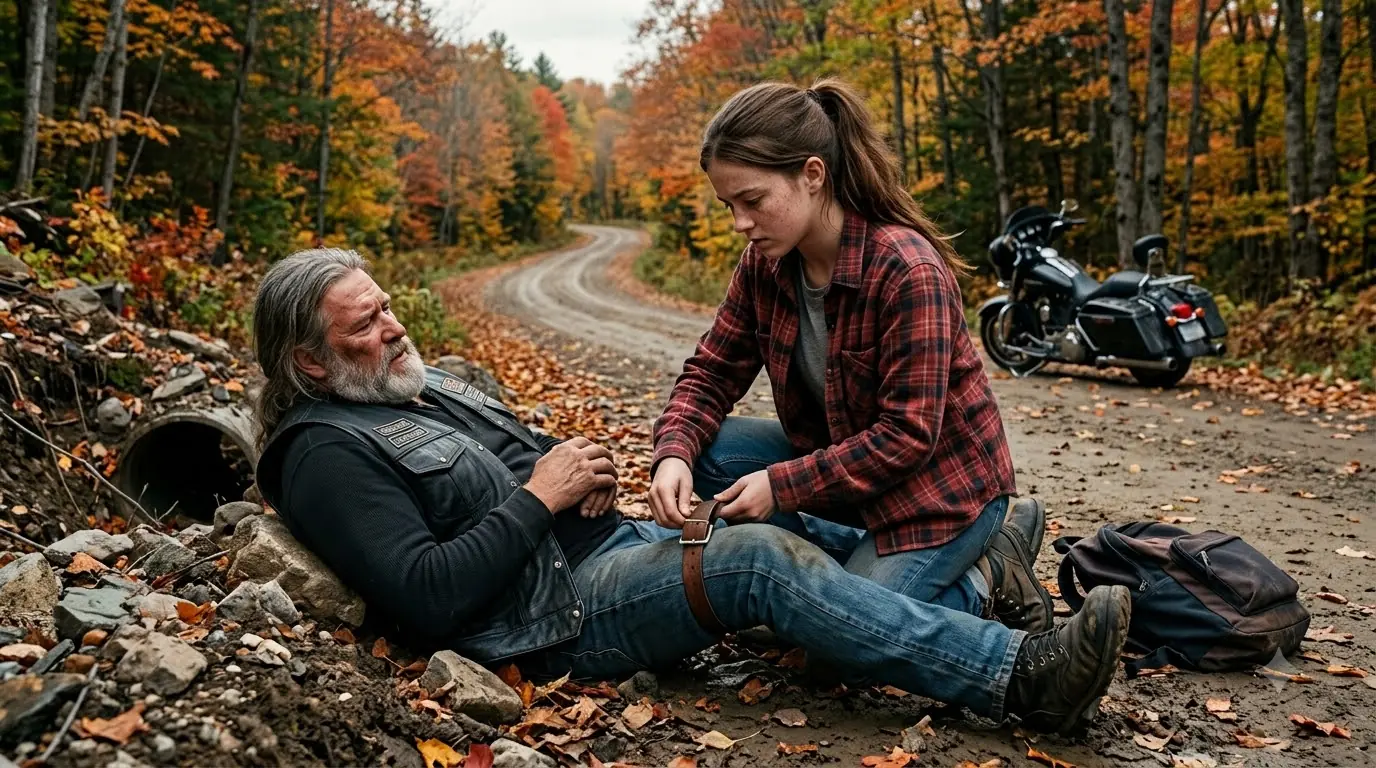
And when 340 Hells Angels finally learned why a stranger had nearly died across her shoulders for those two miles, they came to a remote Vermont hollow to answer for it in a way the whole county would remember.
It was the third week of October in Vermont’s Northeast Kingdom, on a dirt spur off Route 105 north of Island Pond, where the cell signal disappeared long before the pavement did.
The maples had already turned and half dropped their leaves, leaving the woods rust-colored and bare in places. The air carried the first serious bite of northern cold, mixed with wood smoke, wet leaves, and the hard mineral smell that meant winter was close. Late-afternoon light stretched thin across the hills and vanished early.
Nadine Frost was sixteen years old.
Most people called her Deenie.
It was the last thing her mother had called her.
She had been an orphan for eight months.
Her mother and father died together in the spring when black ice sent their truck off Route 114 near the Nulhegan River. There was no close family member willing or able to take her.
What remained was a small hill farm at the end of the dirt spur.
A leaning cabin.
A wood stove.
Forty acres of stone, spruce, rough pasture, and debt her father had never completely paid off.
The county had reluctantly allowed Nadine to stay there through the school year under the loose supervision of a caseworker who drove out once a month. The alternative was a placement nearly two hours south, and there were no available beds nearby.
So Nadine lived alone in her parents’ cabin.
She split her own wood.
She walked two miles to the county road every morning to catch the school bus.
She kept the stove burning the way a person keeps the last ember of something alive.
Her numbers were simple.
Two hundred eleven dollars in a coffee can.
A woodpile that would not survive February.
A property tax bill for $940 coming due in December.
And a neighbor farther down the spur who had already made it clear that he would happily take the forty acres off her hands for a fraction of their value the moment the county stopped protecting her.
His name was Merrick Sloan.
Nadine was sixteen, orphaned, short on money, and living in a house she was in danger of losing.
She had learned to carry heavy things because nobody else was there to carry them.
That was why, when she heard the crash, she ran toward it.
She had heard the motorcycle first.
A deep rolling engine note came off Route 105 and climbed the dirt spur too fast for such a rough road.
Then the engine stopped.
A sharp impact followed.
Then came a long scrape of metal against dirt and stone.
After that, silence.
The crows rose from the trees.
Nadine dropped her backpack and ran.
She found the motorcycle around the next bend, near a washed-out culvert.
A large black touring bike lay on its side thirty feet from the road, its front wheel badly damaged, oil leaking into the leaves.
The rider was in the ditch.
He had gone over the handlebars and landed hard near the edge of the culvert.
There was serious bleeding from high on his left leg and another injury along his scalp.
Even crumpled in the ditch, he was enormous.
Six foot four, maybe 260 pounds.
His leather vest had ridden up across his back.
Nadine could read the patches.
Hells Angels across the upper rocker.
A Massachusetts charter across the bottom.
A winged death’s-head emblem between them.
His eyes were half open.
He was trying to speak, but almost no sound came out.
Nadine dropped to her knees in the cold leaves.
She remembered a Red Cross first-aid course her mother had forced her to take when she was fourteen.
At the time, Nadine had complained through most of it.
Now she heard the instructor’s voice in her head.
Stop the bleeding first.
She put both hands against the wound and leaned her weight into it.
The bleeding slowed, but not enough.
The man groaned.
Nadine pulled out her phone with one hand.
No signal.
Of course.
She was inside the dead zone.
The nearest reliable signal was back toward Route 105.
Almost a mile.
The nearest landline she knew belonged to the Sloan place, another mile farther up the spur.
She did the arithmetic quickly.
A mile back toward the pavement.
Then a 911 call.
Then an ambulance coming from miles away.
Thirty minutes.
Maybe forty.
Sometimes longer out there.
Nadine looked at the man.
He did not have forty minutes.
His skin was already turning pale beneath the road grime.
She made a decision.
She took off her belt and tightened it high on his injured leg. She used a small piece of wood to secure the pressure until the bleeding slowed dramatically.
The man cried out.
“I’m sorry,” Nadine said. “I know. I know.”
She used her flannel shirt and part of her backpack straps to secure what she could.
Then she looked at him.
Two hundred sixty pounds.
She weighed barely 120.
But leaving him meant he might die.
So Nadine Frost got him out of the ditch.
She could not truly carry him.
She learned that within the first ten feet.
Instead, she moved him any way her body could invent.
She got behind him and hooked both arms beneath his shoulders.
Then she dragged.
Three feet.
Rest.
Three more.
Rest.
When the dragging became too rough, she found a wide strip of loose birch bark and worked him onto it.
For a while, she pulled him like a sled across the leaves.
When the ground climbed, the bark caught on roots.
So she changed methods again.
She got his arm across her shoulders.
She bent her knees the way her father had taught her when they hauled firewood.
Then she stood.
His weight nearly crushed her.
His boots dragged deep lines in the road.
They moved ten feet at a time.
Sometimes less.
Both of them fell twice.
Both times, Nadine got him moving again.
She talked constantly.
“Stay awake.”
Another few steps.
“You stay awake, mister.”
Another few.
“You hear me?”
The man tried to answer.
She lowered him carefully.
“What’s your name?”
His lips moved.
“Gus.”
“Gus?”
A faint nod.
“All right, Gus. Stay with me.”
She got him upright again.
“We’re going to the Sloan place. They have a phone.”
Step.
Drag.
Step.
“Stay with me, Gus.”
His name became a rope she threw over and over.
It took nearly an hour to cover the first mile.
The Sloan property sat behind a cattle gate.
A neat house.
Straight fencing.
A barn painted every few years whether it needed it or not.
Merrick Sloan was the neighbor who wanted Nadine’s land.
He came out onto the porch when he saw her approaching.
A bloodstained sixteen-year-old girl dragging a barely conscious man in biker leathers up his driveway.
Merrick did not come down the steps.
“Mr. Sloan.”
Nadine could barely speak.
Her arms shook violently.
Gus sagged against her.
“Please call an ambulance.”
Sloan stared.
“He’s hurt bad. I stopped the bleeding, but he needs help.”
She tried to move another step.
“Please. Your phone.”
Merrick Sloan looked at Gus’s vest.
Then at Nadine.
His expression closed.
“I’m not getting involved in that.”
Nadine stared at him.
“What?”
“Look at him.”
Sloan pointed.
“That’s an outlaw biker.”
“He’s dying.”
“I’m not having that trouble brought onto my property.”
Nadine’s face went blank with disbelief.
“Mr. Sloan, I just need the phone.”
“No.”
He folded his arms.
“You take him somewhere else.”
“He might die.”
“Then maybe he shouldn’t have been riding that road.”
Nadine stood there, almost unable to understand what she was hearing.
Sloan came down two steps.
Not to help.
To move them.
“Off my property.”
“Please.”
“I said move.”
Nadine did not.
Sloan grabbed her shoulder and shoved.
She lost her balance.
Gus’s weight came down with her.
Both hit the gravel.
The makeshift tourniquet shifted.
The bleeding worsened again.
Nadine immediately crawled toward Gus.
“Off my land,” Sloan said above them. “I won’t say it twice.”
Something changed inside her.
Maybe it was exhaustion.
Maybe rage.
Maybe there comes a point when a person has lost enough that fear cannot find anything left to threaten.
Nadine retightened the belt.
Her hands shook, but they worked.
Then she looked up at Merrick Sloan from the gravel.
“His name is Gus.”
Sloan stared at her.
Nadine’s voice became calm.
“And you’re going to be sorry you did this.”
For the first time, Sloan took a step backward.
Nadine got Gus upright again.
Then she left.
The second mile was the one she would never be able to explain properly.
Her legs were finished.
Her arms had stopped feeling like arms somewhere back at Sloan’s cattle gate.
She moved Gus on something beyond strength.
Something beneath muscle that only starts when everything else has failed.
She counted his breaths.
Every ten steps, she stopped.
She lowered her head toward his face.
Listened.
Breath.
Get up again.
Ten more.
Stop.
Breath.
Again.
At some point, she began singing.
An old song her mother used to sing while washing dishes.
Nadine would not remember which one later.
She did not sing because she thought Gus could hear.
She sang because the rhythm kept her feet moving.
The sun disappeared behind the ridge.
Cold climbed out of the ground.
Gus began shivering.
Nadine remembered the Red Cross instructor saying that was bad.
She removed her coat and wrapped it around him.
Then she continued in her shirt sleeves.
Steam rose faintly from her body in the cold air.
Halfway through the second mile, she saw something beside an old stone wall.
A rusted garden cart.
One flat tire.
Probably abandoned for years.
Nadine nearly cried.
She dragged the cart into the road.
Getting Gus into it took everything she had left.
All 260 pounds of him.
His knees bent awkwardly.
His boots hung over one side.
But he was in.
Nadine grabbed the handles.
Then she pushed.
The flat tire resisted every rotation.
The cart groaned.
It cut a crooked rut through the dirt.
But it moved.
It was still the hardest thing Nadine had ever done.
And somehow it was easier than carrying him across her back.
So she pushed.
She cried openly now.
There was nobody to see.
She cried and pushed.
The road climbed.
She pushed.
The sky went black.
She pushed.
At last, she saw the light from Baudry’s Country Store near the pavement.
One gas pump.
One old payphone.
A screen door.
A woman behind the register.
Nadine shoved the cart through the entrance just as the last daylight disappeared.
The woman behind the counter stared.
Nadine could barely form words.
“Call 911.”
She pointed toward the man in the cart.
“He’s a Hells Angel. He’s dying.”
Nadine swallowed.
“His name is Gus.”
Then she sat down on the wooden floor beside him.
Her body shook uncontrollably.
Her hands and forearms were stained from helping him.
She stayed there until the ambulance came.
The paramedic said it later in the hospital.
Twenty minutes.
Maybe less.
If Nadine had left Gus in the ditch and gone back toward the highway for a signal, he probably would not have survived.
She gave him two miles.
And those two miles were exactly enough.
Four days later, reality came back for her.
Because Merrick Sloan was not the kind of man who accepted being told he would regret something.
And Merrick Sloan had spent years building relationships with people around the county for one particular reason.
Nadine’s forty acres.
Within the week, a caseworker appeared at the Frost cabin with a very different tone from previous visits.
Questions about whether Nadine was properly supervised.
Questions about the wisdom of allowing a minor to remain alone.
Questions about the house.
Questions about guardianship.
Questions that had technically always existed but had suddenly become urgent.
Underneath them all was a simple message.
The girl who had embarrassed Merrick Sloan was about to discover how fragile her independence actually was.
Then the tax issue changed.
The $940 bill became suddenly urgent.
Somebody asked whether a sixteen-year-old could legally remain in possession of the property under the existing arrangement.
Somebody else questioned whether the county should intervene.
The pressure was quiet.
Paperwork.
Phone calls.
Appointments.
Official language.
But Nadine understood.
Sloan was trying to get her out.
If she lost the property, he would be waiting.
She sat inside her parents’ cold cabin with $211 in the coffee can and understood something painfully simple.
The one completely good thing she had done might cost her the last thing she owned.
She fed another piece of wood into the stove.
She did not cry.
Crying felt like heat she could not afford to waste.
She waited.
What Nadine did not know was that Gus had survived.
She did not know his full name was Gus Carras.
She did not know that the club called him Diesel and had for forty years.
She did not know he was a longtime road captain from Massachusetts.
And she did not understand that Gus Carras was known and loved in chapters and riding circles across the Northeast.
When a man like Diesel nearly dies and comes back, people ask how.
The story moved faster than any cell signal.
A sixteen-year-old orphan girl found him bleeding beside a dead road.
She stopped the bleeding with what she had.
She moved a man more than twice her weight nearly two miles.
She begged a neighbor for a telephone.
The neighbor refused.
Then shoved her into the gravel.
She got back up.
She fixed what had come loose.
She carried Diesel the rest of the way.
And now that same neighbor was using county pressure to threaten the girl’s home.
That was not a story the club intended to ignore.
Nadine was splitting the last of her dry wood on a gray Saturday morning when she felt something through the maul handle.
A vibration.
Faint at first.
Like a logging truck somewhere down Route 105.
Then it grew.
The stovepipe on the cabin began to hum.
Loose leaves trembled.
The sound became a rolling wall of engines climbing the dirt spur.
Nadine stopped splitting wood.
She set down the maul.
Then she walked toward the road.
Motorcycles appeared around the bend.
Two by two.
Headlights shining beneath the low October sky.
Then more.
And more.
Nadine stood motionless.
The front of the column reached her property while the tail was still turning off Route 105.
A river of motorcycles stretched down a road that rarely saw anything larger than a farm truck.
They filled the spur.
Then the fallow field.
Then the edge of the yard.
Three hundred forty motorcycles.
Three hundred forty riders had come into a remote Vermont hollow for one sixteen-year-old girl.
Then, almost at once, the engines shut off.
The silence afterward rang.
Crows settled back into the bare trees.
At the front of the column, a man carefully dismounted from the lead motorcycle.
He used a cane.
A brace wrapped his left leg.
Gray showed through his beard.
Nadine recognized him before she fully believed it.
“Gus?”
He smiled.
Alive.
Behind him came a lean gray-haired man around sixty wearing a president’s patch.
The others naturally made room for him.
His road name was Steady.
Steady Aldous.
He crossed the road toward Nadine.
She still had wood chips caught in her hair.
Steady stopped in front of her.
Then he took both her hands.
For several seconds, he simply looked at her.
“You’re Deenie.”
She nodded.
“You’re the one who carried him.”
Another nod.
Steady looked toward the hundreds of motorcycles behind him.
Then back to her.
“I need to tell you something.”
Nadine listened.
“I had a younger brother.”
Steady’s voice changed slightly.
“We rode together forty years ago out west.”
Gus lowered his eyes.
“One night, my brother went down on a mountain road. Sand, loose gravel, we never really knew.”
Steady swallowed.
“I was ahead of him.”
His fingers tightened gently around Nadine’s hands.
“I didn’t notice he was gone for twenty minutes.”
The hollow had become silent.
“When I finally doubled back, he was in a ditch.”
Steady’s jaw worked.
“He had a bad leg injury. The kind where one person with the right training and a few minutes could have changed everything.”
His eyes became wet.
He did not hide it.
“But nobody was there.”
Nadine said nothing.
“My brother died alone in the dark, a hundred feet from the road, waiting on people who didn’t know he needed them.”
Steady breathed slowly.
“Forty years I’ve carried that.”
He looked directly at Nadine.
“Forty years thinking that if there had just been one person on that road. One person willing to stop. One person who knew what to do.”
His voice cracked.
“Then a sixteen-year-old girl does exactly that for Diesel.”
Gus looked away and wiped at his face.
“You gave him two miles,” Steady said. “When the world would have excused you for giving him nothing.”
Nadine’s eyes filled.
Steady pressed her hands between his.
“You’re not losing this house.”
Nadine blinked.
“You’re not losing this land.”
She opened her mouth.
Nothing came.
“You are not losing one more thing, child.”
Steady glanced toward the riders.
“There are 340 of us here who intend to make sure of that.”
What happened next happened with paper and daylight.
Not fists.
There were 340 bikers on Nadine’s property, and Merrick Sloan lived barely ten minutes away.
Nobody went near him.
Nobody needed to.
A man who had spent years quietly leaning on county officials to position himself for an orphan’s land had left a trail.
Phone calls.
Letters.
Favor requests.
Property inquiries.
Tax questions made at unusually convenient times.
People who knew records began looking.
A few bikers had legal backgrounds.
Others knew journalists.
Some simply knew how to file public-record requests and keep asking questions until answers came back.
A club attorney took Nadine’s guardianship situation, her tax bill, and her title documents into his hands.
He examined all three.
The first problem was the $940 property tax bill.
Paid.
Then the remaining debt attached to her father’s land.
The club organized help to clear it.
Then came guardianship.
The existing arrangement was loose and vulnerable.
The attorney worked with the county, Nadine’s caseworker, and the court to establish something legitimate and durable.
Not a loophole.
Not intimidation.
Proper paperwork.
A recognized guardian arrangement.
A protected residence.
Clear title.
The county’s posture changed noticeably once the case had legal representation and hundreds of people asking why certain decisions had changed so suddenly.
The pressure on Nadine disappeared.
The tax bill was marked paid.
The deed was secured.
The remaining family debt was resolved.
The guardianship was rewritten into something strong enough that no caseworker could stand on the Frost porch and casually threaten Nadine’s home again.
Merrick Sloan’s role also became known.
Not because anyone painted messages on his barn.
Not because anyone threatened him.
The story simply moved through the Northeast Kingdom.
Porch to porch.
Feed store to feed store.
Firehouse to hardware counter.
Merrick Sloan had seen a sixteen-year-old girl dragging a dying man.
She begged him to call for help.
He refused.
Then he shoved her into the gravel.
Those facts were enough.
Men stopped nodding to him at the feed store.
People who had known him for twenty years suddenly found very little to say.
The volunteer fire company where he had sat for years began holding meetings he somehow no longer fit comfortably into.
No one touched him.
No one threatened him.
The truth simply became public.
By spring, Merrick Sloan put his property on the market.
Then he moved south to a county where fewer people knew what had happened on his driveway.
The light had done the work.
One month after the motorcycles first filled the Frost property, Nadine had a title that was finally secure.
Her taxes were paid.
The remaining debt her father had left behind was gone.
And her woodshed was stacked nearly to the rafters.
Forty bikers came one Sunday with chainsaws, splitters, mauls, trailers, and work gloves.
They cut and stacked three cords of wood.
More than the Frost cabin had held even in her father’s best winter.
Nadine stood beside the shed watching the stacks rise.
For once, she did not have to calculate how many logs she could burn per day.
For once, February did not look like an enemy.
The club attorney kept monitoring her guardianship.
A scholarship fund run by one of the chapters quietly placed Nadine’s name on its list.
Nobody asked whether she planned to attend college.
They had apparently decided she would have the option when the time came.
Gus Carras healed slowly.
He came north whenever doctors allowed.
His damaged leg improved month by month.
He refused to scrap the old Road King.
The motorcycle eventually made its way to the Frost property, where Gus and Nadine worked on it together.
He taught her how to change fluids, adjust cables, inspect brakes, and listen for problems in the engine.
He called her his Two-Mile Girl.
Nadine hated the nickname.
At least she claimed she did.
Gus told the story to anyone willing to listen.
Usually he could get through the crash.
He could get through waking in the ditch.
He could even describe the first mile.
But whenever he reached the part where Merrick Sloan shoved Nadine down and she got back up, Gus had to stop.
Every time.
He would look away.
Clear his throat.
Then continue.
At the end of that month, the riders returned for a gathering at the Frost cabin.
The leaves were almost completely gone.
The first snow drifted lightly from a low iron-colored sky.
The wood stove inside the cabin burned so hot that someone had to crack the door.
People spilled out of the leaning hill house and across the yard.
Grills burned.
Pots of chili sat on folding tables.
Someone built a bonfire in the fallow field, the flames waist high, sparks rising toward the northern stars.
Lights were strung through the bare maple branches.
A generator powered them.
Someone brought a fiddle.
Someone else brought a guitar.
Music carried down the dirt spur through the cold air.
A mile away, Merrick Sloan, already preparing to leave, could hear it.
He could hear exactly what a hollow sounded like when it had decided someone belonged there.
Gus sat beside the fire with his braced leg stretched out.
People kept asking for the story.
He kept telling it.
“She was standing there when I woke up.”
Someone handed him coffee.
“Kid was about this big.”
He held one hand around shoulder height.
Nadine rolled her eyes from the porch.
“I’m not that short.”
Laughter.
Gus continued.
“She got the bleeding stopped.”
He looked toward Nadine.
“Then she moved me.”
Somebody asked, “How?”
Gus shook his head.
“I still don’t know.”
He explained the dragging.
The birch bark.
Her shoulders.
The garden cart.
Then he reached the Sloan property.
His voice slowed.
“She asked for a phone.”
The laughter died.
“He wouldn’t give it to her.”
Gus’s jaw tightened.
“Then he shoved her.”
He stopped.
Looked into the fire.
Cleared his throat.
Nadine already knew what came next.
Everybody did.
“She got back up.”
Gus breathed out.
“She got me back up.”
A long silence followed.
Then he finished.
“And she carried me the rest of the way.”
Nadine stood in the doorway of the house she had almost lost.
Someone had draped a heavy coat around her shoulders.
The firelight caught her face.
The smell of wood smoke and chili filled the yard.
Motorcycles covered the field.
More people stood around her than she had seen in one place since her parents’ funeral.
But this gathering felt nothing like the funeral.
Nobody had come because something ended.
They had come because something had begun.
Nadine watched Steady laughing beside the bonfire.
She saw Gus arguing with a younger rider about how badly he had damaged the Road King.
She saw three women carrying another pot of food toward the cabin.
She saw strangers splitting the final pile of wood even though the woodshed was already full.
For eight months, every problem had been hers alone.
Wood.
Taxes.
School.
Food.
Snow.
The house.
The grief.
Every morning, she woke up and measured what she could carry.
How much wood.
How much money.
How many miles.
How many more days before something broke.
Then she remembered the road.
Gus in the ditch.
The impossible first mile.
Merrick Sloan’s driveway.
The second mile.
The flat tire on the garden cart.
Baudry’s store.
The woman calling 911.
The paramedic saying twenty minutes.
The thought came quietly.
Almost too quietly to hear beneath the fiddle.
I carried a stranger as far as I could carry him by myself.
And I am never going to have to carry everything by myself again.
That winter, snow came early.
The Frost cabin stayed warm.
When a storm dropped eighteen inches overnight, Nadine woke to the sound of an engine outside.
Not a motorcycle.
A pickup with a plow.
Two riders from Vermont had come before sunrise to clear the dirt spur.
Another brought groceries.
Gus called that evening from Massachusetts.
“You warm?”
“I’m warm.”
“Got enough wood?”
“More than I can burn.”
“You studying?”
Nadine sighed.
“Gus.”
“That means no.”
“I’m studying.”
“Good.”
A pause.
Then he added, “Two-Mile Girl.”
“I hate that name.”
“No, you don’t.”
She hung up on him.
Then she smiled.
By Christmas, Nadine’s relationship with the club had settled into something less overwhelming.
The first arrival of 340 motorcycles had felt almost unreal.
Now support came in smaller ways.
A repaired window.
A ride to a court appointment.
A box of school supplies.
Someone dropping off a used laptop.
Someone checking the chimney before the first serious freeze.
Steady came north twice.
The second time, he brought a small photograph.
Two young men stood beside old motorcycles somewhere out west.
One was Steady.
The other was his younger brother.
Nadine studied it.
“He looks like you.”
“Poor kid.”
She smiled.
Steady looked toward the wood stove.
“I never told anyone that whole story before.”
“About your brother?”
He nodded.
“Why did you tell me?”
Steady thought about it.
“Because I spent forty years remembering what nobody did.”
He looked at her.
“You gave me something else to remember.”
Nadine handed the photograph back.
Steady shook his head.
“Keep it.”
“I can’t.”
“You can.”
He pushed it gently toward her.
“Just so you remember one thing.”
“What?”
“Stopping matters.”
She framed the photograph and placed it beside one of her parents.
Spring came late.
Snow remained beneath the spruce trees into April.
By May, Nadine had turned seventeen.
The woodshed was still half full.
Her grades had improved.
Her caseworker now arrived with coffee instead of warnings.
The scholarship fund sent a letter confirming that if Nadine wanted college after graduation, tuition assistance would be available.
She read the letter three times.
Then put it back inside the envelope.
The idea of life beyond the hill farm frightened her almost as much as losing the farm once had.
Gus visited that weekend.
He found her sitting on the porch holding the letter.
“You going?”
“I don’t know.”
“That wasn’t what I asked.”
Nadine looked at him.
“I said I don’t know.”
Gus lowered himself carefully into the chair beside her.
“You know why people like me ride?”
She glanced toward the Road King.
“Because sitting still makes you unbearable?”
“That too.”
He pointed down the dirt spur.
“Because roads mean options.”
Nadine said nothing.
“Having somewhere to go doesn’t mean you hate where you came from.”
He looked toward the cabin.
“You can leave this place for four years and still come home.”
“What if I don’t want to come back?”
“Then don’t.”
She looked surprised.
Gus shrugged.
“It’s your road.”
That stayed with her.
By summer, the repaired Road King was running again.
Not beautifully.
Not yet.
But it ran.
Gus started it one afternoon beside the barn.
The engine settled into a deep uneven rhythm.
Nadine grinned.
“You’re not riding that thing all the way back to Massachusetts.”
Gus looked offended.
“She’s fine.”
“She sounds like a washing machine full of bolts.”
“Respect your elders.”
“Respect your mechanic.”
Gus laughed so hard he had to hold the handlebars.
He called Steady that night and told him Nadine had become impossible.
Steady said that was probably a sign she was doing better.
A year after the crash, October returned to the Northeast Kingdom.
The maples turned again.
The dirt spur filled with wet leaves.
The air carried wood smoke.
Nadine walked the road one afternoon after school.
She stopped at the culvert.
There was nothing marking the place.
No sign.
No memorial.
Just leaves.
A ditch.
Stone.
She stood there remembering the motorcycle.
Gus trying to speak.
Her hands.
The first pull.
The first ten feet.
It seemed impossible now.
Not heroic.
Impossible.
She had been sixteen.
One hundred twenty pounds.
Scared.
Alone.
And yet she had done it.
She continued walking.
A mile later, she reached the Sloan place.
The new owners had repainted the house.
A young family lived there now.
A child’s bicycle lay beside the porch.
The cattle gate stood open.
Nadine slowed.
The mother waved.
“Hi, Deenie.”
Nadine waved back.
No bitterness.
No fear.
Merrick Sloan was gone.
The place no longer belonged to the memory of what he had refused to do.
She kept walking.
At Baudry’s store, the same screen door squeaked.
The same woman stood behind the register.
When she saw Nadine, she smiled.
“Haven’t seen you walking this way in a while.”
“Just felt like it.”
The woman poured her a hot chocolate without asking.
Nadine sat near the window.
Outside, Route 105 stretched away between red and orange hills.
A motorcycle appeared in the distance.
Then another.
Nadine smiled before she could see who was riding.
Gus and Steady pulled into the lot.
Gus removed his helmet.
“You stalking us?”
Nadine laughed.
“You came to my store.”
“Your store?”
“I almost died on this floor.”
Gus pointed toward the doorway.
“I almost died first.”
“Always has to win.”
Steady shook his head.
They sat together outside beneath the weak October sun.
Three people connected by one road and two miles.
Nadine looked toward Gus.
“Do you ever think about what would have happened if I walked the other way?”
Gus’s face became serious.
“Every day.”
Nadine looked down.
“So do I.”
Steady leaned back.
“But you didn’t.”
That was the only answer that mattered.
Years later, people around the Northeast Kingdom still told the story.
The details changed slightly depending on who told it.
Some said Nadine carried Gus the full two miles on her shoulders.
Others said she dragged him.
Some remembered the garden cart.
Some forgot it.
Some claimed there were exactly 340 motorcycles.
Others swore it had to be more.
But the core never changed.
A sixteen-year-old orphan girl found a dying stranger on a road where no help was coming.
She stopped.
She gave him what she had.
Her belt.
Her shirt.
Her strength.
Her coat.
Her voice.
Her back.
Two miles.
When somebody refused to help her, she got up and kept moving.
And when the people who loved that stranger discovered what she had done, they made sure the girl who carried him would no longer have to carry her entire life alone.
No one gave Nadine a new family in a single day.
Families do not work that way.
It happened slowly.
One woodshed.
One legal document.
One phone call.
One motorcycle repair.
One scholarship letter.
One winter storm.
One seat beside a fire.
One person showing up after another.
Merrick Sloan had believed Nadine was vulnerable because she had nobody.
For eight months, he had been right.
Then one dying stranger crashed into her road.
And Nadine chose to save him.
The road changed after that.
Not physically.
It remained dirt and stone, mud in spring, dust in summer, frozen ruts in January.
But whenever Nadine walked it, she no longer saw only the two miles she had once crossed alone.
She remembered the day the ground began shaking beneath her feet.
She remembered 340 engines.
She remembered the impossible sight of Gus standing alive at the front of them.
She remembered Steady taking her hands.
And she remembered the sentence that changed the meaning of the entire hollow.
“You’re not going to lose one more thing.”
For a girl who had lost nearly everything, that promise became something larger than land.
It meant winter would come and someone would check the chimney.
It meant court papers would arrive and someone would read them with her.
It meant college could become a choice instead of a fantasy.
It meant a motorcycle engine in the distance no longer sounded like danger.
Sometimes it meant Gus showing up with another part for the Road King.
Sometimes it meant Steady calling just to ask whether she was eating properly.
Sometimes it meant forty people splitting wood without waiting to be asked.
And sometimes it meant standing in the doorway of a little cabin in northern Vermont while music carried through bare trees and firelight filled a field that had been empty for years.
Nadine Frost had carried a stranger two miles because setting him down would have meant leaving him to die.
She expected nothing back.
That was why what came afterward mattered.
Not payment.
Not debt.
Not a reward.
People simply decided that someone who had refused to abandon a stranger should not be abandoned herself.
And from that October forward, she never was.