The black wheelchair stood upright beside the booth, but its owner was on the floor.
Twenty-three-year-old Emily Hart, a white American woman with long chestnut-brown hair and tearful hazel eyes, sat among broken ceramic, spilled coffee, and several dollar bills that had fallen from her purse. Her burgundy sweater and long black skirt were soaked near the hem, and one ankle boot had twisted beneath her leg when she fell. She gripped the lower frame of the wheelchair with one hand while trying to pull herself upright.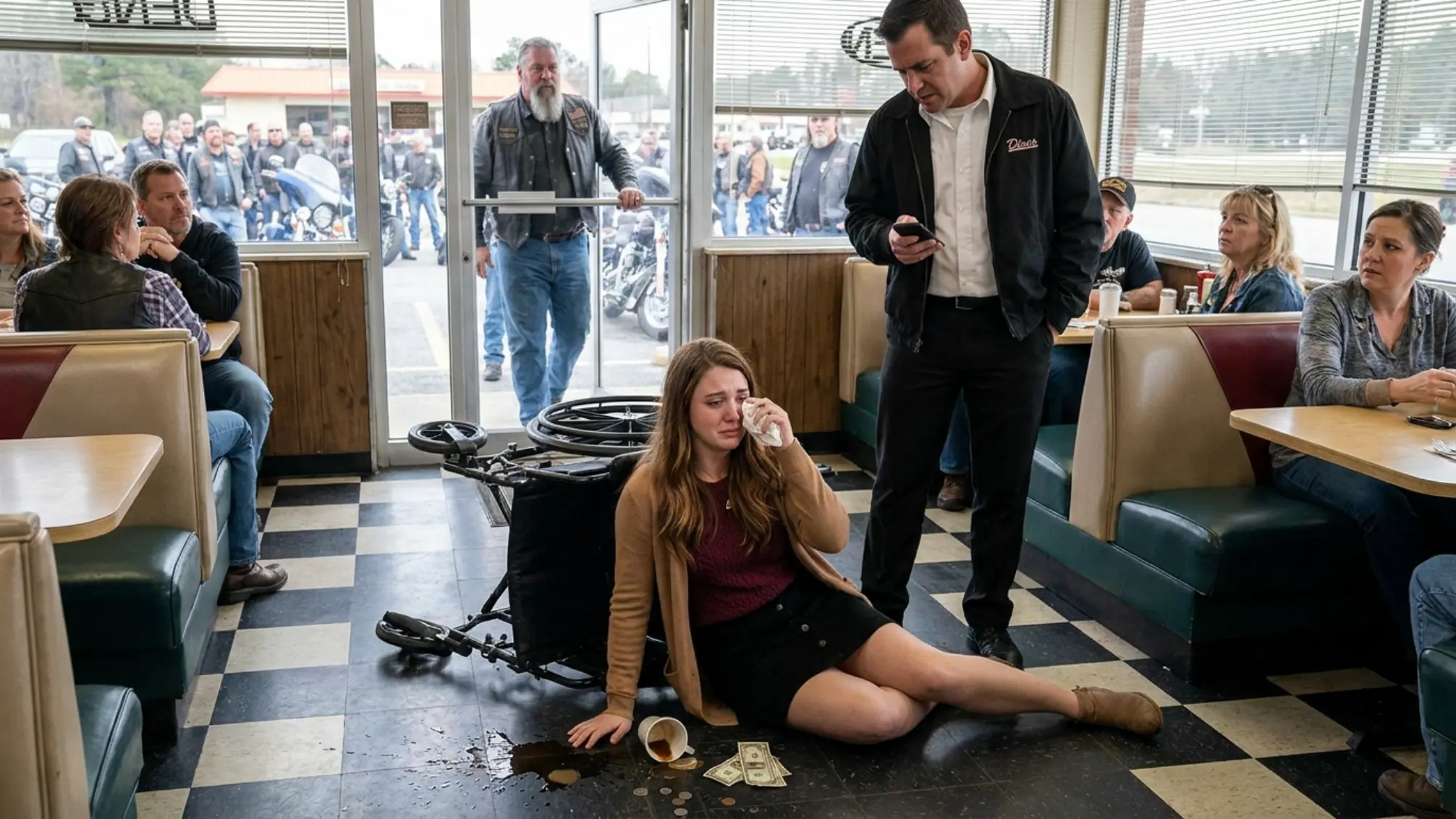
Standing over her was Travis Miller, the twenty-nine-year-old white American assistant manager of Miller’s Highway Diner. His reddish-brown hair was neatly combed, his black uniform jacket was spotless, and his expression showed more annoyance than concern. Instead of helping Emily, he glanced at the frightened customers and lifted his phone as though she were the one embarrassing him.
“Quit pretending,” Travis said. “You’re blocking my customers.”
Emily looked up at him. “You pulled my chair while I was transferring.”
“I moved it because you left it in the aisle.”
“I was still holding it.”
“You should have asked someone to help you instead of making a scene.”
The glass entrance door suddenly opened.
A towering white American biker stepped inside, filling the doorway with broad shoulders, black leather, and a thick gray beard. His name was Mason “Grizzly” Kane, and at forty-eight, his weathered face had frightened men twice Travis’s size without him saying a word. Behind him, rows of black motorcycles covered the diner parking lot, and one hundred fifty American Hells Angels stood outside beneath the cold Pennsylvania morning sky.
Mason’s steel-gray eyes moved from the overturned cup to the empty wheelchair and finally to Emily.
His expression changed instantly.
He walked past Travis, lowered himself beside Emily, and placed the wheelchair upright. He did not grab her arm or attempt to lift her without permission. Instead, he extended one large hand and waited.
“Take my hand, sweetheart,” he said softly. “I won’t let you fall.”
Emily looked toward Travis. Her voice trembled with anger and humiliation.
“He said people like me don’t belong here.”
Mason helped her settle safely into the wheelchair. Then he rose to his full height and turned toward the assistant manager.
“Say it again,” he said quietly. “Now that all one hundred fifty of us are listening.”
Travis’s face lost its color.
The bikers outside did not rush through the entrance or shout threats. They simply stood in rows beside their motorcycles, visible through every front window. Their leather vests, weathered faces, and complete silence made the small diner feel as though the entire building had stopped breathing.
“This is a misunderstanding,” Travis said.
Emily wiped the coffee from her hand. “You told me disabled customers made the dining room look depressing.”
“I never said that.”
“You said it five minutes ago.”
Travis pointed toward the overturned wheelchair. “She was blocking a service aisle. I asked her to move, and she became argumentative.”
Mason looked down at the dark streaks left by the wheelchair’s tires. They ran beside the booth, not through the center of the aisle. The chair had been positioned within the open space reserved for customers with mobility devices.
“You touched her chair without asking,” Mason said.
“I moved restaurant property away from an obstruction.”
“That chair is not restaurant property.”
“I didn’t know that.”
“It has her name engraved on the frame.”
Travis glanced down and saw the small silver plate beneath the armrest: EMILY HART — CUSTOM MOBILITY SYSTEM.
A waitress named Rachel Evans stood several feet away, still clutching a coffee pot. The thirty-four-year-old Black American woman had watched the entire confrontation, but fear of losing her job had kept her silent. Now she looked through the windows at the bikers and then toward Emily.
“He knew,” Rachel said.
Travis turned sharply. “Stay out of this.”
“You asked her to leave before she even reached the table.”
“That is not what happened.”
Rachel placed the coffee pot on the counter. “She asked for the accessible booth. You said it was reserved for normal customers.”
The word hung in the air.
Emily closed her eyes briefly. She had heard versions of it before. People rarely said directly that she did not belong; they called her difficult, inconvenient, unsafe, or disruptive. The meaning was always the same.
Mason moved between Travis and Emily.
“Where is the owner?” he asked.
“I am the manager on duty.”
“I asked for the owner.”
“She isn’t here.”
“Call her.”
Travis gave a nervous laugh. “You don’t get to enter with a gang and order me around.”
Mason glanced toward the parking lot. “Only three of us have entered. The rest are waiting outside because Emily asked us never to frighten ordinary people.”
Two more bikers stepped through the doorway. One was a fifty-seven-year-old Black American man named Samuel Reed, a retired high school principal with a shaved head and calm brown eyes. The other was forty-one-year-old Latino American mechanic Anthony Cruz, whose heavy black vest carried dozens of charity-ride pins.
Neither man approached Travis.
Samuel checked Emily’s wrist and shoulder for injuries while Anthony gathered her purse, phone, and scattered money from the floor. They treated her with the careful respect of men accustomed to following her instructions.
Travis watched them. “Who is she?”
Mason’s voice remained cold. “Someone you should have treated decently before asking who she knew.”
Emily had not always used a wheelchair.
When she was sixteen, a distracted driver crossed the center line and struck the car carrying Emily and her father home from a school concert. Her father escaped with a fractured shoulder. Emily suffered a spinal injury that permanently changed the movement of her lower body.
For months, she believed the accident had reduced her future to hospital rooms and people speaking about her as though she were not present. Her friends stopped inviting her places because they assumed every location would be too difficult. Strangers grabbed the handles of her wheelchair without permission, moved her in grocery stores, and congratulated themselves for helping.
Her father, Benjamin Hart, refused to let the world decide where his daughter belonged.
Benjamin was a mechanic and longtime member of a Pennsylvania Hells Angels chapter. He had a shaved head, a gentle smile, and hands permanently darkened by engine grease. During Emily’s first year of recovery, he gathered several bikers and constructed a wheelchair ramp at the family home.
Then they built one for another family.
Within three years, Benjamin and the club had created Open Road Access, a volunteer program that installed ramps, widened doorways, repaired porches, and modified homes for disabled Americans who could not afford professional construction. Emily designed the application system, scheduled volunteers, and later became the organization’s director.
She was not the biker club’s helpless responsibility.
She was the person who told one hundred fifty stubborn riders where to work, what measurements to use, and when their construction was not good enough.
Benjamin died from a sudden heart attack two years earlier. After his death, Mason became Emily’s godfather and promised to protect the organization they had built. Emily made him promise something in return.
“No fighting for me,” she had said. “No threats. No revenge.”
Mason had kept his word.
That morning, the one hundred fifty bikers had gathered for the annual Benjamin Hart Memorial Ride. The ride raised money for wheelchair ramps, home modifications, and accessible vehicles. Emily had chosen Miller’s Highway Diner as the meeting point because it stood near the beginning of their route.
She had called the owner three weeks earlier and reserved the rear dining area.
Travis had not known any of that when Emily entered alone.
She arrived early to confirm the tables had been arranged with enough room for wheelchair access. Rachel greeted her warmly, but Travis immediately complained that the chair would block servers. Emily showed him the reservation email and explained that a large group would arrive in twenty minutes.
He looked at the wheelchair and laughed.
“What kind of group follows you?”
“Friends of my father.”
“They should have chosen somewhere more appropriate.”
“This diner advertises itself as wheelchair accessible.”
Travis looked toward the entrance ramp. “The ramp means you can enter. It doesn’t mean we have to redesign the dining room around you.”
Emily asked for the booth specified in the reservation. Travis refused and directed her toward a cramped table beside the restroom. When she explained that the table did not provide enough clearance for her chair, he told her she was demanding special treatment.
Rachel offered to move a chair from the accessible booth.
Travis stopped her.
Then he leaned closer to Emily and lowered his voice.
“People come here to relax. They don’t want to spend breakfast watching someone struggle.”
Emily stared at him. “Are you asking me to leave because I use a wheelchair?”
“I am asking you not to make other customers uncomfortable.”
She reached for her phone.
Travis grabbed the wheelchair handles and pulled it backward. Emily was in the middle of shifting her weight to retrieve the phone from her bag. The sudden movement threw her sideways. Her hand lost the armrest, and she fell onto the floor, knocking over the coffee Rachel had placed nearby.
That was the moment Mason entered.
Now Samuel examined Emily’s elbow. A red scrape crossed the skin, but nothing appeared broken.
“We should have a doctor check you,” he said.
“I’m fine.”
“You hit the floor hard.”
“I said I’m fine, Sam.”
Samuel nodded. “Your decision.”
That simple exchange told Rachel everything about the relationship between Emily and the bikers. They were protective, but they did not treat her like a child. They listened when she spoke.
Mason held out his phone to Travis.
“Call the owner.”
Travis folded his arms. “Leave before I call the police.”
Emily looked up at Mason. “Let him.”
Mason’s mouth almost formed a smile.
Travis called emergency services and reported that a motorcycle gang had invaded the diner and was threatening employees. While he spoke, Emily quietly opened the Open Road Access application on her phone. The system automatically stored timestamps connected to the memorial ride’s location.
Anthony noticed two security cameras mounted above the counter.
“Those work?” he asked Rachel.
“Yes.”
Travis ended the call. “The recordings are private business property.”
“Good,” Emily said. “Then they will show exactly what happened.”
Travis’s eyes moved toward the back office.
Rachel noticed.
“So will my phone,” she said.
Everyone turned toward her.
Rachel removed a small device from the pocket of her apron. She had begun recording after hearing Travis tell Emily that disabled customers looked depressing. The video captured his final insults, the moment he grabbed the wheelchair, and Emily’s fall.
Travis stepped toward her. “Delete that.”
Mason shifted once, placing his body in the man’s path.
He did not touch him.
“Try asking more politely,” Mason said.
The police arrived six minutes later. Two white American officers entered and found Emily in her chair, three bikers standing calmly nearby, and Travis demanding immediate arrests. Through the windows, the remaining riders stayed beside their motorcycles with their hands visible.
Officer Laura Bennett reviewed Rachel’s recording.
Her expression hardened.
“You told dispatch they forced their way inside.”
“They did.”
“The door was unlocked.”
“They threatened me.”
“What exactly did they say?”
Travis pointed toward Mason. “He told me to repeat myself in front of the gang.”
“That is not a criminal threat.”
“He intimidated me.”
Mason spoke calmly. “I asked for the owner. I did not raise my voice, touch him, or block the exit.”
Emily provided her statement. Rachel confirmed every detail, as did three customers who had witnessed the fall. One elderly white American customer admitted he had initially assumed Emily caused the problem, but the video made the truth impossible to deny.
The owner arrived before the officers finished.
Margaret Miller was a sixty-two-year-old white American woman with silver-blonde hair and reading glasses suspended from a chain around her neck. Her father had opened the diner in 1978, and she had managed it since his retirement. She entered expecting to find broken furniture and frightened customers.
Instead, she saw Emily’s damaged clothing, the overturned coffee, and one hundred fifty silent motorcycles outside.
Margaret looked at Travis. “What happened?”
“He brought these people here to intimidate me.”
Emily corrected him. “They were already coming. Your diner was the starting point for our charity ride.”
Margaret frowned. “The Hart Memorial Ride?”
“Yes.”
“I approved that reservation myself.”
Travis stared at her. “You knew about this?”
“The reservation is for one hundred fifty breakfasts. It is the largest group booking we have had this year.”
Margaret watched Rachel’s video.
She said nothing while Travis mocked Emily, refused the accessible booth, and grabbed the wheelchair. When the recording ended with Emily striking the floor, Margaret removed her glasses and folded them slowly.
“Give me your keys,” she told him.
Travis blinked. “Margaret—”
“Your office keys.”
“You are firing me because these people frightened you?”
“I am removing you because you assaulted a customer and then lied to the police.”
“I moved a wheelchair.”
“You moved a person’s mobility device while she was using it.”
He looked around the diner for support.
No one defended him.
Margaret took his keys and instructed him to leave through the rear entrance. Before going, Travis looked toward Emily.
“This is what you wanted, isn’t it?”
Emily shook her head.
“I wanted breakfast.”
The simplicity of the answer silenced him more completely than any threat could have.
After Travis left, Margaret approached Emily. “I am sorry.”
Emily’s expression remained guarded. “Did you know he treated disabled customers this way?”
“No.”
“Did anyone ever complain?”
Margaret hesitated.
There had been two complaints. One came from an elderly customer whose walker Travis moved without permission. Another came from the mother of an autistic child whom he accused of disturbing the dining room. Margaret had accepted his explanation both times.
“I should have investigated,” she admitted.
“Yes,” Emily said. “You should have.”
Margaret looked through the window at the waiting riders. “Will your group still eat here?”
Mason’s jaw tightened, but Emily answered before he could.
“That depends.”
“On what?”
“Move the tables properly. Clear the accessible entrance. Let Rachel serve our section. And tomorrow, hire someone to inspect every accessibility problem in this building.”
Margaret nodded. “Done.”
“No special speeches about how inspiring I am.”
A faint smile crossed Margaret’s face. “Also done.”
Emily looked toward Mason. “Bring them in twenty-five at a time. The diner cannot safely hold everyone.”
Mason opened the door and gave the instruction.
The bikers entered in organized groups, wiped their boots, and occupied the tables without shouting or causing trouble. They ordered coffee, eggs, pancakes, and enough bacon to overwhelm the kitchen. Those waiting outside stood beneath the awning or beside their motorcycles until seats became available.
Emily remained at the accessible booth.
Mason sat opposite her, watching while she examined the scratch on her elbow.
“You kept your promise,” she said.
“I wanted to break it.”
“I know.”
“One word from you and that man would never work in this county again.”
“He already lost his job.”
“I meant something less administrative.”
Emily raised an eyebrow.
Mason lowered his eyes to the menu. “I am still learning gentleness.”
“You did well.”
The memorial ride began two hours late.
Before leaving, Margaret came outside and asked to speak with the group. Emily nearly stopped her, fearing the dramatic public apology she had specifically rejected. Instead, Margaret addressed Emily directly.
“My father built this diner because he believed travelers deserved a warm meal no matter what road brought them here. Today, my employee and my own negligence betrayed that principle.”
She handed Emily a written commitment.
The diner would widen the narrow restroom entrance, lower part of the service counter, retrain its staff, and establish a complaint process reviewed by someone other than the manager involved. Margaret also offered to donate the morning’s full revenue to Open Road Access.
Emily read the document.
“The donation is generous,” she said. “But fixing your diner is not charity. It is your responsibility.”
Margaret nodded. “You are right.”
“Donate to the next family waiting for a ramp.”
“That is what I intended.”
Emily signed nothing and promised nothing. She simply accepted that Margaret appeared willing to change.
The one hundred fifty motorcycles eventually left the parking lot in a long formation. Emily rode in an accessible sidecar attached to Mason’s touring bike, something the club had designed after Benjamin’s death. The memorial route passed the garage where her father worked, the hospital where she completed rehabilitation, and the first house where the bikers had built a ramp.
At each stop, another family joined the procession.
The ride raised more than two hundred thousand dollars that year. The money funded nineteen wheelchair ramps, six bathroom modifications, three accessible vans, and structural repairs for several elderly homeowners. Rachel volunteered at two of the construction sites.
Margaret kept every promise.
She hired an independent consultant to inspect the diner and discovered more problems than Emily had noticed. The entrance ramp was too steep, the restroom lacked proper turning space, and several tables prevented safe wheelchair access during crowded hours.
The repairs took six weeks.
When Miller’s Highway Diner reopened, Margaret invited Emily to inspect it. Emily brought Samuel, Anthony, and a woman from a local disability organization. They measured clearances, tested the ramp, and identified two additional changes before approving the work.
Margaret did not complain.
The diner installed a small plaque near the entrance, but Emily rejected the original wording because it called her courage inspirational. The final plaque read:
ACCESS IS NOT A FAVOR.
DIGNITY IS NOT SPECIAL TREATMENT.
EVERY CUSTOMER BELONGS HERE.
Travis later faced a civil claim based on the recording and witness statements. Emily did not seek revenge or demand a public spectacle. She accepted a settlement requiring him to complete disability-awareness training and community service with an independent accessibility organization.
Part of the settlement funded a new ramp for a twelve-year-old Black American boy named Jordan Price.
Jordan had muscular dystrophy and lived with his mother in an old home with six steep front steps. For two years, she carried him outside whenever he needed to leave. The family had been waiting for assistance when the incident at the diner occurred.
One Saturday morning, Emily arrived with one hundred fifty bikers.
Mason supervised lumber deliveries while Anthony led the construction team. Samuel sat with Jordan and helped him design a small platform where he could watch the neighborhood. Rachel painted the handrails.
Emily managed everything from the driveway.
When the ramp was completed, Jordan rolled down it independently for the first time. His mother covered her mouth and cried while the bikers applauded.
Mason leaned toward Emily.
“Still think we handled the diner correctly?”
“Yes.”
“You never wished I had scared him a little more?”
Emily watched Jordan complete another turn on the ramp.
“We scared him by showing him the people he thought did not matter were surrounded by people who knew they did.”
A year later, the Benjamin Hart Memorial Ride again began at Miller’s Highway Diner.
The same one hundred fifty bikers arrived, along with dozens of new riders. Margaret reserved the entire parking lot, and Rachel—now the diner’s general manager—organized the accessible seating herself.
Emily entered without anyone grabbing her chair.
Customers moved naturally around her instead of staring. A waitress asked before shifting an empty seat. The changes were small, ordinary, and exactly what she had wanted.
Mason held the door open.
“After you, sweetheart.”
Emily rolled inside and looked toward the section of floor where she had fallen the year before.
No plaque marked the spot. No one told the story dramatically to new employees. The diner had not turned her humiliation into decoration.
It had simply learned.
Emily joined the bikers at the largest table. She raised her coffee while one hundred fifty leather-clad American riders prepared for another day of building ramps and opening doors.
The year before, Travis had looked down at a young woman on the floor and believed her wheelchair made her powerless.
Then the front door opened.
He saw one hundred fifty Hells Angels waiting outside, but the motorcycles and leather were not the true source of Emily’s strength. Her strength came from knowing that dignity did not depend on whether powerful people were watching.
The bikers did not give her that dignity.
They only made sure the man who tried to take it understood that she had never stood alone.