“This seat isn’t for people like you.”
Rebecca Martinez did not whisper it.
She announced it loud enough for the entire gate A12 area to hear, her voice cutting through the ambient hum of Miami International Airport like a blade through silk.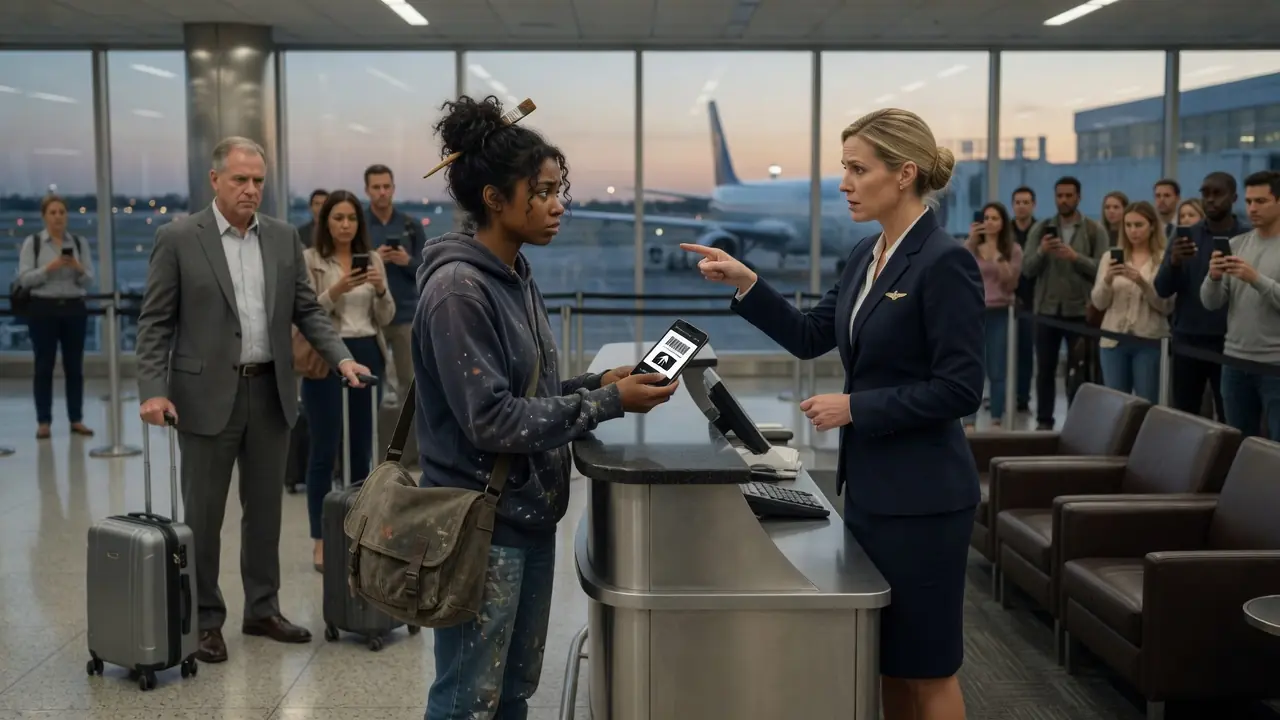
What Rebecca did not know was that in exactly twenty-three minutes, the man sitting quietly in the leather chairs near the gate, reading emails on his tablet, would fire her and dismantle the culture that had protected her.
She had no idea that the young woman standing in front of her, clutching torn pieces of a boarding pass, was the daughter of Marcus Robinson, CEO of Meridian Airlines.
And she certainly did not know that her next words would cost her everything.
The fluorescent lights above gate A12 buzzed with the energy of a Thursday evening rush.
At 4:47 p.m., Miami International was at its peak chaos, but the Meridian Airlines premium gateway stood apart like an island of marble floors and gold accents in a sea of worn carpet and plastic chairs.
The velvet rope that separated the priority boarding area from general boarding was not just a physical barrier.
It was a declaration, a line that said some people mattered more than others.
Zara Robinson, twenty-two years old, stood at that line wearing a faded Columbia University hoodie and paint-stained jeans.
Her thick curls were pulled back in a messy bun secured with what looked like a paintbrush. She carried a worn canvas messenger bag that had seen better decades, and her sneakers squeaked slightly against the polished marble as she shifted her weight from foot to foot.
To anyone watching, she looked exactly like what she was: an exhausted art student who had just spent seventy-two hours straight finishing her thesis defense and desperately wanted to get home to Chicago.
She did not look like someone who belonged in the first-class cabin of Meridian Airlines premium service, where tickets cost four thousand two hundred dollars for a three-hour flight.
She certainly did not look like someone who would be carrying an Obsidian-level boarding pass worth eight thousand five hundred dollars, the kind reserved for heads of state, Fortune 500 CEOs, and exactly twelve other people in the world.
But appearances, as Rebecca Martinez was about to learn, could be devastatingly deceiving.
Zara approached the mahogany podium where Rebecca stood like a sentinel guarding the gates of paradise.
Rebecca was thirty-four years old, had worked for Meridian Airlines for twelve years, and wore her supervisor badge like a crown.
Her navy blazer was pressed to perfection. Her blonde hair was lacquered into immobility, and her manicured nails tapped an impatient rhythm against the granite counter.
Behind Rebecca, the boarding gate stretched like a tunnel toward the aircraft, a Boeing 787 that gleamed white and gold under the terminal lights.
The Meridian logo, a soaring eagle with spread wings, was painted across the tail in elegant script.
Gate A12 was Rebecca’s kingdom, and she ruled it with an iron fist wrapped in a customer service smile.
“Excuse me,” Zara said, her voice tired from exhaustion. “I need to check in for flight 847 to Chicago.”
Rebecca looked up from her computer screen, and her eyes immediately began their assessment.
Hoodie cheap.
Jeans paint-stained.
Shoes worn.
Expression tired.
Young Black woman.
Conclusion: does not belong.
“The general boarding area is over there,” Rebecca said, pointing a perfectly manicured finger toward the chaos of economy-class check-in, where hundreds of passengers snaked through rope barriers like cattle being herded. “This area is reserved for premium passengers only.”
Zara pulled her phone from her hoodie pocket and held it up.
On the screen was a QR code set against a black background, the Obsidian boarding pass that fewer than fifty people on Earth possessed.
“I have a first-class ticket,” she said simply.
Rebecca glanced at the phone for exactly half a second before looking back at Zara’s face with undisguised skepticism.
“Ma’am, this is a restricted boarding area for passengers who have paid premium prices. I’m going to need you to show me proof of purchase, not just a screen you downloaded from the internet.”
The words hit Zara like ice water.
She had been flying on her family’s airline passes since she was five years old. She had been to Paris, London, and Tokyo, always in first class, always treated like royalty, but never once had she been asked to prove she belonged.
“Can you scan it?” Zara asked, holding the phone closer. “It’s a valid boarding pass.”
Rebecca did not touch the phone.
Instead, she reached under her counter and pulled out a laminated card covered in small print.
“According to Meridian Airlines policy 47B,” she read aloud, “any passenger whose appearance or behavior suggests they may not be the legitimate holder of their boarding documentation may be asked to provide additional verification.”
From the leather seating area thirty feet away, a man in a charcoal suit looked up from his tablet.
Marcus Robinson had been watching the interaction for the past two minutes, his dark eyes taking in every gesture, every word, every micro-expression that crossed his daughter’s face.
At fifty-two years old, Marcus had built Meridian Airlines from a small regional carrier into a global empire worth eight billion dollars.
He had flown millions of passengers across oceans and continents, but he had never seen an employee of his company treat a passenger the way Rebecca Martinez was treating his daughter.
Marcus set his tablet aside and leaned forward slightly, his attention now completely focused on gate A12.
Back at the counter, Zara was fighting to keep her voice calm.
“My father taught me to handle situations like this with dignity,” she said, more to herself than to Rebecca. “Can you please just scan my boarding pass?”
Rebecca’s smile was sharp as broken glass.
“Your father sounds like a smart man. Maybe he can teach you about appropriate dress codes for premium travel.”
She turned to the computer terminal and began typing with theatrical precision.
“I’m running a verification check on this pass. These scans can take several minutes when there are irregularities.”
Behind Zara, the sound of expensive shoes on marble announced the arrival of James Mitchell, a man who wore his wealth like armor.
At fifty-eight, Mitchell owned a chain of luxury car dealerships across Florida, and he was not accustomed to waiting.
His Armani suit was worth more than most people’s cars. His Rolex caught the light like a small sun, and his sense of entitlement filled the air around him like expensive cologne.
“Excuse me,” Mitchell said, his voice carrying the authority of someone who had never been told no. “Is there some kind of delay here? I have a very important meeting in Chicago, and I’d prefer not to miss my flight while you’re dealing with administrative issues.”
Rebecca’s entire demeanor transformed.
Her back straightened. Her smile became genuine, and her voice dropped into the warm honey tones reserved for people she deemed worthy.
“Mr. Mitchell, so wonderful to see you again. I sincerely apologize for the delay. We’re just handling a small verification matter, and then I’ll get you boarded immediately.”
She turned back to Zara, and the mask slipped back into place.
“Ma’am, I’m going to need you to step aside while we complete this verification process. You’re holding up legitimate passengers.”
Zara felt heat rise in her cheeks.
“I am a legitimate passenger.”
“Of course you are,” Rebecca said, her tone suggesting the exact opposite. “But as I explained, we need to verify the authenticity of your documentation before we can allow you to access the premium boarding area.”
Thirty feet away, Marcus Robinson stood up.
He was six feet four inches tall, and when he stood, people noticed.
His presence was magnetic, the kind that commanded boardrooms and silenced chaotic shareholder meetings.
He began walking slowly toward gate A12, his movements deliberate and controlled.
Elena Vasquez, a twenty-six-year-old marketing coordinator returning from a business conference, sat in the nearby seating area with her laptop open.
She had been trying to catch up on emails, but the confrontation at the boarding counter was impossible to ignore.
Elena was fourth-generation Mexican American, bilingual, and had seen enough discrimination in her lifetime to recognize it when it was happening.
She closed her laptop, pulled out her phone, and opened a livestream.
“Hey, everyone,” she whispered into the camera. “I’m sitting in Miami International Airport, and something really messed up is happening right in front of me. A gate agent is giving this young woman an incredibly hard time about her boarding pass, and I think you need to see this.”
She angled the camera toward the counter, where Rebecca was now examining Zara’s phone with exaggerated suspicion.
“This looks unusual,” Rebecca announced loudly enough for the growing crowd to hear. “The formatting seems off. These Obsidian passes have very specific security features, and I’m not seeing them here.”
Zara’s exhaustion was giving way to something harder.
“Ma’am, that pass was issued directly by Meridian Airlines corporate office. It’s completely legitimate.”
“I’m sure you believe that,” Rebecca said with condescending sympathy. “But you’d be surprised how sophisticated these forgeries have become. People print fake passes from their home computers and think they can just walk into first class like they own the place.”
The words hung in the air like poison gas.
Elena’s livestream viewer count was climbing rapidly as people began sharing the video.
Comments flooded the screen.
Sue them.
What airline is this?
James Mitchell stepped forward, positioning himself as Rebecca’s ally.
“Young lady, I don’t know what kind of scam you’re running, but this is a respectable airline. We don’t tolerate fraud here.”
Zara turned to look at him, her eyes blazing.
“I’m not running any scam, sir. I have a valid ticket.”
“Then you won’t mind waiting while they verify it properly,” Mitchell said with a smirk. “Real first-class passengers understand that security protocols exist for a reason.”
Marcus Robinson was now fifteen feet away from the counter, close enough to hear every word, close enough to see the tears of frustration building in his daughter’s eyes.
His hands were clenched at his sides, and the small muscle in his jaw was twitching the way it did when he was about to end someone’s career.
Rebecca reached for Zara’s phone.
“I’m going to need to hold on to this while we contact corporate to verify the validity of this pass.”
“You can’t take my phone,” Zara said, pulling it back.
“According to security protocol, any suspected fraudulent documentation must be secured pending investigation,” Rebecca said, reaching for the device again.
That was when it happened.
Rebecca grabbed the phone, and in the struggle, Zara’s boarding pass was pulled up on the screen.
Rebecca looked at it for a fraction of a second, then made a decision that would destroy her life.
She pressed her fingers against the screen and deliberately corrupted the QR code.
“Oh no,” Rebecca said with fake concern. “I’m afraid the pass has been damaged. We’ll need to issue you a new one, but I’m afraid all first-class seats are occupied. I can put you on standby for economy.”
She handed the phone back to Zara with a satisfied smile.
The boarding pass was now unreadable, a digital mess of black squares and distorted data.
Zara stared at the ruined pass, then looked up at Rebecca with disbelief.
“You just destroyed my ticket.”
“I’m sorry, but technical malfunctions happen,” Rebecca said with mock sympathy. “These older phones sometimes can’t handle the security encryption properly.”
Elena’s livestream was now being shared across multiple platforms.
The hashtag Meridian Gate was beginning to trend.
Viewer comments were becoming angrier.
This is racial profiling.
Someone help her.
Please tell me this isn’t real.
Marcus Robinson was now ten feet away, close enough to see everything, close enough to act.
But he waited, watching, learning exactly how his airline treated passengers who looked like his daughter.
What he was seeing was going to cost people their jobs, their reputations, and their futures.
But Rebecca Martinez was not finished.
She reached for the landline phone on her counter, her finger hovering over the security button.
“I think,” Rebecca said loud enough for everyone to hear, “we need to have security remove this individual from the premium boarding area. She’s becoming disruptive, and I’m concerned about the safety of our legitimate passengers.”
That was the moment Marcus Robinson’s patience ended.
That was the moment everything changed.
In exactly sixty seconds, Rebecca Martinez would discover what happened when someone targeted the CEO’s daughter.
And it would not be pretty.
Rebecca’s finger pressed the security button with the authority of someone who had done this before.
The beep echoed through the terminal, sharp and final.
She turned to the growing crowd of onlookers with the satisfied expression of someone who believed she was protecting civilization itself.
“Security to gate A12,” she announced into her headset. “We have a disruptive passenger who needs to be removed from the premium boarding area.”
Zara stood frozen, staring at her destroyed boarding pass.
The QR code that should have been clean black squares on a pristine white background now looked like digital wreckage, corrupted beyond recognition.
She had flown on this airline hundreds of times. She had grown up in the executive lounges and first-class cabins, had considered Meridian Airlines as much her home as the house where she had been raised.
Now she was being treated like a criminal.
“I can’t believe this is happening,” she whispered, more to herself than to anyone else.
Rebecca heard her and leaned forward conspiratorially.
“Honey, let me give you some advice. Next time you want to fly first class, buy a real ticket. Save up your money, dress appropriately, and maybe you won’t have these problems.”
The condescension in Rebecca’s voice was like a slap across the face.
Elena Vasquez, still filming, audibly gasped. Her livestream viewer count had climbed to more than three thousand people, and the comments were becoming a torrent of outrage.
James Mitchell adjusted his gold cuff links and stepped closer to Zara.
“Young lady, I don’t know who put you up to this, but airline fraud is a federal crime. You’re looking at serious consequences if you don’t cooperate.”
Zara turned to face him, her exhaustion now completely replaced by incredulous anger.
“Sir, I haven’t committed any crime. I have a valid ticket to fly home.”
“You had what you claimed was a valid ticket,” Mitchell corrected with a cruel smile. “Now you have nothing but a corrupted file that proves exactly what we suspected.”
From her position in the seating area, Elena was providing running commentary for her viewers.
“This is absolutely insane, everyone. They destroyed this young woman’s boarding pass, and now they’re calling her a criminal. The viewer count is over three thousand now, and people are recording from multiple angles.”
Indeed, at least six other passengers had their phones out, some filming discreetly, others openly documenting what was happening.
The modern phenomenon of viral justice was building momentum.
But Rebecca Martinez was too intoxicated by her own power to notice the cameras turning her into the villain of a story that would be told millions of times.
David Thompson, the security officer responding to Rebecca’s call, was jogging down the concourse with the purposeful stride of someone who took his authority seriously.
At forty-two years old, Thompson had worked airport security for fifteen years, and he had developed the kind of cynical worldview that made him assume the worst about people, especially young people who did not look like they belonged in expensive places.
Thompson knew Rebecca Martinez personally.
She had called security dozens of times over the years, and in Thompson’s experience, Rebecca was usually right about troublemakers.
She had an eye for people who did not belong, people who were trying to scam the system, people who needed to be put in their place.
As Thompson approached gate A12, he could see the situation clearly.
A young Black woman in casual clothes, arguing with airline staff. An obviously wealthy businessman looking concerned. A small crowd beginning to form.
In his mind, the story was already written.
Marcus Robinson watched Thompson approach and felt his blood pressure rising.
He recognized the security officer. He had seen him in action before and had even received positive reports about Thompson’s efficiency in handling difficult passengers.
Now Marcus was beginning to understand what difficult meant in the context of his airline’s operations.
Marcus remained near the seating area for one final moment, his tablet forgotten in his hand, his attention completely focused on what was happening to his daughter.
He had taught Zara to handle discrimination with quiet dignity, to never give bigots the satisfaction of an emotional response.
Now he was watching her put that training to the test under circumstances that would break most adults.
Thompson arrived at the gate counter slightly out of breath, his hand instinctively resting on his radio.
“What’s the situation here, Rebecca?”
Rebecca’s face lit up with relief.
“David, thank God you’re here. This individual has been trying to board with fraudulent documentation. When I attempted to verify her pass, she became aggressive and disruptive.”
Thompson looked at Zara, taking in her appearance with the practiced eye of someone trained to make quick judgments.
Casual clothes.
Tired expression.
Defensive posture.
In his experience, people who belonged in first class did not look like this.
“Ma’am, I need you to step away from the counter,” Thompson said, his voice carrying the weight of authority. “We need to resolve this situation calmly.”
Zara looked at him with a mixture of hope and desperation.
“Officer, there’s been a misunderstanding. I have a legitimate boarding pass for this flight. The gate agent damaged it while examining it, and now she’s claiming it was fake.”
Thompson glanced at Rebecca, who rolled her eyes and shook her head.
“Sir, she’s been telling stories for the past ten minutes,” Rebecca said. “The pass was clearly corrupted when she tried to present it. These scammers are getting more sophisticated, but they always mess up the details.”
Elena Vasquez stood up from her seat, her phone still recording.
“Excuse me, officer. I’ve been watching this whole thing. The gate agent is lying. She damaged the passenger’s pass deliberately.”
Thompson turned toward Elena with annoyance.
“Ma’am, please sit down. We’re handling this situation.”
“But I have it on video,” Elena protested. “Look, I’ve been livestreaming this whole thing. The pass was fine until she grabbed the phone.”
Rebecca’s confident expression faltered for just a moment.
She had not noticed Elena filming. She had not realized that her actions were being broadcast to thousands of people in real time.
But she quickly recovered, doubling down on her story.
“Officer Thompson, this is exactly what I was afraid of,” Rebecca said. “These people always have someone with them to corroborate their stories. They work together to intimidate airline staff.”
The phrase these people landed like a bomb in the suddenly quiet gate area.
The passengers who had been recording exchanged glances, the implications of Rebecca’s words crystal clear to everyone except Rebecca herself.
James Mitchell stepped forward, eager to support the authority figures.
“Officer, I’ve been traveling first class for twenty years. I know what legitimate passengers look like, and this young woman is clearly not one of them.”
He gestured dismissively at Zara’s appearance.
“Look at her clothing, her demeanor. She’s obviously not accustomed to premium service. I’m concerned that allowing this kind of fraud to continue will compromise the security and exclusivity that we pay premium prices to maintain.”
Zara felt something break inside her chest.
Not her spirit, but her restraint.
Her father had taught her to maintain dignity in the face of discrimination, but he had never prepared her for this level of coordinated humiliation.
“Sir,” she said, her voice rising slightly for the first time. “I am not a scammer. I am not a fraud. I am a passenger with a valid ticket, and I have every right to be here.”
Thompson interpreted her raised voice as aggression.
“Ma’am, I’m going to need you to calm down. Your behavior is confirming the concerns that have been raised about your conduct.”
“My behavior?” Zara’s voice cracked with disbelief. “I’ve been standing here politely asking to board my flight. They destroyed my boarding pass, and now they’re calling me a criminal.”
Rebecca leaned across her counter.
“Officer Thompson, she’s becoming increasingly agitated. I’m concerned that she might become violent.”
The accusation hung in the air like a toxic cloud.
Elena’s livestream comments were exploding with outrage, but Rebecca and Thompson were too focused on their performance to notice the digital storm building around them.
Marcus Robinson had heard enough.
He closed his tablet with a soft click and began to stand.
The movement was slow, deliberate, like a predator rising from concealment.
Around him, other passengers began to notice the tall man in the expensive suit, the way he carried himself, the quiet authority that seemed to emanate from him like heat from a furnace.
But Marcus forced himself to wait just one more moment.
He needed to see how far this would go. He needed to understand the full scope of the problem before he acted.
If this was happening to Zara, who had every advantage in the world, what was happening to passengers who did not have those advantages?
Thompson moved closer to Zara.
“Ma’am, we can do this the easy way or the hard way. You can come with me voluntarily, or I can call for backup and we can do this with handcuffs. Your choice.”
Elena zoomed in on Thompson’s face, capturing the threat for her thousands of viewers.
The hashtag Meridian Gate was now trending in Miami, with reposts spreading across the country faster than wildfire.
Zara looked around the gate area, taking in the faces staring at her.
Some looked sympathetic. Others seemed to be enjoying the show. But none of them were stepping in to help her.
She was alone, facing down two authority figures who had already decided she was guilty, in front of an audience that expected her to either submit or become the angry woman they probably assumed she was.
She thought about her father sitting somewhere in this very terminal, trusting her to handle discrimination with the quiet dignity he had taught her.
She thought about the lessons he had drilled into her since childhood.
Never give them a reason to call you angry.
Never give them ammunition to use against you.
Always take the high road, even when they are dragging you through the mud.
“Officer,” she said quietly. “I’m not trying to cause trouble. I just want to go home.”
Thompson nodded, interpreting her calm tone as submission.
“Then you’ll come with me quietly while we sort this out.”
Zara looked at her destroyed boarding pass one more time, then back at Thompson.
“Do I have a choice?”
“Not really,” Thompson said, reaching for her arm.
That was when the voice cut through the terminal like thunder.
“Officer Thompson.”
The voice was deep, resonant, and carried the kind of authority that made grown men stop what they were doing and pay attention.
It came from behind them, from the seating area, and when Thompson turned around, his face went pale.
Marcus Robinson was standing now, his full six-foot-four frame dominating the space around him.
He wore power like a second skin, and when he spoke, people listened.
“Take your hands off my daughter.”
The words fell into the sudden silence like stones into a still pond, creating ripples that spread outward through the entire gate area.
Rebecca’s mouth fell open.
Thompson’s hand froze halfway to Zara’s arm.
James Mitchell looked confused, as if the words did not make sense in the context of what he thought he understood about the world.
Elena’s livestream viewer count spiked past five thousand as the phrase his daughter spread through the comments like wildfire.
Zara turned around, and for the first time in twenty minutes, she smiled.
“Dad.”
Everything changed.
The silence that descended over gate A12 was absolute.
The constant background noise of the airport, the announcements echoing from distant gates, the rumble of aircraft engines, all of it seemed to fade into insignificance.
The only sound was the quiet hum of Elena’s livestream and the collective intake of breath from a dozen onlookers who suddenly realized they were witnessing something extraordinary.
Rebecca Martinez stood behind her mahogany podium, her mouth opening and closing like a fish gasping for air.
Her brain was struggling to process what she had just heard.
The young woman she had been humiliating, the person she had called a scammer and a fraud, had just been claimed as a daughter by a man who radiated the kind of authority that made Rebecca’s knees weak.
Marcus Robinson walked toward the counter with the measured pace of someone who had all the time in the world and all the power to use it.
He was flanked by two people Rebecca had not noticed before: a young woman in a crisp business suit carrying a tablet and an older man with salt-and-pepper hair who looked like he could buy and sell small countries before breakfast.
David Thompson, the security officer, felt his confidence evaporating like morning mist.
He had been in airport security long enough to recognize executive presence when he saw it, and the man walking toward them carried himself like someone who owned things.
Important things.
Expensive things.
Thompson’s hand moved away from Zara’s arm as if it had been burned.
James Mitchell, the wealthy car dealer who had been so eager to support the authority figures moments before, suddenly looked uncertain.
His businessman’s instincts were screaming that he had backed the wrong horse in this particular race.
Marcus stopped directly in front of the counter, his dark eyes moving from Rebecca to Thompson to Mitchell with the cold precision of someone cataloging targets.
When he spoke, his voice was quiet, but it carried the weight of absolute authority.
“Rebecca Martinez. Employee ID 4472. Twelve years of service with Meridian Airlines.”
He was not reading from anything.
The information flowed from him like water.
“David Thompson. Contractor with Secure Solutions Incorporated. Fifteen years of airport security experience.”
His gaze shifted to Mitchell.
“James Mitchell. Owner of Mitchell Luxury Motors. Frequent flyer number 847291.”
The specificity was terrifying.
It meant this man had access to databases, personnel records, and passenger information.
It meant he was exactly who Rebecca was beginning to fear he might be.
Elena Vasquez had zoomed her camera in on Marcus, and her livestream chat was exploding with recognition.
Oh my God, that’s Marcus Robinson.
CEO of Meridian Airlines.
Rebecca is so fired.
The viewer count was climbing toward ten thousand as people shared the stream across every social media platform imaginable.
Zara walked over to her father, and he put his arm around her shoulders in a gesture that was both protective and possessive.
“Are you hurt?” he asked quietly, his voice gentle in a way that made the contrast with his commanding presence even more striking.
“I’m okay,” Zara whispered, but her voice was shaky. “Dad, they destroyed my boarding pass. They called security. They said I was a criminal.”
Marcus nodded once, his jaw tightening.
He looked at Rebecca with the expression of someone who was about to end a career with surgical precision.
“Ms. Martinez,” Marcus said, his voice still quiet but somehow more dangerous than shouting would have been. “Would you like to explain to me why my daughter, a legitimate passenger with a confirmed first-class reservation, was denied boarding and threatened with arrest?”
Rebecca found her voice, though it came out as a squeak.
“Mr. Robinson, sir. I—there was a—the boarding pass appeared to be—”
“Appeared to be what?” Marcus interrupted, his tone sharpening like a blade. “Speak clearly, Ms. Martinez. You’ve been very articulate for the past twenty minutes. Don’t stop now.”
The crowd around gate A12 had grown larger.
Word was spreading through the terminal that something significant was happening, and passengers were abandoning their own gates to witness the confrontation.
Elena had moved closer, her phone capturing every word, every expression, every moment of what was rapidly becoming the most viral airline incident in recent memory.
Rebecca swallowed hard, her throat dry as sand.
“Sir, her appearance. The boarding pass looked suspicious. We have protocols.”
“Her appearance,” Marcus repeated, his voice dropping to barely above a whisper. “You denied my daughter service because of her appearance.”
“Sir, we receive training on identifying potential security threats. And when passengers don’t match the typical profile of our premium customers—”
“Stop.”
The single word cut through Rebecca’s explanation like a sword through silk.
“You’re saying that my daughter, who is Black, who was dressed casually, didn’t match your profile of what a first-class passenger should look like?”
The accusation hung in the air like a toxic cloud.
Rebecca looked around desperately, seeking support from Thompson or Mitchell, but both men had taken several steps backward, suddenly very interested in studying the ceiling tiles.
Elena’s livestream comments were moving too fast to read.
Racist.
Sue them.
This is insane.
She’s done.
The hashtag Meridian Gate was now trending nationally, with news outlets beginning to pick up the story from social media.
Marcus pulled out his phone, a device that looked deceptively simple but cost more than Rebecca’s monthly salary.
With a few swipes, he accessed what appeared to be a complex airline management system.
The screen was filled with data, passenger manifests, flight information, and employee records.
“Let me show you something interesting, Ms. Martinez,” Marcus said, turning the phone so she could see the screen. “This is the passenger manifest for flight 847. Zara Robinson, seat 2A, Obsidian-class boarding pass issued at 9:47 this morning by corporate office.”
Rebecca squinted at the screen, her face growing paler by the second.
“The pass was issued under my personal authorization code,” Marcus continued. “The same code that appears on fewer than twenty boarding passes in the entire world. The same code that your computer system would have verified immediately if you had bothered to scan it instead of destroying it.”
He swiped to another screen.
“But here’s what’s really interesting. This is the access log for your terminal. At 4:52 p.m., you manually flagged seat 2A as suspected fraud in the system. At 4:53 p.m., you marked it for additional verification required. At 4:54 p.m., you added a note that reads, Passenger appears suspicious, possible security threat.”
Rebecca felt the world tilting beneath her feet.
She had added those notes to cover herself, to create a paper trail that would justify her actions.
She had never imagined that someone would have access to see them, let alone the CEO of the airline himself.
“The interesting thing,” Marcus continued, his voice now carrying the tone of a prosecutor building a case, “is that you marked her as suspicious before you even looked at her boarding pass. The timestamps show that you made your decision based purely on visual assessment.”
Elena had positioned herself to capture both Marcus’s presentation and Rebecca’s reaction.
The gate agent looked like she was about to faint, her carefully constructed confidence crumbling in real time.
David Thompson cleared his throat, trying to regain some control over the situation.
“Mr. Robinson, sir, I was responding to a legitimate security call. Ms. Martinez reported a disruptive passenger, and it’s my job to—”
Marcus turned his attention to Thompson with laser-like focus.
“Officer Thompson, how many times have you responded to calls from Ms. Martinez in the past twelve months?”
Thompson blinked, clearly not expecting the question.
“I’m not sure of the exact number.”
“Forty-seven,” Marcus supplied. “Forty-seven calls for disruptive passengers or suspected fraud from gate A12. Would you like to guess how many of those passengers were minorities?”
Thompson’s mouth went dry.
He had never thought about it in those terms.
He had never considered the pattern of who Rebecca considered problematic.
“Forty-three,” Marcus answered his own question. “Forty-three out of forty-seven. And of those forty-three passengers, how many were actually found to have invalid documentation?”
The silence stretched out like a rubber band about to snap.
“Zero,” Marcus said quietly. “Zero passengers were found to have fraudulent tickets. Zero passengers were arrested. Zero passengers posed any actual threat to anyone. But forty-three passengers were humiliated, delayed, and treated like criminals for the crime of not looking like they belonged.”
Elena’s viewer count had crossed fifteen thousand.
News outlets were starting to pick up the story.
Social media was exploding with outrage and support for Zara.
The hashtag Meridian Gate was being shared by celebrities, politicians, and activists.
This was no longer just an airport incident.
It was becoming a national conversation about discrimination and dignity.
James Mitchell, who had been so confident in his support for Rebecca just minutes earlier, was now edging toward the exit.
But Marcus noticed the movement and turned his attention to the car dealer.
“Mr. Mitchell, where are you going?”
Mitchell froze like a deer in headlights.
“I don’t want to intrude on a family matter.”
“A family matter,” Marcus said, his voice carrying genuine surprise. “Is that what you call it when you told my daughter she was running a scam? When you said that real first-class passengers don’t look like her?”
Mitchell’s face flushed red.
“Sir, I was simply supporting airline security protocols. I had no idea.”
“You had no idea that a young Black woman might legitimately belong in first class,” Marcus finished.
The accusation hung in the air like an indictment.
Mitchell opened his mouth to protest, but no words came out.
Around him, passengers were filming his every expression, capturing his discomfort for posterity.
Rebecca made one last desperate attempt to salvage the situation.
“Mr. Robinson, sir, perhaps there has been a misunderstanding. I was just following security protocols. I can fix this right now. I can issue a new boarding pass.”
Marcus looked at her with something that might have been pity.
“Ms. Martinez, do you know why my daughter was flying today?”
The question caught Rebecca off guard.
“Sir?”
“She is returning from her thesis defense at Columbia University. She just spent four years earning a Bachelor of Fine Arts degree, magna cum laude. She was offered full scholarships to graduate programs at Harvard, Yale, and MIT.”
Marcus’s voice was filled with pride and pain in equal measure.
“She chose to fly commercial in casual clothes because she wanted to experience travel the way most passengers do. She wanted to understand what customer service really means at the airline her family built.”
He paused, letting the words sink in.
“Congratulations, Ms. Martinez. You’ve given her quite an education.”
Elena’s livestream had become a global event.
The viewer count was approaching twenty thousand, and major news networks were calling her phone, trying to get permission to use her footage.
The hashtag Meridian Gate was trending in multiple countries.
This single incident was becoming a defining moment in the ongoing conversation about bias, privilege, and corporate responsibility.
Marcus looked around the gate area, taking in the crowd of passengers, the cameras, and the phones recording every moment.
When he spoke again, his voice carried the weight of someone making a decision that would ripple through the airline industry for years to come.
“This ends now.”
Marcus Robinson reached into his jacket pocket and withdrew a slim black wallet.
From it, he extracted a card that gleamed like polished obsidian in the terminal’s fluorescent lighting.
He placed it on Rebecca’s counter with the gentle precision of someone placing the final piece in a chess game that had already been won.
The card was simple, elegant, and terrifying in its understated authority.
It bore the Meridian Airlines logo in raised gold lettering, and beneath it, three words that made Rebecca’s blood turn to ice water.
Chief Executive Officer.
“Rebecca Martinez,” Marcus said, his voice carrying across the suddenly silent gate area like a judge pronouncing sentence. “You are terminated, effective immediately.”
The words hit Rebecca like physical blows.
She staggered backward, her hand reaching for her counter to steady herself.
“Sir, please. I can explain.”
“David Thompson,” Marcus continued, turning to the security officer who looked like he wanted to disappear into the floor. “Your contract with this airport is terminated, effective immediately.”
Thompson’s mouth opened and closed soundlessly.
Fifteen years of security work gone in an instant.
“James Mitchell.”
Marcus’s gaze fell on the car dealer, who had gone pale as winter snow.
“Your frequent flyer status is revoked. You are banned from Meridian Airlines for life, effective immediately.”
Elena Vasquez, still filming, whispered into her phone for her viewers.
“Oh my God. He’s firing everyone. The CEO is literally firing everyone who was involved in this.”
Her livestream had exploded past twenty-five thousand viewers.
The comments were moving too fast to read, a digital waterfall of outrage, support, and disbelief.
Meridian Gate was now trending globally, with international news outlets picking up the story faster than wildfire spreads through dry grass.
But Marcus was not finished.
He turned to face the crowd that had gathered around gate A12, his voice projecting clearly so every person, every camera, and every recording device could capture his words.
“Ladies and gentlemen, my name is Marcus Robinson, and I am the chief executive officer of Meridian Airlines. What you have witnessed here today is not an isolated incident. It is a representation of a culture that I will not tolerate in my company.”
The crowd was completely silent, hanging on every word.
“My daughter, Zara Robinson, is a passenger on this airline. She has flown with us hundreds of times. She has never once been treated with anything less than respect and dignity because she has always been recognized as family. Today, she flew as an anonymous passenger, dressed as a college student, looking like any other young person trying to get home.”
Marcus paused, his eyes moving across the faces watching him.
“And she was profiled, discriminated against, and humiliated by employees who represent my company and my values. This is unacceptable.”
Rebecca found her voice, desperation making her brave.
“Mr. Robinson, sir, please. I have two children. I need this job. It was a mistake, a terrible mistake. I can do better.”
Marcus looked at her with what might have been sympathy, but his voice remained firm.
“Ms. Martinez, a mistake is forgetting to validate a parking ticket. What you did to my daughter was not a mistake. It was a choice. You chose to see a young Black woman and assume she didn’t belong. You chose to ignore her valid documentation. You chose to corrupt her boarding pass. You chose to call security. You chose to accuse her of fraud.”
Each accusation hit Rebecca like a hammer blow.
“Those were not mistakes, Ms. Martinez. Those were conscious decisions rooted in bias and prejudice. And they have consequences.”
Elena’s phone was buzzing with notifications.
News organizations were reaching out. Celebrities were sharing her stream. Politicians were crafting statements.
This was becoming more than an airline incident.
It was becoming a national moment.
Marcus pulled out his phone and made a call.
“Security, this is Marcus Robinson. I need you to escort three individuals from gate A12 immediately. Rebecca Martinez, David Thompson, and James Mitchell. They are no longer welcome on Meridian property.”
Within minutes, actual airport security arrived at the gate.
These were federal airport officers who knew exactly who Marcus Robinson was and understood the gravity of the situation.
“Please escort these individuals from the premises,” Marcus instructed. “Ms. Martinez, you have thirty minutes to collect your personal belongings from your office. Mr. Thompson, your access credentials have been revoked. Mr. Mitchell, you are banned from all Meridian properties indefinitely.”
Rebecca tried one more time.
“Mr. Robinson, please, I’m begging you. I’ll take sensitivity training. I’ll do anything. Please don’t destroy my life over one mistake.”
Marcus looked at her for a long moment.
When he spoke, his voice was quieter, but somehow more devastating.
“Ms. Martinez, you destroyed my daughter’s dignity for sport. You enjoyed humiliating her. You took pleasure in making her feel like she didn’t belong. When you call it one mistake, you’re telling me that you still don’t understand what you did wrong.”
He turned away from her, effectively ending the conversation.
The security officers began escorting the three individuals toward the exit.
Rebecca was sobbing openly.
Thompson stared at the ground in shame.
Mitchell remained red-faced and silent.
As they disappeared down the concourse, Marcus turned his attention back to the crowd.
The gate area was now packed with passengers, airline employees, and even some people who had no flights but had come to witness the unfolding drama.
“I want to address something,” Marcus said, his voice carrying clearly through the terminal. “What happened here today is my responsibility. As CEO of Meridian Airlines, the culture of this company starts and ends with me. If my employees feel comfortable discriminating against passengers, then I have failed as a leader.”
Elena zoomed in on his face, capturing the genuine emotion in his expression.
“Effective immediately, Meridian Airlines will be implementing new training protocols for all customer-facing staff. We will be auditing our hiring practices, our promotion standards, and our disciplinary procedures. We will be bringing in external consultants to help us identify and eliminate bias in our operations.”
The crowd was listening intently, many still recording.
“But more than that, we will be creating new accountability measures. Every gate agent, every security officer, every employee who interacts with passengers will be evaluated not just on efficiency or revenue, but on dignity and respect.”
He paused, looking directly into Elena’s camera.
“No passenger should ever be made to feel like they don’t belong based on their appearance, their age, their race, their clothing, or their accent. Every person who chooses to fly with us deserves to be treated with dignity, regardless of which class of service they’ve purchased.”
The statement was being broadcast live to tens of thousands of viewers, shared across every social media platform and picked up by news outlets around the world.
This was not just a corporate apology.
This was a CEO staking his reputation on fundamental change.
Zara, who had been standing quietly beside her father throughout the confrontation, stepped forward.
Her voice was clear and strong, carrying none of the exhaustion that had marked her earlier interactions.
“I want to say something,” she announced.
The crowd turned its attention to her, cameras adjusting to capture her words.
“My father built Meridian Airlines to connect people across the world. He built it on the principle that travel should be accessible, dignified, and welcoming. Today, I learned that somewhere along the way, we lost sight of those principles.”
She looked around the gate area, her eyes moving across the faces watching her.
“I am not special because I’m the CEO’s daughter. I should have been treated with respect because I am a human being with a valid ticket who deserves dignity. Every passenger deserves that respect, whether they’re flying first class or economy, whether they’re wearing a business suit or a college hoodie.”
Her words were being shared across social media faster than they could be spoken.
Zara Robinson was beginning to trend alongside Meridian Gate.
“What happened to me today happens to countless passengers every single day,” she continued. “They just don’t have a CEO for a father to step in and fix it. That’s what we’re going to change.”
Marcus looked at his daughter with obvious pride.
At twenty-two years old, she was handling this crisis with more grace and wisdom than executives twice her age.
Elena’s viewer count had crossed thirty thousand.
Major news networks were interrupting regular programming to cover the story.
Social media was exploding with support for Zara and demands for broader industry reform.
A young man in the crowd raised his hand tentatively.
“Mr. Robinson, what happens next? How do we know this will actually change anything?”
Marcus nodded, appreciating the directness of the question.
“That’s a fair question, and I’m going to give you a specific answer. Within ninety days, Meridian Airlines will publish a comprehensive diversity and inclusion report. It will include data on our hiring practices, promotion rates, passenger complaints, and employee demographics.”
He pulled out his phone again and began typing.
“I’m posting my personal email address on the company website right now. Any passenger who experiences discrimination on our airline can contact me directly. Not customer service, not a complaint department. Me personally.”
The crowd murmured with surprise.
CEOs of major corporations did not typically make themselves directly accessible to customers.
“Furthermore,” Marcus continued, “we will be establishing a passenger advocate position at every major airport we serve. These will be employees whose only job is to ensure that passengers are treated with dignity and respect.”
Elena whispered to her viewers, “This is unprecedented. I’ve never seen a CEO take this kind of personal responsibility for an incident like this.”
Marcus looked around the gate area one final time.
“This gate will be closed for the next forty-eight hours while we retrain every employee who works here. Flight 847 will be delayed by two hours while we conduct a complete review of our boarding procedures.”
He turned to Zara.
“Would you like to board our flight now?”
Zara smiled for the first time since the incident began.
“Actually, Dad, I think I’d like to stick around and help with the retraining. I want to make sure this never happens to anyone else.”
The crowd erupted in spontaneous applause.
Passengers who had been strangers minutes before were now united in their support for a young woman who had turned her humiliation into an opportunity for change.
Elena ended her livestream with a simple statement.
“I just witnessed something incredible. A company actually taking responsibility for discrimination and promising real change. Let’s see if they follow through.”
As the crowd began to disperse, Marcus and Zara stood together at the gate counter where, just an hour before, she had been denied basic respect.
Now that same counter would become the starting point for a transformation that would ripple through the airline industry for years to come.
The story was far from over.
In fact, it was just beginning.
Within six hours of Marcus Robinson’s public confrontation at gate A12, the headquarters of Meridian Airlines had transformed into a crisis command center.
The executive conference room on the fortieth floor, normally used for quarterly board meetings and strategic planning sessions, was now filled with laptops, smartphones, and the controlled chaos of a company trying to get ahead of a story that was threatening to define its future.
Marcus sat at the head of the mahogany table, his tie loosened and his sleeves rolled up, looking more like a field general than a corporate executive.
Around him sat his core leadership team: Chief Operating Officer Sarah Chen, Chief Legal Counsel David Park, Head of Human Resources Maria Santos, and Director of Corporate Communications Jennifer Walsh.
At the far end of the table sat Zara, a laptop open in front of her, looking every inch the consultant she was rapidly becoming.
The wall-mounted displays showed social media feeds, news coverage, and most importantly, the internal audit results that were painting a picture darker than anyone had imagined.
“Give me the numbers,” Marcus said, his voice grim.
Sarah Chen pulled up a spreadsheet that made everyone in the room wince.
“In the past twelve months, gate A12 generated forty-seven security calls involving passenger disputes. Of those, forty-three involved minority passengers. The average resolution time for disputes involving white passengers was twelve minutes. For minority passengers, it was forty-seven minutes.”
She clicked to the next slide.
“But here’s what’s really disturbing. Rebecca Martinez processed an average of fifteen upgrade authorizations per month, well above the airline average of six. Those upgrades generated approximately four thousand seven hundred dollars in additional revenue per month.”
Marcus leaned forward.
“Revenue that went where?”
David Park, the legal counsel, cleared his throat.
“That’s where it gets complicated. The upgrades were processed as operational necessities, which means they didn’t generate traditional revenue. Instead, they were recorded as customer service adjustments.”
“Meaning what exactly?” Zara asked from the end of the table.
“Meaning Rebecca was essentially selling first-class seats under the table,” Maria Santos explained. “She would claim a passenger’s original seat had a mechanical issue or was overbooked, then offer them an upgraded accommodation for a cash payment that she described as a processing fee.”
The room fell silent as the implications sank in.
Jennifer Walsh pulled up her laptop screen.
“It gets worse. I’ve been monitoring social media since this afternoon. We’re finding dozens of passengers sharing their own stories of discrimination at our gates. Meridian Gate has generated over two million posts in the past six hours. CNN, NBC, and Fox News all have teams on route to Miami. Sixty Minutes just called asking for an interview.”
Marcus rubbed his temples.
“How bad is the financial exposure?”
David Park consulted his notes.
“If every disputed upgrade generates a civil rights lawsuit, we’re looking at potential damages in the hundreds of millions. But that’s not the worst part. The Department of Transportation has opened an investigation. The Civil Rights Division of the Justice Department has formally notified us that they’re reviewing our practices for patterns of discrimination.”
Sarah Chen brought up another slide.
“Stock price is down fourteen percent since the story broke. Our competitors are already adjusting their marketing to highlight diversity and inclusion. Southwest just announced a new ad campaign with the tagline, Everyone belongs in the sky.”
Zara looked up from her laptop.
“Dad, I’ve been reading the passenger complaints that came in through the website since you posted your email address. We’ve received over three hundred messages in the past four hours.”
She turned her screen toward the room.
“This is from Maria Gonzalez in Phoenix. I was denied boarding last month because the gate agent said my children were too loud and disruptive. They were speaking Spanish to each other. When I showed him that we had first-class tickets, he said, There must be a mistake because people like us don’t usually fly first class.”
Zara scrolled to another message.
“This is from James Kim in Seattle. I was pulled aside for additional screening because the gate agent said my name didn’t match my appearance. I’m Korean American, born in Ohio, but apparently I looked too Asian to have an American passport.”
She continued reading.
“This is from Amanda Johnson in Atlanta. I’m a single mother traveling with my three kids. The gate agent asked me if I was sure I could afford first-class seats and suggested I might be more comfortable in economy. When I insisted my tickets were valid, she spent twenty minutes verifying them while other passengers boarded around us.”
Marcus stood up and walked to the window, looking out at the Miami skyline.
“How long has this been going on, Maria?”
Santos pulled up her HR files.
“Based on the complaint patterns, we’re seeing at least three years, maybe longer. The problem is that most passengers don’t complain formally. They just never fly with us again.”
“And Rebecca Martinez was just one agent at one gate,” Sarah Chen added quietly. “We operate seven hundred gates across the country.”
The weight of that statement settled over the room like a heavy blanket.
If the problems at gate A12 were indicative of broader issues, then Meridian Airlines was facing a crisis that went far beyond one viral video.
Marcus turned back to the table.
“I want a full audit of every gate operation, every customer service interaction, every complaint filed in the past five years. I want to know exactly how widespread this problem is.”
“That’s going to be expensive,” David Park warned. “We’re talking about millions of dollars in consulting fees, lost productivity, and potential lawsuits.”
“And how much will it cost us if we don’t do it?” Marcus asked. “How much is our reputation worth? How much is our integrity worth?”
Jennifer Walsh looked up from her phone.
“CNN is reporting that national civil rights groups are calling for a nationwide boycott of Meridian Airlines. The story is now the lead headline on every major news website.”
Zara closed her laptop.
“Dad, I want to propose something.”
The room turned toward her, and for a moment, she looked exactly like her father: calm, determined, and ready to make decisions that would change everything.
“I want to join the company. Not as your daughter, not as a PR move, but as an employee. I want to lead the reform effort.”
Marcus stared at her.
“Zara, you just graduated from Columbia. You have your whole artistic career ahead of you.”
“My artistic career can wait,” she said firmly. “This is bigger than my personal plans. What happened to me today is happening to people all over the country every single day. They just don’t have the platform to fight back.”
Sarah Chen leaned forward.
“Zara, with all due respect, this is incredibly complex work. Cultural change in a corporation this size typically takes years and requires extensive experience.”
Zara interrupted her.
“Ms. Chen, I’m not suggesting I know how to run an airline. But I know what discrimination feels like. I know what it’s like to be judged by your appearance before you even speak. And I know that the people making decisions about diversity and inclusion in this industry are typically people who have never experienced discrimination themselves.”
She stood up, her voice gaining strength.
“You can hire all the consultants you want, implement all the training programs you can design, and create all the policies that look good on paper. But until you have people in leadership positions who understand what it feels like to be othered, to be marginalized, to be told you don’t belong, nothing will really change.”
Marcus looked at his daughter with a mixture of pride and concern.
“What exactly are you proposing?”
“I want you to create a new position. Chief Dignity Officer. Someone whose only job is to ensure that every passenger, regardless of their background, is treated with respect and dignity. Someone who reports directly to the CEO and has the authority to override any employee who violates those standards.”
The room was silent as everyone processed the proposal.
“And you want that position?” David Park asked.
“I want that position,” Zara confirmed. “I want to build a team of people who understand discrimination from the inside. I want to create training programs led by people who have experienced bias, not just studied it. I want to establish accountability measures that have real consequences.”
Maria Santos raised her hand tentatively.
“Zara, no offense, but you’re twenty-two years old. You have no corporate experience, no management background.”
“You’re right,” Zara said calmly. “But Rebecca Martinez had twelve years of airline experience, and she used it to discriminate against passengers. David Thompson had fifteen years of security experience, and he used it to intimidate innocent people. Experience without empathy is just sophisticated prejudice.”
She looked around the table.
“I’m not suggesting I can fix everything overnight, but I’m proposing that we try something different. Instead of hiring executives who look good on paper but have never experienced discrimination, let’s hire people who understand what it feels like to be treated as less than human.”
Marcus walked back to his chair but did not sit down.
“The board will think I’ve lost my mind. Hiring my daughter right after a public relations disaster. They’ll call it nepotism, emotional decision-making.”
“Then we don’t lead with that,” Jennifer Walsh said quietly.
Everyone turned to look at her.
“I mean, we don’t make the family connection the headline. We introduce her as Zara Robinson, recent Columbia graduate, discrimination expert through lived experience, reform specialist, someone who has firsthand experience with the issues we’re trying to address.”
Sarah Chen nodded slowly.
“Actually, that could work. The story angle becomes airline hires discrimination victim to lead reform rather than CEO hires daughter after PR disaster.”
Zara shook her head.
“I don’t want to hide who I am. I’m proud to be Marcus Robinson’s daughter, but I want to earn this position based on my qualifications, not my genetics.”
She pulled out her phone and began scrolling through messages.
“In the past four hours, I’ve received more than fifty messages from passengers sharing their discrimination stories. I’ve also received messages from airline employees, flight attendants, gate agents, baggage handlers, people who work in this industry and see discrimination happening every day but don’t have the power or platform to address it.”
She looked up from her phone.
“I want to give those people a voice. I want to create a plan where employees can report discrimination without fear of retaliation, where passengers can file complaints and know they’ll be taken seriously, where dignity isn’t a luxury reserved for first-class passengers.”
Marcus sat down heavily in his chair.
“The position would need board approval. The budget would be substantial. The resistance from middle management would be intense.”
“Dad, this morning I was an art student coming home from college. This afternoon, I became the face of airline discrimination. Tonight, millions of people know my name and my story. I can either use that platform to advance my art career, or I can use it to try to fix a broken system.”
She leaned forward, her voice passionate.
“This isn’t about me anymore. It’s about every passenger who has ever been made to feel like they don’t belong. Every employee who has seen discrimination and stayed silent. Every person who chooses to drive or take a bus because they’re afraid of how they’ll be treated at thirty thousand feet.”
The room fell quiet again.
Outside the conference room windows, the lights of Miami twinkled like stars, beautiful and distant.
Inside, a family and a corporation were grappling with a moment that would define their future.
Marcus looked around the table at his senior leadership team, then back at his daughter.
“All in favor of creating the position of Chief Dignity Officer.”
Every hand in the room went up.
“All in favor of offering that position to Zara Robinson.”
Again, every hand rose.
Marcus smiled for the first time since the crisis began.
“Congratulations, Ms. Robinson. You start Monday.”
Six months later, Zara Robinson stood in the same terminal where her life had changed, but the space was barely recognizable.
The old gate A12, with its intimidating mahogany counter and velvet rope barriers, had been completely redesigned.
In its place stood a welcoming circular hub with comfortable seating, natural lighting, and open sight lines that eliminated the hierarchical divisions that had made discrimination so easy.
The transformation was not just cosmetic.
Every element had been carefully considered by Zara’s newly formed dignity experience team, a diverse group of former passengers, reformed employees, and cultural consultants who understood discrimination from both sides of the equation.
Zara wore a simple navy blazer with a silver pin that read Chief Dignity Officer in clean modern lettering.
At twenty-three, she had grown into her authority naturally, her quiet confidence earned through six months of challenging conversations, difficult reforms, and measurable results that had surprised even her harshest critics.
Elena Vasquez, the passenger who had livestreamed the original incident, was now standing beside Zara, wearing her own Meridian Airlines badge.
She had accepted a position as regional passenger advocate for the Southeast, one of dozens of similar positions created across the company’s network.
Her viral video skills had been redirected into creating training content that was both engaging and effective.
“Tell me about the numbers,” Zara said to Dr. Michael Torres, the external consultant she had hired to conduct the company’s diversity audit.
Dr. Torres pulled out a tablet displaying comprehensive data visualizations.
“The changes have been dramatic. Passenger complaints involving discrimination are down eighty-seven percent companywide. More importantly, passenger satisfaction scores have increased across all demographics, with the largest improvements among minority passengers.”
He swiped to another screen.
“Employee satisfaction has also improved significantly. Anonymous surveys show that staff feel more confident in their ability to handle difficult situations, and they report feeling supported by management when they make decisions based on dignity and respect rather than rigid policy enforcement.”
Elena nodded, adding her perspective.
“What I’m seeing on the ground level is that employees are actually happier when they’re treating passengers well. It turns out that being trained to look for the best in people instead of the worst makes for a better work environment all around.”
Zara walked toward the redesigned boarding area where passengers were organizing themselves efficiently without the stress and tension that had characterized the old arrangement.
“What about financial impact?”
Dr. Torres smiled.
“That’s where the data gets really interesting. Revenue per passenger has actually increased by twelve percent. When people feel respected and valued, they’re more likely to choose premium services, recommend the airline to others, and remain loyal customers.”
He showed her another chart.
“The cost of the reforms, including training, redesign, and additional staffing, was approximately forty-eight million dollars. But the increased revenue and reduced legal liabilities have already generated a net positive return of more than seventy million.”
A young family approached the counter, clearly first-time flyers, looking nervous and uncertain.
The gate agent, a woman named Patricia Rodriguez, who had been hired specifically for her bilingual skills and customer service orientation, greeted them with genuine warmth.
“Good morning. Flying to Denver today? Wonderful. Let me get you checked in and explain how our boarding process works.”
Zara watched the interaction carefully.
Patricia Rodriguez was actually the replacement for Rebecca Martinez, but the difference in approach was like comparing sunlight to shadow.
Where Rebecca had looked for reasons to exclude, Patricia looked for ways to include.
Where Rebecca had created barriers, Patricia removed them.
The family’s eight-year-old daughter was carrying a worn stuffed animal and looked anxious about the flight.
Patricia noticed immediately.
“Is this your first time flying?” she asked the little girl gently. “That’s so exciting. Would you like to see what the airplane looks like from here?”
She guided the family to the large windows overlooking the tarmac, taking a few extra minutes to explain the boarding process and answer their questions.
The transformation was simple but profound.
Instead of gatekeepers, Meridian had created welcome ambassadors.
Elena’s radio crackled with a message from terminal security.
“We have a situation developing at gate C7. Passenger dispute involving potential discrimination.”
Zara and Elena exchanged glances.
This was the test that came regularly, the chance to prove that their reforms were more than just window dressing.
“Let’s go,” Zara said.
They walked quickly through the terminal, their practiced efficiency born from handling dozens of similar situations over the past six months.
Gate C7 was in the older part of the terminal, not yet redesigned, and the scene that greeted them was depressingly familiar.
A young Muslim woman wearing a hijab was standing at the counter while a gate agent examined her passport with exaggerated scrutiny.
Behind her, a line of increasingly impatient passengers was forming, and the tension was building toward the kind of confrontation that had once been routine.
Zara approached the gate agent, a man named Robert Kim, who had been with the company for eight years but had struggled to adapt to the new customer service standards.
“Good morning, Robert,” Zara said calmly. “How can we help resolve this situation?”
Robert looked up, clearly frustrated.
“Ms. Robinson, this passenger’s documentation seems unusual. I’m concerned about security protocols.”
Zara looked at the passport in Robert’s hands.
It was a standard U.S. passport, recently issued, with clear photos and valid dates.
There was absolutely nothing unusual about it, except that it belonged to a young woman whose appearance did not match Robert’s mental image of what an American passport holder should look like.
“What specifically concerns you about this documentation?” Zara asked, her voice neutral but firm.
“Well, it’s—I mean, the photo.”
Robert stumbled, suddenly aware that he was being watched by a woman who had been hired specifically to identify and eliminate discrimination.
Elena stepped forward and addressed the passenger directly.
“Ma’am, I’m Elena Vasquez, passenger advocate for Meridian Airlines. I sincerely apologize for any confusion. May I ask what’s happening here?”
The young woman, who had been standing silently with remarkable patience, finally spoke.
“I’m trying to check in for my flight to Seattle. I have a valid ticket and a valid passport, but this gentleman seems to think there’s something wrong with my identification.”
Her voice was clear and educated, with a slight accent that suggested English was perhaps her second language, though she spoke it perfectly.
Zara turned back to Robert.
“Mr. Kim, please explain to me exactly what security protocol requires additional scrutiny for this passenger’s documentation.”
Robert’s face flushed red.
He knew, and Zara knew, and everyone watching knew, that there was no such protocol.
He had made his decision based on bias, pure and simple.
“I thought, given current security concerns—”
“Mr. Kim,” Zara interrupted, gently but firmly. “What current security concerns? Please cite the specific federal guideline or company policy that requires additional screening for this passenger.”
The gate area had grown quiet.
Other passengers were watching the interaction, some filming discreetly, all of them learning in real time what the new Meridian Airlines looked like when faced with discrimination.
Robert could not answer because there was no policy to cite.
His bias had been exposed not through confrontation or humiliation, but through calm, professional questioning that made his prejudice impossible to defend.
“I apologize,” Robert said quietly. “I made an error in judgment.”
Zara nodded.
“Mr. Kim, please process this passenger’s check-in immediately. Then please report to the office for additional customer service training.”
She turned to the Muslim woman with genuine warmth.
“Ma’am, on behalf of Meridian Airlines, I apologize for this delay. Your flight doesn’t board for another forty minutes, but I’d like to invite you to use our premium lounge as our guest while you wait.”
The woman looked surprised.
“That’s not necessary.”
“It’s our pleasure,” Elena added. “We want to ensure that your travel experience with us is positive, and frankly, you shouldn’t have had to deal with this situation at all.”
As they walked toward the lounge, the woman introduced herself.
“I’m Dr. Amira Hassan. I’m a pediatric surgeon at Seattle Children’s Hospital. I was visiting my family in Miami.”
Zara felt the familiar anger that came with these encounters, but she had learned to channel that emotion into organized change rather than personal confrontation.
“Dr. Hassan, would you be willing to share your experience with our training team? We’re always looking for real examples to help our employees understand the impact of their actions.”
Dr. Hassan smiled.
“Of course. Though I have to say, the way you handled that situation gives me hope that things are actually changing.”
Later that afternoon, Zara stood in the executive conference room at Meridian headquarters, presenting her six-month progress report to the board of directors.
The same room where the crisis had been managed was now the stage for demonstrating success.
“The dignity initiative has exceeded every benchmark we established,” she reported to the twelve board members. “Customer satisfaction is at an all-time high. Employee retention has improved by thirty-two percent. Most importantly, documented cases of discrimination have dropped by nearly ninety percent.”
Board member Jonathan Phillips, who had been skeptical of Zara’s appointment from the beginning, raised his hand.
“Ms. Robinson, these improvements are impressive. But how do we know they’re sustainable? What happens when the media attention fades and the pressure to maintain these standards decreases?”
Zara had been expecting this question for months.
“Mr. Phillips, that’s exactly why we’ve built accountability into every level of the operation. Dignity metrics are now part of every employee’s performance review. Customer feedback is tracked and reported monthly. Most importantly, we’ve created a culture where discrimination is not just discouraged, it’s actively prevented.”
She clicked to her next slide.
“But you’re right to ask about sustainability. That’s why I’m proposing that we expand the dignity initiative beyond Meridian Airlines.”
The room stirred with interest.
“We’ve proven that treating customers with dignity isn’t just morally right, it’s profitable. I want to create a consulting division that helps other companies implement similar reforms. Hotels, restaurants, retail chains, any business that serves the public could benefit from this approach.”
Marcus, who had been quietly proud throughout the presentation, leaned forward.
“You’re talking about spinning off an entirely new business.”
“I’m talking about creating an industry standard,” Zara corrected. “Imagine if every customer service interaction in America was guided by principles of dignity and respect. Imagine if discrimination became not just socially unacceptable, but economically unsustainable.”
Board member Sarah Martinez nodded thoughtfully.
“The market potential would be enormous. Every major corporation is struggling with diversity and inclusion issues.”
“More than that,” Zara continued, “we would be creating competitive advantage through moral leadership. Companies that adopt these standards will see improved customer loyalty, better employee satisfaction, and reduced legal liability.”
Jonathan Phillips looked at the financial projections on his screen.
“The potential revenue from consulting services could exceed our airline profits within five years.”
“That’s not the primary goal,” Zara said firmly. “The goal is to create broad change that makes discrimination economically impossible. But yes, doing the right thing should also be profitable.”
Marcus stood up, his voice carrying the authority that had built an airline empire.
“All in favor of approving the expansion of the dignity initiative into a standalone consulting division.”
Every hand in the room went up without hesitation.
As the board members filed out, discussing implementation strategies and market opportunities, Marcus and Zara remained behind.
“I’m proud of you,” Marcus said simply. “Six months ago, you were a college student. Today, you’re changing an industry.”
Zara smiled, but her expression was thoughtful.
“Dad, this is just the beginning. Every success story like Dr. Hassan, every employee like Robert Kim who learns to do better, every passenger who feels respected and valued. That’s what real change looks like.”
She walked to the window, looking out at the Miami skyline where everything had started.
“But there are thousands of Rebecca Martinezes still working in customer service jobs across the country. There are millions of passengers who still experience discrimination every day. We’ve proven that change is possible. Now we have to make it inevitable.”
One year later, Zara Robinson walked through Miami International Airport as a different person than the exhausted college student who had been denied boarding twelve months earlier.
She carried herself with the quiet confidence of someone who had transformed personal pain into professional purpose.
But there was no arrogance in her bearing, no sense of superiority.
If anything, her experience had made her more empathetic, more aware of the small dignities that most people took for granted.
The terminal had been completely transformed.
What had once been a fortress of mahogany and velvet ropes was now an open, welcoming space that felt more like a community center than a boarding gate.
Children played in a designated family area while parents checked their phones. Business travelers worked at standing desks with charging stations. Elderly passengers rested in ergonomic chairs designed for comfort rather than intimidation.
The changes were not just aesthetic.
The entire culture of customer service had shifted, and it was visible in every interaction.
Gate agents greeted passengers with genuine smiles. Security officers offered assistance rather than suspicion. The general atmosphere was one of welcome rather than judgment.
Zara was returning from Seattle, where she had spent three days training customer service staff at a major hotel chain.
The dignity initiative had expanded beyond airlines into hospitality, retail, and even healthcare, creating a new industry standard for respectful customer interaction.
Her consulting firm now employed forty-seven people and had contracts with more than two hundred companies across fifteen industries.
But success had not distanced her from the front lines.
Zara still flew commercial often in economy, and she still dressed casually when traveling.
The difference was that now she was treated with respect regardless of her appearance, and she knew thousands of other passengers were experiencing the same transformation.
As she approached gate A12, where everything had started, she saw Elena Vasquez helping a confused family navigate the check-in process.
Elena had become one of the most effective passenger advocates in the Meridian system.
But more than that, she had become a friend and trusted colleague.
“How did Seattle go?” Elena asked, looking up from the family’s boarding passes.
“Three days of intensive training, and they’re already seeing improvements,” Zara replied. “The general manager said employee satisfaction surveys went up twenty percent just from implementing basic dignity protocols.”
Elena nodded, but her attention was focused on the family in front of her.
The parents looked nervous. Their three young children were restless, and their accents suggested that English might not be their first language.
A year ago, this family would have faced suspicion and additional screening.
Today, they were receiving patient assistance and genuine care.
“Mrs. Garcia, your seats are all together in the middle section,” Elena explained in fluent Spanish, then repeated the information in English. “The boarding process starts in about twenty minutes, and I’ll make sure someone helps you get settled with the children.”
The relief on Mrs. Garcia’s face was immediate and profound.
Travel, especially international travel, could be stressful under the best circumstances.
For families who looked different, spoke differently, or came from different cultural backgrounds, it had often been an exercise in endurance.
Now it was becoming what it should have always been: a way to connect people across distances and differences.
Zara watched the interaction with satisfaction, but also with awareness that this was just one family, one moment.
One small victory in a much larger struggle.
Change was happening, but it was incremental.
Person by person.
Interaction by interaction.
A young gate agent named Michael Thompson approached them.
He was David Thompson’s nephew, hired six months earlier as part of the company’s commitment to second chances for families affected by the original incident.
Unlike his uncle, Michael had been trained from the beginning in dignity protocols, and he had become one of the most effective agents in the Miami hub.
“Ms. Robinson, there’s a situation at gate C11 that might need your attention,” Michael said quietly. “Nothing urgent, but it looks like there might be a bias issue developing.”
Zara nodded.
Even with all the training and cultural change, incidents still occurred.
The difference now was that they were identified quickly, addressed immediately, and used as learning opportunities rather than being swept under the rug.
“I’ll handle it,” Elena said.
But Zara shook her head.
“Let’s both go. This is exactly the kind of situation where having multiple perspectives helps.”
They walked through the terminal together, passing a large digital display that showed real-time customer satisfaction scores for each gate.
The metrics were public, updated hourly, and had created a competitive atmosphere among employees to provide the best possible service.
Gamification, it turned out, was a powerful tool for cultural change.
Gate C11 presented a scene that was becoming increasingly rare, but still occasionally occurred.
An elderly Black man in a military uniform was standing at the counter while a gate agent examined his boarding pass with unnecessary scrutiny.
The man’s posture suggested decades of military discipline, but his eyes showed the weariness of someone who had faced this kind of treatment too many times.
Zara approached the situation with practiced calm.
Over the past year, she had developed techniques for de-escalating bias incidents without creating confrontation or embarrassment for anyone involved.
“Good afternoon,” she said to both the agent and the passenger. “I’m Zara Robinson from customer experience. How can I help make sure everyone has a great travel day?”
The gate agent, a newer employee named Jennifer Walsh, looked up with relief.
“Ms. Robinson, I was just verifying this gentleman’s military discount. The system is showing some irregularities.”
Zara looked at the computer screen, then at the man’s boarding pass and military ID.
Everything was clearly in order.
The irregularities existed only in Jennifer’s assumptions about who deserved military discounts.
“Sergeant Major Johnson,” Zara said after checking the military ID. “Thank you for your service. Jennifer, the discount has been properly applied. Is there anything else Sergeant Major Johnson needs for his flight today?”
The intervention was gentle but clear.
Jennifer had been corrected without being humiliated, and Sergeant Major Johnson had been validated without fanfare.
It was the kind of micro-intervention that prevented small biases from escalating into major incidents.
“Actually,” Sergeant Major Johnson said with a slight smile, “I was wondering about upgrading to first class. It’s my granddaughter’s college graduation, and my wife said I should treat myself for once.”
Elena immediately pulled up the upgrade options.
“We have availability, and as a military passenger, you qualify for our complimentary upgrade program. Let me get that processed for you right now.”
As they handled the upgrade, Zara reflected on how much had changed in twelve months.
A year ago, Sergeant Major Johnson would likely have been subjected to additional questioning, delayed processing, and suspicious looks.
Today, he was being offered a complimentary upgrade and thanked for his service.
After ensuring that Sergeant Major Johnson was comfortably settled in the first-class boarding area, Zara and Elena walked back toward gate A12.
The terminal was busy with the usual late afternoon travel rush, but the atmosphere was notably different from the tense, hierarchical environment that had existed a year earlier.
“Do you ever think about what would have happened if your dad hadn’t been there that day?” Elena asked as they walked.
Zara considered the question.
“I think about it constantly. Most passengers who experience discrimination don’t have a CEO father to step in. They just suffer through it and either never fly again or learn to expect mistreatment as normal.”
She paused, watching passengers move through the terminal with ease and dignity.
“That’s why this work matters so much. Every person who’s treated with respect today might be someone who would have been profiled or discriminated against a year ago.”
They passed a display case that had been installed near the original gate A12 location.
Inside were artifacts from the discrimination incident that had started everything: a printed copy of Elena’s viral video, photos from the protests and boycotts that had followed, newspaper headlines from around the world, and a simple placard with the words that had become the company’s unofficial motto.
Dignity is not a privilege.
A group of middle school students on a field trip were gathered around the display while their teacher explained the history.
One student, a young Black girl about twelve years old, raised her hand.
“So this really happened? A girl got kicked off a plane just because of how she looked?”
“It really happened,” the teacher confirmed. “But what’s important is what happened next. Instead of just being angry or trying to get revenge, she used the experience to make things better for everyone.”
The girl looked thoughtful.
“So something bad happened, but then it turned into something good.”
“That’s one way to look at it,” the teacher said. “What do you think? Can bad things sometimes lead to good changes?”
Zara found herself stopping to listen to the conversation.
This was the next generation, kids who would grow up in a world where the kind of discrimination she had experienced was increasingly rare and increasingly unacceptable.
The young girl noticed Zara listening and approached her.
“Excuse me. Do you work here?”
“I do,” Zara said. “I help make sure everyone is treated nicely when they travel.”
“That sounds like a good job,” the girl said seriously. “Is it hard?”
Zara smiled.
“Sometimes. But it’s important work, and it gets easier when everyone helps.”
As the school group moved on, Elena nudged Zara’s shoulder.
“Look who’s here.”
Across the terminal, Marcus Robinson was walking toward them.
But he was not alone.
Beside him walked a woman Zara did not recognize, a tall Black woman in her fifties wearing a business suit and carrying herself with obvious authority.
“Zara, I’d like you to meet Secretary Patricia Williams,” Marcus said as they approached. “Secretary Williams is the new head of the Department of Transportation’s Civil Rights Division.”
Secretary Williams extended her hand with a warm smile.
“Ms. Robinson, I’ve been following your work very closely. The dignity initiative has become a model for the entire transportation industry.”
“Thank you, Secretary Williams. But the real credit goes to people like Elena and all the frontline employees who made the changes real.”
“Which is exactly why I’m here,” Secretary Williams said. “The Department of Transportation is launching a national initiative to eliminate discrimination in all forms of public accommodation. We’d like the dignity initiative to be the foundation for new federal guidelines.”
Zara looked at her father, then at Elena, then back at Secretary Williams.
“You’re talking about making this mandatory across the entire industry.”
“We’re talking about making dignity and respect the legal standard for customer service in America,” Secretary Williams confirmed. “No more voluntary compliance. No more hoping that companies will do the right thing. Discrimination in public accommodation will become not just morally wrong, but legally impossible.”
Elena whispered, “Zara, do you realize what this means? Every airport, every airline, every hotel, every restaurant in the country would have to adopt dignity protocols.”
The magnitude of the proposal was overwhelming.
What had started as a personal experience of discrimination was becoming a national standard for civil rights.
“There’s something else,” Marcus added quietly. “Secretary Williams would like you to consider a position with the federal government, leading the national implementation of dignity standards across all public accommodations.”
Zara felt her breath catch.
A year ago, she had been an art student with paint under her fingernails and dreams of gallery exhibitions.
Now she was being offered the opportunity to reshape civil rights policy for the entire country.
“I don’t know what to say,” she admitted.
Secretary Williams smiled.
“Say you’ll think about it. This kind of change requires people who understand discrimination from the inside. People who have the moral authority to demand better. You’ve proven that dignity isn’t just a nice idea. It’s a business imperative and a civil rights necessity.”
As Secretary Williams departed with promises to follow up, Zara stood with her father and Elena in the middle of the terminal that had become the epicenter of a national movement.
“Are you going to take it?” Elena asked.
“I don’t know,” Zara said honestly. “A year ago, I thought my future was in art galleries and creative expression. Now I’m being asked to help reshape civil rights policy.”
Marcus put his arm around his daughter’s shoulders.
“You know what I think? I think you’ve been creating art all along. It’s just that your canvas is human dignity, and your medium is social change.”
Zara looked around the terminal one more time, taking in the faces of passengers who were traveling with dignity and respect, the employees who were proud of their work, and the families who felt welcome and valued.
“Maybe,” she said quietly. “Maybe this is what I was meant to do all along.”
As they walked toward the exit, past the memorial display and through the transformed terminal, Zara reflected on the journey that had brought her to this moment.
It had started with humiliation and discrimination, but it had become something larger.
Proof that one person’s courage to stand up for dignity could ripple outward to change an industry, a culture, and ultimately a country.
The young woman who had been told she did not belong now held the power to ensure that everyone belonged.
And that, she realized, was the most beautiful art she could ever create.
Three years later, the Dignity in Public Accommodation Act was signed into law, establishing federal standards for respectful customer service across all industries that serve the public.
The signing ceremony took place in the Rose Garden, with Zara Robinson standing beside the president as the legislation that had started with a torn boarding pass became the law of the land.
In her speech that day, Zara said simply, “Dignity is not something we give to people who earn it. It is something we recognize in people because they exist. Today, we make that recognition the foundation of how America treats its citizens.”
The transformation was complete, but the work continued.
One interaction at a time.
One person at a time.
One moment of dignity at a time.
Dignity was not a privilege.
It was a right.
And when one person stood up for her own dignity, she stood up for everyone’s.