Richmond, Virginia, Saturday morning.
A CEO caught his waitress feeding a homeless man outside his diner.
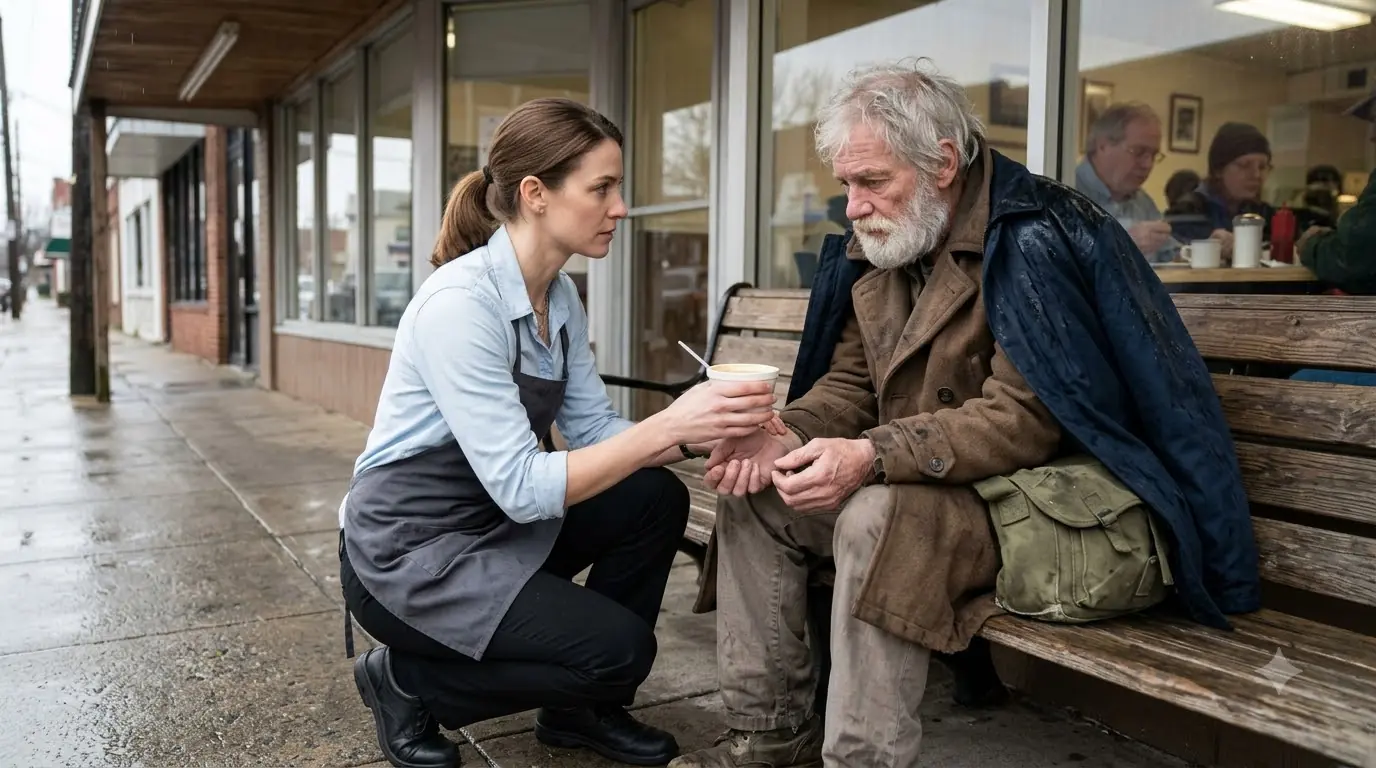
“You’re feeding that garbage on my property?”
“Beg somewhere else, old man. This is a restaurant, not a zoo.”
“He’s a veteran, sir.”
“Served? Look at him. He’s a bum. And you, apron off. You’re fired. Crawl back to whatever hole you came from.”
An hour later, that veteran called his son, a colonel.
“Dad, Doc Foster? She’s real?”
“I saw the dog tags myself, son.”
“Then make the calls. Noon. Dress uniforms. Everyone who owes her their life.”
At exactly noon, fifty officers and soldiers lined up outside that diner.
“Detail! Present arms!”
“They’re saluting the waitress?”
A reporter turned toward the CEO.
“Care to repeat what you called this woman? The cameras are rolling.”
That story started six hours earlier with two eggs, toast, and black coffee.
At 5:30 in the morning, Maple Street still slept beneath a cold October drizzle, but the lights of the corner diner were already on.
Grace Foster unlocked the door the same way she did everything. Exactly on time. Exactly in order.
Keys in the left pocket. Apron folded twice. Tied twice.
Chairs down at 5:32. Coffee brewing by 5:35.
She moved through the dark like someone who had opened a thousand mornings before this one in places far less quiet.
By 6:00, the regulars drifted in.
Construction workers with concrete dust still on their boots. Nurses coming off night shift with their eyes half closed.
Grace knew every order before it was spoken.
Decaf for Earl’s brother. Extra napkins for the twins at table nine.
She carried four plates on one arm and never dropped a thing.
Every morning at 6:15, she did one more thing.
She rang up two eggs, toast, and black coffee with two sugars and paid for it herself from the tip jar.
Then she carried it outside.
The old man sat in the same spot every day, on the bench beneath the awning, wrapped in a coat the color of wet cardboard.
Walter.
Seventy-one years old.
White beard. Cracked hands. A green canvas bag he never let out of his sight.
Most people walked past him the way they walked past parking meters.
Grace never did.
“Morning, soldier,” she said, setting the box on his knees.
“Morning, sunshine,” he rasped. “You’re three minutes late.”
“Line at the register.”
“Some of us work for a living.”
He laughed until the laugh became a cough, and Grace waited until it stopped.
Here was what nobody noticed.
Whenever Grace handed him his coffee, her fingers rested against his wrist for two seconds. Maybe three.
It wasn’t a handshake.
It wasn’t affection.
She was counting.
Steady.
Sixty-eight beats a minute.
Good.
Then, and only then, she released the cup.
She checked other things too without ever appearing to check them.
Whether his lips had gone gray in the cold. Whether the swelling around his ankles looked worse than yesterday.
Whether he ate the protein first or went straight for the toast.
She did it the way other people breathed, automatically and without explanation.
“You should spend that money on yourself,” Walter told her, just as he did every morning.
“And you should eat your eggs before they go cold,” she replied, just as she did every morning.
It was the closest thing either of them had to family.
Inside, Tammy Brooks watched through the window and shook her head.
Tammy had worked the counter for nine years and had opinions about everything.
“Girl, you feed that man more regularly than you feed yourself,” she said when Grace came back inside.
“I had crackers.”
“Crackers ain’t food. Crackers are an apology for food.”
Grace smiled and reached for the coffee pot.
That smile was a door she kept closed.
Tammy had tried to open it several times over the years.
“Where are you from?”
“Georgia.”
“You got people?”
“A grandmother.”
“What’d you do before this?”
“This and that.”
Those were usually all the answers Tammy got.
But Tammy noticed things.
She noticed Grace never flinched when plates shattered, yet went completely still whenever a car backfired on Maple Street.
She noticed Grace kept the first-aid kit organized better than the paramedics who occasionally came in for lunch.
She also noticed the thin steel chain around Grace’s neck, tucked beneath her collar every single day.
Whatever hung from it stayed hidden beneath the fabric, close to Grace’s heart.
Once, while Grace reached for something on a high shelf, her collar slipped.
Tammy caught a flash of flat, stamped metal.
Military-looking.
When she asked about it, Grace tucked it away.
“Just something from another life.”
“Another life?”
That was all anyone got.
Earl Jennings, who owned the place, called Grace the best worker he had employed in thirty years and knew almost nothing about her.
A name.
A start date.
A Social Security card.
That was practically the entire file.
Outside on the porch, Walter finished his eggs and watched her through the glass.
He had spent decades reading people.
Something about her posture, the squared shoulders and the eyes that checked every exit, scratched at a memory he couldn’t quite reach.
He didn’t know it yet, but he was three weeks away from remembering.
Grace’s shift ended at 4:00.
Her second life began at 4:15.
Home was a studio apartment above a laundromat on the east side, where the radiator clanked like a dying engine and the window never quite closed.
One bed. One chair.
One photograph lay face down inside a drawer, something she never looked at and never threw away.
On the kitchen counter sat the envelopes.
Rent due Friday.
Electric bill past due.
A medical bill from a Georgia hospital with a number on it that made Grace’s stomach drop every time she looked at it.
Her grandmother’s heart medication had gone up again.
Grace did the math the way she always did, out loud in a whisper, like defusing something.
“Tips this week, two hundred ten.”
“Rent, hold back six hundred.”
“Grandma’s pharmacy, ninety.”
Whatever remained usually came to almost nothing.
Almost nothing was what she lived on.
The crackers were real.
She ate standing up, washed the plate, and was asleep by 9:00.
That was the easy part.
The hard part came at 2:00 in the morning.
It always started the same way.
Heat.
Dust in her teeth.
The thudding of rotor blades somewhere above her, slicing the sky into pieces.
Then came the sound that had never left.
A voice, young and cracking, screaming one word across the sand.
“Doc! Doc!”
Grace sat upright in the dark, heart pounding, sheets soaked.
The laundromat sign beneath her apartment painted the ceiling red, then white, then red again.
For three full seconds, she didn’t know what country she was in.
Then training took over.
In for four.
Hold for four.
Out for four.
She counted the way she had been taught until the room stopped being a desert.
She didn’t go back to sleep.
She rarely did afterward.
Instead, she reached beside the bed and pulled out a shoebox.
Inside, wrapped in a gray T-shirt, was a small velvet case she hadn’t opened in four years.
She didn’t open it now either.
Her thumb merely traced its edge once.
Like checking a wound.
Beneath the case sat a letter.
The envelope had become soft from handling.
The seal had never been broken.
On the front, in handwriting that still made Grace’s chest cave inward, was one line.
For Doc.
Read this when you make it home.
Grace had made it home four years ago.
She still couldn’t read it.
The next morning, she carried two eggs, toast, and black coffee outside.
Same as always.
Walter could read weather in a face.
“Rough night?” he asked.
“Slept like a baby.”
“Babies wake up screaming every two hours.”
“Exactly.”
Walter laughed his rattling laugh.
They sat together for a while, watching the street come alive.
Maybe because the morning was gray, or maybe because some mornings loneliness simply became too heavy, Walter started talking.
Not the jokes this time.
The real things.
He had once owned a house in Chesterfield.
He had a wife named Dorothy who grew tomatoes and yelled at the television.
When she got sick, their savings disappeared first.
Then the truck.
Then, two years after the funeral, the house.
“Grief’s expensive,” Walter said, slowly turning his coffee cup in his cracked hands. “Nobody tells you that.”
“You got family?” Grace asked.
A long pause followed.
“A son. Career military, like his old man. Stationed away.”
Walter’s jaw worked.
“He doesn’t know about the bench. About any of this.”
“Why not?”
“His mother made him promise he’d make something of himself, and he did. I’m not going to be the thing that drags him back down.”
“He’d want to know.”
“He’d want to fix it,” Walter said. “That’s worse.”
Grace studied him for a long moment.
The cracked hands. The green canvas bag with the faded stencil he never let out of reach.
The way he still sat straight on a bench that wasn’t his.
“You know what I think?” she said quietly.
“What?”
“Everyone was someone before life knocked them down.”
Walter went still.
Then he nodded slowly, his eyes beginning to shine.
He looked away down the street so she wouldn’t see his face.
“Yeah,” he managed. “And some people stay someone even after.”
Neither of them knew it yet.
But in three weeks, one of them would prove the other right in front of fifty witnesses in dress uniform and one man in a three-thousand-dollar suit.
The news arrived on a Tuesday, taped to the break-room door.
Earl Jennings gathered the staff at closing, and for the first time in thirty years, he couldn’t look his employees in the eye.
“I sold the place,” he said.
“Whitmore Hospitality Group. They buy old diners, fix them up, make them modern.”
He turned his cap in his hands.
“I’m seventy-three. My knees are gone. My margins are worse. I’m sorry.”
He found Grace beside the coffee station afterward.
“They promised to keep everybody on,” Earl said. “Ninety-day evaluation, then permanent contracts.”
He hesitated.
“Grace, these are a different kind of people. Just keep your head down.”
Grace had survived worse than new management.
At least that was what she thought.
The new world arrived the following Monday at exactly 8:00 in a convoy of three black Escalades that took up five parking spaces.
Men stepped out wearing suits that cost more than Grace’s annual rent, carrying tablets and matching frowns.
In the middle of them, moving as though Maple Street belonged to him, came Preston Whitmore.
Silver hair.