“Purple weeds, no buyer, and a dying farm—take the dollar.”
Harlan Voss held the crumpled bill inches from Elena Brooks’s face while purple wheat spilled across the concrete floor of the Kansas State Grain Auction. Moments earlier, he had ripped open one of her sacks and overturned it before a room crowded with buyers, farmers, brokers, and elevator operators. Dark-violet kernels rolled beneath muddy boots as laughter moved through the building.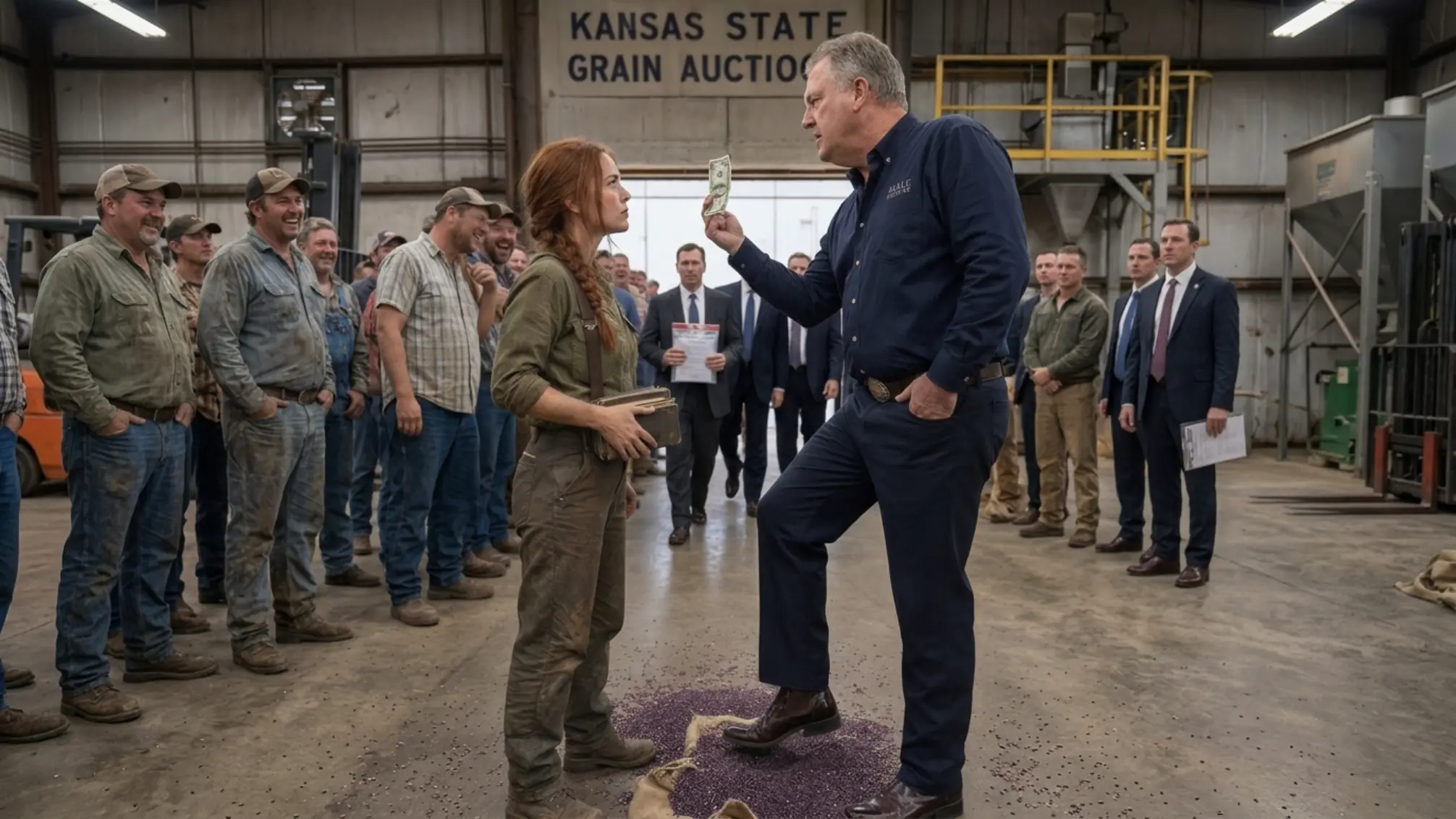
Elena did not reach for the money.
She stood beside eleven years of breeding notebooks, wearing an olive-green farm shirt, brown suspenders, faded work trousers, and boots still carrying dust from her sixty-acre field. Her long auburn hair was braided over one shoulder, and although anger burned behind her green-gray eyes, her voice remained controlled.
“Keep it,” she said. “You’ll need it when farmers stop using your elevators.”
The laughter weakened.
Harlan crushed several purple kernels beneath his polished boot. At fifty-six, he controlled Prairie Crown Elevators, the largest grain-storage network in three counties. Most farmers in western Kansas depended on his dryers, bins, contracts, and rail connections to move a harvest beyond the county line.
“Nobody serious will ever buy this freak crop,” he said.
Elena glanced toward the side entrance.
Three strangers in dark jackets had just entered carrying sealed laboratory reports and a thick contract folder.
“Then laugh louder,” she told Harlan. “And ask them who owns the seed.”
Ten months earlier, Elena sat at her kitchen table holding a bank letter beneath a red foreclosure warning. Outside, dry Kansas wind pushed loose soil across the Brooks farm while the north field’s winter wheat stood shorter than it should have. The equipment loan was due in September, and the operating note would not be renewed without a signed buyer contract.
Her father, Daniel, sat opposite her with one weakened hand resting near his coffee. A stroke had left him walking with a cane and unable to manage long days inside tractors or beneath broken machinery. The farm had been his life, but its future now rested almost entirely on Elena.
“What does the letter say?” he asked.
“Nothing we didn’t already know.”
“That bad?”
“The bank wants a buyer agreement within forty-five days.”
Daniel looked toward the dusty window.
“Harlan came by yesterday.”
Elena’s eyes sharpened. “What did he want?”
“To help.”
Harlan’s version of help waited inside a white envelope on the kitchen counter. He offered enough money to clear most of the farm’s debt but far below the property’s true value. The agreement even allowed Daniel to remain inside his own farmhouse for six months after selling.
Elena read the offer twice.
Then she tore it in half.
“He knows we’re trapped,” she said.
Daniel watched the pieces fall onto the table. “He knows we’re tired.”
“I’m not tired enough.”
That afternoon, Elena entered the oldest seed shed on the property. Rain leaked through the western roof, the doors never closed properly, and cold air passed through every crack during winter. Along the rear wall stood metal cabinets filled with labeled jars, paper envelopes, sealed seed bags, and handwritten notebooks.
The purple wheat had begun with Elena’s grandmother, Ruth.
More than thirty years earlier, Ruth discovered several unusually dark wheat heads growing inside an ordinary field. She saved the kernels because she liked their color, replanted them near the farmhouse, and continued the small patch without calling it anything special.
Elena noticed something different when she was twenty-two.
During a severe dry year, most conventional wheat curled, faded, and collapsed early. Several purple plants remained upright. Elena saved seed from the strongest heads and planted them separately the following season.
She repeated that process for eleven years.
Each generation was evaluated for color, stand strength, protein content, disease resistance, drought performance, and yield. Elena recorded rainfall, soil temperature, planting depth, test weight, emergence rate, heat stress, harvest date, and every visible weakness.
She was not a university scientist.
She was a farmer who refused to stop asking why certain plants survived.
The most stable generation went into sixty acres that spring. Daniel named it Violet Plains. Neighbors called it Elena’s science experiment and joked about purple bread, strange flour, and wheat that looked diseased.
Harlan heard every joke.
Three weeks after Elena rejected his land offer, his spotless black pickup appeared beside the south field. He found her checking irrigation equipment between rows of dark wheat moving beneath the wind.
“I hear you planted more of the purple stuff,” he said.
“Sixty acres.”
“Risky when you need a buyer.”
“I’ll find one.”
Harlan removed his sunglasses. “Prairie Crown won’t accept it.”
“You haven’t tested it.”
“It doesn’t fit our grading system.”
“It’s hard red winter wheat.”
“It’s purple.”
“That is color, not class.”
Harlan smiled as though she had proved his argument for him. Grocery companies expected uniform grain, he explained. Buyers did not want stories, explanations, or strange products that required special handling.
“What do you really want?” Elena asked.
“To keep you from making this harder than necessary.”
“You want the land.”
“I want a clean transaction.”
“You offered less than market value.”
“I offered what the farm is worth without a crop contract.”
Two days later, Prairie Crown sent formal notice refusing Violet Plains because of alleged contamination risk and suspicious discoloration. Three independent buyers soon rejected Elena as well. One apologized quietly; the others stopped answering her calls.
The bank summoned her before the week ended.
Melissa Grant, the loan officer, had known Elena since high school and spoke gently while explaining what would happen. Without a signed purchase agreement, the operating note could not be extended. Healthy grain meant nothing if nobody agreed to buy it.
“There is no market because Harlan is blocking every door,” Elena said.
Melissa lowered her voice.
“Then find one he doesn’t control.”
Elena left without knowing where such a door existed.
A week later, she borrowed a small stone mill from a bakery in another county and ground fifty pounds of Violet Plains. The flour emerged pale lavender and turned deeper purple when mixed with water. Her first loaf carried a dark crust, soft interior, and rich nutty smell.
Daniel ate two slices without butter.
“That’s good bread,” he said.
Elena packaged the remaining flour and took it to a Saturday farmers market. Most shoppers stopped because of the color, but few purchased anything. One parent asked whether it was safe for children.
Then a teenager filmed the display.
The video appeared online beneath the caption: Kansas Farmer Invents Goth Bread.
Instead of hurting sales, the joke brought curious visitors. People drove from neighboring counties to photograph the flour and ask whether the bread remained purple after baking. Elena still sold only small amounts, but the attention created the first opening Harlan had failed to close.
He arrived shortly before noon the following Saturday.
Harlan lifted one flour bag and read the label aloud.
“Violet Plains. Grown and milled by Brooks Family Farm.”
He paid cash.
For one brief moment, Elena wondered whether he had changed his mind. Harlan walked toward a nearby trash can, tore open the package, and emptied the flour inside.
Purple dust rose around him.
“That,” he announced, “is the only market for it.”
Several people laughed.
Elena said nothing. She folded his receipt and placed it carefully inside her jeans pocket.
An hour later, a Wichita bakery owner named Nora Ellis purchased two bags. Unlike other customers, Nora did not ask whether purple wheat was strange or dangerous. She asked about protein percentage, moisture, milling consistency, and how the dough behaved.
One week later, she called Elena.
“The bread held its color.”
“Is that unusual?”
“For natural grain pigment, extremely.”
Nora had already sent a sample to Dr. Rachel Kim at the Kansas Center for Grain Science. Rachel contacted Elena directly and requested seed samples, flour, and every breeding record available.
Elena arrived at the university carrying eleven years of notebooks inside a plastic storage container.
Rachel asked whether a commercial company had provided the original seed.
“No.”
“Any university breeding program?”
“No.”
“Any licensing agreements?”
“No.”
“Genetically modified material?”
“Not that I know of.”
Rachel opened one notebook, then another. Every season contained planting dates, moisture readings, rainfall, yield comparisons, color scores, disease pressure, and detailed decisions explaining why Elena kept or rejected each generation.
“You recorded this yourself?”
“Every year.”
After twenty minutes, Rachel stopped questioning whether Elena knew what she had created.
Early tests confirmed that the purple color came from naturally occurring pigments concentrated in the kernel’s outer layers. Violet Plains demonstrated promising protein levels, good baking performance, and a color stable enough to survive milling and heat.
The field data interested Rachel even more.
During drought years, Violet Plains had produced more usable grain than several conventional varieties planted nearby. It was not indestructible, but its combination of color, baking quality, and dryland resilience created something both food companies and farmers could value.
Rachel ordered additional testing.
“Do not send seed to anyone,” she warned.
“Why?”
“Because the moment people understand its value, this stops being a farming conversation.”
That moment arrived quickly.
Harlan returned to the Brooks farmhouse carrying a new contract. He offered $75,000 for all existing seed, harvested grain, and breeding records connected to Violet Plains.
The agreement transferred permanent ownership to Prairie Crown.
Elena’s name appeared once, identifying her only as the seller.
“You called it contaminated,” she said.
“I called it unmarketable.”
“You said it looked diseased.”
“I was protecting my facilities.”
“What changed?”
“A buyer asked questions.”
“Who?”
“The kind you desperately need.”
Elena returned the contract.
“No.”
“You owe more than this to the bank.”
“No.”
“You could lose the farm.”
“Then I’ll lose it without giving you my seed.”
Harlan’s expression hardened.
“You’re confusing pride with ownership.”
Elena stepped closer. “I know exactly what ownership means.”
Three nights later, someone broke into the old seed shed.
The thief ignored expensive tools, equipment, and a fuel card hanging above the workbench. Six sealed seed samples disappeared from the metal cabinets. Every missing bag belonged to an earlier Violet Plains generation.
A sheriff’s deputy photographed scratches near the damaged lock and recorded the missing lot numbers. He promised to investigate but offered little hope without witnesses or clear footage.
A week later, Rachel discovered a public filing from High Prairie Genetics.
The newly formed company claimed ownership of a drought-tolerant purple wheat variety named Royal Crest. Corporate records connected High Prairie directly to Prairie Crown Elevators.
Harlan had not merely attempted to buy Elena’s work.
He was trying to steal it.
Before Elena could challenge the filing, a state inspector arrived with a contamination complaint. The allegation claimed she had sold unregistered seed and introduced unsafe grain into the human food supply.
The inspector placed a temporary hold on the crop.
Elena could harvest and store Violet Plains but could not move, process, or sell it until testing was complete. The bank’s deadline was three weeks away, while hail, wind, or rain could still damage the mature field.
Harlan called that evening.
“This is becoming ugly,” he said.
“You would know.”
“I can make it disappear.”
“For what price?”
“The farm, grain, seed, records, and debt.”
Elena looked through the kitchen window. Daniel was walking slowly beside the field with his cane, pausing every few steps to watch the violet heads moving in the fading light.
“You stole from me.”
“That is a serious accusation.”
“You filed ownership claims on a variety you never developed.”
“Can you prove it?”
Elena remained silent.
Harlan’s voice softened.
“That’s what I thought.”
Rachel believed the laboratory could establish the connection, but the stolen samples came from earlier generations. If High Prairie used them, their genetic profile would not perfectly match Elena’s current line.
The difference became the key.
Royal Crest carried a heat instability Elena had documented seven years earlier. Under stress, its pigment separated unevenly, leaving patchy color across the kernels. Elena rejected that generation and wrote exactly when, where, and why she removed it from further development.
High Prairie had registered Elena’s discarded version.
The records proved genetic origin but did not yet establish that Harlan knowingly stole her work. Then Daniel remembered the farmers-market receipt.
Elena found it inside a coffee tin.
The receipt documented Harlan’s purchase of Violet Plains flour weeks before High Prairie filed its application. It included the product name, date, farm, and seller.
Harlan could no longer claim ignorance.
The final laboratory comparison was not expected before the Kansas State Grain Auction. That auction remained Elena’s last chance to find a buyer before the bank moved against the farm.
Harlan arranged for Violet Plains to be placed in an experimental category outside normal food-grade listings. By the time Elena arrived, rumors had already spread about contamination, stolen genetics, and foreclosure.
Then he dumped her wheat onto the floor.
Harlan offered one dollar for the entire crop while buyers laughed and phones recorded Elena’s humiliation.
The side doors opened.
Claire Bennett, vice president of product development for North Star Foods, entered with two colleagues. One carried a sealed sample case while the other held a thick folder.
“Before anyone destroys this grain,” Claire said, “we need one question answered.”
The auction room quieted.
“Who owns the breeding rights to Violet Plains?”
Harlan stepped forward.
“You mean Royal Crest.”
Claire finally looked at him.
“No, we do not.”
Rachel entered through another doorway carrying the completed laboratory report. She had driven directly from the university.
“The final testing is complete,” she announced. “Violet Plains is free of fungal contamination, meets food-safety standards, and carries naturally occurring pigment.”
Harlan crossed his arms. “That says nothing about ownership.”
Rachel opened Elena’s oldest notebook.
“The samples submitted by High Prairie Genetics match an unstable generation documented and rejected by Elena Brooks seven years ago.”
“That still proves nothing about what my company knew.”
Claire removed the farmers-market receipt from her folder.
“This proves Prairie Crown purchased a labeled Violet Plains product before High Prairie claimed the variety as its own.”
Harlan’s face changed.
Only slightly.
But everyone saw it.
Claire turned toward Elena.
“North Star Foods is prepared to offer Brooks Family Farm a ten-year commercial partnership valued at up to twenty-four million dollars.”
No one laughed.
The proposed package included production guarantees, research funding, licensing payments, and construction of a specialty milling facility in Kansas. North Star had evaluated Violet Plains for six weeks using samples provided through the university and bakery testing program.
Harlan recovered quickly.
“You can promise whatever you want,” he said. “The grain still has to move. Prairie Crown controls regional storage, drying, and rail contracts.”
Claire closed the folder.
“We signed agreements yesterday with Plains Central Rail and an independent mill outside Garden City.”
Harlan stared at her.
“We do not need your facilities.”
Twenty years of control disappeared inside one sentence.
The state lifted the hold on Elena’s crop that afternoon. High Prairie’s filing was suspended pending an ownership investigation, and the bank delayed foreclosure discussions after receiving confirmation of the commercial offer.
Farmers who had avoided Elena all summer suddenly approached to shake her hand.
She accepted their congratulations.
She did not pretend to forget where they had stood when Harlan emptied the sack.
Harlan made one final attempt.
“Prairie Crown could serve as exclusive distributor.”
Elena looked at the purple grain scattered beneath his boots.
“No.”
“You’ll need experienced logistics.”
“You already showed me what you do with things you can’t control.”
One week later, Elena entered North Star’s headquarters to review the official agreement. The document still carried the twenty-four-million-dollar headline, but deep inside the legal language was a permanent transfer clause.
North Star would own Violet Plains forever.
Elena would receive substantial money, but her grandmother’s seed, her father’s farm, and eleven years of work would disappear into corporate property.
Claire explained that full acquisition was standard.
Elena closed the contract.
“My grandmother saved the first kernels. My father kept this farm alive. I spent eleven years developing this line. I’m not selling all of that so my name can disappear from the package.”
She stood and collected her folder.
Claire asked her to wait.
Elena continued toward the door.
North Star’s chief executive stopped the meeting.
“Rewrite it.”
The final agreement became a ten-year license rather than a permanent sale. Elena retained ownership, control of breeding standards, authority over seed multiplication, and approval rights for participating growers.
Farmers received a guaranteed minimum price.
North Star could manufacture and sell Violet Plains products but could not patent the underlying line or prevent Elena from licensing it elsewhere after the contract ended.
The specialty mill would be built near the Kansas farms producing the grain.
Elena signed that version.
One year later, Violet Plains covered more than four thousand acres of western Kansas. The harvest supplied flour for bread, pasta, breakfast cereal, and snack products.
Elena cleared the Brooks farm debt.
Then she established Purple Plains Growers, a farmer-owned cooperative offering transparent prices, independent storage, and direct rail agreements. Growers who once depended entirely on Prairie Crown finally had somewhere else to sell.
Harlan lost positions on two regional boards. High Prairie’s false filing was canceled, while the investigation into the missing seed continued.
Elena spent little time celebrating.
The next planting season required preparation.
One evening, Daniel joined her at the field’s edge. The setting sun turned the wheat nearly black, but each movement of the wind sent flashes of violet across the land.
“Your grandmother would have liked this,” he said.
Elena smiled.
“She would have said I planted too much.”
Daniel laughed softly. “She would have said that first.”
Near Elena’s office stood one of the original auction sacks inside a glass case. The fabric remained torn where Harlan had grabbed it, and purple dust still marked one corner.
Daniel once asked why she kept it.
“Not because he dumped it?”
“No.”
“Then why?”
Elena looked through the window toward the fields.
“Everyone in that auction believed they were watching the moment Violet Plains became worthless.”
She rested her hand against the glass.
“They were actually watching the last moment anyone else got to decide what it was worth.”
Outside, combines moved through the purple wheat.
For the first time since Elena began planting it, nobody standing beside the road was laughing.