The blizzard hit Detroit like a sledgehammer.
Through frosted glass, 72-year-old Dorothy Washington watched nine massive motorcycles disappear beneath the falling snow.
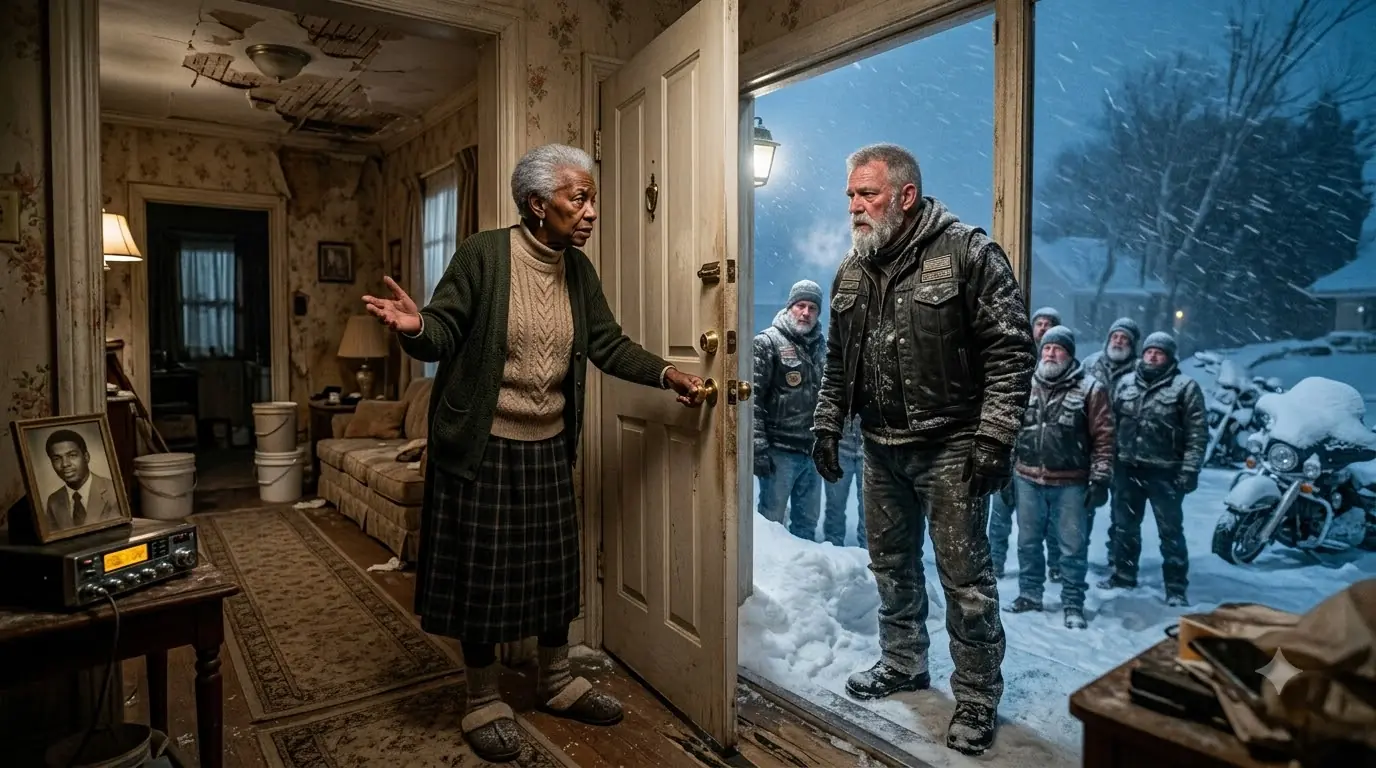
Nine leather-clad giants stood on her crumbling porch, ice clinging to their beards and desperation in their eyes.
Outside, the temperature was dropping toward fifteen below zero.
Without shelter, anyone caught in this storm could die before morning.
Dorothy's arthritic hands trembled on the deadbolt.
Not because of the cold.
Because of fear.
These men could overpower her in seconds. They could take everything she had, hurt her, leave her helpless inside the house she had spent decades protecting.
But they were human beings.
And they were freezing out there.
Dorothy faced an impossible choice.
Lock the door and leave nine strangers outside in a deadly storm, or open it and risk everything.
What she didn't know was that the man standing in the center of that group wasn't just any biker.
And her next decision would change not only nine lives, but eventually transform her entire neighborhood.
Before that life-changing moment, Dorothy Washington had been fighting a battle she seemed destined to lose.
At 72, Dorothy lived alone in a two-story house that was slowly crumbling around her.
Paint peeled from the siding like old skin.
Shingles had blown away during the previous year's storms, leaving dark patches where rain leaked through the roof.
Every morning at 5:30, Dorothy made instant coffee with powdered milk.
Real cream had become a luxury she couldn't justify on her $1,200 monthly Social Security check.
She would sit at the kitchen table reading her worn Bible beneath the light of a single bulb, quietly praying for enough strength to make it through another day.
The house needed at least $15,000 in repairs.
Probably more.
The furnace wheezed and rattled, struggling to heat rooms that leaked warmth through cracked windows.
During winter, Dorothy wore three sweaters indoors. On the coldest mornings, she could see her own breath in the kitchen.
When it rained, she placed pots and buckets throughout the house to catch dripping water.
The steady ping, ping, ping echoed through empty rooms like a countdown.
Her medicine cabinet told the story of her sacrifices.
Blood-pressure pills that were supposed to be taken every day were sometimes stretched longer than they should have been. Diabetes medication was rationed because the prescription cost more than her weekly grocery budget.
Dorothy had learned to make choices nobody should have to make.
Medicine or food.
Heat or groceries.
A repair or another month of hoping nothing else broke.
Every Tuesday, she walked six blocks to the grocery store with a calculator in her purse.
She added prices as she shopped and quietly returned items to the shelves whenever the total exceeded $47.
That was her weekly food budget after housing costs, utilities, and medicine.
The neighborhood around her seemed to be dying too.
Three houses on the block stood abandoned, their windows boarded up like closed eyes.
Broken streetlights left long stretches of darkness where almost anything could happen.
Young men gathered on corners, wary of the police but always respectful when they passed Dorothy's porch.
"Morning, Miss Dot," they would call.
Dorothy would wave back.
She knew their mothers had raised them right, even if the streets were trying to teach them something different.
Despite everything, Dorothy maintained standards.
She swept the front steps every morning, watered struggling houseplants with leftover dishwater, and kept an American flag displayed prominently despite the missing shingles above it.
Her late husband, Robert, had served in Vietnam.
That flag meant something.
The old CB radio from Robert's trucking days still worked, occasionally crackling with voices Dorothy didn't recognize.
Sometimes she heard motorcycle groups communicating in codes she couldn't understand.
The radio was one of the few connections she had with the outside world whenever her inexpensive cell phone lost signal.
Dorothy still held herself with the straight-backed posture Robert had admired.
He had taught her that dignity was one thing poverty could never take unless you surrendered it.
She still baked cookies for neighborhood children when she could afford the ingredients.
She let them use her bathroom when they played outside.
She fed stray cats with food she could barely spare for herself.
The loneliness was harder than the poverty.
Her daughter, Regina, lived in California, building a life with her own family.
Her son, Jerome, was serving overseas.
Dorothy was proud of both of them.
But pride didn't fill empty rooms.
It didn't warm long winter nights.
Dorothy refused to ask for help.
Her children had bills and struggles of their own.
She wouldn't become a burden.
She wouldn't pressure them to sacrifice their futures just to make hers more comfortable.
Some mornings Dorothy stood at the kitchen sink, looking toward the broken neighborhood, whispering the same prayer.
"Lord knows I've made it this far."
She would grip the counter.
"Just need to make it through another winter."
Then she would glance around the aging kitchen.
"The house may be falling down, but I'm not."
Some neighbors kept their distance.
Not because Dorothy was unfriendly, but because she had standards and wasn't afraid to defend them.
She called the police when dealers operated too close to the elementary school.
She reported parties that kept working families awake.
She maintained her property even when nearly everyone else had given up.
Some people thought she was difficult.
They didn't understand that Dorothy believed she was fighting for something larger than herself.
This neighborhood had raised children.
Every crack in the sidewalk held memories of scraped knees Dorothy had bandaged.
Every tree had once shaded birthday parties and family barbecues when times were better.
Each Sunday, Dorothy sorted her pills into a weekly container, making them last as long as she could.
She had learned which medicines she absolutely could not skip and which ones she sometimes tried to stretch when money was tight.
Her body hurt constantly.
Complaining wouldn't pay the bills.
Lately, the CB radio had been unusually active.
Dorothy picked up transmissions from groups that sounded organized and disciplined.
Road conditions.
Welfare checks.
Community-service coordination.
It reminded Dorothy of Robert's old trucking friends looking after one another on long hauls.
That felt like a different world now.
A world where strangers helped one another.
Where a person's word still meant something.
Where service to others mattered as much as service to yourself.
Dorothy didn't know that world was about to knock on her door.
As she prepared for bed one March evening, checking the locks twice and lowering the thermostat to save money, Dorothy had no idea the greatest test of her faith was less than twelve hours away.
Outside, the first snowflakes began to fall.
Then came the storm.
The weather service had been warning residents for three days.
An unprecedented March blizzard was approaching Detroit, bringing life-threatening conditions.
Temperatures were expected to fall toward fifteen below zero.
Winds could reach sixty miles per hour.
Power lines might snap.
Roads could become impassable.
Dorothy had survived plenty of Michigan storms.
This one felt different.
More dangerous.
More final.
At 6:47 that evening, the ancient furnace in Dorothy's basement finally gave up.
She heard it wheeze.
Then rattle.
Then fall silent with a mechanical sigh that almost sounded human.
Within minutes, the house began losing heat.
Dorothy pulled on a third sweater and called Regina in California.
"Just checking in, baby," she said, forcing cheerfulness into her voice. "How are my grandbabies?"
She didn't mention the furnace.
There was nothing Regina could do from two thousand miles away, and Dorothy refused to make her daughter worry over something she couldn't fix.
By 7:23, Dorothy could see her breath in the kitchen.
She plugged in an old space heater.
The house's aging electrical system immediately protested.
The lights flickered.
Then everything went dark.
Dorothy found the CB radio by touch and switched it on, guided by the faint amber glow of its display.
Static filled the room.
Then fragmented emergency transmissions broke through.
Roads blocked by fallen trees.
Motorcycles failing in the extreme cold.
Hypothermia risk increasing.
People searching for emergency shelter.
Dorothy realized a group of motorcyclists was stranded somewhere nearby.
In these conditions, exposed to the storm, they might not survive the night.
The temperature inside Dorothy's house was falling too.
Without a working furnace, she faced her own emergency.
Diabetes already affected her circulation.
The cold hit Dorothy harder than it would most people.
Her fingers were going numb.
Even working the CB dial was becoming difficult.
She might not survive the night herself.
Yet strangers outside seemed to be in even more immediate danger.
Dorothy Washington had been raised to believe that when somebody truly needed help, you helped.
The conflict tore at her.
Every frightening story she'd ever heard about motorcycle clubs flashed through her mind.
Fights.
Crime rumors.
Violence.
Recent incidents around Detroit involving groups that had frightened business owners and residents.
Every survival instinct told Dorothy to stay inside.
Lock the doors.
Let someone else deal with whatever was happening out there.
But another question would not leave her alone.
What would Jesus do?
What would Robert do?
Outside, the storm intensified.
Windows rattled violently in their frames.
Snow blew sideways until visibility disappeared.
Tree branches snapped in the darkness.
Dorothy's old Honda was already buried.
Even if she wanted to leave, escape was becoming impossible.