“Dinner is ready, boys. Eat while it’s hot. You’ve been cold long enough.”
Alice Brooks carried two steaming plates into the crowded kitchen as though nine enormous bikers sleeping throughout her tiny Montana farmhouse were the most ordinary guests in the world.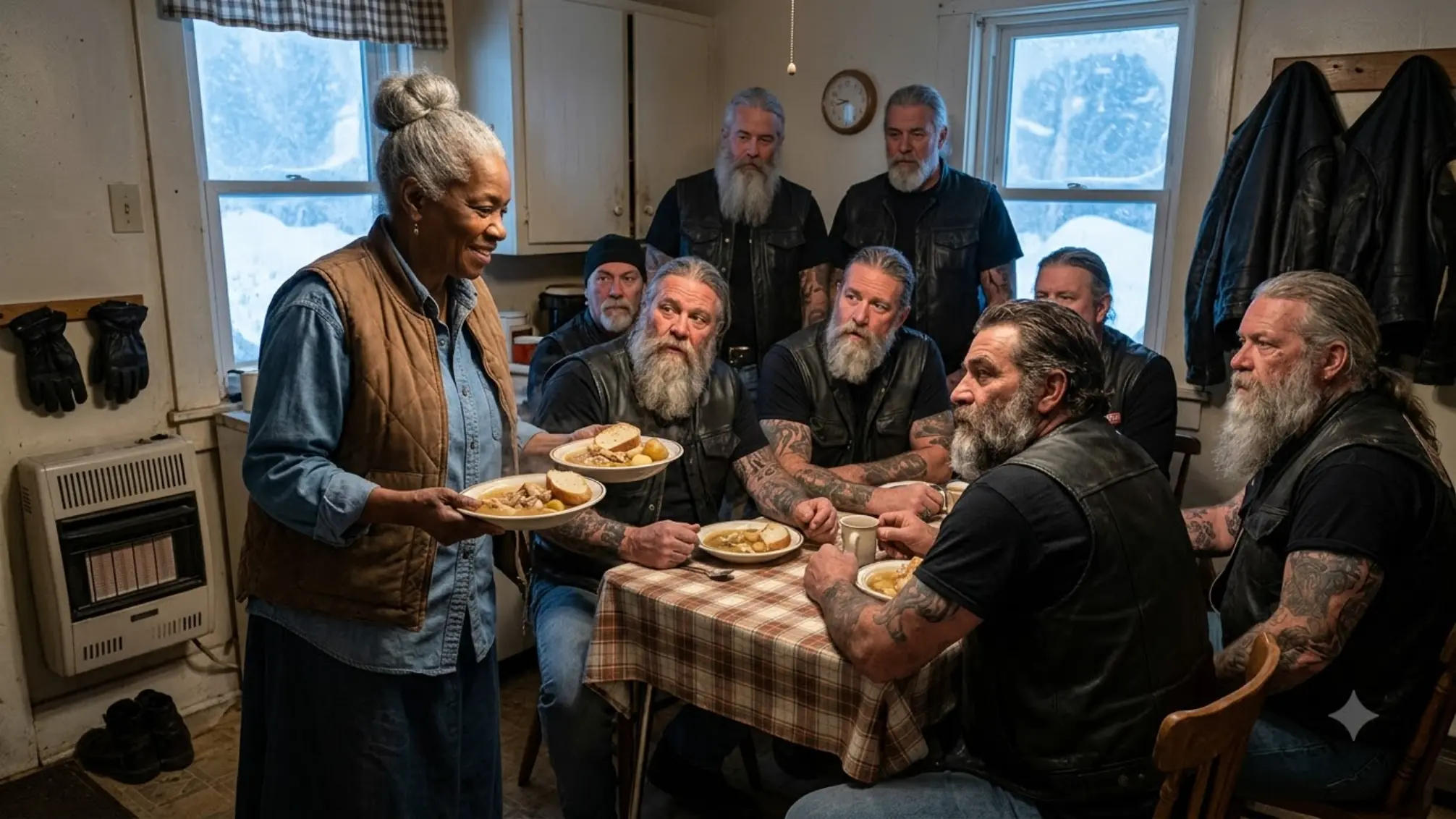
Outside, the worst blizzard Bent Creek had seen in decades covered Route 46 beneath white drifts. Snow hammered against the windows. Wind rattled the old frames, slipping through cracks Alice had been meaning to repair for years but could never afford to fix. The thermostat still read only fifty-eight degrees.
Yet inside the kitchen, nine men were alive because of her.
Three hours earlier, most of them had been lying beside overturned motorcycles on a frozen highway.
Now their wet gloves hung near the heater. Leather vests were draped over chairs. Boots lined the entryway. Men with tattooed arms, gray beards, and intimidating patches sat awkwardly around Alice’s plaid-covered table, holding chipped bowls of turkey soup as though they were being served in the finest restaurant in Montana.
Alice placed another plate in front of a broad, salt-and-pepper-bearded biker named Tommy Wilson.
He did not immediately touch the food.
Instead, he looked at her.
Really looked.
Something about Alice had been bothering him since she dragged him into her battered Buick during the storm.
Her voice.
Her eyes.
The way she called grown men “sweetheart” without sounding afraid of them.
Tommy’s chest tightened.
“Ma’am,” he said softly, “you barely have enough for yourself. Why are you feeding all of us?”
Alice placed one weathered hand on his shoulder.
“Because an empty stomach doesn’t care what vest you wear, sweetheart. Tonight, you’re under my roof.”
Tommy froze.
Sweetheart.
The word opened a door inside him that had been closed for forty years.
A school cafeteria.
Metal lunch trays.
A woman wearing a white apron.
A hungry seven-year-old boy trying to pretend he had eaten breakfast.
Tommy stared at Alice’s face.
His spoon slipped from his fingers.
“Miss Alice…”
She stopped.
The kitchen quieted.
Tommy’s eyes filled.
“Look at me again.”
Alice frowned slightly.
“I think you already saved me once, forty years ago.”
The storm outside continued howling.
But inside that little farmhouse, everything seemed to stop.
Only that morning, Alice Brooks had awakened worried about whether she could afford to keep the house warm.
She was sixty-eight years old and lived alone in the farmhouse she had shared with her husband, Jerome, for more than thirty years.
Jerome had been gone three years.
Heart attack.
Sudden.
One ordinary afternoon, he had left to buy light bulbs from the hardware store.
He never came home.
Alice still wore his old flannel shirt when the house became too cold.
The sleeves were too long.
The fabric had thinned near the elbows.
But it still smelled faintly like cedar from the closet where Jerome had kept his work clothes.
That morning Alice stood beside the thermostat.
Fifty-eight degrees.
She considered turning it to sixty-two.
Then remembered the electric bill.
She left it alone.
Social Security gave her enough to survive if nothing unexpected happened.
Unfortunately, life specialized in unexpected things.
Property tax.
Prescription costs.
Groceries.
Her old Buick needing repairs.
The leaking roof.
The ancient furnace.
Alice had become very good at subtraction.
Take away heat.
Take away meat twice a week.
Split medication when necessary.
Delay replacing shoes.
Cancel anything that could be considered comfort.
One thing Alice never removed from her budget was the glass jar near the kitchen door.
Pennies.
Nickels.
Occasional quarters.
Whenever it filled, she bought granola bars and crackers for children at Bent Creek Elementary.
Alice had spent thirty-five years working in school cafeterias before retirement.
She knew hungry children.
They behaved differently.
Some ate too quickly.
Others ate painfully slowly because they feared the food would disappear.
Some asked whether they could save half their lunch.
Some watched other children throw food away with an expression adults rarely noticed.
Alice noticed.
Jerome used to tease her.
“You’d give away our refrigerator if somebody knocked at the right time.”
Alice would answer, “Then you better pray nobody comes hungry.”
Jerome always smiled.
“We might not have much, Alice. But we’ve got enough to share.”
Those words remained after he was gone.
That afternoon Alice volunteered at the elementary-school library.
Snow began falling before she finished.
By 4:45, the television near the front desk announced a severe blizzard warning.
The librarian offered Alice her couch for the night.
Alice refused.
Her medication was home.
So was the turkey soup she had prepared for several days of meals.
And she hated sleeping anywhere except the bed she had shared with Jerome.
She walked into the grocery-store parking lot with two small bags.
Her 1998 Buick LeSabre struggled to start.
“Come on, baby.”
The engine coughed.
Died.
Alice closed her eyes.
“Please.”
She turned the key again.
The Buick sputtered to life.
Alice smiled.
“Good girl.”
Route 46 was already nearly empty.
Snow thickened as she drove.
Fifteen miles per hour.
Sometimes ten.
Her windshield wipers barely kept up.
She leaned forward over the steering wheel, praying quietly.
“Just get me home.”
At mile marker thirty-two, her headlights caught something lying across the highway.
Alice braked.
The Buick slid sideways before stopping.
Her heart slammed against her ribs.
At first, she thought deer had been struck.
Then one shape moved.
A hand lifted weakly.
Alice switched on the hazard lights and stepped outside.
The cold struck immediately.
Ahead of her, motorcycles lay scattered across the icy road.
And beside them were men.
Nine of them.
Large men wearing leather motorcycle vests.
Several barely moved.
Alice recognized the patches.
She knew the reputation.
For one brief second, fear told her to return to the car.
Then she saw one man’s lips.
Blue.
Another was no longer shivering.
Alice’s old school emergency training came back instantly.
Hypothermia.
Severe.
Dangerous.
The closest conscious biker lay against the guardrail.
“Lady,” he whispered through chattering teeth. “Go.”
Alice bent over him.
“Can you stand?”
“Leave us.”
“I didn’t ask what you wanted.”
His eyes tried to focus.
Alice raised her voice.
“Can. You. Stand?”
He managed a weak nod.
Alice looked toward the others.
“Anybody who can walk, get up.”
Nobody argued after that.
Her voice was the same one she had used to control hundreds of children in cafeteria lines.
Alice loaded four men into the Buick.
Three across the back seat.
One beside her.
Their combined weight made the suspension complain.
“Stay awake,” she ordered.
One biker whispered, “Why?”
Alice put the car in gear.
“Because dying in my Buick would ruin my evening.”
Even half frozen, one of them laughed.
Alice drove eight miles home.
She got them inside.
Turned every blanket she owned over to them.
Then she picked up her keys.
One biker grabbed her wrist.
“There are five more.”
“I know.”
“You can’t go back.”
Alice pulled free.
“You planning on stopping me?”
Nobody answered.
She returned to Route 46.
Visibility had worsened.
The five remaining men were nearly buried.
Three were conscious.
Two were not.
Alice screamed at them.
Pushed them.
Dragged them.
Begged them.
Somehow, all five reached the Buick.
Back at the farmhouse, the living room became a temporary emergency ward.
One biker named Danny seemed to know medicine.
He began checking pulses.
Another man helped.
Alice noticed their skill but had no time to question it.
She counted again.
Nine.
Then Danny looked around.
“No.”
Alice’s stomach dropped.
“What?”
“Our president.”
“Where?”
“The guardrail.”
Alice realized her count had included men twice during the confusion.
One was missing.
She grabbed her coat again.
Danny stood.
“You’re exhausted.”
“So is he.”
“You could die out there.”
Alice looked at him.
“So could he.”
The third trip nearly broke her.
Her arthritic hands could barely hold the steering wheel.
When she reached the crash site, the remaining biker was half covered by snow.
He was enormous.
Six-foot-three.
At least two hundred fifty pounds.
Alice shook him.
“Wake up.”
His eyes barely opened.
“You…”
“Yes, me.”
“Angel.”
Alice snorted.
“I’m somebody’s grandmother. Now get up.”
He could barely help.
Alice pulled.
Dragged.
Rested.
Pulled again.
At one point she looked upward into the swirling snow.
“Jerome, if you’re listening, this would be a fine time to help your wife.”
Somehow she got the biker into the car.
At 8:19 p.m., Alice completed her third trip.
All nine men were inside.
Alive.
Barely.
Emergency services could not reach them for hours.
So Alice did what she had always done when frightened people entered her world.
She fed them.
The turkey soup she intended to eat for several days disappeared in one night.
The bread disappeared too.
She heated canned vegetables.
Made coffee.
Found every blanket in the house.
Nobody asked whether she could afford it.
Alice never mentioned that she could not.
Around midnight, Tommy noticed a photograph on the mantel.
Alice and Jerome.
Tommy walked closer.
He lifted the frame.
His breathing changed.
Danny noticed.
“What?”
Tommy pointed.
“That’s her.”
“Who?”
Tommy could barely speak.
“The cafeteria lady.”
Danny stared.
Tommy had told his friends about her for years.
The woman who fed him when he was a child.
The woman he had unsuccessfully searched for after becoming an adult.
Alice Brooks.
Miss Alice.
At two in the morning, paramedics finally arrived.
All nine bikers were examined.
They had suffered varying degrees of hypothermia, but nobody required immediate evacuation through the still-dangerous storm.
One paramedic pulled Alice aside.
“You understand you probably saved nine lives tonight?”
Alice frowned.
“I made soup.”
“You drove Route 46 three times.”
“They needed help.”
The paramedic smiled.
“That’s usually how heroes explain things.”
Alice waved him away.
By three, her house was silent.
Bikers slept everywhere.
Couch.
Floor.
Kitchen chairs pushed together.
Alice settled into Jerome’s old armchair.
She expected to rest for ten minutes.
She woke at 6:15.
The storm had stopped.
Sunlight covered the snow.
Alice heard movement in the kitchen.
When she entered, she stopped.
Nine bikers stood around her stove.
Someone had cooked eggs.
Someone else made toast.
Coffee filled the room with a smell Alice had nearly forgotten because she usually reused grounds to save money.
Jax, the club president, pulled out a chair.
“Morning, Mrs. Brooks.”
Alice narrowed her eyes.
“Who told you my last name?”
He smiled.
“Pictures.”
Tommy was holding the old photograph.
Alice recognized it.
Jefferson Elementary.
Denver.
“Where did you get that?”
“Your mantel.”
Tommy approached her slowly.
His eyes were already wet.
“Miss Alice.”
She looked at him.
He removed a worn photograph from his wallet.
Same cafeteria.
Same year.
The image showed young Alice standing behind a lunch counter.
In line was a thin little white boy with freckles and sandy hair.
Alice took the photograph.
Something shifted behind her eyes.
“Tommy?”
His face collapsed.
She covered her mouth.
“Little Tommy Wilson?”
He nodded.
“You remember me?”
Alice reached toward his face.
“You were so skinny.”
Tommy laughed through tears.
“You always put extra potatoes on my tray.”
“You needed them.”
“My father had lost his job.”
“I knew something was wrong.”
“We barely ate at home.”
Alice’s eyes filled.
Tommy knelt beside her chair.
“That lunch was sometimes my only meal.”
Alice began crying.
“You never said.”
“I was ashamed.”
“Oh, baby.”
She touched his cheek.
“You were seven.”
Tommy closed his eyes.
“For forty years, I wanted to find you.”
“Why?”
“To say thank you.”
He looked around the kitchen.
“Last night you saved me again.”
Alice shook her head.
Tommy continued.
“I became a physician assistant because people helped me when my family couldn’t help itself.”
Alice stared.
Then Danny stepped forward.
“I’m a nurse.”
Another biker raised his hand.
“Paramedic.”
Another introduced himself as a pharmacist.
Another worked in physical therapy.
Another in hospital administration.
Then Jax spoke.
“Trauma surgeon.”
Alice looked around the table.
“You’re telling me nine bikers nearly froze to death while carrying half a hospital between you?”
Danny laughed.
“Apparently medical degrees don’t defeat black ice.”
The men explained they had been returning from a rural charity clinic and toy drive when the blizzard hit.
Alice sat speechless.
Then Jax placed a folder on the table.
“We also need to talk about you.”
“No.”
Alice immediately knew that tone.
Jax smiled.
“You don’t know what I’m saying.”
“I know people trying to give me things.”
Tommy laughed.
“She’s exactly how I remember.”
Jax opened the folder.
“We know your furnace barely works.”
Alice looked toward Tommy.
“You snooped.”
“You nearly froze keeping us warm.”
Danny added, “We found your medication.”
Alice’s expression changed.
“You went through my medicine?”
“Only because we needed to know if you had anything important we should monitor after three trips in the cold.”
Tommy looked concerned.
“You’ve been splitting tablets.”
Alice looked down.
“It saves money.”
“You’re not doing that anymore.”
“You don’t tell me what to do.”
“I know.”
Tommy smiled.
“But I can make it easier for you not to.”
The men had already made calls.
They wanted to cover her medical expenses through connections with charitable programs and local providers.
They would repair her house.
New furnace.
Windows.
Roof.
Insulation.
Alice immediately objected.
Jax ignored her.
Then Tommy explained their larger idea.
They had spent years running temporary medical outreach in rural Montana communities.
Bent Creek needed one.
They wanted Alice as community liaison.
“No.”
Tommy blinked.
“No?”
“I don’t know medicine.”
“You know people.”
“I know gossip.”
“That’s better.”
Alice almost smiled.
Tommy leaned closer.
“You recognize hunger before somebody asks for food.”
His voice softened.
“You recognize fear before somebody admits being scared.”
He pointed toward the window.
“And apparently you recognize freezing bikers before common sense tells you to drive past.”
Alice shook her head.
“You boys are impossible.”
Jax smiled.
“That a yes?”
Alice looked at Tommy.
Forty years earlier, she had added food to a little boy’s lunch tray without imagining she would ever see him again.
She had not expected repayment.
She barely remembered doing it.
To Tommy, however, that small act had become part of the reason he survived childhood with hope intact.
Alice looked toward Jerome’s photograph.
We might not have much.
But we’ve got enough to share.
Her eyes filled again.
“If we do this clinic…”
Everyone waited.
“It helps anybody who needs it?”
“Yes,” Tommy said.
“No humiliating people because they don’t have money?”
“Never.”
“No asking whether they deserve help?”
Jax shook his head.
“No.”
Alice nodded.
“Then I’ll help.”
The kitchen erupted.
Nine men who had looked terrifying beside the highway now cheered like children.
Three weeks later, construction crews arrived.
Alice stood on her porch watching motorcycles, pickup trucks, contractors, and volunteers fill her driveway.
Her old roof disappeared.
New insulation went into the walls.
Broken windows were replaced.
A modern furnace was installed.
When the thermostat reached seventy-two degrees, Alice stood in the hallway staring at it.
She touched the wall.
For three years, she had worn Jerome’s flannel because heating the house frightened her financially.
Now warmth filled every room.
“Jerome,” she whispered.
“We’re warm again.”
She cried.
The following month, a converted medical vehicle parked beside Bent Creek Community Church.
Alice stood at the entrance wearing a blue blouse beneath a white coat Tommy had given her.
The coat embarrassed her.
Embroidered across the chest were the words:
Alice Brooks
Community Liaison
Fifty-two people arrived the first day.
Some needed blood-pressure checks.
Others needed help understanding prescriptions.
Some had avoided doctors because they were afraid of the bills.
Alice greeted each person the same way.
No judgment.
No embarrassment.
Nobody was invisible.
Tommy watched her interact with an elderly farmer who admitted he had been cutting medication in half.
Alice touched the man’s hand.
“We’ll figure it out, sweetheart.”
Tommy smiled.
Forty years had changed her hair.
Not her heart.
Months passed.
The clinic expanded.
Local businesses contributed.
Residents volunteered rides for elderly neighbors.
Parents offered childcare during appointments.
Farmers donated produce.
A church group organized meals.
The people helped by the clinic began helping others.
Alice disliked being called the woman who started it.
“I didn’t start anything,” she insisted.
“You did,” Tommy answered.
“I stopped a Buick.”
“That was enough.”
One year after the blizzard, Alice returned to mile marker thirty-four.
This time the sky was clear.
More than two hundred people stood beside Route 46.
Nine motorcycles were parked together.
The same nine men Alice had pulled from the snow stood beside them.
Jax approached a microphone.
“One year ago, nine men were dying here.”
He looked toward Alice.
“One woman stopped.”
Alice lowered her eyes.
“She could have driven past.”
Jax paused.
“She didn’t.”
A cloth was removed from a bronze marker.
GUARDIANS MILE
Alice read the inscription beneath it.
Her eyes filled immediately.
Tommy approached carrying two framed photographs.
The first showed young Alice serving lunch at Jefferson Elementary.
Seven-year-old Tommy stood in line.
The second showed the two of them at the Bent Creek clinic decades later.
Between the photographs were four words:
KINDNESS NEVER EXPIRES.
Alice broke down.
Tommy hugged her.
“You fed me forty years ago.”
She laughed through tears.
“You looked hungry.”
“And you saved me in the snow.”
“You looked cold.”
People laughed.
Tommy pulled back.
“You make everything sound simple.”
Alice looked around at families whose lives had been touched by the clinic.
“Maybe it is.”
She walked toward the microphone.
“I’m no hero.”
Several bikers loudly disagreed.
Alice pointed toward them.
“Hush.”
The crowd laughed.
“I stopped because people needed help.”
She looked at the road.
“That’s all.”
Then she faced the crowd again.
“The world keeps trying to convince us kindness needs a reason.”
Her voice trembled.
“It doesn’t.”
She looked at Tommy.
“A hungry child doesn’t need to earn supper.”
Then toward Jax.
“A freezing stranger doesn’t need to prove he’s a good man before you give him a blanket.”
Alice smiled.
“If you have enough to share, share it.”
Behind her, the nine motorcycles started.
The rumbling engines rolled across Route 46.
Alice stood beside Tommy watching them.
He leaned closer.
“Dinner tonight?”
She smiled.
“Six.”
“All nine of us?”
Alice sighed.
“Dinner is ready, boys. Apparently that sentence ruined my quiet retirement.”
Tommy laughed.
Alice linked her arm through his.
Forty years earlier, she had served an extra spoonful of food to a child who seemed hungry.
She never expected that kindness to return.
That was not why she gave it.
And that was exactly why, decades later, when nine strangers lay freezing beneath a Montana blizzard, Alice Brooks never asked who they were before deciding whether their lives mattered.
She simply stopped.
Sometimes a life changes because someone performs an extraordinary act.
But sometimes it changes because a cafeteria worker adds a little more food to a child’s tray.
Because a grandmother turns her car around.
Because someone opens a door.
Because someone says:
Dinner is ready.
Come inside.
There is room for you here.