Dr. Vanessa Reed heard the handcuffs click before she fully understood that Officer Brent Calloway had actually decided to use them.
The sound was small.
Two pieces of steel closing around her wrists.
Nothing dramatic.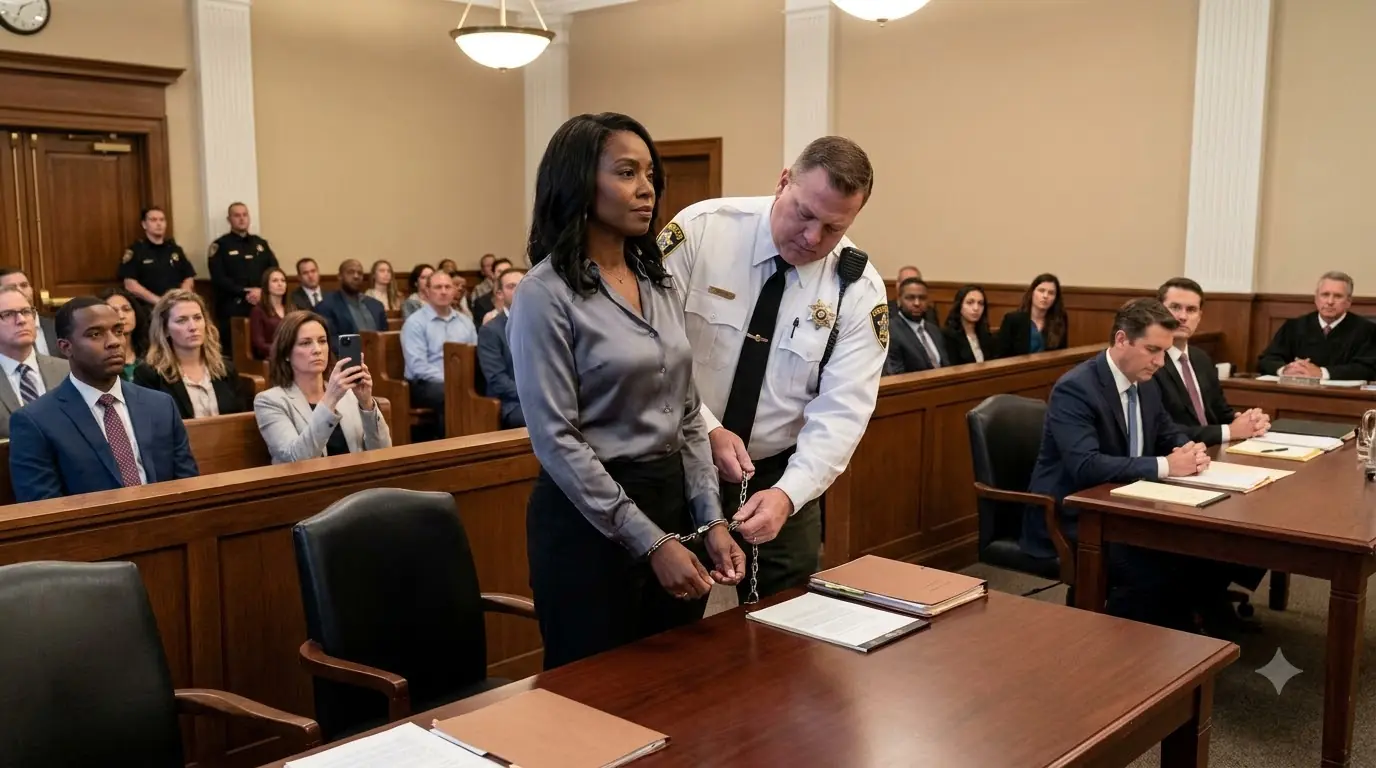
Nothing loud enough to stop the conversations moving through Courtroom 4B of the Franklin County Justice Center.
But Vanessa remembered that sound more clearly than anything else from that morning.
She looked down at her hands.
The polished metal sat against the cuffs of her soft-gray blouse.
Her fingers remained relaxed.
A navy-blue legal folder rested on the table in front of her.
Inside were one hundred and forty-seven pages of documents.
Dates.
Case numbers.
Transfer records.
Signature comparisons.
Courtroom assignment logs.
Missing hearing notices.
And, most importantly, a sequence of administrative changes that somebody in Franklin County had apparently believed nobody would ever place side by side.
Vanessa raised her eyes.
“Officer,” she said calmly, “what exactly am I being detained for?”
Brent Calloway stood behind her.
He was forty-seven years old, six-foot-three, broad across the shoulders, and built like a man who had spent two decades discovering that his physical presence usually ended arguments before they started.
Dark navy uniform.
Silver badge.
Body camera.
Heavy duty belt.
Short dark hair.
A face that seemed permanently arranged into impatience.
“You were told to wait,” he said.
“I was waiting.”
“You entered a restricted area.”
“No, I didn’t.”
Calloway’s jaw tightened.
Vanessa continued.
“I walked through the public witness entrance. A clerk directed me to this table.”
“You crossed behind the rail.”
“After the clerk opened it for me.”
“Keep arguing.”
“I’m answering.”
“That’s your problem.”
Vanessa studied him for a moment.
Behind the wooden rail, almost eighty people filled the gallery.
Attorneys.
Defendants.
Families.
Reporters.
Court employees.
A handful of local activists who had been following the Franklin County courthouse controversy for months.
Some were staring directly at her now.
Others pretended not to.
One woman in the third row had already raised a phone.
Calloway noticed.
“Phones down,” he barked.
The woman lowered it slightly.
Not completely.
Vanessa saw that too.
Good.
Across the courtroom, Assistant District Attorney Nolan Pierce stood beside the prosecution table, arranging papers that did not need arranging.
He was thirty-nine, thin, sharply dressed, and careful about his expressions.
Too careful.
Vanessa had met him once before.
Three months earlier.
A conference room.
No uniforms.
No spectators.
He had smiled then.
Today he would not look at her.
That interested her more than Calloway’s handcuffs.
Judge Martin Keller had not entered yet.
Court was scheduled for nine.
It was 8:47.
Vanessa had arrived early because early was useful.
People became careless before official proceedings began.
They whispered.
Moved files.
Changed seating.
Made phone calls they would not make once reporters were listening.
She had learned more about institutions from the fifteen minutes before meetings than from many meetings themselves.
Calloway stepped closer.
“Sit down.”
Vanessa looked at the chair.
Then at him.
“My wrists are cuffed in front of me. I’m standing exactly where your deputy placed me.”
“I said sit.”
Vanessa sat.
Not because his tone deserved obedience.
Because escalation would serve someone else.
Calloway leaned beside her.
“You people come in here with folders and titles thinking you can walk through my courtroom like you own it.”
Vanessa turned her head.
“Your courtroom?”
His eyes narrowed.
“You know what I mean.”
“I do.”
“Then stop making this harder.”
“I’m not.”
Calloway smiled without warmth.
“Everybody says that.”
Vanessa looked toward the judge’s bench.
“Has Judge Keller been informed that you handcuffed a scheduled witness?”
Calloway paused.
Only for a second.
Then:
“You’re not on today’s witness list.”
There it was.
Vanessa glanced toward Nolan Pierce.
He still would not look at her.
She returned her attention to Calloway.
“Who told you that?”
“The clerk.”
“Which clerk?”
“That doesn’t concern you.”
“It concerns me considerably.”
Calloway leaned closer.
“You’re in cuffs and still want to run the conversation.”
“No.”
Vanessa’s voice remained quiet.
“I want to know why a person summoned to testify was removed from the witness list less than an hour before the hearing.”
Calloway’s expression shifted.
Not surprise.
Recognition.
He knew something.
Vanessa had suspected it.
Now she was nearly certain.
The hearing scheduled for that morning was officially ordinary.
A procedural review in the matter of State of California v. Anthony Bell.
Anthony Bell was a thirty-six-year-old Black American contractor from Franklin City who had spent eleven months fighting a felony evidence-tampering charge.
The allegation sounded straightforward.
During a commercial dispute, Bell was accused of altering digital inspection records connected to a county construction project.
The prosecution claimed he had changed timestamps to conceal late work.
Bell insisted the records had been altered after leaving his company’s system.
Normally the case would have attracted little attention.
Then Bell’s attorney, Rachel Donovan, noticed something strange.
A county exhibit contained a metadata export.
The timestamps inside the export did not match the timestamps printed on the prosecution’s own evidence summary.
Rachel requested the original digital audit log.
The court ordered production.
Nothing arrived.
A second order followed.
Still nothing.
Then one county technician resigned.
Another said the files had been migrated.
A clerk claimed the backup server failed.
The district attorney’s office said it had relied on materials supplied by the county.
Weeks became months.
Rachel kept filing motions.
Eventually, a state appellate judge reviewing an unrelated emergency petition noticed the repeated discovery problems.
That judge forwarded the matter to the California Judicial Integrity Commission.
The commission quietly retained an outside expert to review Franklin County’s digital case-management environment.
That expert was Vanessa Reed.
She was not a prosecutor.
Not defense counsel.
Not a police officer.
Not an FBI agent.
She was a forensic systems auditor who had spent twenty-six years analyzing how institutional records changed, disappeared, duplicated, and contradicted themselves.
Her doctorate was in information governance.
She had worked for state commissions, inspector general offices, federal monitors, large court systems, and once a hospital network where fourteen million patient records had been partially corrupted by a badly configured migration.
People often expected forensic auditors to be computer technicians.
Vanessa was more dangerous than that.
She understood systems.
And systems told stories.
Franklin County’s story was troubling.
At first she found routine incompetence.
Duplicate entries.
Outdated templates.
Mislabeled scans.
Poor access controls.
Nothing unusual for a government system assembled over twenty years through multiple vendors.
Then she found deliberate behavior.
Specific cases were accessed late at night.
Certain documents were replaced after filing.
Original timestamps were overwritten by administrative users.
Hearing notices were generated and then removed.
Digital exhibits were exported, renamed, and re-uploaded.
Not constantly.
Selectively.
Vanessa mapped each event.
Then she mapped the people connected to those events.
A pattern emerged.
Most affected cases involved one of three circumstances.
Challenges to county contractors.
Complaints against law enforcement.
Or defendants represented by attorneys who aggressively requested underlying records.
Anthony Bell’s case fit the first category.
His company had refused to sign off on drainage work performed by Keller Municipal Development, a company owned by Judge Martin Keller’s younger brother, Robert Keller.
That fact alone proved nothing.
Vanessa knew families overlapped in small communities.
Then she found three county cases involving Keller Municipal Development in which judicial assignments had been modified after filing.
Two landed before Judge Martin Keller.
One landed before a judge who later recused.
Again, suspicious.
Not proof.
Then she found the access account.
BCALLOWAY_ADMIN
Officer Brent Calloway.
Court security officer.
Why did a court security officer have administrative access to digital case-management archives?
Vanessa initially assumed vendor mistake.
Maybe the account belonged to another employee with same initials.
It did not.
Brent Calloway had been granted elevated access eight years earlier when courthouse security systems were integrated with courtroom scheduling software.
The privilege should have been temporary.
Nobody removed it.
More importantly, someone had used it.
Forty-two times in three years.
Twenty-nine after normal business hours.
Eleven involving cases later appearing in complaints about missing or changed documents.
Including Anthony Bell.
Vanessa wrote one sentence in her preliminary report:
The access pattern cannot be explained by Calloway’s assigned court-security duties.
That sentence changed the direction of the review.
Two weeks later she received a phone call from a man she had never met.
“Dr. Reed?”
“Yes.”
“My name is Samuel Whitmore.”
Vanessa sat straighter.
Everyone who worked around California courts knew that name.
Samuel Whitmore, sixty-eight, Chief Justice of the California Supreme Court.
He was not calling through staff.
No scheduler.
No assistant.
Directly.
“I’ve read your preliminary memorandum,” he said.
Vanessa looked toward closed office door.
“That was fast.”
“I asked for it.”
“I assumed the commission would brief your office.”
“They did.”
Pause.
“Then I asked for original.”
Vanessa smiled faintly.
“I appreciate that.”
“You shouldn’t.”
“Why?”
“Because now I have questions.”
“That usually happens.”
Whitmore gave quiet laugh.
Then his tone changed.
“Do you stand by the access findings?”
“Yes.”
“Confident?”
“Very.”
“Could innocent explanation exist?”
“Of course.”
“Likelihood?”
“I don’t assign percentages without more evidence.”
“Good answer.”
“I’ve learned judges dislike invented certainty.”
“Some judges.”
That interested her.
Then:
“Dr. Reed, Franklin County has requested authority to close portions of Bell’s evidentiary hearing due alleged security concerns.”
“Security concerns involving what?”
“They have not been specific.”
Vanessa looked at her notes.