Snow drifted silently through the steel canyons of Manhattan, falling between towers of glass and stone as if the sky had finally grown tired and begun to break apart.
It covered the parked cars first.
Then the curb edges.
Then the subway stairs.
Then the shoulders of people walking too fast to notice anything but their own warmth, their own homes, their own destinations waiting beyond the white blur.
The cold was not just sharp that night.
It felt personal.
It had fingers.
It slipped beneath collars, crawled into sleeves, bit exposed skin, and whispered the same cruel sentence to anyone without shelter.
You do not belong here.
Down beneath the city, deep in the belly of the subway system, where snow could not reach but winter still haunted the concrete, a boy sat alone on a bench that had long ago stopped being just a bench.
To him, it was a hiding place.
A waiting place.
Sometimes, when the police moved everyone along, it became a place he lost and had to find again.
His name was Malik Johnson.
He was twelve years old.
And he had learned to sit very still.
Still boys were easier to ignore. Still boys did not draw attention. Still boys could sometimes stay in one place long enough to get warm from the leftover heat of passing trains and tired bodies.
He sat with his back against a tiled wall, knees pulled close, arms wrapped around a threadbare backpack that carried everything he had left in the world.
Inside was a torn comic book with pages so worn they felt soft as cloth.
A stub of pencil.
A half-empty bottle of water.
A wrinkled photograph of a woman with tired eyes and a smile so bright it looked like it had survived every hard thing thrown at it.
And a black wool sweater.
It was too big for him.
The neck was stretched.
One sleeve had begun to unravel.
A careful patch near the elbow had been sewn with gray thread that did not match.
It had belonged to his mother.
To anyone else, it would have looked like an old sweater, something to throw away, something no one would bother stealing.
To Malik, it was the last thing she had touched often enough to still feel alive.
Her name had been Denise Johnson.
She had worked two jobs, laughed softly, sang off-key while folding laundry, and told Malik that drawing was not a waste of time if it helped him see the world differently. She used to wear that sweater on cold mornings when she walked him to school, pulling the sleeves over her hands and pretending she was fancy because the sweater had once belonged to a woman she cleaned houses for near Park Avenue.
“Rich people throw away warmer things than we own,” she had said once, laughing.
Malik had laughed too, back when laughter came easily.
Then she got sick.
Then the bills grew.
Then the apartment disappeared.
Then she did.
After that, the sweater became his coat, his blanket, his memory, and sometimes, on the hardest nights, the only proof that anyone had ever loved him without asking him to prove he deserved it.
He had not eaten since the afternoon before.
A church volunteer had given him half a sandwich and an apple with a soft brown spot near the bottom. He had eaten slowly, trying to trick his stomach into believing the meal was larger than it was. It had not worked.
Now hunger sat inside him like a locked door with someone knocking from the other side.
He counted the coins in his pocket again.
Three quarters.
Two dimes.
Four pennies.
Still not enough.
He was not surprised anymore.
Surprise was for people who expected different endings.
A train screeched into the station, sending a gust of wind along the platform. Wrappers, old receipts, and cigarette butts skittered across the dirty floor. People stepped out of the train in coats, scarves, boots, headphones, and expressions that said the world began at their phone screens and ended at their apartment doors.
No one looked at Malik.
That was not unusual.
He had become very good at being unseen.
Sometimes invisibility protected him.
Sometimes it made him feel like he had already disappeared.
Above ground, winter roared louder.
Walter Kingsley walked through the snow with one gloved hand gripping a cane and the other tucked inside the pocket of an expensive wool coat that had seemed warm enough when he left his apartment.
It was not.
Nothing felt warm enough anymore.
Walter had once been a name people recognized.
Kingsley Development.
Kingsley Tower.
Kingsley Plaza.
He had owned buildings, argued with bankers, shaken hands with mayors, and stood in rooms where men measured each other by watch brands, square footage, and whose phone calls were answered fastest.
His name had been written in gold letters on office doors and charity programs.
Now he was seventy-three years old, widowed, half-forgotten by the city he had helped reshape, and too proud to admit that most nights he felt afraid of his own apartment.
The penthouse on Riverside Drive had everything money could buy.
Radiant heat.
Thick carpets.
A kitchen stocked by a housekeeper.
Floor-to-ceiling windows.
Art on the walls.
A piano no one played.
But the apartment was too quiet now.
His wife, Evelyn, had made noise beautiful. She hummed in hallways. She argued with flower arrangements. She tapped spoons against teacups while thinking. She called to him from other rooms even after forty-two years of marriage, as if she still liked knowing where he was.
She had loved Christmas.
By the first week of December, the apartment used to glow with garlands, candles, ornaments, and one ridiculous ceramic choir she refused to throw away even after Walter claimed the angels looked suspicious.
But Evelyn had been gone for three years.
Their daughter, Caroline, had not called in two.
That silence was partly Walter’s fault.
He knew that, though he hated admitting it.
He had been a hard father. Proud, demanding, quick to provide, slow to listen. When Caroline chose teaching over business, he called it wasted potential. When she married a social worker instead of someone from their circle, he called it impractical. When she asked him not to treat her life like a failed investment, he told her she was being dramatic.
Evelyn had tried to mend the distance.
After she died, no one did.
That night, the penthouse had become unbearable.
The silence pressed against him.
So Walter put on his coat, took his cane, and went outside because sometimes a man would rather face a storm than sit alone with the truth.
He had walked farther than he meant to.
Past the deli Evelyn used to love.
Past a florist closed for the night.
Past a corner where carolers had once sung badly enough to make Evelyn laugh so hard she cried.
Walter’s hip began to ache.
He knew he should turn back.
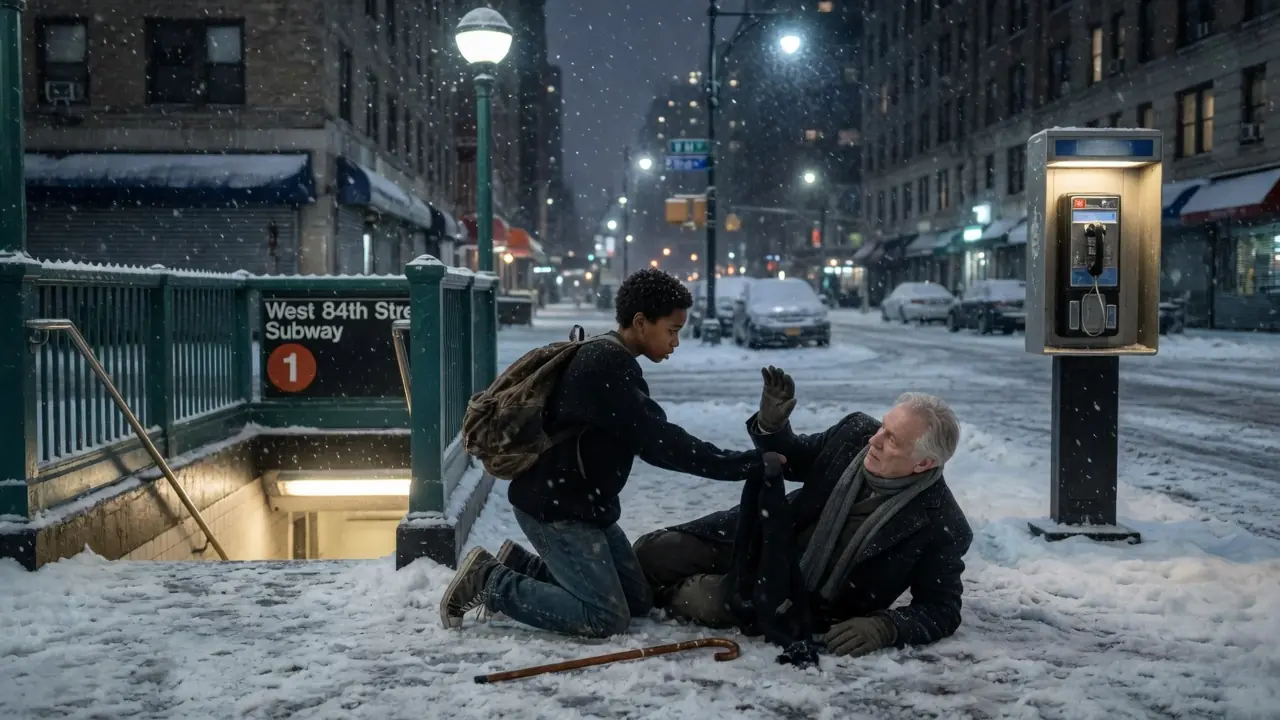
He was halfway across a slushy intersection near West 84th Street when his leg buckled.
The pain shot up from his hip like a bolt.
His cane slipped.
The world tilted.
Then everything went sideways.
Walter hit the ground hard.
His cheek pressed into snow that melted instantly against his skin before freezing at the edges. His hat fell somewhere beyond his reach. His cane rolled toward the curb.
For several seconds, he could not breathe.
Then he tried to move.
His body refused.
Cold began seeping through his coat.
Not slowly.
Quickly.
The snow kept falling, covering his shoulder, his sleeve, the side of his face.
He tried to call for help.
Only a thin sound came out.
A taxi passed at the far end of the block.
Its red taillights disappeared.
A window high above glowed warm, then went dark.
Walter lay in the snow, a man who had once owned half a skyline, and understood with terrible clarity that the city did not care.
Then Malik came up from the subway.
He had climbed the stairs hoping to find something near the late-night carts. Sometimes vendors threw away food after the crowds thinned. Sometimes people dropped bags. Sometimes there was nothing, but hunger was a stubborn reason to check.
The wind hit him as soon as he reached the street.
Malik pulled his mother’s sweater tighter around himself and ducked his head.
He almost walked past the shape in the snow.
At first, it looked like a pile of coats, maybe trash bags covered by white. Then the pile groaned.
Malik stopped.
Every rule he had learned shouted at him.
Do not get involved.
Do not touch strangers.
Do not stand too long in open places.
Do not be the kid near trouble when adults arrive.
Trouble always needed someone to blame.
And a homeless boy was easy to blame.
He took one step back.
The shape moved again.
A hand twitched in the snow.
Malik looked up and down the block.
No one.
Lights in windows.
Curtains closed.
Cars passing far away.
A city full of people, and not one of them standing where help was needed.
He stepped closer.
The man was old.
His face was pale, his eyelashes dusted white, his mouth trembling around words that did not form. His coat was expensive. His shoes were polished. His cane lay near the curb.
Malik knew this man belonged somewhere.
Not here.
Not in the snow.
He knelt beside him.
“Sir?”
Walter’s eyes fluttered open.
For a moment, he did not seem to see Malik.
Then his lips moved.
“Cold.”
Malik swallowed.
He looked down at his own sweater.
His mother’s sweater.
The only thing keeping him warm.
The only thing that still smelled faintly like her, though maybe that smell existed only in memory now.
Every instinct screamed no.
He had survived by protecting what little he had.
But his mother’s voice came from somewhere deep inside him, soft and tired and absolute.
If someone is hurting and you can help, Malik, you help. Don’t let the world make you mean just because it got mean first.
His hands shook as he pulled the sweater over his head.
The cold struck him immediately.
It slipped through his thin shirt and wrapped around his ribs.
He gasped but did not stop.
He spread the sweater across Walter’s chest and shoulders, tucking it around him the way his mother used to tuck blankets around Malik when he was younger.
Walter’s eyes focused.
A boy.
A thin boy.
No coat now.
Shivering.
“Don’t move,” Malik said, though he did not know if the man could.
His teeth began to chatter.
There was an old public phone on the corner, one Malik knew still worked if you hit the side twice and pressed the receiver hard against your ear.
He ran to it.
His fingers were stiff from cold by the time he dialed 911.
“What is your emergency?” the dispatcher asked.
“There’s an old man,” Malik said quickly. “He fell in the snow. West 84th and Riverside. He can’t get up. He’s real cold.”
“What is your name?”
Malik looked back at Walter.
The old man lay still beneath the black sweater.
“I don’t have one,” Malik said.
“Sir, I need your name.”
“He needs help. Please send someone.”
“Are you with him now?”
Malik heard sirens far away, or maybe imagined them.
“I have to go.”
“Stay on the line.”
He hung up.
Then he ran back just long enough to make sure the sweater still covered Walter.
The old man’s eyes moved toward him.
“Boy,” he whispered.
Malik stepped back.
He should have stayed.
Maybe.
But he knew what happened when police arrived and found a homeless kid beside a rich man on the ground. Questions. Suspicion. Hands on his backpack. Maybe a shelter. Maybe worse. He had learned that doing the right thing did not always protect you from being treated like the wrong person.
“I called,” he said.
Then he disappeared into the dark.
Sirens reached the block two minutes later.
Malik watched from the mouth of the subway stairs, arms wrapped around his own body, shaking so hard his bones seemed to knock together. He saw the ambulance lights wash the snow red and blue. He saw paramedics kneel beside Walter. He saw one lift the black sweater and say something to another.
Then Malik went back underground.
Without the sweater, the station felt colder than it had ever felt before.
He curled on the bench and pressed his face into his backpack.
For the first time in months, he cried.
Not loudly.
Not for himself exactly.
For his mother.
For the sweater.
For the old man.
For the unfairness of a world where giving away the last warm thing you had could leave you colder but still feel like the only thing you could have done.
To Malik, that was the end of it.
He had seen a man in the snow.
He had helped.
Now the man would go back to his warm life, and Malik would go back to being invisible.
He was wrong.
The first sound Walter Kingsley heard was the steady beep of a heart monitor.
At first, he thought he was still in the snow.
Then he opened his eyes and saw fluorescent light, white curtains, a hospital bed rail, and a nurse adjusting something near his arm.
“You’re awake,” she said. “That’s good.”
Walter tried to speak.
His throat felt scraped raw.
“Who brought me in?”
“Ambulance.”
“No.” He swallowed. “Who called?”
The nurse checked the chart.
“Anonymous 911 call. You were found unconscious near West 84th and Riverside. Hypothermic episode, fall-related trauma, but you were lucky.”
Lucky.
Walter looked toward the foot of the bed.
“My sweater.”
The nurse frowned.
“Your belongings are in the closet.”
“No. Not mine.” He struggled to sit higher. “A black wool sweater. Old. Torn sleeve. A boy put it on me.”
The nurse’s expression softened in the way people soften when they think age has blurred the edges of truth.
“You were very cold, Mr. Kingsley. Sometimes memory comes in pieces.”
Walter’s eyes sharpened.
“I know what I remember.”
Later, a doctor came.
Walter told him too.
A boy.
Around twelve.
Thin.
No coat after he gave Walter the sweater.
The doctor listened politely.
“Well, whoever made the call did the right thing. You are fortunate.”
Walter hated that word.
Fortunate made it sound passive.
A boy had chosen.
A boy had given the only warm thing he owned.
A boy had saved his life.
Three days later, when Walter was discharged, he refused to leave without the sweater.
A hospital administrator had to track it through the ambulance inventory. It had been bagged with Walter’s other items because a paramedic thought it belonged to him.
When they finally returned it, Walter held it in both hands.
Black wool.
Faded.
Frayed.
One sleeve torn.
A patch near the elbow sewn with care.
It smelled faintly of snow, street air, and something like lavender soap from a long time ago.
Walter took it home.
Back in the penthouse, he placed the sweater on his nightstand.
The apartment looked exactly as he had left it, but now it felt different. Not warmer. More accused.
He had spent years inside rooms heated by machines, served by staff, surrounded by soft things, and still convinced himself loneliness was the worst kind of cold.
Then a boy without a coat had covered him in the snow and disappeared.
Walter sat in Evelyn’s old chair by the window, the sweater in his lap.
“What would you do?” he whispered.
The room did not answer.
But he knew.
Evelyn would have found the boy.
So Walter began.
He asked his doorman.
Then the night security guard.
Then the man at the corner deli.
Then subway workers.
Then church volunteers.
Then shelters.
He described the boy again and again.
Twelve years old.
Thin.
Black sweater, if he still had it, though Walter knew he did not.
Quiet eyes.
Carrying a worn backpack.
Most people shook their heads.
Some shrugged.
A few looked suspicious.
One shelter worker said there were hundreds of boys like that in the city.
Walter replied, “No. There is one boy like that.”
On the fifth day, a volunteer at a Midtown church paused when Walter described him.
“Malik,” she said.
Walter went still.
“You know him?”
“I don’t know him well. He comes by sometimes. Always polite. Always hungry. Likes to sit near the stained-glass window and draw.”
“Draw?”
“Yes. On napkins, mostly. Any paper he can find.”
Walter returned the next afternoon.
He arrived just as a commotion was unfolding in the church hall.
An older woman stood near a table of donated bread, holding one small loaf in her hand and pointing toward a corner.
“He was standing right there. I turned around and it was gone.”
A man in a clerical collar tried to calm her.
“Mrs. Palmer, please. Let’s not accuse anyone without knowing.”
Against the wall stood Malik.
His backpack was clutched to his chest.
His face was still.
Not guilty.
Not innocent.
Just resigned.
As if he had already heard the verdict and was waiting for everyone else to catch up.
Walter recognized him instantly.
The eyes.
The thin shoulders.
The silence.
He stepped forward.
“I know this boy.”
Everyone turned.
Walter’s voice carried through the hall.
“He saved my life.”
The room went quiet.
Malik looked at him sharply.
Not with relief.
With caution.
Walter walked toward him slowly. His hip still hurt, and the cane tapped against the church floor.
“It was you,” Walter said softly. “The sweater. The phone call.”
Malik’s jaw tightened.
“I don’t know you.”
“No,” Walter said. “But you helped me anyway.”
He lowered himself carefully until he was closer to the boy’s height. The motion hurt, but he did it because standing over Malik felt wrong.
Walter pulled the black sweater from a paper bag and unfolded it.
“I believe this belongs to you.”
Something moved across Malik’s face.
Pain first.
Then disbelief.
Then something like longing before he forced it away.
He reached out but stopped before touching it.
Walter understood.
The sweater was not clothing.
It was a person.
“It was my mother’s,” Malik said.
His voice was so quiet Walter almost missed it.
“I know,” Walter said, though he had only guessed.
The woman with the bread looked uncomfortable.
Walter stood and faced the room.
“This boy did not steal your bread.”
Mrs. Palmer frowned.
“How would you know that?”
“Because a boy who gives away the last warm thing he has to save a stranger deserves the benefit of a question before an accusation.”
No one answered.
Walter turned back to Malik.
“I would like to speak with you.”
“Why?”
“Because I owe you more than I know how to repay.”
“I don’t want money.”
“I did not offer money.”
Malik’s eyes narrowed.
Adults with money often thought everything became clean if they paid for it.
Walter saw that thought on his face.
“I want to make sure you have somewhere warm tonight,” he said. “And food. And someone to listen. Not a shelter if you do not want that. Not police. Not anyone taking your backpack.”
Malik looked toward the door.
His whole body remained ready to run.
Walter added, “You can leave anytime.”
That was the sentence that made Malik hesitate.
Not because he believed it.
Because he wanted to.
That night, Malik stepped into a world he had never known.
The elevator to Walter’s penthouse was silent and soft. It rose so smoothly Malik barely felt movement. The hallway smelled of polished wood and flowers. The apartment doors opened into warm light, high ceilings, art on the walls, and windows that looked out over a city Malik had only ever seen from below.
He did not speak.
He stood just inside the entrance with his backpack pressed against his chest.
Walter led him to a spare room.
“It is yours for now,” he said. “Only for as long as you want to stay.”
Malik looked at the bed.
The clean sheets.
The folded towels.
The lamp.
The small desk.
His eyes moved to the window, where the city stretched glittering and distant beneath the winter sky.
“It’s too much,” Malik said.
Walter leaned on his cane.
“It is a room.”
“No.” Malik swallowed. “It’s too much.”
Walter did not argue.
He had learned enough in the church hall to know that arguments could feel like traps.
“There is food in the kitchen,” he said. “Bathroom is through that door. No one will touch your backpack. No one will come in without knocking.”
Malik nodded once.
He did not sit.
The first night, he did not sleep.
The bed was too soft.
The sheets smelled too clean.
The silence was too complete.
In the subway, silence was never total. There was always a train, a drip, a shout, footsteps, music, brakes, wind. In Walter’s apartment, the silence felt expensive and suspicious. It made Malik feel like the room was listening for proof he did not belong.
Before dawn, he slipped into the kitchen.
The motion-sensor lights flicked on, and he jumped back.
He stood frozen, staring at a bowl of fruit on the counter. Apples, oranges, bananas, grapes. More fruit than he had seen in one place outside a store.
Walter found him there ten minutes later.
He did not ask why Malik was awake.
He simply started making coffee.
The smell filled the kitchen.
Warm.
Bitter.
Alive.
“Hungry?” Walter asked.
Malik nodded but did not move.
Walter placed a croissant, eggs, and orange slices on a plate, then set it on the counter.
“You do not have to ask before eating here,” he said.
Malik took the plate slowly.
“Thank you.”
He carried it back to his room.
Over the next few days, Walter tried to build a rhythm.
He bought clothes, but Malik wore only what he accepted from the package himself. Walter arranged a doctor’s visit, but only after Malik agreed. He called a lawyer who specialized in child welfare and guardianship, but he explained every step out loud because Malik had lived too long in a world where adults made decisions about him without telling him why.
Still, Malik did not settle.
He moved through the penthouse like someone waiting to be told he had misunderstood the invitation.
He flinched when the housekeeper entered too quickly.
He froze when the doorman used his name.
He hid food in his backpack until Walter gently told him that was allowed if it made him feel safer, and then kept the pantry stocked with things Malik could take without asking.
Walter noticed something else too.
The way other people looked at him.
The concierge asked one day, quietly, “Is everything all right with the boy?”
The security log noted, “Unauthorized minor near lobby at 10:43 p.m.”
A neighbor in diamonds whispered in the elevator, “He seems rough around the edges.”
Walter corrected them at first.
Firmly.
Then, slowly, discomfort began to find cracks in him.
It embarrassed him later to admit that.
He wanted to think kindness had transformed him immediately into someone better. But old habits do not die because one night in the snow frightened a man into gratitude. Walter had spent his life trusting polished surfaces, credentials, manners, and people who knew which fork to use.
Malik did not fit any of that.
And the world around Walter kept reminding him.
When Walter secured a late admission for Malik at a private academy, he thought he was opening a door.
He did not realize doors could open into rooms where a boy felt even more alone.
The academy was modern and glossy, with a mission statement about inclusion printed in gold. The front office smelled like waxed floors and confidence. Students wore expensive jackets and carried laptops thinner than Malik’s sketchbook.
From the first day, Malik felt the stares.
Not all cruel.
Some curious.
Some pitying.
Some pretending not to stare at all.
He wore thrift-store jeans because the new ones Walter bought felt too stiff. His backpack was still frayed at the corners because he refused to replace it. His shoes were clean now, but old enough to tell the truth.
In class, he rarely raised his hand.
Not because he did not know answers.
Because attention felt dangerous.
On the third Friday, a boy in science class asked if Malik had ever slept in a real bed before.
Another asked whether Walter was “adopting a charity case.”
A girl at lunch asked if his mother had been “in trouble.”
Malik said nothing.
That was his first language.
Silence.
Then one afternoon, during recess, he saw a smaller boy named Theo being shoved near the fence by two older students. Theo was pale, red-cheeked, and crying silently as his books scattered across the wet pavement.
Malik moved before he thought.
He stepped between them.
“Leave him alone.”
The older boys laughed.
One shoved Malik in the shoulder.
Malik shoved him back.
Not hard.
Hard enough to make space.
A teacher came out seconds later and saw only the last part: Malik standing tense, one boy stumbling back, Theo on the ground behind him.
By the end of the school day, Malik sat in the headmaster’s office.
Walter was called.
The headmaster, polished and grave, showed him security footage from a hallway camera.
There was no audio.
No beginning.
No Theo crying.
No books on the ground before Malik stepped in.
Only Malik pushing another student.
The clip lasted twenty-seven seconds.
“We understand Malik has faced challenges,” the headmaster said carefully. “But aggression cannot be excused by background.”
Walter stared at the screen.
His chest tightened.
He wanted to defend Malik.
But doubt entered quietly.
The church accusation.
The building security comments.
The whispers.
The silence.
Always the silence.
Malik never explained himself.
Never gave adults the words they needed to believe him.
Walter left the school with the suspension letter in his coat pocket and fear growing where trust should have stood.
At home, he found Malik sitting on the wide window ledge, knees drawn up, looking out over the city.
Walter removed his coat.
“I saw the video.”
Malik did not turn.
Walter waited.
Nothing.
“I need you to tell me what happened.”
Still nothing.
“Malik, this is serious. You are suspended. This could affect everything I am trying to do for you.”
Malik looked down at his hands.
“You already think you know.”
Walter felt irritation rise.
“I am trying to help you, but you are not making it easy.”
Malik’s jaw tightened.
“I didn’t do anything wrong.”
“But you won’t explain.”
“You won’t listen.”
Walter’s voice sharpened.
“That is unfair.”
Malik turned then.
His eyes were tired.
Not angry.
That was worse.
“People only ask what happened after they decide what kind of kid I am.”
Walter shook his head.
“Do not start with that. Not every person is against you. Sometimes, Malik, sometimes it is not the world. Sometimes the problem is you.”
The words left his mouth before wisdom could stop them.
The room changed.
Malik went very still.
Walter knew immediately he had struck something deeper than the conversation.
But pride, fear, and frustration kept moving.
“I thought I could help you,” Walter said. “I thought I could change things for you. But maybe I was naive.”
Malik stood slowly.
He did not shout.
He did not cry.
He only walked to the chair where the black sweater rested, picked it up, and carried it to his room.
The door closed quietly.
Walter remained in the living room, breathing hard, unsure whether he was angry at Malik, the school, himself, or the ugly little voice inside him that had been waiting for an excuse to doubt the boy.
Morning came pale and cold.
Walter stood at Malik’s door and knocked.
No answer.
He opened it.
The room was empty.
The bed had been made carefully, not perfectly, but with effort.
The backpack was gone.
The sweater was gone.
On the pillow lay three things.
The wrinkled photograph of Malik’s mother.
The torn comic book.
And a folded piece of lined paper.
Walter picked it up with trembling fingers.
If you want, I can give the sweater back.
But thank you for letting me know what it feels like to have a bed.
Walter sat down on the edge of the mattress.
His knees did not so much bend as give way.
The note blurred in his hands.
Shame filled him, cold and bitter.
He had given Malik a room but not trust.
Food but not faith.
A school but not protection from being misunderstood.
He had treated Malik’s silence as defiance instead of injury.
In that empty room, Walter finally understood.
Malik had not stayed quiet because he had nothing to say.
He had stayed quiet because the world had taught him that his words did not matter.
At shelters.
In churches.
On sidewalks.
In classrooms.
And now, in Walter’s own living room.
Walter folded the note and slipped it into the inside pocket of his coat, directly over his heart.
Then he left.
He went first to the church.
No Malik.
Then the subway station where he had been seen before.
No Malik.
Then two shelters.
Three platforms.
A soup kitchen.
A library.
The city swallowed hours.
Walter’s hip ached. His cane slipped twice. His breath grew short. He did not stop.
By late afternoon, he returned to the 96th Street platform.
The rush had ended.
The station was quieter now.
At the far end, near a vending machine, a familiar shape sat curled against the wall.
Black sweater.
Backpack.
Knees drawn to chest.
Head tucked down.
Walter approached slowly and sat beside him on the cold concrete.
He did not speak at first.
A train arrived.
People got off.
People got on.
The doors closed.
The train left.
Only then did Walter say, “I looked everywhere for you.”
Malik did not lift his head.
“Didn’t think you would.”
“I had to.”
“No, you didn’t.”
Walter looked down.
“You’re right. I chose to.”
That made Malik turn slightly.
Walter kept his voice low.
“I treated you like a project. Like you were a broken thing I could repair with food, school, and a clean room.”
Malik stared at the tracks.
“I didn’t need fixing.”
“I know.”
“You didn’t yesterday.”
“No,” Walter said. “Yesterday I forgot.”
Silence settled between them.
Then Malik spoke.
“I didn’t run because of the suspension.”
Walter waited.
“I ran because I believed you. When you said maybe it was me. I thought, there it is. He finally sees it too.”
Walter closed his eyes.
“I was wrong.”
“You saw that video and remembered the bread at the church.”
“Yes.”
“You started looking at me like everyone else.”
Walter’s throat tightened.
“I looked at you like a coward afraid of being disappointed. And because I was afraid, I disappointed you first.”
Malik’s hands tightened in the sweater sleeves.
“You know why I don’t talk much?”
Walter shook his head.
“Because talking doesn’t help when people already wrote the story. You can say every word right, and they still hear what they decided before you opened your mouth.”
His voice broke slightly.
“And after a while, you stop wanting to hear yourself beg to be believed.”
Walter had spent decades in rooms where his words became decisions.
He had never imagined what it meant to speak and have the world refuse to receive the sound.
“I am sorry,” he said.
Malik did not answer.
Walter continued.
“I am not asking you to come back because I want to feel better. I am asking because I want to do better. But only if you want that too. You can say no.”
Malik looked at him then.
Really looked.
“Even if I mess up?”
“Yes.”
“Even if people at school think I’m trouble?”
“Yes.”
“Even if I don’t talk when you want me to?”
Walter nodded.
“Then I will learn to wait.”
Malik’s eyes filled, but no tears fell.
“I don’t want to be someone’s second chance.”
Walter understood the wound beneath the sentence.
Walter had lost Evelyn.
Lost Caroline.
Nearly lost himself.
Malik did not want to be a replacement for any of that.
“You are not my second chance,” Walter said. “You are Malik. That is enough.”
For a long moment, the boy did not move.
Then he reached out.
Walter took his hand.
They climbed the subway stairs together.
The wind above ground cut through the streets, but this time Malik did not walk alone.
The next week, Walter returned to the academy.
Not alone.
He brought Malik, Dana Brooks, the child welfare attorney, and a quiet determination that made the headmaster sit straighter before anyone spoke.
Walter requested the full incident review.
Not the edited clip.
All footage.
All witnesses.
Theo, the smaller boy Malik had protected, finally came forward when his mother was contacted directly. He told the truth. The older students had been harassing him for weeks. Malik had stepped in. The school had seen only the final movement and accepted the easiest version.
Walter sat beside Malik as Theo spoke.
He did not interrupt.
He did not speak for Malik.
He simply stayed.
When the headmaster apologized, Malik looked at the table.
Walter waited.
Then Malik said, “You believed the video because it was easier.”
The headmaster looked uncomfortable.
“Yes,” he admitted. “We did.”
It was not enough.
But it was truth.
The suspension was removed.
The older boys faced consequences.
Theo began sitting with Malik at lunch.
And Walter learned that advocacy was not the same as rescue.
Rescue was dramatic.
Advocacy was paperwork.
Meetings.
Repeating the truth until institutions became tired of dismissing it.
Walter had once built towers.
Now he learned how to sit in school offices and demand that a homeless boy be treated like a child, not a risk assessment.
Spring came slowly to New York.
Snow retreated from sidewalks in gray piles.
Trees in Central Park remained bare for weeks before small green buds appeared like shy promises.
Walter and Malik sat often on a bench near the duck pond.
The black sweater had been repaired.
Not professionally.
Walter had tried to mend it himself.
The stitches were uneven. One patch was crooked. The thread did not match. Malik noticed immediately and said nothing for almost a minute.
Then he said, “You’re bad at sewing.”
Walter replied, “I am learning.”
Malik wore the sweater anyway.
One afternoon, Malik held a letter in both hands.
He had applied to a youth art program at a respected school with a scholarship fund. Walter had offered to call donors, board members, anyone who might help. Malik said no.
“If I get in,” he said, “I want it to be because they saw my work.”
So they submitted his portfolio anonymously.
Now the letter was open.
Malik read the words for the fourth time.
Full scholarship.
Fall semester.
Portfolio ranked in the top three out of seventy-nine applicants.
Walter sat beside him, trying not to look as proud as he felt because Malik hated being watched too closely during feelings.
“What did you submit?” Walter asked.
Malik opened his sketchbook.
The drawing covered two pages.
A snowy city street.
A man collapsed in white darkness.
A child kneeling beside him, wrapping a black sweater across his chest.
The old man’s face was barely visible.
The child’s expression was drawn with impossible care.
Not fear.
Not panic.
Something purer.
Determination.
Compassion.
“I called it The Snow Man,” Malik said. “Not like the Christmas kind. Just a man in the snow.”
Walter’s throat tightened.
“That night,” Malik continued, “I didn’t think I was doing anything special. I just couldn’t walk away.”
Walter looked at the drawing.
“I do not think heroes know they are being heroic while it is happening.”
Malik glanced sideways.
“I’m not a hero.”
“No,” Walter said. “You are better than that. You are a boy who did the right thing while cold.”
Malik looked down, but this time he smiled.
Small.
Real.
That summer, Walter made another call he had avoided for too long.
His daughter, Caroline, answered on the fifth ring.
“Dad?”
Her voice was older than he remembered.
Or perhaps he was finally hearing it properly.
Walter stood by the window, Malik’s note still folded in his coat pocket though it was warm outside now.
“Caroline,” he said. “I need to apologize.”
There was a long silence.
“For what?” she asked carefully.
He closed his eyes.
“For treating your choices like disappointments because they were not mine. For making your life something I measured instead of something I respected. For letting your mother do the listening I should have done too.”
No response.
Walter continued, voice shaking.
“I am not asking you to forgive me today. I only wanted to stop pretending silence was dignity.”
On the other end, Caroline began to cry.
It took months.
Phone calls first.
Then coffee.
Then dinner.
Then one Sunday afternoon, Caroline met Malik.
She brought her husband, Aaron, and their ten-year-old daughter, Sophie, whom Walter had not seen since she was small enough to lift.
Sophie liked Malik immediately because he drew her a dragon wearing sneakers.
Caroline watched Walter and Malik together with complicated eyes.
Later, when Malik and Sophie were arguing gently over whether dragons needed subway cards, Caroline stood beside Walter in the kitchen.
“He changed you,” she said.
Walter looked toward the living room.
“He gave me the chance. I had to do some of the work.”
Caroline nodded.
“That sounds new.”
“It is.”
She smiled through tears.
“Good.”
Years passed.
Not perfectly.
Life did not become simple because kindness had entered it.
Malik had hard days.
Walter had old fears.
There were arguments, silences, school struggles, legal processes, therapy appointments, and memories that returned without warning. Malik never called Walter “Dad,” and Walter never asked him to. Their bond did not need to borrow names from other relationships to become real.
Sometimes Malik called him “old man.”
Walter pretended to be offended.
Sometimes Walter called Malik “young man.”
Malik pretended to hate it.
The black sweater remained.
The stitches multiplied.
Some Walter made.
Some Malik made.
One patch Caroline added when the shoulder tore again.
Another Sophie decorated with a tiny embroidered star.
The sweater became less like a garment and more like a map of everyone who had chosen to help keep the warmth inside it.
By the time Malik turned eighteen, his artwork had been displayed in three youth exhibitions, then a city gallery. His pieces were quiet but powerful: subway benches, forgotten gloves, warm windows seen from outside, strangers passing one another, a child’s hand holding an old sweater sleeve.
Critics called his work “urban tenderness.”
Malik laughed when he read that.
“What does that even mean?”
Walter adjusted his glasses.
“It means they needed two expensive words for kindness.”
Malik sold his first major piece at nineteen.
It was titled Bench Number Four.
It showed an empty subway bench beneath flickering light, but if a person looked closely, they could see a small folded sweater tucked in the corner.
The buyer offered more money than Malik had ever imagined holding.
He accepted half.
Then he used the rest to start a small winter fund for homeless youth.
Not a grand foundation at first.
Just coats.
Gloves.
Sketchbooks.
Transit cards.
Food vouchers.
A warm line of help moving quietly through the city.
Walter helped with the structure.
Caroline helped with outreach.
Sophie designed the first flyer.
Malik named it The Sweater Project.
When Walter saw the name, he had to sit down.
“You sure?” he asked.
Malik shrugged.
“It started with one.”
The project grew.
Artists donated prints.
Schools held coat drives.
Subway workers quietly connected outreach volunteers to kids sleeping on platforms.
Churches opened warmer spaces.
Small galleries hosted fundraisers.
Walter contributed money, yes, but Malik insisted money was not the heart of it.
“The heart is people not looking away,” Malik said at the first public event.
He was twenty-one then, standing behind a microphone in a community hall filled with winter coats stacked along the walls.
Walter sat in the front row, older now, thinner, cane across his lap, eyes fixed on the boy who had once vanished into snow.
Malik looked nervous, but he did not run.
“My name is Malik Johnson,” he began. “When I was twelve, I thought being invisible was the safest thing I could be.”
The room quieted.
“Then one night, I saw an old man in the snow. I gave him my mother’s sweater and called 911. I thought that was the end of the story.”
He looked at Walter.
“It wasn’t.”
Walter’s eyes filled.
Malik continued.
“People like to tell stories about rescue like one person saves another and everything becomes okay. That’s not how it happened. Walter helped me. Then he hurt me. Then he came back. Then he listened. Then I learned to stay. Then he learned to trust. Then we both learned that warmth isn’t just something you give once.”
He touched the patched sleeve of the black sweater, which he still wore that night.
“It is something you keep choosing.”
The applause came slowly at first.
Then stronger.
Walter did not clap immediately.
He was crying too hard.
After the event, Malik found him near the coat tables.
“You okay, old man?”
Walter wiped his face.
“I am proud of you.”
“I know.”
“You do?”
“You get a look.”
“What look?”
“Like you swallowed a sunrise.”
Walter laughed.
It was not a sound he had made often before Malik.
Now it came more easily.
Walter lived long enough to see The Sweater Project open its first permanent winter center.
It was not large.
A renovated building near a subway line, with a warm entry room, lockers, showers, food, counseling referrals, tutoring, art tables, and staff trained to ask questions without making children feel like suspects.
On opening day, Malik hung a framed drawing near the entrance.
The Snow Man.
Below it was a small plaque:
For every child who was cold and helped anyway.
For every adult who learned to listen too late, but not too late to change.
Walter read it twice.
Then he sat on a bench by the front window while Malik moved through the room, directing volunteers, greeting teenagers, adjusting boxes of gloves.
Caroline sat beside him.
“He built something beautiful,” she said.
Walter nodded.
“Yes.”
“You helped.”
Walter looked at her.
“So did you.”
She smiled.
“So did Mom, somehow.”
Walter’s eyes moved to the window.
Outside, snow had begun to fall again.
Not as fiercely as that first night.
Softly now.
Almost gently.
A teenage boy entered the center wearing a hoodie too thin for winter. He stood near the door, uncertain, ready to flee.
Malik saw him.
He walked over slowly, hands visible, voice calm.
“You can sit anywhere,” Malik said.
The boy looked down.
“I don’t have money.”
Malik smiled.
“I didn’t ask.”
Walter closed his eyes.
The circle had not closed.
It had widened.
That winter, Walter’s health began to fail more noticeably.
He did not fear death as much as he once had.
He feared leaving words unsaid.
So he said them.
To Caroline.
To Sophie.
To Malik.
One evening, as snow tapped softly against the penthouse windows, Malik sat beside Walter’s chair with a sketchbook on his knee.
Walter looked at the black sweater folded over the arm of the sofa.
“You kept it all these years,” he said.
Malik did not look up from drawing.
“Of course.”
“It was never mine.”
“No.”
“But it saved me.”
Malik’s pencil paused.
“Me too.”
Walter turned his head.
“How?”
Malik looked at the sweater.
“When I gave it away, I thought I had lost the last piece of my mother. But it came back with you. Then it kept collecting people. You. Caroline. Sophie. The kids at the center.”
He smiled faintly.
“Turns out memory doesn’t get smaller when you share it.”
Walter let that settle in him.
“Your mother would be proud.”
Malik swallowed.
“I hope so.”
“I know so.”
Malik looked at him.
This time, he believed it.
Years later, long after Walter was gone, Malik would still sit sometimes on the bench near the duck pond in Central Park.
The city kept changing.
Glass towers rose.
Old stores vanished.
New children ran along the paths with crumbs for birds.
Snow came and went.
The black sweater, too delicate to wear daily now, stayed framed in Malik’s studio office at The Sweater Project’s winter center. Not behind glass like a museum object, exactly, but protected enough to last.
Its sleeves were uneven.
Its patches did not match.
Its stitches told the story of unskilled hands learning care.
Below it hung Walter’s favorite line, handwritten by Malik:
Warmth is not proven by how much you own.
It is proven by what you are willing to share.
When people asked Malik whether Walter Kingsley had saved him, he always paused.
Then he said, “He came back.”
That, to Malik, mattered more.
Many people did one kind thing when emotion struck.
Fewer came back after making mistakes.
Fewer listened.
Fewer stayed.
And when people asked whether Malik saved Walter, he gave nearly the same answer.
“I stopped.”
Because that mattered too.
On a freezing night in New York, a homeless boy wearing the only warm thing he had saw an old man collapsed in the snow. He could have walked past. Most people did.
Instead, he stopped.
He took off his late mother’s torn black sweater and covered the stranger with it.
He called for help.
Then he disappeared, believing the world would forget him again by morning.
But the old man remembered.
He came back.
Not perfectly.
Not wisely at first.
But he came back, and then he learned to stay.
Together, they discovered that saving someone is not one grand act in the snow. Sometimes it is a thousand smaller acts afterward. A plate of food. A room with a door. An apology in a subway station. A school meeting where someone finally listens. A patched sleeve. A scholarship letter. A winter center with lights on.
A boy gave away his last warmth.
An old man returned it differently.
And between them, in a city famous for looking away, they built a place where no child had to earn the right to be warm.