Bruce Maddox had survived men twice his size, highways covered in black ice, motorcycle crashes that should have put him underground, and enough bad decisions to fill several lifetimes.
But nothing frightened him like watching his six-year-old daughter reach for his face because she had never seen it.
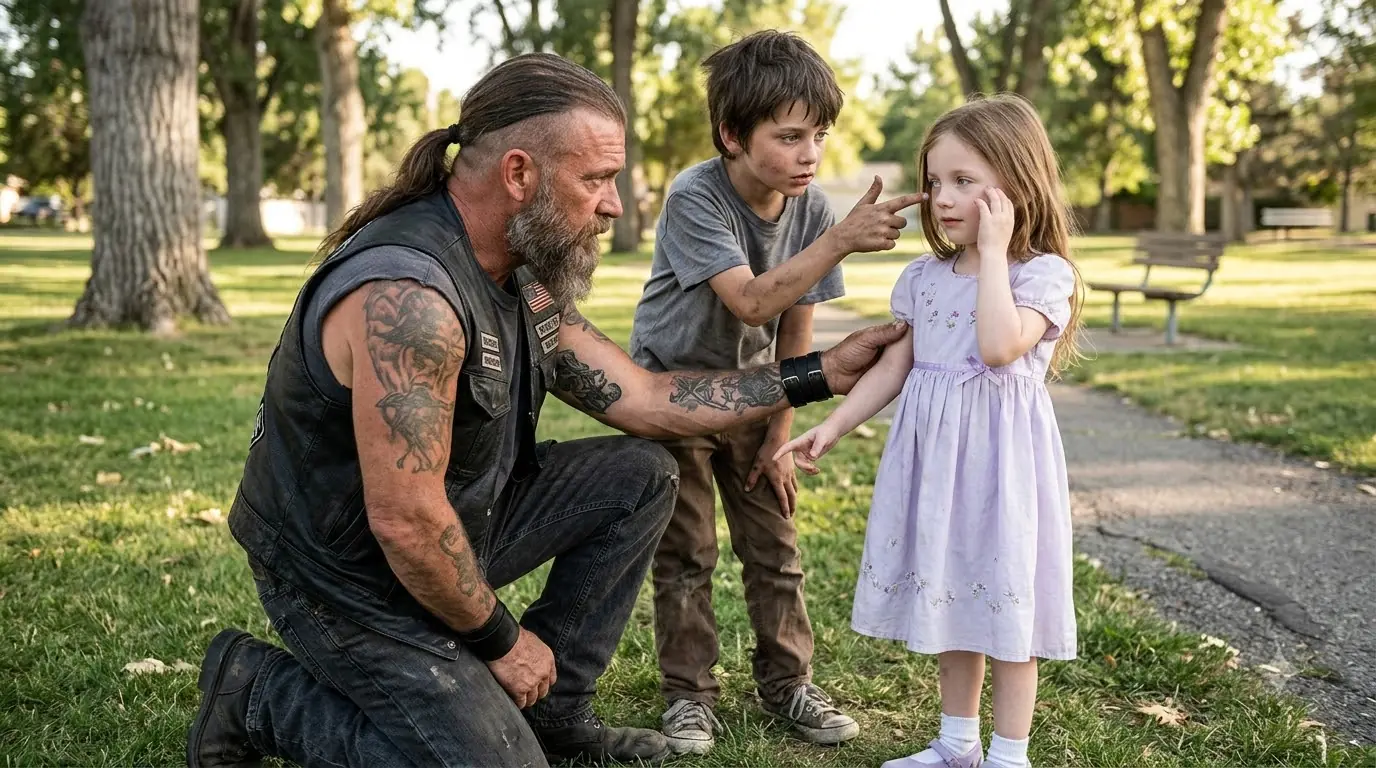
“Daddy?”
Bruce immediately turned toward the sound.
Emma stood in the middle of their small Reno living room wearing a pale-lavender dress, one hand extended until her fingertips found the edge of the couch.
“I’m right here, sweetheart.”
She smiled.
Bruce crossed the room and placed her tiny hand against his cheek.
Emma traced his beard.
“You need to shave.”
Bruce laughed.
“You can’t even see it.”
“I can feel it.”
“Fair point.”
Emma smiled wider.
Bruce’s smile remained until she lifted her other hand toward her right eye.
Again.
She rubbed gently near the corner.
Her expression tightened for half a second.
Bruce noticed.
He always noticed.
“Hurting?”
“A little.”
“Pressure?”
Emma nodded.
Bruce’s jaw tightened.
That pressure had become another unanswered question in a life filled with them.
Emma had been blind since infancy.
Not partially blind.
Not merely visually impaired.
For all practical purposes, she had lived in darkness.
Bruce first noticed something was wrong before her first birthday.
She did not follow colorful toys with her eyes.
She did not respond when someone waved from across the room.
Bright windows meant nothing to her.
At first the pediatrician told him to wait.
Babies developed differently.
Bruce waited.
Then he stopped waiting.
The appointments began.
Pediatric ophthalmologists.
Neurologists.
Retinal specialists.
Imaging.
Tests.
Second opinions.
Third opinions.
Trips to California.
A consultation in Seattle.
Every doctor seemed to discover another reason to order another test.
Nothing produced a clear explanation.
Some believed the problem was neurological.
Others suspected a developmental abnormality.
Yet imaging showed structures that seemed remarkably intact for a child with such profound loss of sight.
That contradiction followed Bruce everywhere.
The tests said one thing.
Emma’s world said another.
Over six years, Bruce spent more money than he cared to calculate.
He would have sold the motorcycle.
The house.
Every possession he had.
He would have walked barefoot across Nevada if someone could promise him there was an answer waiting at the end.
Nobody could.
The worst part was Emma’s right eye.
She touched it constantly.
Sometimes she described pressure.
Sometimes irritation.
Sometimes simply:
“It feels like something’s there.”
Bruce repeated that sentence at nearly every appointment.
Doctors examined her.
Nothing obvious.
No foreign object.
No clear surface injury.
No simple obstruction anyone felt could explain six years of blindness.
Eventually the phrase Bruce hated most appeared again.
We don’t know.
Bruce Maddox had spent his entire adult life believing almost every problem could be attacked directly.
Broken engine?
Find the failing part.
Broken road?
Take another route.
Threat?
Stand your ground.
But there was no opponent he could confront here.
No machine he could dismantle.
No person he could intimidate into giving Emma sight.
So he did something much harder.
He learned how to help her live without it.
Emma learned the rooms of their house by memory.
Bruce kept furniture in exactly the same places.
She counted steps.
Used sound.
Touched walls.
Recognized people by footsteps and voices.
She became astonishingly capable.
That did not make Bruce less angry at the world.
It made him prouder of her.
But pride could exist beside heartbreak.
It usually did.
The Tuesday that changed everything began without any expectation of change.
Bruce decided Emma needed an afternoon away from doctors, appointments, and adults talking about her as though she were a medical puzzle.
He packed juice boxes.
Crackers.
A blanket.
Then drove her to a neighborhood park on West Fifth Street.
It was not beautiful.
A few swings.
A weathered slide.
Basketball court.
Patchy grass.
Several old trees.
But children were laughing.
Emma heard them as soon as Bruce opened the truck door.
“Swings?”
Bruce smiled.
“You have radar.”
“I have ears.”
He helped her down.
Emma held his fingers loosely as they crossed the gravel.
Bruce guided her without pulling.
She hated being dragged through spaces as though she were fragile.
They reached the swings.
Emma sat.
Bruce began pushing gently.
Her lavender skirt moved in the breeze.
She tilted her face upward.
The afternoon sun touched skin that could feel its warmth but had never understood its brightness.
Twenty feet away, a ten-year-old boy sat alone on a wooden bench.
His name was Daniel.
Bruce did not notice him at first.
Most people did not.
Daniel had become very good at being overlooked.
His dark-brown hair had grown too long.
His gray T-shirt was stained.
His brown pants were several sizes too large.
Dirt covered his hands and knees.
His sneakers were worn so thin that he could feel gravel through the soles.
He had been surviving on his own for almost two years.
Surviving was different from living.
Daniel knew that better than most adults.
His mother died when he was seven.
His father disappeared less than a year later.
Daniel had spent brief stretches around shelters and temporary arrangements, but fear of being separated repeatedly and moved through homes he did not know eventually drove him away.
He learned where restaurants threw out usable food.
Which shop owners exchanged small chores for sandwiches.
Which public bathrooms stayed unlocked longest.
Which benches police rarely checked.
He did not steal if he could avoid it.
He hated begging.
He worked.
Swept.
Carried boxes.
Cleaned tables.
Helped vendors close stalls.
People occasionally gave him food.
Rarely did they ask why a ten-year-old was doing any of those things alone.
Daniel learned something important from being invisible.
Invisible people saw everything.
He noticed which waitresses rubbed their lower backs after double shifts.
Which old men struggled to read menus.
Which children were afraid of their parents.
Which adults smiled only when someone was looking.
Observation became survival.
That afternoon Daniel watched Emma.
At first because she moved differently.
Her hand remained slightly extended when she walked.
Her eyes did not follow motion naturally.
Her father stayed close without hovering.
Then Daniel noticed something else.
Every few moments Emma touched the same place near her right eye.
Always the same side.
Always the same careful pressure.
Daniel sat forward.
Bruce helped her off the swing.
Emma walked toward the slide.
Sunlight struck the side of her face.
For one instant Daniel saw something near the eye.
Not clearly.
A reflection.
A faint irregularity.
Maybe nothing.
He changed position.
Looked again.
Emma touched the spot.
Daniel’s pulse quickened.
Months earlier, a man behind a diner had spent days complaining about eye pain.
Daniel had not treated him.
But he had been the one to notice something caught beneath the eyelid and convinced the man to visit a free clinic.
The doctor removed it.
The old man came back later and told Daniel:
“You notice things, kid.”
Daniel never forgot that.
Now something about Emma’s eye bothered him.
Maybe it was harmless.
Maybe every doctor already knew.
But what if they did not?
Daniel looked at Bruce.
Large.
Tattooed.
Black leather vest.
Thick beard.
The kind of man a street kid normally avoided.
Daniel’s instincts told him to stay invisible.
Then Emma winced again.
Daniel stood.
Bruce heard footsteps approaching.
He turned immediately.
A dirty boy was walking straight toward Emma.
Bruce moved between them.
“Stop.”
Daniel stopped.
His hands lifted instinctively.
“I’m not trying to bother her.”
“Then don’t.”
Daniel looked past Bruce toward Emma.
“There’s something near her eye.”
Bruce’s expression changed.
“What?”
“I saw something.”
“Back up.”
Daniel did.
But he did not leave.
Emma turned toward their voices.
“Daddy?”
“It’s okay.”
Daniel pointed carefully from several feet away.
“Her right eye.”
Bruce stared at him.
“She keeps touching it.”
Bruce’s suspicion sharpened.
“How do you know that?”
“I watched.”
“That supposed to make me feel better?”
“No.”
Daniel swallowed.
“I just think someone should look at it again.”
Bruce crossed his arms.
“Seventeen specialists have looked at her.”
Daniel’s confidence faltered.
“Okay.”
“She’s had scans you couldn’t pronounce.”
“I believe you.”
“Then what exactly do you think you see?”
Daniel stared at Emma’s eye.
“I don’t know.”
That answer stopped Bruce.
Not because it was impressive.
Because it was honest.