“Sir… that gray car’s been watching the kids for a long time.”
The boy spoke so softly that Gabriel Mercer almost missed the warning beneath the afternoon traffic. He stood beside Gabriel’s table outside Iron Grill Diner, thin shoulders folded beneath a faded red T-shirt, one hand gripping the torn strap of a dirty backpack. His messy brown hair fell across nervous eyes that kept darting toward the colorful playground on the opposite side of the street.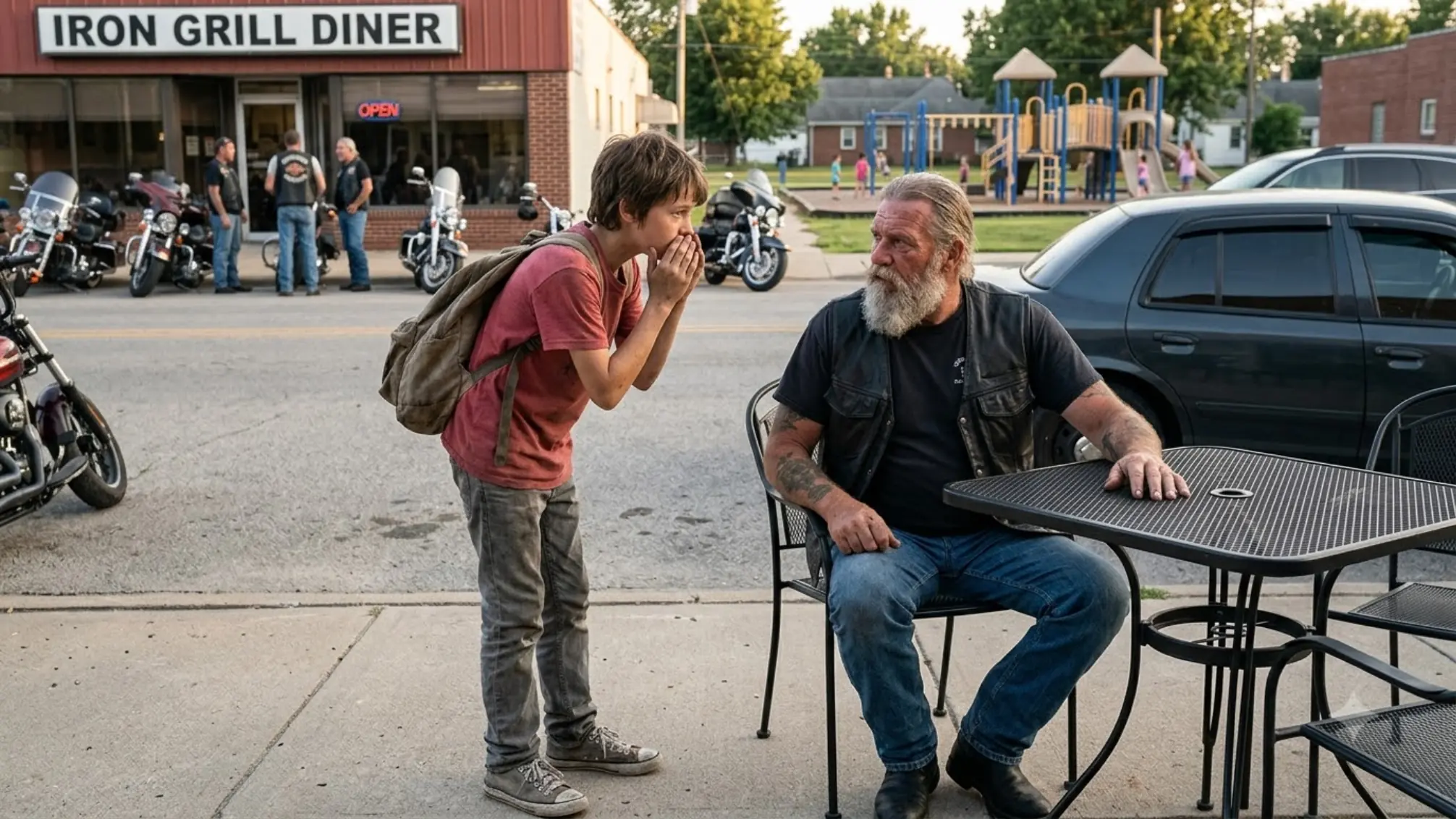
Gabriel set down his coffee.
He was fifty-eight, broad and weathered, with a long gray beard, tattooed forearms, and the heavy black leather vest of the Iron Harbor Riders stretched across his shoulders. Behind him, nineteen other bikers talked quietly beside a row of polished motorcycles. They had stopped for lunch during a charity ride and were preparing to leave when the boy approached.
“You did right telling me, son,” Gabriel said gently. “Did you see who’s inside?”
The boy shook his head.
“The windows are too dark. But every time a child moves, the driver moves too. I’m scared they’re waiting for one to be alone.”
Gabriel looked across the road.
The gray sedan sat beneath a tree near the far corner of the playground. Its engine appeared to be running, though the afternoon was mild enough that no one needed air-conditioning badly. The front wheels pointed toward the street, ready to pull away quickly.
“Stay beside this table and don’t look back,” Gabriel told the boy. “In ten seconds, that car’s going to realize this playground isn’t unguarded anymore.”
The boy’s name was Noah Lane.
He was thirteen years old, though hunger and exhaustion made him appear younger. For almost five months, he had lived between an abandoned loading shed, a church basement that opened during severe weather, and the storage room behind a laundromat whose owner sometimes pretended not to notice him.
Noah had not always been homeless.
A year earlier, he lived in a small apartment with his mother, Rachel, who worked evenings at a bakery. After she became sick, medical bills consumed what little money they had saved. The bakery replaced her when she missed too many shifts, the landlord issued an eviction notice, and their lives began shrinking one bag at a time.
Rachel entered a county hospital three months later.
She arranged for Noah to stay temporarily with a distant cousin named Derek. The arrangement lasted seventeen days. Derek drank heavily, shouted often, and used the money Rachel sent for food to pay his own debts.
Noah left after Derek struck him for asking where the grocery money had gone.
He told himself he would return to the hospital and find his mother, but the facility had transferred her to a rehabilitation center outside the county. Noah did not have the address, a working phone, or enough money for the bus.
He survived by noticing things.
He noticed which restaurants placed unused bread beside the dumpster instead of mixing it with garbage. He noticed which shopkeepers tolerated him during rainstorms and which police officers asked questions he could not safely answer. He noticed when parents became distracted at the playground and when children wandered beyond the fence.
Most adults looked through Noah.
That morning, the person inside the gray car had looked directly at him.
The sedan arrived shortly after noon and parked near the playground without anyone getting out. Noah had been sitting beneath the slide eating crackers when he noticed the driver raising a phone toward the children.
At first, he assumed it was a parent.
Then a little girl in a purple jacket ran toward the drinking fountain, and the sedan rolled forward several feet. When her mother called her back, the car stopped.
Twenty minutes later, a boy chased a ball toward the sidewalk. The sedan moved again.
Noah watched for nearly an hour.
The driver never left the vehicle. No child approached the car, and no adult appeared to know who was inside. When Noah crossed the street to get a better look, the sedan’s tinted window lowered less than an inch.
A phone camera pointed through the opening.
Then the window closed.
Noah considered telling the police, but two months earlier an officer had found him sleeping behind the laundromat. Instead of listening, the man threatened to place him in juvenile detention for trespassing.
Noah did not trust uniforms easily anymore.
Then the motorcycles arrived.
The Iron Harbor Riders looked frightening from a distance: leather vests, heavy boots, gray beards, tattoos, and large machines that shook the diner windows when they entered the parking lot. But Noah noticed details other people might have missed.
One rider helped an elderly woman carry groceries to her car.
Another gave his unopened sandwich to a man sitting beside the bus stop.
Gabriel moved his motorcycle so a mother could push a stroller through the sidewalk without entering the street.
Noah decided men who noticed small problems might listen to a larger one.
Now Gabriel rose from the metal chair and made a subtle hand signal.
Conversations behind him stopped.
Bear Nolan, the largest rider in the group, followed Gabriel’s gaze toward the gray sedan. Lisa Grant quietly removed her phone and began recording. Mateo Ruiz crossed the parking lot and positioned himself where he could see the sedan’s license plate.
No one shouted.
No one touched a weapon.
Gabriel’s riders had spent years helping with missing-child searches, storm evacuations, domestic-violence escorts, and community safety rides. They knew the difference between looking intimidating and acting carelessly.
Gabriel walked toward the curb.
The gray sedan’s brake lights illuminated.
“Bear, take six riders around the playground’s north exit,” Gabriel said. “Lisa, call the police and tell them we have a suspicious vehicle watching children. No accusations, only what we observed.”
“What about the boy?” Lisa asked.
“Keep him near the diner.”
Noah heard them.
“I can show you where the car moved.”
Gabriel looked back.
“You stay where I can see you.”
“But there’s a blind corner near the swings. The driver watches it.”
Gabriel studied the child’s face.
Noah was afraid, but he was not guessing.
“Walk beside me,” Gabriel said. “Do exactly what I tell you.”
Twenty motorcycles did not roar to life at once. That would have frightened the children and warned the driver too early. Instead, riders moved quietly into positions along the sidewalk, diner entrance, and two streets bordering the playground.
Parents began noticing.
A father lifted his daughter from a swing and brought her closer. A woman called two boys back from the fence. Gabriel raised both hands to reassure them.
“We’re not here to cause trouble,” he said. “Someone reported that car watching the children. Police are coming.”
The gray sedan reversed.
Bear and six riders stepped into view near the north exit. They remained on the sidewalk and did not block the road, but their presence eliminated the easiest direction of escape.
The sedan stopped again.
Noah moved closer to Gabriel.
“That’s what it did before.”
“What?”
“It waits when somebody sees it. Then it tries another side.”
Gabriel watched the driver’s silhouette.
A hand appeared near the steering wheel. The person inside seemed to be holding a phone or radio.
“Did you see anyone else in there?” Gabriel asked.
“Maybe someone in the back.”
A little girl screamed near the playground gate.
Every adult turned.
A man wearing a baseball cap had grabbed the arm of the girl in the purple jacket and was pulling her toward a narrow service path between two buildings. The child’s mother ran after them, shouting that she did not know him.
The gray sedan accelerated.
Gabriel understood instantly.
The car had been a distraction and an escape vehicle.
“Bear, the child!” he shouted.
Three riders ran toward the service path while Gabriel stepped into the road far enough to make the driver slow without placing himself directly in front of the vehicle. Lisa continued recording from the sidewalk.
The sedan swerved around Gabriel.
Mateo called out the license plate.
Noah stared toward the service path.
“He’s taking her to the other street!”
Gabriel ran.
He was not as fast as he had been twenty years earlier, but fear moved him faster than pain could slow him. Bear reached the stranger first and caught the back of his coat before he could drag the girl around the corner.
The man released her and swung wildly.
Bear blocked the strike, stepped between him and the child, and forced him backward without hitting him. Two other riders guided the crying girl toward her mother.
The stranger turned to run.
Noah appeared at the opposite end of the path.
For a terrible second, the boy stood directly between the fleeing man and the street.
“Move, son!” Gabriel shouted.
Noah jumped behind a metal trash container.
The stranger rushed past him, but the delay allowed Mateo and another rider to close the distance. They took the man to the ground and held his arms where everyone could see them.
“No punching,” Gabriel ordered. “Hold him until police arrive.”
The gray sedan disappeared around the far corner.
Lisa had captured the plate, vehicle, and driver’s profile. Several parents had recorded the attempted abduction. The little girl was frightened but physically unharmed.
Police arrived four minutes later.
The first officer approached with his weapon drawn and ordered everyone away from the man on the pavement. Gabriel immediately raised his hands and instructed the riders to step back.
Bear released the stranger only after the officer took control.
The man began shouting that the bikers had attacked him without cause. The child’s mother answered before Gabriel could.
“He grabbed my daughter.”
The little girl clung to her waist.
Lisa approached slowly with her phone visible.
“I recorded the vehicle and part of the incident.”
Another parent held up a second video.
The stranger stopped shouting.
Officers searched him and found zip ties, a disposable phone, two children’s photographs, and a folded map marking playground exits. His identity card belonged to someone else.
The situation became larger than a single attempted kidnapping.
Detectives sealed the playground and began taking witness statements. A citywide alert went out for the gray sedan. Officers reviewed Lisa’s recording and confirmed the plate had been partially covered with removable tape.
Noah stood near the diner, holding his backpack against his chest.
No officer had asked for his statement yet.
He watched adults praise the riders, comfort the child, and speak into cameras. The warning had begun with him, but he was fading into the background again.
Gabriel noticed.
He walked to the boy and lowered himself onto one knee.
“You saved her.”
Noah looked toward the child.
“You stopped him.”
“We stopped him because you saw the car first.”
The boy shook his head.
“Police don’t listen to kids like me.”
“I listened.”
“You’re not police.”
“No.”
Noah looked at the motorcycles.
“Are you going to leave now?”
Gabriel heard something beneath the question.
The boy was not only asking about the riders.
He was asking whether being useful had earned him a few more minutes of not being invisible.
“No,” Gabriel said. “Not until you’ve eaten and someone helps us find your family.”
Noah stepped backward.
“I don’t have family here.”
“Then tell me where they are.”
“I don’t know.”
A detective named Maria Santos approached. She had watched Gabriel speak with the boy and understood immediately that sudden authority might send him running.
She stopped several feet away.
“Is this our first witness?”
Gabriel nodded.
“This is Noah. He watched the vehicle for nearly an hour.”
Maria did not ask why he was alone.
She did not reach for him or speak like he was five years old.
She opened a notebook.
“Can you tell me what you noticed?”
Noah looked at Gabriel.
“You can answer her,” Gabriel said. “I’ll stay.”
The statement took twenty minutes.
Noah described the sedan’s movements, the lowered window, the phone camera, and the possible passenger in the back. He remembered that the driver wore a silver ring and that one rear light had a crack across the lower corner.
Maria wrote down every detail.
“You have an excellent memory,” she said.
“I have to.”
“Why?”
“Because people lie when they think nobody was watching.”
Maria paused.
Gabriel understood that sentence contained more than today’s incident.
When the interview ended, Maria asked gently where Noah lived.
The boy’s shoulders tightened.
“Different places.”
“Is there an adult expecting you tonight?”
“No.”
“Do you know where your mother is?”
“She was sick. They moved her.”
Maria did not threaten him with detention.
She asked for his mother’s full name, former hospital, and date of birth. A patrol officer began checking transfer records while Gabriel ordered food from the diner.
Noah ate two hamburgers, fries, soup, and half a piece of pie before slowing down.
Bear sat across from him.
“You planning to leave any ketchup for the rest of town?”
Noah looked alarmed, unsure whether the big man was serious.
Bear slid another bottle toward him.
“Take that one too.”
For the first time, Noah smiled.
Meanwhile, officers located the gray sedan behind an abandoned warehouse three miles away. The cracked rear light and altered plate matched Noah’s description. Inside, investigators found additional restraints, children’s clothing, and phones containing photographs taken at several public parks.
The driver had fled.
Police dogs followed a trail toward a bus terminal.
The man caught near the playground refused to identify him, but his disposable phone contained recent messages discussing “the red-shirt lookout.”
Noah had been noticed.
The driver knew a homeless boy was watching and had taken his photograph through the partially lowered window. One message suggested removing Noah before attempting another abduction.
Maria returned to the diner with a serious expression.
“Gabriel, may I speak with you?”
He followed her several steps away.
“The suspects identified Noah as a problem.”
Gabriel looked toward the boy.
“Is he in danger?”
“Potentially. We need to place him somewhere secure while we find his mother and locate the driver.”
“Not juvenile detention.”
“That is not my plan.”
“What is?”
“A child-advocacy shelter with protected access.”
Gabriel shook his head.
“He’s already afraid of systems.”
“I know.”
“Let him meet the staff first. Let him keep his backpack. No locked doors without explanation.”
Maria considered the request.
“You’ve done this before.”
“Too many times.”
Iron Harbor had supported children escaping violent homes, but Gabriel understood that good intentions could still feel like force to someone who had survived by avoiding adults.
They told Noah the truth.
The men in the car had photographed him. One suspect remained missing. The shelter would give him a private room, meals, clean clothes, and a caseworker who could help find Rachel.
Noah looked at the motorcycles outside.
“Can he come?”
He pointed at Gabriel.
Maria nodded.
Gabriel rode behind the police vehicle to the shelter while Bear followed in a pickup carrying Noah’s backpack. The other riders remained near the playground until every child left safely.
Twenty motorcycles had surrounded the area.
Not one rider acted as though the motorcycles made them law enforcement.
Their job was to make sure no child stood alone while the real investigation continued.
At the shelter, a caseworker named Elaine Porter found Noah’s mother before midnight.
Rachel Lane had been transferred from the county hospital to a rehabilitation center in Cedar Rapids after complications from surgery. She had recovered enough to leave several weeks earlier but was told Noah was living safely with Derek.
When she called Derek, he claimed Noah had run away and refused to say more.
Rachel had been searching through police departments, shelters, and schools ever since.
Noah spoke with her by video call.
The moment her face appeared, he stopped breathing.
“Mom?”
Rachel covered her mouth.
“Oh, baby.”
Noah tried to remain strong, but the sound of her voice broke through every wall he had built. He cried so hard Gabriel had to steady the tablet while Elaine placed a blanket around his shoulders.
“I tried to find you,” Rachel said.
“I thought you forgot.”
“Never.”
“Derek said you didn’t want me.”
“He lied.”
Noah wiped his face.
“I helped save a girl.”
Rachel looked confused.
Gabriel gently explained what happened.
Her tears returned.
“That sounds like him,” she said.
“Like who?” Gabriel asked.
“Noah. He always watches over younger children.”
The following morning, Gabriel and three riders drove Noah to meet his mother. Maria arranged security because the driver had not yet been captured.
The reunion occurred inside the rehabilitation center lobby.
Rachel was thinner than Noah remembered and walked with a cane, but she crossed the room without it when she saw him. They collided halfway between the chairs and held each other for several minutes.
Gabriel turned toward the window.
Some reunions deserved privacy even when they happened in public.
Police arrested the sedan’s driver later that afternoon at a bus station across the state line. Evidence connected both suspects to surveillance at four playgrounds and an attempted abduction in another county.
Noah’s observations became central to the case.
He identified the driver, described the vehicle, and explained how the suspects coordinated their movements. Prosecutors later said his attention prevented the little girl from being taken and helped uncover a wider plan before another child disappeared.
News reporters requested interviews.
Rachel refused until Noah decided for himself.
When he finally spoke, he did not stand before the motorcycles or accept the label of hero easily. He wore a clean red shirt provided by the shelter and sat beside his mother.
“I only told somebody what I saw,” he said.
A reporter asked why he approached the bikers.
Noah looked toward Gabriel.
“Because they looked like they would stop.”
The answer spread widely.
Donations arrived for Rachel and Noah, but Gabriel insisted they be managed through a legitimate family-support organization. The money helped Rachel secure a small apartment near her rehabilitation clinic and covered several months of rent while she returned to work.
Iron Harbor furnished the apartment.
Bear carried in the couch and complained loudly that modern furniture had been designed by people who hated stairs. Lisa stocked the kitchen. Mateo repaired Rachel’s old car without charging her.
Noah returned to school.
The transition was not easy. He hid food beneath his bed for several weeks and woke whenever a car idled outside. A counselor helped him understand that survival habits did not disappear merely because the danger changed.
Gabriel visited every Sunday.
Sometimes they talked.
Sometimes they worked on a small motorcycle engine in the apartment garage. Gabriel taught Noah to identify tools, record each removed part, and never assume a machine was ruined before inspecting it properly.
Months later, Iron Harbor organized a community-safety ride past the playground.
Twenty motorcycles entered the street slowly, then parked outside the diner. Parents and children gathered near the swings while officers discussed safe ways to report suspicious behavior.
Noah stood beside Gabriel.
A little girl in a purple jacket approached them holding her mother’s hand.
It was the child from that afternoon.
She looked at Noah.
“Are you the boy who saw the car?”
He nodded.
She gave him a folded drawing.
It showed a playground surrounded by motorcycles. A small figure in a red shirt stood in the center holding a shield.
Noah stared at it.
“I didn’t have a shield.”
The girl pointed toward his eyes.
“You saw them.”
He folded the picture carefully and placed it inside his backpack.
The same backpack had once carried everything he owned.
Now it carried schoolbooks, engine diagrams, and proof that someone remembered what he had done.
Gabriel looked toward the playground.
“You okay?”
Noah nodded.
“Do you still watch every car?”
“Most of them.”
“That may take time.”
“I know.”
Across the street, a vehicle paused near the curb. Noah tensed automatically.
The driver lowered the window and waved to a child waiting with his father. The boy ran safely toward them.
Noah exhaled.
Gabriel noticed.
“You checked before deciding.”
“You taught me that.”
“No,” Gabriel said. “You were doing it before we met.”
The Iron Harbor Riders became known locally as the men and women who surrounded a playground. But Gabriel corrected the story whenever people told it incorrectly.
The riders did not discover the danger.
They responded to it.
A homeless boy in a faded red shirt noticed the gray car, studied its movements, and risked approaching twenty strangers because he believed the children across the street mattered more than his fear.
Twenty motorcycles made the response visible.
Noah’s courage started it.
On the day of the suspects’ sentencing, Rachel and Noah sat in the second row of the courtroom. The mother of the little girl sat beside them.
The driver looked toward Noah once but quickly turned away.
The judge described the child’s warning as the moment the plan failed.
Afterward, reporters gathered outside.
Noah ignored them and walked toward Gabriel’s motorcycle.
A thin red ribbon had been tied around the mirror.
“What’s that for?” Gabriel asked.
Noah shrugged.
“So you’ll know someone might need you to stop.”
Gabriel touched the ribbon carefully.
“Who needs help?”
“Maybe nobody today.”
“Then why leave it?”
Noah looked toward the playground visible at the end of the street.
“Because somebody should always be watching for the kid nobody else sees.”
Gabriel placed one hand on his shoulder.
The motorcycles started one after another, their engines rolling through the afternoon air. Noah stood beside his mother as the riders pulled into the street.
Months earlier, he had believed being invisible kept him safe.
That day, he learned being seen by the right people could save more than one life.
The gray sedan had watched the children.
Noah watched it back.
And when he whispered his warning to one biker, twenty engines answered.