Rosie had been living behind the dumpsters of Rosie’s Diner for three months. She was a ghost in an oversized, threadbare olive-green parka, surviving on discarded fries, half-eaten pies, and the rare kindness of passing truck drivers.
She had run away from a broken foster system in Nevada, trading the emotional scars of her past for the physical hardship of the streets. Her golden rule was simple: stay invisible.
Invisibility meant safety.
Invisibility meant survival.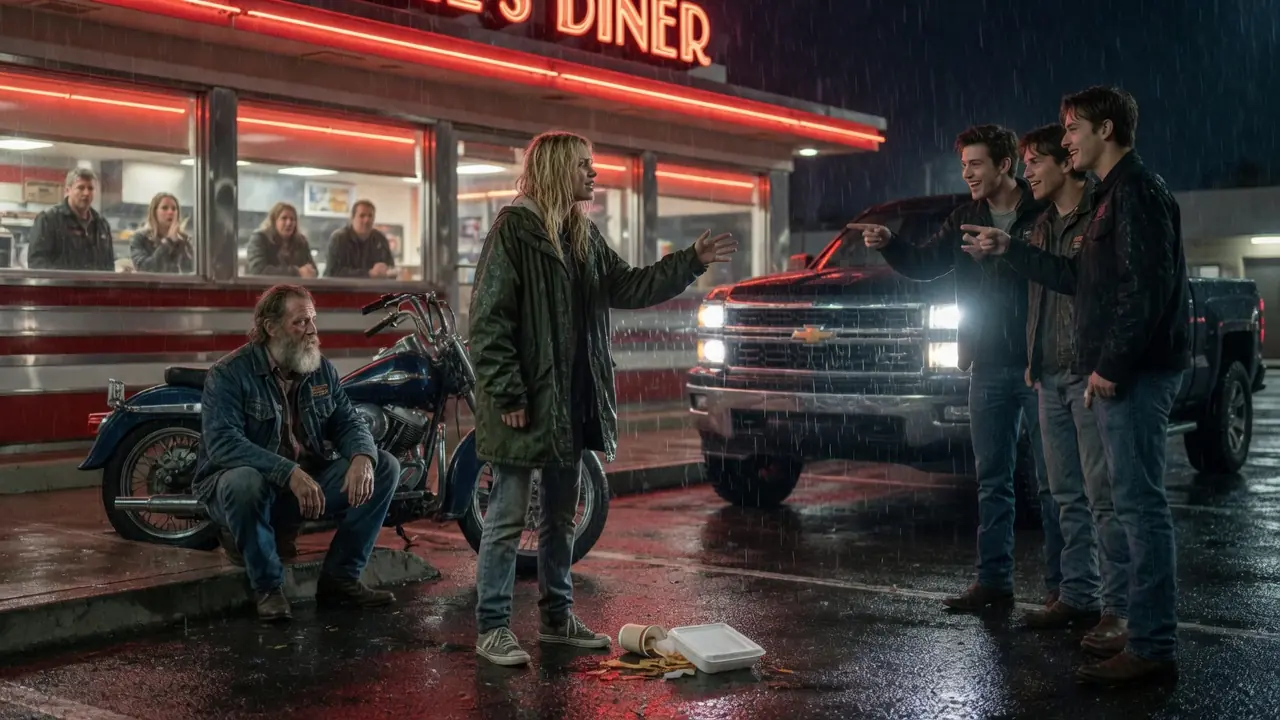
On that particular Tuesday night, the diner’s parking lot was mostly empty, except for a rusted-out station wagon and the howling wind. Rosie sat on her flattened cardboard mattress, pulling her knees to her chest, trying to stop her teeth from chattering.
Then the low, guttural rumble of a V-twin engine tore through the quiet night.
A lone motorcycle pulled into the lot. It was a pristine vintage 1978 Harley-Davidson Shovelhead, painted a deep midnight blue. The rider killed the engine, and the sudden silence felt heavy.
The man who stepped off the bike was a mountain, though age had clearly begun to weather him.
Arthur Hayes, known to those who mattered simply as Rusty, was in his late sixties. He had a thick iron-gray beard, a weathered face lined with decades of sun and wind, and hands that looked like they had been carved from oak.
He wore heavy faded denim over a thick red flannel shirt, guarding himself against the biting desert cold.
Rusty didn’t look like a savior. He looked like a man who just wanted a hot cup of black coffee and a slice of cherry pie.
But as he walked toward the diner entrance, his sharp eyes caught movement in the shadows near the dumpsters.
He stopped.
Rosie held her breath and shrank back into the darkness. She expected the usual bark of disgust, the “Get out of here, kid,” that she had heard from every business owner and passing stranger in town.
Instead, Rusty reached into his pocket, pulled out a worn leather wallet, and walked inside without a word.
Ten minutes later, the diner door chimed open again.
Rusty came out carrying two large Styrofoam containers and a steaming cup of coffee. He didn’t approach her directly. He knew better than to corner a frightened stray.
He simply set the bag down on the dry concrete near the edge of the building, nodded toward the shadows, and walked back to sit on the curb near his bike.
Rosie hesitated.
The smell of hot meatloaf, mashed potatoes, and rich gravy overpowered her fear. She crept out, grabbed the containers, and retreated to her corner.
“Eat slow, kid,” Rusty’s deep, gravelly voice echoed across the lot. “Your stomach won’t thank you if you rush it.”
It was the first time someone had spoken to her like a human being in months.
Rosie didn’t say anything, but as she took her first bite of hot food, a tear tracked down her dirty cheek.
Before she could finish, the atmosphere in the parking lot shifted.
A lifted black Chevy Silverado roared off the highway, tires squealing as it whipped into the diner lot. The truck’s bright LED high beams blinded Rosie, and the heavy bass from inside rattled the diner windows.
Out stepped three local young men.
Leading them was Trent Caldwell, a 22-year-old college dropout whose father owned half the car dealerships in Mohave County. Trent was arrogant, drunk, and bored. Flanking him were his two equally privileged friends, Bryce and Logan.
They wore designer jeans, expensive boots, and the careless confidence of people who had rarely faced consequences.
They spotted Rusty sitting on the curb.
“Look at this museum piece,” Trent slurred, swaggering toward the motorcycle. He kicked the front tire with his boot. “Hey, Grandpa, this thing actually run, or do you just pedal it?”
Rusty remained seated, his face unreadable.
“It runs fine. Step away from the bike, son.”
Trent laughed harshly.
“Son? I ain’t your son, old man.”
To prove his point, Trent threw a leg over the leather saddle of the pristine Shovelhead. The metal teeth of his belt buckle dragged across the midnight-blue paint of the gas tank, leaving a deep, jagged silver scratch.
Rusty stood.
He didn’t yell. He didn’t posture. He just moved with sudden, terrifying calm for a man his age.
In three strides, he was at the bike. He clamped one massive hand onto Trent’s jacket collar and yanked him off the motorcycle, sending the younger man stumbling hard onto the wet asphalt.
“I said,” Rusty growled, “step away.”
Trent scrambled back, his face flushing red with humiliated rage. Bryce and Logan immediately stepped up, fists clenched.
“You’re done, old man,” Trent spat, getting to his feet. “Get him.”
The three young men rushed the old biker.
Rusty was a seasoned fighter, a veteran of countless roadside confrontations, and he slipped Bryce’s wild swing with practiced ease before driving a heavy punch into the young man’s ribs. Bryce dropped to one knee, gasping.
But age is a cruel tax, and three on one are terrible odds.
Logan tackled Rusty around the waist, driving him backward into the side of the truck, while Trent pulled a heavy flashlight from his belt. A moment later, Rusty dropped to one knee.
Before he could recover, the three men forced him to the ground.
They were fueled by adrenaline, cheap alcohol, and bruised egos, and their anger turned reckless fast.
From the shadows by the dumpsters, Rosie dropped her food.
Her golden rule screamed in her mind.
Stay invisible.
But she looked at the spilled coffee, the open container of hot food, and the old man on the ground. The only person who had shown her kindness in months was being hurt in front of her.
The ghost decided to become solid.
“Stop!” Rosie’s voice was raw and frantic as she sprinted across the wet asphalt. “Leave him alone!”
Trent, Bryce, and Logan barely had time to register her arrival before she threw her fragile frame directly into the middle of it.
She didn’t try to fight them. She knew she couldn’t win.
Instead, she threw herself over Rusty’s body, curling into a tight ball, turning her back into a human shield to protect his head and chest.
Trent paused, chest heaving, staring down at the dirty oversized parka now covering his target.
“What is this?” he sneered. “Get off him, you little street rat.”
“Please,” Rosie sobbed, clutching Rusty’s heavy denim jacket. “He’s an old man. Please, just go.”
“I’ll tell you when we’re done,” Trent snapped.
He grabbed the hood of Rosie’s parka, trying to rip her away, but she locked her fingers into Rusty’s clothing with a desperate grip.
“Fine,” Bryce muttered, still struggling to breathe after Rusty’s punch. “Then she can stay there.”
What followed was terrifying.
The young men tried to force Rosie off Rusty, pushing, striking, and shoving at her until pain exploded through her ribs, back, and shoulders. She squeezed her eyes shut and refused to let go.
Every impact stole the breath from her lungs, but she tightened her grip around the old biker beneath her.
Rusty was regaining awareness. Through swollen eyes, he realized what was happening.
A homeless girl, a child he had bought a plate of food for, was taking the punishment meant for him.
With a surge of desperate strength, Rusty shifted and tried to wrap his arms around Rosie to protect her. As he moved, the heavy denim jacket he wore against the cold ripped open.
The diner’s neon light caught the leather beneath.
Embroidered across the back of Rusty’s leather cut were three unmistakable patches.
The top rocker read Hells Angels.
The bottom rocker read Arizona.
And in the center was the winged death head.
Bryce froze mid-motion.
“Trent,” he stammered, his voice suddenly smaller. “Trent, look at his vest.”
Trent scoffed, wiping rain from his eyes. But when he looked down, the color drained from his face.
Even rich, entitled kids in Mohave County knew what that patch meant.
You didn’t touch the colors.
You certainly didn’t leave the man wearing them broken in a diner parking lot.
“He bought it online,” Trent stuttered, trying to convince himself. “It’s fake. It’s got to be fake.”
“I don’t care if it’s fake,” Logan yelled, already backing away toward the Silverado. “We need to go. Now.”
Panic overtook their rage.
Trent looked down at the injured girl and the battered biker. His face twisted with one last flash of spite before he turned and sprinted to the truck.
The doors slammed shut. The engine roared. The black Silverado peeled out of the diner parking lot, ran the red light, and vanished into the stormy night.
Silence descended, heavy and suffocating, broken only by the steady patter of rain and Rosie’s ragged attempt to breathe.
She rolled off Rusty and collapsed onto her back. Her vision blurred at the edges, swimming with dark spots. Her ribs felt like shattered glass, and rainwater pooled around her hair.
Rusty groaned and slowly forced himself up onto one elbow. His face was bruised and swollen, his gray beard soaked with rain.
He looked over at the tiny, broken girl lying beside him. His chest heaved with pain and awe.
“You,” Rusty wheezed. “You shouldn’t have done that, sweetheart.”
Rosie’s lips barely moved.
“You bought me meatloaf.”
Then her eyes closed.
Rusty dragged his heavy body closer and checked her pulse. It was there, but faint. He knew he couldn’t move her. She needed help immediately.
With shaking fingers, Rusty reached into the interior pocket of his leather cut and pulled out an old flip phone.
He didn’t hesitate.
He held down the number one on speed dial.
It rang twice.
“Yeah, Rusty,” a deep, alert voice answered.
It was Big Jim Donovan, president of the Arizona charter, a man who commanded absolute loyalty from hundreds of riders.
“Jim,” Rusty rasped, his voice tight with pain. “I’m at Rosie’s Diner in Kingman. I’m down bad.”
The line went silent for a fraction of a second.
Then the tone shifted from casual to martial law.
“Who?”
“Three kids. Black lifted Chevy Silverado. Went north.” Rusty coughed hard. “Jim, there’s a girl here. A kid. She saved my life. Took it for me. She’s hurt bad. Send help. And send the club.”
“We’re coming,” Jim said.
The call ended.
Rusty let the phone drop to the wet asphalt. He pulled off his heavy denim jacket and laid it gently over Rosie’s shivering body, leaving himself in his bloodied leather colors.
Then he sat beside her in the rain and kept watch.
For ten minutes, the only sound was the howling wind.
Then it started.
Not as a sound at first, but as a vibration.
A low, rhythmic tremor seemed to rise from the core of the earth, traveling through the wet asphalt and vibrating against the soles of Rusty’s boots. The water in the puddles around them began to ripple.
Then came the sound.
Distant at first, like a rolling thunderstorm breaking over the desert mountains. But it grew louder, deeper, and more overwhelming with every passing second.
The diner windows began to rattle in their frames.
The waitress inside, who had been hiding behind the counter, finally dared to peek out the window.
Her jaw dropped.
Headlights cut through the rain.
Not two.
Not ten.
Dozens.
Then hundreds.
A massive, synchronized formation of Harley-Davidsons turned off the highway, moving like one mechanical beast. The thunderous roar of 500 V-twin engines drowned out the storm and swallowed the town of Kingman whole.
The Hells Angels had arrived.
They poured off Interstate 40 like a river of chrome, steel, and fury. The roar vibrated through the foundation of Rosie’s Diner, shaking the booths and rattling the coffee cups on the counter.
They filled the diner parking lot in seconds, organized even in their haste. When the lot was full, they packed the adjacent streets and blocked the intersections, effectively sealing this section of Kingman from the rest of the town.
Sirens wailed in the distance, but they stopped far back. No local police cruiser was driving straight into a wall of 500 riders without knowing exactly what had happened first.
At the center of the formation, a massive custom-built Harley Road Glide came to a stop.
The rider stepped off.
This was Big Jim Donovan.
Standing six-foot-five, with a barrel chest and eyes like chipped flint, Jim exuded absolute authority. He didn’t rush, but his strides ate up the asphalt as he moved toward the dumpsters, where a circle of patched members had already formed a protective wall.
The crowd parted silently for their president.
Jim looked down.
Rusty leaned against the brick wall, refusing to lie flat. His face was swollen and bruised, but he wasn’t looking at Jim. He was looking at the tiny, fragile shape beneath his denim jacket.
“Doc!” Jim bellowed.
A lean older biker with a salt-and-pepper ponytail pushed through the crowd. Doc had been a combat medic in Vietnam before he traded his uniform for leather colors.
He dropped to his knees beside Rosie and pulled back the denim with care. His hands moved with practiced clinical precision. He checked her airway, her pulse, and gently assessed her ribs.
His face tightened.
“She’s in bad shape, Jim. Multiple rib injuries, head trauma, shallow breathing. She needs an ambulance now.”
“I called dispatch,” another biker growled, holding up a radio scanner. “Ambulance is sitting at the roadblock. Cops won’t let them through. They think it’s a riot.”
Jim’s jaw tightened.
“Ride out there. Escort the paramedics in. Any cruiser blocking the ambulance moves. Make it happen.”
Three riders instantly peeled away, their bikes screaming into the night.
Jim knelt beside Rusty in the wet oil and rainwater. He placed a heavy gloved hand on the old man’s shoulder.
“Talk to me, brother.”
“Three kids,” Rusty wheezed. “Rich boys. Drunk. Went for the bike. I put one down. They got me with a flashlight.”
He coughed and pointed a shaking finger toward Rosie.
“She came out of nowhere, Jim. Threw herself over me. Took the hit. They hurt her trying to get to me.”
Jim Donovan looked at the pale, bruised face of the unconscious teenager.
A homeless street kid had sacrificed herself for a fully patched Hells Angel.
That demanded a debt no one in that parking lot intended to forget.
“Who were they, Rusty?” Jim asked, his voice dropping dangerously quiet.
“Locals. College age. Lifted black Chevy Silverado. Custom rims. Deep scratch down the side where one of them dragged his belt buckle across my tank.”
Jim stood.
He turned to the hundreds of riders surrounding him.
The silence that fell over the crowd was deafening, save for the rain.
“Brothers,” Jim’s voice carried over the wind. “Three local punks in a black lifted Silverado put our oldest brother on the ground. Worse, they hurt a girl who tried to protect him.”
A low collective rumble of fury rippled through the crowd.
“Kingman is locked down,” Jim commanded. “Nobody leaves this town. Fan out. Check every back road, every driveway, every motel parking lot, and every garage. You find that truck, you find those boys, you do not touch them. You call it in and wait for me. We do this right. Now ride.”
The roar that followed shook the diner sign.
Hundreds of motorcycles dropped into gear and flooded the streets. The Angels dispersed with disciplined precision. They didn’t just look on the main roads. They swept residential neighborhoods, motel lots, alleys, and storage yards.
The town of Kingman watched from behind locked doors and drawn blinds.
Meanwhile, on the outskirts of town, Trent Caldwell was falling apart.
He had driven the black Silverado deep into a private gated storage facility owned by his wealthy father. He parked inside a massive aluminum warehouse, slamming the rolling door shut behind them.
The three boys sat in the dark, surrounded by expensive boats and classic cars, their bravado completely gone.
“They saw the plates,” Logan said, pacing. “We’re done. Trent, you idiot. Why did you have to mess with his bike?”
“Shut up!” Trent snapped, trying to wipe the evidence of the night off his boots. “They don’t know who we are. It was dark. We hide here until morning, then my dad fixes it. My dad knows the chief. We’ll say the old man attacked us first.”
“You hit him with a flashlight,” Bryce said, clutching his ribs. “He had a Hells Angels patch. You don’t buy your way out of that.”
Trent pulled out his phone to call his father.
Then he froze.
A faint hum came through the corrugated metal walls of the warehouse. Within seconds, it grew into an earth-shaking vibration.
The ground beneath their feet began to tremble.
Trent dropped his phone.
Outside, a lone rider had spotted the wet tire tracks leading through the mud to the Caldwell storage facility. He had made the call.
Now, hundreds of riders surrounded the warehouse.
Headlights pierced through the cracks in the aluminum siding, casting long shadows across the boats and cars.
“No,” Trent whispered, backing away from the rolling door. “No, no, no.”
There was no knock.
Instead, a tow truck driven by a patched member who owned a local salvage yard backed up to the aluminum warehouse door. With a deafening crunch, the truck tore the rolling door open, exposing the terrified boys to the blinding glare of motorcycle headlights.
Trent, Bryce, and Logan fell to their knees on the grease-stained concrete, throwing their hands over their faces.
They were surrounded by wet leather, denim, and furious, unblinking eyes.
Big Jim Donovan walked slowly through the ruined doorway, his boots crunching over twisted metal. Four massive sergeants-at-arms flanked him.
Jim walked straight toward the black Silverado. He traced a calloused finger over the deep silver scratch running along the truck’s side, matching the damage done to Rusty’s vintage Harley.
“Is this the truck?” Jim asked.
“Matches perfectly, boss,” one sergeant answered.
Jim turned to the three boys cowering on the floor.
“Please,” Trent begged, his voice cracking. “My dad has money. He’s Robert Caldwell. We can pay you whatever you want. Just please—”
Jim stopped three feet in front of him.
The disgust on his face seemed to pull the air out of the warehouse.
“You think this is about money?” Jim asked quietly. “You think you can write a check for what you did to a patched brother? For what you did to a girl who weighs less than my front tire?”
“We didn’t mean to hurt her,” Bryce sobbed.
“You went after an old man sitting alone,” Jim said. “Then you went after a defenseless girl because she tried to protect him. That’s not a mistake. That’s cowardice.”
Trent squeezed his eyes shut, bracing for what he thought was coming.
But Jim didn’t strike him.
He lifted one hand.
From the crowd of riders, two Kingman sheriff’s deputies were escorted forward. They had been stopped, briefed, and brought to the scene.
“Arrest them,” Jim said.
The lead deputy hesitated. “Mr. Donovan, we have to process the scene.”
“I said arrest them,” Jim interrupted. “Attempted murder. Aggravated assault. There’s evidence on their clothes and boots. We have witnesses. You put them in cuffs right now, or everyone here stays until the state police arrive and asks why you didn’t.”
The deputies moved fast after that.
They cuffed Trent, Bryce, and Logan, then hauled them toward the cruisers as the three young men cried and begged for their fathers, lawyers, and second chances.
Jim watched them go without a flicker of sympathy.
Then he turned to his men.
“The boys belong to the justice system,” he said. “The truck goes nowhere until it’s evidence.”
By sunrise, the Silverado had been photographed, tagged, and impounded. Its deep scratch, damaged front tire, and traces from the diner lot were all documented. It would no longer be a symbol of Trent Caldwell’s arrogance.
It would be part of the case against him.
Two days later, Kingman General Hospital was under an unofficial lockdown.
Local police had given up trying to clear the intensive care waiting room. Three dozen heavily tattooed bikers occupied every available chair and stood guard at the main entrances, acting impeccably polite to the nurses and hospital staff.
In a quiet room on the third floor, Rosie slowly opened her eyes.
It felt as though a cinder block was resting on her chest.
As her blurred vision cleared, she saw a mountain of a man sitting awkwardly in a tiny visitor’s chair.
It was Rusty.
His left arm was bound in a sling, and half his face was covered in white bandages, but his one visible eye crinkled with deep warmth.
“Hey there, kid,” Rusty rasped softly.
Rosie panicked for a moment.
“The men,” she whispered.
“Gone,” Rusty said firmly. “They’re sitting in a steel cage, sweetheart. They’re going away for a very long time.”
Rosie swallowed hard.
“My spot behind the diner. I left my sleeping bag.”
“Someone will take it,” Rusty said gently, taking her bruised fingers in his massive calloused palm. “And you don’t need to worry about the cold, or sleeping bags, or hiding anymore.”
The door creaked open.
Big Jim Donovan stepped inside, holding a massive bouquet of bright sunflowers.
“How are we doing, sweetheart?” Jim asked gently.
Rosie stared at the leather vests and the protective eyes around her.
“Who are you people?”
Jim looked at Rusty, then back at her.
“We’re your family now.”
Rosie blinked.
“Family?”
Jim nodded. “I had a conversation with Robert Caldwell. He agreed it would be in everyone’s best interest to set up a comprehensive fund to cover your medical care, your recovery, and your future. Very generous of him once he understood the seriousness of the situation.”
Rusty squeezed Rosie’s hand.
“You protected me, kid. You stood between me and harm when you had every reason to stay hidden. Around here, that means something.”
Rosie’s eyes filled.
“I didn’t know what else to do.”
“You did the brave thing,” Rusty said. “And brave people don’t go back to sleeping behind dumpsters.”
Jim stepped closer, his voice lower now.
“When you get out of this hospital, you’re coming home with Rusty and his wife for a while, if you want. His old lady makes a mean pot roast. After that, we figure out school, paperwork, whatever else needs figuring. You’ve got people now.”
Rosie looked from Rusty to Jim, then toward the hallway where more riders stood guard like a wall of leather and loyalty.
For the first time in nineteen years, Rosie Adams did not feel the need to be invisible.
She closed her eyes as tears fell freely, feeling the overwhelming weight of something she had never been able to count on before.
Safety.
Real safety.
A week later, Rosie was moved out of intensive care. Rusty visited every day, always with coffee he wasn’t supposed to bring into the room and jokes that made the nurses roll their eyes. Big Jim came twice, both times pretending he was just checking logistics when everyone knew he was checking on her.
Doc stopped by with a thick folder full of medical instructions and a stern warning that she was not allowed to act tough with cracked ribs.
Rosie listened to him because Doc had the kind of voice even grown men listened to.
One afternoon, Rusty’s wife, Marlene, arrived with homemade soup, a faded cardigan, and the kind of hug that did not ask permission but somehow still felt safe.
“You’re too skinny,” Marlene announced, setting containers on the rolling table beside the bed. “That changes now.”
Rosie didn’t know what to say.
So she just whispered, “Thank you.”
Marlene looked at her sharply, then softened.
“You can thank me by eating.”
Outside the hospital, the story spread through Kingman faster than the desert wind.
People who had ignored Rosie for months suddenly remembered seeing her. The diner owner sent flowers. Truck drivers left cards. A church group collected clothes. A school counselor came by with forms and a plan.
But Rosie understood the difference between guilt and love.
Guilt arrived late and carried flowers.
Love had come in the rain, with one hot meal, one old biker, and 500 engines shaking the ground.
Three weeks later, Rosie left the hospital in Rusty’s truck, wrapped in Marlene’s cardigan, with a seat belt pulled carefully across her healing ribs.
As they drove past Rosie’s Diner, the neon sign buzzed above the wet asphalt. The dumpster corner where she had slept was empty now. Her cardboard was gone. Her old sleeping bag was gone.
For a moment, she stared at the spot.
Rusty slowed the truck.
“You okay?”
Rosie looked at the red glow of the sign, then at the old biker beside her.
“I thought being invisible kept me safe,” she said.
Rusty kept both hands on the wheel.
“Sometimes it does,” he said. “For a while.”
She nodded.
“But not forever.”
“No,” Rusty said softly. “Not forever.”
Behind them, two motorcycles followed at a respectful distance. Not because anyone expected trouble, but because the Angels had quietly decided Rosie would never again go anywhere alone unless she wanted to.
She leaned back against the seat, careful of her ribs, and watched the diner disappear in the side mirror.
For the first time, leaving the place where she had survived did not feel like losing something.
It felt like being found.
Months later, when Rosie was strong enough to walk without pain, Rusty took her to the clubhouse.
She expected smoke, noise, and danger.
What she found was a long wooden table covered in food, women laughing in the kitchen, old men arguing about engines, children running between heavy boots, and a banner someone had made by hand that read:
Welcome Home, Rosie.
She stood in the doorway, frozen.
Every head turned.
Then Big Jim Donovan lifted his coffee mug.
“To the bravest kid in Arizona.”
The room answered with a thunder of voices.
Rosie pressed both hands over her mouth.
Marlene wrapped an arm around her shoulders.
Rusty stood beside her, bruises mostly healed now, his gray beard trimmed, his leather cut hanging heavy across his back.
“You don’t have to say anything,” he murmured.
Rosie looked around the room at the people who had come when she called without knowing she had called.
Then she looked at Rusty.
“I’m not invisible anymore,” she said.
Rusty’s one good eye crinkled.
“No, sweetheart,” he said. “You’re not.”
And outside, under the wide Arizona sky, the Harleys sat in rows like sleeping thunder, waiting for the next time someone small, scared, and forgotten needed the ground to shake.