"Men dressed like you do not belong in a hotel like this,” Victoria Sterling said, pointing toward the revolving doors. “Leave before security removes you.”
Damon Washington stood beside a black rolling suitcase beneath the crystal chandelier of the Grand View Imperial Hotel. He wore black trousers, clean leather sneakers, and a fitted dark navy-blue shirt that revealed the disciplined strength in his shoulders. There was nothing threatening about his posture, yet the lobby had gone silent as if he had drawn a weapon instead of requesting the suite reserved under his company’s name.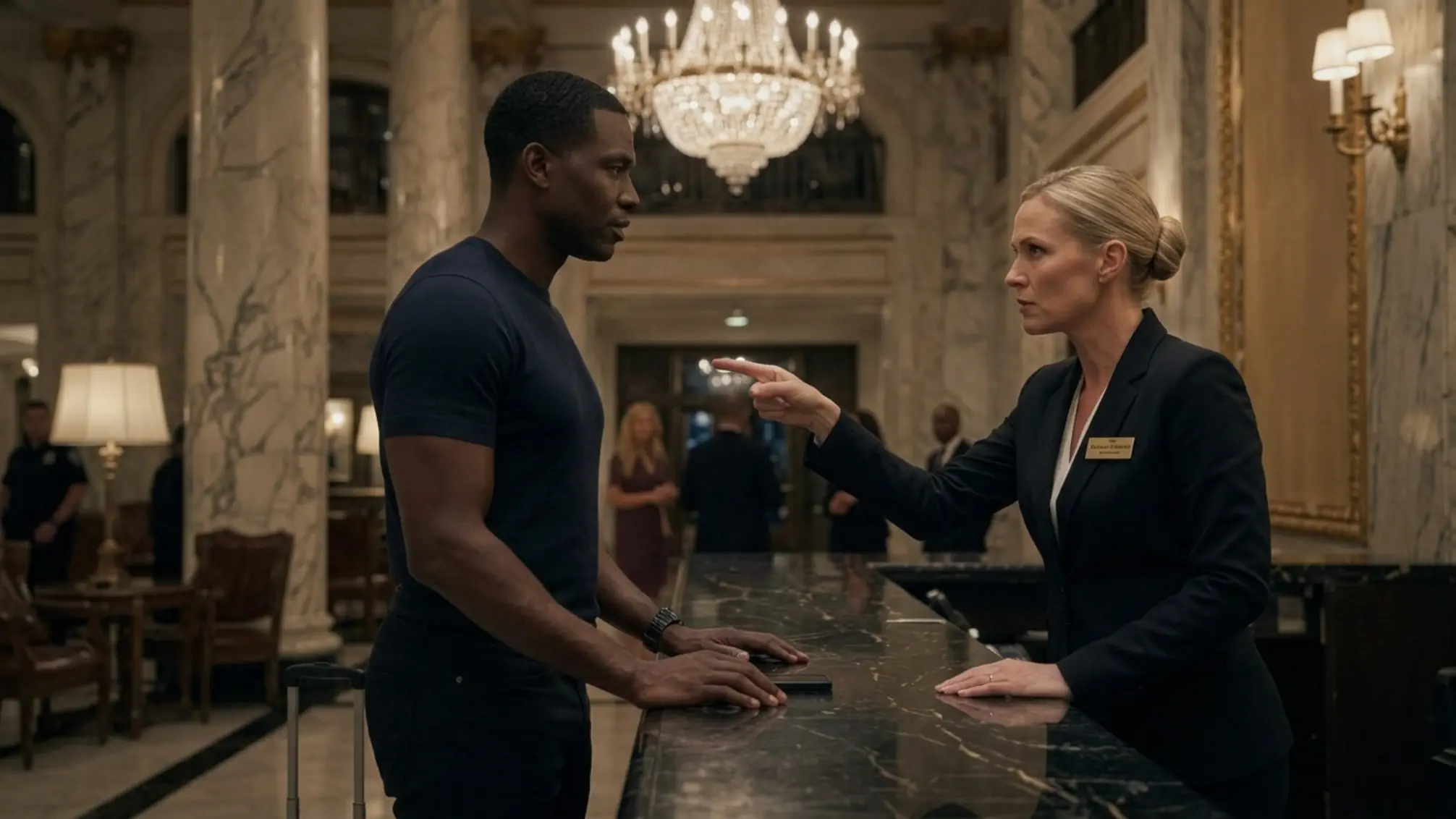
Damon looked at the woman behind the black-marble reception counter. Victoria was forty-eight, sharply dressed, and perfectly composed, with blonde hair secured in a severe bun and a gold management badge pinned to her tailored black jacket. She wore authority like perfume, applying enough of it that everyone nearby understood she expected obedience.
“Check my name,” Damon said, “before your prejudice signs your termination.”
A woman holding a champagne glass turned toward her husband. Two businessmen near the elevator exchanged amused looks, while a bellman quietly lowered his eyes. Victoria’s lips tightened, not because the accusation troubled her, but because Damon had challenged her loudly enough for guests to hear.
“They will drag you out before you touch this desk again,” she said, raising two fingers toward security.
Damon removed his phone and placed it on the marble counter. “Perfect. Freeze her access and remove her from my hotel.”
The nearest security guard stopped.
Victoria laughed once, but the sound lacked confidence. “Your hotel?”
Damon tapped a saved contact. He did not raise his voice or look away from her as the call connected.
“This is Damon Washington,” he said. “Activate executive review at Grand View Imperial. Freeze front-desk administration, preserve every camera feed from the lobby, and place the regional director on speaker.”
The laughter disappeared from Victoria’s face.
Behind her, the young assistant manager stared at the computer screen. A notification had appeared across every terminal, replacing the reservation system with a red message:
EXECUTIVE OWNERSHIP PROTOCOL ACTIVE — ACCESS SUSPENDED PENDING REVIEW.
“Ms. Sterling,” the assistant manager whispered, “your login just disappeared.”
Victoria turned sharply. “Refresh it.”
“I already did.”
Damon’s phone came alive on the counter. A man’s urgent voice filled the lobby.
“Mr. Washington, the regional office is online. Do you authorize full ownership protocol?”
Damon watched Victoria’s face lose its color.
“Yes,” he said. “Begin with the employee who decided I did not belong in my own building.”
Three days earlier, Washington Hospitality Group had completed its acquisition of controlling interest in the Grand View Imperial. The hotel had been struggling quietly beneath its polished exterior, burdened by declining occupancy, high staff turnover, and complaints that disappeared before reaching corporate headquarters. Damon had purchased the property because he believed the location, architecture, and employees still carried value that poor leadership had failed to protect.
He could have arrived with lawyers, photographers, and executives waiting beside a private car. Instead, he booked a room under the corporate ownership account, flew commercially, and took a rideshare from the airport. He wanted to experience the hotel as an ordinary guest would experience it when no one knew an inspection had begun.
Damon’s mother had taught him that powerful people rarely discovered the truth while everyone around them was prepared. She had cleaned hotel rooms for fourteen years, often entering buildings through service doors while wealthy guests crossed marble lobbies without seeing her. Damon had grown up hearing stories about managers who smiled for executives and humiliated workers the moment those executives left.
He founded Washington Hospitality Group partly because of her.
His first property had been a neglected roadside hotel outside Oakland. He renovated the building himself with a small team, raised wages before replacing the lobby furniture, and demanded that every guest receive respect before anyone checked the limit on their credit card. Seventeen years later, his company controlled thirty-two hotels across the country.
The Grand View Imperial was supposed to become the thirty-third.
Victoria did not know any of that when Damon approached her desk.
She saw a Black man in a simple shirt, arriving without a chauffeur, porter, or designer luggage. She decided his appearance made his reservation impossible before allowing the computer to tell her otherwise. Everything that followed came from that first decision.
Now the lobby watched her discover the price of it.
“This is some kind of mistake,” Victoria said. “Anyone can call a number and stage a performance.”
Damon turned his phone so she could see the active conference screen. The names displayed across it belonged to the regional director, corporate counsel, head of security, and chief financial officer of Washington Hospitality Group.
A new voice entered the call.
“Mr. Washington, this is Regional Director Elaine Foster. We have confirmed your location through the lobby’s security network. Do you want me to notify the property staff that ownership has arrived?”
“They have already been notified,” Damon said.
Victoria looked toward the guards. “Remove him.”
Neither man moved.
The first security guard, a broad-shouldered Black man named Anthony, took one step away from Damon. He had worked at the Grand View for three years and had seen Victoria order guests questioned for wearing work clothes, speaking accented English, or sitting too long in the lobby without purchasing anything.
“Ms. Sterling,” Anthony said carefully, “I need confirmation before taking action.”
“I am the confirmation.”
“Your administrative authority has been suspended.”
Her head snapped toward him. “You work for me.”
Damon answered instead.
“He works for the hotel. That distinction may save his job.”
Anthony lowered his hands. The second guard followed his lead.
Victoria stared at them in disbelief. Her control had always depended on people obeying before examining whether her orders were reasonable. The moment they paused, the performance of authority began collapsing.
The assistant manager behind the desk stepped closer to Damon’s phone.
“Mr. Washington,” he said, “my name is Caleb Moore. I can confirm your reservation is in the system.”
Victoria turned on him. “Do not interfere.”
Caleb swallowed, but he did not retreat. “The presidential suite is reserved under Washington Hospitality Group. The profile contains executive authorization.”
Damon looked at Victoria. “You never checked.”
“I was managing a potential disturbance.”
“You created one.”
Victoria’s eyes moved around the lobby. Guests who had silently approved of her cruelty now watched with uncomfortable fascination. Some held phones at chest level, recording the confrontation while pretending not to.
She leaned toward Damon and lowered her voice.
“Mr. Washington, perhaps we should continue this conversation privately.”
“No.”
The single word landed more heavily than anger.
“You made the accusation publicly,” Damon continued. “You summoned security publicly. You informed this lobby that a man dressed like me could not belong here. The review begins where the misconduct occurred.”
Victoria glanced toward the cameras mounted beneath the mezzanine. “I was protecting the hotel.”
“From what?”
She did not answer.
“From a Black guest carrying his own suitcase?” Damon asked. “From a customer wearing a shirt without a visible designer label? Which part became dangerous?”
“I did not mention race.”
“You did not need to.”
A champagne glass clicked softly against a nearby table as someone set it down too quickly.
Damon picked up his phone but kept the call on speaker.
“Corporate security,” he said, “preserve the previous ninety days of lobby video. Flag every incident involving guest removal, denied check-in, security intervention, or reservation cancellation authorized by Ms. Sterling.”
Victoria’s eyes widened. “Ninety days?”
“Should I request a year?”
“You cannot review private guest interactions without cause.”
“I have cause standing in front of me.”
Corporate counsel spoke through the phone. “The preservation order is active. No footage can be deleted from property systems.”
Caleb glanced at Victoria. His expression revealed something beyond nervousness now—relief.
Damon noticed.
“What else should be preserved?” he asked him.
Victoria struck the counter with one palm. “Do not answer that.”
Caleb’s shoulders stiffened. He had spent eleven months apologizing to guests after Victoria humiliated them, then watching her rewrite the incident reports before submitting them to ownership. Twice, she had threatened to destroy his career if he challenged her decisions.
He looked at Damon.
“The complaint archive,” Caleb said. “And the employee discipline records.”
Victoria’s voice sharpened. “You are finished here.”
Damon did not look away from Caleb. “Not tonight.”
The older housekeeper standing near the service corridor stepped forward. Her name tag read MARIA ALVAREZ — HOUSEKEEPING SUPERVISOR. She had been silent since Damon entered, but tears had gathered in her eyes.
“Mr. Washington,” she said, “there are complaints that never reached corporate.”
Victoria pointed toward the corridor. “Return to your department.”
Maria remained where she was.
“What happened to them?” Damon asked.
“They were closed.”
“By whom?”
Maria looked directly at Victoria. “Management.”
Victoria’s face hardened. “Those complaints were investigated.”
“My daughter worked here,” Maria said. “A guest called her a racial slur and threw a drink at her. Victoria apologized to the guest for the inconvenience.”
A murmur spread through the lobby.
Damon’s expression did not change, but something colder entered his eyes. “What happened to your daughter?”
“She was suspended for upsetting a VIP.”
Victoria turned toward the watching guests. “This is being taken completely out of context.”
“Then provide the context,” Damon said.
“The guest had spent nearly one hundred thousand dollars with the property that year. The employee escalated the interaction rather than remaining professional.”
Maria’s voice broke. “She stood there while he called my child an animal.”
Victoria ignored her. “Luxury hospitality requires emotional discipline.”
Damon leaned both hands against the marble counter.
“My mother cleaned rooms in hotels like this,” he said. “She endured people refusing to look at her while leaving their worst messes behind. She taught me that hospitality means serving people without surrendering your humanity.”
The entire lobby listened.
“What you describe is not discipline,” Damon continued. “It is selling your workers’ dignity to the highest-paying guest.”
Victoria stepped backward.
He asked corporate counsel to locate Maria’s daughter’s disciplinary file. The answer came within minutes. The suspension had been categorized as employee misconduct, while the guest’s behavior appeared nowhere in the official report.
Damon instructed human resources to reopen the case immediately, reimburse lost wages, and contact Maria’s daughter with a formal apology. Maria covered her mouth with one hand.
“Thank you,” she whispered.
“You should never have needed the owner to stand in this lobby before someone believed you,” Damon replied.
That sentence changed the atmosphere more than the ownership announcement had.
Employees near the elevators began stepping forward. A bellman reported that Victoria ordered him to follow young Black guests through the lobby. A concierge said she had been instructed to direct visibly poor visitors toward the public café rather than the hotel restaurant. Anthony admitted that security received informal descriptions such as “not our usual clientele” and “watch the one near the artwork.”
Every accusation stripped another layer from the polished image Victoria had built around herself.
She listened with growing fury.
“You are allowing disgruntled employees to attack me because you are embarrassed,” she told Damon. “I have protected this property for twelve years.”
Damon looked toward the marble columns, the enormous chandelier, and the guests standing beneath both.
“A building this beautiful should not need cruelty to feel exclusive.”
“You do not understand our clientele.”
“I understand them well enough to know decency does not lower the room rate.”
One of the businessmen near the elevator stepped forward. He was in his sixties, silver-haired, and dressed in a tailored charcoal suit. Earlier, he had smirked when Victoria summoned security.
“I think this has gone far enough,” he said.
Damon turned toward him. “Were you involved?”
“No. But I have stayed here for twenty years. Victoria knows how to maintain standards.”
The word irritated Damon more than the defense itself.
“What standard did she maintain tonight?”
The businessman adjusted his cuff. “Presentation matters in luxury environments.”
Damon looked at the man’s expensive shoes, then at his own simple clothes.
“So does character.”
The businessman’s wife touched his arm and pulled him back before he could respond.
Damon asked Elaine Foster to send the hotel’s interim management team immediately. The regional director confirmed that two executives were already traveling from the airport and would arrive within thirty minutes.
Victoria’s voice became quieter.
“You planned this.”
“I planned to observe the hotel.”
“You arrived dressed that way to provoke someone.”
Damon almost smiled, but there was no humor in it.
“I arrived dressed comfortably after a six-hour flight. If my shirt provoked you, the problem was never my clothing.”
Victoria stared at him.
For the first time, she seemed to understand there was no sentence capable of restoring her position. Her authority had not been stolen by a trick. It had been destroyed by her own behavior before she knew the person receiving it could impose consequences.
Damon turned toward Anthony.
“Would you have removed me?”
The guard considered the question honestly.
“Before the system froze, I probably would have followed her order.”
“Even without knowing what I had done?”
Anthony lowered his eyes. “Yes.”
“Why?”
“Because refusing her could cost me my job.”
Damon nodded. “That answer does not excuse it, but it explains the culture.”
He looked across the gathered employees.
“From this moment forward, no security action occurs without a clearly stated safety or legal reason. Clothing, race, accent, income, or discomfort from wealthy guests will not qualify.”
Anthony met his gaze. “Understood.”
“Do not understand it only because the owner is standing here.”
“I won’t.”
Damon believed he meant it, though policy would still need to protect people when good intentions weakened.
The interim team arrived twenty-seven minutes later. Elaine Foster entered first, followed by corporate counsel and a human-resources director. She crossed the lobby directly toward Damon and extended her hand.
“Mr. Washington, ownership protocol is fully active.”
Damon shook it. “Ms. Sterling is suspended pending investigation. Remove her system access, collect hotel property, and escort her to a private office for formal notice.”
Victoria stared at him. “You are firing me without hearing my side.”
“I heard your side when you decided I clearly did not belong here.”
“That was one mistake.”
“No. It was one moment exposing a pattern.”
Elaine stepped beside Victoria. “Please surrender your badge, office keys, and company phone.”
The manager looked around the lobby for support.
The wealthy guests who had enjoyed Damon’s humiliation now avoided her eyes. Employees who once obeyed her without hesitation stood silent. Even the guards waited for Elaine’s instruction instead of Victoria’s.
Slowly, Victoria unpinned the gold badge from her jacket.
She placed it on the marble counter between herself and Damon.
“You will regret allowing a mob to run this hotel,” she said.
Damon looked at the badge. “Accountability feels like a mob only to people accustomed to silence.”
Elaine escorted her toward the administrative corridor.
Victoria stopped before disappearing through the doorway and looked back at Damon. For a fraction of a second, anger gave way to fear—not fear of losing a job alone, but fear that the recordings would reveal every person she had mistreated when she believed no one important was watching.
Then the door closed behind her.
The lobby remained quiet.
Damon lifted the handle of his suitcase. “Now, may someone check my reservation?”
Caleb released a breath that sounded almost like laughter. He returned to the computer after Elaine restored limited front-desk access.
“Yes, sir,” he said. “The presidential suite is ready.”
Damon looked toward the waiting bellman. “I can carry my own bag.”
The young man nodded, though Damon noticed disappointment. Bellmen earned part of their living through tips, and refusing assistance on principle could become its own kind of thoughtlessness.
Damon handed him the suitcase.
“Show me the room,” he said, slipping cash into his hand. “And tomorrow, show me what guests see when management is not watching.”
The following morning, Damon met with every department separately. He spoke with housekeepers before executives, kitchen staff before investors, and maintenance workers before reviewing renovation proposals. Employees described unpaid overtime, favoritism, manipulated complaints, and rules designed to protect wealthy guests from consequences.
The ninety-day video review uncovered seventeen serious incidents.
A Black physician had been questioned in the lobby while waiting for his wife. A Latino family with a valid reservation had been moved to another property after Victoria claimed their children might disturb premium guests. Two women wearing construction uniforms were refused service at the lobby bar until they showed corporate credit cards.
The recordings proved Victoria personally approved or directed each decision.
Her suspension became termination.
Further investigation revealed that she altered guest reports, punished employees who challenged discrimination, and offered complimentary services to prevent targeted customers from filing formal complaints. Washington Hospitality Group turned the evidence over to the appropriate authorities and contacted every identifiable guest with an apology and compensation.
Damon refused to frame the scandal as the misconduct of one unusually cruel woman.
“Victoria operated openly,” he told his leadership team. “That means the system rewarded her until she mistreated someone with enough power to stop it.”
He ordered the hotel’s culture rebuilt from the ground up.
Security policies changed. Complaint records became impossible for a single manager to erase. Employees received protected channels to report misconduct outside the property’s leadership. Performance reviews began measuring whether staff treated ordinary guests with the same care given to celebrities and corporate clients.
Maria’s daughter returned to the Grand View as a training consultant rather than a housekeeper. She helped create a program teaching managers how to respond when guests abused employees. Caleb became interim operations manager after employees overwhelmingly recommended him.
Anthony remained in security.
On his first week under the new policy, a wealthy guest demanded that he remove a delivery driver waiting near the elevators. Anthony asked what the driver had done. The guest replied only that the man looked out of place.
Anthony refused.
The guest threatened to have him fired.
Anthony calmly offered to call Damon’s corporate office himself.
Six months after the confrontation, the Grand View Imperial reported lower staff turnover, fewer complaints, and its strongest occupancy in four years. Luxury had not collapsed because cruelty disappeared. Guests still admired the marble, the rooftop dining, and the chandelier glittering above the lobby.
The difference was that dignity no longer depended on appearing wealthy enough to deserve it.
Damon returned without warning one winter evening. He wore the same dark navy-blue shirt beneath a simple coat and carried the same black suitcase. This time, Caleb greeted him from the desk without ceremony.
“Welcome back, Mr. Washington.”
A new employee nearby stiffened upon hearing the name. Damon noticed and raised one hand.
“Please continue treating me like the tired guest I look like.”
Caleb smiled. “Your reservation is ready.”
Damon looked around the lobby. A construction worker sat in one of the velvet chairs speaking on his phone. A family in inexpensive winter coats studied a city map near the elevators. No guard followed either of them.
Maria crossed the lobby carrying fresh linens and greeted Damon warmly. Anthony stood near the entrance, helping an elderly guest with her luggage rather than watching the clothing of everyone who entered.
The building appeared almost unchanged.
The same chandelier hung overhead.
The same black marble reflected every movement.
The same brass rails gleamed beside the staircase.
Yet Damon understood that hotels, like people, were defined less by what they displayed than by what they permitted. For years, the Grand View had permitted one woman to turn prejudice into policy because she produced profitable numbers and kept powerful guests comfortable.
That changed only when the person she attacked happened to own the building.
Damon never considered that justice.
Justice would have been believing the workers and guests who complained before his arrival. Justice would have been protecting Maria’s daughter without requiring a billionaire to experience similar humiliation. Justice would have been stopping Victoria when the first ordinary person said she had crossed a line.
Ownership gave Damon the authority to act.
The real lesson was that authority should never have been necessary for dignity to matter.
He stopped beside the reception counter where Victoria had placed her badge months earlier. The marble had been polished so thoroughly that no trace of the confrontation remained.
Caleb handed him his room key.
“Anything else, sir?”
Damon glanced toward the revolving doors as another traveler entered carrying a worn backpack and wearing rain-soaked clothes. The new front-desk agent smiled and welcomed him before asking for a name.
Damon watched long enough to see the reservation checked without hesitation.
“No,” he said. “That was everything.”
He took his key and walked toward the elevators.
The Grand View Imperial still belonged to Washington Hospitality Group. Legally, its land, furniture, contracts, and reputation were Damon’s property. But he had never wanted ownership to mean the right to stand above others.
He wanted it to mean responsibility for what happened beneath his roof.
Victoria Sterling had looked at a Black man in a simple blue shirt and believed he lacked the wealth, status, and power necessary to belong in her marble lobby. She summoned security because she assumed his dignity had no protection.
One phone call proved she was wrong about his identity.
The investigation proved something worse about hers.
Damon did not belong because he owned the hotel.
He belonged because every person who entered those doors did.
And the manager’s greatest mistake was not failing to recognize the billionaire standing before her.
It was believing she needed to recognize one before offering him basic respect.