“Sir, can my little sis eat what left behind?”
The question came so quietly that Gabriel Mercer almost believed he had imagined it.
Rain streaked the wide windows of Miller’s Roadside Diner outside Cedar Falls, Iowa, blurring the highway lights into pale ribbons. The dinner crowd had thinned, leaving only a few truckers, an elderly couple near the jukebox, and three local families waiting for the storm to ease. Gabriel sat alone in a red vinyl booth with half a steak, mashed potatoes, and green beans cooling on the plate before him.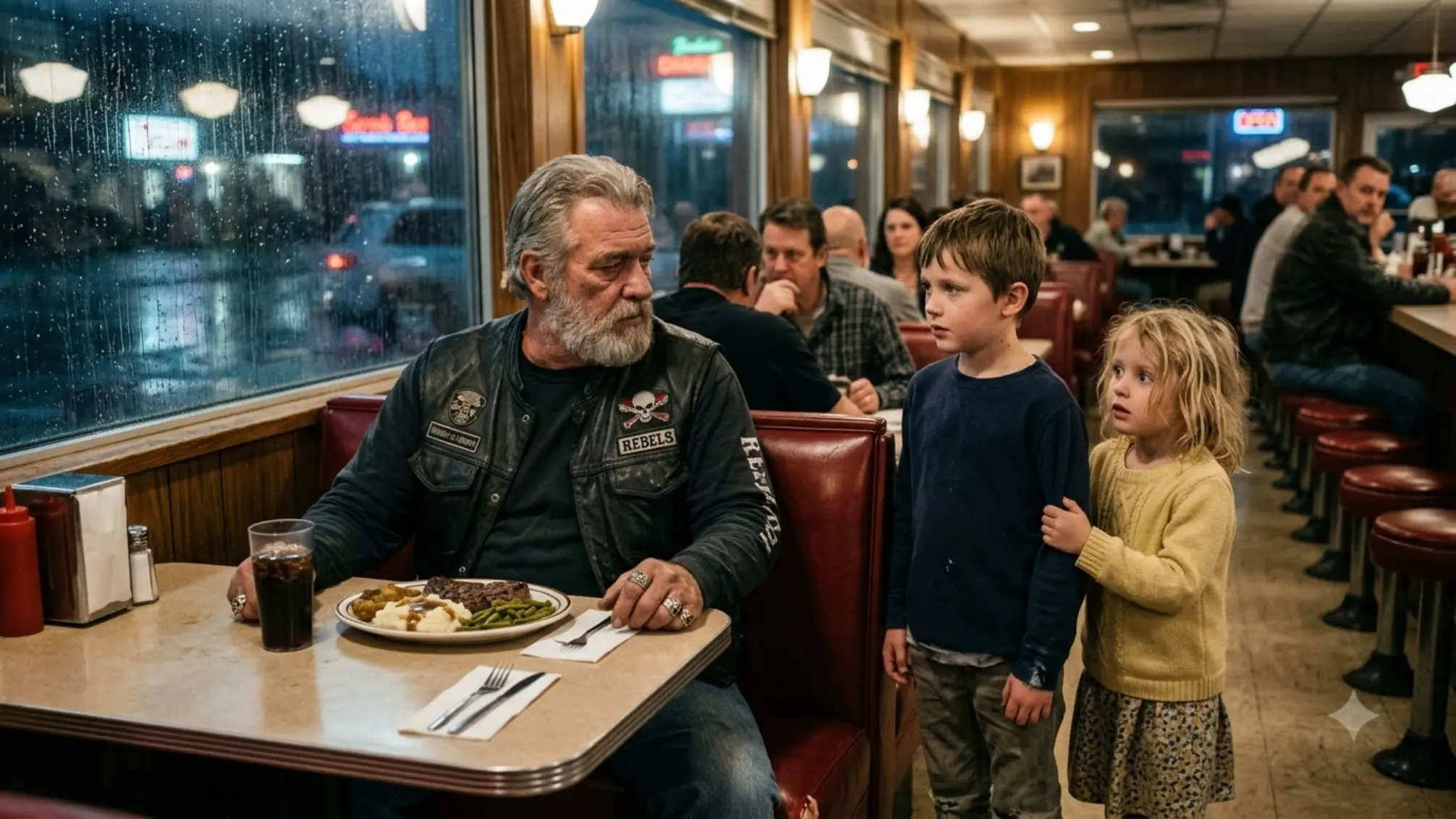
He turned toward the voice.
A thin boy stood beside the table, trying to keep his shoulders straight despite the water dripping from his dark hair. He could not have been older than nine. A soaked navy long-sleeve shirt clung to his narrow frame, and his worn jeans were dark around the knees from the rain.
Behind him stood a little girl of about six.
She wore a faded yellow sweater over a gray skirt, black tights, and brown shoes that looked one winter too small. Wet strands of light-brown hair stuck to her cheeks. One small hand clutched the back of her brother’s shirt while her wide eyes remained fixed on Gabriel’s plate.
Gabriel had spent thirty-eight years riding with the Iron Harbor Riders. He had faced violent men, buried friends, and walked into situations that sent younger bikers running for safer ground.
Yet the boy’s question struck him harder than any fist ever had.
“That plate’s still mine, kid,” Gabriel said gently. “Why are you asking for scraps instead of a seat?”
The boy swallowed.
“Because she’s hungry,” he whispered. “And I only need to know if she can eat first.”
The little girl lowered her head, embarrassed by the attention.
Gabriel pushed the plate toward the empty side of the booth.
“Then sit down right now,” he said. “And tell me who left you two out in that rain.”
The boy did not move.
“We don’t have money.”
“I didn’t ask for any.”
“People say that first.”
Gabriel studied him. That sentence had not come from a suspicious child. It had come from a child who had learned that kindness often arrived with conditions hidden behind it.
Gabriel raised one hand and motioned to the waitress.
“Carla, bring two hot chocolates, two cheeseburgers, fries, and whatever pie is freshest.”
The boy’s eyes widened.
“We only asked for what you didn’t want.”
“I know.”
“We can’t pay you back.”
Gabriel leaned against the booth.
“Neither could I when someone fed me at your age.”
That finally made the boy look at him.
Carla hurried over with two towels. She had worked at Miller’s for nearly twenty years and knew Gabriel well enough not to ask questions in front of the children. She wrapped one towel around the little girl’s shoulders and offered the other to the boy.
The girl climbed slowly into the booth.
The boy remained standing until Gabriel nodded toward the seat beside her. Only then did he slide in, positioning himself close enough to block anyone from reaching his sister without first passing him.
Gabriel noticed the movement.
“What’s your name?”
“Eli.”
“And hers?”
“Rose.”
The little girl glanced up.
“I’m six,” she said softly.
Gabriel smiled. “That’s an important age.”
Rose nodded seriously. “Eli says I’m almost seven.”
“You are,” Eli said. “In three months.”
Gabriel looked at the front windows. Rain rolled across the parking lot in silver sheets. Beyond the glass, three black motorcycles stood beneath the diner awning, water dripping from their chrome and leather seats.
“Where are your parents?”
Eli’s expression closed.
“Our mom’s coming back.”
“When?”
“She said soon.”
“Where did she go?”
“To find somewhere warm.”
Gabriel waited.
Eli gripped the edge of the table. “She told us to stay near the bus station. But the security man made us leave.”
The bus station sat nearly two miles away.
“You walked here?”
Eli nodded.
“In this storm?”
“Rose was cold.”
Rose leaned toward her brother and whispered, “I’m warmer now.”
The food arrived.
Eli stared at the plates as if they might vanish if he reached too quickly. He waited until Rose picked up her burger, then began eating his own. The little girl took two hurried bites and immediately wrapped half the burger in a napkin.
Gabriel noticed.
“What’s that for?”
Rose froze.
Eli answered for her. “Tomorrow.”
Carla turned away, pretending to wipe the counter while blinking hard.
Gabriel reached into the pocket of his leather vest and removed his phone.
“Eli, what’s your mother’s name?”
The boy stopped chewing.
“Why?”
“So I can help find her.”
“You’ll call the police.”
“Maybe.”
Eli pushed his plate away.
“We should go.”
Rose looked frightened but immediately set down her food.
Gabriel did not block them.
“Did the police hurt your mother?”
Eli stared at him.
“No.”
“Then why are you afraid of them?”
“Because they’ll separate us.”
The diner became quieter around them.
Gabriel placed the phone on the table where Eli could see it.
“I won’t make that call without telling you. But two children cannot stay outside tonight.”
“We’ve stayed outside before.”
“That doesn’t make it right.”
Eli’s jaw tightened with the fragile pride of a child carrying responsibilities far beyond his years.
“I take care of Rose.”
“I can see that.”
“She stays with me.”
Gabriel leaned forward.
“Listen carefully, son. Protecting her doesn’t mean you have to fight every battle alone.”
Eli looked toward the rain.
“That’s what Mom said.”
“When?”
“The night she got sick.”
Gabriel felt something cold settle in his chest.
“How sick?”
“She was coughing. She fell down near the station. An ambulance came, and she told us to wait under the roof. But they took her away.”
Rose’s eyes filled with tears.
“Mommy couldn’t breathe.”
“How long ago?”
Eli looked toward the diner clock.
“This morning.”
Gabriel grabbed his phone.
“Which hospital?”
“I don’t know.”
“There’s only one emergency hospital within twenty miles.”
Eli shook his head violently. “You promised not to call anyone without telling us.”
“You’re right.”
Gabriel placed the phone down again.
“I need to call the hospital and find your mother. I also need to call someone whose job is to keep children safe while their parent is sick. I will tell them that you stay together. I will not let anyone pull Rose away from you while I am standing here.”
“You can’t promise that.”
Gabriel looked directly into his eyes.
“No. I can promise I’ll fight for it.”
Eli studied the patches on Gabriel’s vest.
“Are you a bad man?”
A trucker near the counter nearly choked on his coffee.
Gabriel glanced down at the winged skull stitched across his chest.
“I have been.”
Rose looked alarmed.
Gabriel continued, “But I try not to be anymore.”
Eli considered the answer.
Most adults would have denied it. Gabriel suspected that was why the boy finally believed him.
“Call the hospital,” Eli said.
Gabriel contacted St. Anne’s Medical Center.
A receptionist could not release patient information without a full name. Eli gave him “Megan Lane,” and Gabriel repeated it into the phone.
There was a long pause.
The receptionist transferred him to the emergency department.
A nurse confirmed that Megan Lane had been admitted with severe pneumonia and complications from untreated asthma. She was stable but unconscious under heavy medication. Hospital staff had found no emergency contact information and did not know she had children waiting outside the bus station.
Gabriel ended the call.
“Your mother is alive.”
Rose burst into tears.
Eli held her instantly.
“Can we see her?”
“Not tonight. But we’re going to make sure she knows you’re safe.”
Gabriel called Mara Bennett next.
Mara had once ridden with the Iron Harbor club before becoming a county family-support coordinator. She knew the foster-care system, emergency placements, and every judge in the county who understood that siblings should not be separated merely because paperwork made it convenient.
When Gabriel explained the situation, Mara’s voice changed.
“Keep them there. I’m coming.”
Eli heard her through the speaker.
“Who is she?”
“Someone who knows the rules better than the people who misuse them.”
Forty minutes later, Mara entered the diner carrying two blankets and a folder. She was fifty-three, with silver-streaked black hair, brown skin, and the direct expression of a woman who had spent years walking into difficult rooms without asking permission.
She introduced herself to the children and sat at the edge of the booth.
“I need to ask some questions,” she said. “You can answer only what you know.”
Eli nodded.
“Where have you been sleeping?”
“Different places.”
“With your mother?”
“Yes.”
“How long have you been without a permanent home?”
Eli looked down.
“Since October.”
It was now February.
Their mother had lost her apartment after missing work during repeated asthma attacks. She moved between motels, shelters, and borrowed rooms while trying to keep the children enrolled in school. When her savings ended, they began sleeping in a car owned by a friend.
The friend took the car back three weeks earlier.
Since then, Megan and the children had survived in shelters when beds were available and public places when they were not.
“Do you have family?” Mara asked.
“Our grandma died,” Eli said.
“Your father?”
Eli’s face hardened.
“He left before Rose remembers.”
Mara opened the folder.
“There is an emergency foster home available tonight.”
Eli grabbed Rose’s hand.
“No.”
“You would stay together.”
“No.”
“It belongs to a woman named Denise who has cared for siblings before.”
“No.”
Gabriel saw panic rising in the boy’s eyes.
“What’s wrong with foster homes?”
Eli said nothing.
Rose whispered, “The last man yelled.”
Mara slowly closed the folder.
“Your family has been in care before?”
“Only two nights,” Eli said. “Mom was in the hospital last year. They put us with a man and woman. The man got angry because Rose wet the bed.”
Rose hid her face.
“He locked me in the laundry room,” she said.
Gabriel’s hand tightened around the coffee mug.
Mara’s expression became carefully controlled.
“Did anyone report that?”
“Mom did,” Eli said. “They said there wasn’t proof.”
Gabriel stood.
“Where can they stay that does not involve strangers?”
Mara looked at him.
“You know the answer you’re trying to make me say.”
“Say it anyway.”
“With a licensed emergency caregiver.”
“I’ll become one.”
“That takes time.”
“How much?”
“Usually weeks.”
“How fast if the county director is awakened by thirty bikers parked outside his house?”
Mara glared.
“That is not helping.”
“It would get him awake.”
Carla approached with fresh hot chocolate.
“I have a spare room,” she said. “My daughter moved to Kansas. I’ve passed background checks for the diner and the church nursery.”
Mara looked at her.
“Do you live alone?”
“My sister lives upstairs.”
“Pets?”
“One old dog that sleeps through thunder.”
“Separate beds?”
“Yes.”
Eli shook his head.
“We’re not going without Mom.”
Mara turned toward him.
“Your mother needs time in the hospital. Sleeping outside will not help her recover.”
“She’ll wake up and think we left.”
Gabriel sat down again.
“What if I take you to see her first?”
Mara hesitated.
“The hospital may allow a brief visit if the social worker approves.”
“Then let’s ask.”
The rain had weakened by the time they left the diner.
Gabriel could not carry both children safely on his motorcycle, so Carla drove them in her station wagon while Gabriel and two other Iron Harbor riders followed. Mara contacted the hospital and arranged a supervised visit.
Megan Lane lay unconscious beneath white sheets, an oxygen mask covering her mouth and nose. She was thirty-two but looked older from exhaustion. Dark circles surrounded her closed eyes, and one hand rested beside an intravenous line.
Rose ran to the bed.
“Mommy.”
Eli remained near the doorway.
For the first time that evening, he looked like the nine-year-old child he was instead of a small exhausted father.
Gabriel placed one hand on his shoulder.
“You can go to her.”
Eli shook his head.
“What if she dies while I’m touching her?”
“Then she’ll know you were there.”
The boy crossed the room.
He climbed carefully onto the chair beside the bed and took his mother’s hand.
Rose pressed the wrapped half of her hamburger onto the bedside table.
“For tomorrow,” she whispered.
Mara turned away.
A hospital social worker explained that Megan might remain admitted for at least a week. Untreated infection had spread through both lungs, and her asthma made recovery more difficult. She needed rest, medication, and a stable discharge plan.
The word stable carried more weight than the others.
Megan could survive the pneumonia and still lose her children if she returned to the street.
Gabriel understood before anyone said it.
He waited until the children were asleep in Carla’s spare room before calling the Iron Harbor Riders.
Twenty-three men answered within an hour.
They met at the clubhouse, a converted mechanic’s shop on the edge of town. Gabriel stood beside a map while rain tapped against the metal roof.
“A mother is in the hospital,” he said. “Two kids are staying with Carla. They need somewhere permanent before she gets released.”
Bear Collins, the club’s treasurer, folded his arms.
“What happened to their apartment?”
“Medical debt, lost work, eviction.”
“How much debt?”
“I don’t know yet.”
“What do they need?”
“A home.”
No one laughed.
Iron Harbor had a reputation built from noise, leather, and men who did not always choose peaceful solutions. But the club also maintained a relief fund for families of deceased riders and injured workers. They repaired roofs, delivered food during winter storms, and escorted abused women to court when their former partners tried to intimidate them.
They did not advertise any of it.
“What kind of home?” Bear asked.
Gabriel pointed toward an abandoned property on Willow Road.
The small house had belonged to a club member named Dennis Cole, who died the previous summer. Dennis had no children, and his sister wanted the property sold. The roof was sound, but the plumbing leaked and the interior needed repairs.
“We buy it,” Gabriel said.
“With what?”
“The emergency fund.”
Bear frowned. “That fund belongs to members.”
Gabriel looked around the room.
“So did Dennis.”
The men became quiet.
Dennis had spent his childhood moving between foster homes. He once told Gabriel that the only place he ever felt chosen was inside Iron Harbor.
Bear opened the financial ledger.
“We can make an offer. But repairs will cost.”
“I’ll cover the rest.”
“You don’t have the rest.”
“I have my retirement account.”
Bear stared at him.
“You’re fifty-eight.”
“I noticed.”
“You need that money.”
“So do they.”
The club voted.
Every hand rose.
Work began the next morning.
Iron Harbor riders replaced broken pipes, repaired drywall, painted bedrooms, installed kitchen cabinets, and cleared weeds from the yard. Carla chose yellow curtains for Rose’s room and navy bedding for Eli’s.
Gabriel objected.
“Too obvious.”
Carla ignored him.
Local businesses joined after hearing only that a family needed help. A furniture store donated beds. A grocery owner filled the pantry. A contractor replaced the damaged furnace without charging labor.
Mara handled the legal side.
The house could not simply be handed to Megan without creating taxes and obligations she could not manage. Instead, the club established a housing trust that allowed her to remain there at a minimal rent while she rebuilt her finances. The trust would cover major repairs, and every payment Megan made would build toward eventual ownership.
It was not charity disguised as control.
It was a path.
Megan woke on the third day.
Her first words were the children’s names.
Gabriel brought Eli and Rose into the room.
Megan began crying before they reached the bed.
“I’m sorry,” she whispered. “I’m so sorry.”
Eli climbed beside her.
“You came back.”
“I always come back.”
Gabriel stood near the door.
Megan looked at him.
“Who are you?”
“The man whose dinner your son interrupted.”
Fear entered her eyes.
“What did he ask you for?”
“Leftovers.”
Her face crumpled.
Gabriel continued before shame could swallow her.
“He asked for Rose first.”
Megan covered her mouth.
“I tried.”
“I know.”
“You don’t know anything about me.”
“I know your son stands between his sister and the world. Kids learn that kind of love somewhere.”
Megan looked toward Eli.
“He should never have had to.”
“No.”
Gabriel stepped closer.
“But that doesn’t mean you failed him. It means you ran out of help.”
Megan remained in the hospital for nine days.
During that time, the Iron Harbor Riders finished the Willow Road house. Gabriel visited each afternoon but never mentioned it. He brought books for the children, coffee for Megan, and forms Mara needed signed.
On the morning of Megan’s discharge, a county van arrived to transport the family to a temporary shelter.
Gabriel stopped it in the hospital parking lot.
Mara stood beside him holding a key.
Megan looked between them.
“What is this?”
“Your discharge plan,” Mara said.
They drove to Willow Road.
Twenty motorcycles lined both sides of the street, their engines silent. Riders stood beside the small white house wearing leather vests and expressions that attempted unsuccessfully to hide their emotions.
Rose saw the yellow curtains first.
“Those are like sunshine.”
Eli stared at the navy blanket visible through the front bedroom window.
Gabriel handed Megan the key.
She did not take it.
“I can’t accept a house.”
“It isn’t free,” he said.
Her expression changed.
“You’ll pay a small rent into a trust. You’ll follow the recovery plan, meet with the employment counselor, and keep the children enrolled in school. When you’re stable, those payments begin building ownership.”
Megan looked at the riders.
“Why?”
Bear stepped forward.
“Because Gabriel talks too much when he cares.”
Gabriel glared at him.
Rose smiled for the first time.
Megan finally took the key.
The front door opened into a clean living room containing a secondhand sofa, a wooden table, and framed photographs of Iowa fields. The refrigerator was full. Coats hung near the door in three sizes.
Rose ran into her room and shouted.
Eli remained in the hallway.
“This is ours?”
“As long as your family needs it,” Gabriel said.
“What happens when we do something wrong?”
“You fix it.”
“What if we can’t pay one month?”
“You tell Mara before it becomes three months.”
“What if someone changes their mind?”
Gabriel crouched so they were eye level.
“No one is coming to throw you outside while you sleep.”
Eli’s face tightened.
He tried to nod, but tears came first.
Gabriel opened one arm.
The boy stepped into it.
For a long moment, Eli held onto the front of Gabriel’s vest and cried with the full force of every fear he had suppressed for Rose.
Gabriel did not tell him to be strong.
He had been strong long enough.
Months passed.
Megan recovered gradually and found work at a medical billing office that allowed flexible hours. She completed certification courses at night while Eli and Rose did homework at the kitchen table.
The children returned to school.
Eli struggled at first. He hid food in his backpack and panicked whenever Megan arrived late. A counselor helped him understand that preparedness was not the same as responsibility for everyone’s survival.
Rose stopped wrapping half her meals in napkins.
Not immediately.
The first time Gabriel noticed an empty plate in front of her, he said nothing. He only looked away long enough to wipe his eyes.
The riders became part of the family without formally deciding to.
Bear repaired Eli’s bicycle. Carla taught Rose to bake apple pie. Mara helped Megan negotiate old medical bills. Gabriel attended school conferences because Eli asked him to come.
At the end of the year, Eli’s class held a family day.
Students brought parents, grandparents, or guardians to speak about work and community. Eli invited Megan, Gabriel, and half the Iron Harbor club.
The teacher limited him to two guests.
He chose his mother and Gabriel.
During the presentation, Eli stood at the front of the room wearing a clean navy sweater.
“My mom works helping people with hospital bills,” he said. “Gabriel leads a motorcycle club, but mostly he tells people what to fix.”
The class laughed.
Gabriel folded his arms.
Eli continued.
“One night, I asked him if my sister could eat his leftovers. He gave us food, but that wasn’t the most important thing.”
The room became still.
“He asked why we didn’t have a seat.”
Gabriel looked toward Megan.
She was crying.
Eli finished quietly.
“Sometimes people give you something because they feel sorry for you. Gabriel made us feel like we belonged at the table.”
Two years after the rainy night, Megan made the final payment required to begin transferring the Willow Road house into her name. The club gathered in the yard for a celebration.
Rose wore a bright yellow dress.
Eli stood beside Gabriel in a small denim vest Carla had sewn for him. It carried no club insignia, only a patch reading FAMILY.
Megan handed Gabriel an envelope.
Inside was a photograph taken at Miller’s Diner. Carla had captured it without anyone noticing. Rose sat eating beside the untouched hot chocolate, Eli watched Gabriel cautiously, and Gabriel pushed his plate toward them.
On the back, Megan had written:
You did not give my children leftovers. You gave them the first safe place they had known in months.
Gabriel read the message twice.
“I only bought dinner.”
Megan shook her head.
“You stayed.”
That evening, the family returned to Miller’s Diner.
They sat in the same booth.
Rose ordered steak, mashed potatoes, and green beans because she remembered Gabriel’s old meal. Eli asked for a cheeseburger and ate every bite.
A nervous young father entered carrying a sleeping toddler. He counted the money in his wallet, looked at the menu, and quietly asked Carla whether he could order only milk for the child.
Gabriel noticed.
Before he could stand, Eli was already moving.
The boy walked to the counter and placed the money he had saved from mowing lawns beside the register.
“Put their dinner on this,” he whispered.
The young father looked at him.
“I can’t take your money.”
Eli smiled gently.
“That’s okay. You don’t have to pay me back.”
Gabriel watched from the booth.
A child who once begged for scraps was now offering someone else a seat.
Outside, the Iron Harbor motorcycles stood beneath the diner lights. The rain had stopped, and the highway stretched dark and open beyond the glass.
Rose leaned against Gabriel’s arm.
“Are we bikers now?”
Megan laughed.
Gabriel considered the question.
“No.”
Rose frowned.
“You’re family,” he said. “That’s harder to get into.”
She smiled and returned to her pie.
Gabriel looked around the table at Megan, Eli, Rose, Carla, Bear, and the riders filling the neighboring booths.
Years earlier, he believed belonging meant wearing the same patch, riding the same roads, and standing beside the same men when trouble arrived.
He understood it differently now.
Belonging was a child saving half a hamburger because hunger had taught her not to trust tomorrow.
It was a boy asking for scraps because pride mattered less than his sister’s empty stomach.
It was a mother surviving long enough to accept help without losing her dignity.
And it was a room full of people deciding that two frightened children would never again have to ask whether they deserved a place at the table.
Eli had entered the diner asking for what someone else left behind.
Gabriel gave him dinner.
The club gave him a house.
But the thing that changed the boy’s life was simpler than food, money, or walls.
Someone looked at him and said:
Sit down.
You belong here.