The deafening roar of one hundred and forty Harley-Davidsons did not simply shake the cracked asphalt of Sunnyside Trailer Park.
It broke something open.
It shattered the quiet desperation of a ten-year-old boy’s life, a life that had become too small, too hungry, too hot, and too frightened for any child to carry.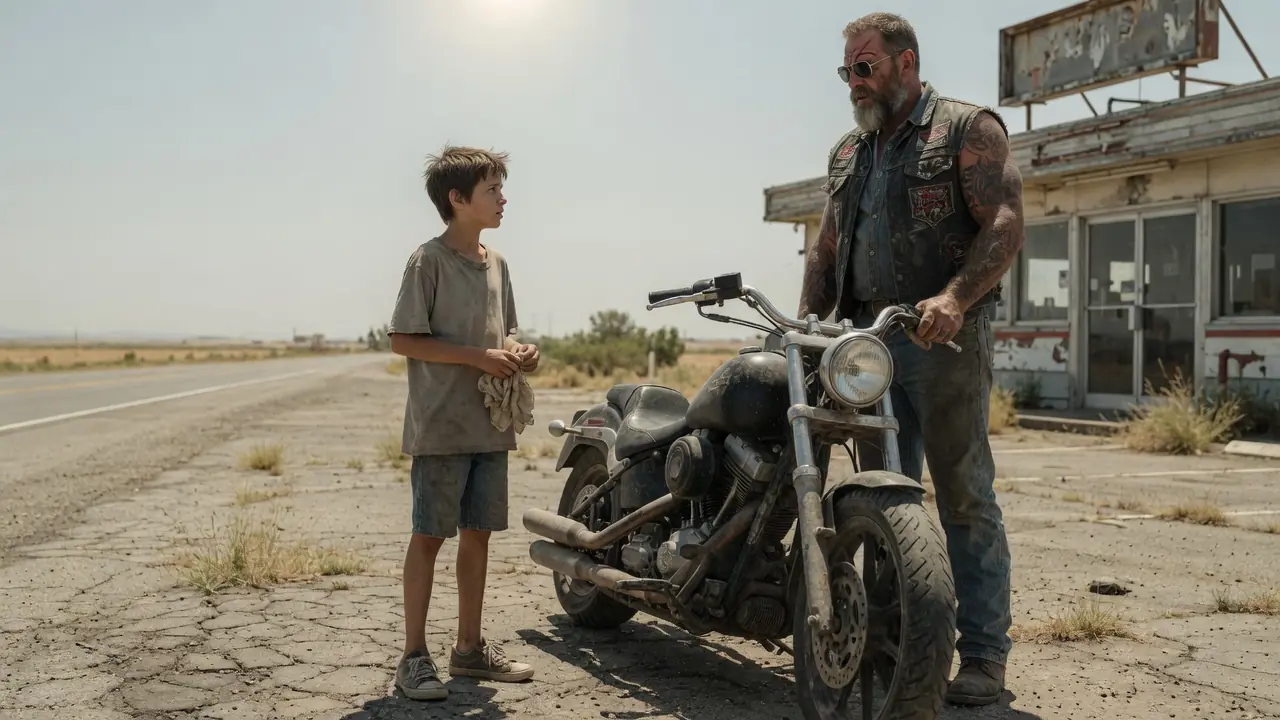
Leo Ramirez had only wanted a single dollar.
One dollar for cleaning the dust off a stranger’s chrome fender.
One dollar for a sandwich he hoped to split with his sick mother.
One dollar to prove that he was not just a hungry kid wandering a diner parking lot with empty pockets and a heart full of panic.
He never expected a dangerous motorcycle club to hear the part of his life he was too ashamed to say out loud.
He never expected the man with the scarred eyebrow and the red-and-white winged death head on his vest to look into his eyes and see more than trouble.
He never expected an army to come back for him.
The blistering July sun beat down on the outskirts of Fresno, California, turning the cracked pavement outside Henderson’s Diner into a mirror of wavering heat. The air smelled of gasoline, fryer oil, baked dust, and old weeds dying along the edge of the highway.
For Leo, the heat was the least of his problems.
His stomach had been twisting itself into painful knots since yesterday morning. He had tried drinking water from the rusted faucet outside the trailer park office to fool his body into thinking it had eaten. It had not worked.
Hunger always came back honest.
It did not care how brave he tried to be.
The worn soles of his sneakers scuffed against the gravel parking lot as he searched for dropped coins. His eyes moved over bottle caps, cigarette butts, straw wrappers, gravel, ants, old gum, and dark oil stains. Anything round made his heart jump for half a second before disappointment pulled it down again.
A quarter would have been a miracle.
A dime would have mattered.
A dollar felt almost impossible.
Leo was thin, too thin for a boy his age. His collarbones jutted sharply beneath the neckline of his oversized faded T-shirt. His jeans were held up by a shoelace tied through the belt loops. His sneakers had holes near the toes, and the rubber soles had started to peel away at the edges.
His eyes were the worst part.
They were large, dark, and watchful, with shadows underneath them that belonged on the face of an old man who had stayed awake through too many bad nights.
Back at the trailer, one mile down the road behind the old lumber yard, his mother, Diane, was fighting a respiratory infection that seemed to tighten around her lungs by the hour.
Diane Ramirez had worked at the Fresno Valley Packing Plant for eleven years. She had stood on concrete floors through heat waves, early mornings, late shifts, and supervisors who never remembered anyone’s name unless something went wrong. She could move faster than anyone on Line Four. She could inspect fruit with one glance, tape a box with one hand, and hum old ranchera songs under her breath when the day became too long.
Then the coughing began.
At first, she told Leo it was dust from the plant.
Then allergies.
Then just a summer cold.
But the cold went deeper. It soaked into her chest. It turned her voice rough and wet. It made her bend over the sink at night, one hand braced against the counter while Leo stood helplessly nearby holding a glass of water she could barely drink.
No health insurance.
No paid leave left.
No savings.
The factory cut her hours, then stopped scheduling her entirely.
Their small world collapsed in less than two weeks.
The pantry was empty except for salt, half a box of stale crackers, and a can of tomato paste Leo had opened the night before and eaten with a spoon. The electricity was scheduled to be shut off by Friday. Their landlord had already taped a notice to the trailer door, warning that rent was late again.
Leo had hidden the notice before his mother saw it.
She already had enough to breathe through.
That morning, Diane had tried to get out of bed to make him breakfast, as if there were something left to cook. She swung her legs over the side, coughed until she nearly fell, and whispered, “I’m sorry, mijo.”
Leo hated those words.
He hated that she said them to him.
He hated that she thought being sick was something to apologize for.
So he lied.
“I’m not hungry,” he said.
His stomach growled loudly enough that both of them heard it.
Diane closed her eyes.
Leo left before she could cry.
He told her he was going to look for bottles to return.
That part was partly true.
He checked the alley behind the liquor store. Nothing. The gas station trash cans. Nothing worth carrying. The wash bay behind the old car lot. Empty. By late afternoon, the sun had climbed so high and hot that everything seemed to blur at the edges.
That was how Leo ended up in the parking lot of Henderson’s Diner.
He had been there for two hours, walking slow circles around the lot, looking for coins near tires, under picnic benches, beside the soda machine, anywhere people might drop change without noticing.
He found nothing.
Not a quarter.
Not a penny.
Just as he was about to give up and begin the long, humiliating walk home empty-handed, a low thunder rolled across the highway.
Leo looked up.
The sound vibrated through the soles of his shoes before the motorcycle appeared.
A massive custom black Harley-Davidson Panhead turned into the diner lot, its engine growling deep and rough, the kind of sound that made people stop speaking without knowing why. The chrome exhaust flashed blindingly in the harsh sunlight. The black paint looked almost liquid beneath the dust of the road.
The rider pulled into a space near the front of the diner and killed the engine.
The silence afterward felt heavy.
He was a mountain of a man, dressed in faded denim, black boots, and a leather vest marked with the unmistakable red-and-white winged death head. Fully patched. Hells Angels Motorcycle Club.
Even Leo knew what that meant.
Kids in his neighborhood knew which men to avoid without anyone teaching them properly. They learned from tone, from glances, from how adults lowered their voices. The Hells Angels were not people you stared at. They were not people you touched. They were certainly not people whose motorcycles you approached without permission.
The rider swung one heavy boot off the peg, adjusted his dark aviator sunglasses, and walked toward the diner doors.
Leo watched from behind a rusted dumpster.
The man had a thick graying beard, tattooed arms, and a jagged scar cutting through his left eyebrow. He moved like someone used to people getting out of his way.
The glass diner door closed behind him.
Leo’s eyes drifted back to the bike.
It was terrifyingly beautiful.
After miles of highway riding, pale gritty dust coated the front fender, chrome primary cover, handlebars, and headlight housing. The machine looked like a sleeping animal, powerful and dangerous even at rest.
An idea flashed through Leo’s mind.
Not a good idea.
A desperate one.
He did not have soap.
He did not have water.
But he had a reasonably clean rag tucked into his back pocket, a scrap of cloth usually used to wipe sweat from his mother’s forehead when the fever came up at night.
He could clean the bike.
Not touch anything important.
Not scratch it.
Just wipe away dust.
Maybe when the biker came out, Leo could ask for a dollar.
Just one.
A dollar was not stealing.
A dollar for work.
A dollar for trying.
His survival instincts screamed at him not to do it.
His hunger screamed louder.
Leo stepped out from behind the dumpster.
He approached the motorcycle with trembling hands.
Every few seconds he glanced toward the diner windows. He could see the big rider at the counter, talking to a waitress. He was turned partly away. Leo had time.
Carefully, almost reverently, he touched the rag to the chrome exhaust.
Nothing happened.
He wiped once.
Dust came away.
The chrome shone beneath.
Leo’s heartbeat sped up.
He worked in tight, careful circles, buffing away highway grit from the exhaust, the fender, the primary cover, and the headlight. He wiped the leather seat gently, then the handlebars. Sweat ran down his temples and into his eyes, but he did not stop.
He wanted the bike to look good.
Not just good enough to earn pity.
Good enough to earn a dollar.
Ten minutes passed.
Then the heavy glass door of Henderson’s Diner swung open with a violent crash.
“Hey!”
The voice boomed across the lot, deep and gravelly enough to shake the dust from the awning.
“Get your hands off my ride.”
Leo froze.
His fingers tightened around the rag.
His heart slammed so violently against his ribs he thought the biker might see it through his shirt.
Slowly, he turned.
The rider stormed down the diner steps, boots crushing gravel beneath him. Up close, he looked even larger. His arms were covered in faded ink. His scar split one eyebrow into two uneven halves. His beard was thick and gray at the edges, and his sunglasses turned his eyes into black glass.
Richard “Reaper” Hayes.
Leo did not know the name yet.
He only knew the man looked like every warning he had ever been given.
“I asked what the hell you think you’re doing, kid,” Reaper growled, stopping inches from him.
The man’s shadow swallowed the boy.
Leo’s mouth opened, but no sound came out.
He wanted to run.
His legs would not move.
“I was just cleaning it, sir,” Leo whispered finally. “It was dusty from the highway.”
Reaper’s jaw tightened.
“You were cleaning my bike.”
“Yes, sir.”
“With that?”
Leo looked at the rag in his hand.
It suddenly seemed filthy.
He nearly dropped it.
“I was careful,” he said quickly. “I promise. I didn’t scratch anything. I just thought if I made it shine, maybe you might...” His voice cracked. “Maybe you might spare a dollar.”
Reaper did not move.
“A dollar.”
Leo nodded.
“Just one dollar, sir. For a sandwich.”
The parking lot seemed to go silent around them.
Reaper’s face remained hard, but something in his body changed. Not softened exactly. Recalibrated.
His gaze moved over Leo with the attention of a man trained by hard living to distinguish danger from desperation.
He saw the frayed shirt.
The shoes peeling at the soles.
The hollow cheeks.
The way the boy held the rag not like a thief caught stealing, but like a worker afraid he had done the job wrong.
Reaper had dealt with hustlers, thieves, addicts, liars, and street kids for decades. He knew the difference between a con and raw need. He had been raw need once himself.
“You touched my bike for one dollar?” Reaper asked, his voice lower now.
Leo nodded.
“Do you know who I am?”
“No, sir.”
“Do you know what happens to people who put their hands on my property?”
Leo’s eyes filled with tears despite how hard he fought them.
“I’m sorry,” he whispered. “My mom is sick. We don’t have food. I just wanted one dollar.”
For a long, agonizing moment, Reaper said nothing.
Leo braced himself.
For shouting.
For a shove.
For a slap.
For the world to remind him again that hunger did not make him worth mercy.
Instead, Reaper reached into the pocket of his heavy jeans.
Leo flinched.
Reaper noticed.
That flinch did something to him.
Something old and ugly moved behind his sunglasses.
He pulled out a thick silver money clip, peeled off a crisp one-dollar bill, and held it out.
Leo stared.
“Take it,” Reaper said.
Leo reached slowly, as if the bill might vanish.
When his fingers closed around it, his whole body seemed to loosen and shake at the same time.
“You did a good job on the chrome,” Reaper muttered.
Leo blinked up at him.
“What’s your name?” Reaper asked.
“Leo, sir.”
“Leo what?”
“Leo Ramirez.”
“Where do you live, Leo Ramirez?”
Leo hesitated.
He had been taught not to tell strangers where he lived.
But this man had given him the dollar.
And his mother was sick.
“The trailer park behind the old lumber yard,” he said. “Sunnyside. Number forty-two.”
Reaper stared down the road.
Sunnyside Trailer Park.
He knew it.
Everyone knew it.
A row of dying trailers, broken fences, failing air conditioners, and people too poor to leave. Recently, a small street crew had started using the entrance as a hangout. Dealers, scavengers, wannabe tough guys who preyed on people who had no power to complain.
Reaper looked back at the boy.
“You got anybody else?”
Leo shook his head.
“Just my mom.”
“What’s wrong with her?”
“She coughs a lot. She can’t breathe good. She can’t work right now.”
“Doctor?”
“No money.”
The answer was so simple it cut through every lie adults told about systems and options and responsibility.
No money.
No doctor.
No food.
Reaper folded the money clip and put it away.
Then he swung his massive frame over the Harley.
The engine roared to life with a deafening explosion of sound.
Leo stepped back, clutching the single dollar bill to his chest.
Reaper looked at him once more.
“Go buy your sandwich,” he said.
Then he pulled out of the parking lot, kicking up a cloud of white dust.
Leo stood frozen long after the motorcycle disappeared down the highway.
He did not know that his small, desperate act had just set something enormous into motion.
He did not know that Reaper was not the kind of man who forgot the eyes of a hungry child.
He did not know that by tomorrow morning, the one dollar in his hand would become a story people in Fresno would tell for the rest of their lives.
The Fresno Hells Angels clubhouse sat on the industrial side of town behind a high corrugated metal fence topped with razor wire.
Inside, the heavy air smelled of stale beer, motor oil, cigarette smoke, leather, and old wood. The main room was dimly lit by neon beer signs and harsh overhead lights above two worn pool tables. Motorcycle parts sat on shelves beside framed photos of men who had lived hard, ridden far, and in some cases, died young.
Reaper kicked open the heavy steel door and stepped inside.
The low murmur of conversation stopped.
Men looked up.
The brothers of the charter knew Reaper’s moods better than they knew their own wives, and the massive biker looked deeply disturbed.
He did not head for the pool tables.
He did not grab a beer from the cooler.
He walked straight to the long, scarred wooden bar and slammed his fist against the oak surface.
“I need Bones.”
From the back office emerged Jackson “Bones” Miller, president of the Fresno charter.
Bones was lean and wiry, with cold blue eyes and a mind like a steel trap. He did not have Reaper’s size, but when he entered a room, men larger than him made space. He had led the chapter through raids, funerals, prison terms, betrayals, and wars of pride that nearly destroyed lesser men.
He walked to the bar wiping grease from his hands with a shop towel.
“What’s eating you, Rick?”
Reaper turned to the room.
Several key members gathered near him.
Billy Ford, the sergeant-at-arms, a massive bald brawler with a gold tooth and forearms like cinder blocks.
Tommy Henderson, the road captain, quiet, precise, always thinking in routes and timing.
David “Doc” Harrison, an old combat medic who wore his leather cut over a faded college shirt and carried a black medical bag in his truck.
Reaper placed both hands on the bar and lowered his head for a moment.
When he looked up, his voice was rough.
“I was at Henderson’s Diner an hour ago. Came outside and found a kid no older than ten wiping down my Panhead with a rag.”
A low groan moved through the room.
Billy crossed his arms.
“Tell me you didn’t put a kid in the hospital, Rick.”
Reaper turned on him.
“I didn’t touch him.”
Billy lifted both hands.
“Good.”
“He was shaking like a leaf,” Reaper continued. “Starving. Ribs showing through his shirt. He wasn’t stealing. Wasn’t begging, either. He was working. Cleaning chrome because he wanted one dollar for a sandwich.”
The room quieted further.
Reaper reached into his vest, pulled out his money clip, and threw it onto the bar with a clatter.
“I gave him his dollar.”
Bones watched him.
“But?”
“But I looked in that kid’s eyes,” Reaper said. “And I saw myself thirty years ago.”
No one moved.
Reaper rarely spoke about the past.
Men knew pieces.
An alcoholic father.
A mother who vanished.
A little sister who cried herself to sleep from hunger.
A boy stealing bread from the corner store, not because he was bad, but because the world had already decided he was.
“I saw that same dirt-poor hungry kid,” Reaper said. “The one who learns early not to ask grown men for help because help costs more than hunger.”
Doc Harrison’s jaw tightened.
“What’s his name?”
“Leo Ramirez. Sunnyside Trailer Park. Number forty-two. Mother’s sick. No doctor. No food.”
The name of the trailer park changed the air in the room.
Tommy Henderson looked at Bones.
“Sunnyside’s been getting worse.”
Bones nodded once.
He knew.
A low-level street crew had been circling that park for months. Not serious enough to threaten the Angels directly, but cruel enough to make poor families live with their curtains closed. They pushed drugs, collected fake debts, broke windows, threatened tenants, and stole whatever could be sold.
They were parasites.
Not powerful.
But dangerous to people too tired and poor to fight back.
Bones leaned against the bar.
“What are you saying, Reaper?”
Reaper stepped closer.
“I know what we are. We ain’t saints. But we protect what’s ours.”
A few men nodded.
“That boy had more guts than half the grown men I’ve met,” Reaper said. “He walked up to my bike scared out of his mind and worked because he didn’t want charity. He wanted to earn a dollar.”
His voice dropped.
“If we ride in there, we do two things. We feed the boy, and we send a message to those punks at Sunnyside. The families there stop living under their boots.”
Billy’s gold tooth flashed.
“A show of force.”
“Overwhelming force,” Reaper said. “We hit the wholesale market. Load the chase trucks. Bring food, supplies, medicine, whatever Doc says. Then we go straight through the front gate.”
Bones looked around the room.
The men waiting for his decision were not gentle men.
Many had done things the law would not forgive.
But outlaw codes are complicated. The same men who could be brutal over disrespect could become fiercely protective of children, widows, the sick, and anyone who reminded them too much of who they had been before the world hardened them.
Bones turned to Billy.
“Call Bakersfield.”
Billy’s grin widened.
“Yeah?”
“Call Oakland. Call the Nomads. Call every patched brother within a hundred miles.”
Tommy straightened.
“How many you want?”
Bones’s blue eyes went cold.
“All of them.”
The clubhouse erupted into motion.
Phones came out. Boots pounded across wooden floors. Men barked orders. Someone opened the office safe. Someone else started counting cash. Doc Harrison began making a list of medical supplies, food, bottled water, and fever medicine.
Reaper stepped outside onto the concrete patio and lit a crumpled cigarette.
The sun was dropping behind the industrial yard, staining the sky a deep red-orange over Fresno.
He thought of Leo holding that dollar like it was a life raft.
He thought of himself at ten, hiding behind a dumpster with a stolen loaf of bread under his shirt, waiting for someone to hit him.
Tomorrow, that kid was not getting a dollar.
He was getting an army.
Dawn did not break quietly over the San Joaquin Valley.
It arrived beneath the earth-shaking blast of raw horsepower.
By six o’clock, the perimeter of the Fresno charter’s clubhouse was overrun. The call had gone out across the state, and the brotherhood had answered with terrifying speed.
They came in off Highway 99 in packs of ten and twenty.
From Bakersfield came Wyatt “Dutch” Vanderwall, an imposing president with a white beard, red bandana, and a stare that made arguments unnecessary. He led thirty riders, their leather cuts thick with road dust.
From Oakland came Iron Mike Sullivan with a line of custom choppers gleaming under the pale morning light. His men rode quiet and tight, two by two, like a dark river of chrome and black steel.
Nomads arrived alone or in pairs, men with no single home chapter, carrying bedrolls, hard eyes, and cash stuffed into their pockets.
By sunrise, one hundred and forty fully patched Hells Angels had gathered.
The industrial park looked less like a clubhouse lot and more like a war camp.
Reaper stood by his Panhead, holding black coffee in a grease-stained Styrofoam cup. He watched Bones walk to the center of the asphalt and raise one tattooed arm.
Engines cut.
The sudden silence was almost as powerful as the roar had been.
“Listen up,” Bones barked.
His voice carried across the lot.
“We got a situation on the south side. Ten-year-old kid. Name is Leo Ramirez. Lives at Sunnyside Trailer Park with his mother. She’s sick. No food. No power coming by Friday. No help.”
Men shifted.
Some looked down.
Some clenched jaws.
“Yesterday,” Bones continued, “this kid stood up to Reaper’s bike with a rag in his hand because he wanted to earn one dollar. Not steal it. Not beg for it. Earn it.”
A murmur moved through the ranks.
“That dollar is going to buy him a hell of a lot more than a sandwich today.”
Low approval rippled through the crowd.
“But that’s not the whole story. Sunnyside is being squeezed by a crew of street punks who think poor people are easy targets and our backyard is theirs to poison.”
Bones’s eyes moved across the men.
“Today we make two deliveries. Food to trailer forty-two. A message to the cockroaches at the gate.”
Billy laughed once, low and dangerous.
Bones pointed toward three black Ford F-250 pickups parked near the gate, the chapter’s chase trucks normally used for hauling broken-down bikes.
“We hit the wholesale market first. Meat, bread, canned goods, bottled water, medicine, blankets, clothes, hygiene supplies. Every man digs into his wallet.”
He paused.
“And no stealing. We pay clean. This one is for the kid.”
Twenty minutes later, the quiet morning routine of Gary Stevenson, manager of Valley Wholesale Foods, was violently interrupted.
The glass doors slid open, and a sea of leather-clad giants poured into the aisles.
Gary nearly dropped his clipboard.
He reached instinctively for the phone beneath the customer service counter. His hands shook so badly he missed it twice.
Reaper stepped up to the counter and placed a thick stack of hundred-dollar bills on the laminate surface.
“We need food,” he said.
Gary stared at the money.
“Food?”
“Meat. Bread. canned goods. fruit. rice. beans. bottled water. Kids’ clothes. Cleaning supplies. Portable air conditioner if you got one.”
Gary opened his mouth.
Reaper’s scarred face remained deadpan.
“And keep the change.”
For the next hour, the bikers moved through the warehouse with startling efficiency.
They cleared shelves of nonperishable food, pasta, peanut butter, rice, beans, soup, cereal, flour, and canned vegetables. They loaded fresh produce, milk, eggs, ground beef, chicken, bread, bottled water, and electrolyte drinks. Doc Harrison selected fever reducers, cough medicine, thermometers, disinfectant, and inhalers he legally purchased through a clinic contact before they rolled out.
They bought blankets, towels, soap, toothpaste, laundry detergent, a portable air conditioning unit, and a box of children’s clothes.
One biker who looked like he had never willingly entered a children’s aisle in his life held up two packs of socks and asked another, “What size is ten-year-old boy?”
The other biker shrugged helplessly.
A grandmother shopping nearby said, “Get medium. They grow fast.”
The biker nodded seriously and grabbed five packs.
By nine o’clock, the trucks were loaded until their heavy suspensions groaned.
Bones and Reaper took the front of the formation.
One hundred and forty Harley-Davidsons roared to life.
The sound rattled storefront windows, set off two car alarms, and sent pigeons exploding from the roof of the market.
They rode two abreast through Fresno, a seemingly endless column of chrome, black steel, denim, leather, and thunder.
Local police cruisers slowed at intersections.
No one tried to stop them.
Maybe the officers knew better.
Maybe someone had made a call.
Maybe the sight of three trucks full of groceries behind one hundred and forty bikers confused them enough to wait and see.
By the time the convoy reached the dirt access road leading to Sunnyside Trailer Park, the sun was already rising hot and white over the valley.
Sunnyside was a desolate stretch of rusted single-wides, broken chain-link fences, dead weeds, leaning mailboxes, and patched roofs. A few old air conditioners hung uselessly from windows. Stray dogs slept beneath trailers in the shade. Children’s toys lay faded in dirt yards where no grass had survived.
Near the entrance, six members of the street crew sat on the hoods of two modified sedans.
They were laughing, passing something between them, too comfortable in a place that did not belong to them.
Their leader, Jesse, skinny and sharp-faced, wore a gold chain over a white tank top and the lazy confidence of a man who had only ever frightened people weaker than him.
The laughter died when the ground began to vibrate.
Jesse looked up.
Around the bend came Bones and Reaper.
Behind them came a tidal wave of motorcycles.
The sound became physical, pressing against the chest, rattling the trailer windows, making loose metal siding tremble. Dust rose in a thick brown cloud, swallowing the sun.
The bikers did not slow.
They fanned out with practiced precision until the six men at the entrance were surrounded by a tight, suffocating ring of idling machines and grim, silent riders.
Jesse slid off the hood of the sedan.
His swagger vanished so quickly it almost looked like a magic trick.
Reaper killed his engine.
Several bikes idled down around him.
He stood, towering over Jesse.
“You boys are leaving.”
Jesse swallowed.
“What?”
“You’re leaving,” Reaper repeated. “You’re leaving the cars. You’re leaving whatever poison you brought into this park. And you’re walking out of this county.”
One of Jesse’s friends took half a step back.
Reaper’s voice remained flat.
“If I ever see your faces near Sunnyside again, you won’t be walking much afterward.”
Jesse looked around at the ring of one hundred and forty bikers. Every path was blocked. Every eye was on him. These were not frightened tenants. These were not exhausted mothers or old men with bad backs. These were men built from years of violence, loyalty, scars, and road dust.
Jesse raised his hands slowly.
“Okay. We’re going.”
“Now,” Bones said.
The six men walked backward at first, then turned and hurried down the dirt road, abandoning their cars, their corner, and their illusion of power.
No one chased them.
No one had to.
Bones nodded once.
The convoy moved deeper into the park.
Inside trailer forty-two, Leo was sitting on a stained rug, trying to soak a rag in a bowl of lukewarm tap water. He planned to place it on his mother’s forehead again.
Diane coughed from the bedroom, each sound wet and painful.
When the rumble began, Leo thought it was an earthquake.
The trailer walls vibrated. Plates rattled in the sink. A cracked picture frame buzzed against the wall. The sound grew louder and deeper until it seemed to enter Leo’s chest and shake his bones.
“Leo!” Diane cried from the bedroom, her voice hoarse with panic. “Lock the door. Don’t let anyone in.”
She assumed the worst.
Everyone at Sunnyside assumed the worst when engines came in numbers.
Leo crept to the front window and peeled back a corner of the yellowed blinds.
His breath caught.
The dirt road outside was completely blocked.
Motorcycles stretched as far as he could see.
At the front, walking toward the cracked concrete blocks that served as their steps, was the giant man from the diner.
The man with the scar.
The man from the black Harley.
The man who had given him a dollar.
A heavy knock echoed through the thin metal door.
“Leo!” Diane coughed. “Don’t open it!”
Leo reached into his pocket.
The one-dollar bill was still folded there.
He did not know why he had kept it instead of spending it.
Maybe because it had become more than money.
Proof, maybe.
Proof someone had looked at him and not turned away.
With trembling fingers, he unlocked the door and opened it.
Reaper stood on the porch, his massive frame blocking the sun.
Behind him stood Bones, Dutch, Doc Harrison, and men holding cardboard boxes.
“Morning, Leo,” Reaper said.
His voice was gruff, but not hard.
“I brought you that sandwich.”
Leo stared.
“What?”
Reaper looked over his shoulder.
“Boys.”
The invasion began.
But it was an invasion of mercy.
Bikers filed into the trailer in an organized line. They did not joke. They did not push. They did not treat the home like trash even though it was falling apart around them. They moved with strange, solemn care.
Iron Mike carried in the new portable air conditioning unit and installed it in the living room window. Within minutes, cold air began blowing through the stifling metal box.
Two men carried boxes of food to the tiny kitchen. Rice, beans, pasta, soup, bread, cereal, peanut butter, canned vegetables, fruit, milk, eggs, beef, chicken, and water. Another man stacked cleaning supplies by the sink. Someone placed new towels in the bathroom. Someone else set folded blankets on the couch.
A huge biker with tattoos across his neck crouched beside Leo and held out three packs of socks like a sacred offering.
“Kid size,” he said awkwardly. “Maybe.”
Leo took them because he did not know what else to do.
From the bedroom doorway, Diane appeared wrapped in a thin sheet. She leaned heavily against the wall, pale, sweating, and shaking from fever.
Her sunken eyes widened as she watched tattooed men quietly fill her empty pantry.
“What is happening?” she whispered. “Who are you people?”
Reaper removed his sunglasses and nodded respectfully.
“Ma’am. Your boy did a job for me yesterday. Good work. I owed him a bonus.”
Diane’s eyes filled.
“We can’t pay for this.”
“It’s paid.”
“But—”
“It’s paid,” Reaper said again, gently but firmly.
Doc Harrison stepped forward with his black medical bag.
“Ma’am, I’m Doc. I need to listen to your lungs.”
Diane looked frightened.
Leo moved toward her instinctively.
Doc saw it and softened his voice.
“I was a medic. I’m here to help, nothing else.”
Diane let him guide her to the couch.
He checked her temperature, listened to her lungs, measured her oxygen level, and asked careful questions. His expression grew serious, but not hopeless.
“You’ve got a bad respiratory infection,” he said. “You need real treatment. I’ve got antibiotics and inhalers to start. You also need rest, fluids, and follow-up care.”
“I don’t have insurance,” Diane whispered.
Doc looked at Bones.
Bones said, “You do today.”
Diane stared at him.
Bones placed a thick white envelope on the kitchen counter.
Inside was three thousand dollars in cash, collected from the pockets of one hundred and forty outlaws before breakfast.
“That’s for back rent, electric, and doctor visits,” Bones said. “You focus on getting healthy.”
Diane began to shake.
“I don’t understand why you’re doing this.”
Reaper looked at Leo.
“Because your boy asked for one dollar and worked for it.”
Diane covered her mouth.
A sob broke through her.
Not delicate crying.
Not quiet tears.
A deep, exhausted sound from a woman who had been holding up a collapsing world with both hands and had finally felt someone take part of the weight.
Leo stood in the center of the trailer, unable to move.
Food filled the kitchen.
Cold air filled the room.
Medicine sat on the coffee table.
His mother was crying, but not from fear.
Everything had changed too quickly for his mind to understand.
Reaper walked over and knelt before him.
It was not easy for a man that size, but he did it anyway.
He looked Leo directly in the eyes.
“You keep your head up, kid.”
Leo swallowed.
“You’re the man of the house,” Reaper said. “But that doesn’t mean you carry it alone. You hear me?”
Leo nodded, tears blurring his vision.
“If anyone bothers you, your mother, or anyone in this trailer park, you find me.”
“I don’t know where.”
Reaper reached into his vest and handed Leo a card. It had no fancy design. Just a name and number.
“Now you do.”
Leo looked at the card.
Then at the man.
“I didn’t spend the dollar,” Leo admitted.
Reaper tilted his head.
“No?”
Leo pulled the folded bill from his pocket.
“I was going to. But then I thought...” His voice shook. “I thought maybe I should keep it because you gave it to me for working.”
Reaper stared at the bill.
Something heavy passed through his face.
He took the dollar from Leo, folded it carefully, and placed it back into the boy’s hand.
“Then keep it,” he said. “One day, when you got your own shop or your own business or whatever life you build, you put that behind glass. Remember you earned your first dollar when you were hungry and scared, and you still worked careful.”
Leo cried then.
He tried not to.
He failed.
Reaper placed one huge hand on his shoulder.
No one laughed.
No one looked away.
Outside, the one hundred and forty motorcycles waited in rows beneath the California sun.
Before the Angels left, they gathered the residents of Sunnyside near the park entrance.
People came out slowly at first.
An old man with an oxygen tank.
A young mother holding a baby.
Two teenage boys who pretended not to be afraid.
An elderly woman clutching a rosary.
Families who had spent months hiding behind blinds now stood in the road, looking at the abandoned cars at the entrance and the wall of bikers beyond them.
Bones stood on the bed of one of the pickup trucks.
“This park is done paying fear tax,” he said.
No one spoke.
“Those boys at the gate are gone. If they come back, you call the number posted at trailer forty-two. If your landlord tries illegal evictions, you call. If someone threatens you, you call. If kids here need food, school supplies, help fixing a bike, whatever, you call.”
A woman in the crowd began crying.
Bones pointed toward Leo’s trailer.
“That boy over there worked for one dollar while grown men looked away. We’re done looking away.”
Reaper stood beside Leo.
For the first time in months, maybe years, Leo felt the eyes of the trailer park on him and did not feel ashamed.
The convoy left before noon.
When the bikes started again, the roar filled the trailer park.
But to Leo and Diane, it no longer sounded like a threat.
It sounded like protection.
Like thunder choosing a side.
Like a choir made of engines.
The massive column pulled out in a cloud of dust, leaving behind full cupboards, cold air, medicine, paid bills, abandoned fear, and a story that began spreading before the last motorcycle turned onto the highway.
In the days that followed, things did not become easy.
But they became possible.
Doc Harrison returned two days later to check on Diane. Then again the next week. He drove her to a clinic where a nurse practitioner adjusted her medication and arranged follow-up care. Ruth Morales, a retired school secretary from the trailer park, started sitting with Diane when Leo returned to school.
Because he did return.
The Angels made sure of that too.
A backpack appeared one morning on the porch. New notebooks. Pencils. Two pairs of jeans. Socks that fit. Sneakers without holes. A lunchbox with a note inside that read:
Work hard. Eat lunch. Reaper.
Leo carried that lunchbox like treasure.
At school, people whispered.
Some said the Hells Angels had adopted him.
Some said his mother was connected to criminals.
Some said Leo had become dangerous.
Leo let them talk.
He had survived worse than whispers.
But something had changed in him.
He no longer moved like a child trying not to be seen. He walked straighter. He turned in homework. He ate every meal slowly, as if teaching his body to trust food again.
When a boy in class made a joke about his old shoes, Leo looked at him calmly and said, “You should be careful what you think makes a person poor.”
The boy did not know what to say.
Neither did the teacher.
Diane recovered slowly.
Not all at once.
Some days the cough came back hard. Some nights she cried because accepting help felt like losing pride. But food stayed in the pantry. The power stayed on. The rent was caught up. Cold air moved through the trailer during the worst heat of July.
One evening, as the sun set orange over Sunnyside, Diane sat outside in a folding chair while Leo cleaned the small porch.
“You know,” she said, “I used to be scared of those men.”
Leo looked up.
“Me too.”
“And now?”
He thought about Reaper’s hand on his shoulder. Bones standing on the truck. Doc listening to his mother’s lungs. A huge tattooed man holding socks like he had been entrusted with something sacred.
“I still think they’re scary,” Leo said.
Diane smiled faintly.
“Maybe scary isn’t always bad.”
Leo nodded.
“Maybe sometimes scary protects you from worse scary.”
Months passed.
Then years.
Sunnyside Trailer Park was eventually sold to a developer and torn down. By then, Diane had found steady work at a smaller packing company with better supervisors. With help from a local nonprofit Doc connected them to, she and Leo moved into a small apartment above a laundromat.
Leo kept the one-dollar bill in a plastic sleeve.
He did not spend it.
Not when he was thirteen and wanted a comic book.
Not when he was sixteen and needed gas money.
Not when he was nineteen and working nights at a brake shop while taking classes during the day.
He kept it because Reaper told him to.
And because that dollar had become the dividing line in his life.
Before the dollar, he believed help was something that happened to other people.
After the dollar, he understood that one act of courage, even a desperate one, could call an unexpected force into motion.
Leo did not become an outlaw.
Reaper made sure of that.
When Leo turned fifteen and started hanging too close to the clubhouse, fascinated by engines and leather and brotherhood, Reaper pulled him aside.
“You’re not joining us,” he said.
Leo frowned.
“You said I could find you if I needed anything.”
“And you did. Now you need something else.”
“What?”
“A future that doesn’t come with lawyers and prison visits.”
Leo looked offended.
Reaper sighed.
“You love bikes?”
Leo nodded.
“Then learn to fix them better than anyone. Open a shop. Hire kids who need work. Build something clean.”
That conversation changed Leo’s direction.
He learned engines.
Not just enough to tinker.
Enough to understand them.
He apprenticed with a mechanic named Frank Delgado, who had once owed Bones a favor and paid it forward by teaching Leo everything he knew. Leo learned carburetors, ignition timing, brake systems, electrical diagnostics, welding, fabrication, patience, and how to tell when a customer was lying about what noise the car made.
By twenty-eight, Leo Ramirez opened his own automotive repair shop in downtown Fresno.
Ramirez Custom Auto & Cycle.
The sign was blue and silver.
The front counter was polished wood.
Behind it, mounted in a frame of heavy glass and chrome, hung one crisp one-dollar bill.
Customers asked about it all the time.
Leo never told the short version.
The short version was too small.
So he told them about the heat.
The diner.
The black Harley.
The scarred biker who scared him half to death.
His sick mother.
The dollar.
The roar that came the next morning.
The trucks full of groceries.
The air conditioner humming to life.
The envelope on the counter.
The way one hundred and forty dangerous men became guardians because one hungry child tried to earn his help instead of stealing it.
He told the story carefully.
Not to make heroes out of men who were complicated.
Not to pretend the world was simple.
But to remember that mercy sometimes wore leather, smelled like gasoline, and arrived louder than anyone expected.
Diane lived to see the shop open.
On opening day, she arrived in a blue dress and cried before she made it through the door. Reaper came too, older now, beard almost fully gray, scar still cutting through his eyebrow, shoulders not quite as broad but presence undiminished.
He stood behind the counter and looked at the framed dollar.
“Damn,” he said quietly. “You really kept it.”
Leo smiled.
“You told me to.”
“I say a lot of things.”
“That one mattered.”
Reaper looked around the shop.
Three bays.
Clean floors.
A waiting area with coffee and a bowl of free fruit.
A sign near the register that read:
If a kid comes in hungry, feed him first.
Reaper saw the sign and looked away.
Leo pretended not to notice the old biker wiping his eye.
A few years later, Leo started a program through the shop for teenagers aging out of foster care or living in poverty. He called it First Dollar Training. The students learned oil changes, tire repair, basic diagnostics, customer service, and how to show up on time even when life was messy.
Every student earned one dollar on the first day.
Not much money.
But symbolic.
Leo would hand it to them and say, “This is not charity. This is proof. You worked. You earned. Keep it until you know what it means.”
Some spent it.
Most kept it.
One boy framed his.
One girl taped hers inside a toolbox.
One quiet thirteen-year-old held hers and cried without explaining why.
Leo understood anyway.
Years after the day at Sunnyside, the trailer park existed only in memory, dust, and old property records. Henderson’s Diner changed owners twice. Bones passed away after a long illness, and hundreds of riders came to the funeral. Doc Harrison retired to the coast. Diane grew tomatoes in a small backyard behind the house Leo bought for her.
Reaper still came by the shop on Saturdays.
He never made appointments.
He said appointments were for dentists and people who trusted calendars.
He would pull his old Panhead into Bay One, sit on a stool with coffee, and complain about every motorcycle built after 1984.
Leo always checked the chrome.
Always wiped the fender.
Always did it carefully.
One Saturday, a little boy came into the shop with his mother. He was thin, quiet, and kept glancing at the bowl of fruit on the counter.
Leo saw it immediately.
He remembered being seen.
He picked up an apple and held it out.
The boy hesitated.
Leo said, “You can have it. No charge.”
The boy took it with both hands.
His mother’s eyes filled with embarrassment.
“I’m sorry,” she said. “We’re just here about the tire. I don’t get paid until Monday.”
Leo looked at Reaper, who sat in Bay One pretending not to listen.
Then Leo looked back at the woman.
“We’ll take care of the tire,” he said.
“I can’t pay today.”
“I know.”
“Then why—”
Leo smiled slightly.
“Because sometimes people need help before they can afford it.”
Reaper looked down at his coffee.
The old biker’s mouth twitched.
The lesson had traveled.
From a dollar in a diner parking lot.
To a trailer full of groceries.
To a repair shop in Fresno.
To a hungry boy holding an apple with both hands.
That was how mercy survived.
Not as a speech.
Not as a headline.
But as a thing passed from one person to another when the world expected indifference.
Leo often thought back to that July afternoon.
He remembered the heat.
The hunger.
The fear of touching the Harley.
The shame of asking for one dollar.
He remembered Reaper’s shadow blocking the sun.
And then, more than anything, he remembered the roar the next morning.
One hundred and forty engines.
One hundred and forty men who had no reason, at least no ordinary reason, to care about a sick woman in trailer forty-two and her hungry son.
But they came.
They came because somewhere inside the leather, the scars, the rules, the violence, the reputation, and the road, there remained a code that recognized a child trying to survive with dignity.
They came because Reaper had once been a hungry boy too.
They came because sometimes the people the world fears are the only ones willing to frighten the monsters away.
And behind the counter of Ramirez Custom Auto & Cycle, framed in heavy glass and polished chrome, the one-dollar bill remained.
Not spent.
Not forgotten.
A reminder that even in the darkest, most desperate moments of life, salvation can arrive in a form no one expects.
Sometimes it arrives softly.
Sometimes it arrives quietly.
And sometimes, it arrives on two wheels, one hundred and forty strong, with the thunder of engines loud enough to tell a forgotten boy that the world had finally heard him.