“I don’t care who you think you are—leave before security drags you out.”
Patricia Whitman’s voice cut through the quiet Beverly Hills jewelry boutique, sharp enough to stop every conversation inside the store. Two sales associates froze beside a diamond display, while a wealthy couple near the entrance turned openly to watch. Behind the glass counters, rows of necklaces, watches, and engagement rings glittered beneath perfect white lights.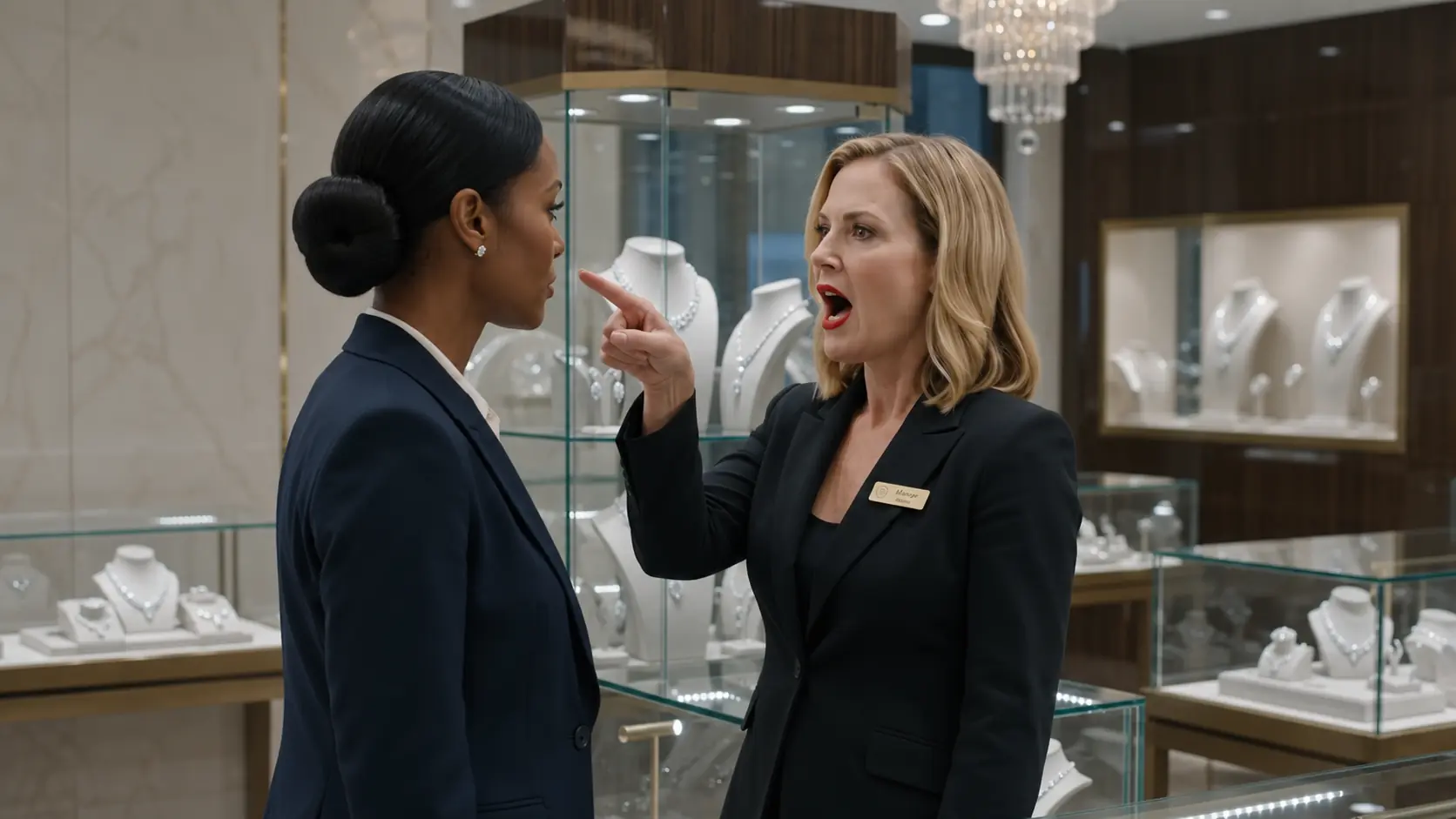
Diana Mitchell stood three feet away from the manager without moving.
At forty-two, Diana was a striking Black American woman with smooth dark-brown skin, intelligent brown eyes, and sleek black hair arranged in a polished low bun. She wore an elegant navy blazer over an ivory silk blouse, tailored trousers, pearl earrings, and understated black heels. Nothing about her appearance was careless, loud, or disruptive.
Still, Patricia looked at her as though she had wandered in from the street.
“Call them,” Diana said coldly.
Patricia’s red lips tightened. She was a forty-five-year-old white American woman with shoulder-length blonde hair, a fitted black designer suit, and a gold manager’s badge pinned proudly above her breast pocket. She had managed the Beverly Hills location for three years and behaved as though every diamond inside the building belonged personally to her.
“You’ll be banned from every store we own,” Patricia warned.
Diana opened her handbag and placed a black identification card on the counter between them.
“Perfect,” she said. “Then they can watch me fire you.”
Patricia barely glanced at the card.
She assumed it was a membership card, a business credential, or another attempt to appear important. Her expression remained smug as she reached for the telephone beneath the counter.
“You people always think showing a card changes the rules.”
The words landed heavily.
One of the younger associates, a twenty-three-year-old Latina American woman named Sofia Reyes, lowered her eyes in discomfort. She had worked at the boutique for six months and had already seen Patricia her eyes in discomfort. She had worked at the boutique for six months and had already turn away customers she considered undesirable, but never this openly. Complaints were usually disguised beneath phrases like private appointment, security policy, or inventory protection.
Diana stared at Patricia.
“What people?”
Patricia paused only briefly.
“People who enter luxury stores without understanding that service is offered at our discretion.”
Diana’s hands remained still at her sides, but the control in her face grew tighter.
Five minutes earlier, she had entered the store alone because she wanted to observe the customer experience without advance notice. No assistant, no company car waiting at the curb, and no regional director clearing the path before her. She wanted to see what happened when employees did not know the owner was watching.
She had learned more quickly than expected.
The boutique belonged to Mitchell & Rowe, a luxury jewelry company founded twenty-six years earlier by Diana’s late mother and a retired American gemologist named Harold Rowe. What began as a small Atlanta showroom had grown into thirty-eight locations across the United States, including flagship boutiques in New York, Beverly Hills, Chicago, Miami, and Dallas.
Diana became chief executive after her mother’s death.
Under her leadership, the company expanded internationally, created apprenticeship programs for young jewelers, and built a reputation for personal service. Diana’s name appeared in annual reports, trade publications, investor meetings, and internal company materials.
Yet Patricia Whitman had apparently never taken the time to recognize the woman whose signature appeared on her employment contract.
Diana had arrived that morning because the Beverly Hills store’s numbers looked suspicious. Sales remained high, but customer retention had fallen sharply. Complaints were increasing, employee turnover had doubled, and mystery shoppers repeatedly described the atmosphere as cold and judgmental.
Patricia blamed demanding customers.
The regional director blamed staffing shortages.
Diana had decided to inspect the store herself.
She entered shortly after ten, smiled at the nearest associate, and asked to view the private Heritage Collection. The collection included handcrafted pieces based on designs created by Diana’s mother during the company’s earliest years.
Sofia had greeted her politely.
Before she could retrieve the collection book, Patricia crossed the floor and interrupted.
“The Heritage Collection is available by private appointment only.”
“I understand,” Diana said. “I’d still like to see the catalog.”
“Appointments require verified purchase history.”
“I have one.”
Patricia looked over Diana’s outfit, handbag, and jewelry with a calculating expression.
“Not at this location.”
“My records are company-wide.”
Patricia smiled without warmth.
“Then perhaps you should return to the location that normally serves you.”
The meaning was obvious.
Diana could have ended the situation immediately. She could have announced her title, called the regional director, or shown the executive identification card in her bag. Instead, she asked another question.
“What makes you believe I shouldn’t be served here?”
Patricia stepped closer and lowered her voice.
“Experience.”
Diana’s eyes sharpened.
“What kind of experience?”
“The kind that tells me when someone is wasting my staff’s time.”
Sofia stood nearby holding the collection catalog, visibly uncertain whether to follow Patricia’s order or assist the customer. Diana noticed the fear in the young associate’s posture.
“Please hand me the book,” Diana said.
Sofia started to move.
Patricia stopped her.
“No.”
Then she turned to Diana and ordered her to leave.
Now the entire store was watching.
Patricia picked up the telephone.
Diana did not stop her.
She wanted to know how far the manager would go when she believed there would be no consequences.
“Security,” Patricia said into the receiver. “I have a disruptive woman refusing to leave the showroom.”
Diana spoke clearly enough for everyone nearby to hear.
“I asked to view a jewelry catalog.”
“She has become aggressive,” Patricia continued.
Diana’s expression changed.
There was no shouting, threatening movement, or aggressive conduct. Patricia was inventing danger because she understood that a calm Black woman asking questions did not justify removal.
Sofia looked toward the floor.
Another associate, a twenty-nine-year-old white American man named Ethan Cole, pretended to arrange watches while listening closely. He had worked for Patricia for nearly two years and had learned that disagreement usually meant losing weekend commissions or being assigned inventory duty.
Diana turned toward him.
“Have I threatened anyone?”
Ethan hesitated.
Patricia covered the receiver. “Do not involve my employees.”
“They are witnesses.”
“They answer to me.”
“No,” Diana said. “They answer to the company.”
Patricia laughed.
“And you think you know how this company operates?”
“Better than you realize.”
Two building security officers arrived moments later.
The first was Marcus Hill, a tall Black American man in his late thirties who had worked security for the luxury complex for seven years. Beside him stood a younger white American officer named Aaron Pierce.
Marcus entered cautiously.
“What seems to be the problem?”
Patricia pointed at Diana.
“This woman refused to leave after being denied access to restricted merchandise.”
Marcus looked at Diana, then at the untouched display cases.
“Did she attempt to enter a restricted area?”
“She demanded access.”
“I asked to see a catalog,” Diana corrected.
Marcus turned toward Patricia.
“That’s different.”
Patricia’s face hardened.
“She is disturbing customers.”
The wealthy couple near the entrance exchanged glances. The woman finally spoke.
“She wasn’t disturbing anyone until the manager started shouting.”
Patricia stared at her.
The customer lifted both eyebrows. “We all heard it.”
A second customer nodded.
Diana remained silent.
Marcus looked between the witnesses and Patricia.
“Ma’am, unless there’s more to this, I don’t have grounds to remove her.”
Patricia lowered her voice.
“I am the store manager. I decide who remains on the premises.”
Marcus did not move.
“This is private property, but building security still documents removals. I need a legitimate reason.”
Patricia’s composure began cracking.
“She does not have an appointment.”
“Then tell her appointments are required,” Marcus said. “That isn’t a security matter.”
Diana looked at him with quiet approval.
Patricia noticed.
“This conversation is over,” she snapped. “Escort her out.”
Marcus looked directly at Diana.
“Would you like to show me the card on the counter?”
Patricia finally glanced down.
The black card displayed Diana’s photograph, her full name, and three words embossed in silver:
CHIEF EXECUTIVE OFFICER
The color drained from Patricia’s face.
She picked it up with trembling fingers.
“No.”
Diana said nothing.
Patricia turned the card over as though another explanation might appear on the back.
“This could be fake.”
Diana removed her phone and called one number.
The call connected immediately.
“Good morning, Diana,” said a male voice through the speaker. “Are you at the Beverly Hills location?”
“I am.”
The voice belonged to Samuel Grant, the fifty-four-year-old Black American president of Mitchell & Rowe’s retail division.
“Is Patricia Whitman present?” he asked.
Diana held Patricia’s gaze.
“She’s standing in front of me.”
Samuel became quiet.
“So the complaints were accurate.”
Patricia’s mouth opened.
“Mr. Grant, I can explain.”
“You may explain to Human Resources,” Samuel replied. “Diana, the regional director and legal counsel are ten minutes away. They were waiting for your assessment.”
Patricia stared at Diana.
“You planned this?”
“I planned an inspection,” Diana said. “You created the rest.”
The security officers stepped back.
The customers no longer pretended not to watch. Sofia still held the Heritage Collection catalog against her chest, but her expression had changed from fear to stunned recognition.
Patricia placed the executive card carefully on the counter.
“Ms. Mitchell, there has been a misunderstanding.”
“No.”
“I didn’t recognize you.”
“That is not the misunderstanding.”
Patricia swallowed.
“If I had known who you were—”
“That is exactly the problem.”
Diana’s voice remained level, which made every word feel heavier.
“You believe respect depends on recognizing power. You didn’t know I owned the company, so you decided I deserved humiliation.”
Patricia shook her head quickly.
“I treat every customer according to store policy.”
Diana looked toward Sofia.
“Is refusing catalogs company policy?”
Sofia hesitated.
Patricia stepped toward her.
“Think carefully before you answer.”
Diana immediately moved between them.
“Do not threaten her.”
“I wasn’t threatening anyone.”
“You just warned an employee to protect you.”
Patricia’s breathing became shallow.
Diana turned to Sofia.
“You may answer freely. Your job is protected.”
Sofia clutched the catalog.
“No, ma’am. Customers are allowed to view it without an appointment.”
The admission broke something open.
Ethan stepped away from the watch display.
“She tells us not to show premium pieces to people she thinks won’t buy.”
Patricia spun toward him.
“You have no idea what you’re saying.”
“I know exactly what I’m saying.”
Another associate came forward.
“She makes us follow customers around if they wear casual clothes.”
A third employee added that Patricia deleted complaint emails before sending weekly reports to the regional office.
Diana listened without interrupting.
Each statement confirmed what the numbers had already suggested. The falling retention rate, staff turnover, and unexplained complaints were not random management issues. Patricia had created a culture of bias, fear, and selective service inside one of the company’s most visible boutiques.
The regional director arrived with legal counsel and a Human Resources executive.
The regional director was a forty-eight-year-old white American man named Thomas Keller. He entered quickly, saw Diana standing beside security, and looked immediately toward Patricia.
“What happened?”
Diana handed him the executive card.
“Your manager refused to serve me, threatened me with removal, falsely described me as aggressive, and attempted to force employees to support her version.”
Thomas looked devastated.
“Diana, I had no idea.”
“You received twelve complaints in six months.”
“They were vague.”
“They were specific enough to investigate.”
Thomas lowered his eyes.
Patricia seized the opening.
“Mr. Keller, she came in without an appointment and deliberately provoked a confrontation.”
Diana turned.
“How did I provoke you?”
“You challenged my authority.”
“I asked to see a catalog.”
“You kept questioning me.”
“Because your answers revealed discrimination.”
Patricia’s voice rose.
“This is absurd. I protect this store. We deal with theft, fraudulent purchases, and people who enter only to waste time. Every luxury retailer uses judgment.”
“Judgment based on what?”
“Behavior.”
“My behavior was calm.”
“Your attitude was confrontational.”
Diana stepped closer.
“No. My confidence offended you because you expected submission.”
Patricia went silent.
Diana faced Thomas.
“Pull the surveillance footage.”
Legal counsel immediately contacted the security department.
Within minutes, the video appeared on a monitor in the private consultation room. It showed Diana entering, greeting Sofia, requesting the catalog, and standing calmly while Patricia moved aggressively into her space.
There was no threatening gesture.
No raised voice from Diana.
No attempt to access restricted merchandise.
Only a manager deciding from the first glance that a Black woman did not belong in her showroom.
The Human Resources executive reviewed the footage twice.
“This supports immediate suspension pending investigation.”
Diana looked at Patricia.
“No.”
Patricia’s eyes filled with hope.
Diana continued.
“Her employment ends today.”
Thomas looked startled.
“Diana, company procedure usually requires—”
“Company procedure also requires honest reporting, equal service, and protection from retaliation.”
Legal counsel nodded slowly.
“The documented conduct, witness statements, and false security report support termination.”
Patricia’s face collapsed.
“You cannot fire me over one mistake.”
Diana looked toward the employees.
“This was not one mistake.”
She asked Sofia how many customers Patricia had denied access to premium collections. Sofia named at least eight she remembered personally.
Ethan described three incidents in which Patricia told him certain customers would “never afford anything worth showing.”
Another employee revealed that Patricia had rejected a Black American couple looking for an anniversary necklace, only to discover later that the husband was a professional athlete.
Patricia’s excuses changed with every accusation.
She said she was protecting inventory.
Then she said she was training employees to prioritize serious buyers.
Then she blamed pressure from quarterly sales targets.
Finally, she accused the staff of resenting her standards.
Diana allowed her to finish.
“Your standards did not improve this store,” she said. “They poisoned it.”
Patricia removed her manager’s badge.
Her hands shook as she placed it on the table.
“I have given three years of my life to this company.”
“And how many customers left believing Mitchell & Rowe saw them the way you did?”
Patricia’s eyes hardened again.
“You’re making an example of me.”
“Yes,” Diana said. “Because every employee watching needs to understand that luxury never excuses contempt.”
Marcus escorted Patricia to the employee office while Human Resources supervised the collection of her belongings.
Unlike Patricia, Diana did not invent aggression.
She did not demand public humiliation or security force.
She simply ended the authority Patricia had abused.
After the former manager left, the boutique remained unusually quiet.
The customers were still present. Some had stayed because they wanted to see the outcome, while others seemed uncertain whether shopping should continue.
Diana walked to the center of the showroom.
“My name is Diana Mitchell,” she said. “My mother founded this company because she believed fine jewelry should mark moments of dignity, love, memory, and achievement. What happened here today violated that belief.”
She looked at the employees.
“No customer should have to prove wealth before receiving courtesy. No employee should be threatened for telling the truth. And no manager will use this company’s reputation as permission to judge who belongs.”
The wealthy woman near the entrance began applauding softly.
Her husband joined her.
Soon, several customers followed.
Diana did not smile.
The moment was too serious for celebration.
She turned toward Sofia.
“Would you please show me the Heritage Collection?”
Sofia’s eyes widened.
“Of course.”
She opened the catalog on the main counter.
The first page displayed a sapphire necklace designed by Diana’s mother twenty-four years earlier. The center stone rested inside a setting inspired by magnolia petals, surrounded by small diamonds.
Diana touched the photograph.
“My mother sketched this at our kitchen table.”
Sofia looked at her.
“It’s beautiful.”
“She made it after a store refused to let her try on a necklace.”
The young associate stared.
Diana smiled sadly.
“She walked out humiliated and decided to build a company where no one would be treated that way.”
The meaning settled over everyone listening.
Diana had not merely witnessed poor customer service.
She had watched her mother’s worst experience repeated inside the company created to prevent it.
Thomas joined her beside the counter.
“I failed to catch this.”
“Yes.”
“I should resign.”
Diana studied him.
“Do you want to resign because the work is difficult or because you’re embarrassed?”
He looked down.
“Embarrassed.”
“Then embarrassment is not enough.”
“What do you want me to do?”
“Review every complaint from every location in your region. Speak directly with employees without their managers present. Create a report showing which customers were denied service, why, and what happened afterward.”
Thomas nodded.
“And if we find other managers doing this?”
“You already know the answer.”
Within one week, Diana ordered a company-wide service audit.
Mystery shoppers of different ages, races, clothing styles, and apparent income levels visited every Mitchell & Rowe location. Their experiences were documented and compared.
The results exposed uncomfortable patterns.
Customers wearing casual clothing waited longer.
Black and Latino customers were followed more often.
Young shoppers were sometimes ignored.
Employees with accents were less likely to be assigned high-value clients, regardless of experience.
Diana presented the report at the quarterly executive meeting.
Several board members argued that luxury retail naturally required discretion.
Diana placed the Beverly Hills surveillance footage on the screen.
“Discretion is noticing a customer’s needs,” she said. “Bias is deciding what they deserve before they speak.”
No one challenged her again.
The company rewrote its service policies.
Managers could no longer restrict access to catalogs based on perceived purchasing ability. Customer removal required documented conduct, not intuition. Complaint reports went directly to a centralized review team, preventing local managers from deleting them.
Employees received anti-bias training tied to real customer interactions rather than generic presentations.
Diana also changed promotion requirements.
Sales numbers remained important, but managers were evaluated on staff retention, complaint resolution, and customer-return rates. A leader who generated revenue while driving away employees and humiliating customers would no longer be considered successful.
Sofia was promoted to assistant manager.
She initially tried to refuse.
“I’ve only been here six months.”
“You told the truth while your supervisor was threatening you,” Diana said. “Experience can teach inventory systems. Character is harder to train.”
Ethan became head of client relations after helping the review team document previous incidents.
Thomas remained regional director, but Diana placed him under direct quarterly evaluation. To his credit, he accepted responsibility and became one of the strongest advocates for the new system.
Six months later, Diana returned to the Beverly Hills boutique.
This time, no one had been told she was coming.
She watched from outside as a young Black American couple entered wearing jeans and simple jackets. They looked uncertain, almost prepared to leave quickly.
Sofia greeted them immediately.
“What brings you in today?”
The man explained that he wanted to buy an engagement ring but did not know how much he needed to spend.
Sofia smiled.
“You need to spend what is comfortable for you. Let’s find something that feels right.”
She showed them several rings at different prices, explaining stone quality without pressure or condescension. When the couple asked to think about it, she gave them her card and thanked them for visiting.
They left smiling.
Only then did Diana enter.
Sofia saw her and straightened.
“You were watching.”
“I was.”
“Did I pass?”
Diana looked toward the door where the couple had disappeared.
“They did.”
Sofia understood.
The test had never been whether an employee could impress the chief executive.
It was whether customers could enter without having to defend their right to be there.
Later that afternoon, Diana sat alone in the private consultation room with the original magnolia necklace resting on velvet before her. She had brought it from company archives for the boutique’s anniversary exhibit.
Her mother had worn it at the opening of the first Mitchell & Rowe showroom.
Diana remembered standing beside her as a teenager, watching customers enter cautiously because they had never before seen a Black-owned luxury jewelry store in their neighborhood. Her mother greeted every person personally, whether they bought a diamond bracelet or only asked to look.
“People remember how a beautiful thing made them feel,” she used to say. “But they remember even longer how the person selling it treated them.”
Diana closed the display case.
Patricia Whitman had believed luxury meant deciding who was worthy of attention.
Diana’s mother had understood something better.
True luxury was being seen without being judged.
The Beverly Hills boutique eventually became the company’s highest-rated location for customer experience. Sales rose, but Diana considered that the least important result.
Complaints fell.
Employee turnover dropped.
Customers who had once avoided the store returned.
One of them was the Black couple Patricia had denied service months before Diana’s visit. They purchased a necklace for their twentieth wedding anniversary from Sofia.
When Diana heard, she wrote them a personal letter apologizing on behalf of the company.
The husband replied with one sentence:
We came back because someone finally made it feel like the store belonged to us too.
Diana framed the note in her office.
Beside it, she placed Patricia’s discarded manager’s badge—not as a trophy, but as a warning.
Authority could be earned over years and lost in five minutes.
And every time a Mitchell & Rowe employee entered Diana’s office, they saw the letter before they saw the badge.
That was intentional.
One represented the power to exclude.
The other represented the reason the company existed.
Years later, people still repeated the story of the manager who ordered a Black woman out of a Beverly Hills jewelry boutique without realizing she owned the company.
Some told it as a dramatic story about instant revenge.
Diana always corrected them.
She had not fired Patricia because the manager failed to recognize a chief executive.
She fired her because Patricia believed ordinary customers deserved less respect than powerful ones.
The difference mattered.
Diana had entered the store as a stranger, been judged in seconds, and threatened with removal for refusing humiliation.
Five minutes later, Patricia learned that the woman standing calmly before her controlled every store she had threatened to ban her from.
But the most important change came afterward.
Diana did not merely remove one cruel manager.
She forced an entire luxury company to look honestly at who it welcomed, who it doubted, and who it had taught to feel invisible.
And beneath the bright lights of the Beverly Hills showroom, among diamonds designed to last for generations, Mitchell & Rowe finally recovered the principle on which it had been founded:
No customer should need to reveal their power before being treated with dignity.