The laughter spread along the fence beside the Buffalo County Fair pulling track, but the Farmer never looked toward the men enjoying the joke. He stood beside the faded red tractor he had assembled inside his barn from salvaged machinery, an old truck transmission, and an engine everyone else had declared useless. Rust remained along the hood, several panels carried mismatched bolts, and the exhaust pipe leaned slightly to the left. Yet every important part beneath the surface had been measured, rebuilt, and tested by his own hands.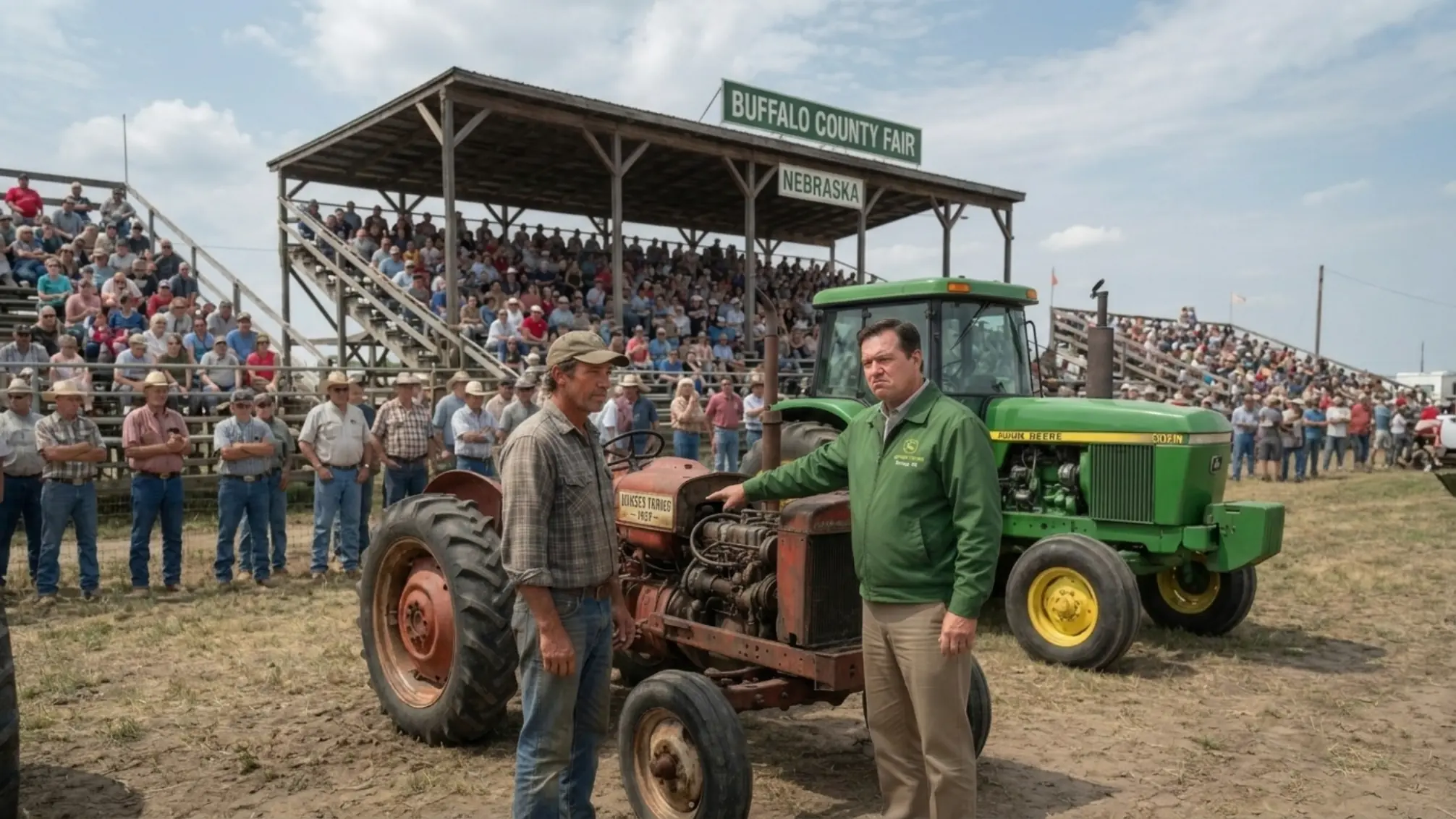
The Farmer was a handsome forty-three-year-old American single dad with sun-bronzed skin, sharp blue eyes, short dark-brown hair, and a lean, muscular build shaped by years of physical work. His faded plaid shirt and worn jeans made him look poor beside the dealership representatives wearing clean green jackets. Behind the fence, his handsome sixteen-year-old Son watched with both hands gripping the wooden rail. The boy knew that the machine in front of them was not merely an entry in a county contest.
It was their final chance to keep the farm.
Six months earlier, the Farmer had driven his aging pickup into the most successful John Deere dealership in the county. The truck was almost thirty years old, with faded paint, a repaired tailgate, and a muffler held steady by a bracket the Farmer had fabricated himself. He parked between two polished tractors whose prices were greater than the remaining value of his land. Several salesmen looked through the showroom windows and laughed before he reached the door.
The Dealer met him beside the newest tractor on the floor. He was a wealthy fifty-two-year-old American man with neatly combed dark hair, a broad build, and the smooth confidence of someone who had spent years watching desperate farmers enter his office. His green dealership jacket was spotless, his expensive watch caught the overhead light, and his polished shoes had never touched muddy soil. He looked past the Farmer toward the old pickup and smiled.
“You planning to trade that thing?” he asked.
“I need a tractor strong enough to finish planting.”
The Dealer laughed again. “That truck might cover the down payment on one tire.”
The Farmer ignored the insult and explained his situation. His primary tractor had suffered a transmission failure during the worst possible week of spring. The weather forecast offered only twelve dry days before heavy rain, and nearly two hundred acres still needed planting. Without a replacement machine, the farm would lose an entire season.
The Dealer offered a new tractor under a financing package that looked reasonable on the first page. The monthly payment was high but possible if the harvest succeeded. However, the contract also included a variable rate, mandatory dealership servicing, software activation charges, transportation fees, and a clause allowing immediate repossession after one missed payment. The Farmer read every line.
“This could cost twice the listed price,” he said.
“It costs what modern equipment costs.”
“And only your mechanics can repair it?”
“Only certified technicians should touch machinery like this.”
The Farmer glanced through the glass wall toward the service yard. Several tractors waited in a line, and one older American Farmer stood beside the counter arguing about a repair bill. He had already paid thousands to replace a sensor, but the tractor remained locked by software until another activation fee was processed. The Dealer called it protection.
The Farmer called it control.
He closed the contract and pushed it back. “I’ll find another way.”
The Dealer leaned across the desk. “There isn’t another way. Your tractor is dead, the weather is closing, and the bank already knows your numbers.”
The Farmer’s eyes narrowed. “How do you know what my bank knows?”
The Dealer sat back too quickly.
That small reaction stayed in the Farmer’s mind.
The Farmer left without signing. As he climbed into his pickup, two salesmen stood near the showroom window pretending not to watch. The old engine started on the first turn. It rattled, smoked briefly, and carried him home.
His Son waited in the barn beside their disabled tractor. The boy had inherited his father’s blue eyes, steady hands, and refusal to panic when machinery failed. He had already removed the damaged transmission cover and arranged the bolts carefully on a sheet of cardboard. The broken gears were worse than expected.
“Did they approve the loan?” the Son asked.
“I didn’t take it.”
The boy looked toward the silent fields. “Then we miss planting.”
“Not yet.”
The Farmer walked to the rear of the barn, where an old delivery truck had rested beneath a canvas cover for eleven years. It had belonged to his late wife’s father, who used it to transport grain before the engine failed. The truck’s body was damaged, but the heavy transmission and rear axle remained strong.
The Farmer pulled away the cover.
His Son stared at the vehicle. “You’re not thinking about fixing that.”
“No.”
“Then what are you thinking?”
The Farmer looked from the old truck to the disabled tractor. “I’m thinking they have parts the other one needs.”
The project began as an emergency repair. The Farmer planned to adapt the truck’s transmission to the tractor, finish planting, and rebuild properly after harvest. Yet nothing fit naturally. The mounting points were different, the gearing was wrong, and the tractor frame could not safely carry the additional weight without reinforcement.
Most farmers would have stopped.
The Farmer cut steel.
He built new brackets, reinforced the frame, and modified the clutch assembly. His Son cleaned parts, measured shafts, and searched technical manuals late into the night. A retired Mechanic from the neighboring town heard what they were attempting and arrived with a toolbox, expecting to explain why it was impossible.
Instead, he stayed for three days.
The Mechanic was a handsome sixty-eight-year-old American widower with silver hair, strong hands, and an old injury that made him walk with a cane. He had repaired agricultural equipment before modern dealerships controlled every diagnostic process. He examined the Farmer’s drawings and found several weaknesses, but he did not dismiss the idea.
“You understand this machine may tear itself apart,” he said.
“Then show me where.”
The Mechanic pointed.
They rebuilt those sections together.
The adapted tractor crossed the first field nine days later. It was loud, slow, and ugly, but it pulled the planter steadily for fourteen hours without overheating. The Farmer and his Son worked in shifts, sleeping in the pickup while the other drove. They placed the final seed into the ground hours before the rain arrived.
The harvest remained uncertain, yet the season was no longer lost.
Word of the homemade repair spread through the county. Some farmers admired it. Others called it dangerous and foolish. The Dealer called it proof that the Farmer had become too desperate to make rational decisions.
He visited the farm in a new green company truck shortly after planting.
The Farmer found him standing beside the rebuilt tractor, examining its mismatched panels with open disgust. The Dealer asked whether the machine was insured, certified, or approved by any manufacturer. The Farmer answered that it remained private farm equipment and had passed a safety inspection performed by an independent agricultural engineer.
The Dealer smiled. “One repair doesn’t make you a manufacturer.”
“I never said it did.”
“You’ll still need a real tractor by harvest.”
“This one planted every acre.”
“And when it fails?”
“I’ll repair it.”
The Dealer looked toward the farmhouse. “You should think about selling while the land still has value.”
The Farmer’s late wife had grown up inside that house. Their Son had taken his first steps on the kitchen floor and learned to drive along the southern fence. The Dealer knew exactly what the property meant to them.
That was why he wanted it.
The farm bordered a planned highway expansion, and the Dealer had quietly purchased several nearby parcels. If he acquired the Farmer’s land, he could build a regional equipment distribution center with direct highway access. The old farm was worth far more for development than its owner had been told.
The Farmer discovered this from a county planning notice hidden beneath ordinary meeting documents. He then checked property records and found that businesses linked to the Dealer had purchased three neighboring farms after their owners defaulted on equipment loans. Each family had financed machinery through the dealership.
The same bank handled every loan.
The Farmer began asking questions.
One older Farmer revealed that the Dealer had encouraged him to buy a larger tractor than he needed. When grain prices fell, the monthly payment increased under the variable-rate contract. The dealership repossessed the machine, the bank foreclosed on the land, and a property company purchased the farm at auction.
Another family told the same story.
Then another.
The Dealer did not merely sell equipment. He used expensive financing, restrictive repairs, and private information from the bank to identify farms vulnerable to takeover. His dealership profited once from the sale, again from servicing, again from repossession, and finally from purchasing the land through hidden companies.
The Farmer had nearly entered the same trap.
His homemade tractor had saved him from more than a lost planting season.
It had kept his name off the Dealer’s contract.
The Farmer collected copies of agreements, auction notices, service invoices, and ownership records. Yet circumstantial patterns were not enough. The Dealer could claim every foreclosure resulted from ordinary business risk.
The Farmer needed direct evidence.
It arrived from the dealership’s former Bookkeeper.
She was a beautiful forty-seven-year-old American woman with dark hair, careful brown eyes, and a quiet manner. She had worked for the Dealer for nine years before being dismissed after questioning unexplained transfers. When she heard that the Farmer was investigating the property companies, she visited his barn after sunset.
She brought a flash drive and three paper ledgers.
The records showed payments from the Dealer to a lending officer at the county bank. In exchange, the officer shared private information about farmers behind on payments, upcoming refinancing requests, family medical debts, and land valuations. The Dealer then targeted the most vulnerable owners with aggressive equipment contracts.
The property companies were registered through relatives and former employees.
The Bookkeeper had copied the records before being fired, but she feared no one would believe her. The Dealer was one of the largest employers in the county, sponsored youth events, donated equipment to schools, and sat beside elected officials at public dinners. Challenging him meant challenging half the town’s image of itself.
The Farmer believed her.
He also refused to release the records immediately.
“If we move too early, he calls them stolen and destroys the originals.”
“What do you suggest?” the Bookkeeper asked.
“We make him reveal how badly he needs my farm.”
The opportunity came when the Buffalo County Fair announced its annual tractor-pulling competition. The dealership had sponsored the event for twelve consecutive years. The Dealer’s newest demonstration tractor was expected to win its class and appear in advertisements across the region.
The Farmer entered his homemade red tractor.
The Dealer tried to block him.
He argued that the machine lacked factory certification and posed a danger to spectators. The fair committee requested an inspection from an independent Engineer. The Farmer welcomed it, presented his modifications, and corrected two concerns before the deadline.
The tractor was approved.
County residents began talking about the contest weeks in advance. Most expected the Farmer’s machine to fail publicly. A few remembered how it had planted two hundred acres when no dealership would offer fair terms. For families who had lost land after financing equipment, the red tractor became something larger than machinery.
It became evidence that dependence was not the only choice.
The Dealer visited the farm again, this time without smiling.
“Withdraw from the competition.”
“No.”
“You embarrass yourself, not me.”
“Then you have nothing to worry about.”
The Dealer offered to buy the farm at three times his original price. The amount was large enough to clear every debt and provide the Farmer and his Son with a comfortable life elsewhere.
The Farmer asked why the offer had increased.
“Market conditions.”
“The highway plan?”
The Dealer’s expression changed.
The Farmer continued. “Or because the land gives your distribution center the only direct access wide enough for transport trailers?”
The Dealer stepped closer. “You are a mechanic pretending to understand development.”
“I’m a farmer who finally started reading what men like you hoped I’d sign.”
The Dealer’s voice dropped. “Enter that machine in the fair, and you will regret it.”
The Farmer looked toward the tractor. “You already tried to frighten me with failure.”
“I’m warning you about consequences.”
“So am I.”
The county fair opened beneath a clear summer sky. Families crowded the grandstand, vendors filled the midway, and tractors lined the pulling area in polished rows. The Dealer’s green demonstration tractor arrived on a company trailer with banners, promotional staff, and a professional driver.
The Farmer drove his red tractor directly from the farm.
Its faded hood, visible welds, and old truck components drew laughter near the registration area. The Dealer approached in front of the grandstand, pointed at the machine, and delivered the insult he expected everyone to remember.
“You brought that junk heap to my fair?”
The Farmer answered without raising his voice.
“Mine works. Yours only shines.”
The crowd reacted with surprised laughter.
The Dealer’s face reddened. “When it dies, I’ll buy your farm for scrap.”
The Farmer climbed onto the seat. “Start the clock—then say it again.”
The first round measured pulling distance under a moderate load. Several older tractors stopped before the final marker. The dealership’s new machine crossed easily, its engine smooth and controlled.
Then the Farmer’s tractor connected to the sled.
The fair Judge inspected every chain and signaled the start. The Farmer eased forward instead of accelerating aggressively. The adapted transmission transferred power slowly, and the homemade machine pulled with a deep mechanical growl.
It crossed the marker.
The spectators stood.
The second round added more weight. The dealership tractor completed the pull but showed slight wheel spin near the end. Its professional driver blamed the track conditions.
The Farmer adjusted tire pressure, changed his gear setting, and studied the dirt. He had designed the machine for torque rather than speed. The old truck transmission offered a low range the newer competitor did not use efficiently.
The red tractor crossed again.
By the final round, only the two machines remained.
The Dealer personally climbed into his tractor, unwilling to let an employee control the result. He accelerated hard, believing raw power would end the humiliation. The machine surged forward and carried the sled farther than any earlier attempt.
Then it stopped six feet before the line.
The crowd applauded respectfully.
The Dealer climbed down and turned toward the Farmer. “Beat that.”
The Farmer’s Son approached the red tractor with a pressure gauge and wrench. Father and son checked the hitch, tires, cooling lines, and transmission temperature together. The Retired Mechanic stood nearby but did not interfere.
“This is your build,” he told them. “Trust it.”
The Farmer climbed aboard.
The red tractor moved.
Its engine did not sound as refined as the dealership machine, but every component worked for the single purpose the Farmer had designed it to perform. The wheels gripped the dirt. The transmission held.
Three feet remained.
Then two.
The engine strained, and smoke rose from the exhaust. Spectators began shouting from the grandstand. The Son ran along the fence, his face tense but hopeful.
The tractor crossed the line.
The fair erupted.
The Farmer stopped safely and shut down the engine. He did not raise his arms or celebrate wildly. He placed one hand on the hood, feeling the vibration fade from the machine that everyone had called worthless.
The Dealer pushed through the officials and accused the Farmer of using an illegal modification. The Judge replied that the tractor had passed inspection and performed within every rule.
The Dealer demanded another test.
The Farmer climbed down. “The contest is over.”
“This proves nothing.”
“It proves my tractor crossed the line.”
“You think one county ribbon saves your farm?”
“No.”
The Farmer looked toward the entrance.
Two state investigators walked onto the track with the former Bookkeeper and the County Bank Manager behind them. The Manager’s face was pale, and his wrists were held together in front of him.
The crowd fell silent.
The Farmer had delivered copies of the financial records to state authorities two weeks earlier. Investigators quietly confirmed the payments, private information sharing, property companies, and manipulated foreclosures. They delayed action until search warrants were approved and the Dealer’s records could be secured simultaneously.
The fair provided the perfect moment.
Nearly every dealership executive was present, leaving the main office accessible to investigators. The Dealer had also brought his company phone and laptop, both connected to records he might otherwise have hidden.
An Investigator approached him.
“You need to come with us.”
The Dealer stared at the Farmer. “You planned this.”
“I documented it.”
“You think these people will believe a bankrupt farmer and a fired employee?”
The Bookkeeper stepped forward. “They don’t need to believe us. They have your accounts.”
Deputies arrived at the dealership while investigators searched the Dealer’s fair vehicle. They found draft purchase agreements for the Farmer’s land, confidential bank reports, and a list of seventeen farms marked by payment status and development value.
Several families in the grandstand recognized their names.
The laughter disappeared completely.
The Dealer was charged with conspiracy, bribery, misuse of private financial information, fraud, and attempted manipulation of property auctions. The Bank Officer agreed to cooperate in exchange for a reduced sentence and identified every farm targeted through the scheme.
The investigation expanded beyond one county.
Foreclosure sales involving the Dealer’s hidden companies were reviewed. Families who had lost land through manipulated loans received legal assistance, financial restitution, or opportunities to repurchase property at corrected values. Not every loss could be reversed, but the system that produced them was exposed.
The dealership entered court supervision.
The John Deere corporation terminated its relationship with the local ownership after reviewing the evidence and transferred authorized service operations to a new independent management group. The Farmer refused an offer to take control of the dealership. He did not want to replace one monopoly with another person holding the same power.
Instead, he helped create a county repair cooperative.
Farmers pooled tools, hired independent technicians, and established shared access to diagnostic equipment. The Retired Mechanic trained younger workers, while the Farmer’s Son began an apprenticeship focused on agricultural engineering.
The cooperative did not eliminate dealerships.
It gave farmers another option.
The Farmer’s harvest succeeded that autumn. His homemade tractor handled planting, hauling, and field work with several additional improvements. The county fair prize money was modest, but the publicity brought repair requests from farmers who owned older equipment no dealership wanted to service.
The Farmer opened a small fabrication shop beside his barn.
He did not sell unsafe homemade tractors to anyone who asked. Every modification received proper inspection, and each customer was told clearly what old parts could and could not do. The Farmer’s reputation grew because he refused to promise miracles.
His Son designed a cleaner transmission bracket as a school engineering project. Two years later, the design became the basis for an affordable conversion kit allowing certain older tractors to use rebuilt commercial components safely.
The family patented the mounting system.
They licensed it to the repair cooperative under terms that kept prices reasonable for small farms. Larger manufacturers offered to buy exclusive rights, but the Farmer declined agreements that would prevent independent mechanics from using the design.
The farm debt was paid in full before his Son graduated.
On the day the final payment cleared, the Farmer drove the old pickup back to the dealership. The building had new management, transparent financing notices, and a service department required to provide written estimates before beginning repairs.
The former salesman who had laughed through the window still worked there.
He stepped outside and looked at the truck. “You ever going to replace that thing?”
The Farmer rested one arm on the faded door. “Why?”
“It’s old.”
“It starts.”
The salesman smiled awkwardly. “Fair enough.”
The red tractor returned to the Buffalo County Fair the following year, but not as a competitor. It stood inside an agricultural education exhibit beside photographs showing every stage of its construction. The display did not describe it as a machine that defeated a modern tractor.
It described it as the machine that gave one family enough time to uncover the truth.
The Farmer stood beside it while children examined the exposed components. His Son explained how the truck transmission had been adapted, where the first frame cracked during testing, and why several early designs were rejected.
The fair Judge approached carrying the previous year’s ribbon.
“You never collected this,” he said.
The Farmer looked at the faded red fabric. “My Son should have it.”
The boy shook his head. “We built it together.”
The Retired Mechanic cleared his throat. “Then hang it on the tractor and stop arguing.”
They tied the ribbon beneath the steering wheel.
People later told the story as though the Farmer had defeated the Dealer through a single tractor pull. They remembered the polished green machine stopping short, the rusty red tractor crossing the line, and the Dealer being taken away while the crowd watched.
But the machine did not expose the conspiracy by itself.
The Farmer read contracts, studied property records, listened to families others ignored, protected a frightened Bookkeeper, and waited until investigators could secure proof. The tractor gave him independence long enough to do those things.
The Dealer believed the old pickup proved the Farmer had no money, no choices, and no future.
He never understood that a man who keeps old machinery alive learns something valuable.
He learns that appearance reveals very little about what still has the strength to work.