Nine days after her father died, fourteen-year-old Hattie May Vance walked into Redfern’s John Deere dealership in Lewisburg, Tennessee, wearing his clothes. His tan canvas jacket swallowed her narrow shoulders, and the sleeves had been rolled three times around her wrists. His brown work boots were two sizes too large, so her mother had packed newspaper into the toes to keep them from slipping. In both hands, Hattie held twenty-eight dollars and the parts order for the tractor her father had left torn apart inside their equipment shed.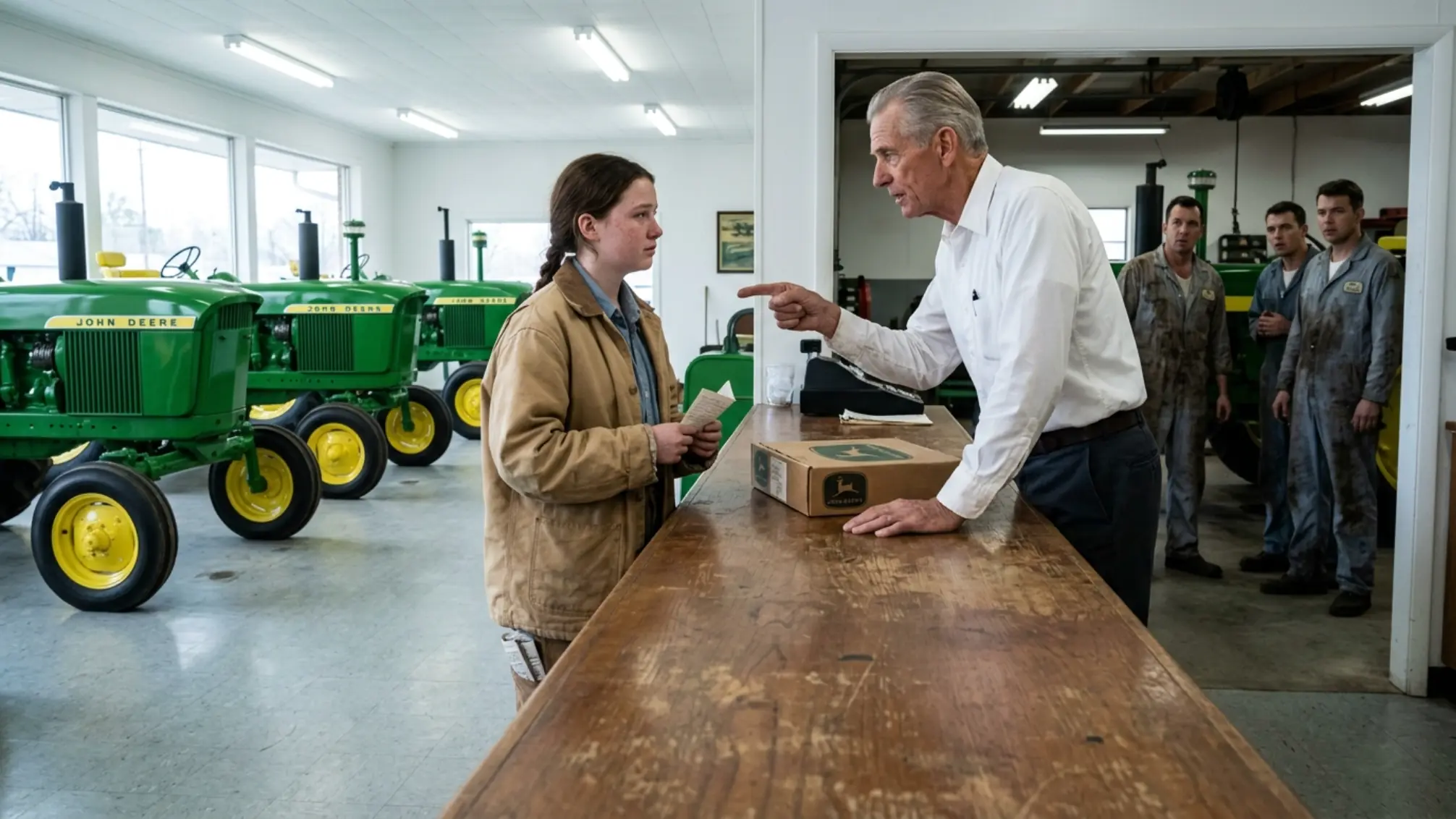
Silas Redfern stood behind the wooden service counter beneath bright fluorescent lights. At sixty-two, he had silver hair combed neatly away from his face, pressed white shirts, and forty years of experience selling farm equipment to nearly every family in Marshall County. He had known Hattie since she was a baby. He had also sold her father the John Deere 60 that now sat useless on jack stands while one hundred sixty acres of corn waited to be harvested.
“I came for the clutch assembly my daddy ordered,” Hattie said.
Silas picked up the order and recognized Thomas Vance’s handwriting immediately.
“The part came Tuesday,” he said. “Who is installing it?”
“I am.”
Silas lowered his reading glasses.
“You’re fourteen.”
“I’ve worked on that tractor with Daddy since I was nine.”
The two farmers examining a green tractor near the showroom stopped talking. One of them was Curtis Holloway, who owned eighty acres beside the Vance property. The other was Earl Dawson, the local grain-elevator owner.
Silas set the order on the counter.
“Hattie, I loved your father. That is why I’m going to tell you the truth. Go home. Tell your mother to call Wendell Ashcroft and arrange a lease.”
Hattie’s hands tightened around the money.
“No.”
Silas leaned closer, his voice still gentle but absolute.
“You cannot run one hundred sixty acres by yourself. You don’t have the size, the experience, or the strength. A tractor that large can kill a grown man who makes one mistake.”
“My daddy taught me.”
“Your daddy was a grown farmer with twenty years of experience.”
“And now he’s dead.”
The room went quiet.
Silas’s face softened, but he did not change his position.
“There is no shame in admitting the farm is too much. Ashcroft can work the ground. Your mother and the children can remain in the house.”
Hattie reached into her father’s jacket.
“My daddy told me Wendell Ashcroft is not our friend.”
Silas shook his head. “Your mother needs someone with money and equipment.”
“He bought our loan.”
Every expression in the showroom changed.
Hattie removed a folded envelope and opened the letter Thomas Vance had written the night before he died. Her father had warned that Wendell Ashcroft had tried to purchase their land three times in twelve years. When Thomas refused, Ashcroft secretly acquired the family’s thirty-two-hundred-dollar seed loan through a shell company.
The loan was due December fifteenth.
If the Vances failed to pay it, Ashcroft could foreclose on the eighty acres of valuable bottomland pledged as collateral.
Hattie raised the letter.
“You just told me to surrender our farm to the man who bought our debt because he was waiting for my father to die.”
Silas stared at her.
“My daddy left me operational authority. He told me not to sell and not to lease. So I’m asking you one last time. Are you selling me that clutch, or am I driving to another county?”
Silas removed his glasses and wiped them slowly with a handkerchief. His hands had begun to shake.
He had not known about the loan.
He had believed Ashcroft would protect the widow and children. Instead, his advice would have delivered the Vance property directly to a man who had been circling it for years.
“I’ll sell you the part,” Silas said.
Hattie counted out the money.
Silas disappeared into the service area and returned carrying a heavy clutch assembly wrapped in brown paper. He set it on the counter, then looked directly at Hattie for the first time that morning.
“I was wrong to tell you to call Ashcroft.”
“You were.”
“I still don’t believe you can farm that ground alone.”
Hattie picked up the part.
“You don’t have to believe it yet.”
She carried the clutch to her father’s 1958 Ford pickup. The assembly was almost too heavy for her, but she refused help. She wrapped it in an old feed sack so it would not slide across the bed and climbed into the cab.
Her eyes barely cleared the steering wheel.
She drove home using the back roads.
The Vance farm sat seven miles outside Lewisburg on Mill Creek Road. Thomas had died in the barn while repairing the John Deere 60. Hattie found him at six in the morning, already cold, lying beside the opened transmission.
Her mother, Cordelia, had never driven a tractor or negotiated with a banker. Hattie’s brother Caleb was eleven. Her sisters, Verna and Clara, were eight and five.
There was no uncle, hired hand, or grandfather coming to save them.
Hattie parked beside the equipment shed and carried the clutch inside. Her father’s tool chest remained open where he had left it. A ratchet lay across the top, and his coffee cup still sat near the workbench.
Hattie poured out the old coffee, rinsed the cup, and placed it on a high shelf.
Then she studied the broken tractor.
The transmission housing weighed nearly twice as much as she did. Thomas had always removed it with another man’s help, but Hattie had rope, a block-and-tackle system, and the rafters above her.
She built a cradle beneath the front of the tractor and drove wooden wedges behind the rear wheels. She labeled every bolt and washer in small coffee cans, just as her father had taught her. Before removing each part, she measured its position and recorded it in his black notebook.
At the top of the first blank page, she wrote:
October 23, 1963. John Deere 60 clutch replacement. Begin 11:12 a.m.
Hattie worked until two-thirty the next morning.
She slept four hours on the living-room couch without removing her father’s boots. At sunrise, she made coffee for her mother, packed lunches for the younger children, and watched them board the school bus.
Then she returned to the tractor.
On the second night, headlights swept across the barnyard.
A black Cadillac stopped near the equipment shed, and Wendell Ashcroft stepped out wearing a camel-colored overcoat and gray fedora. In one hand, he carried white chrysanthemums. In the other, he held a manila envelope.
He smiled when he saw Hattie.
“I came to speak with your mother.”
“She’s sleeping.”
“Wake her.”
“No.”
Ashcroft walked closer.
“I’m here to help your family.”
“My father said you weren’t our friend.”
Ashcroft’s smile remained in place, but his eyes changed.
“Your father is dead.”
“I know.”
“I can forgive the thirty-two-hundred-dollar loan. In return, your mother signs over the farm. I’ll let all of you remain in the house for one dollar a year.”
“You already own the loan.”
Ashcroft stopped.
“Who told you that?”
“My daddy wrote it down.”
For one second, the kindness disappeared from his face.
Then the smile returned.
“That note is due in fifty-three days. You are a child, Hattie. You will not raise that money.”
“Get off our land.”
Ashcroft dropped the envelope onto the ground. The flowers landed on top of it.
“You’ll come to me before winter is over.”
He returned to his Cadillac and drove away.
Hattie carried the envelope and flowers to the burn barrel. She struck a match and watched Ashcroft’s offer disappear into orange flame.
Then she went back inside the shed and picked up the torque wrench.
The John Deere started three days later.
Hattie sat on a folded blanket so she could reach the pedals. When she turned the key, the engine coughed black smoke and shuddered violently.
Then it settled into a steady rhythm.
Hattie gripped the steering wheel.
The tractor had belonged to her father.
Now it belonged to the family he had left behind.
She drove it into the north cornfield that afternoon.
For nineteen days, Hattie harvested from sunrise until darkness. The tractor seat was built for a grown man, forcing her to lean forward for ten hours at a time. She carried cold biscuits in her jacket pockets because returning to the house for lunch cost too much daylight.
On the seventh day, the corn picker threw a bearing.
The machine screamed once and stopped in the middle of the field. Rain was forecast for the weekend, and Hattie had neither a spare bearing nor much money left.
She sat in the corn stubble with her forehead resting against her knees.
For twenty minutes, she considered driving to Ashcroft’s house.
If she surrendered the land, her family would have shelter. Her mother could find work in town. Caleb and the girls could attend school without worrying about crops, debts, or broken equipment.
It would be easier.
Hattie stood up.
She removed the damaged bearing, measured it with her father’s calipers, and drove to the auto-parts store. A replacement cost three dollars and sixty cents.
She installed it herself and finished the interrupted row before dark.
The neighbors began watching.
Curtis Holloway arrived with his grain truck and helped haul corn to Earl Dawson’s elevator. He never apologized for agreeing with Silas that Hattie should give up.
He simply showed up again and again.
Earl paid Hattie four cents per bushel above the market price. When she questioned him, he claimed the grain tested unusually well.
Both knew it was not the full truth.
On the eleventh day, Curtis found Hattie slumped over the tractor’s steering wheel. She was conscious but too exhausted to climb down.
He lifted her from the seat and carried her to the porch.
Cordelia came outside in her apron.
“She’s fourteen years old,” she whispered. “My husband is dead, and my daughter is killing herself in his fields.”
Curtis removed his cap.
“I don’t think you can stop her.”
“Then what am I supposed to do?”
“We make sure she doesn’t die doing it.”
Hattie completed the harvest on November eleventh.
The crop yielded less than the county average but enough to produce a check for forty-three hundred twelve dollars. After paying property taxes, fuel, electricity, animal feed, repairs, and seed for the following year, nothing remained.
Then Cordelia remembered a letter from First National Bank.
The thirty-two-hundred-dollar note remained due in thirty-four days.
Hattie visited the bank the next morning.
Vice President Randall Pierce kept her waiting forty-five minutes before allowing her into his paneled office. A photograph on his desk showed him golfing beside Wendell Ashcroft.
Pierce reviewed the file and declared that no extension would be granted.
“Your mother has no independent credit history,” he said. “You have no acceptable co-signer.”
“Is it true that this bank sold my father’s loan to Ashcroft through a Nashville company?”
Pierce’s expression froze.
“Bank transactions are confidential.”
“Then why is the foreclosure notice still printed on your letterhead and signed by you?”
Pierce stood.
“This meeting is over.”
Hattie rose but did not leave immediately.
“My father left a letter explaining the transaction. If this farm loses one acre, I will send that letter to state banking authorities along with everything else I find.”
Pierce looked suddenly uncertain.
Hattie had no documents beyond Thomas’s letter and did not even know which state office regulated banks. Pierce did not know that.
After she left, he called Ashcroft.
“We have a problem,” he said.
Hattie returned to school while continuing to work every afternoon. At night, she studied her father’s account ledger, searching for any asset the family could sell without sacrificing the farm.
She found an entry from 1961.
Thomas had sold mature oak trees from the back forty acres for more than eleven hundred dollars.
Hattie surveyed the woodlot herself. Forty mature trees could bring approximately twenty-four hundred dollars—still eight hundred short, but closer than before.
That evening, Caleb ran into the kitchen shouting.
“The tobacco barn is burning!”
Flames covered the roof. Four tons of cured tobacco hung inside, representing the family’s last remaining income.
Hattie, her siblings, and the neighbors fought the blaze with buckets until the volunteer fire department arrived. They saved sixty percent of the crop.
Sheriff Orville Bates examined the foundation afterward.
“Somebody poured gasoline along the sill,” he said. “This was set deliberately.”
Hattie looked toward the road.
“I might know who wanted the farm badly enough.”
Ashcroft arrived after midnight, claiming he had heard about the tragedy and wanted to renew his offer.
Hattie sat beside the smoldering barn with her father’s rifle resting across her knees.
“I’ve never fired this gun,” she told him. “Take one more step toward my mother’s house, and we’ll both find out whether I can.”
Ashcroft returned to his Cadillac.
Silas Redfern arrived the following morning with a crate of tractor parts, filters, belts, oil, and a new battery.
Hattie refused charity.
Silas sat beside her on the porch.
“I had a son,” he said. “Matthias was fifteen when a tractor rolled over him. He died on the way to Nashville.”
Hattie turned toward him.
“For twenty years, I have sent young people away whenever they tried to take over a farm. I told myself I was protecting them. The truth is, I was protecting myself from seeing another child get hurt.”
“I’m sorry about your son.”
“I was wrong about you.”
Hattie stared at the burned barn.
“I’m still eight hundred dollars short.”
Silas stood.
“Sunday night. Seven o’clock. Be at the Grange Hall.”
“What are you planning?”
“I’m going to make some telephone calls.”
Fifteen people attended the meeting: fourteen men and a widowed farmer named Lorraine Pettigrew. Silas explained the loan, the fire, and Ashcroft’s attempt to obtain the farm.
One by one, the farmers pledged money.
Three hundred dollars.
Two hundred.
One hundred fifty.
Seventy-five.
When Silas totaled the promises, the amount exceeded thirty-four hundred dollars.
Hattie stood.
“I cannot accept gifts I may never repay.”
Silas walked around the table.
“It is not a gift. It is a loan from the Marshall County Farmers Fund, which I am creating tonight. Zero interest. Pay it when you can.”
“I will pay every dollar with interest.”
“I believe you.”
On December second, Hattie and the farmers entered First National Bank carrying envelopes filled with cash and cashier’s checks.
Pierce had no choice but to accept payment.
Silas demanded the original note. In front of witnesses, Pierce wrote across Thomas Vance’s signature:
PAID IN FULL — DECEMBER 2, 1963.
Hattie folded the note and placed it beside her father’s letter.
Ashcroft never returned to the Vance farm.
He waited for Hattie to fail.
She did not.
Hattie finished school while operating the farm. She repaid every contributor to the farmers fund by 1969, adding six percent interest despite their objections.
In 1970, Cordelia transferred formal ownership to her.
Hattie expanded carefully, purchasing eighty acres in cash, then another one hundred twenty, then one hundred sixty more. She refused heavy debt because she never forgot how thirty-two hundred dollars had nearly cost her family everything.
By the mid-1980s, Hattie owned more than five hundred acres without a mortgage.
During the farming crisis, neighboring operations disappeared beneath foreclosure notices.
The Vance farm survived.
Wendell Ashcroft did not.
He had borrowed aggressively to acquire thousands of acres. When land values collapsed and interest rates rose, his lenders seized nearly all of it.
In 1989, the seventy-nine-year-old man arrived at Hattie’s farm in a rusted pickup.
“I need work,” he said.
Hattie stared at him.
“Why here?”
“Everyone else said no.”
She hired him for the same wage paid to every farmhand.
Ashcroft fed animals, cut hay, repaired fences, and worked beneath the authority of the girl whose land he had tried to steal. When he collapsed from heat exhaustion, Hattie brought food and water to his hospital room.
“I thought you would fire me,” he said.
“Why?”
“I cost you a day of hay.”
“I’ve lost more days to rain than I’ll ever count. Return when the doctor clears you.”
At the end of his six-month contract, Ashcroft came to her porch.
“I paid a man twenty dollars to burn your tobacco barn,” he confessed. “I didn’t strike the match, but I paid for it. I don’t ask for forgiveness.”
Hattie listened without interrupting.
Ashcroft died four months later.
She attended his funeral.
When Cordelia asked why, Hattie replied, “Bitterness never grows into anything worth harvesting.”
Silas retired in 1983.
On his final day, Hattie returned to the dealership where he had once ordered her to go home. She presented him with the original bank note marked paid in full.
“You saved my farm,” she said.
“I told you to surrender it.”
“You changed your mind and helped me stay. That matters more.”
Silas cried openly.
Years later, Hattie established the Thomas Vance Mentorship Program. Whenever a young person inherited a farm after losing a parent, the program paired that child with an experienced farmer for five years.
The mentor did not take control of the land.
The mentor simply showed up.
Over the next three decades, thirty-one children received help. Most kept their family properties, and many remained farmers as adults.
In 2006, Hattie stood at the Tennessee State Fairgrounds to receive the state’s highest farming honor.
She now owned seven hundred forty acres, carried no debt, and had earned the highest soil-quality ratings in her district for eleven consecutive years.
The presenter told the audience that she began running the operation alone at fourteen.
An older man sitting in the rear closed his eyes.
He was Silas Redfern’s son.
After the ceremony, he handed Hattie a letter written by his father before his death.
Silas wrote that telling her to go home had been the greatest mistake of his career. Watching her become the finest farmer he had ever known had nearly made up for it.
Hattie folded the letter and placed it beside her heart.
The John Deere 60 remained inside the Vance equipment shed. Her family started it every spring, and her father’s boots rested on a shelf nearby with the original newspaper still packed into their toes.
At fourteen, the boots had been too large.
The farm had appeared too heavy.
The debt had seemed impossible.
None of those things became smaller.
Hattie became strong enough to carry them.
The dealer who told her to go home eventually helped her stay. The neighbors who doubted her became the people who stood beside her. And the frightened child wearing a dead man’s clothes grew into the farmer who ensured that no other grieving child in Marshall County would ever be forced to stand alone.