The auditorium fell silent after ten-year-old Tiana Turner delivered the final warning. She stood alone beneath the stage lights, wearing a secondhand brown dress and worn gray sneakers that squeaked whenever she moved. Her long braids framed a delicate face that looked frightened but determined, while the fading words For Mama remained written across her palm. Hundreds of people waited to see whether the little Black girl from Riverside would collapse beneath Victoria Mitchell’s public humiliation.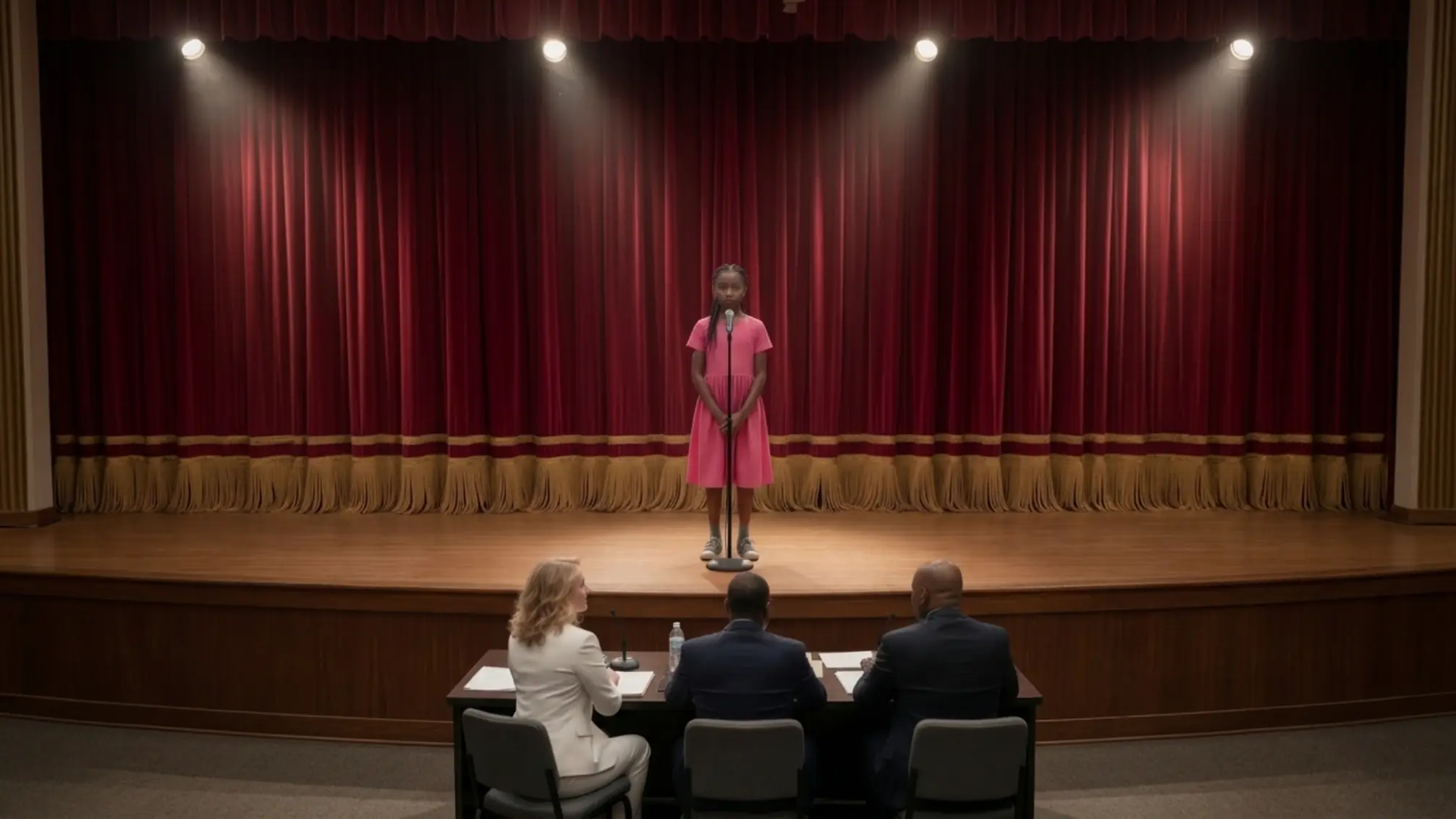
Victoria sat at the center of the judges’ table in an expensive ivory pantsuit. Her styled blonde hair, gold earrings, and cold smile made her appear polished enough for the cameras gathering near the back wall. Beside her sat local music teacher Robert Harrison and Christopher Hayes, a celebrated music executive known for discovering young artists. Christopher had been staring at Tiana since the moment she entered the building, though she had no idea why.
Three weeks earlier, Tiana found the talent-show flyer inside her mother’s purse. The grand prize was fifty thousand dollars and a recording opportunity, nearly enough to cover the surgery her mother desperately needed. Diane Turner had stage-three breast cancer, and the hospital required payment before the tumor became inoperable. The insurance company had already denied coverage, leaving a final bill of fifty-two thousand dollars taped to the refrigerator.
At seventeen, Diane had lost almost everything except her daughter. She worked hospital cleaning shifts during the day and grocery-store hours at night until chemotherapy made standing difficult. Their one-bedroom apartment sat inside Riverside’s Section 8 housing complex, where unpaid bills accumulated beside school notices and medication bottles. Tiana understood that if nothing changed quickly, her mother might not survive.
She had been singing since she was three. Tiana taught herself through online videos, practicing in hospital stairwells because the concrete walls gave her small voice a fuller sound. She sang to frightened children in the pediatric ward while waiting for Diane’s shifts to end, helping them sleep through pain and treatments. Nurses often recorded her, but Tiana never considered herself a performer.
When she was seven, she began posting simple practice covers online under the name RiverKid. Over three years, fifty thousand strangers followed the anonymous singer without knowing she was a poor child recording on her mother’s old phone. The account earned no money, and Tiana never appeared clearly on camera. It was only a place where she could practice and feel heard.
Talent competitions had never treated her kindly. A school teacher gave a major solo to Victoria’s daughter, Madison, even though Tiana had the strongest voice. The church choir kept her in the back row because leaders claimed they needed a more “uniform” appearance. At community showcases, Victoria repeatedly said there was no room for another child from Riverside.
This time, however, Tiana was not performing for recognition. She spent eight months selling lemonade, sweeping porches, sorting recycling, and completing small neighborhood chores. Every coin went into a pink elephant bank Diane had given her for her fourth birthday. The night before registration, Tiana broke it open and counted exactly one hundred fifty dollars.
At the competition office, Victoria flicked Tiana’s first application from the desk with a pen. It landed in a puddle near the doorway, staining the carefully written name. Victoria said children from Section 8 came only for sympathy and sprayed sanitizer between them as though poverty were contagious. Parents watched, several raising phones, while Tiana silently retrieved the soaked paper.
She nearly left until Diane’s message arrived. The hospital had issued its final denial, and the surgery window was closing. Tiana returned inside, emptied her coffee tin onto the registration table, and counted every quarter and crumpled bill in front of Victoria. The judge accepted the entry fee only because too many witnesses were recording.
As Tiana walked away, she nearly collided with Christopher Hayes. The successful music executive stared at her face as though he had seen someone return from the dead. He asked Victoria for the child’s name, but she dismissed Tiana as another irrelevant contestant who would disappear during preliminaries. Christopher remained frozen because Tiana had Diane’s eyes—and his own face.
Eleven years earlier, Diane had told Christopher she was pregnant. He was twenty-four, recently signed to a record label, and terrified that fatherhood would destroy his career. He promised to send money, walked away, and never returned. Diane raised their daughter alone while Christopher built the exact life he had chosen over them.
Diane never told Tiana his name. She kept one old photograph for years but eventually tore Christopher’s face from it after realizing he would not return. Whenever Tiana sang, Diane heard the same unusual tone Christopher once possessed. She told her daughter the gift came from somewhere special but never explained where.
Now Christopher sat at the judges’ table watching the child he abandoned prepare to sing. He noticed the structure of her face, the angle of her chin, and the way she steadied herself before approaching the microphone. Every detail confirmed what he already feared. The girl Victoria had humiliated was almost certainly his daughter.
Tiana closed her eyes and began her performance without accompaniment. Her opening note crossed the auditorium with such clarity that conversations stopped immediately. The voice was not merely powerful; it carried exhaustion, fear, love, and determination no ten-year-old should have understood. People who had laughed at her shoes slowly raised their phones.
Diane sat in the front row beside Carol Bennett, a Black nurse who had watched Tiana sing in the hospital for years. Chemotherapy had left Diane painfully thin, with a scarf covering patches of missing hair. She pressed one hand over her mouth as her daughter sang directly toward her. Carol held Diane upright when her body became too weak to stand.
Christopher forgot to judge. The performance sounded like his younger voice transformed by everything Diane and Tiana had survived without him. Tears rolled down his face as the child poured years of fear into the song. For the first time, he understood that his success had been purchased partly with their suffering.
When Tiana finished, the room remained silent for several seconds. Then the audience erupted into a standing ovation so loud that the walls seemed to shake. Robert Harrison gave her a perfect score and called the performance extraordinary. Christopher broke protocol by saying he wished he could give more than ten.
Victoria awarded Tiana only seven points. The audience booed, and someone shouted that the score was dishonest. Even with Victoria’s deliberate reduction, Tiana finished the preliminary round in first place. She left the stage believing the most difficult part was over.
Victoria had already begun planning how to remove her.
She discovered the RiverKid account and used the childhood cover recordings to file an ethics complaint. She claimed Tiana had violated copyright rules, behaved illegally online, and demonstrated inadequate parental supervision. The deadline for producing impossible licensing documents was set only five hours before the finals. Without those papers, Tiana would be disqualified and Madison would become the likely winner.
Christopher overheard Victoria pressuring the competition coordinator to submit the complaint. He recorded the conversation on his phone as she admitted she wanted to protect the money invested in Madison’s training. Her words revealed that the rule was merely an excuse. She could not tolerate being defeated by an untrained Black child from Riverside.
That night, Christopher searched for Diane online. He found photographs of her after chemotherapy, a fundraising page describing the surgery, and an image of Tiana holding her mother’s hand beside a hospital bed. The amount still needed was more than thirty thousand dollars. Christopher felt physically sick knowing his daughter had spent months selling lemonade because he had never provided a single child-support payment.
The next morning, Diane received the disqualification notice. Tiana believed she had accidentally destroyed her mother’s only chance to survive. Diane tried free legal-aid numbers, online parent groups, and every contact she could find, but no one could produce licenses for recordings made by a seven-year-old child. By one-thirty, both of them sat inside the competition office, exhausted and nearly defeated.
Victoria stood nearby wearing a satisfied smile.
Christopher entered twenty-five minutes before the deadline. His suit was wrinkled, his eyes red from a sleepless night, and his phone contained the evidence needed to stop the disqualification. He informed the coordinator that he was not only a music executive but also a licensed entertainment attorney. Then he explained that Tiana’s noncommercial childhood practice recordings had not generated income and could not justify selectively removing her from the competition.
Victoria argued that rules were rules. Christopher played the recording of her discussing Madison’s training and demanding that Tiana be eliminated. Her own voice filled the office, exposing that the complaint had been filed to target one child rather than enforce a policy fairly. Christopher promised an immediate discrimination lawsuit if the organization continued.
The coordinator withdrew the complaint in writing.
Tiana looked at the stranger who had defended her. “Who are you?”
Christopher’s composure nearly broke. “Someone who should’ve been here a long time ago.”
Diane recognized him before Tiana understood the answer. Her expression shifted from confusion to fury as eleven years of abandonment returned at once. She ordered Christopher to leave, refusing to let him transform one helpful act into forgiveness. He obeyed, but not before telling Tiana that her performance had been extraordinary.
By finals night, Tiana’s preliminary video had spread across the country. Millions had watched the little girl stand against Victoria and sing for her mother. Donations entered Diane’s medical fund, though the total still remained below the hospital’s requirement. Hundreds of supporters gathered outside the packed auditorium wearing shirts bearing Tiana’s name.
Madison performed with expensive costumes, choreography, backing tracks, and professional coaching. Her voice was technically controlled, but the audience sensed that every movement had been rehearsed to impress. She received strong scores but no overwhelming reaction. Victoria could no longer judge her own daughter after complaints about favoritism.
Tiana drew the final performance slot. She wore the thrift-store dress and worn sneakers from the preliminary round because the family had no money for replacements. Backstage, she looked at the nearly faded words on her palm. This time, fear did not control her.
When her name was announced, the audience stood before she reached the microphone. Tiana waited until the cheering stopped, then said she was singing for her mother and every child who had been told they were not enough. She briefly looked at Victoria, then at Christopher. The music began softly.
The performance carried even more emotional force than the preliminary. Tiana sang about standing after being pushed down, walking through pain, and refusing to disappear. She never copied another artist’s delivery; the words became her own story. The audience remained completely still except for quiet crying throughout the room.
Diane watched her daughter with tears covering her face. Carol held one arm around her because she lacked the strength to remain upright alone. Christopher sat at the judges’ table openly sobbing, no longer pretending the performance affected him only as a music professional. He was hearing his abandoned child plead for her mother’s life.
Near the final section, members of the church youth choir began harmonizing softly from the audience. Tiana’s voice rose above them, clear and fearless. She held the last note until the sound seemed to fill every corner of the auditorium. When she released it, complete silence lasted several seconds.
Then twelve hundred people erupted.
Robert Harrison gave Tiana a perfect ten. Christopher said he had spent decades working with celebrated performers but had never witnessed anything as honest. He also awarded a ten. Tiana Turner won the competition with the highest score in its history.
The oversized fifty-thousand-dollar check was almost wider than her body. Tiana held it with shaking hands and immediately looked toward Diane. “Mama can have her surgery,” she whispered. The cameras captured the moment, and people across the auditorium began crying again.
After the ceremony, Christopher found Diane near the stage steps. She attempted to move past him, but he asked for one minute to tell the truth. Tiana approached while carrying the prize check, confused by the anger between them. Christopher knelt so his eyes were level with hers.
“My name is Christopher Hayes,” he said. “I’m your father.”
Tiana stared at him without understanding. Diane immediately protested, saying he had no right to reveal himself during the biggest night of their daughter’s life. Christopher agreed that he had no right, then admitted everything: he abandoned Diane during pregnancy, chose his career, promised money, and never sent it. He did not ask Tiana to forgive him.
“Why would you leave me?” she asked.
“Because I was scared and selfish.”
“My mama raised me alone.”
“I know.”
“You don’t get to be the hero now.”
“You’re right.”
Christopher showed them a hospital confirmation on his phone. Earlier that evening, he transferred the full fifty-two thousand dollars required for Diane’s surgery. The hospital had accepted payment and moved the operation to seven o’clock the following morning.
Diane covered her mouth. Tiana looked between the payment confirmation and her mother, barely able to breathe. The competition money no longer had to purchase the surgery; it could support school, housing, and Tiana’s future. Christopher explained that paying the bill did not erase eleven years, but he could not allow Diane to die while pretending the situation had nothing to do with him.
“I don’t forgive you,” Tiana said.
“I understand.”
“Maybe I never will.”
“That’s your right.”
She wiped tears from her face. “But thank you for helping my mama.”
Christopher nodded because he could no longer speak. He stepped away while Diane held Tiana against her chest. The moment was not a reunion, and it was not redemption. It was only the first honest step after eleven years of silence.
Diane’s surgery succeeded. The doctors removed the tumor, and follow-up scans showed no remaining cancer. Over the following months, her hair began returning in soft curls and strength gradually returned to her body. She kept the hospital receipt beside Tiana’s first competition number as reminders of the night everything changed.
Tiana signed a carefully controlled recording agreement after Diane hired independent lawyers. The contract protected her education, limited performances, guaranteed counseling, and placed most earnings into a trust. She continued attending school and visited the pediatric ward each month to sing without charging anyone. Her first original recording helped fund cancer treatment for families unable to afford it.
Christopher met with Tiana only when Diane approved. Their first conversations happened in public cafés with a counselor nearby. Tiana called him Christopher, not Dad, and he never corrected her. He learned that rebuilding trust meant showing up repeatedly without demanding affection as payment.
For her eleventh birthday, Tiana allowed him to buy her a guitar. It was the first gift she accepted from him, but she reminded him that a guitar did not erase absence. Christopher agreed and attended every supervised meeting afterward. Some months Tiana barely spoke, while other months they discussed music until the café closed.
Madison eventually sent Tiana an apology. She admitted that her mother’s actions had been cruel and that Tiana deserved the victory. They did not become close friends, but they later performed together at a fundraiser for children receiving cancer treatment. Madison began choosing songs she genuinely cared about instead of performing only to satisfy Victoria.
Victoria was removed from the community arts council after the recording of her discrimination became public. Sponsors withdrew support until the organization created independent judging standards and complaint procedures. The coordinator also resigned after admitting that he allowed Victoria’s influence to outweigh fairness. Future contestants could no longer be disqualified through secret complaints hours before a performance.
Six months after the finals, Tiana stood inside the hospital pediatric ward surrounded by children holding hands. Some had no hair, others carried medical lines, and several were too weak to leave their beds. Diane watched from the doorway wearing a shirt identifying her as a cancer survivor. Christopher stood farther down the hallway, invited but careful not to claim a place he had not yet earned.
Tiana raised the microphone and began singing.
She was no longer the frightened child retrieving a ruined application from a puddle. She was the girl who had protected her mother, exposed a dishonest judge, and forced a successful man to face the daughter he abandoned. Her voice remained powerful, but the strength behind it no longer came only from fear.
It came from survival.
Victoria believed a child from Section 8 would embarrass the competition. Instead, Tiana’s performance exposed the prejudice behind the judges’ table, saved her mother’s life, and made an entire community stand beside children who had been told they did not belong.
The world remembered the final note.
Tiana remembered the promise written on her palm.
For Mama.