The first time fourteen-year-old Leo Rossi saw the motorcycle, almost nothing about it looked worth saving. It lay half buried beneath rusted sheet metal and tumbleweeds at the back of O’Malley’s Scrap and Salvage outside Barstow, California, where twelve years of desert heat had turned its once-polished chrome dull and its black paint into scorched patches. The front forks were bent, the leather seat had been torn apart by weather and animals, and the engine looked as though oil, sand, and time had fused into one solid shell. Most people would have seen scrap.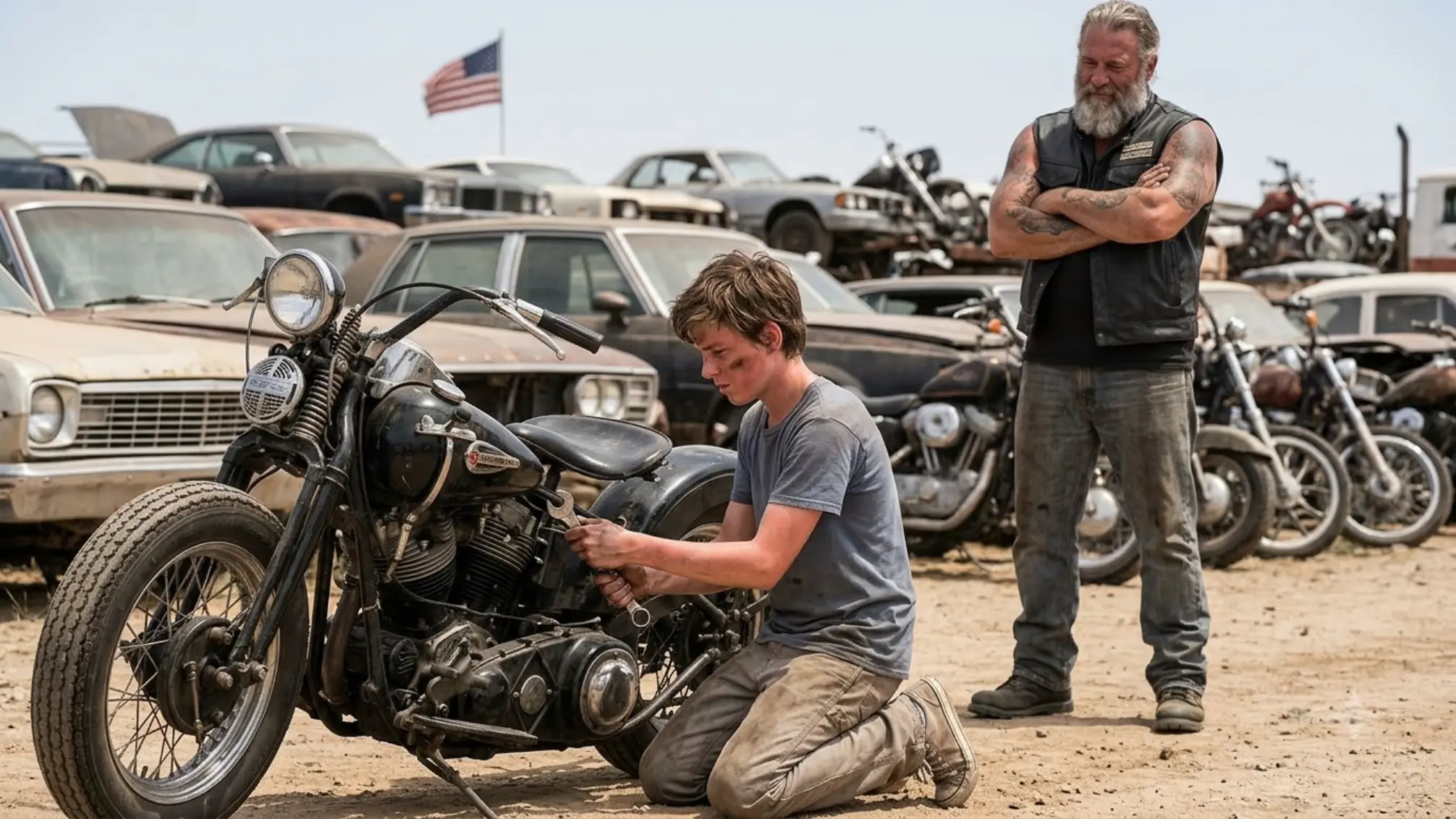
Leo saw a machine that had not been given its final chance.
He spent three hours uncovering it beneath the brutal July sun. By the time he dragged away the last piece of corrugated tin, sweat had soaked his faded blue-gray T-shirt and grease streaked his narrow face. Leo recognized the remains of a 1998 Harley-Davidson Dyna Super Glide, though almost every visible part seemed damaged. He knelt beside the engine and ran one dirty hand along the cylinder head.
Frank O’Malley approached with a cigarette hanging from the corner of his mouth.
“You found a ghost, kid.”
Leo looked up.
“Whose?”
Frank shrugged.
“State troopers dumped it here twelve years ago after a wreck on Route 66. Rider didn’t make it. Nobody claimed the machine.”
Leo looked back at the bike.
“Can I have it?”
Frank stared at him.
Then he laughed.
“That engine is seized solid. Frame might be twisted. You’d spend a year trying to fix something worth less than the tools.”
Leo waited.
Frank finally waved one hand.
“You want it, take it. Just don’t let your hobby interfere with the work I actually pay you five dollars an hour to do.”
Leo smiled.
It was the best deal anybody had offered him all year.
He had been working at the salvage yard because his mother, Sarah, was already working double shifts at a diner and still could not keep up with everything. Rent arrived every month whether business at the diner was good or bad. Her asthma medication cost more than either of them wanted to discuss. Groceries kept becoming more expensive.
Leo had learned early that being young did not protect a person from adult problems.
So he hauled scrap.
Sorted copper.
Removed usable parts from abandoned cars.
Cleaned tools.
Swept rust and broken glass from the yard.
And now, every free minute went into the Harley.
He built a crude shelter using old tarps and steel poles so he could work without the sun burning directly against his neck. His tools were a mismatched collection purchased from pawn shops or pulled from junk drawers inside Frank’s workshop. When a bolt refused to move, Leo learned patience. When a part was broken, he walked the yard until he found something close enough to modify.
The engine was the real problem.
Leo removed the spark plugs and poured a mixture of diesel fuel and automatic transmission fluid into the cylinders. Then he waited. Every night after work, he put a breaker bar on the crankshaft and applied pressure.
Nothing.
The following night, nothing again.
On the ninth night, he thought he felt movement.
He stopped immediately.
He marked the position.
The next evening, he tried again.
A few millimeters.
That tiny movement became proof.
The engine was not dead.
For nearly three weeks, Leo worked the crankshaft back and forth until the seized parts slowly released. He cleaned everything he could reach and replaced what he could not save. A damaged carburetor was rebuilt using pieces from a wrecked Sportster. A clutch cable came from another abandoned motorcycle.
The brake system became a puzzle.
Leo found replacement lines from an old Yamaha and adapted them carefully. He used Frank’s lathe after hours to clean and reshape damaged components. The repaired machine slowly became a strange collection of parts from different motorcycles held together by Leo’s patience.
Some nights he hated it.
A bolt would snap.
A gasket would leak.
A replacement part would almost fit but not quite.
Once Leo threw a wrench into the dirt and sat beneath the tarp crying because he had spent three hours solving one problem only to create two more.
Then he picked up the wrench.
He always picked it up.
His mother knew he was working on something but never understood how much of himself he had put into it. Leo told her he was repairing an old motorcycle that Frank had given him. Sarah smiled and warned him not to spend his grocery money on engine parts.
Leo promised.
He mostly kept that promise.
Then he discovered something hidden inside the machine.
While cleaning a custom center bar, Leo noticed one end had been sealed differently from the rest. He worked it open and found a narrow PVC tube hidden inside. The tube contained a pair of military dog tags and a heavy silver ring.
The dog tags read:
ARTHUR HOLLAND.
The silver ring carried the name of a motorcycle club Leo recognized immediately.
He had seen the patches on highways.
He had heard stories.
But fourteen-year-old Leo understood the ring mainly as something that had belonged to the man who once rode the Harley.
He considered selling it.
For about thirty seconds.
The silver alone might have been worth something, and his mother needed medicine.
But it was not his.
Leo placed the ring and dog tags back inside the tube and hid it beneath greasy rags in his toolbox.
Then he returned to the motorcycle.
Eight months after he first uncovered the machine, Leo believed it was finally ready.
He connected a scavenged battery.
Added gasoline.
Checked the electrical system again.
Then he hit the starter.
Nothing.
Leo closed his eyes.
“Come on.”
He tried again.
Silence.
Frank watched from outside the tarp.
“Told you, kid.”
Leo ignored him.
He checked the fuel.
Checked ignition.
Adjusted the carburetor.
Then he tried a third time.
The engine coughed.
Frank’s cigarette dropped slightly.
Leo froze.
“Did you hear that?”
Frank nodded.
“Again.”
Leo hit the starter.
The engine turned.
Coughed.
Then exploded into an uneven roar that shook the tarp and sent black smoke bursting from the exhaust.
Leo stumbled backward.
The Harley roared again.
It did not sound perfect.
It sounded alive.
Leo dropped onto his knees beside the machine and laughed until tears ran through the grease on his cheeks.
Frank stared at the bike.
“I’ll be damned.”
Leo looked up.
“Told you.”
“No, you didn’t.”
“I was thinking it.”
“Convenient.”
By April, the Harley could move.
Leo straightened the damaged front assembly as best he could and replaced enough broken pieces to make the motorcycle functional. He covered the mismatched surfaces with flat black primer. It was not beautiful.
It was his masterpiece.
At least, Leo believed it was his.
He began riding it only on quiet dirt roads outside the salvage yard. The machine gave him something his life rarely offered.
Freedom.
When the engine vibrated beneath him and the desert opened ahead, Leo was not the kid worrying about his mother’s medication.
He was not the boy sorting other people’s abandoned property for five dollars an hour.
He was simply moving.
The secret lasted until one Tuesday afternoon when the fuel tank ran dry two miles from the junkyard.
Leo pushed the Harley to a gas station near the highway.
He was counting crumpled bills beside the pump when an old pickup stopped nearby.
A thin man climbed out.
He looked at the Harley.
Then stopped.
His eyes followed the custom exhaust.
The frame.
The faint shape beneath the primer on the tank.
“Where’d you get that?”
Leo tightened the gas cap.
“Built it.”
The man laughed.
“No, kid. You repaired it.”
Leo said nothing.
The stranger walked around the motorcycle.
“These pipes are familiar.”
He removed his phone.
Leo immediately became uncomfortable.
“Don’t.”
The man took a photograph.
Then another.
“People have been looking for something like this.”
“Leave me alone.”
Leo started the motorcycle and rode away.
He did not know where those photographs went.
They traveled much farther than Barstow.
Within hours, someone recognized the frame.
Then the exhaust.
Then the faint outline hidden beneath the black primer.
The bike had belonged to Arthur “Dutch” Holland, a respected rider whose death twelve years earlier had left friends with almost nothing to remember him by. They had believed his motorcycle had been destroyed after the Route 66 crash.
Now photographs showed it running again.
And a fourteen-year-old kid was riding it.
Three days later, Leo was sorting copper wiring when he felt the ground vibrate.
At first he assumed heavy trucks were approaching.
Then the sound grew.
Hundreds of engines.
Frank stepped from his office.
His face changed immediately.
Motorcycles filled the road outside the salvage yard.
Dozens became hundreds.
According to the count that later passed around Barstow, 305 riders eventually surrounded O’Malley’s Scrap and Salvage. Engines idled beneath the desert sun while dust rose around rows of motorcycles.
Leo stared through the fence.
“What did I do?”
Frank swallowed.
“I think we’re about to find out.”
The engines shut down.
The sudden silence felt heavier than the noise.
A huge gray-bearded biker climbed from the lead motorcycle.
Big Jim Callahan walked toward the gate.
He was in his mid-fifties, broad enough to make the black vest across his shoulders look small. Tattoos covered his arms, and his expression carried the exhausted seriousness of someone who had spent much of his life on highways.
Frank opened the gate.
Big Jim entered with several riders behind him.
His eyes found Leo.
Then the black Harley.
Leo instinctively stepped between them.
Big Jim stopped.
“That bike isn’t yours, kid.”
Leo’s heart hammered.
“I found it.”
“It belonged to a friend.”
“It was buried under junk.”
Big Jim looked toward the motorcycle.
“We were told it was destroyed.”
Leo gripped the wrench in his hand.
“I rebuilt it.”
One biker behind Jim started forward.
Jim raised one hand.
The man stopped.
Big Jim looked at Leo again.
“How long?”
“Eight months.”
Jim approached the motorcycle.
Leo wanted to stop him.
Instead, he watched.
Big Jim crouched beside the engine and touched the custom exhaust.
His expression shifted.
“Dutch welded this.”
Nobody behind him spoke.
“He spent weeks getting the angle right because he said factory pipes sounded too polite.”
A few riders smiled faintly.
Big Jim inspected the engine.
“How’d you free it?”
Leo blinked.
“What?”
“The pistons.”
“Diesel and transmission fluid.”
Jim looked up.
“How long?”
“Three weeks.”
“Breaker bar?”
Leo nodded.
“Little movements.”
Big Jim stood.
For the first time, his expression contained something besides suspicion.
“Smart.”
Leo lowered the wrench slightly.
Then Jim asked:
“Did you find anything inside the center bar?”
Leo’s stomach dropped.
He said nothing.
Jim knew.
Leo walked toward his toolbox.
He pulled out the sealed tube and returned.
Big Jim accepted it.
When he opened the container and the silver ring fell into his palm, the entire atmosphere changed.
Jim stared at the name on the dog tags.
“Arthur Holland.”
His voice became quiet.
Leo watched the enormous biker’s eyes fill.
“We called him Dutch.”
Jim turned the ring between his fingers.
“He taught me how to ride in formation when I was young enough to think speed was the only thing that mattered.”
Leo looked toward the motorcycle.
Jim continued.
“They told us there was nothing left after the wreck.”
He closed his fist around the ring.
“You kept these?”
Leo nodded.
“Why didn’t you sell them?”
“They weren’t mine.”
Jim looked at him for several long seconds.
“You understand something a lot of grown men don’t.”
Leo swallowed.
“Are you taking the motorcycle?”
Jim looked toward the Harley.
“Yes.”
Leo’s face fell.
“No.”
Several bikers shifted.
Leo stepped forward.
“I fixed it.”
“I know.”
“I spent eight months on it.”
“I know.”
“I need it.”
Jim’s expression hardened.
“The machine belonged to Dutch.”
Leo’s eyes burned.
“You didn’t find it.”
Jim said nothing.
“You didn’t spend nights freeing the engine. You didn’t rebuild the carburetor. You didn’t scrape rust until your fingers cracked.”
His voice broke.
“I did.”
The riders behind Jim remained silent.
Leo wiped his face angrily.
“I was going to sell it.”
Jim frowned.
“Why?”
Leo looked down.
“My mom has asthma.”
He struggled to steady his voice.
“She works double shifts and still can’t keep up with medicine and rent. I thought if I fixed something valuable…”
He stopped.
Big Jim looked at the teenager standing in front of him.
Grease beneath his fingernails.
Worn shirt.
Cheap shoes.
A wrench trembling in one hand.
Then Jim turned toward the riders.
“Officers.”
Several men stepped closer.
“We need to talk.”
The discussion lasted nearly twenty minutes.
Leo could not hear most of it.
He only saw expressions.
Arguments.
Nods.
One rider pointed toward the bike.
Another pointed toward Leo.
Eventually Big Jim raised one hand.
The group went quiet.
He addressed them.
“The motorcycle goes home.”
Several men nodded.
“But nobody takes eight months of a kid’s work and calls that honor.”
One biker reached inside his vest.
He pulled out a stack of cash.
He walked toward the Harley and placed the money on the seat.
“Dutch helped me once.”
Another followed.
Then another.
Leo stared.
Twenty dollars.
Fifty.
Hundreds.
Soon riders farther back began passing money forward.
The pile grew.
Nobody announced amounts.
Nobody made speeches.
They simply contributed.
When it ended, Big Jim gathered the cash and walked toward Leo.
He pushed the bundle gently into the boy’s hands.
Leo stared down.
There was more money than he had ever held.
“Jim…”
“This is for the work.”
Leo’s hands shook.
“And for your mother.”
“I can’t take this.”
“You can.”
“How much?”
“Enough that you shouldn’t be thinking about medicine bills for a while.”
Leo looked toward the black Harley.
Jim followed his gaze.
“I know.”
Two riders began carefully preparing Dutch’s motorcycle for transport.
Leo felt something inside him ache as he watched.
The machine had been the first thing he had ever rebuilt completely.
The first thing that made him believe he might become more than the kid working among abandoned metal.
Then another motorcycle rolled through the gate.
An older Harley-Davidson Sportster 1200.
The paint was scratched.
Chrome dull.
Seat worn.
But it was complete.
Big Jim pointed toward it.
“That one needs work.”
Leo stared.
“What?”
“Carburetor needs attention. Paint is terrible.”
Jim glanced at Leo.
“Figured you liked impossible projects.”
Leo looked from Jim to the motorcycle.
“For me?”
Jim held out the key.
“A mechanic without anything to work on seems wrong.”
Leo did not reach for it immediately.
“You’re serious?”
Jim placed the key in Leo’s palm.
“Completely.”
Leo closed his fingers around it.
His throat tightened.
Big Jim rested one hand gently on his shoulder.
“Kid, you didn’t steal from us.”
Leo looked up.
“You gave a dead brother part of his story back.”
For several seconds Leo could not speak.
“So you’re still taking it?”
Jim nodded.
“Dutch’s bike goes home.”
He pointed toward the Sportster.
“But this one stays with you.”
Then he nodded toward the money.
“And wait until your mother sees what three hundred brothers left for her.”
Leo laughed through tears.
By late afternoon, Dutch Holland’s restored Harley was secured to a trailer.
Big Jim placed the silver ring and dog tags inside his vest close to his chest.
Before leaving, he walked back toward Leo.
“You keep fixing machines?”
“That’s the plan.”
“Good.”
Jim looked toward Frank’s rusting salvage yard.
“You’ve got talent.”
Leo glanced at the Sportster.
“I’ve got a lot to learn.”
“That’s why you’ll get good.”
Then the bikers mounted their motorcycles.
Engines started almost together.
The thunder returned.
Leo stood beside the Sportster holding the money against his chest while hundreds of riders disappeared toward the desert highway with the motorcycle he had brought back from the dead.
His mother arrived twenty minutes later after Frank called the diner.
She rushed through the gate believing Leo had been hurt.
Instead she found him beside another motorcycle with tears dried into the dust on his face.
“What happened?”
Leo held out the money.
Sarah stared.
“What is that?”
“Your medicine.”
She looked at him.
“What?”
“And rent.”
“Leo.”
“And probably a lot of other stuff.”
Sarah stared toward the empty road.
Then toward the motorcycle.
Leo told her everything.
When he finished, she sat on an overturned bucket and cried.
Not because of the money alone.
Because for years she had believed she was failing her son by not giving him enough.
Now she understood he had been quietly trying to save her too.
She pulled Leo against her.
“You’re fourteen.”
“I know.”
“You’re supposed to worry about school and girls and stupid things.”
Leo smiled against her shoulder.
“I can start tomorrow.”
“You’re going back to school.”
His smile disappeared.
“Mom.”
“That part isn’t negotiable.”
Leo laughed.
“Fine.”
The money gave Sarah something she had not possessed in years.
Time.
Medical bills were stabilized.
Rent stopped feeling like an approaching disaster.
Leo returned to school while continuing to work limited hours at the salvage yard.
And the Sportster waited beneath the tarp.
He rebuilt the carburetor first.
Then the electrical system.
He kept the scratched paint for almost a year because Big Jim had been right.
There was plenty to learn before appearance mattered.
The story spread through Barstow.
People exaggerated it.
Some claimed five hundred bikers arrived.
Others insisted Leo had fought them for the motorcycle.
Frank enjoyed correcting everyone.
“The kid didn’t fight anybody.”
Then he would pause.
“He just refused to lie down.”
Years later, what Leo remembered most was not the sight of hundreds of motorcycles surrounding the junkyard.
It was Big Jim’s hand on the damaged engine.
The moment the biker recognized his friend’s work beneath twelve years of rust.
Leo had thought he was repairing machinery.
He eventually understood he had restored somebody’s memory.
Dutch’s motorcycle returned to the people who had loved the man who built it.
Leo received something different.
A chance.
Money that helped his mother breathe easier.
A motorcycle of his own to rebuild.
And proof that knowledge gained with dirty hands could carry value far beyond the junkyard where he had learned it.
The machine Leo found had been abandoned because everyone believed nothing useful remained.
In that way, perhaps the Harley and the fourteen-year-old mechanic had something in common.
People looked at a ruined motorcycle and saw scrap.
People looked at a poor junkyard kid and saw cheap labor.
Leo Rossi spent eight months proving both judgments wrong.
And when 305 motorcycles finally disappeared beyond the Barstow horizon, taking Dutch Holland’s resurrected Harley home, Leo stood in the settling desert dust holding a new set of keys.
For the first time, the road ahead did not look like another thing someone had abandoned.
It looked like somewhere he might actually go.