The winter storm hit Pinewood without warning. The sky, a rolling gray, poured snow that clung to the bare branches of oak and maple, and the wind shrieked through the small town like a living thing. Streets quickly became rivers of ice, and residents hurried home, abandoning the sidewalks and leaving the town eerily silent except for the occasional creak of a sign swaying in the gusts. At the edge of the town, tucked along a winding lane that led to the old mill, sat a modest home owned by Harold Thompson, a widower in his late seventies. His silver hair, neatly combed, and the deep lines etched into his face told of decades spent working the fields and managing the family lumberyard, but his eyes, a clear gray, still held the warmth of someone who had never lost his faith in people.
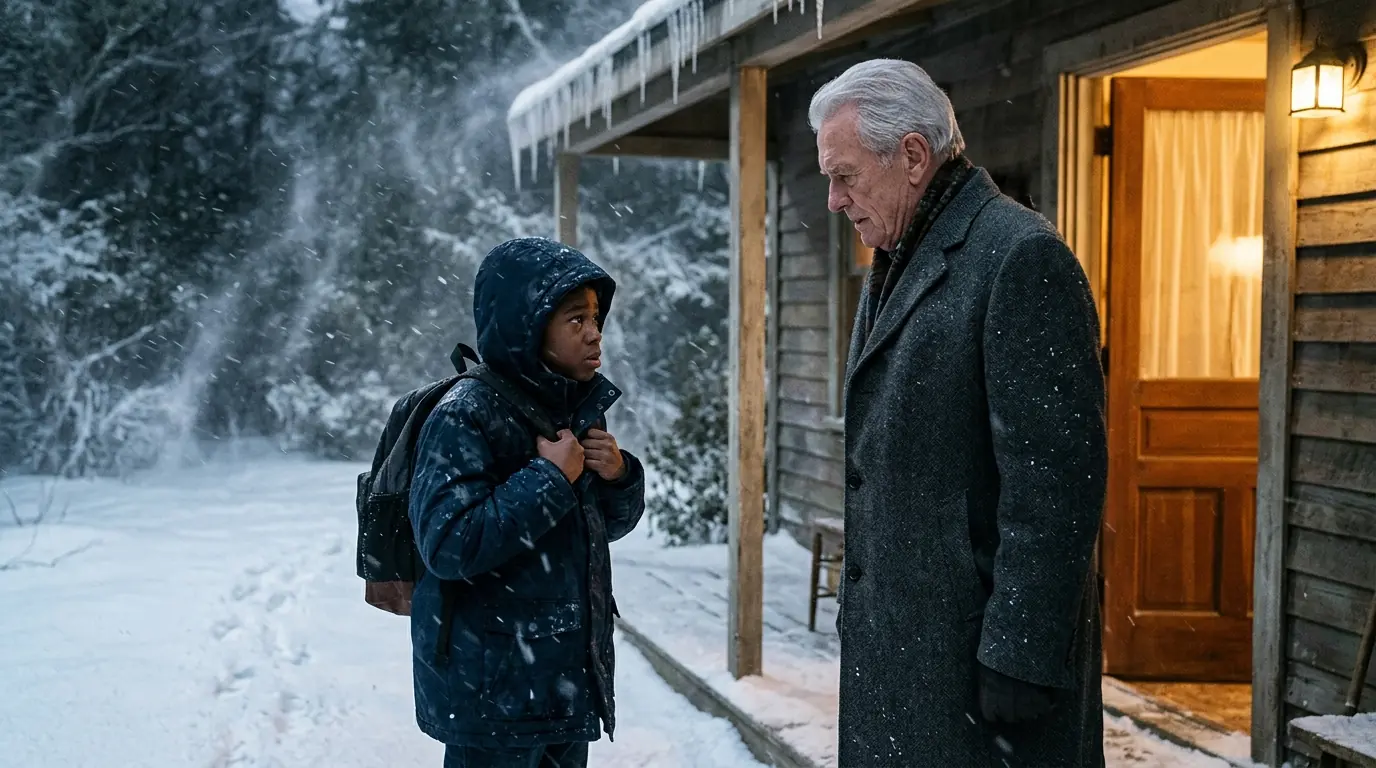 That evening, Harold sat near the fire in his living room, a wool blanket draped over his shoulders and a steaming mug of tea cradled in his hands. The wind howled outside, rattling the windowpanes and rattling the old shutters he had painstakingly repaired last summer. He had just settled into the quiet, the kind of quiet that came after a day spent chopping wood and stacking it neatly in the shed, when a faint, desperate knock echoed through the storm. At first, he thought it was the wind, but then it came again, more urgent, and he realized someone was at the door.
Cautiously, Harold stood, his joints protesting the sudden movement, and went to the door. Peering through the frosted glass, he saw a small figure huddled against the porch, shivering violently. The child’s coat was soaked, and snow clung to the hood pulled low over his face. He was no more than ten years old, eyes wide with fear, his lips pale and trembling from the cold. Without hesitation, Harold opened the door and ushered him inside, closing it against the biting wind.
“Here, you’ll warm up by the fire,” Harold said gently, guiding the boy toward the hearth. “I’m Harold. What’s your name?”
The boy didn’t respond. He merely shook, wrapping his arms around himself. Harold noticed a small, worn backpack clutched to his chest. He pulled over a chair and helped the boy sit, offering the tea he had been drinking. “Drink slowly. It’ll help,” Harold encouraged. The boy’s fingers trembled as they wrapped around the cup, the warmth seeping into his frozen skin. Finally, a whispered sound escaped him: “Ethan.”
“Ethan,” Harold repeated, nodding. “Alright, Ethan. You’re safe here. You won’t have to be alone tonight.” He poured more tea into another cup and set it beside the boy, then went to the kitchen to retrieve a blanket and some dry socks. By the time he returned, Ethan had tucked himself closer to the fire, his small frame hunched against the chill.
Over the next hour, Harold learned little from the boy, who spoke only in nods and gestures. But it didn’t matter. The child’s exhaustion and fear were enough to tell Harold that Ethan had been alone in the storm for some time. Harold set about preparing a simple dinner, heating broth and bread, and placed it on a tray beside the boy. “Eat a little, alright?” he said softly. Ethan looked at the food but shook his head, still too frightened. Harold sat beside him, keeping him company, and after several minutes, the boy took a tentative bite, and then another. Harold didn’t rush him. He simply stayed, offering quiet reassurance with his presence.
That night, Harold set up a cot in the corner of the living room for Ethan, laying down another blanket and tucking him in as best he could. The boy, exhausted from the cold and the storm, finally slept, his breathing slow and steady. Harold, sitting nearby, watched the fire flicker, listening to the wind howl, feeling a weight in his chest that he hadn’t expected. He had lived a long life, full of hard work and routine, but in that moment, he felt the deep, almost sacred responsibility of caring for someone who needed him. He didn’t know where Ethan had come from or how he had ended up in the storm, but he knew one thing: the boy would not face it alone tonight.
The next morning, the storm had passed. Snow still blanketed the town, and the sun reflected off the icy surfaces, creating a brilliant, blinding glare. Harold prepared breakfast, porridge with a dash of sugar and cinnamon, and called gently, “Ethan, breakfast.” The boy stirred, still cautious, but accepted the bowl that Harold set before him. They ate in silence, punctuated only by the occasional scrape of a spoon against the bowl. After breakfast, Harold helped Ethan into dry clothes and wrapped a warm coat around his small frame.
“We’ll get you some help,” Harold said. “I know people in town who can make sure you’re safe. But you can stay here until we figure it out.” Ethan nodded slightly, the first real acknowledgment he had given.
Over the following days, Harold contacted local authorities, neighbors, and even a social worker who specialized in children in crisis. No one seemed to know where Ethan had come from or who his parents were, and the boy offered no clues. But he did not resist Harold’s care. He began to eat better, warm meals replacing cold, meager rations. He slept without fear. And slowly, he began to trust the old man, following him from room to room, assisting with chores around the house, helping carry firewood into the kitchen, and even sweeping the porch when the sun came out.
Harold and Ethan settled into a rhythm, a quiet life marked by small tasks and shared routines. Harold read aloud in the evenings, tales of pioneers and explorers, imagining worlds far beyond the snow-laden hills of West Virginia. Ethan listened intently, occasionally asking questions in whispers. His voice, soft but determined, began to emerge, filling the house with a new energy that had been absent for so long.
Months turned into years. Ethan flourished under Harold’s care. He enrolled in the local school, initially shy and hesitant, but gradually opening to classmates and teachers. Harold became a constant presence, attending school events, helping with homework, and guiding him through life’s small challenges. The bond between them grew, founded not on blood, but on trust, kindness, and the steadfast consistency of care.
One autumn afternoon, when the leaves had turned gold and crimson and the air carried the crisp scent of harvest, Harold and Ethan sat on the porch, looking out over the fields that stretched behind the house. Ethan, now twelve, had grown taller, more confident. He kicked a small rock along the path, then turned to Harold. “You saved me,” he said simply. There was no question in his voice, only an acknowledgment of the truth they both understood. Harold nodded, placing a hand on the boy’s shoulder. “We saved each other,” he said.
Years passed. Ethan became a young man, sixteen by the time he graduated from Pinewood High School. He had a quiet dignity, a steady demeanor, and a sharp mind. He excelled in his studies and was well-liked among his peers. But he never forgot the winter storm that had brought him to Harold’s door, nor the kindness of a man who had taken a lost child into his home when no one else would.
After high school, Ethan received a scholarship to a university in Virginia. The day he left, Harold walked him to the bus stop, the same stoic old man who had once welcomed a frightened child into his home. Ethan hugged him tightly. “I’ll never forget you,” he whispered. Harold squeezed back. “Don’t forget yourself,” he said. “Remember the man you are because of the people who helped you become him.”
Harold watched until the bus disappeared over the snowy horizon. His house felt emptier, quieter, but there was a sense of peace. He had done what he had promised: he had provided shelter, safety, and love, and he had done it without asking for anything in return. Life, he knew, was full of departures, but those left behind carried the echoes of the care they had given.
Years turned into decades. Harold aged gracefully, his health eventually declining as time claimed its due. He remained active in the community, helping neighbors, volunteering at the library, and maintaining the little house at the edge of town. Though he had no children of his own, Ethan had become family, a living testament to his compassion and patience. Harold’s reputation as a man of kindness and integrity grew quietly, a quiet legacy that few understood fully but everyone respected.
One spring afternoon, when Harold was in his early eighties, a knock came at the door. He opened it to see a young man, tall and confident, yet with the familiar gray in his eyes that reminded Harold of a winter long ago. “Harold?” the young man asked. Harold’s face lit up with recognition. “Ethan,” he said, his voice thick with emotion. The boy he had saved so many years ago had returned, now a man in his own right.
Ethan stepped inside, carrying a small, wrapped package. “I wanted to thank you,” he said. He handed Harold the package, which, when unwrapped, revealed a handmade wooden box, carved intricately with symbols of the seasons and the forest that had surrounded Harold’s home. Inside the box were letters, photographs, and keepsakes chronicling the life he had built, the life that had begun the night of the storm. “I owe you everything,” Ethan said. “Not just the house, not just the meals, but the belief that someone would care for me when the world had turned its back.”
Harold’s eyes glistened. He took the box, turning it over in his hands. “You’ve made a life of it,” he said softly. “I didn’t do it for thanks, Ethan. I did it because it was right.” Ethan smiled. “And because of that, I am who I am. I’ve started a foundation for children in crisis. I’m using the lessons you taught me to help kids who have no one. I wanted you to know that you made this possible.”
For hours, they talked, sharing memories and laughter, tears and pride. Harold listened as Ethan recounted the successes, the challenges, and the lives touched by his foundation. Each story was a reflection of the seed of kindness planted in a snowy evening decades ago, a kindness that had grown into something immeasurably large and powerful.
As the sun set over Pinewood, casting a warm golden light across the fields, Harold realized that the storm had been more than just a test of survival. It had been the beginning of a bond that transcended time, a bond that had endured storms far greater than the one that had brought them together. The house, the fire, the meals, and the quiet evenings—they had all been the framework of a life that now flourished because of a single act of compassion.
Ethan stayed late into the evening, helping Harold with the woodpile and the garden, just as he had years ago. They moved together with ease, a testament to the continuity of care and love that had defined their relationship. As the last light faded from the horizon, Harold felt a profound sense of fulfillment. He had opened his home to a lost child during a storm, and that decision had rippled outward, touching lives in ways he could never have imagined.
When Ethan finally left that night, Harold stood at the door and watched him walk down the lane, his steps steady, confident, and sure. For the first time in many years, Harold felt the quiet joy of seeing the fruits of his generosity return, not in wealth or accolades, but in the continuation of care, compassion, and the creation of new opportunities for others. The storm had long passed, but its echoes remained, alive in the man who had once been a lost boy and now returned to honor the kind old man who had given him a second chance at life.