The fiercest snowstorm in 30 years swept through North Carolina, leaving Naomi Brooks’s diner, run by a compassionate woman, unusually desolate.
Suddenly, a strong gust of wind made the door burst open. A trembling elderly woman, her coat soaked and lips pale, stumbled in, pleading for help.
Without a moment’s hesitation, Naomi rushed to her, gently guiding her to a seat, wrapping her in a blanket, and warming her cold, numbed hands.
However, when the woman whispered the name of a powerful CEO, Naomi realized that this initial act of rescue had pulled her back into a past she had tried to bury forever.
The winter hit Asheville harder than any in 30 years.
Naomi Brooks stood at the window of the Cedar Table, watching snow bury the street in white silence. The world outside had gone still. No cars, no voices, just the wind howling against glass.
Inside the restaurant was warm. Soft lights, the smell of soup simmering on the stove.
Clarence sat in his corner booth, both hands wrapped around a coffee mug. Seventy-two years old, retired bus driver, silver hair and kind eyes. He’d been there since five, talking about nothing and everything the way old friends do.
“You’re too good, Naomi,” he said, not for the first time that night.
Naomi glanced back at him, smiled slightly.
“Someone has to be.”
“That’s what worries me.” He set down his mug, his expression serious now. “Being good in this world when everyone else is looking out for themselves… that’s the coldest place you can be. Nobody’s going to keep you warm.”
Naomi turned back to the counter and started wiping it down, even though it was already clean. Her hands needed something to do when her mind went to places she didn’t want it to go.
That was three years ago.
Ancient history.
She’d moved on, built this place, started over.
“I can handle the cold,” she said quietly.
Clarence studied her for a long moment, then sighed. He stood, joints creaking, and reached for his coat.
“Well, I should head out before the roads get any worse. You be careful tonight, you hear?”
“I will. Drive safe, Clarence.”
He buttoned his coat, wrapped a scarf around his neck, and moved toward the door with the careful steps of a man who knew his body didn’t forgive falls anymore.
His hand was on the doorknob when it happened.
The door burst open.
Wind screamed into the restaurant, carrying snow and ice and the smell of winter. And with it, stumbling through the threshold, came a woman.
Old. Thin. Coat white with snow like she’d been carved from the storm itself.
She took one step inside.
Then her legs gave out.
Clarence caught her before she hit the ground, his arms wrapping around her frail body.
“Naomi!”
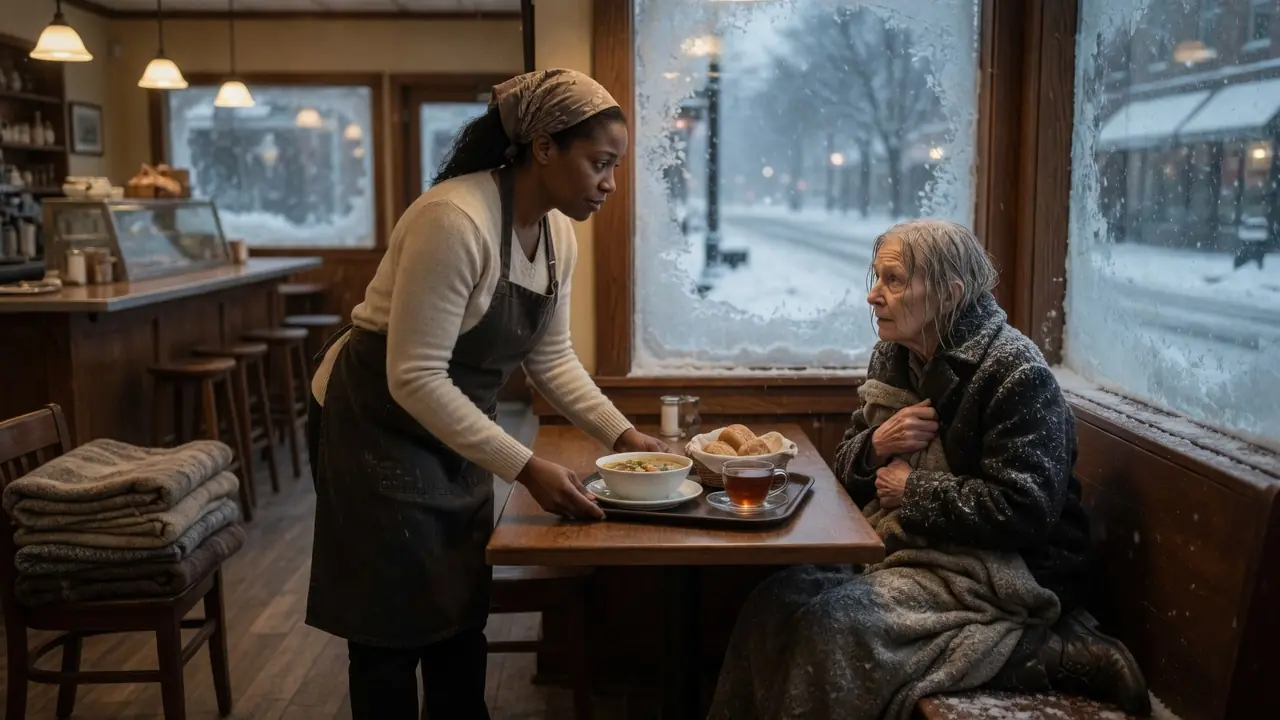
Naomi was already moving, around the counter, across the floor in seconds. Together, they lowered the woman into the nearest booth, easing her down gently.
The woman was shaking violently. Her lips were pale. Her skin felt like ice.
“Get blankets,” Naomi said, her voice sharp with focus. “Back room, top shelf.”
Clarence moved fast, all traces of age forgotten in the moment.
Naomi knelt beside the woman, fingers pressing gently against her neck, feeling for a pulse.
There.
Faint but steady.
Hypothermia, definitely.
How long had she been outside?
“Ma’am,” Naomi said, keeping her voice soft and calm. “Can you hear me? You’re safe now. You’re inside.”
The woman’s eyes fluttered open. Gray eyes like the storm outside, confused, distant, then slowly focusing.
“I…” Her voice was barely a whisper. “I need to find my son.”
Clarence returned with blankets, and Naomi wrapped them around the woman’s shoulders, layering warmth around her trembling frame.
“We will,” Naomi said. “But first, let’s get you warm.”
She went to the kitchen, moving on instinct and training, the kind that came from growing up with a mother who’d been a nurse.
Kettle on. Herbal tea, the strong kind. Soup from the pot, still hot.
Her hands worked quickly, efficiently, while her mind raced.
Where had this woman come from?
Why was she walking in this weather?
Where was her family?
She brought the tea and soup back, helped the woman take small sips, and watched color slowly return to her cheeks.
The violent shaking eased to tremors.
“Thank you,” the woman whispered.
“What’s your name?” Naomi asked gently.
The woman hesitated.
Then, “Margaret. Margaret Leighton.”
Across the room, Clarence froze.
Naomi kept her face neutral, but her mind caught on the name.
Leighton.
That name meant something in North Carolina.
It meant money. Power. The kind of family that made headlines.
“Where does your son live, Margaret?” Naomi asked carefully.
“Hawthorne Hill. The estates.” Margaret’s hands tightened around the teacup. “I have to see him. I have to fix something I did wrong.”
She fumbled with her coat pocket, her fingers still clumsy from the cold.
Something fell out.
A card, landing face up on the table.
Naomi picked it up.
Leighton Biotech Systems.
The logo was clean, corporate, expensive, the kind of card that opened doors most people would never see.
“Wait.”
The voice came from the counter, a truck driver who’d been sitting quietly, forgotten until now. He was staring at Margaret, eyes wide.
“Leighton? You mean Nathan Leighton? The CEO of Leighton Biotech?”
Margaret closed her eyes.
A tear slid down her weathered cheek.
The driver shook his head slowly.
“I delivered equipment to one of his facilities once. That man is cold as steel. Walks past people like they’re furniture. I heard he turned away a family whose car broke down outside his estate during the last cold snap. They had a kid with them.”
He leaned forward, his voice dropping.
“Storm or no storm, that man doesn’t open his door for anyone.”
The words settled over the restaurant like heavy snow.
Margaret’s hand started shaking again, but this time it wasn’t from cold.
It was something deeper, something that lived in the bones and the heart.
“He wasn’t always like that,” she said, her voice barely audible.
She opened her eyes, staring at nothing.
“When he was young, he had the softest heart. He’d bring home injured birds, stray cats. He cried at movies.”
She paused, struggling.
“He just forgot. Somewhere along the way, he forgot his own heart.”
The way she said it, not with anger, but with a grief so deep it seemed to fill every corner of the room, made Naomi’s chest tighten.
She knew what it was like to lose pieces of yourself.
To forget who you were before the world taught you to protect yourself by feeling less.
“Mrs. Leighton,” Naomi said gently. “Why were you walking in the storm? Why not call your son?”
“Because he wouldn’t answer.”
Margaret’s voice was firm despite the tears.
“He hasn’t answered my calls in eight months. Not since I told him he was becoming someone I didn’t recognize.”
She looked down at her hands.
“So, I thought if I showed up, if he saw me at his door, maybe then he’d remember. Maybe then he’d see.”
Naomi understood.
Desperation made people walk into storms. Made them believe physical presence could break through walls that words couldn’t touch.
“How did you even get here?” Clarence asked quietly.
“Taxi. Dropped me at the bottom of Hawthorne Hill. Driver said the roads were too dangerous to go farther.”
Margaret pulled the blankets tighter.
“I thought I could walk. It didn’t look far on the map.”
“That’s three miles,” Clarence said, his voice tight. “Uphill. In this weather, you could have died.”
“I know.”
Margaret met his eyes.
“But some things are worth dying for.”
The silence that followed was absolute.
Naomi made a decision.
“You’re not going anywhere tonight. Not in this storm.”
“But—”
“No.” Naomi’s voice was firm, the kind she’d used in boardrooms when men tried to talk over her. “The roads are impossible. You can barely stand. Your son can wait until morning. Right now, you need rest.”
Margaret opened her mouth to protest, then seemed to deflate.
The fight went out of her all at once.
“Okay,” she whispered. “Okay.”
Naomi helped her stand, one arm around her waist, bearing most of her weight.
Margaret felt like paper, fragile and worn thin.
“I have an apartment upstairs,” Naomi said. “You can sleep there.”
They moved slowly toward the back of the restaurant, past the kitchen, toward the narrow staircase.
Each step was an effort, but Margaret climbed, stubborn in a way only desperate people could be.
Clarence watched them go, then looked toward the front window, his expression troubled.
The apartment was small but warm.
Naomi settled Margaret on the couch, piled blankets around her, then went to make real food.
Grilled cheese. Simple, but made with care.
Margaret ate slowly, like someone who’d forgotten what hunger was.
When she finished, she looked up at Naomi.
“Do you believe good people still have a place in this world?”
The question caught Naomi off guard.
She could give an easy answer, something comforting.
But Margaret deserved better.
“If I didn’t believe that,” Naomi said slowly, “I wouldn’t have kept this place open tonight.”
Margaret studied her with those sharp gray eyes.
“You’ve been hurt.”
Not a question.
A recognition.
Naomi didn’t answer.
Some wounds were visible even when you couldn’t see them.
“We’re the same, you and I,” Margaret said softly. “Both carrying scars from trusting too much.”
The words landed harder than they should have.
Naomi felt something crack in her chest. Not breaking, just opening enough to let a little truth escape.
“Yeah,” she said quietly. “Maybe we are.”
Outside, the wind screamed.
The storm showed no signs of stopping.
Naomi helped Margaret to the bedroom, made sure she had everything she needed, watched her eyes close, watched her breathing slow into sleep.
For a moment, Naomi stood in the doorway looking at this stranger who’d walked into a storm to reach a son who wouldn’t open his door.
This mother who still believed love could thaw a frozen heart.
She turned off the light and closed the door quietly.
Downstairs, Clarence was putting on his coat again, preparing to leave.
“She going to be all right?” he asked.
“Physically? Yes. The rest?” Naomi shook her head. “That’s harder to fix.”
Clarence nodded, moved toward the door.
“You did a good thing tonight.”
“Just gave someone shelter.”
“That’s more than her own son would do.”
He paused, his hand on the doorknob.
“Be careful, Naomi. Men like Nathan Leighton don’t like people getting involved in family business, even when those people are just trying to help.”
“I’ll be fine.”
Clarence didn’t look convinced, but he nodded.
“Lock up behind me.”
She did.
Then Naomi stood alone in her restaurant, listening to the storm and the silence.
She should go upstairs. She should check on Margaret one more time, then get some sleep.
But something kept her at the window.
A feeling, irrational but insistent.
The feeling that the night wasn’t over yet.
Then she saw them.
Headlights cutting through the snow like knives.
A SUV, massive and expensive, pushing through drifts that would have stopped anything else. It moved with confidence, with power, carving a path through the impossible.
It pulled up directly in front of the Cedar Table.
Stopped.
Engine running.
Exhaust billowing white in the frozen air.
Naomi’s heart started beating faster.
The driver’s door opened.
A man stepped out.
Tall, dark coat that probably cost more than her monthly rent.
He didn’t flinch at the cold. Didn’t hurry.
Just stood there for a moment, looking up at the restaurant, looking directly at the window where Naomi stood.
Then he started walking toward the door.
The door opened, not violently, but with control.
Deliberate.
The man stepped inside, and the temperature in the room seemed to drop despite the heater running full blast.
He was maybe 40, maybe younger. Hard to tell with men who wore expensive suits like armor. Dark hair with threads of gray at the temples, sharp jawline, eyes that assessed everything in one sweep.
The empty tables.
The dim lighting.
Naomi standing behind the counter.
He closed the door behind him.
Snow clung to his shoulders, but he didn’t brush it off.
“We’re closed,” Naomi said, even though the lights were still on and she was clearly standing right there.
The man’s gaze settled on her, cold and analytical, the look of someone used to measuring people and finding them lacking.
“I’m looking for someone,” he said.
His voice was smooth, educated, with the kind of authority that came from never being told no.
“An elderly woman. Gray hair. About five-three. She would have been on foot.”
Naomi’s hands rested on the counter. She kept them still, kept her face neutral.
“Nobody’s been here,” she said.
It was a gamble, a lie that could blow up in her face.
But something in her gut said this man, whoever he was, wasn’t here to help Margaret.
He was here to control her.
The man studied Naomi for a long moment.
Then his eyes moved past her, scanning the restaurant, looking for evidence, looking for mistakes.
“I have reason to believe she came this direction,” he said. “Her phone’s last signal was near this block.”
“Then maybe she found shelter somewhere else.”
“There is nowhere else. Everything’s closed.”
He took a step closer to the counter.
“Except this place.”
Naomi didn’t move. Didn’t give an inch.
“Like I said, nobody’s been here.”
The man’s expression didn’t change, but something flickered in his eyes.
Frustration maybe.
Or calculation.
He reached into his coat, pulled out his phone, tapped the screen, then turned it to face her.
A photo.
Margaret, younger, smiling, standing in front of a garden somewhere sunny.
“This is my mother,” he said quietly. “She has early-stage dementia. She gets confused, wanders off sometimes.”
His voice softened. Not much, but enough to sound almost human.
“She could be in serious danger out there. If you’ve seen her, I need to know.”
And there it was.
The reasonable explanation.
The concerned son.
The medical condition that made everything make sense.
Except Naomi had sat with Margaret for the past hour. Had listened to her speak in clear, coherent sentences. Had watched her make deliberate choices, express complex emotions, remember details.
Whatever Margaret was running from, it wasn’t her own confusion.
“I haven’t seen her,” Naomi said again, her voice steady.
The man’s jaw tightened.
“You’re lying.”
“I’m telling you what I know.”
“No.”
He leaned forward, both hands flat on the counter now, close enough that Naomi could smell expensive cologne and cold air.
“You’re protecting her, which means she’s here.”
Naomi met his gaze, held it, refused to look away.
“You need to leave.”
“I’m not leaving without my mother.”
“Then you’re not leaving, because she’s not here.”
They stared at each other.
The heater hummed.
Outside, wind threw snow against the windows.
Then from upstairs, a sound.
Faint, but unmistakable.
A cough.
The man’s eyes snapped toward the ceiling, then back to Naomi.
“She’s upstairs.”
“That’s my apartment.”
“That’s what I heard.”
But the lie didn’t land this time.
They both knew it.
The man moved toward the back of the restaurant, toward the staircase that led up to Naomi’s home.
Naomi stepped out from behind the counter and put herself between him and the stairs.
“You can’t go up there.”
He stopped, looked at her like she was an insect that had landed on his sleeve.
Annoying, but easily dealt with.
“Move.”
“No.”
“I don’t think you understand who I am.”
“I don’t care who you are. This is my property. You don’t have permission to be here, and you definitely don’t have permission to go upstairs.”
His expression shifted.
Not to anger. That would have been almost human.
Instead, it went colder, more remote, the look of someone recalculating, adjusting strategy.
“My name is Nathan Leighton,” he said, enunciating each word like he was explaining something to a child. “I own Leighton Biotech Systems. Perhaps you’ve heard of it.”
“I have.”
“Then you know I have the resources to make this very simple or very complicated.”
He paused.
“Your choice.”
Naomi’s heart was pounding now, but she kept her voice level.
“Is that a threat?”
“It’s a fact. My mother is sick. She needs medical attention. She needs to be somewhere safe.”
“She is safe. She’s warm. She’s fed, and she’s resting.”
“She needs to be home.”
“She came here instead. Maybe you should ask yourself why.”
The words landed like a slap.
For the first time, something cracked in Nathan’s controlled facade.
A flash of something.
Pain?
Guilt?
Gone too fast to name.
“You don’t know anything about my family,” he said quietly.
“I know she walked three miles in a blizzard rather than call you. I know she almost died out there. I know she’s more afraid of seeing you than she is of freezing to death.”
Naomi crossed her arms.
“So yeah, maybe I don’t know everything. But I know enough.”
Nathan’s jaw worked.
She could see him fighting something, emotion trying to break through ice.
Then his phone rang.
He pulled it out, glanced at the screen, and his expression went flat again.
Professional.
Back in control.
“I have to take this.”
He turned slightly away.
“Leighton.”
Naomi couldn’t hear the other side of the conversation, but she watched Nathan’s body language shift. Shoulders straightening, voice dropping into that corporate tone that brooked no argument.
“I understand, but that can wait until morning. No, I’m dealing with a family matter. It’s under control. Fine, send me the files. I’ll review them tonight.”
He ended the call and stood there for a moment with his back to Naomi.
When he turned around, something had changed.
The edge had dulled slightly.
Or maybe he was just tired.
“Look,” he said, and for the first time, he sounded like an actual person. “I’m not trying to be… I just want my mother safe. That’s all.”
“She is safe.”
“Not out here. Not in some stranger’s apartment.”
“Better than alone in a mansion with locked doors,” Naomi said quietly.
Nathan flinched, small but visible.
Before he could respond, the lights flickered once.
Twice.
Then the restaurant went dark.
The heater died mid-hum. The refrigerator went silent. The only light came from the windows, dim gray filtered through snow.
“Perfect,” Nathan muttered.
Naomi moved instinctively, muscle memory from countless nights working late.
She went behind the counter, found the emergency candles she kept under the register. Her hands found the matches and struck one.
Warm light flared in the darkness.
She lit three candles, placing them strategically around the restaurant.
The space transformed. Smaller, more intimate, shadows dancing on the walls.
Nathan stood in the middle of the room, looking suddenly out of place, like he didn’t know what to do without electricity, without his phone working at full capacity, without the modern world insulating him from the cold.
“How long do power outages usually last?” he asked.
“In weather like this? Could be hours, could be days.”
He pulled out his phone again and checked it.
“I’m not getting signal.”
“Tower is probably down.”
“I need to…”
He stopped, seemed to realize how useless that sentence was.
Need didn’t matter.
The storm didn’t care what Nathan Leighton needed.
Naomi watched him stand there, this man who controlled millions of dollars and thousands of employees, completely helpless against snow and ice and failed infrastructure.
“You can’t drive in this,” she said. “Even with that tank you showed up in. Roads are probably completely blocked by now.”
Nathan looked toward the door, then back at her.
She could see him working through options, none of them good.
“So, what do you suggest?”
“I suggest you accept that you’re stuck here for the night.”
Naomi picked up one of the candles and headed toward the kitchen.
“And since you’re stuck, you might as well make yourself useful.”
“Useful? How?”
“Circuit breakers in the back storage room. We can check if it’s just a tripped breaker or if the whole grid’s down. You know how to use a flashlight?”
He followed her.
“I’m not incompetent.”
“Didn’t say you were. Just asked if you could handle a flashlight.”
In the storage room, Naomi found the old camping lantern she kept for emergencies.
She clicked it on. LED light flooded the small space, harsh after the candlelight.
She opened the breaker box.
All the switches were in the correct position.
“Grid’s down,” she confirmed. “We’re on our own until the power company gets things running again.”
Nathan stood in the doorway looking at the breaker box like it had personally offended him.
“I should call someone. Get a generator brought out.”
“With what phone service? And even if you could call, nobody’s driving in this. Not even for you.”
The words came out sharper than she’d intended.
But she was tired.
Tired of men who thought money solved everything.
Tired of people who’d never learned that sometimes you just had to sit with discomfort and wait.
Nathan didn’t respond, just stood there jaw-tight, clearly hating every second of being powerless.
Naomi brushed past him back into the main restaurant, started assessing what they had, what they’d need.
“There’s a gas stove in the kitchen,” she said. “We can still heat water, make coffee, warm up food. I’ve got candles for light, blankets upstairs.”
She looked at him.
“You’re welcome to sleep in one of the booths, or you can try to walk back to your car and see how that goes.”
“I’m not leaving without my mother.”
“She’s sleeping. She’s exhausted, and she’s not going anywhere until morning at the earliest.”
Naomi set the lantern on the counter.
“So, you can either spend the night fighting with me, or you can accept the situation and try to be civil. Your call.”
Nathan stared at her.
She could practically hear him thinking, calculating, trying to figure out how this small restaurant owner was managing to dictate terms to him.
Finally, he shrugged out of his expensive coat and laid it over a chair.
“Fine,” he said. “But I want to see her. Just to confirm she’s okay.”
Naomi considered this.
“You can look in on her quietly. But if you wake her up, I’m kicking you out into the snow. Clear?”
“Clear.”
She led him upstairs, the lantern casting long shadows on the narrow walls.
At the bedroom door, she pushed it open slowly, carefully.
Margaret was still asleep, breathing steady, face peaceful in a way it hadn’t been when she’d arrived.
She looked small under the blankets, fragile, but safe.
Nathan stood in the doorway, not entering, just looking.
Naomi watched his face in the dim light, saw something crack there just for a second, something that looked like grief or regret, or maybe just exhaustion.
“She’s fine,” Naomi whispered. “Better than fine. She’s resting.”
Nathan nodded.
Didn’t speak.
Couldn’t, maybe.
They went back downstairs.
Naomi went to the kitchen and started heating water on the gas stove. She made tea, strong and , the kind that kept you awake when your body wanted to shut down.
Nathan sat at the counter watching her work.
“Why did you lie?” he asked finally. “When I first came in. You knew she was here.”
Naomi poured tea into two mugs and slid one across to him.
“Because I didn’t know if you were here to help her or control her.”
“She’s my mother.”
“That doesn’t answer the question.”
Nathan picked up the mug, held it between his hands, stared into it like it might have answers.
“I’m trying to protect her,” he said quietly.
“From what?”
“From herself. From making decisions when she’s not… when she can’t.”
“She seemed pretty coherent to me.”
“She has good days and bad days.”
“Or,” Naomi said carefully, “she has days when she agrees with you and days when she doesn’t.”
Nathan’s eyes snapped up. Hard, cold again.
But Naomi didn’t back down.
She was done backing down from men who thought authority equaled truth.
“You don’t know what you’re talking about,” he said.
“Maybe not. But I know what I saw. A woman who made a choice to come here. Who walked through a blizzard because she needed something from you and couldn’t get it any other way.”
“She needed to be safe.”
“She needed to be heard.”
The words hung between them, sharp and true.
Nathan set down the mug, stood up, paced to the window, and looked out at the storm that showed no signs of stopping.
Morning came slowly.
The storm had exhausted itself sometime around dawn, leaving behind a world buried in white.
Naomi woke to silence, the kind that only comes after nature has finished shouting.
She had fallen asleep in the booth nearest the kitchen, wrapped in blankets that smelled faintly of coffee and smoke.
Her body ached, but the quiet was almost holy.
Across the room, Nathan was still asleep in another booth. His expensive suit was wrinkled, his hair out of place. In sleep, he looked younger, softer, human.
Naomi sat up, stretched until her spine cracked.
The candles had burned out hours ago. Gray light pushed weakly through the snow-covered windows.
No power.
No signal.
Just the faint hum of the world catching its breath.
She moved into the kitchen, lit the gas stove, and set water to boil.
The small hiss of flame felt like victory.
Coffee grounds. Boiling water. The slow, steady pour.
Routine.
The thing that always steadied her.
She had just lifted her cup when she heard footsteps on the stairs.
Margaret appeared in the doorway, one hand brushing the wall for balance.
She looked better. Color in her cheeks, eyes clear again. Her gray hair was a little wild, but she’d made the effort.
“Good morning,” Naomi said softly.
Margaret smiled, small but real.
“Is the storm over?”
“That’s something.”
Margaret nodded, glancing toward the window.
“And my son?”
Naomi gestured toward the dining room, where Nathan was still asleep.
“He showed up last night looking for you.”
Margaret’s smile thinned. Not surprised, just a quiet resignation.
“Of course he did. Always tracking, always managing, never just letting things be.”
“He was worried,” Naomi offered.
Margaret took the cup Naomi handed her, warmth seeping into her fingers.
“No,” she said, almost to herself. “He was inconvenienced. There’s a difference.”
Before Naomi could respond, a new voice came from behind them.
“I can hear you.”
Nathan stood in the doorway, rumpled, tired, smaller somehow without his armor of control.
“Good morning, Nathan,” Margaret said evenly.
“Don’t good morning me.”
But his voice lacked heat, only exhaustion.
“You could have died out there.”
“But I didn’t,” she replied.
“Because you got lucky. Because this woman—”
He gestured toward Naomi.
“—happened to be here when she shouldn’t have been.”
“Maybe that’s not luck,” Margaret said quietly. “Maybe that’s grace.”
Nathan’s jaw flexed, but he said nothing more.
“Is there coffee?”
Naomi nodded toward the pot in the kitchen.
He moved past them, poured a cup, his hand trembling slightly.
None of them spoke for a while.
The silence was as thick as the snow outside.
Then Margaret broke it.
“I’m not going back with you, Nathan.”
He froze.
“Mom—”
“Not yet,” she said, firm but gentle. “Not until we talk. Really talk.”
Her voice didn’t rise, but it cut clean through the air.
“No more managing. No more deciding what’s best for everyone but me.”
She straightened.
“I’m still your mother, Nathan. I still have a voice.”
Nathan sighed, the sound heavy and tired. He glanced at Naomi as if hoping for rescue.
She stayed silent.
“This isn’t the place.”
“This is exactly the place,” Margaret interrupted. “No office, no assistants, no phone to hide behind. Just you and me and the truth.”
The CEO’s mask flickered back into place, but Margaret didn’t move.
“When did you become this?” she asked softly. “Someone who values control more than connection. Who treats people like problems to fix instead of hearts to understand?”
He blinked, thrown by her gentleness.
“That’s not fair.”
“Isn’t it?” she asked, stepping closer. “When was the last time you called just to talk? Not about schedules or medication. Just to talk.”
Nathan stared into his coffee.
“I’ve been busy.”
Margaret shook her head.
“No, Nathan. You’ve been hiding.”
The words landed like a blow.
Naomi saw him flinch.
“I have responsibilities,” Nathan said tightly. “People depend on me. Hundreds of employees, patients—”
Margaret stopped him with a quiet voice.
“And one mother,” she said, “who just wants to know her son still has a heart.”
The silence after that was almost unbearable.
Naomi shifted toward the door.
“Maybe I should give you two—”
“No,” Margaret said quickly. “Stay. Sometimes men like Nathan need a witness.”
Nathan gave a dry, humorless laugh that faltered halfway. He rubbed his face, weary.
“Fine. What do you want from me, Mom? What am I supposed to say?”
“The truth,” she said. “Do you even care that I walked through a blizzard to see you, or are you just angry that I didn’t fit into your schedule?”
Nathan’s jaw tightened.
“Of course I care. You’re my mother. But you can’t just put yourself in danger and expect me to…”
He stopped, his voice catching.
“Expect me to be okay with it.”
Margaret’s response came soft, almost weary.
“Maybe it would have been easier for you if I hadn’t come back at all.”
“Don’t,” he said sharply.
The single word cracked in the air.
“Don’t ever say that.”
“Then tell me why,” she pressed, voice trembling now. “Why the silence? Why the distance? Why move me into that sterile apartment with nurses and no life? Why take away my car, my choices, my freedom?”
Nathan turned away, both hands raking through his hair.
“Because you’re sick.”
“I’m aging,” she countered. “That’s not the same.”
“The doctor said—”
“They said maybe. Early decline. Maybe. They said I needed support, not a cage.”
He stood there with his back to them, shoulders rising and falling.
When he spoke again, his voice was quiet.
“I’m scared.”
The room went still.
Margaret’s tone softened instantly.
“Of what, sweetheart?”
His voice broke.
“Of losing you. Of watching you forget who I am. Of standing there helpless while you fade. Of becoming an orphan at 40.”
Margaret reached out, her hand light on his arm.
“You won’t lose me. Not the parts that matter. Not if you stay close. Don’t grieve me before I’m gone.”
“But the disease might come.”
“Might not.” She gave a small, sad smile. “But if you treat me like I’m already gone, that’s on you, not the disease.”
Nathan’s throat worked.
He nodded once.
“I don’t know how to do this.”
“You don’t have to know,” she said gently. “You just have to stay.”
He looked at her for a long time, like someone stepping into warmth after years in the cold.
“I thought I was protecting you,” he said, his voice breaking. “But I was just pushing you away.”
Margaret smiled through tears.
“Yes. But you can stop now.”
Nathan nodded, slow and uncertain.
Then he turned to Naomi, voice raw.
“Thank you for keeping her safe. For being what I wasn’t.”
Naomi shook her head.
“I just did what anyone should.”
A faint smile touched his mouth.
“Most wouldn’t have.”
She met his gaze, calm and steady.
“Maybe not. But she asked for help, and I still believe that matters.”
The power came back around noon.
The lights flickered on, the heater groaned to life, and the modern world reasserted itself with a hum of electricity and connectivity.
Nathan’s phone immediately started buzzing.
Missed calls, texts, emails, the accumulated urgency of 12 hours offline.
He pulled it out, looked at the screen, then deliberately turned it off.
“That can wait,” he said.
The words seemed to surprise him as much as anyone.
Margaret smiled.
Naomi started preparing lunch, real food.
Now that the refrigerator was running again, she pulled out vegetables, pasta, ingredients for a simple but satisfying meal.
Nathan watched her work from his seat at the counter.
“Can I help?” he asked.
Naomi glanced at him, surprised.
“You cook?”
“I used to. Before…”
He trailed off.
“Before I got too busy for things like that.”
“Chop these.”
She slid an onion and a knife across to him.
“Small pieces.”
He picked up the knife, held it awkwardly at first, then found the rhythm. Sliced through the onion with careful, deliberate cuts.
“When I was in college,” he said suddenly, “I worked as a delivery driver. Pizza place near campus. Terrible pay. Long hours, but I loved it.”
Naomi looked up.
“Yeah?”
“Yeah. I’d drive around the city at night, music playing, no responsibilities except getting the food there hot. People were always happy to see me. I made them happy, you know, just by showing up with dinner.”
He smiled at the memory, and it transformed his face. Made him look like someone Naomi might have liked to know.
“What changed?” she asked.
“Business school. First job at a consulting firm. Learned that success meant strategy, not service. That power came from distance, not connection.”
He finished the onion, started on a bell pepper.
“I was good at it. Really good. Got promoted fast. Made partner young. Built the company into what it is now. But…”
“But?”
“Somewhere along the way, I stopped being the guy who made people happy just by showing up. Started being the guy who made people nervous, who people avoided in hallways, who only got invited to meetings, never to dinners.”
Margaret, sitting at a nearby table with her own coffee, spoke up.
“You became your father.”
Nathan’s knife stilled.
“What?”
“Your father. My late husband.” Margaret’s voice was gentle but firm. “He was brilliant, successful, built the company from nothing. And he died alone in his office at 62 because he’d forgotten how to be anything except a businessman.”
“That’s not—”
Nathan started, then stopped.
“Is that really what you think?”
“It’s what I know. And it’s what I’ve watched you become. A man who has everything except the things that matter.”
Nathan set down the knife, looked at his hands. The expensive watch, the manicured nails, the hands that signed contracts but rarely touched anyone with affection.
“I didn’t mean to,” he said quietly.
“No one ever does.”
Naomi added the chopped vegetables to the pan, stirred them with olive oil and garlic. The smell filled the kitchen, warm, alive, human.
“My father died when I was 14,” she said, not looking up from the stove. “Heart attack. Sudden. One day he was there, next day he wasn’t.”
She paused, adjusted the heat.
“For years I wished I’d told him things. Important things. How much I appreciated him. How his quiet presence made me feel safe. How I wanted to be like him when I grew up. Steady, reliable, kind.”
She stirred the vegetables.
“But I never said any of it. Thought there’d be more time. There wasn’t.”
Nathan was watching her intently now.
“After he died, my mom and I went through his things. Found this journal he’d kept. Just random thoughts, nothing organized. But there was an entry from a few months before he died.”
She smiled sadly.
“He wrote, ‘Naomi is growing up so fast. Hope she knows how proud I am. Should tell her more often. Will tell her tomorrow.’”
The kitchen was quiet except for the sizzle of vegetables.
“He didn’t get tomorrow,” Naomi finished. “So I learned something. You don’t wait. You don’t assume there’s always more time. You say the things that matter while you can.”
She turned off the stove, plated the food, and set it in front of Nathan and Margaret.
“That’s why I opened my door last night,” she said. “Because maybe that’s someone’s last chance. Maybe that’s the moment that matters. You don’t get to know in advance. You just have to show up.”
They ate in silence for a while, but it was different now.
Not uncomfortable, not tense. Just quiet in the way that happens when people are thinking about things that matter.
Finally, Nathan spoke.
“What happened to you in New York?” he asked. “The thing that made you leave?”
Naomi considered not answering. Considered deflecting or changing the subject.
But something about the moment, about the food, and the candle still burning even though the power was back, made her want to tell the truth.
“I worked for Northbridge Capital,” she said. “Fund management firm. High stakes, big money. I was good with numbers. Really good. Could see patterns nobody else noticed.”
She took a breath.
“One day, I found discrepancies in our reports to investors. Small at first, but consistent. Someone was manipulating valuations, making our returns look better than they were. Classic fraud, but sophisticated.”
“What did you do?” Margaret asked.
“Reported it. To my supervisor, to compliance, to the partners. Showed them the evidence, explained the risks.”
Naomi’s voice hardened.
“They thanked me, said they’d investigate. Two weeks later, they fired me.”
“For reporting fraud?” Nathan sounded genuinely shocked.
“For committing it. Or so they claimed. Suddenly, all the evidence I’d gathered pointed to me. My access, my signatures, my files. They’d flipped the whole thing. Made me the scapegoat.”
“That’s criminal.”
“Yes. But also effective. They had better lawyers, more resources, institutional credibility. I had the truth, which turned out to be worth less than I thought.”
She met Nathan’s eyes.
“They gave me a choice. Sign an NDA, take a severance, disappear quietly, or fight it in court and spend the next five years of my life in legal battles I couldn’t afford to win.”
“You took the severance.”
“I took the severance, moved here, started over.”
She gestured around the restaurant.
“Built something small. Something mine. Something that couldn’t be taken away by people who valued profit over integrity.”
Nathan was quiet for a long moment.
Then, “What was the name of your supervisor? The one you reported to?”
“Does it matter?”
“It might.”
Naomi studied him, trying to read his intention.
“Jackson Carter. Why?”
Nathan’s face went very still.
“Jackson Carter. Senior executive. Tall, silver hair, always wears expensive suits.”
“That’s him.”
“He works for me now. Has for three years. Head of strategic partnerships at Leighton Biotech.”
The words landed like ice water.
Naomi set down her fork.
“What?”
“I recruited him from Northbridge. He had an impressive track record, strong connections in the finance world. Came highly recommended.”
Nathan’s voice was tight.
“Are you telling me he’s the one who—”
“Who destroyed my career? Yes. He’s the one who flipped the evidence. Who convinced the partners to protect themselves by sacrificing me. Who probably walked away with a promotion for his trouble.”
Margaret reached across the table, placed her hand over Naomi’s.
“Oh, honey.”
Nathan stood abruptly and paced to the window. His jaw was working. His hands clenched.
“I didn’t know,” he said. “I swear I didn’t know.”
“How could you? I signed an NDA. Nobody knows my side except me.”
“But I should have.”
He turned back to them.
“I should have done better due diligence. Should have looked harder at his background. I just saw the credentials and the recommendations and assumed.”
“You assumed someone successful must be good,” Naomi finished. “That’s what everyone assumes. That’s how people like Jackson keep winning.”
Nathan returned to the counter and sat down heavily.
“He’s been pushing for a major acquisition. A pharmaceutical startup with promising research. The numbers look good, but I’ve had this feeling…”
He stopped.
“This feeling that something’s off.”
“Not provable, just instinct?”
“Trust your instinct,” Naomi said. “It’s probably right. If he’s doing to this company what he did to your career, then people will get hurt. Investors, employees, patients who depend on your products.”
She looked at him steadily.
“But you can stop it. You have the power. I didn’t have the resources, the position, the credibility. But you do.”
“No proof.”
“Then find proof. Look at the numbers. Follow the money. Do what I did, but this time make sure you’re the one with the leverage.”
Nathan’s expression shifted.
The executive returning, but different now. Focused not on control but on purpose.
“Will you help me?” he asked.
Naomi blinked.
“What?”
“You see patterns. You said so yourself. If I give you access to the files, can you find what I’m missing?”
“Nathan—”
“I know it’s asking a lot. I know you have no reason to trust me or my company. But if Jackson Carter is doing something wrong, if he’s putting people at risk the way he put you at risk…”
He leaned forward.
“Please help me stop him.”
Naomi looked at Margaret, who nodded slowly.
Then back at Nathan, at this man who was starting to remember how to be human.
“I’ll look,” she said finally. “But I’m not making promises. And if I find something, we handle it the right way. Legally, transparently. No cover-ups, no scapegoats. The truth, whatever it costs, even if it damages your company.”
“Especially then,” Nathan said quietly. “Because what’s the point of building something if it’s built on lies?”
Naomi held his gaze, searching for deception or manipulation or corporate doublespeak.
She found none.
“Okay,” she said. “I’ll help.”
They spent the afternoon working.
Nathan had brought his laptop because, of course, he had. And after the power came back, he’d retrieved it from his SUV.
Now he sat at one of the restaurant tables, files spread out while Naomi looked over his shoulder.
Margaret had fallen asleep again, exhausted from the emotional weight of the morning. She rested upstairs, peaceful, while her son finally started doing something that mattered.
“Here,” Nathan said, pulling up a spreadsheet. “This is the acquisition Jackson’s been pushing. Biogenesis Research. Small startup, only three years old, but they’ve developed a promising new drug delivery system.”
Naomi studied the numbers, revenue projections, burn rate, investor returns.
“These look almost too good,” she said.
“That’s what I thought. But Jackson keeps saying it’s a ground-floor opportunity, that we’d be foolish to pass on it.”
“Who verified these numbers?”
“Jackson’s team. He said the startup’s internal audit was solid.”
“Did anyone from your company independently verify?”
Nathan paused.
“No. Jackson said it wasn’t necessary, that he had relationships with their board, that he’d done the due diligence himself.”
Naomi sat back.
“That’s red flag number one. No independent verification means no checks on his claims.”
“What else?”
She leaned forward again, scrolled through the documents, stopped on a page listing investors.
“This name,” she said, pointing. “Clearwater Holdings. It’s listed as the primary investor in Biogenesis. But it’s just a shell company. No operating history, no public filings, just a name and a Cayman Islands address.”
“How do you know it’s a shell?”
“Because I spent three years tracking money for people who didn’t want it tracked. You learn to spot the signs.”
She pulled up another window, started searching.
“Shell companies aren’t illegal, but they’re often used to hide ownership, to obscure who’s really behind a transaction.”
Nathan watched her work.
Her fingers flew across the keyboard, pulling up registries and databases and financial filings.
“There,” she said finally. “Clearwater Holdings was incorporated 18 months ago. Single director listed. Want to guess who?”
“Jackson.”
“Close. His brother-in-law, Marcus Reeves.”
Nathan’s face darkened.
“Jackson never disclosed a family connection.”
“Because that would require him to recuse himself from the acquisition. It would require someone else to verify the numbers.”
Naomi kept digging.
“If Jackson controls both sides of the transaction, if he’s pushing your company to buy a startup that his family partly owns, that’s a massive conflict of interest at minimum. At worst, it’s fraud.”
“Can you prove it?”
“Maybe. If I can access more of Jackson’s communications, his financial disclosures, the actual books from Biogenesis.”
She looked at Nathan.
“How much clearance can you give me?”
“Full access. Whatever you need. Even to executive files. Even to mine. I’ve got nothing to hide. And if I did, I’d rather you found it now than later.”
Naomi studied him.
This was the moment, the test of whether he really meant what he said about transparency and truth.
“Okay,” she said. “Give me remote access to your systems. I’ll start tonight.”
They worked until evening.
Nathan explained company structures, introduced her to the filing systems, gave her every password and clearance she needed.
Margaret woke around sunset and came downstairs to find them hunched over the laptop, surrounded by papers and empty coffee cups.
“You two look like conspiracy theorists,” she said, amused.
“We’re hunting one,” Nathan replied without looking up. “Thanks to Naomi.”
Margaret smiled.
“Good. It’s about time you used your power for something other than profit.”
Nathan did look up then.
“Is that really what you think I do? Just chase money?”
“Isn’t it?”
He set down his pen.
“I thought I was building something. Something that mattered. Medical research, pharmaceutical development, technologies that save lives.”
“You are,” Margaret said gently. “But you got so focused on the building that you forgot about the people living in what you built. The employees you never talk to. The patients who depend on your drugs. The community that watches your company and wonders if you care about anything beyond the next quarterly report.”
“I care.”
“Then show it. Not with press releases or donations that are really just tax write-offs. Show it by being present, by listening, by letting yourself be human instead of just being successful.”
Nathan was quiet for a long moment.
Then he nodded.
“I’m trying.”
“I know, sweetheart. I can see it.”
Naomi stood and stretched. Her back ached from hours of sitting.
“I need a break. Going to make dinner.”
“I’ll help,” Nathan said immediately, closing the laptop.
In the kitchen, they worked side by side.
Nathan chopped vegetables while Naomi started a sauce. They moved around each other with surprising ease, like they’d done this before, even though they hadn’t.
“Can I ask you something?” Nathan said after a while.
“Go ahead.”
“Why did you really stay open last night? And don’t say it was just about helping people. There’s more to it than that.”
Naomi stirred the sauce, watched it bubble.
“You’re right. There is more.”
She paused, choosing her words.
“When everything fell apart in New York, when everyone I trusted turned on me, I felt invisible. Like I didn’t matter. Like I could disappear and nobody would notice or care.”
She added herbs to the pot. Basil, oregano, the smell rising warm and familiar.
“I kept thinking if one person had just seen me, if one person had said, ‘I believe you,’ or ‘You matter,’ or even just, ‘I’m sorry this happened,’ maybe it would have been different. Maybe I wouldn’t have felt so…”
She struggled for the word.
“So erased.”
Nathan stopped chopping.
“So you stay open because you don’t want anyone else to feel erased.”
“I stay open because I want to be the person I needed when I had nothing. Because if I can be that for someone, even just one person one night, then maybe all the bad things that happened to me mean something. Maybe they taught me how to recognize pain in others. How to respond with grace instead of indifference.”
“That’s…”
Nathan’s voice caught.
“That’s beautiful.”
“It’s just survival.”
“Survival with a purpose.”
They finished cooking in comfortable silence.
The pasta was simple but good, the kind of meal that felt like home even when you were far from it.
Margaret joined them at the table. They ate together, the three of them, while outside the world continued its slow work of digging out from the storm.
“Nathan,” Margaret said eventually, setting down her fork. “I need to tell you something.”
He looked up.
“What?”
“Yesterday, walking into that storm, it wasn’t confusion. It wasn’t my condition. It was a choice.”
“What do you mean?”
Margaret took a breath.
“I wanted you to have to come find me. To have to leave your office, your schedule, your controlled environment. I wanted to force you into a situation where you couldn’t manage everything, where you’d have to just be.”
Nathan stared at her.
“You did this on purpose.”
“Yes. And I’m not sorry, because look what happened.”
She gestured around the restaurant.
“You met Naomi. You slowed down. You remembered how to talk about things that matter. You started being my son again instead of just my caretaker.”
“You could have died.”
“But I didn’t. And maybe that’s the point. Maybe sometimes you have to risk something to save something more important.”
Nathan looked stunned.
Then slowly, he started to laugh.
Not bitterly.
Genuinely.
The sound surprised all of them.
“You manipulated me,” he said, still laughing. “You actually manipulated me into becoming a better person.”
“Guided,” Margaret corrected, but she was smiling. “Not manipulated. There’s a difference.”
“Is there?”
“Yes. Manipulation is about control. Guidance is about love.”
Nathan shook his head, still grinning.
“I can’t believe you did that.”
“I can’t believe it worked.”
Naomi watched them and felt something warm settle in her chest.
This was what healing looked like.
Not perfect. Not complete.
But real.
Two people finding their way back to each other through honesty and humor and the willingness to try.
“So what now?” Nathan asked, looking at his mother. “You’ve guided me into enlightenment. Where do we go from here?”
“Home,” Margaret said simply. “But a different kind of home than before. One where we talk. Where you visit not because you’re checking on me, but because you want to see me. Where I’m your mother again, not your responsibility.”
“I’d like that.”
“So would I.”
They finished dinner, cleaned up together, moved around the small kitchen with a coordination that came from shared purpose rather than practice.
As they were drying the last dishes, Nathan turned to Naomi.
“Come work for me,” he said suddenly.
She nearly dropped the plate she was holding.
“What?”
“Come work for Leighton Biotech. Not in finance unless you want to, but somewhere you can make a difference. Chief ethics officer, maybe. Someone who keeps us honest. Who calls out the Jackson Carters before they do damage.”
“Nathan—”
“I’m serious. You see things clearly. You’re not afraid to tell the truth even when it costs you. That’s exactly what my company needs. What I need.”
Naomi set down the dish and turned to face him fully.
“You can’t just hire me because I helped you through a crisis.”
“I’m not. I’m hiring you because you’re brilliant and ethical and everything my company should be but isn’t always. Because you understand that profit and principle don’t have to be opposites. Because…”
He paused.
“Because you make me want to be better. And I think you could make my entire company better, too.”
She searched his face for signs of pity or guilt or corporate strategy.
Found only sincerity.
“I’ll think about it,” she said finally.
“That’s all I ask.”
But they both knew she’d already decided.
Outside, the snow was melting.
Slowly but inevitably, the world was thawing, and inside the Cedar Table, three people who’d been strangers 48 hours ago sat together in the warm light, learning how to trust again, learning how to hope.
By the third morning, the town had started to wake again.
Snowplows cleared the main road. The radio played softly. The smell of coffee filled the air.
Life was returning, tentatively, carefully, but it was returning.
Then the back door opened.
No knock, no hesitation, just the sound of confident footsteps on tile.
Naomi froze mid-motion, a dish towel still in her hands.
When she turned, he was already standing in the doorway.
Tailored coat.
Polished shoes.
The storm barely touching him.
Jackson Carter.
Naomi’s breath caught.
Six feet tall, silver hair perfectly styled, charcoal suit that probably cost more than most people’s monthly rent.
He looked exactly as she remembered. Polished, confident, untouchable.
Their eyes met.
For a split second, something flickered across his face.
Surprise.
Recognition.
Then it was gone, replaced by that smooth corporate smile.
“Well,” he said, voice like silk over steel. “This is unexpected.”
Naomi set down the dish towel carefully.
Her hands wanted to shake, but she wouldn’t let them.
“Jackson.”
“Naomi Brooks. It’s been what, three years?”
He stepped farther into the kitchen, casual, like he owned the space.
“I heard you’d left New York. Didn’t realize you’d ended up here. Small world.”
“Not small enough.”
He laughed.
Actually laughed.
“Still bitter, I see. That’s unfortunate. I’d hoped you’d moved on.”
“I moved on. Doesn’t mean I forgot.”
“Fair enough.”
He glanced around the kitchen, taking in the modest equipment, the small workspace.
“This is quite the downgrade from Northbridge. But I suppose it’s honest work. Nothing wrong with that.”
Every word was calculated, designed to remind her of what she’d lost, what he’d taken.
Naomi crossed her arms.
“What are you doing here, Jackson?”
“I’m looking for Nathan, actually. His assistant said he’d been unreachable for two days. Given the storm and his mother’s situation, I thought I should check in.”
His eyes narrowed slightly.
“You wouldn’t happen to know where he is, would you?”
Before Naomi could answer, Nathan’s voice came from the stairs.
“I’m right here.”
Jackson turned, his smile brightening.
“Nathan, thank God. We’ve been worried. When you didn’t respond to any messages—”
“I turned off my phone,” Nathan said, descending the stairs with Margaret behind him. “I needed space to think.”
“Of course. Of course. Family matters take priority.”
Jackson’s gaze shifted to Margaret, his expression arranging itself into concern.
“Mrs. Leighton, you gave us quite a scare. Are you feeling better?”
“I’m perfectly fine,” Margaret said coolly. “Though I don’t recall asking for your concern.”
Jackson’s smile tightened almost imperceptibly.
“Just making sure you’re safe. Nathan’s mentioned your recent health challenges.”
“Has he?”
Margaret moved to stand beside Naomi, a deliberate choice.
“How thoughtful.”
The temperature in the room seemed to drop.
Jackson looked between the three of them, clearly sensing something, but not quite able to identify what.
His gaze lingered on Naomi.
“I didn’t realize you knew Nathan’s family,” he said casually.
“We just met,” Naomi replied. “Circumstances.”
“Interesting circumstances, I’m sure.”
He turned back to Nathan.
“Listen, I hate to intrude on your personal time, but we have the Biogenesis meeting scheduled for Monday. Final approval on the acquisition. I need you back in the office to review the paperwork.”
“I’ve been reviewing it,” Nathan said. “Here.”
Jackson’s tone held the faintest edge of condescension.
“Nathan, this deal requires proper attention, full documentation, legal review.”
“I said, I’ve been reviewing it thoroughly.”
Nathan’s voice was calm but firm.
“And I have some questions.”
Jackson’s smile never wavered.
“Of course. That’s why we have the meeting. All your questions will be addressed then.”
“No. I want to address them now.”
Something shifted in Jackson’s eyes.
Something cold and calculating.
But his voice remained pleasant.
“Nathan, I don’t think this is the appropriate venue.”
“Clearwater Holdings,” Nathan said. “The primary investor in Biogenesis. Tell me about them.”
Jackson didn’t even blink.
“Standard investment firm. Venture capital mostly focused on biotech startups. They’ve been in the game for years.”
“Two years,” Naomi corrected quietly. “Clearwater was incorporated 18 months ago.”
Jackson’s gaze snapped to her.
For a moment, the mask slipped. She saw anger there and something else.
Concern, maybe.
Or fear.
“I’m sorry,” he said, voice suddenly harder. “Who are you to be commenting on our business dealings?”
“Someone who knows how to read a corporate filing,” Naomi replied. “And who knows that Clearwater’s sole director is Marcus Reeves, your brother-in-law.”
The silence was absolute.
Jackson recovered quickly, but not quickly enough.
“That’s a matter of public record. I’ve done nothing wrong.”
“Except fail to disclose a family connection,” Nathan said. “Except push an acquisition where you have an undisclosed financial interest. Except—”
“I don’t have to explain myself to her,” Jackson interrupted, gesturing at Naomi.
“I don’t know what she’s told you, Nathan, but—”
“She told me the truth,” Nathan said quietly. “About Northbridge Capital. About what you did to her.”
Jackson went very still.
“I have no idea what you’re talking about.”
“Yes, you do. She reported fraud. You framed her for it, made her the scapegoat so you and your partners could walk away clean.”
“That’s a lie.”
“Is it?”
Naomi stepped forward.
“Because I have copies of the original reports I filed, timestamped with my analysis intact. And I have the altered versions that appeared after I was fired, the ones with my name attached to the fraudulent numbers. Funny how they don’t match.”
Jackson’s jaw tightened.
“You signed an NDA.”
“To protect Northbridge. Not to protect you. And the NDA doesn’t cover criminal fraud.”
She tilted her head.
“Want to guess how long it would take the SEC to get interested in a case like this? Especially if they knew the same person was now pushing questionable deals at one of the region’s largest biotech firms?”
“You’re bluffing.”
“Am I?”
They stared at each other.
Naomi could feel her heart pounding, but she kept her expression calm.
She’d learned something in New York.
Men like Jackson only respected power, only understood threats.
So she gave him one.
“Here’s what’s going to happen,” Nathan said, his voice cutting through the tension. “You’re going to walk out of here. You’re going to go back to the office, and you’re going to have your resignation letter on my desk by Monday morning.”
Jackson’s head snapped toward him.
“You can’t be serious.”
“Completely serious. You lied to me. You manipulated company resources for personal gain. You pushed a deal with undisclosed conflicts of interest. That’s grounds for termination and possibly legal action.”
“Nathan, be reasonable. Think about what you’re throwing away. The Biogenesis acquisition could be worth hundreds of millions.”
“Built on deception. I don’t want it.”
“You’re making a mistake. A huge mistake.”
Jackson’s voice rose slightly, control finally cracking.
“That company needs this deal. Your shareholders need this deal. You’re letting personal feelings cloud your judgment.”
“No,” Nathan said calmly. “I’m finally seeing clearly.”
Jackson looked at Margaret as if she might intervene.
“Mrs. Leighton, surely you can talk sense into your son.”
“My son is making perfect sense,” Margaret said. “More sense than he has in years. Now, I believe he asked you to leave.”
Jackson’s face hardened.
The pleasant mask was completely gone now, replaced by something ugly and calculating.
“You’ll regret this,” he said, looking directly at Nathan. “All of you. I have friends, connections, people who won’t take kindly to being embarrassed.”
“Is that a threat?” Naomi asked.
“It’s a fact.”
He straightened his suit jacket.
“I built my reputation on being smarter than everyone else in the room. On seeing opportunities others miss. On winning.”
“You built it on lies,” Naomi said. “And on destroying people who got in your way. But eventually, that catches up with you.”
Jackson smiled, but there was no warmth in it.
“We’ll see. In my experience, people like you, people who think morality matters more than results, you’re the ones who end up losing. Because the world doesn’t reward virtue, Miss Brooks. It rewards victory.”
“Then I guess we have different definitions of winning,” she replied.
He looked at her for a long moment.
Then at Nathan.
Then at Margaret.
“This isn’t over,” he said quietly.
Then he turned and walked out the back door, leaving it open behind him.
Cold air rushed in, making the kitchen lights flicker.
Nathan moved to close it and locked it firmly.
For a moment, none of them spoke.
Then Margaret let out a long breath.
“Well, that was unpleasant.”
“That was necessary,” Nathan corrected.
He looked at Naomi.
“Are you okay?”
She nodded, though her hands were shaking now with delayed adrenaline.
“Yeah. I’m okay.”
“He’s going to fight this,” Nathan said. “He’s not the type to just walk away.”
“I know. But you did the right thing.”
“Did I?”
Nathan ran a hand through his hair.
“He’s right about one thing. The shareholders won’t be happy about losing the Biogenesis deal. The board will question my judgment. This could cost me.”
“What does it cost if you don’t do it?” Margaret asked gently. “What does it cost to build a company on corruption? To let people like Jackson operate without consequences?”
Nathan nodded slowly.
“Everything that actually matters.”
“Then you have your answer.”
The next 48 hours were chaos.
Jackson didn’t resign quietly.
Instead, he went to the board, claimed Nathan was suffering emotional distress due to his mother’s health. Suggested that Nathan’s judgment was compromised. Called for an emergency board meeting to review the Biogenesis acquisition and Nathan’s fitness to lead.
Nathan spent those two days building his case, gathering evidence, preparing for the fight of his professional life.
Naomi helped him.
They worked side by side at her small apartment, spreading documents across every surface, cross-referencing financial records, building an airtight argument.
Margaret watched them work with quiet satisfaction, occasionally bringing coffee or food, reminding them to sleep.
“You look like you’re preparing for war,” she said on the second night.
“We are,” Nathan replied without looking up. “Jackson’s not going down without making this hurt.”
“Good thing you’re not alone, then.”
Nathan glanced at Naomi, who was hunched over a spreadsheet, making notes in the margins.
“Yeah,” he said. “Good thing.”
The board meeting was scheduled for Monday afternoon.
Nathan would have one chance to present his case.
One chance to prove Jackson’s corruption without destroying the company in the process.
No pressure.
Sunday night, Naomi found Nathan standing at her apartment window, staring out at the city lights.
“Can’t sleep?” she asked.
“Too much in my head.”
He didn’t turn around.
“What if I’m wrong? What if I blow up this deal and the evidence isn’t enough? What if the board sides with Jackson?”
“Then you lose the company.”
“That’s not reassuring.”
“It’s not supposed to be. It’s just true.”
Naomi moved to stand beside him.
“But you already knew that when you made this choice. You knew the risk.”
“I did. I just didn’t expect it to be this hard.”
“Important things usually are.”
They stood in silence for a moment, watching the world outside continue its indifferent rotation.
“Can I tell you something?” Nathan said quietly. “Something I haven’t told anyone.”
“Of course.”
“When my father died, he left me the company. I was 28, too young, too inexperienced, but it was mine, and I was terrified.”
He paused, choosing his words carefully.
“Everyone expected me to fail. The board, the investors, even my own employees. They’d smile to my face and bet against me behind closed doors. So I decided to prove them wrong. I’d be harder, smarter, more ruthless than any of them. I’d win at any cost.”
“And you did,” Naomi said.
“Yeah. I won. Built the company into something three times the size my father left me. Made everyone who doubted me eat their words.”
He finally turned to look at her.
“But somewhere in all that winning, I forgot why I started. Forgot that my father didn’t build this company just to make money. He built it to help people, to create medicine that saved lives, to do something that mattered.”
“You can still do that,” Naomi said. “You’re doing it now by refusing to let Jackson corrupt what your father built.”
“What if it’s too late? What if I’ve already become the thing I’m fighting against?”
Naomi considered this, really considered it.
She could give him easy comfort, tell him he was fine, that he was nothing like Jackson, but he deserved better than comfortable lies.
“Maybe you did become that thing,” she said slowly. “For a while. But the difference between you and Jackson is that you stopped. You looked at yourself, didn’t like what you saw, and chose to change. Jackson would never do that. He doesn’t even see the problem.”
Nathan nodded slowly.
“You know what the worst part is? I almost didn’t stop. If my mother hadn’t walked into that storm, if I hadn’t ended up here, if I hadn’t met you…”
He trailed off.
“I was one board meeting away from approving Jackson’s deal. One signature away from being complicit in exactly the kind of corruption I’m now trying to expose.”
“But you didn’t sign it.”
“Only because I got lucky.”
“No. Because deep down, some part of you knew. Some part of you was still your father’s son, still the kid who delivered pizzas and made people happy. That part never died. It just got buried. And now, you’re digging it back up, one choice at a time.”
Nathan smiled slightly, the first real smile she’d seen from him in days.
“When did you get so wise?”
“When I lost everything and had to figure out what actually mattered.”
Naomi returned the smile.
“Trauma’s a hell of a teacher.”
They laughed, and for a moment, the weight lifted.
Then Nathan’s expression grew serious again.
“Tomorrow, when I go into that boardroom, I need you there.”
“Nathan, I’m not—”
“You’re the only one who can explain the financial evidence in a way they’ll understand. The only one who can walk them through exactly what Jackson did. And more than that…”
He paused.
“You’re my proof. Proof that Jackson has done this before. That this isn’t just about one bad deal. It’s about a pattern of corruption.”
“They’ll ask why I didn’t report him years ago.”
“And you’ll tell them about the NDA. About the choice you were given. About what it costs to tell the truth when nobody wants to hear it.”
Naomi felt her stomach twist.
Going into that boardroom meant exposing herself.
Meant reliving the worst period of her life in front of strangers who had no reason to believe her.
But it also meant Jackson wouldn’t get away with it again.
“Okay,” she said. “I’ll be there.”
The boardroom was on the 47th floor of the Leighton Biotech Tower.
Floor-to-ceiling windows overlooked the city. A massive mahogany table dominated the space, surrounded by leather chairs that probably cost more than Naomi’s car.
Twelve board members sat waiting when Nathan, Margaret, and Naomi entered.
Jackson was already there, sitting at the far end of the table, looking confident and relaxed, like this was just another day at the office.
“Nathan,” the board chair, an older man named Robert Hutchins, said gravely. “We’re glad you could make it. Please sit.”
They took their seats.
Naomi felt acutely aware of her simple dress, her lack of corporate polish.
She didn’t belong here.
Everyone in the room knew it.
But she was here anyway.
“Let’s get started,” Hutchins said. “Jackson has raised concerns about the Biogenesis acquisition. He claims you’re attempting to kill the deal based on personal bias rather than business judgment. Is that accurate?”
“No,” Nathan said calmly. “I’m attempting to kill the deal because it’s fraudulent.”
Murmurs around the table.
Jackson’s expression didn’t change, but Naomi saw his fingers tighten slightly on his pen.
“That’s a serious accusation,” Hutchins said. “Do you have evidence?”
“I do.”
Nathan opened his laptop, connected it to the presentation screen.
“I’m going to walk you through exactly what Jackson Carter has been hiding. But first, I want you to meet someone.”
He gestured to Naomi.
“This is Naomi Brooks. Three years ago, she worked as a senior analyst at Northbridge Capital, the firm where Jackson was employed before joining Leighton Biotech. She’s going to tell you what happened when she discovered fraud in that organization. And she’s going to tell you who was responsible.”
All eyes turned to Naomi.
Her mouth went dry.
Her heart pounded so hard she thought everyone must hear it.
But she stood, looked around the table, met Jackson’s cold gaze, and she spoke.
“Three years ago, I found evidence that Northbridge Capital was manipulating investment valuations,” she began, her voice steadier than she felt. “I reported it through proper channels. I provided documentation. I did everything right.”
She paused, pulled up the copies of her original reports on the screen.
“This is what I submitted. Clear evidence of fraud. Numbers that didn’t add up, patterns of manipulation designed to inflate returns and deceive investors.”
She clicked to the next slide.
“This is what appeared after I was fired. The same analysis, but altered. My name attached to the fraudulent numbers. The evidence flipped to make me look guilty instead of the people actually committing the crime.”
She looked directly at Jackson.
“Jackson Carter orchestrated that flip. He convinced the partners to protect themselves by destroying me. And it worked. I signed an NDA, took a severance, disappeared. He got promoted, and nobody ever questioned what really happened.”
The room was silent.
“That’s a convenient story,” Jackson said smoothly. “But it’s just that. A story. Miss Brooks has no proof. She signed an NDA, which suggests guilt, not innocence. And this is clearly a desperate attempt to discredit me because Nathan wants to kill a deal that would make us all wealthy.”
“Actually,” Naomi said, “I have proof. I kept copies of everything. Original timestamped files, email threads, meeting notes. And I recently contacted two former Northbridge employees who confirmed they were pressured to alter reports at Jackson’s direction.”
She pulled up emails on the screen, names redacted, but the content clear.
“This is from a junior analyst who was told to adjust my findings. This is from a compliance officer who was fired when she questioned the altered reports. This is a pattern, and it’s happening again right here with Biogenesis.”
Nathan took over, clicking through the financial documents.
“Jackson pushed this acquisition without proper due diligence. He failed to disclose that his brother-in-law controls the primary investor. He falsified projections to make the deal look better than it is, and he pressured me to approve it without independent verification.”
“These are serious allegations,” Hutchins said, his face grave. “Jackson, what’s your response?”
Jackson stood, buttoned his suit jacket.
Still confident. Still controlled.
“My response is that this is character assassination. Nathan is under stress because of his mother’s health. He’s allowing personal feelings to override business judgment. Miss Brooks is a disgruntled former employee with an axe to grind, and this entire presentation is designed to justify killing a deal that I’ve spent months developing.”
“Then explain Clearwater Holdings,” Nathan said. “Explain why you didn’t disclose your family connection.”
“I didn’t think it was relevant. Marcus Reeves is barely an in-law. We’re not close.”
“Then you won’t mind if we subpoena your financial records,” Naomi said quietly. “To verify that you have no financial stake in Biogenesis or Clearwater.”
Jackson’s jaw tightened.
“That’s invasive and unnecessary.”
“It’s standard procedure when there’s a suspected conflict of interest,” Hutchins said.
He looked at Jackson carefully.
“I’m inclined to allow an independent audit to clear this up definitively.”
“Robert, you can’t be serious.”
“I’m very serious. This company’s reputation is at stake. If there’s even a chance that fraud has occurred, we need to investigate thoroughly.”
Jackson’s control finally cracked.
“Fine. Audit away. You won’t find anything because there’s nothing to find. But when this is over, when you realize Nathan and his pet analyst are wrong, I expect apologies. And I expect Nathan to step down for this embarrassment.”
“If the audit clears you,” Hutchins said, “then we’ll discuss Nathan’s judgment. But until then, the Biogenesis acquisition is suspended, and you’re on administrative leave pending the investigation’s outcome.”
Jackson’s face went white, then red.
“You’re suspending me based on unproven accusations.”
“We’re protecting the company. Standard protocol.”
For a moment, Jackson looked like he might flip the table, might scream, or threaten, or break the corporate veneer entirely.
Instead, he gathered his things with sharp, angry movements.
“You’ll regret this,” he said, looking at Nathan, then at Naomi. “All of you.”
Then he walked out, slamming the door hard enough to rattle the windows.
The room exhaled collectively.
Hutchins looked at Nathan.
“You understand this investigation will examine everything, including your own decisions. If you knew about Jackson’s conflicts and didn’t act sooner, that’s a problem.”
“I understand. I have nothing to hide.”
“Good.”
Hutchins stood.
“We’ll reconvene in two weeks with the audit results. Until then, carry on as normal. And Nathan…”
He paused.
“You did the right thing. Not the easy thing, but the right thing. Your father would be proud.”
Nathan’s eyes got suspiciously bright, but he nodded.
“Thank you.”
Six months later, the Cedar Table had a new sign.
Open Hearts Café hung above the door, painted in warm gold letters.
The restaurant looked the same inside. Same wooden tables, same warm lighting, but it felt different, fuller, like more life had been breathed into it.
Naomi stood behind the counter making coffee the way she always did.
But now she only worked there three days a week.
The other four days, she worked at Leighton Biotech as Chief Ethics and Compliance Officer.
The audit had taken three months.
They’d found everything.
Jackson’s financial ties to Biogenesis, the falsified projections, the pattern of manipulation going back years. He’d been fired, charged with fraud, and was currently awaiting trial.
Nathan had been cleared of any wrongdoing.
The board had praised his decisive action.
The company’s stock had taken a hit initially, but recovered once investors understood that Leighton Biotech was choosing integrity over quick profits.
The door chimed.
Nathan walked in, snowflakes on his shoulders.
It was winter again, but this year the cold felt different. Less harsh, more like a season that would pass.
“Hey,” he said, smiling.
That smile came easier now, more natural.
“Hey, yourself. The usual?”
“Actually, I’m here for something else.”
Naomi raised an eyebrow.
“Yeah?”
Nathan pulled a small box from his coat pocket and set it on the counter between them.
Naomi’s heart stuttered.
“Nathan…”
“Before you panic, let me say something.”
He took a breath.
“I’m not asking you to marry me today. I’m not even asking you to marry me soon. I’m just asking if you’d consider someday building something with me. Not a company, not a career. Just a life.”
Naomi stared at the box, then at him.
“Open it,” he said softly.
She did.
Inside was a ring.
Not diamond.
Ruby.
Deep red, set in simple gold. Beautiful and unexpected.
“My mother helped me pick it,” Nathan said. “She said you’d appreciate something real over something perfect.”
Naomi felt tears burning in her eyes.
“It’s beautiful.”
“So, is that a yes to considering it?”
She looked up at him.
This man who’d walked into her restaurant six months ago, cold and closed and afraid, who’d learned slowly, painfully, how to be human again.
“I’m keeping my name,” she said. “Brooks. To remember where I came from.”
“I wouldn’t ask you to change it.”
“And I’m keeping this place. The café. It matters to me.”
“I know. I love that about you.”
“And if I say yes, I need you to understand something.”
She met his eyes.
“I’m not here to fix you. I’m not here to be your conscience or your redemption. I’m here because I choose to be. Because you make me want to choose you every day.”
“That’s all I want,” Nathan said. “Your choice. Every day. For as long as you’ll give it to me.”
Naomi smiled, picked up the ring, slipped it on her finger.
“Then yeah. I’ll consider it. I’m considering it right now, actually.”
Nathan laughed, a real, full laugh, and pulled her into a kiss across the counter.
Behind them, Margaret appeared from the back room, grinning.
“Finally. I thought you two would dance around this forever.”
They broke apart, both flushing.
“You were watching?” Nathan asked.
“Obviously. Someone had to make sure you didn’t mess it up.”
Margaret moved to hug Naomi.
“Welcome to the family, honey. Officially pending whatever this is.”
“Thank you,” Naomi said, squeezing her back. “For everything. For walking into that storm. For making this whole thing happen.”
“Sometimes,” Margaret said wisely, “you have to get lost in the cold to find the warmth. That’s just how grace works.”
That evening, after the café closed, the three of them sat together at Naomi’s favorite table.
Snow fell gently outside, but inside it was warm.
They talked about small things, funny things, the kind of conversation that only happens when people are truly comfortable with each other.
And when the snow stopped, Nathan and Naomi walked outside together.
The city was quiet, blanketed in fresh white. Streetlights cast golden circles on the ground.
Nathan pulled her close, and they swayed gently.
Not quite dancing, just moving together in the stillness.
“I never thanked you properly,” he said quietly.
“For what?”
“For opening your door that night. For keeping my mother safe. For refusing to let me be anything less than I could be.”
“You did that yourself.”
“No. You showed me how. You and my mother. You reminded me that power without humanity is just tyranny, and success without integrity is just emptiness.”
Naomi rested her head against his chest, listening to his heartbeat.
Steady. Real. Here.
“You know what I think?” she said. “I think sometimes the coldest storms bring us exactly where we need to be. They strip everything away until only the truth remains. And if we’re brave enough to see it, if we’re brave enough to choose it, then maybe the cold was worth it.”
Nathan kissed the top of her head.
“Maybe it was.”
They stood there together, two people who’d been broken and frozen and lost, now finding their way back to warmth.
Not because the world had become kinder, but because they had chosen to be kind in it.
And sometimes that’s all the magic anyone really needs.
From the coldest winter, they found the truest warmth.
And sometimes miracles aren’t light from heaven.
They’re just hands that open doors for strangers in the night.