The entire leasing lobby went silent as the Black CEO lowered her phone. Behind the glass reception counter, two leasing agents stopped typing, while prospective tenants seated beneath the towering windows turned toward the confrontation. The white Leasing Manager still held her tablet across her chest, but the confident smirk on her face had begun to weaken. She had expected the elegant woman in the chocolate-brown suit to retreat, not claim ownership of the luxury Manhattan tower.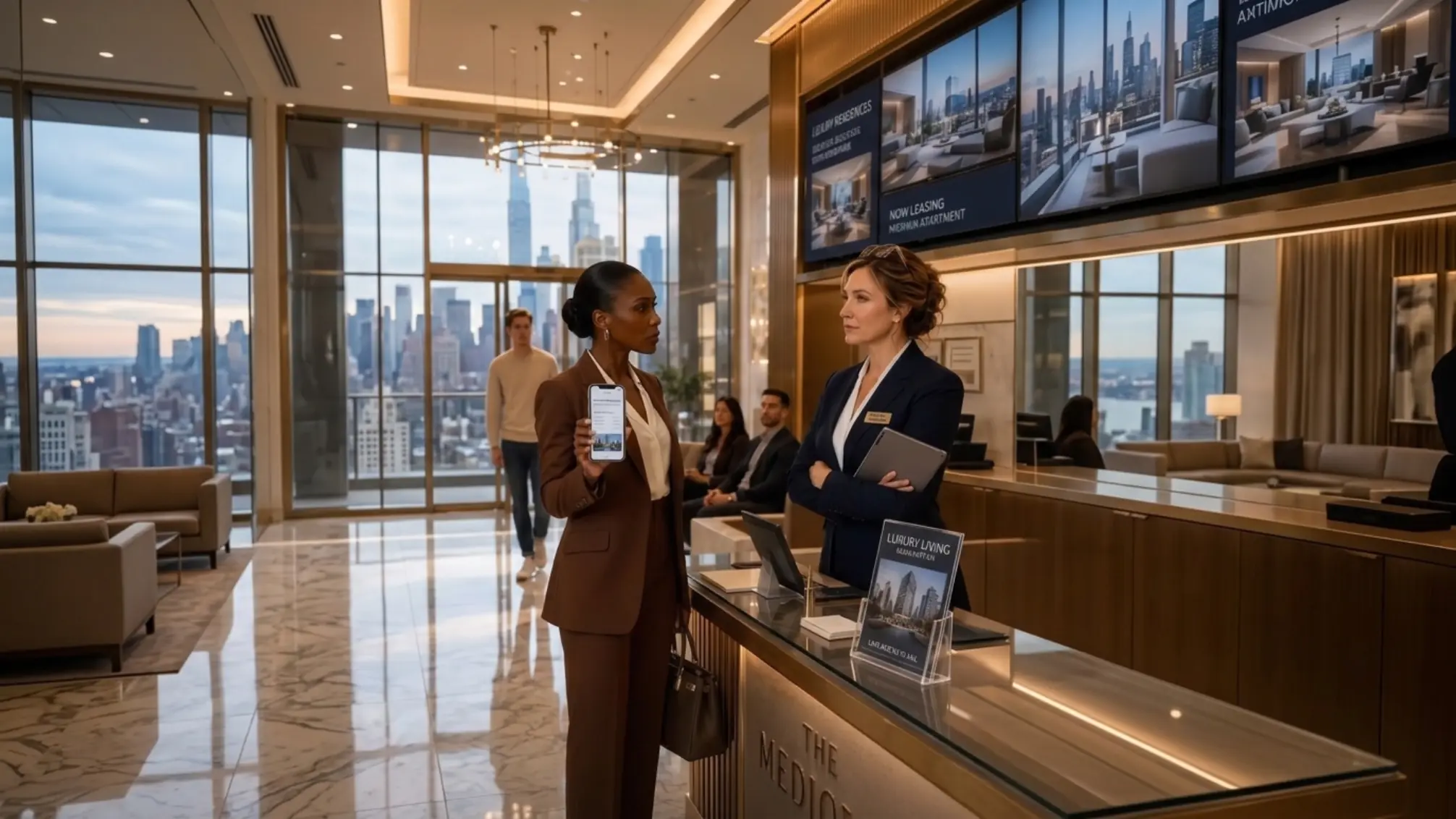
At thirty-nine, the CEO carried herself with controlled authority that did not depend on anyone recognizing her. Her rich brown skin, sharp dark eyes, and sleek low bun complemented a tailored pantsuit, ivory blouse, gold earrings, and pointed heels. A structured leather handbag hung from one hand, while the other held a phone displaying three apartment listings confirmed by the office that morning. Nothing visible identified her as the founder and chief executive of the development company that owned the building.
The forty-six-year-old Leasing Manager had made her judgment before hearing the CEO’s name. She had fair skin, carefully styled brown hair, and an immaculate navy suit bearing a gold nameplate that identified her as Senior Leasing Manager. For eight years, she had controlled access to some of the most expensive apartments in Manhattan. She believed that gave her the right to decide who looked wealthy enough to enter the elevators and who should be pushed back toward the street.
The CEO’s name was Naomi Carter. Carter Urban Holdings owned twelve residential towers, three mixed-use developments, and several commercial properties across New York. The company’s newest acquisition was Meridian Heights, a forty-story luxury building marketed as a place where accomplished professionals could live without sacrificing privacy, comfort, or dignity. Naomi had approved that promise personally.
During the previous six months, however, anonymous complaints had begun reaching the corporate office. Several prospective tenants claimed Meridian Heights advertised available units but refused to show them after applicants arrived in person. Others described sudden income requirements that did not appear in published policies, unexplained credit restrictions, and leasing agents who became hostile after seeing certain applicants.
The reports shared another pattern.
Most came from Black, Latino, Middle Eastern, or younger professional applicants. Many earned more than enough to qualify, carried strong credit, and had scheduled appointments in advance. Yet their appointments disappeared, available apartments became unavailable, or staff insisted that only less desirable units remained.
The Leasing Manager denied every accusation.
Her monthly reports showed high occupancy, strong revenue, and almost no unresolved complaints. She claimed disappointed applicants often accused luxury buildings of discrimination after learning they could not afford them. Because Meridian Heights remained profitable, several corporate executives accepted her explanation without looking deeper.
Naomi did not.
She ordered the compliance department to compare appointment records, advertisements, availability reports, and leasing outcomes. The numbers revealed that apartments were sometimes marked unavailable for specific appointments and restored to the system minutes after the applicants left. Certain leasing agents used unwritten income requirements far above company policy, while preferred clients received exceptions and discounted deposits.
Someone was controlling who entered the building.
Naomi decided to visit without announcing herself.
She created a legitimate rental inquiry using her legal name, personal phone number, and accurate financial information. Her income exceeded every requirement, her credit history was flawless, and the leasing office confirmed three available apartments in writing. She scheduled a morning appointment and arrived alone, dressed as she would for an ordinary business meeting.
The receptionist greeted her politely and entered her name into the system. The moment the Senior Leasing Manager saw Naomi waiting, she crossed the lobby and asked whom Naomi was meeting. Naomi showed the confirmation email and requested tours of the three units.
The Manager barely glanced at the screen.
“Those apartments are no longer available.”
Naomi looked toward the large digital display mounted above the reception desk. All three units were still advertised as ready for immediate leasing. One was a two-bedroom corner apartment on the thirty-second floor, another faced Central Park, and the third was a furnished corporate residence.
“Your office confirmed them less than two hours ago,” Naomi said.
“The website has not updated.”
“Then which apartments are available?”
“None within your likely range.”
Naomi’s expression remained neutral. “You haven’t asked my budget.”
The Manager looked at the brown suit, handbag, and understated jewelry. “People usually misunderstand what luxury living costs.”
“I understand the listed rent.”
“Do you?”
The question carried enough contempt to make the receptionist look down. Naomi asked the Manager to open the appointment record and review the income documentation already submitted. Instead, the woman folded her arms and claimed no financial file had been received.
Naomi displayed the submission receipt.
The Manager did not examine it.
“You may have contacted a third-party broker.”
“The confirmation came from this office.”
“Then someone made a mistake.”
Naomi stepped closer to the counter. “Correct it.”
The Manager’s eyes narrowed. She was accustomed to applicants becoming embarrassed and leaving quietly after being challenged. Naomi’s refusal to apologize for her presence irritated her more than any raised voice could have.
The Manager lowered her tone.
“This building is not appropriate for everyone.”
“What makes it inappropriate for me?”
“You’re becoming confrontational.”
“I asked for the appointment your office confirmed.”
“You’re disturbing our residents.”
Several people in the lobby were not residents at all. They were waiting for tours, completing applications, or meeting brokers. One young white couple had arrived without an appointment and was already being offered champagne by another leasing agent.
Naomi noticed the contrast.
The couple asked about the same corner apartment Naomi had scheduled to see. The leasing agent told them it was available and could be toured immediately.
Naomi turned toward the Senior Leasing Manager.
“You just said that unit was unavailable.”
“It is unavailable to you.”
The words were quiet, but the receptionist heard them.
So did the young couple.
Naomi raised her phone and opened the email again. “Your office confirmed three available apartments this morning.”
The Manager stepped into her path. “Not for someone like you—leave before I call security.”
Naomi moved closer rather than stepping back. “Say that again and let the entire office hear you.”
The Manager looked around the lobby, then smiled with the confidence of someone who believed the staff would protect her version of events.
“You couldn’t afford a closet here.”
Naomi pressed a button on her phone.
The complete recording of the conversation, appointment confirmation, listing screenshots, and leasing data was sent simultaneously to the company’s board chair, general counsel, compliance director, and regional operations president.
Then she delivered the line that silenced the room.
“Call security—then tell the board you just threatened the woman who signs your paycheck.”
The Manager stared at her.
For one second, the words did not register. Then her tablet vibrated, followed by the receptionist’s phone and both computers behind the counter. A corporate notification appeared across the leasing system.
Executive compliance hold initiated by Naomi Carter, Chief Executive Officer, Carter Urban Holdings.
The Manager’s face lost its color.
She looked again at Naomi’s photograph on the corporate profile now displayed on her tablet. The woman she had dismissed as an unqualified applicant stood in front of her with the same composed expression, but the power inside the lobby had completely reversed.
“You’re Naomi Carter,” the receptionist whispered.
Naomi did not look away from the Manager. “Yes.”
The Manager immediately softened her voice. “Ms. Carter, there has clearly been a misunderstanding.”
“No. You were very clear.”
“I didn’t recognize you.”
“That is the problem.”
The Manager glanced toward the watching applicants. “May we discuss this privately?”
“You chose to humiliate me publicly.”
“I was following security and qualification procedures.”
“You reviewed neither.”
“I believed the appointment was fraudulent.”
“Why?”
The Manager looked at Naomi’s suit, then realized any honest answer would expose what had guided her decision. She tried another explanation, claiming online listings sometimes remained active after units were reserved.
Naomi pointed toward the young couple.
“Why were they offered the thirty-second-floor apartment?”
The leasing agent serving them stepped away from the desk. She looked frightened, but the couple answered before she could.
“We were told it was open,” the man said.
“And we didn’t have an appointment,” the woman added.
The Senior Leasing Manager turned toward them sharply. “This is an internal matter.”
Naomi’s tone hardened. “Do not intimidate witnesses.”
The Manager gripped her tablet more tightly.
Naomi asked the receptionist to pull up the appointment record. The young employee hesitated, then entered Naomi’s name. The system showed a complete application package, verified income, approved identity documents, and a confirmed tour time.
It also showed that the Manager had manually placed a restriction on the file four minutes after Naomi entered the lobby.
The restriction code read: Applicant unlikely to qualify—discretionary screening required.
Naomi asked what information justified the decision.
The Manager claimed the code was routine.
The receptionist shook her head before fear could stop her.
“It isn’t.”
Everyone turned toward her.
The receptionist explained that discretionary screening was normally used only when an applicant submitted incomplete documentation, conflicting identity records, or unverifiable income. Naomi’s file contained none of those problems.
The Manager stepped toward the receptionist. “You are not authorized to discuss internal codes.”
Naomi moved between them.
“She is now.”
The regional operations president entered the lobby less than ten minutes later, accompanied by the company’s compliance director and two corporate security officers. They had been working in another Manhattan property when Naomi’s alert arrived. Their presence confirmed that the confrontation was no longer an argument between a manager and an applicant.
The Senior Leasing Manager attempted to take control of the explanation.
She claimed Naomi had arrived behaving aggressively, refused to accept that apartments were unavailable, and secretly recorded staff. The compliance director asked whether the lobby displayed notice that conversations and security activity could be recorded.
The Manager looked toward the ceiling cameras.
It did.
Naomi had also recorded only her own conversation inside a public-facing leasing area. Company legal counsel had approved the inspection in advance because of the previous complaints.
The operations president asked the Manager to surrender her tablet, office keys, and administrative credentials pending investigation.
“You are suspending me because I did not recognize the CEO?” she demanded.
Naomi answered calmly.
“You are being suspended because you treated an applicant differently after seeing her.”
“That is not what happened.”
“The system will show us.”
The Manager looked toward the computers and understood that every change carried her name, timestamp, and device identification.
She had spent years believing digital records could be explained away as professional discretion. Now those records would be compared with appointment photographs, income documents, unit availability, and the race of each applicant.
Corporate security escorted her to a private office while investigators preserved her devices. She was not allowed to contact employees, alter records, or leave with company documents. Before entering the office, she turned toward Naomi.
“I made this building profitable.”
Naomi held her gaze. “Profit built on exclusion is evidence, not success.”
The investigation began immediately.
Compliance auditors locked the leasing database and downloaded three years of appointment histories. They compared when units were advertised, when applicants arrived, when availability changed, and which employees entered restriction codes.
The pattern was stronger than Naomi expected.
Qualified Black applicants were nearly four times more likely to be told no units were available despite active listings. Latino applicants were frequently asked for additional employment letters that company policy did not require. Applicants with Middle Eastern names were subjected to extended identity checks, while white applicants with similar documents proceeded directly to tours.
The system also revealed corporate betrayal.
The Senior Leasing Manager had not acted entirely alone. A regional vice president knew that she used selective screening to maintain what he privately described as the building’s “preferred tenant profile.” Emails showed him praising Meridian Heights for attracting residents who would “protect the property’s image.”
He never wrote race directly.
He did not need to.
In one message, the Manager complained that online advertising was bringing “too many aspirational applicants.” The vice president advised her to use income verification, application timing, and temporary unit holds to discourage them without creating obvious written denials.
Another email instructed staff to avoid using words that could appear discriminatory in court.
The Manager responded: Understood. We’ll keep it verbal.
Naomi read that sentence twice.
The confrontation in the lobby was not an isolated insult. It was the visible edge of a policy designed to hide behind silence, discretion, and missing records.
The young receptionist became an important witness. Her name was Maya Collins, a twenty-six-year-old Black American woman who had joined the leasing office eight months earlier. She admitted that the Manager instructed her to delay certain applicants, misstate availability, and claim income documents were missing.
Maya had resisted several times.
Each time, the Manager reduced her hours or assigned her undesirable weekend shifts. She remained because she supported her mother and younger brother and feared losing stable employment.
“Why didn’t you report it?” the regional president asked.
“I did.”
Maya opened a personal email account containing copies of three complaints sent to Human Resources. None received a meaningful response. One had been forwarded directly back to the regional vice president involved in the scheme.
Within days, the vice president was suspended.
Human Resources records showed he advised that Maya was “overly sensitive to routine luxury-market standards.” He then approved the Manager’s request to place a negative communication note inside Maya’s personnel file.
Naomi ordered the note removed and every retaliation complaint reopened under independent counsel.
The investigation spread beyond Meridian Heights.
Auditors reviewed all properties managed by the vice president. Similar patterns appeared in three buildings, though none were as extreme. Leasing teams had been encouraged to maintain certain resident profiles, prioritize applicants referred by private brokers, and quietly discourage people who looked unlikely to fit the building’s social image.
Private brokers played another role.
Several received commissions for steering preferred applicants toward units kept temporarily hidden from public availability. In return, they sent wealthy clients directly to the Senior Leasing Manager, bypassing ordinary waiting lists.
One penthouse had been advertised as unavailable for two months while the Manager held it for the son of a corporate investor. During that period, five qualified applicants were denied tours.
The investor claimed he knew nothing about the arrangement.
Records showed otherwise.
He had sent the Manager a luxury vacation package shortly after his son signed the lease.
Naomi froze every questionable leasing decision and brought in outside fair-housing attorneys. Available units were returned to the public system, applicants who had been denied were contacted, and improperly collected fees were refunded.
Some rejected applicants no longer wanted apartments in the building.
Naomi understood.
A refund could return money, but it could not erase the moment someone was made to feel unworthy of entering a lobby. The company offered compensation for documented expenses and provided written findings to those who wanted them.
One applicant was a Black pediatric surgeon who had relocated for a hospital position. She had been told her income letter was too recent, although a white applicant employed for less time was approved that afternoon. Unable to secure housing quickly, the surgeon spent six weeks in an expensive hotel and nearly abandoned the position.
Another was a Latino technology founder whose company had already paid a corporate housing deposit. The leasing office returned it without explanation and told his assistant that the building preferred “more stable tenants.”
His company had been profitable for nine years.
Naomi called both personally.
She did not ask them to forgive Carter Urban Holdings. She apologized, explained the investigation, and asked what evidence or restitution would help correct the damage. Their answers shaped the company’s reforms more than any consultant’s presentation.
The Senior Leasing Manager defended herself publicly after her suspension became known. Through an attorney, she claimed she was being punished for enforcing strict standards in a competitive luxury market. She described Naomi’s visit as a staged trap designed to create a viral confrontation.
Naomi refused to release a short edited clip.
Instead, the company published the complete investigation after legal review. It included anonymized leasing data, policy violations, retaliation findings, and corrective measures. The full lobby recording showed that Naomi had remained calm while the Manager denied availability, threatened security, and said someone like her could not afford the building.
The Manager’s own words ended the argument.
She was terminated for discriminatory conduct, falsifying availability, retaliation, and manipulating leasing records. The regional vice president was fired for directing and concealing the system. Several brokers lost contracts, while two employees who accepted improper payments were referred for criminal investigation.
The board faced consequences too.
One director had received complaints months earlier but chose not to investigate because Meridian Heights exceeded revenue targets. Naomi demanded his resignation from the compliance committee. When he refused, the board removed him through a formal vote.
“This company failed before that Manager spoke to me,” Naomi told the directors. “It failed every time someone reported the pattern and we chose the comfort of profitable numbers.”
The company rebuilt its leasing process.
Unit availability became visible through a centralized system that local managers could not secretly change without documented reasons. Every temporary hold required approval and automatically expired. Income and credit standards were published clearly and applied consistently.
Applicants could request an audit of any denial.
The review went to a team outside the building and included all changes made to the file. Leasing employees received alerts when managers added nonstandard requirements, while demographic data was monitored for unequal outcomes.
Mystery applicants were sent regularly to company properties.
Unlike Naomi’s visit, they represented different ages, races, accents, clothing styles, and income levels. Their purpose was not to trap employees but to compare whether the written process remained equal when no executive was watching.
Maya entered the company’s management-development program after an independent panel reviewed her performance. Naomi refused to promote her solely because she had witnessed the confrontation. Maya completed training, passed the required assessments, and later became Assistant Leasing Director.
Her first policy change was simple.
Every person entering the leasing office received a printed explanation of available units, qualification standards, fees, and complaint rights. No applicant had to depend entirely on a Manager’s verbal claims.
Six months later, Naomi returned to Meridian Heights without warning.
She wore a simple navy dress and carried no visible corporate identification. A newly hired leasing consultant greeted her at the desk, asked whether she had an appointment, and checked the system.
Naomi used a test profile approved by legal counsel. It qualified for two apartments but not the most expensive penthouse.
The consultant explained that clearly.
She offered tours of the two eligible units, showed the written qualification standard, and did not promise access to the penthouse merely because Naomi appeared influential. Only after completing the process did Maya approach from the office and greet Naomi by name.
The consultant’s eyes widened.
Naomi smiled. “You treated me correctly before knowing who I was.”
“That is how everyone should be treated.”
“Yes.”
Outside the lobby, the Manhattan skyline reflected across the glass facade. Meridian Heights remained luxurious, but Naomi no longer accepted luxury as an excuse for exclusion. A beautiful lobby, expensive apartments, and high rent did not grant staff permission to measure human worth through appearance.
The former Leasing Manager had believed her power came from standing between applicants and the homes they wanted. She could erase appointments, hide apartments, invent requirements, and call security whenever someone refused humiliation.
She believed the Black woman holding a phone would be another applicant pushed quietly into the street.
Instead, Naomi sent one email.
The message reached the board, froze the leasing system, preserved the evidence, and exposed the executives who had protected discrimination because it remained profitable.
The Manager threatened to call security.
Naomi told her to call them.
Then she ordered her to tell the board that she had just threatened the woman who signed her paycheck.
By the end of that day, the entire office had turned against the Manager—not because the CEO demanded loyalty, but because employees finally understood that the truth they had been afraid to speak was now protected by someone powerful enough to act on it.